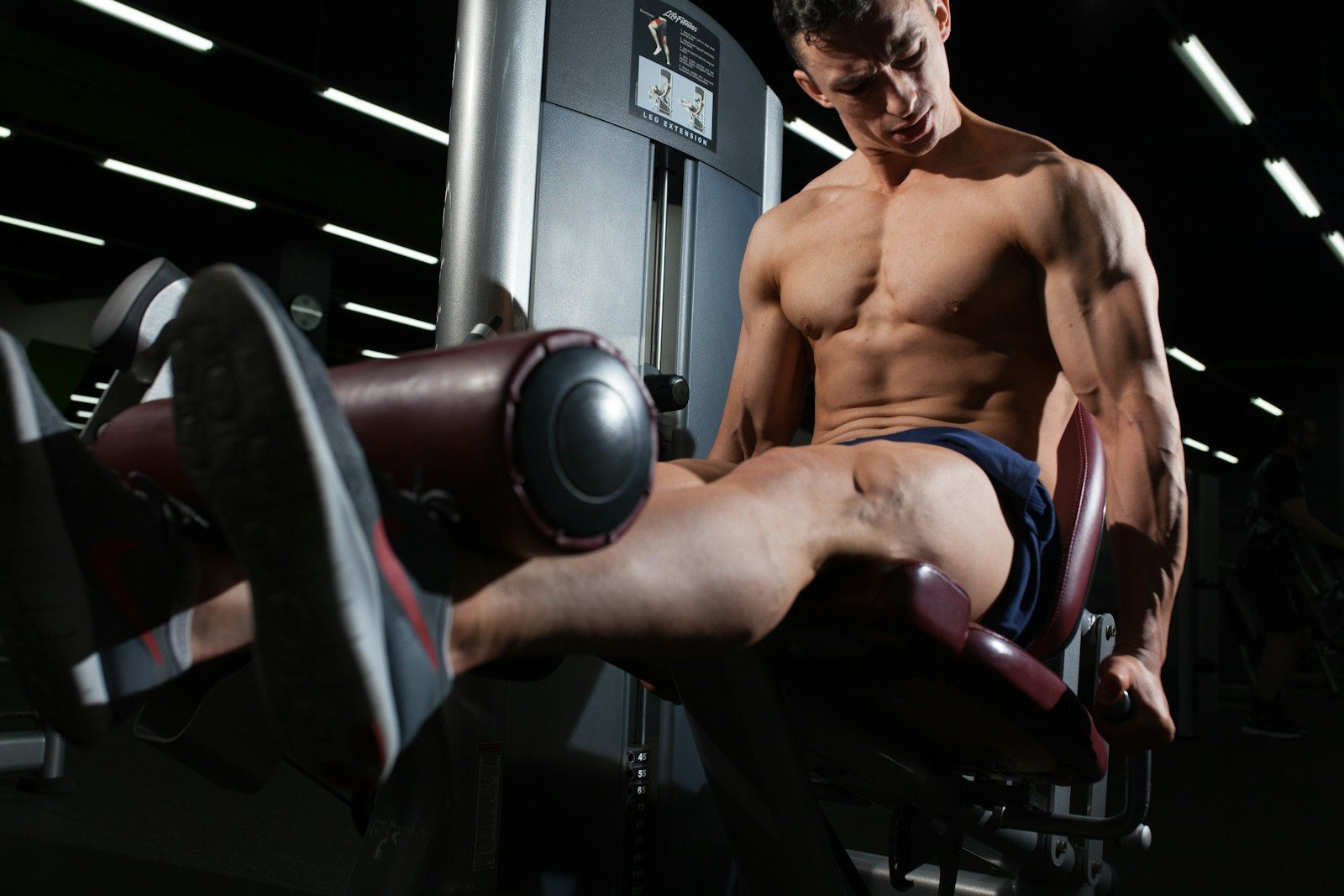
The best leg exercises for men combine squatting, hip hinging, single-leg training, knee flexion, knee extension, and calf work so every major lower-body muscle receives enough attention.
You do not need to perform all 10 exercises in the same session. A productive leg workout usually contains four to six movements selected from this list, with the largest compound exercise performed first and smaller isolation exercises later.
The exercises below can help build stronger, more muscular quadriceps, hamstrings, glutes, adductors, and calves. Although this guide is written for men, the movements and programming principles can be used by any healthy adult.
Leg Exercises for Men at a Glance
| Exercise | Best for | Main muscles worked | Starting recommendation | |
|---|---|---|---|---|
| 1 | Barbell back squat | Overall leg strength | Quadriceps, glutes, adductors | 3 sets of 4–8 reps |
| 2 | Romanian deadlift | Hamstring and hip-hinge strength | Hamstrings, glutes, spinal stabilizers | 3 sets of 6–10 reps |
| 3 | Bulgarian split squat | Single-leg strength and size | Quadriceps, glutes, adductors | 2–3 sets of 8–12 reps per leg |
| 4 | Leg press | Stable, high-volume leg training | Quadriceps, glutes, adductors | 3 sets of 8–15 reps |
| 5 | Hack squat | Quadriceps-focused squat training | Quadriceps, glutes | 3 sets of 6–12 reps |
| 6 | Barbell hip thrust | Direct glute development | Gluteus maximus, hamstrings | 3 sets of 6–12 reps |
| 7 | Dumbbell reverse lunge | Unilateral strength and coordination | Quadriceps, glutes, adductors | 2–3 sets of 8–12 reps per leg |
| 8 | Seated leg curl | Direct hamstring training | Hamstrings, gastrocnemius | 2–4 sets of 10–15 reps |
| 9 | Leg extension | Quadriceps isolation | Quadriceps | 2–4 sets of 10–20 reps |
| 10 | Standing calf raise | Calf strength and size | Gastrocnemius, soleus | 3–4 sets of 8–20 reps |
These are starting ranges rather than fixed rules. Use a load that lets you complete each repetition with controlled technique while keeping approximately one to three good repetitions in reserve.
What Should a Complete Leg Workout Train?
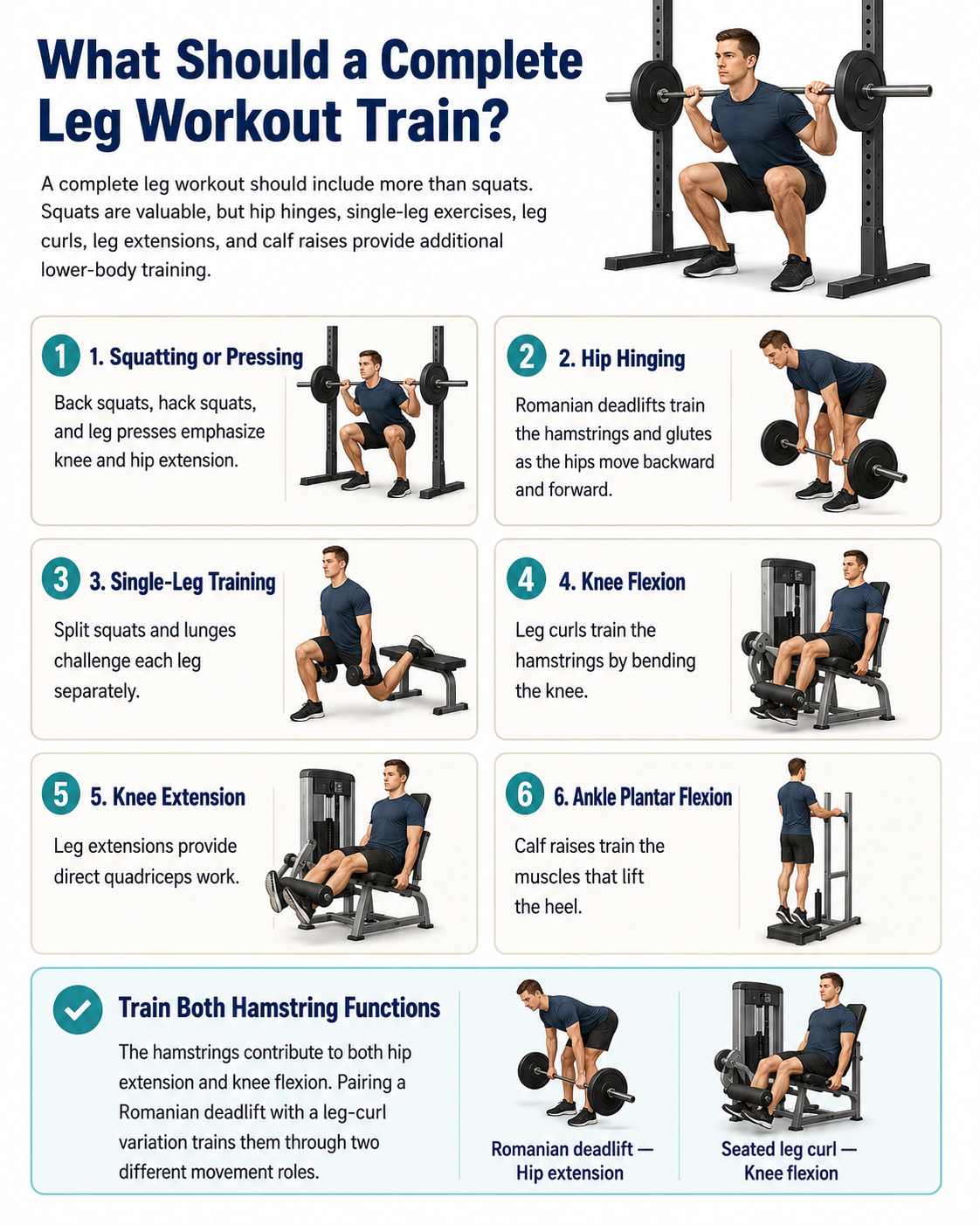
A complete leg workout should include more than squats. Squats are valuable, but they do not provide the same type of direct work as hip hinges, leg curls, or calf raises.
A balanced routine should cover the following movement patterns:
- Squatting or pressing: Back squats, hack squats, and leg presses emphasize knee and hip extension.
- Hip hinging: Romanian deadlifts train the hamstrings and glutes as the hips move backward and forward.
- Single-leg training: Split squats and lunges challenge each leg separately.
- Knee flexion: Leg curls train the hamstrings by bending the knee.
- Knee extension: Leg extensions provide direct quadriceps work.
- Ankle plantar flexion: Calf raises train the muscles that lift the heel.
The hamstrings contribute to both hip extension and knee flexion. Research indexed by the National Library of Medicine supports using exercises that train the hamstrings in different positions, so pairing a hinge such as the Romanian deadlift with a leg-curl variation gives them two different training roles rather than relying on only one movement.
How Strength and Muscle-Building Training Differ
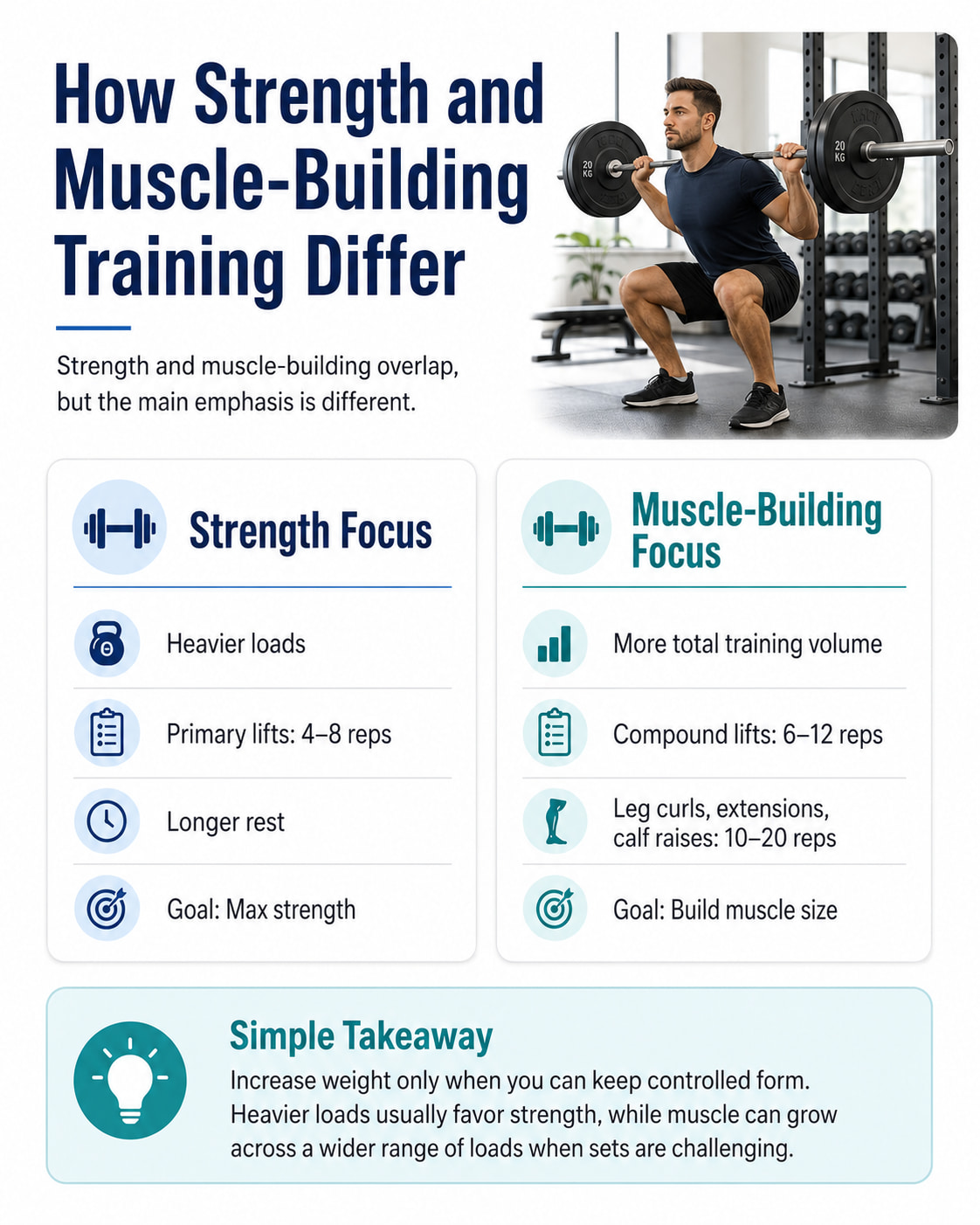
Training for strength and training for muscle size overlap, but they are not identical.
Updated guidance from the American College of Sports Medicine found that heavier loads—approximately 80% of one-repetition maximum or more—are especially helpful for maximal strength. Higher weekly training volume, around 10 challenging sets per muscle group, can further support muscle growth. That volume is a useful target to build toward, not a minimum every beginner must complete immediately.
In practical terms:
- Use approximately 4–8 reps for your primary strength exercise.
- Use approximately 6–12 reps for most compound muscle-building exercises.
- Use approximately 10–20 reps for leg curls, extensions, and calf raises.
- Rest longer after demanding compound lifts than after isolation exercises.
- Increase the load only when you can control the full set.
Research indexed by the National Library of Medicine suggests that heavier loads generally produce greater maximal-strength improvements, while muscle growth can occur across a wider range of loads when sets are sufficiently challenging.
10 Best Leg Exercises for Men
These 10 leg exercises target the quadriceps, hamstrings, glutes, adductors, and calves while covering the main lower-body movement patterns.
1. Barbell Back Squat
Best for: Building overall lower-body strength and practicing a heavily loadable squat pattern.
Muscles worked: Quadriceps, gluteus maximus, adductors, calves, abdominals, spinal erectors, and upper-back stabilizers.
Equipment needed: Barbell, weight plates, squat rack, and properly positioned safety arms.
Sets, reps, and rest: Perform 3–4 sets of 4–8 reps. Rest for approximately 2–3 minutes between hard sets.
How to Do It
- Position the bar in the rack slightly below shoulder height and set the safety arms just below your expected bottom position.
- Step beneath the bar and place it securely across the muscles of your upper back, not directly on your neck.
- Unrack the bar, take one or two controlled steps backward, and place your feet at a comfortable squat width.
- Brace your trunk, keep your whole foot in contact with the floor, and bend your hips and knees together.
- Allow your knees to travel in the same general direction as your toes.
- Descend as far as you can while maintaining foot pressure, balance, and control of your spine.
- Push the floor away and extend your knees and hips to return to standing.
Common mistakes: Avoid lifting the heels, allowing the knees to collapse inward, relaxing your trunk at the bottom, or descending deeper than you can control. Do not add weight simply because you reached an arbitrary depth.
Regression or progression: Begin with a goblet squat or box squat if you are still learning the movement. Progress by gradually adding load, repetitions, or a controlled pause at the bottom.
Coaching cue: Keep your ribs stacked over your pelvis and push the floor away.
The American Council on Exercise provides an additional back-squat setup and form reference.
2. Romanian Deadlift
Best for: Building hamstring and glute strength through a controlled hip hinge.
Muscles worked: Hamstrings, gluteus maximus, adductor magnus, spinal erectors, abdominals, upper back, and grip muscles.
Equipment needed: Barbell and weight plates. Dumbbells can also be used.
Sets, reps, and rest: Perform 3–4 sets of 6–10 reps. Rest for approximately 2–3 minutes.
How to Do It
- Stand with the bar against the front of your thighs and your feet approximately hip-width apart.
- Soften your knees slightly and brace your trunk.
- Push your hips backward while keeping the bar close to your legs.
- Lower the bar until you feel strong tension in your hamstrings or can no longer move your hips back without rounding your back.
- Keep your neck aligned with your torso rather than lifting your chin.
- Push through your feet and drive your hips forward to return to standing.
The bar does not need to touch the floor. Your stopping point depends on your proportions, mobility, and ability to maintain a controlled hip hinge.
Common mistakes: Do not turn the movement into a squat by bending the knees excessively. Other common errors include letting the bar drift forward, reaching for the floor, rounding the lower back, and leaning backward at the top.
Regression or progression: Use dumbbells or begin with the weight elevated on blocks. Progress by increasing the load or adding a short pause in the lowered position.
Coaching cue: Close the car door behind you with your hips.
The American Council on Exercise also emphasizes moving the hips backward while keeping the weight close to the body.
3. Bulgarian Split Squat
Best for: Building single-leg strength, quadriceps size, glute strength, and lower-body control.
Muscles worked: Quadriceps, gluteus maximus, adductors, hamstrings, calves, and hip stabilizers.
Equipment needed: Bench or stable platform and dumbbells.
Sets, reps, and rest: Perform 2–3 sets of 8–12 reps per leg. Rest for 90–150 seconds after training both sides.
How to Do It
- Stand a comfortable stride in front of a stable bench.
- Place the top of one foot on the bench behind you.
- Keep most of your bodyweight over the front leg and brace your trunk.
- Bend the front knee and lower the rear knee toward the floor.
- Keep the front heel planted and allow the knee to follow the direction of the toes.
- Descend as far as you can without losing balance or pelvic control.
- Push through the front foot to return to the starting position.
A small forward torso angle is normal, particularly when emphasizing the glutes. You do not need to force your torso perfectly vertical.
Common mistakes: Avoid standing too close to the bench, balancing on an extremely narrow line, pushing mainly through the rear leg, or bouncing out of the bottom. Do not use a bench so high that the rear hip or knee becomes uncomfortable.
Regression or progression: Use a supported split squat with both feet on the floor. Hold a rack or post for balance before adding weight. Progress with heavier dumbbells, a barbell, or a front-foot elevation.
Coaching cue: Lower straight down and drive through the whole front foot.
The American Council on Exercise provides an additional Bulgarian split-squat technique reference.
4. Leg Press
Best for: Adding quadriceps and glute training volume with less balance demand than a free-weight squat.
Muscles worked: Quadriceps, gluteus maximus, adductors, and hamstrings.
Equipment needed: Leg press machine.
Sets, reps, and rest: Perform 3–4 sets of 8–15 reps. Rest for 90–180 seconds.
How to Do It
- Adjust the seat so you can place your back and pelvis firmly against the pad.
- Position your feet around hip- to shoulder-width apart on the platform.
- Release the safety handles while keeping your knees controlled.
- Lower the platform by bending your knees and hips.
- Stop when you reach your deepest controlled position without your pelvis rolling away from the pad.
- Press evenly through both feet and extend your legs.
- Finish each repetition without forcefully snapping the knees backward.
Foot placement can be adjusted slightly for comfort, but it should allow you to keep your heels down and your knees moving in line with your feet.
Common mistakes: Avoid loading more weight than you can control, shortening every repetition, allowing the knees to collapse inward, or lowering so deeply that your lower back rounds away from the pad.
Regression or progression: Reduce the load and use a comfortable range of motion. Progress by increasing repetitions, adding weight, or using the single-leg press when appropriate.
Coaching cue: Keep your hips heavy against the pad.
The National Academy of Sports Medicine provides additional guidance on supported leg-press setup and controlled pressing mechanics.
5. Hack Squat
Best for: Training the quadriceps with a stable squat pattern that can be progressively loaded.
Muscles worked: Quadriceps, gluteus maximus, adductors, and calves.
Equipment needed: Hack squat machine.
Sets, reps, and rest: Perform 3–4 sets of 6–12 reps. Rest for approximately 2 minutes.
How to Do It
- Place your back and shoulders firmly against the machine pads.
- Position your feet at a width that allows your knees and hips to bend comfortably.
- Release the machine stops and brace your trunk.
- Bend your knees and lower the sled under control.
- Keep your heels planted and your knees moving in line with your toes.
- Stop at the deepest position you can reach without your heels lifting or your pelvis losing contact with the pad.
- Press through your feet to return to the starting position.
Hack squat machines differ in angle, pad position, and platform size. Follow the instructions provided on the specific machine and adjust your foot position before adding substantial weight.
Common mistakes: Avoid placing the feet in an extreme position, bouncing at the bottom, lifting the heels, allowing the knees to collapse inward, or aggressively locking the knees at the top.
Regression or progression: Use a goblet squat or leg press if the machine does not suit your body proportions. Progress with additional load, a slower lowering phase, or a controlled pause.
Coaching cue: Sit between your knees while keeping your whole foot planted.
6. Barbell Hip Thrust
Best for: Directly loading hip extension and emphasizing the gluteus maximus.
Muscles worked: Gluteus maximus, hamstrings, adductor magnus, and trunk stabilizers.
Equipment needed: Barbell, plates, sturdy bench, and bar pad.
Sets, reps, and rest: Perform 3–4 sets of 6–12 reps. Rest for 90–180 seconds.
How to Do It
- Sit on the floor with your upper back against the long side of a stable bench.
- Roll a padded barbell over your legs and position it across the crease of your hips.
- Place your feet approximately hip-width apart.
- Brace your abdomen and keep your chin slightly tucked.
- Drive through your feet and extend your hips.
- Stop when your hips are fully extended and your torso and thighs form a roughly straight line.
- Lower your hips under control without letting the bar roll out of position.
At the top, your shins will often be close to vertical, although exact foot position varies. The goal is to finish with the glutes rather than creating extra movement by arching the lower back.
Common mistakes: Avoid placing the bench against an unstable surface, overextending your lower back, pushing primarily through your toes, lifting your head, or dropping quickly into the bottom.
Regression or progression: Begin with a floor glute bridge or dumbbell hip thrust. Progress by adding load, pausing briefly at the top, or using a single-leg variation with a lighter resistance.
Coaching cue: Bring your belt buckle toward your ribs at the top.
The American Council on Exercise demonstrates a similar bench-supported hip-extension setup with the elevated glute bridge.
7. Dumbbell Reverse Lunge
Best for: Building unilateral strength while practicing a controlled step-back movement.
Muscles worked: Quadriceps, gluteus maximus, adductors, hamstrings, calves, and hip stabilizers.
Equipment needed: Dumbbells and open floor space.
Sets, reps, and rest: Perform 2–3 sets of 8–12 reps per leg. Rest for 90–150 seconds.
How to Do It
- Stand tall with a dumbbell in each hand and your feet approximately hip-width apart.
- Brace your trunk and step one foot backward.
- Lower the rear knee toward the floor as the front knee bends.
- Keep the front foot planted and your pelvis facing forward.
- Descend until you reach a comfortable depth with both legs controlled.
- Push through the front foot and step the rear leg forward.
- Complete all repetitions on one side or alternate legs.
Take a long enough step that you can lower smoothly without the front heel lifting. The front knee may move forward as long as the foot remains planted and the movement is comfortable.
Common mistakes: Avoid stepping onto a tightrope-like line, crashing the rear knee downward, pushing excessively from the back foot, leaning sideways, or taking a step that is too short to control.
Regression or progression: Perform bodyweight reverse lunges while lightly holding a rack. Progress with heavier dumbbells, a front-loaded barbell, or a controlled deficit variation.
Coaching cue: Use the back foot for balance and the front leg for work.
The American Council on Exercise provides an additional reverse-lunge movement reference.
8. Seated Leg Curl
Best for: Directly training knee flexion and adding targeted hamstring volume.
Muscles worked: Biceps femoris, semitendinosus, semimembranosus, and gastrocnemius.
Equipment needed: Seated leg-curl machine.
Sets, reps, and rest: Perform 2–4 sets of 10–15 reps. Rest for 60–120 seconds.
How to Do It
- Adjust the seat so the machine’s rotation point aligns closely with your knee joint.
- Position the lower-leg pad just above your heels.
- Secure the thigh pad so your legs remain stable.
- Sit back against the support and hold the handles.
- Curl your heels downward and back by bending your knees.
- Pause briefly in the shortened position.
- Return the weight slowly without allowing the stack to slam down.
Keep your hips and back against the pads throughout the set. Use the largest comfortable range you can control without shifting in the seat.
Common mistakes: Avoid jerking the weight, lifting the hips, shortening the return, pointing the toes aggressively, or choosing a load that prevents controlled knee flexion.
Regression or progression: Reduce the load or use a stability-ball hamstring curl. Progress with single-leg curls, a longer pause, or a slower lowering phase.
Coaching cue: Pull your heels under the seat without lifting your hips.
A controlled study indexed by the National Library of Medicine found greater overall hamstring growth from seated leg curls than prone leg curls, possibly because the seated position trained several hamstring muscles at longer lengths. That does not make prone curls ineffective, but it supports choosing the seated version when both machines are available.
The National Academy of Sports Medicine provides additional seated leg-curl machine adjustment and movement guidance.
9. Leg Extension
Best for: Isolating the quadriceps without adding substantial fatigue to the hips or lower back.
Muscles worked: Rectus femoris, vastus lateralis, vastus medialis, and vastus intermedius.
Equipment needed: Leg-extension machine.
Sets, reps, and rest: Perform 2–4 sets of 10–20 reps. Rest for 60–120 seconds.
How to Do It
- Adjust the backrest so your knees align with the machine’s pivot point.
- Place the lower-leg pad just above your ankles.
- Sit with your back and hips firmly supported.
- Hold the handles and brace your trunk.
- Extend your knees smoothly until your legs are nearly straight.
- Pause briefly while keeping your hips in contact with the seat.
- Lower the weight under control.
Use a manageable load and a comfortable range of motion. The movement should come from knee extension rather than kicking your hips upward.
Common mistakes: Avoid swinging the weight, lifting the hips, dropping the stack, using only short partial repetitions, or straightening the knees with an uncontrolled snap.
Regression or progression: Reduce the load or use one leg at a time. A controlled step-up or supported squat can be used when a leg-extension machine is unavailable.
Coaching cue: Lift the pad smoothly and lower it even more slowly.
The American Council on Exercise identifies the seated leg extension as a beginner-level machine exercise for the thighs.
10. Standing Calf Raise
Best for: Building calf strength and emphasizing the gastrocnemius while the knee remains relatively straight.
Muscles worked: Gastrocnemius and soleus.
Equipment needed: Standing calf-raise machine, Smith machine, dumbbells, or a stable step.
Sets, reps, and rest: Perform 3–4 sets of 8–20 reps. Rest for 60–120 seconds.
How to Do It
- Stand with the balls of your feet securely supported on the platform.
- Keep your legs straight without aggressively locking the knees.
- Hold the machine or another stable support.
- Lower your heels gradually through a comfortable range.
- Press through the balls of your feet and lift your heels as high as you can without rolling your ankles.
- Pause briefly at the top.
- Lower under control before beginning the next repetition.
Calf raises are usually more productive when performed with a deliberate stretch, a complete upward contraction, and minimal bouncing.
Common mistakes: Avoid rapidly rebounding from the bottom, using only a small range, bending the knees excessively, or allowing the ankles to roll outward.
Regression or progression: Begin with supported bodyweight calf raises on the floor. Progress to a step, a single-leg variation, or external resistance.
Coaching cue: Rise straight upward through the center of your big toe and second toe.
A comparative training study indexed by the National Library of Medicine found that standing calf raises produced greater gastrocnemius growth than seated calf raises. Seated calf raises can still be included as additional bent-knee calf work, but the standing version is a strong primary choice.
How to Build a Leg Workout From These Exercises
Do not attempt to fit every exercise into one workout. Excessive exercise selection can produce unnecessary fatigue without improving the quality of your training.
Build each session around the following structure:
- One primary squat or press: Back squat, hack squat, or leg press.
- One hip-dominant exercise: Romanian deadlift or hip thrust.
- One single-leg exercise: Bulgarian split squat or reverse lunge.
- One or two isolation exercises: Leg curl and/or leg extension.
- One calf exercise: Standing calf raise.
Back squats, hack squats, and leg presses overlap substantially. You can rotate between them across different sessions rather than performing all three every workout.
The same principle applies to Bulgarian split squats and reverse lunges. Both are useful, but most people need only one hard single-leg exercise per session.
Sample Two-Day Leg Workout for Strength and Size
Train on nonconsecutive days, such as Monday and Thursday, so the same muscles have time to recover.
Leg Day A: Strength Emphasis
| Exercise | Sets | Reps | Rest |
|---|---|---|---|
| Barbell back squat | 3 | 4–6 | 2–3 minutes |
| Romanian deadlift | 3 | 6–8 | 2–3 minutes |
| Bulgarian split squat | 2 | 8–10 per leg | 90–150 seconds |
| Seated leg curl | 2 | 10–15 | 60–120 seconds |
| Standing calf raise | 3 | 8–15 | 60–120 seconds |
Leg Day B: Size Emphasis
| Exercise | Sets | Reps | Rest |
|---|---|---|---|
| Leg press or hack squat | 3 | 8–12 | 2 minutes |
| Barbell hip thrust | 3 | 8–12 | 90–180 seconds |
| Dumbbell reverse lunge | 2 | 8–12 per leg | 90–150 seconds |
| Leg extension | 2 | 12–15 | 60–90 seconds |
| Seated leg curl | 2 | 10–15 | 60–90 seconds |
| Standing calf raise | 3 | 10–20 | 60–90 seconds |
Beginners can perform two sets instead of three for most exercises and omit one isolation movement from each workout. Add volume gradually after you can recover consistently and maintain performance.
How Hard Should Each Set Be?
Most working sets should end with approximately one to three repetitions in reserve, often abbreviated as RIR.
For example, stopping at two RIR means you believe you could have completed about two more technically sound repetitions. This should feel challenging, but your range of motion and control should remain consistent.
A systematic review indexed by the National Library of Medicine found no clear overall strength or hypertrophy advantage from taking every set to failure. Related quadriceps research also found similar muscle growth when participants trained to failure or stopped with approximately one to two repetitions remaining, while failure produced more immediate fatigue.
A useful approach is:
- Stop heavy squats and Romanian deadlifts with approximately 2–3 reps in reserve.
- Stop lunges and split squats with approximately 1–3 reps in reserve.
- Take leg curls, extensions, and calf raises closer to failure when your technique remains controlled.
How to Progress Your Leg Exercises
Use a simple double-progression system.
Suppose your target is three sets of 8–12 repetitions:
- Choose a weight you can perform for approximately eight good reps.
- Keep that load until you gradually reach 12 reps on every set.
- Increase the weight by the smallest practical amount.
- Return to approximately eight or nine reps.
- Build back toward 12 reps.
You can also progress by improving your range of motion, stability, tempo, or consistency. Adding weight is not meaningful progress when it causes shallower repetitions or poorer control.
The American College of Sports Medicine emphasizes progressive resistance training while also noting that complicated periodization and advanced techniques are not necessary for most healthy adults.
Should You Use a Full Range of Motion?
Use the largest range of motion you can control comfortably.
Research indexed by the National Library of Medicine suggests that full-range lower-body training generally performs well for strength and muscle development, but range should not be forced. Stop a squat, press, lunge, or hinge before you lose foot pressure, balance, machine contact, or spinal control.
A controlled, repeatable range is more useful than forcing extra depth with poor positioning. Your available range may gradually improve as your technique, strength, and mobility develop.
Common Leg-Training Mistakes
Performing Too Many Exercises
More exercises do not automatically create a better workout. Four to six well-chosen movements performed consistently are usually enough for one session.
Training Only the Quadriceps
Repeated squats, hack squats, and leg presses may leave little room for direct hamstring work. Include both a hip hinge and a knee-flexion exercise.
Changing Exercises Every Week
Frequent changes make it difficult to measure progression. Keep your main movements consistent long enough to improve your repetitions, load, or control.
Adding Weight Before Earning It
Do not increase the resistance when your range shortens, balance worsens, or repetitions become jerky. Repeat the same weight until your form is reliable.
Taking Every Compound Set to Failure
Failure is not required for productive training and can make technique less consistent. Keep a small repetition reserve on demanding free-weight exercises.
Neglecting Calves
Calf work is easy to postpone until the end of the workout and then skip. Include calf raises in the written plan rather than treating them as optional.
Leg Workout Safety Tips
Begin with approximately 5–10 minutes of easy movement, such as walking or cycling. Follow this with lighter practice sets of your first exercise before using your working weight. The American Academy of Orthopaedic Surgeons recommends 5–10 minutes of low-impact activity before strengthening exercise.
Also follow these precautions:
- Use safety arms when barbell squatting.
- Learn how to engage and release each machine’s safety mechanism.
- Secure benches so they cannot slide.
- Use a bar pad for heavy hip thrusts.
- Adjust machine seats and pads before adding weight.
- Keep the training area clear of loose plates and equipment.
- Use a spotter or qualified coach when learning unfamiliar heavy lifts.
- Increase training volume and load gradually.
Stop exercising and seek appropriate help if you experience sharp pain, numbness, dizziness, chest pain, extreme shortness of breath, faintness, or other unusual symptoms. MedlinePlus advises stopping and seeking help when exercise causes pain, extreme shortness of breath, dizziness, or a general feeling that something is not right.
Frequently Asked Questions
How often should men train their legs?
Training the major leg muscles approximately twice per week is a practical starting point for strength and size. This allows you to distribute your weekly sets across two higher-quality sessions instead of completing everything in one exhausting workout.
Beginners who become extremely sore may start with one weekly leg session or two smaller full-body sessions before progressing.
What rep range is best for bigger legs?
Muscle growth can occur across several rep ranges when the sets are challenging. Most people find approximately 6–12 reps practical for compound exercises and 10–20 reps practical for isolation exercises.
Research indexed by the National Library of Medicine indicates that lower repetitions are useful for building maximal strength, while moderate and higher repetitions can also support muscle growth when sets are sufficiently challenging.
Are squats enough for a complete leg workout?
Squats train several major lower-body muscles, but they do not provide complete direct work for every function. A balanced routine should also include a hip hinge, a knee-curl exercise, single-leg work, and calf raises.
Should beginners use machines or free weights?
Both can be effective. Machines reduce balance demands and can make it easier to learn how to challenge a target muscle. Free weights require more control and allow you to practice moving an external load through space.
The American College of Sports Medicine found that equipment type did not consistently change training outcomes for the average healthy adult. Choose the option you can perform comfortably, progressively, and consistently.
Do you need conventional deadlifts to build strong legs?
No. Conventional deadlifts are effective but not mandatory. Romanian deadlifts, squats, leg presses, hip thrusts, lunges, and curls can provide a complete lower-body program without conventional deadlifts.
Exercise selection should match your goals, equipment, experience, and ability to recover.
Are leg extensions bad for your knees?
Leg extensions are not automatically unsuitable for everyone. Correct machine adjustment, manageable resistance, controlled repetitions, and a comfortable range of motion are important.
Anyone with current knee pain, a recent injury, or a medical restriction should seek individualized guidance rather than attempting to diagnose or correct the issue through an online workout.
How many leg exercises should you do in one workout?
Most workouts need approximately four to six exercises:
- One squat or press
- One hip-dominant movement
- One single-leg movement
- One or two isolation exercises
- One calf exercise
This provides broad lower-body coverage without turning every workout into an unnecessarily long session.
Conclusion
The best leg exercises for men are not simply the movements that allow the most weight. They are exercises you can perform with stable technique, progress over time, and combine into a balanced routine.
Start with one squat or press, one hip hinge, one single-leg exercise, one or two isolation movements, and a calf raise. Train hard without sacrificing form, keep a record of your sets and repetitions, and increase the challenge gradually.
This content is for informational purposes only and is not a substitute for medical advice.
References
- American College of Sports Medicine — Resistance Training Prescription for Muscle Function, Hypertrophy, and Physical Performance in Healthy Adults
- Resistance Training Load Effects on Muscle Hypertrophy and Strength Gain: Systematic Review and Network Meta-analysis
- Effects of Resistance Training Performed to Repetition Failure or Non-Failure on Muscular Strength and Hypertrophy
- Effects of Range of Motion on Muscle Development During Resistance Training Interventions
- Greater Hamstrings Muscle Hypertrophy After Training at Long Versus Short Muscle Lengths
- Triceps Surae Muscle Hypertrophy Is Greater After Standing Versus Seated Calf-Raise Training