The dumbbell bench press is a compound upper-body exercise that primarily works the chest while the front shoulders and triceps assist the press. It is performed by lowering two dumbbells beside the chest on a flat bench and pressing them upward with controlled shoulder, elbow, and wrist positions.
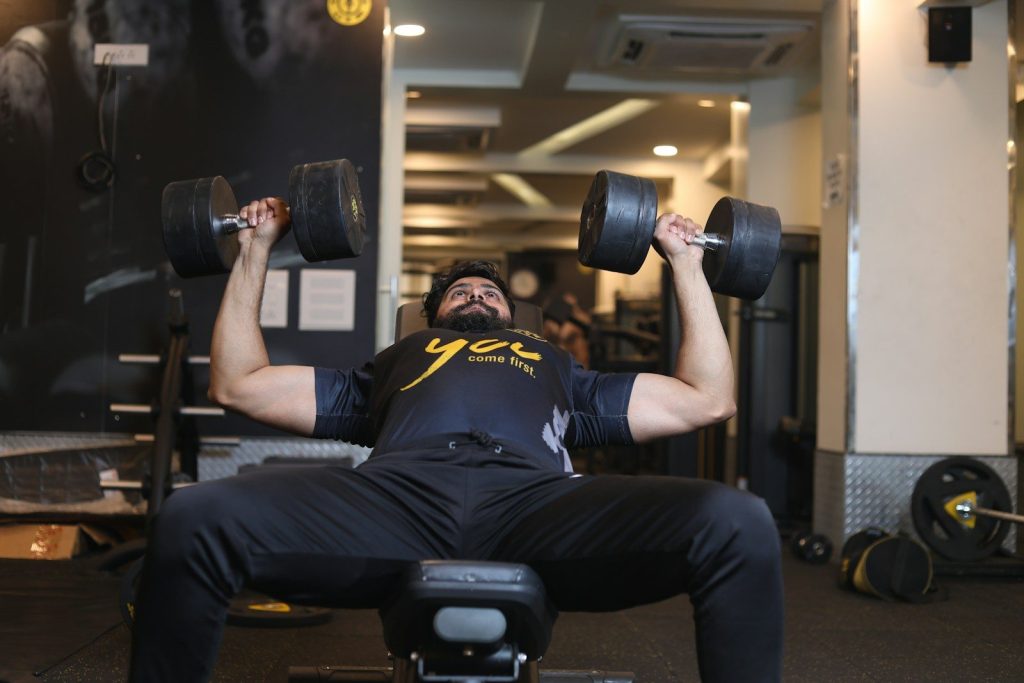
Because each arm controls its own weight, the dumbbell bench press can help develop pressing strength, expose side-to-side differences, and provide more freedom to adjust your hand position than a fixed barbell grip. This guide explains proper form, muscles worked, common mistakes, programming, variations, and safe progression.
Dumbbell Bench Press at a Glance
| Training detail | Recommendation |
|---|---|
| Best for | Building chest muscle and upper-body pressing strength |
| Primary muscle | Pectoralis major |
| Assisting muscles | Anterior deltoids and triceps |
| Equipment needed | A stable flat bench and two matched dumbbells |
| Beginner starting point | 2–3 sets of 8–12 repetitions |
| Rest between sets | Approximately 90–150 seconds |
| Effort level | Finish with about 2–3 controlled repetitions in reserve |
| Suggested frequency | Include chest pressing in 1–2 weekly workouts |
What Is the Dumbbell Bench Press?
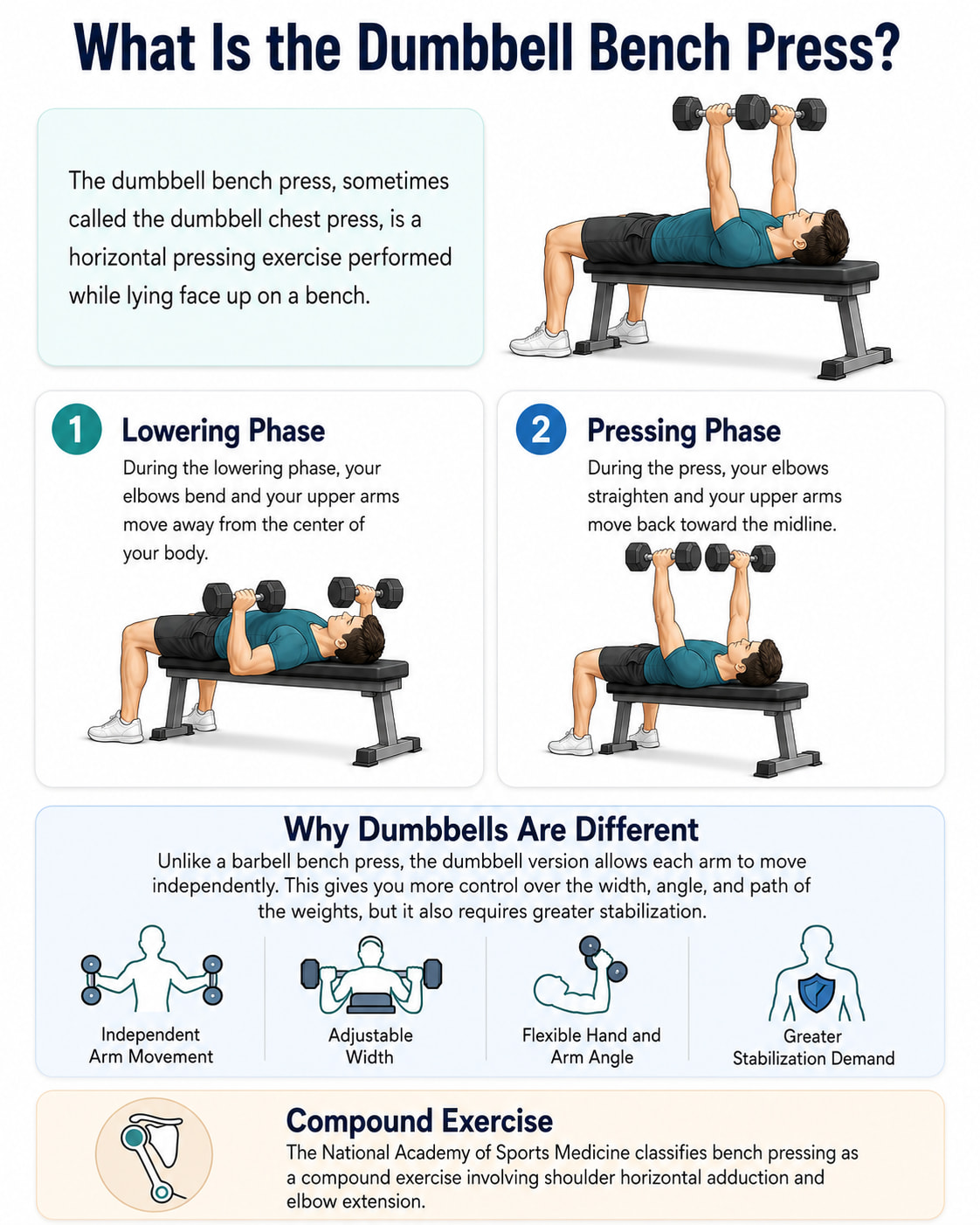
The dumbbell bench press, sometimes called the dumbbell chest press, is a horizontal pressing exercise performed while lying face up on a bench.
During the lowering phase, your elbows bend and your upper arms move away from the center of your body. During the press, your elbows straighten and your upper arms move back toward the midline.
Unlike a barbell bench press, the dumbbell version allows each arm to move independently. This gives you more control over the width, angle, and path of the weights, but it also requires greater stabilization.
The National Academy of Sports Medicine classifies bench pressing as a compound exercise involving shoulder horizontal adduction and elbow extension.
How to Do the Dumbbell Bench Press With Proper Form
Best for: Developing the chest, improving general pressing strength, and training each arm independently.
Muscles worked: Pectoralis major, anterior deltoids, triceps brachii, rotator-cuff muscles, biceps, and trunk stabilizers.
Equipment needed
- Two matching dumbbells
- A strong, stable flat bench
- A spotter when using weights that are difficult to position or control
Sets, reps, and rest: A practical starting point is 2–3 sets of 8–12 repetitions with 90–150 seconds of rest. Choose a weight that lets you finish each set with approximately two or three good repetitions still possible.
How to Do It:
- Position the dumbbells. Place the weights near the front of the bench so you can reach them without twisting or stretching awkwardly.
- Sit on the bench. Pick up the dumbbells using a controlled squat or hip hinge. Sit with one dumbbell resting securely on each thigh.
- Lie back under control. Use your thighs to help guide the dumbbells toward your chest as you lower your upper body onto the bench. Move your body and the dumbbells together rather than falling backward.
- Set your body position. Plant both feet firmly on the floor. Keep your head, upper back, and hips supported. Brace your abdomen while preserving a small, natural curve in your lower back.
- Set your shoulders. Draw your shoulder blades gently back and down to create a stable upper-back position against the bench. Do not force your shoulders into an uncomfortable position.
- Position the dumbbells. Hold them over the chest with your palms mostly facing forward. Wrap your thumbs around the handles and keep your wrists straight.
- Lower the weights. Inhale and bend your elbows, lowering the dumbbells toward the outside of your mid-chest. Keep your forearms close to vertical and your elbows approximately 30–60 degrees from your torso. About 45 degrees is a useful starting point.
- Use a controlled depth. Stop when you feel a comfortable chest stretch and can still keep your shoulders stable, wrists stacked over your forearms, and hips on the bench.
- Press upward. Exhale as you press the dumbbells up and slightly inward. Finish with the weights above the chest or shoulders without forcing them to collide.
- End the set safely. Bring the dumbbells toward your chest, guide them back to your thighs, and sit upright as one controlled movement. Place them on the floor only after you are seated securely.
The American Council on Exercise also emphasizes firm foot support, a closed grip, neutral wrists, shoulder-blade control, and maintaining contact between the body and bench.
Coaching cue: Keep each wrist stacked over its elbow as you lower and press.
How Low Should You Lower the Dumbbells?
There is no single correct depth for every lifter.
Many people can lower the dumbbells until their upper arms are approximately level with the bench or slightly below it. Others may need to stop sooner because of shoulder mobility, previous injuries, limb length, grip choice, or individual anatomy.
Use the deepest range in which you can maintain all of the following:
- Shoulders remain controlled against the bench.
- Wrists remain stacked over the forearms.
- Elbows follow a consistent path.
- Hips stay on the bench.
- No sharp pain, pinching, or numbness occurs.
- You can reverse the weight without bouncing or jerking.
A deeper range is not automatically more effective. Stop the descent when your shoulder begins to roll forward or you lose control of the dumbbells. Cleveland Clinic similarly recommends lowering only as far as you can maintain control without joint pain.
Dumbbell Bench Press Muscles Worked
Pectoralis Major
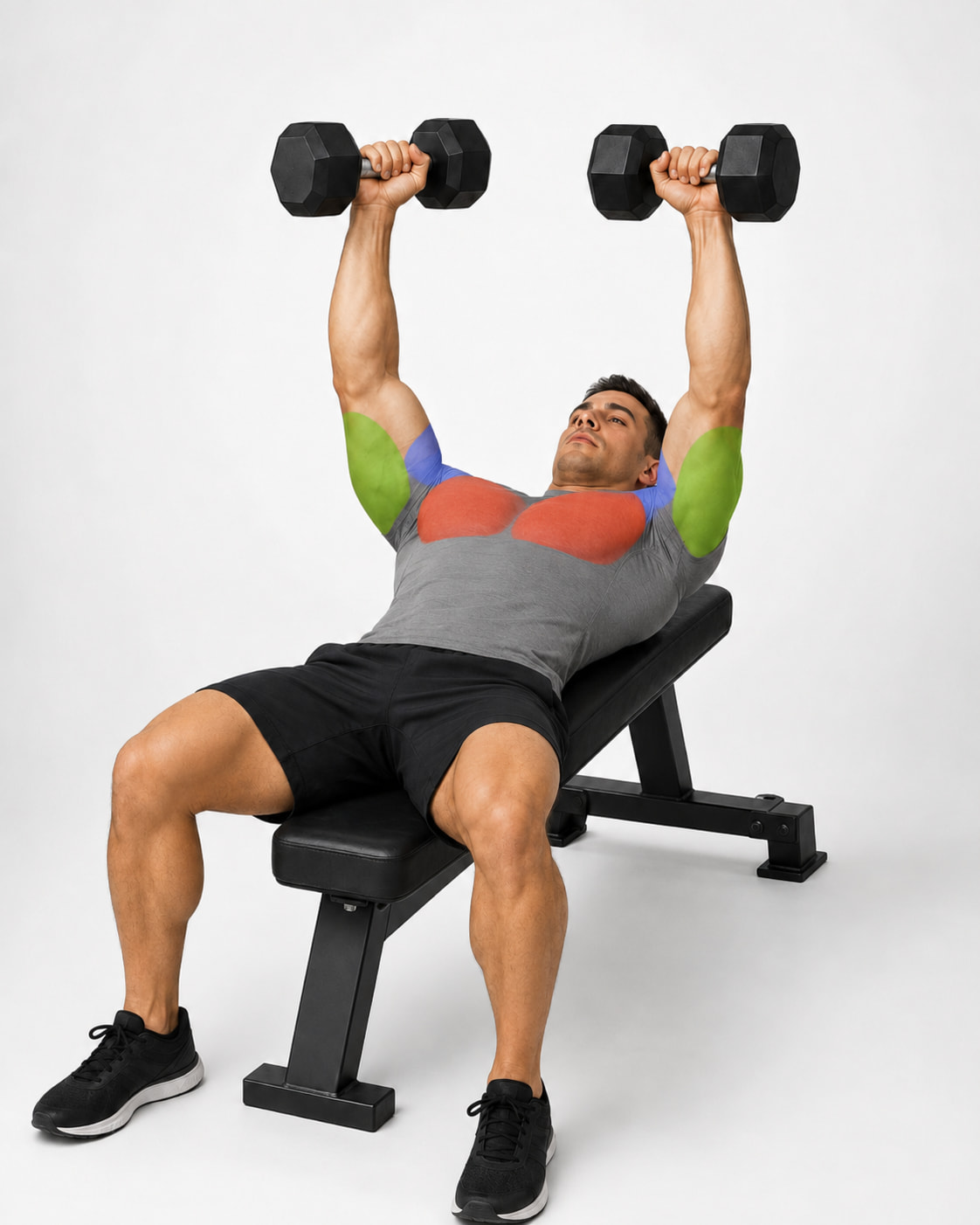
The pectoralis major is the main muscle trained during the dumbbell bench press.
It has clavicular fibers near the upper chest and sternocostal fibers across the larger middle and lower portion of the chest. Together, these fibers help bring the upper arms toward the center of the body during the press.
The flat dumbbell bench press trains both regions, although the sternocostal portion generally performs much of the work during a horizontal press. The NCBI Bookshelf describes the pectoralis major’s main actions as arm flexion, adduction, and internal rotation.
Anterior Deltoids
The anterior deltoids are the front sections of the shoulder muscles. They assist the pectoralis major as your upper arms move forward and upward.
You may feel more shoulder involvement when:
- Your elbows flare straight out.
- You lower beyond your controllable range.
- Your shoulders roll forward.
- The dumbbells drift too close to your head.
- You use an incline bench instead of a flat bench.
Triceps Brachii
The triceps on the backs of your upper arms straighten your elbows during the pressing phase. They generally work harder when you use a narrower pressing position or keep your elbows closer to your sides.
The primary anatomical function of the triceps is elbow extension, according to the NCBI Bookshelf anatomy review.
Stabilizing Muscles
Several muscles help keep the weights and body controlled:
- Rotator-cuff muscles stabilize the shoulder joints.
- Biceps contribute to shoulder and elbow control.
- Upper-back muscles help maintain scapular position.
- Abdominal and other trunk muscles resist unwanted body movement.
- Forearm and hand muscles maintain the grip and wrist position.
The dumbbell bench press should still feel mainly like a chest, shoulder, and triceps exercise. Stabilizers help control the movement rather than becoming its main target.
Benefits of the Dumbbell Bench Press
Builds the Chest and Pressing Muscles
The exercise trains the pectoralis major together with the anterior deltoids and triceps. These muscles contribute to pushing movements in strength training, sports, and everyday activities.
Trains Each Arm Independently
Each arm must control its own dumbbell. The stronger arm cannot directly move the weaker arm’s weight, as it may during a barbell press.
This can make side-to-side differences easier to notice. However, it does not automatically correct an imbalance. Use the same weight and controlled range on both sides rather than allowing one arm to perform extra repetitions.
Allows an Adjustable Hand Position
Dumbbells let you rotate your hands slightly instead of keeping them fixed on a straight bar. A standard palms-forward grip works well for many lifters, while a semi-neutral or fully neutral grip may feel more comfortable for others.
Provides Flexible Loading
Dumbbells are available in weights lighter than a standard Olympic barbell. This can make the movement accessible to beginners or anyone rebuilding pressing strength with lighter resistance.
May Allow a Longer Comfortable Range
Because there is no bar across the chest, the dumbbells may travel slightly below chest level when shoulder mobility and control permit.
Do not chase extra depth simply because the equipment allows it. The useful range ends when technique or comfort deteriorates.
Works in Home and Gym Programs
The exercise can serve as the main chest press in a full-body workout, upper-body day, push workout, or dedicated chest session.
Common Dumbbell Bench Press Mistakes
1. Using Too Much Weight
What happens: The dumbbells wobble, the range becomes inconsistent, the hips lift, or another person must complete the repetition.
How to fix it: Reduce the weight until you can lower and press both dumbbells through the same controlled path. Load should increase only after your form is repeatable.
2. Flaring the Elbows Straight Out
What happens: The upper arms move close to 90 degrees from the torso, potentially placing the shoulders in an uncomfortable position.
How to fix it: Begin with your elbows approximately 45 degrees from your torso. Adjust slightly based on your build and comfort while keeping your wrists over your elbows.
3. Tucking the Elbows Too Closely
What happens: The dumbbells drift inward, the forearms tilt, and the movement becomes heavily triceps-dominant.
How to fix it: Use a natural diagonal elbow position. The goal is not to press with the elbows touching your sides.
4. Bending the Wrists Back
What happens: The dumbbell sits behind the forearm instead of being supported over it.
How to fix it: Grip the center of each handle firmly, point your knuckles generally upward, and keep the wrist stacked over the forearm.
5. Letting the Shoulders Roll Forward
What happens: The shoulders lift away from the bench at the bottom or reach excessively toward the ceiling at the top.
How to fix it: Keep your upper back stable and your shoulder blades gently set against the bench. Shorten the range if you cannot maintain that position.
6. Lowering Too Deeply
What happens: The elbows drop far below the torso, the shoulders tilt forward, or the lifter feels pinching rather than a controlled chest stretch.
How to fix it: Stop at the deepest pain-free position you can control. Use a neutral grip or dumbbell floor press when a shorter range is preferable.
7. Using an Excessive Back Arch
What happens: The hips lift or the lower back arches dramatically to shorten the pressing range.
How to fix it: Keep your feet planted, abdomen braced, and hips supported. A small natural lower-back curve is acceptable; an exaggerated arch is not necessary for general training.
8. Crashing the Dumbbells Together
What happens: The weights collide at the top, causing loss of control and unnecessary movement at the shoulders.
How to fix it: Finish with the dumbbells separated and balanced above the chest. They do not need to touch for the repetition to count.
9. Dropping the Weights After the Set
What happens: The dumbbells are released beside the bench or pulled toward the floor from a vulnerable shoulder position.
How to fix it: Use manageable loads, return the dumbbells to your thighs, and sit up under control. Ask for help when the weights are difficult to position safely.
Beginners should prioritize scapular control, abdominal bracing, breathing, and a consistent pressing path before adding weight.
How to Choose the Right Dumbbell Weight
Choose a weight based on technique and effort, not on what another person presses.
For a target of 8–12 repetitions, the correct starting weight should let you:
- Complete at least eight repetitions with stable form.
- Keep both arms moving at approximately the same speed.
- Maintain a controlled lowering phase.
- Keep your wrists, elbows, shoulders, and hips in position.
- Finish with approximately two or three repetitions still possible.
The weight is probably too heavy when you cannot reach the bottom of the target range or your form changes before the set ends.
The weight may be too light when you reach the top of the range and could continue for many additional repetitions without slowing down.
You do not need to test a one-repetition maximum to choose an effective training load. Rep-based progression is usually simpler and safer for general fitness.
Dumbbell Bench Press Sets, Reps, and Rest
There is no single repetition range that works for every goal. Use the following ranges as practical starting points.
| Goal | Sets | Repetitions | Rest | Suggested effort |
|---|---|---|---|---|
| Beginner technique | 2–3 | 8–12 | 90–150 seconds | 2–3 reps in reserve |
| Muscle building | 3–4 | 6–12 | 90–180 seconds | 1–3 reps in reserve |
| General strength | 3–4 | 5–8 | 2–3 minutes | 2–3 reps in reserve |
| Muscular endurance | 2–3 | 12–20 | 60–120 seconds | 2–3 reps in reserve |
These ranges overlap. You can build muscle with different loads when sets are sufficiently challenging and total training is appropriate.
Longer rest periods are useful when short rests cause your repetitions or weight to drop sharply. A systematic review available through PubMed Central found a small muscle-growth advantage for rest periods longer than 60 seconds, possibly because longer rests help preserve training volume.
How Often Should You Do the Dumbbell Bench Press?
Most people can include the exercise in one or two workouts per week.
You do not necessarily need to perform the exact same press twice. For example:
- Monday: Flat dumbbell bench press
- Thursday: Incline dumbbell press or push-ups
The American College of Sports Medicine recommends training major muscle groups at least twice per week and adjusting load and weekly volume to the individual’s goal. For muscle growth, approximately 10 weekly sets per muscle group can be a useful general target, but beginners may progress with less.
Count all challenging chest exercises toward that weekly total, including presses, push-ups, machines, and fly variations. Do not perform all of the volume through the dumbbell bench press alone.
How to Progress the Dumbbell Bench Press
A repetition-first method is one of the simplest ways to progress.
Suppose your plan calls for three sets of 8–12 repetitions:
- Select a weight you can press for three controlled sets of at least eight repetitions.
- Keep the same weight while gradually adding repetitions.
- Progress until you can complete 12 repetitions on every set with consistent form.
- Increase each dumbbell by the smallest available amount.
- Return to approximately eight repetitions and build back up.
For example:
- Workout 1: 10, 9, 8 repetitions
- Workout 2: 10, 10, 9
- Workout 3: 11, 10, 10
- Later workout: 12, 12, 12
- Next workout: Increase the weight and restart near 8 repetitions
Add weight only when you can maintain your shoulder position, wrist alignment, range of motion, and control.
Training to complete muscular failure is not required for every set. Failure training and advanced programming methods are optional for the average healthy adult.
Dumbbell Bench Press Regressions
Light Dumbbell Bench Press
The most specific regression is simply using lighter dumbbells. This preserves the full exercise while reducing the demand on your chest, shoulders, grip, and setup.
Dumbbell Floor Press
Lie on the floor with your knees bent and feet planted. Lower the dumbbells until the backs of your upper arms contact the floor, pause briefly, and press upward.
The floor limits the bottom range, which can make the movement easier to control. Use a slow landing rather than letting your arms hit the floor.
Neutral-Grip Dumbbell Bench Press
Turn your palms toward each other and keep your elbows closer to the torso. This changes the shoulder and forearm position and may feel more comfortable for some lifters.
Chest Press Machine
A machine provides a guided pressing path and removes much of the independent stabilization required by dumbbells. Adjust the seat so the handles begin around mid-chest height, keep your feet supported, and avoid letting the shoulders roll forward.
The NASM chest press machine guide recommends aligning the handles with the mid-chest, bracing the core, and beginning with the elbows around 45 degrees from the torso.
Dumbbell Bench Press Progressions and Variations
These options change the challenge or emphasis. They are not automatically better than the standard exercise.
Paused Dumbbell Bench Press
Pause for one or two seconds near the bottom before pressing. This reduces momentum and makes consistent positioning more important.
Use lighter dumbbells than you would for normal repetitions.
Tempo Dumbbell Bench Press
Take approximately three seconds to lower the weights, pause briefly, and press up under control.
A slower lowering phase can improve awareness and control, but it may reduce the load or repetitions you can complete.
Incline Dumbbell Bench Press
Raise the bench to a low or moderate incline. This changes the pressing angle and generally increases the involvement of the clavicular, or upper, region of the chest as well as the anterior deltoids.
Research available through PubMed Central found greater upper-chest muscle activity around a 30-degree incline, while steeper angles increased anterior-deltoid involvement. Electromyography measures short-term muscle activity and does not by itself prove superior long-term growth.
Single-Arm Dumbbell Bench Press
Press one dumbbell while the other arm remains unloaded or holds a lighter position. The uneven load challenges the trunk to resist rotation.
Begin with a light weight, keep both hips supported, and avoid allowing your torso to twist. Single-arm pressing is better treated as a stability variation than as a way to lift heavier weights.
Alternating Dumbbell Bench Press
Hold one dumbbell stable while pressing the other, then alternate arms. This increases the length of the set and the demand on shoulder and trunk control.
Dumbbell Bench Press vs. Barbell Bench Press
Neither exercise is universally better. The best option depends on your goals, equipment, experience, and comfort.
| Factor | Dumbbell bench press | Barbell bench press |
|---|---|---|
| Arm movement | Each arm moves independently | Both hands control one bar |
| Hand position | Can be adjusted or rotated | Fixed on the bar |
| Typical load | Usually lighter | Usually allows more total weight |
| Stability demand | Higher independent stabilization | More stable connection between arms |
| Range of motion | May allow a deeper comfortable range | Bar stops at the chest |
| Setup | Heavy dumbbells can be difficult to position | Requires a rack and usually a spotter |
| Best use | Independent arm training and flexible pressing path | Maximum pressing strength and heavier loading |
A small study indexed by PubMed involved 12 resistance-trained men and found that participants used a lower total load with dumbbells than with a barbell. Pectoralis-major and anterior-deltoid muscle activity was similar, while dumbbells produced more biceps and less triceps activity in that test.
These results describe one small, short-term study and should not be interpreted as proof that either exercise produces greater long-term muscle growth.
Use the variation you can perform consistently, progressively, and without pain.
Sample Dumbbell Bench Press Workout
This balanced upper-body session can be performed once or twice per week with at least one recovery day between sessions.
Warm-Up
Spend approximately five minutes on easy movement, such as brisk walking, cycling, or arm circles. Then complete two or three lighter dumbbell bench press sets before your working weight.
Example warm-up:
- Very light dumbbells: 10–12 repetitions
- Moderate warm-up weight: 6–8 repetitions
- Slightly heavier warm-up weight, when needed: 3–5 repetitions
Warm-up sets should prepare you without creating significant fatigue.
Workout
| Exercise | Sets and reps | Rest |
|---|---|---|
| Dumbbell bench press | 3 × 8–12 | 90–150 seconds |
| One-arm dumbbell row | 3 × 8–12 per side | 90 seconds |
| Neutral-grip incline dumbbell press | 2 × 10–12 | 90 seconds |
| Dumbbell reverse fly | 2 × 12–15 | 60–90 seconds |
Finish most sets with approximately two repetitions in reserve. When you reach the top of the repetition range on every set with controlled form, increase the weight by the smallest available amount.
Beginners can start with two sets of each exercise and add a third set only when recovery and technique remain good.
Dumbbell Bench Press Safety Tips
- Use a bench that does not wobble, slide, or tip.
- Check that adjustable dumbbell plates or locking mechanisms are secure.
- Keep the floor around the bench clear.
- Learn the setup and dismount with light weights before progressing.
- Use a spotter when the dumbbells are difficult to position or control.
- Avoid testing maximal loads alone.
- Do not continue a repetition after losing control of a shoulder, wrist, or elbow.
- Stop if you experience sharp pain, numbness, dizziness, chest pain, or unusual symptoms.
- Seek guidance from a qualified medical or fitness professional when returning after a shoulder, elbow, wrist, chest, or back injury.
A challenging chest-muscle sensation is different from sharp or persistent joint pain. Pain should not be treated as a normal requirement of effective pressing.
Frequently Asked Questions
Is the dumbbell bench press good for building the chest?
Yes. The pectoralis major is the primary muscle responsible for bringing the upper arms toward the body during the press.
Muscle growth also depends on suitable weekly volume, challenging effort, recovery, nutrition, and gradual progression—not simply exercise selection.
What angle should my elbows use?
Approximately 45 degrees from the torso is a useful starting point. Some people are more comfortable slightly closer to or farther from the body.
Avoid forcing your elbows straight out or pressing them tightly against your sides. Keep your wrists positioned above your elbows.
How low should the dumbbells go?
Lower them as far as you can while maintaining shoulder stability, neutral wrists, and a pain-free range.
Your upper arms may finish level with the bench or slightly below it, but individual depth varies.
Should the dumbbells touch at the top?
No. Finish with the weights balanced above your chest or shoulders. Forcing them together can create unnecessary movement and reduce control.
Why do I feel the exercise mostly in my shoulders?
Common reasons include flaring the elbows, lowering too deeply, allowing the shoulders to roll forward, pressing the weights too close to the head, or using more weight than you can control.
Reduce the load, set your shoulder blades against the bench, and keep your elbows under your wrists. Stop if the feeling is sharp, pinching, or located inside the joint.
Is a neutral grip better?
A neutral grip is not automatically better, but it may feel more comfortable for some wrists, elbows, or shoulders.
It usually places the elbows closer to the torso and may increase the relative contribution of the triceps.
Can I Do the Dumbbell Bench Press Without a Bench?
Use a dumbbell floor press instead. The floor supports your body and limits how far the elbows can travel below the torso.
Do not substitute an unstable chair, bed, or improvised raised surface for a proper exercise bench.
Conclusion
The dumbbell bench press is most effective when you treat control as the foundation of progression. Keep your feet planted, upper back stable, wrists stacked over your forearms, and elbows in a comfortable diagonal position.
Lower only as far as you can control, then press without bouncing or forcing the dumbbells together.
Start with a manageable weight, finish most sets with a few repetitions in reserve, and increase the load only after you can complete the top of your repetition range with consistent form.
This content is for informational and educational purposes only and is not intended as a substitute for professional medical advice, diagnosis, or treatment.
References
- American College of Sports Medicine: Resistance Training Prescription for Muscle Function, Hypertrophy, and Physical Performance
- American Council on Exercise: Chest Press Exercise Guide
- National Academy of Sports Medicine: Bench Press Muscles, Grips, and Movement Patterns
- Saeterbakken et al.: Comparison of Dumbbell, Barbell, and Smith-Machine Chest Presses
- Rodríguez-Ridao et al.: Effect of Bench Inclination on Chest, Shoulder, and Triceps Activity
- Singer et al.: Interset Rest Duration and Muscle Hypertrophy
- Schoenfeld et al.: Loading Recommendations for Strength, Muscle Growth, and Endurance
12 thoughts on “Dumbbell Bench Press: Proper Form, Muscles, and Tips”