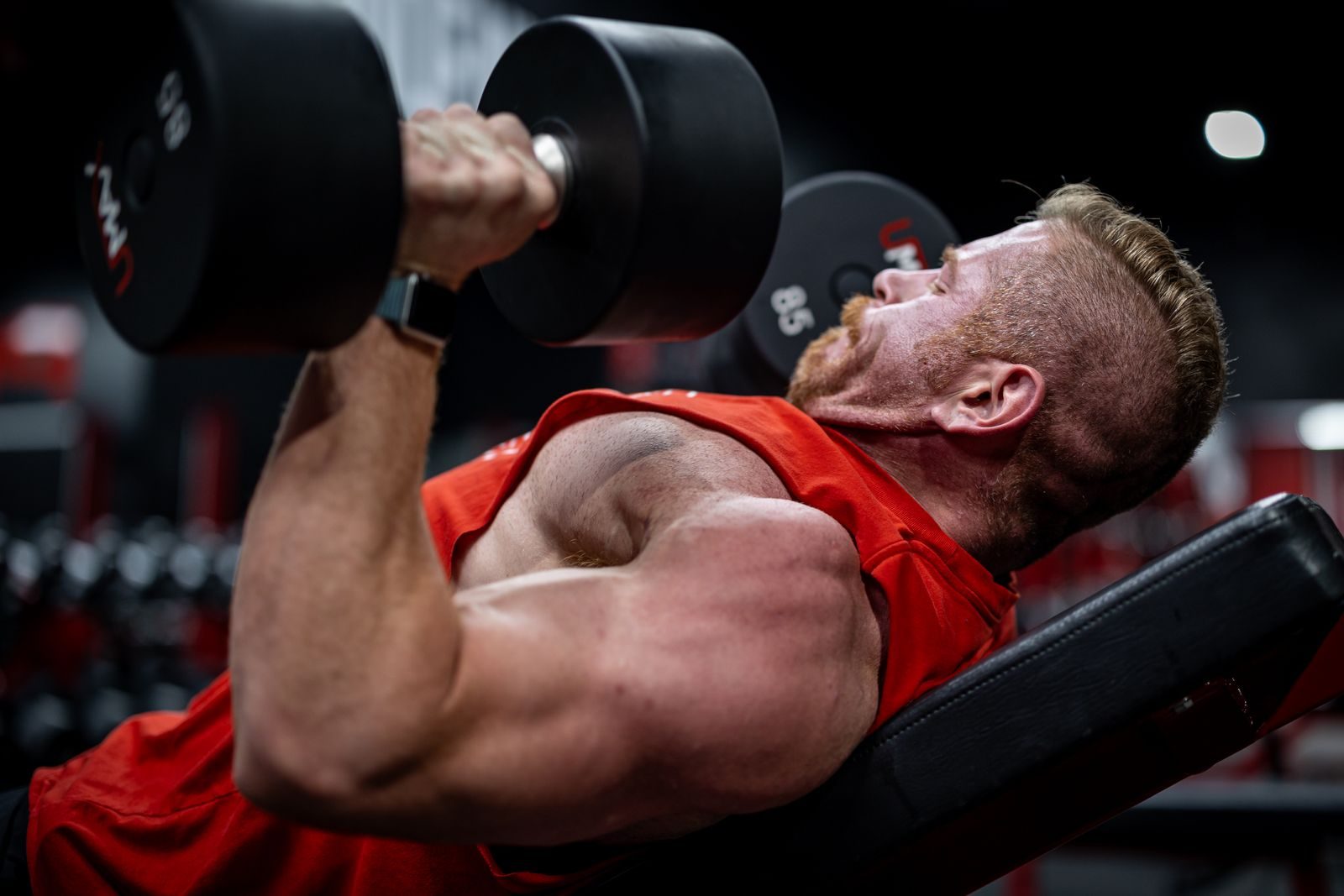
The dumbbell incline press is a compound chest exercise that emphasizes the upper portion of the pectoralis major while also training the front shoulders and triceps. Using a moderate bench incline, controlled repetitions, and a stable pressing position makes the exercise useful for building upper-body strength and muscle.
This guide explains the best bench angle, proper dumbbell incline press form, muscles worked, sets and reps, common mistakes, and safe ways to progress.
Dumbbell Incline Press at a Glance
| Category | Recommendation |
|---|---|
| Exercise type | Compound upper-body press |
| Main purpose | Chest strength and muscle development |
| Primary muscle | Pectoralis major, with greater emphasis on the clavicular region |
| Assisting muscles | Anterior deltoids and triceps |
| Equipment | Two dumbbells and an adjustable bench |
| Suggested bench angle | Approximately 30–45 degrees |
| Beginner starting point | 2–3 sets of 8–12 reps |
| Muscle-building range | 3–4 sets of 6–12 reps |
| Strength-focused range | 3–4 sets of 4–6 reps |
| Rest between sets | 90 seconds to 3 minutes |
| Effort | Finish most sets with 1–3 good reps available |
| Common placement | Early in a chest or push workout |
What Is the Dumbbell Incline Press?
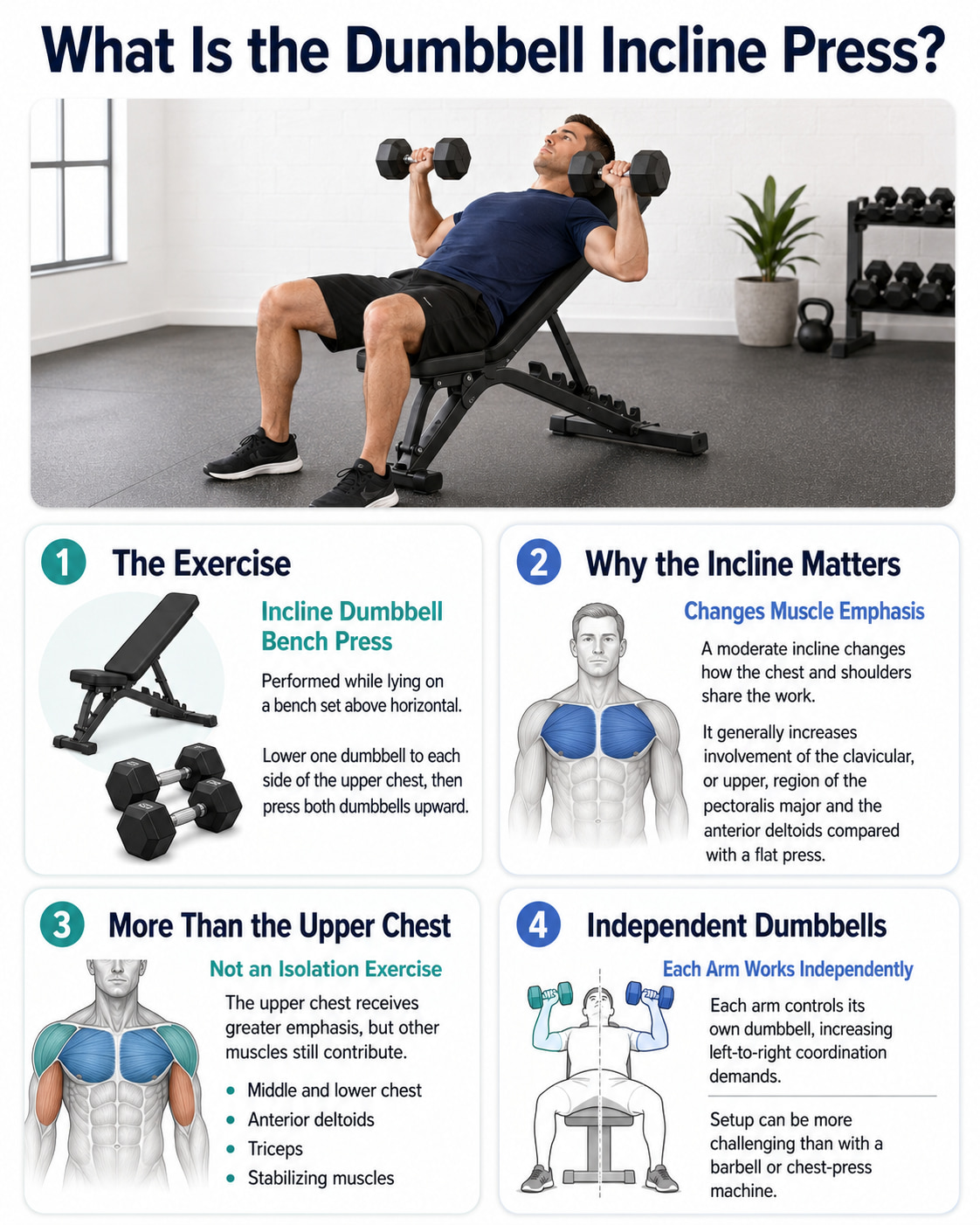
The dumbbell incline press, sometimes called the incline dumbbell bench press, is performed while lying on a bench set above horizontal. You lower one dumbbell on each side of your upper chest and then press them upward.
The inclined torso position changes how the chest and shoulder muscles share the work. Compared with a flat press, a moderate incline generally increases the involvement of the clavicular, or upper, region of the pectoralis major and the anterior deltoids.
It is not an upper-chest isolation exercise. The middle and lower regions of the chest, triceps, shoulders, and stabilizing muscles still contribute.
Because each arm controls its own dumbbell, the exercise also requires coordination between the left and right sides. However, dumbbells can be harder to move safely into and out of position than a barbell or chest-press machine.
Dumbbell Incline Press Muscles Worked
| Muscle Group | Role in the Dumbbell Incline Press | Key Details |
|---|---|---|
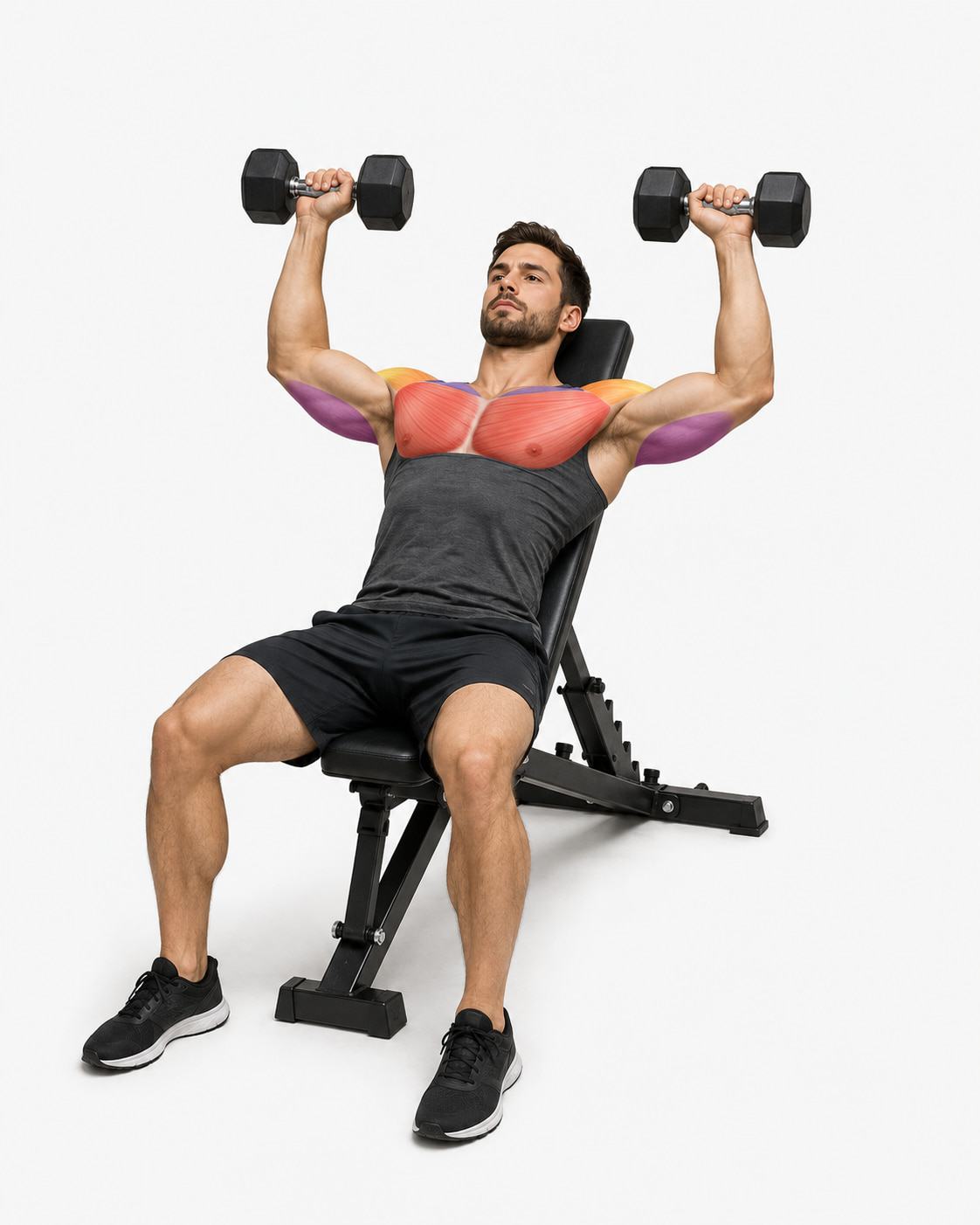
| Pectoralis major | Primary chest muscle | The clavicular region near the collarbone receives greater emphasis during incline pressing, while the sternocostal region across the middle and lower chest also contributes. The pectoralis major helps with shoulder flexion, adduction, and internal rotation. |
| Anterior deltoids | Major assisting muscle | The front shoulders help raise the upper arms as the dumbbells move upward. Shoulder involvement generally increases as the bench becomes steeper. |
| Triceps brachii | Assists elbow extension | The triceps straighten the elbows during the press and contribute strongly as the arms approach the top position. Avoid forcefully snapping the elbows into lockout. |
| Rotator-cuff muscles | Shoulder stabilization | Help control and stabilize the shoulder joints throughout the movement. |
| Upper-back muscles | Pressing-base stability | Help keep the upper body stable against the incline bench. |
| Forearm muscles | Wrist and dumbbell control | Help maintain stable wrists and control the dumbbells throughout each repetition. |
| Abdominal and lower-back muscles | Torso stabilization | Help maintain a stable trunk and controlled body position during the press. |
| Legs | Provide a stable base | Firm foot contact helps maintain overall body stability during each repetition. |
The NCBI Bookshelf anatomy review describes the pectoralis major as an important contributor to shoulder flexion, adduction, and internal rotation.
What Is the Best Bench Angle?
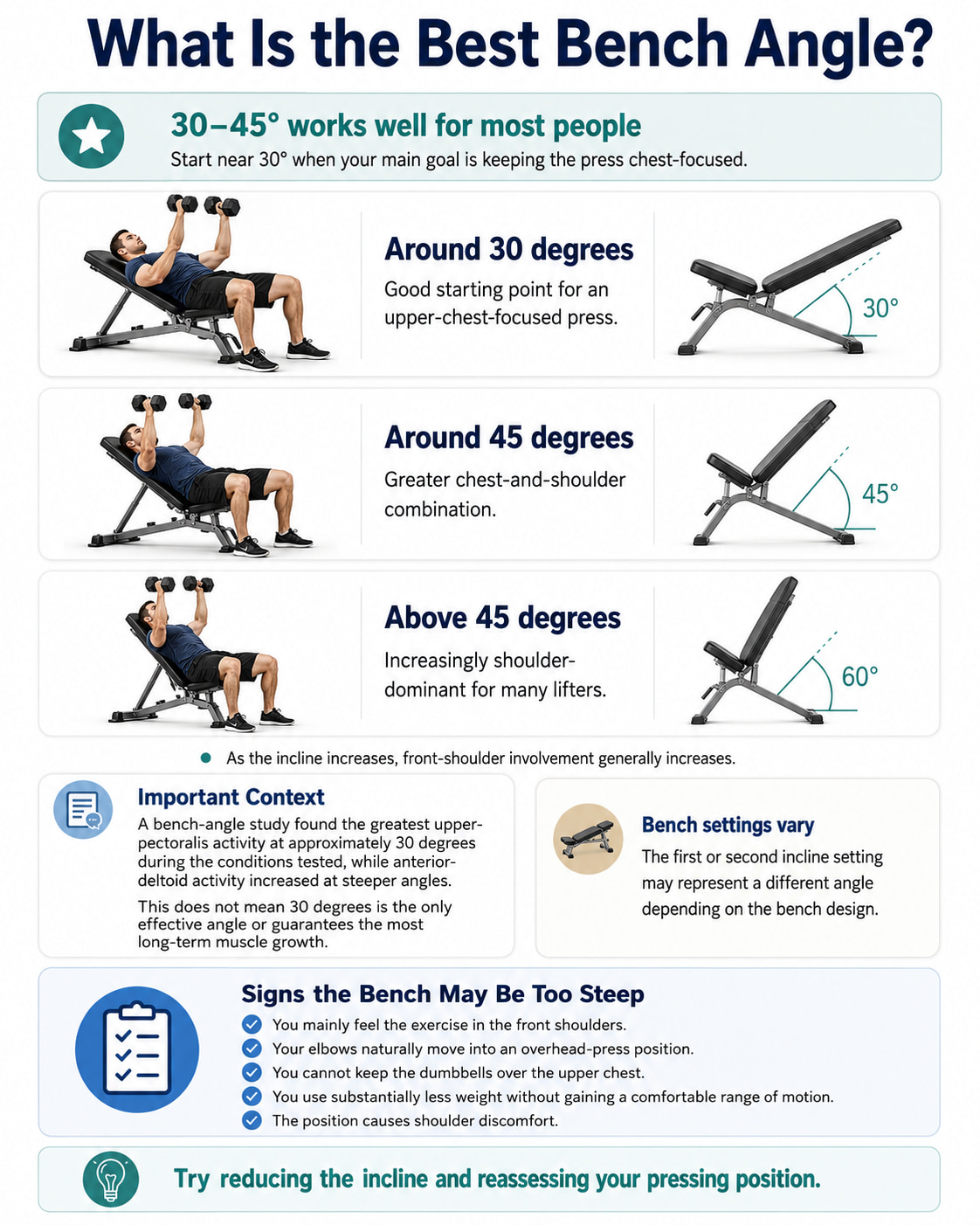
A bench angle of approximately 30–45 degrees works well for most people.
Start near 30 degrees when your main goal is keeping the movement chest-focused. A slightly steeper angle may feel comfortable for some lifters, but increasing the incline generally increases front-shoulder involvement.
A bench-angle study indexed in PubMed found the greatest upper-pectoralis activity at approximately 30 degrees during the conditions tested. It also found increasing anterior-deltoid activity at steeper inclines.
However, muscle activation during one study does not prove that 30 degrees is the only effective angle or that it always produces the most long-term growth. The study also examined barbell pressing rather than the exact dumbbell variation.
Use the following as a practical guide:
- Around 30 degrees: Good starting point for an upper-chest-focused press
- Around 45 degrees: Greater chest-and-shoulder combination
- Above 45 degrees: Increasingly shoulder-dominant for many lifters
Bench manufacturers use different backrest positions, so the first or second incline setting may not equal the same angle on every bench.
Signs the Bench May Be Too Steep
Consider reducing the incline when:
- You mainly feel the exercise in the front shoulders.
- Your elbows naturally move into an overhead-press position.
- You cannot keep the dumbbells over the upper chest.
- You use substantially less weight without gaining a comfortable range of motion.
- The position causes shoulder discomfort.
Benefits of the Dumbbell Incline Press
- Emphasizes the upper chest: Places greater demand on the clavicular region of the pectoralis major.
- Trains each arm independently: Makes side-to-side differences in control and strength easier to notice.
- Allows a flexible grip: Dumbbells let you use a palms-forward, slightly angled, or neutral hand position.
- Builds pressing strength: Trains the chest, front shoulders, and triceps together.
- Fits different goals: Works well for strength, muscle growth, higher-rep accessory work, or paused control-focused sets.
- Pairs well with other chest exercises: Complements flat presses, push-ups, and other chest movements rather than replacing them entirely.
Equipment and Setup
You need:
- Two matching dumbbells
- A stable adjustable bench
- Enough clear space around the bench
- A spotter when using challenging weights
Set the bench angle before picking up the dumbbells. Confirm that the backrest is securely locked and that the bench does not slide.
Perform a brief general warm-up followed by one to three progressively heavier practice sets. Your warm-up sets should prepare the movement without tiring you before the working sets.
How to Do the Dumbbell Incline Press
- Set the bench.
Position the backrest at approximately 30–45 degrees. - Place the dumbbells on your thighs.
Sit with one dumbbell resting upright on each thigh. Keep your feet firmly planted. - Guide the dumbbells into position.
Lean back while using your thighs to help move the dumbbells toward your shoulders. Avoid trying to curl heavy dumbbells into place using only your arms. - Create a stable base.
Keep your head, upper back, and glutes supported by the bench. Plant both feet and brace your abdomen. A small natural lower-back arch is acceptable, but do not exaggerate it. - Set your shoulders and wrists.
Gently draw the shoulder blades back and down against the bench. Hold the dumbbells above the upper chest with your wrists straight and stacked over your forearms. - Position your elbows.
Begin with the elbows approximately 45 degrees from your torso rather than pointing directly sideways. Your forearms should remain close to vertical when viewed from the front. - Lower the dumbbells under control.
Inhale and lower the weights toward the sides of your upper chest. Keep the wrists over the elbows and avoid allowing the shoulders to shrug. - Stop at a comfortable depth.
Lower only as far as you can maintain stable shoulders, straight wrists, and control. The dumbbells do not have to touch your chest. - Press upward.
Exhale as you press the dumbbells upward and slightly inward. Keep both weights moving at approximately the same speed. - Finish without crashing the weights together.
End with the dumbbells above the shoulders or upper chest. They may move closer together, but they do not need to touch.
The NASM incline dumbbell press guide and ACE incline chest press guide both emphasize stable body contact, controlled lowering, neutral wrist alignment, and avoiding excessive back arching.
Coaching cue: Keep your wrists over your elbows and press up and slightly inward.
How Low Should You Lower the Dumbbells?
There is no single correct bottom position for every person.
A common stopping point is when the elbows are approximately level with, or slightly below, the torso. However, your comfortable range depends on:
- Shoulder mobility
- Arm length
- Bench angle
- Dumbbell size
- Grip position
- Previous shoulder problems
- Ability to keep the shoulder blades controlled
Do not force the elbows far below the bench simply to create a deeper stretch. Extra depth is not useful when it causes the shoulders to roll forward, the wrists to bend, or control to disappear.
Reduce the range if you feel pinching, sharp pain, numbness, or instability.
How to End the Set Safely
Finishing the set deserves as much attention as starting it.
With manageable weights:
- Complete the final repetition.
- Bring the dumbbells toward your shoulders.
- Raise your knees and guide the dumbbells onto your thighs.
- Use the momentum of your legs to help return to a seated position.
Avoid dropping the dumbbells sideways. This can damage the equipment, place unnecessary stress on the shoulders, and endanger anyone nearby.
Ask a spotter to help with the setup and finish when the weights are difficult to control independently.
Dumbbell Incline Press Sets and Reps
Choose your sets, repetitions, and rest period according to your training goal.
| Goal | Sets and reps | Rest | Effort |
|---|---|---|---|
| Beginner and form practice | 2–3 sets of 8–12 reps | 90–120 seconds | 2–3 reps in reserve |
| Muscle development | 3–4 sets of 6–12 reps | 90–150 seconds | 1–3 reps in reserve |
| Strength emphasis | 3–4 sets of 4–6 reps | 2–3 minutes | Heavy but controlled |
| Accessory work | 2–3 sets of 12–15 reps | 60–90 seconds | Stop before form changes |
“Reps in reserve” describes how many technically sound repetitions you could likely complete before reaching failure. Finishing with two reps in reserve means you stop when you believe you could perform approximately two more good repetitions.
Most sets do not need to reach complete failure. Stop when your repetition speed slows substantially or your shoulders, wrists, back, or elbows begin changing position.
The ACSM resistance-training guidance emphasizes consistency, appropriate weekly training volume, and gradual progression rather than complicated techniques or constant failure training.
How Many Times Per Week?
Most people can perform the dumbbell incline press one or two times per week, depending on their routine, total chest volume, and recovery.
Count all chest exercises when evaluating weekly volume. For example, incline presses, flat presses, push-ups, chest-press machines, and fly variations all contribute to chest training.
A beginner may start with two or three working sets once per week. More experienced lifters may divide their chest work across two sessions.
How to Choose the Right Dumbbell Weight
Choose a weight that allows you to:
- Complete the bottom of your target repetition range
- Lower each repetition under control
- Keep the wrists stacked over the forearms
- Maintain a consistent elbow path
- Press without bouncing or twisting
- Finish with the intended number of repetitions in reserve
The weight is probably too heavy when:
- You cannot safely get the dumbbells into position.
- Your hips lift away from the bench.
- Your feet move or push unevenly.
- One arm finishes noticeably before the other.
- The dumbbells drift toward your face.
- You shorten the range more with each repetition.
- You need a spotter to complete every working set.
Using a lighter load with stable technique is more productive than forcing heavy repetitions through an inconsistent path.
How to Progress the Dumbbell Incline Press
A simple double-progression method works well.
For example, use a target of three sets of 8–12 repetitions:
- Select dumbbells you can press for three sets of at least eight controlled repetitions.
- Keep the same weight while gradually adding repetitions.
- Increase the weight after you can complete all three sets for 12 repetitions with consistent form.
- Return to approximately eight repetitions with the heavier dumbbells.
- Build back toward 12 repetitions.
Increase the weight only when you can also maintain:
- A controlled lowering phase
- Equal movement between both arms
- Stable feet and torso
- Straight wrists
- A comfortable range of motion
- The planned number of repetitions in reserve
Dumbbell weight jumps can be large relative to your current strength. When the next pair is too heavy, progress by adding repetitions, slowing the lowering phase, or improving control before increasing the load.
Common Dumbbell Incline Press Mistakes
Setting the Bench Too High
A steep bench shifts more work toward the front shoulders.
Fix: Reduce the bench to approximately 30 degrees and check whether you can press over the upper chest rather than overhead.
Flaring the Elbows Straight Out
Holding the upper arms at approximately 90 degrees from the torso can create an uncomfortable shoulder position for some lifters.
Fix: Start with the elbows around 30–60 degrees from the torso. Approximately 45 degrees is a useful starting point.
Bending the Wrists Backward
Extended wrists reduce stability and may make heavy dumbbells harder to control.
Fix: Keep the handles low in the palms and stack the knuckles, wrists, and forearms.
Lowering Too Deeply
A deeper range is not automatically better. Excessive depth can cause the shoulders to roll forward or the elbows to move far behind the torso.
Fix: Stop at the deepest position you can control comfortably.
Letting the Dumbbells Drift Toward the Face
Pressing too far toward the head changes the exercise into a more shoulder-dominant movement.
Fix: Keep the weights moving over the upper chest and shoulders rather than directly over the face.
Using an Excessive Back Arch
A large arch can change the torso angle and turn the movement into something closer to a flat press.
Fix: Keep the glutes on the bench, brace the abdomen, and maintain only a small natural arch.
Shrugging the Shoulders
Allowing the shoulders to rise toward the ears reduces upper-back stability.
Fix: Keep the neck relaxed and maintain gentle shoulder-blade control throughout the set.
Bouncing Out of the Bottom
Dropping the weights quickly removes control and can change the shoulder position.
Fix: Lower for approximately two seconds and reverse direction smoothly.
Crashing the Dumbbells Together
Hitting the weights together does not increase chest activation and may disrupt shoulder or wrist position.
Fix: Press slightly inward but finish with a small space between the dumbbells.
Using Leg Drive to Complete Repetitions
The feet should create stability, not launch the weights upward.
Fix: Reduce the load and keep your glutes, upper back, and feet firmly positioned.
Why Do I Feel the Incline Press in My Shoulders?
Some front-shoulder involvement is normal. The anterior deltoids are major assisting muscles during the exercise.
However, the shoulders may dominate when:
- The bench is too steep.
- The elbows are excessively flared.
- The weights are too heavy.
- The dumbbells travel toward the head.
- The shoulder blades are not stable.
- The range is deeper than you can control.
- You begin with the shoulders already shrugged.
Try lowering the bench angle, reducing the weight, using a slightly angled grip, and stopping the descent before the shoulders roll forward.
Stop the exercise if it causes sharp or persistent pain rather than normal muscular effort.
Beginner Regressions
Use a Lower Incline
A 15- to 30-degree incline may feel more stable and less shoulder-dominant than a steeper bench.
Reduce the Range of Motion
Lower only to the depth you can control. Gradually increase the range as your stability and comfort improve.
Use a Neutral or Semi-Neutral Grip
Turning the palms partly or fully toward each other can provide a comfortable pressing path for some people.
Use an Incline Chest-Press Machine
A machine reduces the balance required to control two separate dumbbells. It can be useful for learning the pressing pattern or training without a difficult dumbbell setup.
Use Lighter Dumbbells
Start with weights that are easy to position independently. Practice the setup and finish before progressing the load.
Progressions and Variations
Paused Dumbbell Incline Press
Pause briefly at the bottom without relaxing the shoulders or bouncing. This variation improves control and makes lighter weights more challenging.
Slow-Eccentric Incline Press
Lower the dumbbells for three or four seconds before pressing normally. Use less weight than you would for standard repetitions.
Single-Arm Dumbbell Incline Press
Press one dumbbell while the other arm rests or holds its weight in position. The single-arm variation creates a greater trunk-stability challenge.
Keep the torso centered and avoid rotating toward the working arm.
Alternating Dumbbell Incline Press
Press one dumbbell while holding the other at the top or bottom position. This increases time under tension and coordination demands.
Neutral-Grip Incline Press
Keep the palms facing each other throughout the repetition. This changes the arm path and may feel more comfortable for some lifters.
Dumbbell Incline Press vs. Flat Dumbbell Press
Neither exercise is automatically better. They emphasize the pressing muscles differently.
Dumbbell Incline Press
- Places greater relative demand on the upper chest and anterior deltoids
- Usually requires less weight than a flat press
- Works well for upper-chest-focused training
- Becomes more shoulder-dominant as the bench gets steeper
Flat Dumbbell Press
- Trains the entire chest with more emphasis across the sternocostal region
- Often allows heavier dumbbells
- Usually involves less front-shoulder demand than a steep incline
- Works well as a primary general chest press
A dumbbell pressing study indexed in PubMed found that changing from a flat press to an incline press altered the relative involvement of the chest and anterior deltoids. The findings support using both angles according to the goal rather than treating one as universally superior.
Dumbbell Incline Press vs. Barbell Incline Press
Dumbbells
- Allow each arm to move independently
- Permit more freedom in grip and pressing path
- Require more stabilization
- Can expose side-to-side differences
- Are more difficult to move into position at heavy loads
Barbell
- Provides one connected implement
- Often allows more total weight
- May be easier to set up in a rack
- Uses a fixed hand position
- Requires suitable safety arms or a spotter for heavy training
Choose the version you can perform safely, progress consistently, and fit into your available equipment.
Sample Dumbbell Incline Press Workout
This chest-and-push session is suitable for a beginner or intermediate lifter.
| Exercise | Sets and reps | Rest |
|---|---|---|
| Dumbbell incline press | 3 sets of 6–10 reps | 2 minutes |
| Flat dumbbell press or controlled push-up | 2–3 sets of 8–12 reps | 90 seconds |
| Dumbbell lateral raise | 2 sets of 12–15 reps | 60 seconds |
| Dumbbell triceps extension | 2 sets of 10–15 reps | 60–90 seconds |
Finish most sets with approximately two good repetitions available.
Perform the workout once or twice per week with at least one recovery day between hard upper-body sessions. Beginners can start with two sets per exercise.
For the incline press, add repetitions until you can complete three sets of 10 with controlled form. Then increase the dumbbells by the smallest available amount and return to six to eight repetitions.
Frequently Asked Questions
Is 30 or 45 Degrees Better for the Dumbbell Incline Press?
Approximately 30 degrees is a practical starting point when upper-chest emphasis is the main goal. A 45-degree incline can also train the chest effectively but generally involves more front-shoulder work.
Use the angle that allows stable shoulders, a controlled range, and a pressing path over the upper chest.
Should the Dumbbells Touch My Chest?
No. Touching the dumbbells to the chest is not required.
Lower them until you reach a comfortable depth without losing wrist, elbow, or shoulder position. Arm length, mobility, and dumbbell size influence the bottom position.
Should the Dumbbells Touch at the Top?
They can move toward each other, but they do not need to touch. Crashing them together may disrupt your wrist and shoulder position.
Finish with the weights controlled above the shoulders or upper chest.
Can Beginners Do the Dumbbell Incline Press?
Yes. Beginners should use a moderate incline, light dumbbells, and a controlled range of motion.
Practice moving the dumbbells into and out of position before using challenging weights. A machine incline press may be easier when the setup is the main difficulty.
Is the Dumbbell Incline Press an Upper-Chest Isolation Exercise?
No. It emphasizes the upper region of the pectoralis major but also trains the rest of the chest, anterior deltoids, and triceps.
It is a compound pressing exercise rather than an isolation movement.
How Often Should I Perform It?
One or two sessions per week works well for many training programs.
Consider your total weekly chest and shoulder work. More sessions are not automatically better when they reduce recovery or cause technique to decline.
Where Should I Place It in My Workout?
Place it early in the workout when it is a priority exercise. Perform it after your warm-up and before smaller movements such as lateral raises, chest fly variations, or triceps extensions.
When another press is your main priority, the incline press can be performed second with moderate weight and repetitions.
Conclusion
The dumbbell incline press works best when the bench is moderately inclined, the wrists remain stacked over the elbows, and every repetition stays controlled. Start near 30 degrees, use a weight that leaves one to three good repetitions available, and progress only when both arms maintain the same stable movement.
Treat the exercise as part of your total chest program rather than trying to perform all your weekly chest work with one pressing angle.
References
- NASM: Two-Arm Incline Dumbbell Chest Press
- ACE: Incline Chest Press
- ACSM: Resistance Training Guidelines Update
- PubMed: Effects of Bench Inclination on Upper-Body Muscle Activation
- PubMed: Muscle Activation During Flat, Incline, and Shoulder Dumbbell Presses
- NCBI Bookshelf: Anatomy of the Pectoral Region
This content is for informational purposes only and is not a substitute for medical advice.