The dumbbell lat raise—more commonly called the dumbbell lateral raise—is a shoulder exercise that primarily trains the lateral deltoid. You perform it by lifting dumbbells out to the sides, stopping around shoulder height, and lowering them under control.

In this exercise name, “lat” is short for lateral. The movement does not primarily train the latissimus dorsi muscles of the back.
This guide explains correct dumbbell lat raise form, muscles worked, appropriate sets and reps, weight selection, common mistakes, beginner modifications, and safe progression.
Dumbbell Lat Raise at a Glance
| Detail | Recommendation |
|---|---|
| Primary muscle | Lateral deltoid |
| Assisting muscles | Supraspinatus, trapezius, serratus anterior, rotator cuff |
| Equipment | Two dumbbells |
| Movement | Shoulder abduction |
| Difficulty | Beginner to intermediate |
| Typical range | Arms raised to approximately shoulder height |
| Suggested sets | 2–4 |
| Suggested reps | 10–20 |
| Rest | 60–120 seconds |
| Effort | Finish with 1–3 good repetitions still possible |
| Best workout position | Usually after compound pressing exercises |
The American Council on Exercise lateral raise guide recommends a neutral grip, a braced torso, neutral wrists, and a controlled lift to approximately shoulder height.
What Is a Dumbbell Lat Raise?
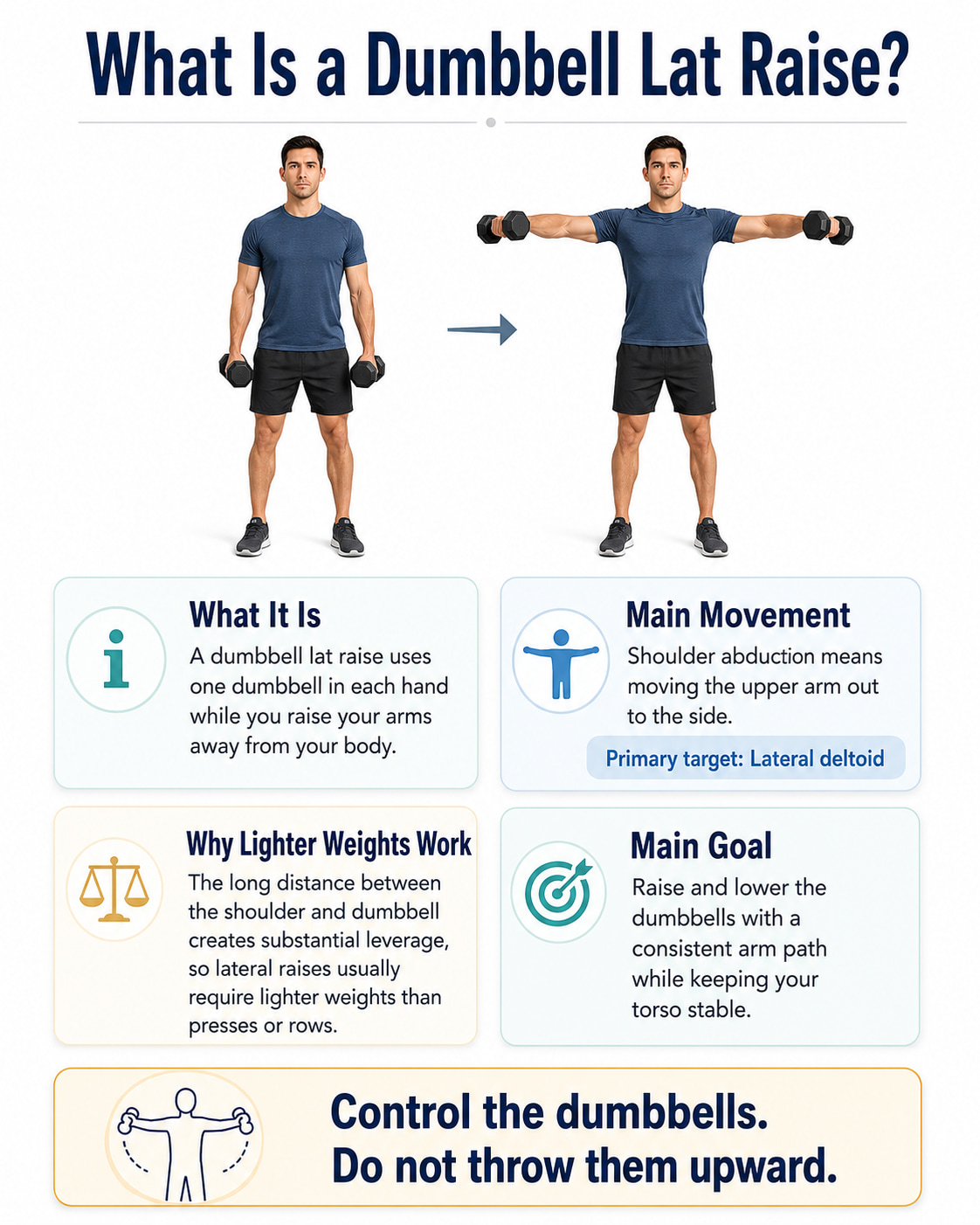
A dumbbell lat raise is performed by holding one dumbbell in each hand and raising the arms away from the body.
The main joint action is shoulder abduction, which means moving the upper arm out to the side. The lateral portion of the deltoid produces much of this movement, while several smaller shoulder and shoulder-blade muscles assist and stabilize the joint.
Although the exercise looks simple, the long distance between the shoulder and the dumbbell creates substantial leverage. That is why most people need much lighter weights for lateral raises than they use for presses or rows.
The goal is not to throw the dumbbells as high as possible. The goal is to raise and lower them with a consistent arm path while keeping the torso stable.
Dumbbell Lat Raise Muscles Worked
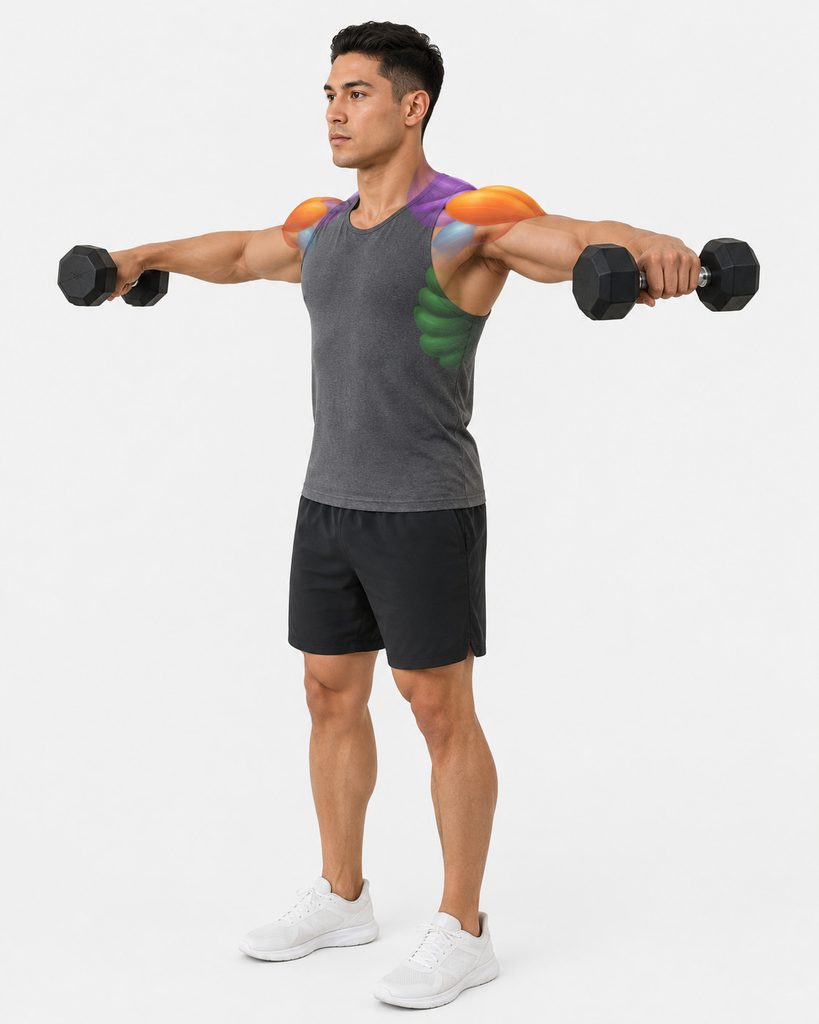
1. Lateral Deltoid
The lateral deltoid—also called the middle or acromial deltoid—is the primary target.
It covers the outer portion of the shoulder and helps lift the arm away from the body. The NCBI Bookshelf overview of shoulder mechanics identifies the middle deltoid as an important contributor to shoulder abduction between approximately 15 and 90 degrees.
You will usually feel the exercise most clearly around the outer shoulder.
2. Supraspinatus and Rotator Cuff
The supraspinatus is one of the four rotator-cuff muscles. It helps begin shoulder abduction before the deltoid becomes the main contributor.
The other rotator-cuff muscles help keep the upper-arm bone controlled within the shoulder joint as the arm moves.
These muscles assist the exercise, but the dumbbell lateral raise should not be described as a complete rotator-cuff exercise.
3. Trapezius and Serratus Anterior
The trapezius and serratus anterior help control the shoulder blades as the arms rise.
Some upper-trapezius activity is normal. The shoulder blades are not supposed to remain completely motionless during arm elevation.
The problem occurs when every repetition begins with an exaggerated shrug, the shoulders move toward the ears, and the intended arm movement becomes secondary.
4. Supporting Muscles
Your forearms and hands hold the dumbbells, while the abdominal, oblique, and back muscles stabilize your torso.
These supporting muscles should prevent unnecessary movement rather than generate momentum.
How to Do a Dumbbell Lat Raise
Best for: Adding focused lateral-deltoid work to a shoulder or upper-body workout.
Sets, reps, and rest: Begin with 2–3 sets of 12–15 repetitions. Rest for approximately 60–90 seconds between sets.
Step-by-Step Instructions
- Choose light dumbbells. Use a load you can control without swinging or leaning backward.
- Stand in a stable position. Place your feet approximately hip- to shoulder-width apart. Keep your knees softly bent rather than locked.
- Set the starting position. Hold the dumbbells beside the outer thighs with your palms facing your body. Keep your wrists straight and your elbows softly bent.
- Brace your torso. Keep your ribs controlled, spine neutral, and head aligned naturally over your shoulders.
- Raise your upper arms. Lift the dumbbells out and slightly forward. Lead the movement with your elbows while allowing your hands to follow.
- Stop around shoulder height. At the top, your upper arms should be approximately parallel to the floor or slightly lower. Keep the elbows softly bent and the wrists neutral.
- Lower under control. Take approximately two seconds to return the dumbbells to your sides. Do not allow them to drop.
- Reset before the next repetition. Maintain the same posture, elbow angle, and arm path throughout the set.
Coaching cue: Lead with your elbows and keep the dumbbells quiet.
Correct Arm Path
Your arms do not have to travel directly sideways in a perfectly straight line.
A slightly forward arm path may feel smoother for many shoulders. However, the dumbbells should not drift so far forward that the movement becomes a front raise.
Use the arm path that allows you to:
- Keep your wrists neutral
- Avoid shoulder pinching
- Maintain a stable torso
- Raise both sides through a similar comfortable range
- Control the lowering phase
Correct Hand Position
Begin with a neutral grip, meaning your palms face your thighs.
As the dumbbells rise, allow the palms to face mostly toward the floor. Keep the thumbs neutral or slightly higher than the little fingers if that position feels more comfortable.
Avoid deliberately rotating the thumbs sharply downward as though pouring water from a container.
A small electromyography study of 10 competitive bodybuilders found that changing humeral rotation altered the activity of the deltoids, upper trapezius, and other muscles. Neutral lateral raises produced high middle-deltoid activity, while internal rotation increased upper-trapezius, posterior-deltoid, and triceps activity. The study measured short-term muscle activation, so it does not prove that one position produces greater long-term muscle growth. Read the study through PubMed.
How High Should You Raise the Dumbbells?
Shoulder height is a practical endpoint for the standard dumbbell lateral raise.
You may need to stop slightly below shoulder height if raising higher causes you to:
- Shrug aggressively
- Lean backward
- Arch your lower back
- Push your head forward
- Bend your elbows more
- Lose wrist position
- Experience shoulder discomfort
NASM recommends shortening the lateral-raise range when posture begins to deteriorate, including when the shoulders move forward, the head shifts, or the lower back arches. Review NASM’s exercise regression guidance.
Raising above shoulder height is not automatically unsafe for every healthy person, but it is unnecessary for the standard variation. Do not force extra range when you cannot control it.
How Many Dumbbell Lat Raise Reps Should You Do?
The best repetition range depends on your experience, load, training goal, and total shoulder workload.
Because the dumbbell lat raise uses a long lever and relatively light weights, moderate-to-high repetitions usually make it easier to challenge the deltoids without relying on excessive momentum.
| Goal | Sets | Reps | Rest | Effort |
|---|---|---|---|---|
| Learn the movement | 2 | 12–15 | 60–90 seconds | Stop with 3–4 reps possible |
| General muscle building | 3–4 | 10–20 | 60–120 seconds | Stop with 1–3 reps possible |
| Upper-body accessory work | 2–3 | 12–20 | 60–90 seconds | Stop with 2–3 reps possible |
These are practical starting ranges rather than mandatory rules.
The 2026 American College of Sports Medicine resistance-training guidance emphasizes consistency, individualization, appropriate effort, and goal-specific training volume. It also notes that reaching momentary muscular failure is not consistently necessary for the average healthy adult.
Should You Train to Failure?
You do not need to take every lateral-raise set to complete failure.
Most sets can end when you believe you could perform another one to three controlled repetitions. This is often called leaving one to three repetitions in reserve.
End the set when continuing would require you to:
- Swing the dumbbells
- Shorten the range significantly
- Shrug toward your ears
- Lean backward
- Change your elbow angle
- Drop the weights during the lowering phase
Occasionally reaching the end of your controlled repetition capacity can be useful, but poor-quality repetitions should not be counted as productive progress.
How to Choose the Right Dumbbell Weight
Start lighter than you think you need.
A suitable weight should allow you to complete at least 10 controlled repetitions while maintaining the same posture and arm path from the first repetition to the last.
The weight is appropriate when you can:
- Raise both arms without using leg drive
- Keep your torso nearly motionless
- Maintain a consistent elbow bend
- Reach a comfortable height
- Keep your wrists straight
- Lower the dumbbells slowly
- Finish with approximately 1–3 good repetitions possible
The weight is probably too heavy when you:
- Bounce through the knees
- Swing the hips
- Lean backward
- Turn the raise into a shrug
- Bend the elbows increasingly
- Cannot reach 10 controlled repetitions
- Drop the dumbbells quickly
Simple Weight-Selection Test
- Select a light pair of dumbbells.
- Perform 12 controlled repetitions.
- Check whether your final two or three repetitions are challenging without changing your form.
- Reduce the load if you must swing or shrug.
- Increase the load slightly if you could easily complete more than 20 repetitions.
Small weight increases work best. Moving from a 5-pound dumbbell to a 10-pound dumbbell doubles the load, which may be too large a jump for this exercise.
Benefits of Dumbbell Lat Raises
Provide Focused Lateral-Deltoid Training
Shoulder presses train the deltoids, but they also depend on the triceps and other supporting muscles.
The lateral raise gives the lateral deltoid a more direct role by making shoulder abduction the main movement.
Complement Pressing Exercises
Presses often place substantial demand on the front portion of the shoulder.
Adding lateral raises can provide focused work through a different arm path without requiring another heavy pressing exercise.
The movement should complement presses, rows, and rear-deltoid exercises rather than replace them.
Require Minimal Equipment
You need only a pair of dumbbells and enough space to raise your arms.
The exercise can be performed in a gym, at home, or while traveling when suitable dumbbells are available.
Allow Simple Progression
You can progress lateral raises by:
- Adding controlled repetitions
- Increasing the weight slightly
- Adding one set
- Slowing the lowering phase
- Pausing briefly near the top
- Using one arm at a time
Progress one variable at a time so you can identify what is improving.
Make Side-to-Side Differences Easier to Notice
Each arm controls its own dumbbell.
This makes it easier to notice when one arm rises faster, travels through a different path, or reaches a different comfortable height.
Small natural differences are common. Use a weight that allows both sides to perform controlled repetitions rather than forcing one shoulder to copy the other exactly.
Common Dumbbell Lat Raise Mistakes
1. Using Too Much Weight
Excessive weight is the most common reason lateral raises become uncontrolled.
The long arm position makes even light dumbbells challenging. Reduce the weight when you cannot raise and lower it without swinging.
2. Swinging the Hips or Legs
Bouncing through the knees and driving the hips forward can move heavier dumbbells, but it reduces the amount of controlled shoulder work.
Keep your knees softly bent and your torso stable. A split stance can provide additional balance when needed.
3. Leaning Backward
Leaning backward often occurs when the dumbbells are too heavy or the lifter is trying to raise them too high.
Keep your ribs positioned over your pelvis. End the set or reduce the weight when you cannot maintain this position.
4. Shrugging Toward the Ears
The trapezius normally assists arm elevation, so feeling some trap activity does not mean the exercise is wrong.
However, an exaggerated shrug should not begin every repetition. Use less weight, keep your neck relaxed, and stop at a slightly lower height if necessary.
5. Changing the Elbow Bend
Bending the elbows more as the dumbbells rise shortens the lever and makes the repetition easier.
A small elbow bend is appropriate, but it should remain almost unchanged throughout the repetition.
6. Turning the Thumbs Sharply Downward
You do not need to imitate a pouring motion to train the lateral deltoid.
Keep the hands neutral or allow the thumbs to remain slightly higher than the little fingers. This usually creates a simpler, more comfortable shoulder position.
7. Turning the Exercise Into a Front Raise
Allowing the dumbbells to travel slightly forward is acceptable. Raising them far in front of the torso shifts the movement toward a front raise.
Keep the elbows moving primarily outward rather than straight forward.
8. Forcing the Dumbbells Too High
Do not chase a higher endpoint when it causes shrugging, leaning, or lower-back arching.
Shoulder height or slightly below is sufficient for the standard version.
9. Dropping the Dumbbells
Letting gravity pull the dumbbells quickly to your sides removes control from the lowering phase.
Use a weight you can lower smoothly for approximately two seconds.
10. Performing Repetitions Too Quickly
Fast repetitions make it easier to use momentum and harder to notice changes in form.
Raise the dumbbells smoothly, pause only if you can maintain position, and lower them under control.
Dumbbell Lat Raise Regressions
Lighter Dumbbell Lateral Raise
Use the lightest available dumbbells and focus on consistent technique.
This is the simplest regression and is usually the best starting point.
Bent-Arm Lateral Raise
Bend the elbows to approximately 90 degrees and keep that angle fixed.
Shortening the lever can make the movement easier even when the dumbbell weight remains the same.
Partial-Range Lateral Raise
Raise the dumbbells only to mid-rib or chest level.
Gradually increase the height as long as you can maintain control and the movement remains comfortable.
Supported Single-Arm Lateral Raise
Hold a stable support with one hand and perform the raise with the other.
The support can reduce balance demands and help you focus on one shoulder at a time.
Seated Dumbbell Lateral Raise
Sit on a stable bench with your feet firmly planted.
The seated position reduces assistance from the legs, although you may need lighter dumbbells because it is harder to generate momentum.
Dumbbell Lat Raise Progressions and Variations
Double Progression
Choose a repetition range such as 10–15.
Keep the same weight until you can perform 15 controlled repetitions on every set. Then increase to the smallest available dumbbell and begin near the lower end of the range again.
Paused Lateral Raise
Pause for approximately one second near the top without shrugging or losing wrist position.
A pause can improve awareness and reduce momentum, but you may need lighter dumbbells.
Slow-Eccentric Lateral Raise
Raise the dumbbells normally and lower them over approximately three seconds.
Use the slower lowering phase as a control challenge rather than making every repetition unnecessarily slow.
Single-Arm Dumbbell Lateral Raise
Train one arm at a time while the other arm rests.
This variation makes it easier to concentrate on the arm path and compare control between sides.
Cable Lateral Raise
A low cable provides a different resistance profile because it can maintain resistance near the beginning of the movement.
A 2025 study involving 24 resistance-trained men and women compared matched dumbbell and cable lateral raises for eight weeks. Both variations produced similar increases in measured lateral-deltoid muscle thickness. The study was short and used trained participants, so it does not prove that the two exercises are identical for everyone. Read the study in Frontiers in Physiology.
Choose between dumbbells and cables based on equipment access, comfort, and which variation you can perform consistently.
How to Use Dumbbell Lat Raises in a Workout
Lateral raises usually work best as an accessory exercise after heavier upper-body movements.
A practical order is:
- Compound pressing or pulling exercise
- Secondary upper-body exercise
- Dumbbell lateral raise
- Other smaller accessory exercises
Performing lateral raises before pressing is also possible when the lateral deltoids are your main priority. However, tiring the shoulders first may reduce the weight or repetitions you can use during presses.
Beginner Dumbbell Lat Raise Plan
- Frequency: 1–2 times per week
- Warm-up: 1–2 practice sets with no weight or very light dumbbells
- Working sets: 2 sets
- Repetitions: 12–15
- Rest: 75–90 seconds
- Effort: Finish with approximately 3 controlled repetitions possible
After you can complete both sets comfortably with consistent form, progress to three working sets.
Muscle-Building Dumbbell Lat Raise Plan
- Frequency: 1–2 times per week
- Working sets: 3 sets
- Repetitions: 10–20
- Rest: 60–120 seconds
- Effort: Finish with 1–3 controlled repetitions possible
When you reach 20 repetitions on every set without swinging or shrugging, increase the dumbbells by the smallest available amount and return closer to 10–12 repetitions.
Remember that presses and other shoulder exercises also contribute to your total weekly shoulder workload. More lateral-raise sets are not automatically better.
Dumbbell Lat Raise Safety Tips
Use a load and range of motion that you can control.
Do not force your arms to shoulder height when a lower position is more comfortable and stable. Both shoulders may not move through exactly the same range.
Stop the exercise if it causes sharp pain, numbness, dizziness, chest pain, or other unusual symptoms. Persistent or worsening shoulder discomfort should be assessed by a qualified health professional.
Frequently Asked Questions
Is a dumbbell lat raise the same as a dumbbell lateral raise?
Yes. “Dumbbell lat raise” is commonly used as a shortened name for the dumbbell lateral raise.
However, the standard and clearer exercise name is dumbbell lateral raise.
Do dumbbell lat raises work the lats?
No. The exercise primarily trains the lateral deltoid in the shoulder.
The latissimus dorsi muscles perform different actions, including pulling the upper arm downward and toward the torso. Exercises such as pulldowns and rows are more appropriate for direct lat training.
Should your arms be completely straight?
No. Maintain a small, comfortable bend in the elbows.
The important point is keeping that bend consistent rather than bending the elbows more as the dumbbells rise.
Should you raise the dumbbells above shoulder height?
You generally do not need to raise them above shoulder height for the standard lateral raise.
Stop slightly lower when reaching shoulder height causes shrugging, leaning, arching, or discomfort.
Why do I feel dumbbell lateral raises in my traps?
The trapezius helps control the shoulder blades during arm elevation, so some trap involvement is normal.
If the traps dominate the movement, use lighter dumbbells, keep your neck relaxed, and stop at a lower height.
How heavy should dumbbell lat raises be?
Use a weight that allows approximately 10–20 controlled repetitions without swinging, leaning backward, shrugging excessively, or dropping the dumbbells.
The correct load is often lighter than expected.
Are cable or dumbbell lateral raises better?
Both can train the lateral deltoid effectively.
Dumbbells are simple and widely available. Cables provide resistance through a different portion of the movement. Choose the version that feels comfortable, matches your equipment, and allows consistent progression.
Conclusion
The dumbbell lat raise is most effective when you use a manageable weight, lead with the elbows, maintain neutral wrists, and stop around a comfortable shoulder-height position.
Begin with 2–3 sets of 12–15 controlled repetitions. Add repetitions before increasing the weight, and end the set when maintaining good technique is no longer possible.
References
- American Council on Exercise: Lateral Raise Exercise Guide
- NCBI Bookshelf: Anatomy of the Glenohumeral Joint
- NCBI Bookshelf: Anatomy of the Deltoid Muscle
- American College of Sports Medicine: 2026 Resistance-Training Guidelines
- PubMed: Electromyographic Analysis of Lateral Raise Variations
- NASM: Exercise Progressions and Regressions
- Frontiers in Physiology: Dumbbell Versus Cable Lateral Raises
This content is for informational purposes only and is not a substitute for medical advice.