Neck exercises for vertigo may help accompanying neck stiffness, but ordinary neck stretches are not a general treatment for vertigo. The right approach depends on what is causing the dizziness—not simply on whether moving your head brings it on.
This guide explains when gentle neck movement may be appropriate, how to perform three basic mobility exercises, and when a different type of assessment or exercise program is needed.
Can Neck Exercises for Vertigo Actually Help?
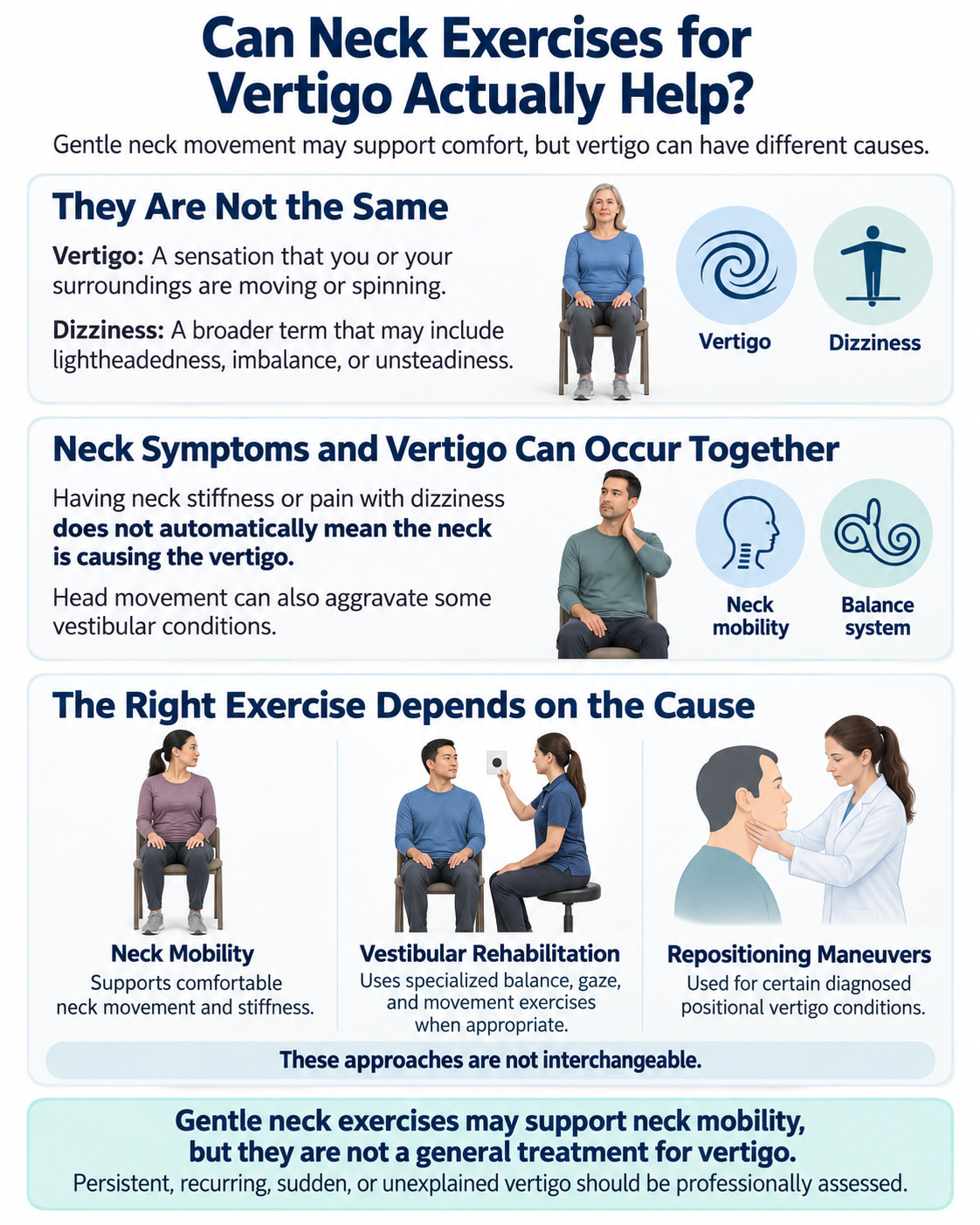
Vertigo is a sensation that you or your surroundings are moving, often described as spinning. Dizziness is a broader term that can also include lightheadedness or unsteadiness. These symptoms do not all have the same cause.
Neck pain and dizziness can occur together, but that does not prove the neck is responsible. The Bárány Society found insufficient evidence for a clear mechanistic link between neck problems and vertigo. Head movement can also aggravate underlying vestibular conditions.
The useful distinction is this: neck mobility addresses comfortable neck movement; vestibular rehabilitation and repositioning maneuvers address specific balance-related problems. These approaches are not interchangeable.
Before You Try Neck Exercises
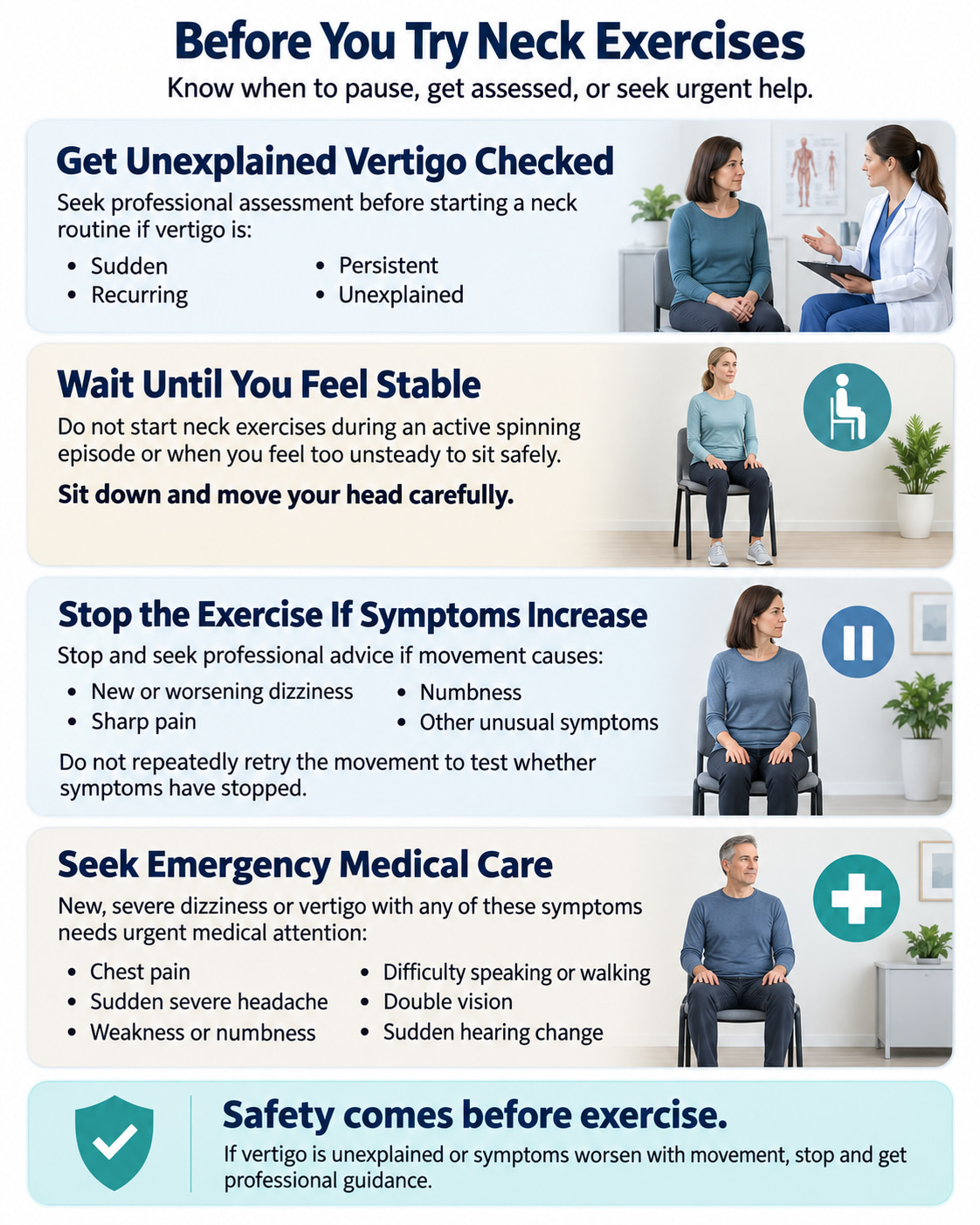
Have unexplained, recurring, sudden, or persistent vertigo assessed before starting a self-directed neck routine. Mayo Clinic recommends medical evaluation for these patterns of dizziness.
Do not start the exercises below during an active spinning episode or when you feel too unsteady to sit safely. The NHS advises sitting down when dizziness occurs and moving the head carefully during daily activities.
For these general neck-mobility drills, stop and seek professional advice if movement causes new or worsening dizziness, sharp pain, numbness, or other unusual symptoms. Do not repeatedly retry the movement to test whether the dizziness has gone away.
Seek emergency medical care for new, severe dizziness or vertigo with chest pain, a sudden severe headache, weakness or numbness, difficulty speaking or walking, double vision, or a sudden change in hearing.
3 Gentle Neck Movements to Discuss With Your Clinician
The following movements are options for accompanying neck stiffness after a healthcare professional confirms they are appropriate. They are not a treatment plan for unexplained vertigo.
Use a firm, stable chair without wheels, with your feet supported and enough room to move comfortably. No weights or resistance bands are needed.
1. Seated Chin Retraction
Best for: Practicing a small, controlled change in head position without bending the neck forward.
This movement appears in Cambridge University Hospitals neck exercise guidance. Think of a gentle backward glide—not a forceful chin tuck.
How to Do It
- Sit comfortably upright, with your shoulders relaxed and eyes looking ahead.
- Gently slide your head backward a small distance while keeping your chin approximately level.
- Pause comfortably without clenching your jaw or holding your breath.
- Release back to your natural starting position.
Common mistakes: Looking down, tipping the head backward, or pushing the chin with a hand.
Make it easier: Shorten the glide and omit the pause. The movement can be very small; do not chase a strong stretch.
2. Gentle Seated Neck Rotation
Best for: Practicing comfortable left-and-right turning.
The NHS seated exercise guidance includes neck rotation as a mobility and flexibility exercise. Here, the aim is an easy turning range rather than the largest possible movement.
How to Do It
- Begin with your head facing forward and your hands resting on your thighs.
- Slowly turn your head to the right while keeping your shoulders facing ahead.
- Stop within a comfortable range, without forcing your chin toward your shoulder.
- Return to the middle, pause, and repeat to the left.
Common mistakes: Twisting the whole torso, lifting the chin, or turning quickly.
Make it easier: Use a smaller turn. Do not force both sides to reach the same distance. If turning produces dizziness, stop rather than continuing with shorter repetitions.
3. Gentle Seated Side Bend
Best for: Practicing comfortable side-to-side neck movement without adding hand pressure.
NHS Dynamic Health includes side bending in its neck range-of-motion guidance. It involves tilting the head toward one shoulder rather than rotating the face toward it.
How to Do It
- Sit upright with your face pointing ahead and both shoulders relaxed.
- Gently tilt your right ear a short distance toward your right shoulder.
- Keep the shoulder down naturally; do not lift it to meet your ear.
- Return to the middle, then repeat on the left.
Common mistakes: Pulling on the head, leaning the torso sideways, or combining the tilt with a backward neck bend.
Make it easier: Reduce the tilt and return immediately instead of holding. A mild sense of lengthening may be enough; a deep stretch is unnecessary.
A Simple Neck-Mobility Practice Plan
Once your clinician approves the movements, the following is a conservative example of how to organize them—not a validated exercise dose for vertigo. Use only the exercises that are suitable for you; completing all three is not necessary.
| Exercise | Example starting amount |
|---|---|
| Seated chin retraction | 1 set of 2–3 gentle repetitions |
| Gentle seated neck rotation | 1 set of 2 repetitions per side |
| Gentle seated side bend | 1 set of 2 repetitions per side |
Pace and effort: Move slowly, breathe normally, and stay within an easy range. These are low-load mobility drills, not a demanding neck-strength workout.
Rest: An example is 30–60 seconds between exercises, or longer as needed. Rest is not permission to resume after dizziness or other concerning symptoms; stop the session and seek advice in that situation.
Frequency: Ask your clinician whether one brief daily session is appropriate. Follow their schedule rather than automatically adding several sessions a day.
How to Progress Without Forcing It
Progression should match your clinician’s plan. When movement remains comfortable during and after practice, discuss whether to add a repetition or slightly increase the range—not both at once.
For this routine, keep turning and side bending separate. Do not add forceful neck circles, hand-assisted stretching, rapid movements, or resistance as a way to make the exercises “work better.” General neck guidance emphasizes comfortable movement and modifying exercises when needed.
When a Different Approach Is Needed
Vestibular Rehabilitation Is More Than Neck Exercise
Vestibular rehabilitation is an individualized program for particular balance-system problems. Depending on the findings, it may include exercises for keeping vision steady during head movement, balance, walking, and tolerance of movement.
The American Physical Therapy Association strongly supports supervised vestibular rehabilitation for adults with diagnosed peripheral vestibular hypofunction—reduced function in the inner-ear balance system. Its recommendations should not be applied to every unexplained dizzy spell.
Some prescribed vestibular exercises deliberately produce mild, controlled dizziness. That is different from pushing through symptoms during an ordinary neck stretch. Your therapist should explain the intended response, acceptable symptom limits, and when to stop.
The Epley Maneuver Is Not a Neck Stretch
Benign paroxysmal positional vertigo, or BPPV, involves displaced calcium crystals in the inner ear. An appropriate repositioning maneuver uses a specific sequence of head and body positions; it does not work by stretching tight neck muscles.
The American Academy of Otolaryngology–Head and Neck Surgery Foundation recommends an appropriate canalith repositioning procedure for posterior-canal BPPV.
According to Johns Hopkins Medicine, home Epley use should follow an assessment supporting BPPV and instruction about the affected side. Neck or back disease and certain other conditions can make it unsuitable without professional guidance. Do not choose a maneuver solely because turning your head makes you dizzy.
What Does Research Say About Neck Exercise and Dizziness?
A 2023 randomized controlled trial published in Frontiers in Neurology enrolled 32 adults assessed as having non-traumatic cervicogenic dizziness. The home program combined neck muscle training, mobility, and eye-movement exercises.
After two weeks, participants in the exercise group reported better dizziness-related and neck-disability scores. However, the groups did not differ significantly in neck pain, neck range of motion, or the measured balance outcome. The study also had limitations, including short follow-up and a lack of standard diagnostic criteria.
This suggests a possible role for a combined, individualized program in selected patients. It does not establish that any single neck stretch treats vertigo—or that the three movements above will stop dizzy episodes.
Frequently Asked Questions
Can Chin Tucks Stop Vertigo?
Chin retraction is a neck-positioning exercise, not an established stand-alone treatment for vertigo. The small trial discussed above tested several types of exercise together, so its findings cannot show that chin tucks alone reduce dizziness.
Why Do I Feel Dizzy When I Turn My Head or Look Up?
Some vestibular conditions, including BPPV, can be triggered or aggravated by head-position changes. That pattern does not prove a neck-muscle problem. Describe the trigger to your clinician rather than repeatedly provoking it yourself.
Should I Stretch My Neck During a Vertigo Episode?
Do not start this routine during an active episode. Sit somewhere safe and avoid forceful neck movement. A previously prescribed vestibular program may have different instructions, but those instructions should come from the professional managing your condition.
How Long Should Neck Exercises Take to Help?
There is no reliable universal timeline for neck exercises to improve vertigo. Improvement in neck comfort does not necessarily mean the cause of dizziness has been addressed. Persistent or recurring symptoms need follow-up rather than simply more repetitions.
The Bottom Line
Gentle neck movement can have a place in a plan for accompanying stiffness, but neck exercises for vertigo should not replace assessment of the dizziness itself. Start by establishing which movements are appropriate, practice them without forcing the range, and stop if they provoke concerning symptoms.
Bring this short exercise list to your clinician or vestibular physical therapist and ask which, if any, belong in your plan.
This content is for informational purposes only and is not a substitute for medical advice.
References
- Bárány Society — The Bárány Society Position on “Cervical Dizziness”
- Piromchai et al. — The Efficacy of Self-Exercise in a Patient With Cervicogenic Dizziness: A Randomized Controlled Trial
- American Physical Therapy Association — Vestibular Rehabilitation for Peripheral Vestibular Hypofunction
- American Academy of Otolaryngology–Head and Neck Surgery — BPPV Clinical Practice Guideline
- Cambridge University Hospitals — Neck Exercises and Advice
- Johns Hopkins Medicine — Home Epley Maneuver