The dumbbell wrist curl is a beginner-friendly forearm exercise that strengthens the muscles responsible for bending the wrist toward the palm. Proper form requires a light, controllable weight, supported forearms, a secure grip, and movement that comes only from the wrists.
This guide covers the standard palms-up dumbbell wrist curl. You will learn which muscles it trains, how to perform it correctly, how much weight to use, common mistakes to avoid, and how to add it to a balanced forearm workout.
What Is a Dumbbell Wrist Curl?
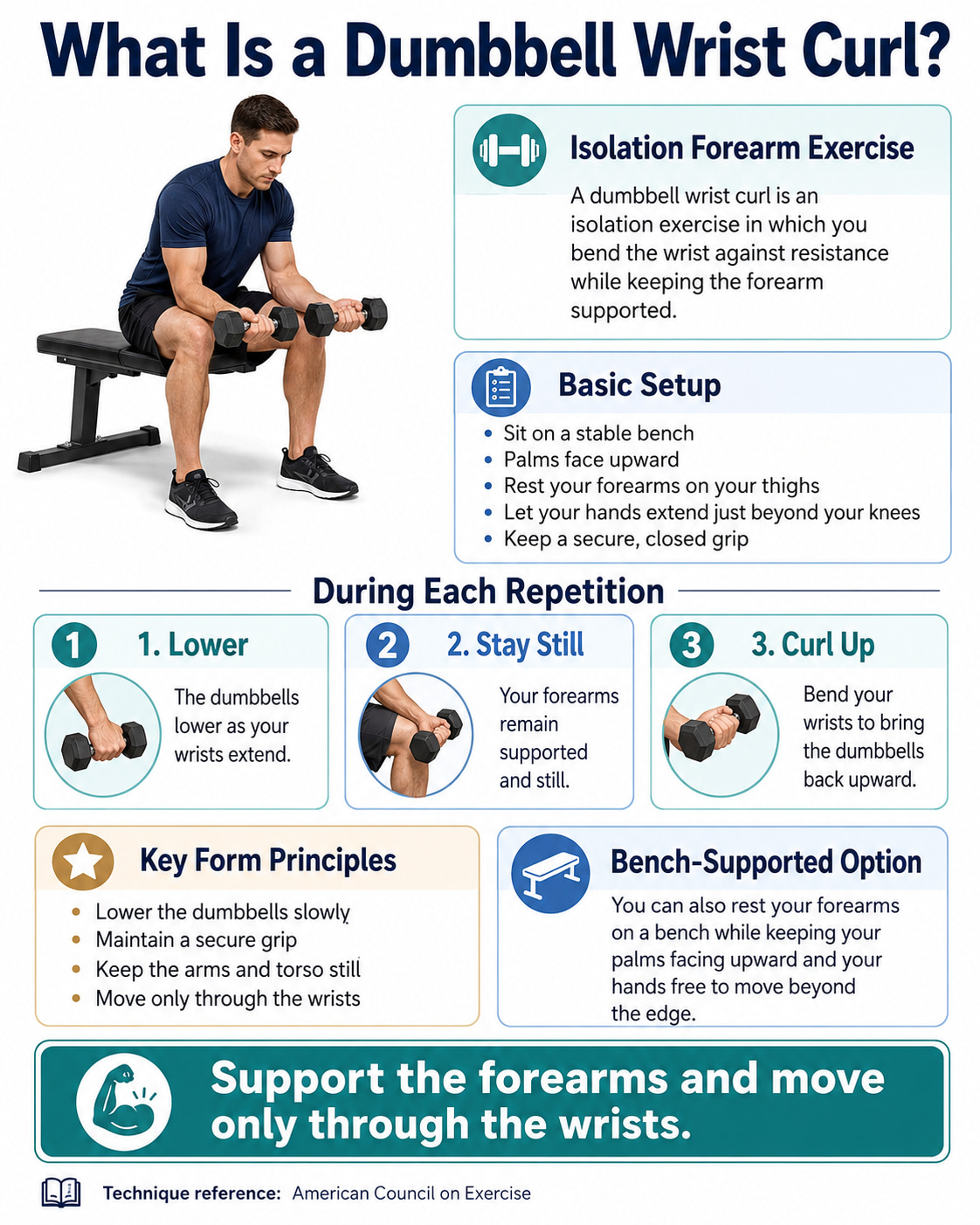
A dumbbell wrist curl is an isolation exercise in which you bend the wrist against resistance while keeping the forearm supported.
You normally perform it seated with your palms facing upward and your forearms resting on your thighs. Your hands extend just beyond your knees so the wrists can move freely.
During each repetition:
- The dumbbells lower as your wrists extend.
- Your forearms remain still.
- You bend your wrists to bring the dumbbells back upward.
The American Council on Exercise wrist-curl demonstration uses a bench-supported position with the palms facing upward. ACE recommends lowering the dumbbells slowly, maintaining a secure grip, and avoiding movement through the arms or torso.
This guide uses a seated, thigh-supported setup because it requires little equipment. A bench-supported version follows the same main principle: support the forearms and move only through the wrists.
Dumbbell Wrist Curl Muscles Worked

The dumbbell wrist curl primarily trains the muscles on the palm side of the forearm.
1. Flexor Carpi Radialis
The flexor carpi radialis helps bend the wrist toward the palm. It also assists with moving the hand slightly toward the thumb side.
It is one of the major superficial muscles in the forearm’s flexor compartment.
2. Flexor Carpi Ulnaris
The flexor carpi ulnaris also produces wrist flexion. It assists with moving the hand toward the little-finger side.
The NCBI Bookshelf review of the flexor carpi ulnaris describes it as a powerful wrist flexor.
The flexor carpi radialis and flexor carpi ulnaris work together during a controlled wrist curl. Their opposing side-to-side actions help keep the hand moving in a relatively centered path rather than bending sharply toward either side.
3. Finger and Thumb Flexors
The muscles that close the fingers around the dumbbell also work throughout the exercise. They maintain your grip and keep the handle from rolling out of your hand.
These muscles contribute to the exercise, but the main visible movement should still occur at the wrist.
4. Wrist Extensors
The muscles on the back of the forearm are not the primary movers during a palms-up wrist curl. However, they may help stabilize the wrist and control its position.
The forearm contains separate flexor and extensor compartments. The anterior compartment primarily flexes the wrist and fingers, while the posterior compartment primarily extends them, according to an NCBI Bookshelf overview of the forearm compartments.
How to Do a Dumbbell Wrist Curl With Proper Form
Seated Dumbbell Wrist Curl
Equipment needed: One or two light dumbbells and a stable chair or bench.
Sets, reps, and rest: Begin with 2–3 sets of 10–15 repetitions. Rest for 45–75 seconds between sets.
How to Do It
- Sit near the front of a stable bench or chair with your feet flat on the floor.
- Hold one dumbbell in each hand with your palms facing upward. Wrap your fingers and thumbs securely around the handles.
- Rest your forearms on your thighs. Position your hands just beyond your knees so the wrists can move without the dumbbells touching your legs.
- Begin with the wrists approximately neutral. Keep your elbows and forearms pressed gently into your thighs.
- Lower the dumbbells slowly by allowing your wrists to bend downward. Stop when you reach a comfortable stretch in the forearms.
- Curl the dumbbells upward by bending your wrists and bringing your knuckles toward your forearms.
- Pause briefly at the top without lifting your forearms or forcing the wrists into an extreme position.
- Lower the dumbbells under control and repeat.
Inhale while lowering the weights and exhale while curling them upward.
Coaching cue: Move your hands, not your forearms.
How Far Should Your Wrists Move?
Use the largest range you can control comfortably, but do not force the bottom or top position.
At the bottom, you may feel a mild stretch through the palm-side forearm muscles. At the top, you should feel the forearms contract without needing to lift your elbows or bend the wrists sideways.
Your available range may differ from another person’s because wrist structure, flexibility, injury history, and dumbbell size vary.
How to Choose the Right Dumbbell Weight
There is no universal starting weight for dumbbell wrist curls. The correct load depends on your current forearm strength, the size of the dumbbell increments available, and how well you can control the movement.
Start with one of the lightest dumbbells available and perform 10–15 repetitions.
The weight is appropriate when you can:
- Keep your forearms in contact with your thighs
- Maintain a secure, closed grip
- Lower the dumbbells slowly
- Use a comfortable range of motion
- Keep the hands aligned with the forearms
- Finish with approximately 2–3 good repetitions still possible
The dumbbells are probably too heavy when you must lift your elbows, shorten the range, bounce out of the bottom, open your hands, or move your torso to complete the set.
Because wrist curls use relatively small loads, moving to the next dumbbell can represent a large increase. When the next weight is too heavy, continue using the lighter weight and improve your repetitions, pauses, or lowering control before increasing the load.
Benefits of Dumbbell Wrist Curls
Provide Direct Wrist-Flexor Training
Rows, curls, carries, and deadlifts involve the forearms, but their main purpose is not isolated wrist flexion.
Dumbbell wrist curls allow you to train the wrist flexors directly without making the back, biceps, or lower body the main limiting factor.
Allow Each Wrist to Work Independently
Each hand controls its own dumbbell. This can make differences in strength, range, or coordination easier to notice.
Independent resistance does not automatically correct every imbalance, but it prevents one hand from directly assisting the other as it could with a single barbell.
Require Minimal Equipment
You need only one or two dumbbells and a stable place to sit. A separate wrist-curl machine or specialized forearm device is unnecessary.
This makes the exercise practical for home workouts, commercial gyms, and dumbbell-only training programs.
Can Complement Grip Training
The finger and thumb muscles must hold the dumbbells throughout the set. Wrist curls may therefore support some of the muscular qualities involved in gripping.
However, they should not be treated as complete grip training. Carries, rows, hangs, holds, and other exercises challenge the hands and forearms differently.
Are Easy to Add to a Workout
Wrist curls require little setup and usually take only a few minutes. They work well as an accessory exercise after your main upper-body movements.
Common Dumbbell Wrist Curl Mistakes
Using Too Much Weight
Heavy dumbbells often cause short, jerky repetitions. You may also lift your elbows or use your biceps to move the weights.
Reduce the load until you can control both the lifting and lowering phases.
Lifting the Forearms From the Thighs
The forearms should remain supported throughout the set. When they rise, the movement becomes a partial arm curl rather than an isolated wrist exercise.
Press the forearms gently into your thighs without creating unnecessary tension through the shoulders.
Rolling the Dumbbells Onto the Fingertips
Some advanced variations deliberately allow the dumbbells to roll toward the fingers. This guide does not recommend that method for beginners.
ACE warns that releasing the grip can increase the risk of losing control of the dumbbells or irritating the wrists. Keep your entire hand securely wrapped around each handle during both phases.
Dropping Quickly Into the Bottom Position
Do not let gravity pull the wrists suddenly downward. Rapid lowering places more stress on the bottom position and reduces muscular control.
Take approximately two seconds to lower each repetition.
Bending the Wrists Sideways
The hands should remain aligned with the forearms. Avoid allowing them to drift noticeably toward the thumbs or little fingers.
A lighter weight often makes a centered path easier to maintain.
Forcing the Range of Motion
More movement is not automatically better. Lower only until you reach a comfortable end range.
Do not push through pinching, sharp pain, or a strong pulling sensation around the wrist joint.
Performing the Exercise Too Early in the Workout
Fatiguing your forearms before rows, pull-ups, curls, or loaded carries may reduce your ability to hold the weights during those exercises.
Unless wrist curls are your main priority, perform them near the end of the workout.
Dumbbell Wrist Curl vs. Reverse Wrist Curl
A wrist curl and reverse wrist curl train different sides of the forearm.
| Feature | Dumbbell Wrist Curl | Dumbbell Reverse Wrist Curl |
|---|---|---|
| Palm position | Facing upward | Facing downward |
| Main action | Wrist flexion | Wrist extension |
| Primary emphasis | Palm-side forearm muscles | Back-of-forearm muscles |
| Typical loading | Usually slightly heavier | Usually lighter |
| Forearm position | Back of forearm supported | Palm-side forearm supported |
The ACE wrist-extension exercise guide demonstrates the reverse version with the palms facing downward and the forearm extensors lifting the weights.
The exercises are complementary rather than interchangeable. Including both can provide more complete direct forearm training than performing only the palms-up variation.
Beginner Modifications
Use One Dumbbell at a Time
Perform the exercise with one arm while using your free hand to support the working forearm.
This can make it easier to concentrate on wrist position and notice unwanted elbow movement.
Use a Shorter Range of Motion
Reduce the range if the bottom position feels uncomfortable. Gradually increase it only when you can do so without pain or loss of control.
A shorter comfortable range is better than forcing a deeper position.
Support the Forearms on a Bench
Kneel or sit behind a flat bench and rest your forearms across the pad. Allow only the hands to extend beyond the edge.
This setup may feel more stable than resting the forearms on the thighs.
Begin With One Dumbbell Held in Both Hands
Hold the ends of one light dumbbell with both hands and support both forearms on your thighs.
This variation reduces the total equipment required, although each wrist no longer works completely independently.
Dumbbell Wrist Curl Progressions
Add Repetitions
Begin at the lower end of the repetition range. Gradually work toward 15 controlled repetitions before increasing the weight.
Increase the Weight Gradually
Once you can complete every set at the top of the range with approximately 2–3 repetitions remaining, use the smallest available weight increase.
Return to the lower end of the repetition range after increasing the load.
Add a Controlled Pause
Pause for one second at the top of each repetition without squeezing into an extreme wrist position.
You can also pause briefly at the bottom to prevent bouncing.
Slow the Lowering Phase
Lower the dumbbells over three seconds while keeping the forearms completely still.
This increases the difficulty without requiring a heavier dumbbell.
Sets, Reps, Rest, and Frequency
A practical beginner starting point is:
- Sets: 2–3
- Repetitions: 10–15
- Rest: 45–75 seconds
- Frequency: 1–2 times per week
- Effort: Finish with approximately 2–3 controlled repetitions remaining
- Tempo: Lift in 1–2 seconds and lower in approximately 2 seconds
You do not need to reach muscular failure on every set. The 2026 American College of Sports Medicine resistance-training guidance emphasizes individualization, consistency, and suitable training volume. It also reports that momentary failure and other advanced techniques are not necessary for the average healthy adult.
Reduce the volume when your regular training already includes a large amount of rowing, climbing, carrying, racket sports, or other grip-intensive activity.
How to Add Dumbbell Wrist Curls to a Workout
Perform wrist curls after major exercises that depend on your grip.
Suitable workout placement includes:
- At the end of a back and biceps workout
- After a full-body dumbbell workout
- At the end of an arm workout
- As part of a short forearm accessory session
Avoid performing several hard forearm exercises every day. The wrists and gripping muscles need time to recover like other trained areas.
Beginner Forearm Accessory Routine
Perform this routine once or twice per week after your main workout.
1. Dumbbell Wrist Curl
- 2 sets of 10–15 repetitions
- Rest 45–60 seconds
- Stop with 2–3 repetitions remaining
2. Dumbbell Reverse Wrist Curl
- 2 sets of 12–15 repetitions
- Rest 45–60 seconds
- Use a lighter weight than you use for palms-up wrist curls
3. Dumbbell Suitcase Hold
- 2 sets of 20–30 seconds per side
- Rest 60 seconds
- Stand tall without leaning toward or away from the dumbbell
When you can complete the top of each range for two workouts with consistent form, add the smallest practical amount of weight.
Safety Considerations
A working or burning sensation in the forearm muscles can occur during a challenging set. Sharp, pinching, or increasing pain around the wrist is not a normal goal of the exercise.
The American Academy of Orthopaedic Surgeons’ safe-exercise guidance recommends resting when fatigue, significant soreness, or pain makes exercise inappropriate.
Stop the exercise and seek appropriate professional help if you experience:
- Sharp or persistent wrist pain
- Numbness or tingling in the hand or fingers
- Sudden weakness or loss of grip
- Significant swelling
- Dizziness
- Chest pain
- Any other unusual symptoms
Do not use wrist curls as a treatment for carpal tunnel syndrome, tendon problems, fractures, or another wrist condition unless a qualified healthcare professional has recommended the exercise for you.
Frequently Asked Questions
What muscles do dumbbell wrist curls work?
Dumbbell wrist curls primarily train the flexor carpi radialis and flexor carpi ulnaris. The finger and thumb flexors also help maintain your grip, while other forearm muscles stabilize the wrist.
How heavy should dumbbell wrist curls be?
Use a weight that allows at least 10 controlled repetitions without lifting the forearms, opening the hands, shortening the range, or bouncing.
Most beginners need considerably less weight for wrist curls than they use for biceps curls or rows.
Should I roll the dumbbells onto my fingertips?
Beginners should maintain a secure, closed grip throughout the repetition. Allowing the weights to roll toward the fingertips makes them more difficult to control and may increase the chance of dropping them.
Use separate grip exercises when finger strength is your main goal.
Do wrist curls improve grip strength?
They train wrist flexion and require you to hold the dumbbells, so they may support some components of gripping ability.
However, grip strength involves more than wrist flexion. Combine wrist curls with exercises such as loaded carries, rows, hangs, or static dumbbell holds for broader grip training.
Can dumbbell wrist curls make your forearms bigger?
They may help build the wrist-flexor portion of the forearms when performed consistently with progressive resistance and sufficient recovery.
They do not train every forearm muscle equally. Reverse wrist curls and grip-focused exercises can complement them.
How often should beginners perform wrist curls?
One or two sessions per week is a reasonable starting point. Allow additional recovery when your forearms are already receiving substantial work from pulling exercises, sports, or manual activities.
Why do my wrists hurt during wrist curls?
Possible training-related causes include using too much weight, dropping quickly into the bottom position, forcing the range, or allowing the wrists to bend sideways.
Stop rather than attempting to train through wrist-joint pain. Persistent pain, numbness, tingling, weakness, or swelling should be evaluated by a qualified healthcare professional.
Conclusion
The dumbbell wrist curl is most effective when you treat it as a small, controlled wrist movement rather than an exercise for lifting heavy weights.
Support your forearms, keep a secure full-hand grip, move through a comfortable range, and lower the dumbbells slowly. Begin with 2–3 sets of 10–15 repetitions and increase the weight only after you can complete every repetition without moving your forearms or losing wrist control.
References
- American Council on Exercise: Wrist Curl—Flexion
- American Council on Exercise: Wrist Curl—Extension
- NCBI Bookshelf: Forearm Flexor Carpi Ulnaris Muscle
- NCBI Bookshelf: Forearm Compartments
- American College of Sports Medicine: 2026 Resistance-Training Guidelines
- American Academy of Orthopaedic Surgeons: Safe Exercise
This content is for informational purposes only and is not a substitute for medical advice.