The best dumbbell bicep exercises combine a palms-up curl, a neutral-grip curl, and a supported or differently positioned curl. This gives your elbow flexors a varied training stimulus without filling one workout with several nearly identical movements.
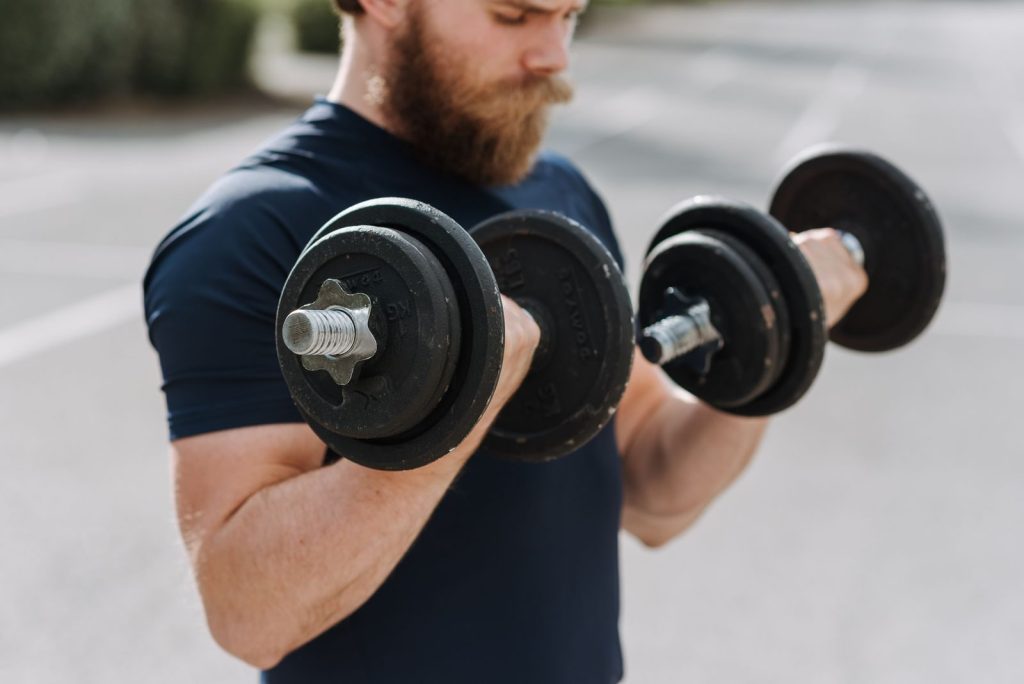
This guide explains how to perform each exercise, which muscles it works, common mistakes to avoid, and how to organize dumbbell bicep exercises into a practical routine.
Dumbbell Bicep Exercises at a Glance
You do not need to perform all 12 exercises in one workout. Use this table to quickly compare the options and choose two or three that fit your equipment, experience, and training goal.
| Exercise | Best for | Main muscles worked | Extra equipment |
|---|---|---|---|
| Standing Dumbbell Biceps Curl | Learning the basic curl pattern | Biceps, brachialis, forearms | None |
| Alternating Rotating Dumbbell Curl | Training each arm independently | Biceps, brachialis, forearms | None |
| Seated Dumbbell Biceps Curl | Reducing lower-body momentum | Biceps, brachialis | Bench or sturdy chair |
| Incline Dumbbell Curl | Training with the arms behind the torso | Biceps, brachialis | Adjustable bench |
| Single-Arm Dumbbell Preacher Curl | Supporting the upper arm | Biceps, brachialis | Preacher or incline bench |
| Dumbbell Spider Curl | Strict chest-supported curls | Biceps, brachialis | Incline bench |
| Concentration Curl | Controlled single-arm training | Biceps, brachialis | Bench or sturdy chair |
| Dumbbell Hammer Curl | Neutral-grip elbow-flexor training | Brachialis, brachioradialis, biceps | None |
| Cross-Body Hammer Curl | Unilateral neutral-grip curls | Brachialis, brachioradialis, biceps | None |
| Zottman Curl | Combining curls with forearm training | Biceps, brachialis, forearms | None |
| Dumbbell Reverse Curl | Pronated-grip elbow-flexor training | Brachioradialis, brachialis, biceps | None |
| Dumbbell Drag Curl | Using a different upper-arm path | Biceps, brachialis | None |
If you are new to biceps training, start with a standing or seated dumbbell curl plus a hammer curl. These two exercises give you a simple palms-up and neutral-grip combination without making the workout unnecessarily complicated.
General Dumbbell Curl Form
Each curl variation has a slightly different setup, but the same basic form principles apply to most of them:
- Set your posture. Stand or sit tall with your torso stable and your ribs controlled.
- Keep your wrists straight. Hold the dumbbells in line with your forearms rather than bending your wrists forward or backward.
- Start from a comfortable bottom position. Let your elbows extend naturally without forcing them into a hard lockout.
- Curl without swinging. Bend your elbows while keeping unnecessary hip and torso movement to a minimum.
- Keep your shoulders controlled. Do not push the shoulders forward or shrug just to lift the dumbbells higher.
- Lower the weight slowly. Control the dumbbells back to the starting position instead of letting them drop.
- End the set when your form breaks down. If you have to lean back, swing, or shorten the movement significantly, the set is effectively finished.
The American Council on Exercise hammer curl guide similarly emphasizes a stable torso, neutral wrists, controlled shoulders, and a controlled lowering phase.
Your natural arm and wrist structure may also affect where the dumbbells feel comfortable at the bottom. You do not need to force the weights tightly against your thighs if doing so bends your wrists.
With those basics in place, you can choose the curl variations that best fit your goals and equipment.
12 Best Dumbbell Bicep Exercises
The sets and repetitions below are practical starting points, not rigid requirements. Adjust the load and volume according to your experience, recovery, and other pulling exercises.
1. Standing Dumbbell Biceps Curl
Best for: Learning the foundational palms-up curl and building general biceps strength.
Muscles worked: Biceps brachii, brachialis, brachioradialis, and forearm muscles.
Equipment needed: Two dumbbells.
Sets, reps, and rest: Perform 2–4 sets of 6–12 repetitions. Rest 75–120 seconds.
How to Do It
- Stand with your feet approximately hip- to shoulder-width apart.
- Hold a dumbbell in each hand with your palms facing forward.
- Brace your torso and keep your shoulders relaxed.
- Bend your elbows and curl the dumbbells toward your shoulders.
- Pause briefly without pushing your elbows far forward.
- Lower the dumbbells until your arms are comfortably extended.
Common mistakes: Leaning backward, driving the hips forward, shrugging, bending the wrists, and dropping the weights quickly.
Regression or progression: Use one dumbbell at a time if both arms together make it difficult to stay stable. Progress by adding repetitions before increasing the weight.
2. Alternating Rotating Dumbbell Curl
Best for: Training one arm at a time while actively rotating the forearm into a palms-up position.
Muscles worked: Biceps brachii, brachialis, brachioradialis, and forearm muscles.
Equipment needed: Two dumbbells.
Sets, reps, and rest: Perform 2–3 sets of 8–12 repetitions per arm. Rest 60–90 seconds.
How to Do It
- Stand with the dumbbells beside your thighs and your palms facing inward.
- Curl one dumbbell while gradually turning your palm upward.
- Finish with the palm facing your shoulder.
- Lower the weight slowly while rotating back to the neutral starting position.
- Repeat with the opposite arm.
Common mistakes: Twisting only at the wrist, leaning toward the working side, rushing between arms, or rotating the dumbbell after the curl is already finished.
Coaching cue: Turn the entire forearm, not just the hand.
3. Seated Dumbbell Biceps Curl
Best for: Reducing help from the legs and making the torso easier to stabilize.
Muscles worked: Biceps brachii, brachialis, brachioradialis, and forearms.
Equipment needed: Two dumbbells and a sturdy chair or bench.
Sets, reps, and rest: Perform 2–4 sets of 8–15 repetitions. Rest 60–90 seconds.
How to Do It
- Sit tall with your feet flat on the floor.
- Hold the dumbbells at your sides with your palms forward or facing inward.
- Keep your torso stable and curl the dumbbells toward your shoulders.
- Avoid lifting the shoulders as the weights rise.
- Lower the dumbbells under control until the elbows are comfortably extended.
Common mistakes: Sliding forward on the bench, arching the lower back, lifting the elbows excessively, and allowing the shoulders to round.
Progression or regression: Use a back-supported bench for more stability. Use an unsupported bench when you can maintain your posture without leaning.
4. Incline Dumbbell Curl
Best for: Training curls with the upper arms positioned behind the torso.
Muscles worked: Biceps brachii, brachialis, brachioradialis, and forearm muscles.
Equipment needed: Two dumbbells and an adjustable bench.
Sets, reps, and rest: Perform 2–3 sets of 8–15 repetitions. Rest 75–120 seconds.
How to Do It
- Set the bench to approximately 45–60 degrees.
- Sit back with your head, upper back, and hips supported.
- Allow your arms to hang naturally with your palms facing forward.
- Curl the dumbbells without bringing the upper arms far forward.
- Stop before the shoulders roll toward the ears.
- Lower the dumbbells slowly into a comfortable stretch.
Common mistakes: Setting the bench too low, moving the elbows forward to finish the rep, lifting the shoulders, or forcing an uncomfortable bottom position.
Regression or progression: Begin with a steeper bench angle or lighter dumbbells. Reduce the angle gradually only when your shoulders remain comfortable.
5. Single-Arm Dumbbell Preacher Curl
Best for: Supporting the upper arm and making body momentum more difficult to use.
Muscles worked: Biceps brachii, brachialis, and forearm muscles.
Equipment needed: One dumbbell and a preacher bench or adjustable incline bench.
Sets, reps, and rest: Perform 2–3 sets of 8–12 repetitions per arm. Rest 75–120 seconds.
How to Do It
- Position the back of your upper arm securely against the pad.
- Hold the dumbbell with your palm facing upward.
- Begin with the elbow nearly straight but not forcefully locked.
- Curl the weight while keeping your upper arm on the pad.
- Squeeze briefly at the top.
- Lower slowly without relaxing suddenly at the bottom.
Common mistakes: Lifting the upper arm off the pad, dropping into the bottom position, using too much weight, or shortening every repetition.
Safety note: The bottom can be demanding. Start lighter than you would for a standing curl.
6. Dumbbell Spider Curl
Best for: Strict chest-supported curls with the arms hanging in front of the torso.
Muscles worked: Biceps brachii, brachialis, brachioradialis, and forearms.
Equipment needed: Two dumbbells and an incline bench.
Sets, reps, and rest: Perform 2–3 sets of 10–15 repetitions. Rest 60–90 seconds.
How to Do It
- Set an incline bench to approximately 45 degrees.
- Lie chest-down with your feet securely supported.
- Let your arms hang toward the floor with your palms facing forward.
- Curl the dumbbells without lifting your chest from the bench.
- Keep the upper arms mostly vertical.
- Lower until the elbows are comfortably extended.
Common mistakes: Raising the elbows forward, shrugging, lifting the chest, swinging the dumbbells, and turning the movement into a short partial curl.
Regression or progression: Perform alternating repetitions if curling both dumbbells causes you to lose position.
7. Concentration Curl
Best for: Controlled single-arm training with minimal equipment.
Muscles worked: Biceps brachii, brachialis, brachioradialis, and forearms.
Equipment needed: One dumbbell and a bench or sturdy chair.
Sets, reps, and rest: Perform 2–3 sets of 10–15 repetitions per arm. Rest 45–75 seconds.
How to Do It
- Sit with your feet wider than hip-width apart.
- Hold one dumbbell and place the back of your upper arm against your inner thigh.
- Begin with the arm comfortably extended.
- Curl the dumbbell toward the shoulder without rotating your torso.
- Pause briefly at the top.
- Lower slowly before switching arms.
Common mistakes: Pressing the elbow sharply into the leg, twisting the torso, lifting the shoulder, or using a short range of motion.
Coaching cue: Keep your upper arm supported while your forearm moves.
8. Dumbbell Hammer Curl
Best for: Neutral-grip training and lifters who find a palms-up grip uncomfortable.
Muscles worked: Brachialis, brachioradialis, biceps brachii, and grip muscles.
Equipment needed: Two dumbbells.
Sets, reps, and rest: Perform 2–4 sets of 8–15 repetitions. Rest 60–90 seconds.
How to Do It
- Hold the dumbbells beside your thighs with your palms facing inward.
- Keep your thumbs pointing upward throughout the movement.
- Brace your torso and curl the weights toward the front of your shoulders.
- Keep the wrists straight and the elbows close to your sides.
- Lower the dumbbells slowly without rotating the palms.
Common mistakes: Bending the wrists, swinging heavy dumbbells, allowing the elbows to travel far forward, and shrugging at the top.
Progression or regression: Alternate arms to make the exercise easier to control. Progress to simultaneous hammer curls when you can remain stable.
9. Cross-Body Hammer Curl
Best for: Unilateral neutral-grip curls with a diagonal dumbbell path.
Muscles worked: Brachialis, brachioradialis, biceps brachii, and forearm muscles.
Equipment needed: Two dumbbells.
Sets, reps, and rest: Perform 2–3 sets of 10–15 repetitions per arm. Rest 60–90 seconds.
How to Do It
- Stand with a dumbbell in each hand and your palms facing your thighs.
- Curl one dumbbell diagonally toward the opposite side of your upper chest.
- Keep the elbow near your side rather than lifting it in front of you.
- Pause when the forearm approaches the upper arm.
- Lower slowly and repeat with the opposite side.
Common mistakes: Rotating the entire torso, lifting the working shoulder, swinging the dumbbell across the body, or allowing the wrist to collapse.
How to use it: Choose either standard or cross-body hammer curls in one workout. You rarely need both.
10. Zottman Curl
Best for: Combining a palms-up curl with a controlled palms-down lowering phase.
Muscles worked: Biceps brachii, brachialis, brachioradialis, wrist stabilizers, and forearm muscles.
Equipment needed: Two dumbbells.
Sets, reps, and rest: Perform 2–3 sets of 10–15 repetitions. Rest 60–90 seconds.
How to Do It
- Begin with the dumbbells at your sides and your palms facing forward.
- Curl both dumbbells toward your shoulders.
- At the top, rotate your forearms until your palms face downward.
- Lower the dumbbells slowly in the palms-down position.
- Rotate back to palms-up at the bottom before beginning the next repetition.
Common mistakes: Using the same load as a heavy standard curl, rotating too quickly, bending the wrists, and dropping through the lowering phase.
Regression or progression: Start with very light dumbbells. Increase the load only when the rotation and lowering phase remain controlled.
11. Dumbbell Reverse Curl
Best for: Adding a palms-down curl that challenges the elbow flexors and forearm muscles.
Muscles worked: Brachioradialis, brachialis, biceps brachii, and wrist-stabilizing muscles.
Equipment needed: Two dumbbells.
Sets, reps, and rest: Perform 2–3 sets of 10–15 repetitions. Rest 60–90 seconds.
How to Do It
- Hold the dumbbells with your palms facing backward.
- Keep your wrists straight and your knuckles pointing forward.
- Curl the dumbbells without allowing the elbows to flare outward.
- Stop before the wrists begin to bend.
- Lower slowly to the starting position.
Common mistakes: Letting the wrists drop, choosing a weight that is too heavy, lifting the elbows, and using hip momentum.
Safety note: Most people need significantly lighter weights than they use for regular or hammer curls.
12. Dumbbell Drag Curl
Best for: Using a different upper-arm path while keeping the dumbbells close to the torso.
Muscles worked: Biceps brachii, brachialis, brachioradialis, and forearms.
Equipment needed: Two dumbbells.
Sets, reps, and rest: Perform 2–3 sets of 8–12 repetitions. Rest 75–120 seconds.
How to Do It
- Stand with your palms facing forward and the dumbbells beside your thighs.
- Pull your elbows backward as you begin curling.
- Keep the dumbbells close to your torso as they rise.
- Finish around the lower chest or upper-abdominal area.
- Reverse the movement slowly and return the elbows to the starting position.
Common mistakes: Turning the movement into an upright row, shrugging the shoulders, leaning backward, or pulling the dumbbells too high.
Coaching cue: Slide the dumbbells upward instead of swinging them forward.
Unlike a standard curl, backward elbow movement is intentional during a drag curl. The goal is controlled movement, not keeping the elbows completely frozen.
What Muscles Do Dumbbell Bicep Exercises Work?
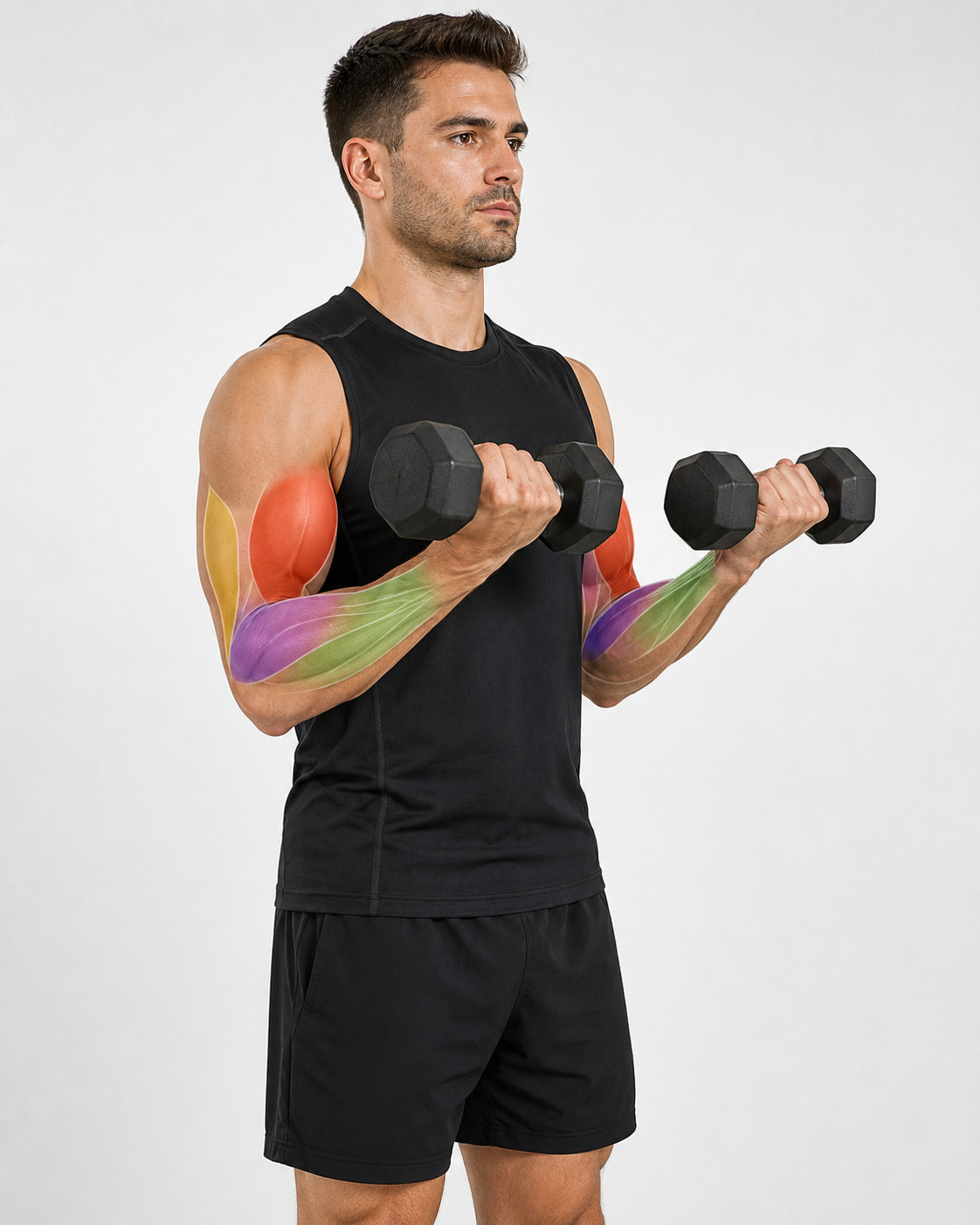
Dumbbell curls mainly train the muscles responsible for bending the elbow. Grip and upper-arm position can change how the exercise feels, but several muscles continue working together.
1. Biceps Brachii
The biceps brachii is the prominent muscle on the front of the upper arm. It has a long head and a short head.
Its main actions include:
- Bending the elbow
- Turning the palm upward
- Assisting with some shoulder movements
The palm-up position used during a traditional curl allows the biceps to contribute to both elbow flexion and forearm supination. The NCBI Bookshelf biceps anatomy review describes the biceps as an important forearm supinator as well as an elbow flexor.
2. Brachialis
The brachialis sits underneath the biceps and attaches to the upper arm and forearm. It bends the elbow but does not rotate the forearm.
Because it contributes to elbow flexion in different hand positions, the brachialis remains active during regular, hammer, and reverse curls. The NCBI Bookshelf brachialis review describes it as a strong elbow flexor that works throughout normal forearm positions.
3. Brachioradialis
The brachioradialis runs along the thumb side of the forearm and assists with elbow flexion. It works during palms-up, neutral, and palms-down curls, although neutral- and pronated-grip exercises are commonly used when lifters want more direct forearm involvement.
The NCBI Bookshelf brachioradialis review notes that the muscle contributes to elbow flexion across different forearm positions.
4. Forearm and Grip Muscles
Your forearm muscles stabilize the wrists and help you hold the dumbbells. Reverse curls, Zottman curls, and heavier hammer curls can make this demand especially noticeable.
Keep your wrists aligned with your forearms. Letting the wrists bend backward or curl forward can shift attention away from the intended elbow movement.
Can You Isolate the Long or Short Head of the Biceps?
You cannot completely isolate one biceps head while switching off the other. Both heads join into a common muscle and contribute to elbow flexion and forearm supination.
Changing grip, shoulder position, support, and resistance can alter the movement’s mechanics. An incline curl, for example, begins with the upper arm behind the torso, while a preacher curl places the arm in front of the body.
These are useful differences, but they do not prove that one exercise exclusively builds the “peak,” “inner biceps,” or “outer biceps.”
A 2026 controlled study published in Frontiers in Physiology found similar elbow-flexor growth from cable curls performed with the shoulder neutral or extended when effort, elbow range of motion, and resistance profiles were matched. Exercise comfort and your ability to progress may therefore matter more than chasing a supposedly perfect shoulder angle.
Benefits of Dumbbell Bicep Exercises
1. Provide Direct Elbow-Flexor Training
Rows, pulldowns, and chin-ups involve the biceps, but the back muscles and grip may become limiting factors. Dumbbell curls make elbow flexion the main movement.
A small eight-week study involving untrained men found greater elbow-flexor muscle-thickness gains from unilateral biceps curls than from unilateral dumbbell rows. The study was small, so it should not be treated as proof that rows are ineffective. It supports using direct curls when developing the elbow flexors is a specific goal.
2. Allow Each Arm to Work Independently
Dumbbells help prevent the stronger arm from taking over the entire movement. You can also begin unilateral exercises with the weaker side and match the same number of controlled repetitions with the stronger arm.
3. Offer Several Comfortable Grip Options
Palms-up, neutral, and palms-down grips let you choose positions that feel comfortable for your wrists and elbows.
No grip should be forced. If keeping the dumbbells tight against your sides bends your wrists, allow the weights to sit slightly farther away while maintaining wrist alignment.
4. Require Minimal Equipment
Many variations require only a pair of dumbbells. A chair or adjustable bench adds more options but is not necessary for a complete beginner workout.
5. Make Progress Easy to Track
You can progress by:
- Performing more controlled repetitions
- Increasing the dumbbell weight
- Adding a set
- Improving range of motion
- Reducing unnecessary momentum
- Performing the movement one arm at a time
How to Choose the Best Dumbbell Bicep Exercises
A complete workout does not need several versions of the same curl. Choose exercises that serve different purposes.
Choose One Foundational Curl
Good options include:
- Standing dumbbell curl
- Alternating rotating curl
- Seated dumbbell curl
These are useful for building general technique and strength.
Choose One Neutral- or Pronated-Grip Exercise
Good options include:
- Hammer curl
- Cross-body hammer curl
- Reverse curl
- Zottman curl
These exercises add grip variety and involve the brachialis, brachioradialis, and forearm muscles alongside the biceps.
Add One Supported or Differently Positioned Curl
Good options include:
- Incline curl
- Preacher curl
- Spider curl
- Concentration curl
- Drag curl
This third exercise is optional. Beginners can make progress using only one foundational curl and one hammer-curl variation.
Common Dumbbell Curl Mistakes
Using Too Much Weight
Heavy dumbbells are not helpful when every repetition requires hip drive, back extension, or shoulder movement.
Choose a weight that lets you complete the planned repetitions while keeping the last few reps challenging and controlled.
Swinging the Torso
A small amount of natural movement may occur during difficult repetitions, but repeatedly leaning backward changes the exercise.
Brace before each set and stop when you can no longer control your posture.
Bending the Wrists
Keep your wrists generally aligned with your forearms. Avoid curling the wrists forward at the top or letting them bend backward at the bottom.
A different dumbbell position may be more comfortable than forcing the weights tightly against your legs.
Moving the Shoulders Instead of the Elbows
The main movement should occur at the elbow. Excessive forward shoulder movement can turn the curl into a partial front raise.
Some upper-arm movement is intentional in exercises such as the drag curl. Follow the technique required by the specific variation rather than applying one rule to every curl.
Cutting the Range of Motion Short
Lower the dumbbells until you reach a comfortable elbow extension, then curl through the largest controlled range you can use.
Do not force the elbow into a painful lockout or relax suddenly at the bottom.
Performing Too Many Similar Exercises
Three palms-up curl variations in one workout may create more fatigue without adding much variety.
For most sessions, choose two or three movements that use different grips, support, or arm positions.
Training Every Set to Failure
You do not need to reach complete muscular failure on every set. Ending most sets with approximately one to three controlled repetitions still possible can provide a strong training effort without making technique break down unnecessarily.
How to Program Dumbbell Bicep Exercises
The American College of Sports Medicine’s 2026 resistance-training update emphasizes consistency, individualization, progressive training, and adjusting volume to the goal. It also notes that advanced methods and mandatory failure training are not necessary for most healthy adults.
Sets and Repetitions
| Goal | Sets per exercise | Repetitions | Rest | Suggested effort |
|---|---|---|---|---|
| Learning technique | 2 | 10–15 | 60–90 seconds | About 3 reps in reserve |
| General strength and muscle | 2–4 | 8–15 | 60–120 seconds | About 1–3 reps in reserve |
| Strength-focused curls | 3–4 | 6–10 | 90–150 seconds | About 1–3 reps in reserve |
| Light accessory work | 2–3 | 12–20 | 45–90 seconds | About 2–3 reps in reserve |
A rep in reserve is an estimate of how many more technically sound repetitions you could have performed.
There is usually little reason to test a one-repetition maximum on a dumbbell curl. Use a challenging but controllable repetition range instead.
Weekly Training Volume
The 2026 ACSM update identifies approximately 10 weekly sets per muscle group as a general hypertrophy target, not a mandatory number for every person. Rows, pulldowns, and chin-ups also contribute to elbow-flexor training, so 10 weekly sets does not necessarily mean 10 additional direct curl sets.
A practical starting range is:
- Beginners: Approximately 4–6 direct curl sets per week
- Intermediate lifters: Approximately 6–12 direct curl sets per week
- People performing high-volume back training: Begin near the lower end
Increase volume only when your current workload is no longer producing progress and your elbows, shoulders, and forearms are recovering well.
Training Frequency
Most people can begin with one or two direct biceps sessions per week.
Two shorter sessions may make it easier to maintain good performance than placing every set in one workout. Leave recovery time between demanding arm sessions, especially when your back workouts also contain heavy pulling exercises.
Exercise Order
Place curls after your main rows, pulldowns, presses, or full-body exercises when the larger movements are the priority.
Place curls earlier when improving curl strength is a major goal. Be aware that tiring the biceps first may reduce your performance during later rows or pulldowns.
Beginner Dumbbell Biceps Workout
Perform this workout one or two times per week.
| Exercise | Sets | Reps | Rest |
|---|---|---|---|
| Standing Dumbbell Biceps Curl | 2 | 10–15 | 75–90 seconds |
| Dumbbell Hammer Curl | 2 | 10–15 | 75–90 seconds |
Use a weight that leaves approximately two or three controlled repetitions in reserve.
When you can complete 15 clean repetitions on every set, increase the weight by the smallest available amount and return to the lower end of the range.
Intermediate Two-Day Dumbbell Biceps Plan
Leave at least one non-biceps-focused day between these sessions.
Day 1
| Exercise | Sets | Reps | Rest |
|---|---|---|---|
| Incline Dumbbell Curl | 3 | 8–12 | 90–120 seconds |
| Dumbbell Hammer Curl | 3 | 8–12 | 75–90 seconds |
Day 2
| Exercise | Sets | Reps | Rest |
|---|---|---|---|
| Single-Arm Dumbbell Preacher Curl | 3 | 10–15 per arm | 75–120 seconds |
| Dumbbell Reverse Curl | 2 | 12–15 | 60–90 seconds |
Finish most sets with approximately one to three repetitions in reserve.
This plan provides 11 direct weekly sets. Reduce one or two sets if you also perform a large amount of rowing, pulldown, or chin-up work.
How to Progress Your Dumbbell Biceps Training
Use a simple double-progression method:
- Select a repetition range, such as 8–12.
- Begin with a weight you can control for at least eight repetitions.
- Keep the same weight until you reach 12 repetitions on every set.
- Increase to the next available dumbbell.
- Return to approximately eight repetitions and build upward again.
Increase the load only when you can keep your wrists aligned, use the intended range, and avoid swinging.
When the next dumbbell is too heavy, progress by:
- Adding one repetition
- Slowing the lowering phase
- Adding one set
- Using alternating repetitions
- Improving your range of motion
- Pausing briefly at the top
- Reducing momentum
Change exercises when a movement feels uncomfortable, equipment is unavailable, or your program needs variety. You do not need to replace an exercise simply because it has been in your routine for a few weeks.
Dumbbell Bicep Exercise Safety Tips
Use dumbbells you can control throughout the complete repetition. Secure adjustable weights before beginning, and make sure benches and chairs are stable.
A challenging muscular contraction or temporary arm fatigue can occur during curls. Sharp pain, joint pain, numbness, or tingling is not something to push through.
Stop exercising and seek appropriate professional help if you experience sharp pain, numbness, dizziness, chest pain, or other unusual symptoms. People with a current shoulder, elbow, wrist, or neck problem should ask a qualified medical or exercise professional whether a specific curl variation is appropriate.
Frequently Asked Questions
Can You Build Strong Biceps With Only Dumbbells?
Yes. Dumbbells provide enough resistance and exercise variety to build elbow-flexor strength and muscle when you train consistently and gradually increase the challenge.
You can use standing curls, hammer curls, concentration curls, and rotating curls without specialized gym machines.
How Many Dumbbell Bicep Exercises Should You Do in One Workout?
Most people need only two or three biceps exercises in one workout.
A practical combination is:
- One palms-up curl
- One neutral- or palms-down curl
- One supported or differently positioned curl, if additional work is needed
Beginners can start with only two exercises.
Are Hammer Curls Better Than Regular Curls?
Neither is universally better.
Regular curls use a palms-up grip and include active forearm supination. Hammer curls maintain a neutral grip and provide another way to train the biceps, brachialis, brachioradialis, and grip muscles.
Use the variation that feels comfortable, or include both across the week.
Should You Curl Both Dumbbells Together or Alternate Arms?
Both methods can work.
Curling both dumbbells together is time-efficient but requires more torso stability. Alternating arms lets you concentrate on one side and may make it easier to control heavier dumbbells without swinging.
Choose the version that allows better technique.
Should Your Elbows Stay Completely Still During Curls?
During standard curls, minimize unnecessary elbow movement so the shoulders do not take over.
The elbows do not have to remain perfectly motionless. Some natural movement may occur, and certain variations intentionally use a different path. During a drag curl, for example, the elbows move backward by design.
Should You Fully Straighten Your Arms at the Bottom?
Use the largest comfortable range you can control. Straighten the elbows without forcing them into an uncomfortable lockout or suddenly relaxing under the weight.
If the bottom position causes joint pain, reduce the load, adjust the exercise, or stop using that variation.
Can You Train Your Biceps Every Day?
Daily direct biceps training is unnecessary for most people. The biceps also work during rows, pulldowns, chin-ups, and other pulling exercises.
Begin with one or two direct sessions per week and increase frequency only when your total training volume and recovery support it.
Conclusion
The best dumbbell bicep exercises are the ones you can perform comfortably, progress consistently, and fit into the rest of your training.
Start with a foundational curl and a hammer-curl variation. Add an incline, preacher, spider, concentration, reverse, or drag curl when it serves a clear purpose.
Control every repetition, keep your wrists aligned, and increase the challenge only after you can complete the current workload without swinging or shortening the movement.
References
- American College of Sports Medicine: Updated Resistance Training Guidelines
- NCBI Bookshelf: Biceps Brachii Anatomy
- NCBI Bookshelf: Brachialis Anatomy
- NCBI Bookshelf: Brachioradialis Anatomy
- American Council on Exercise: Hammer Curl Exercise Guide
- PubMed: Biceps Curl Compared With Dumbbell Row for Elbow-Flexor Hypertrophy
- Frontiers in Physiology: Shoulder Position and Elbow-Flexor Hypertrophy
This content is for informational purposes only and is not a substitute for medical advice.