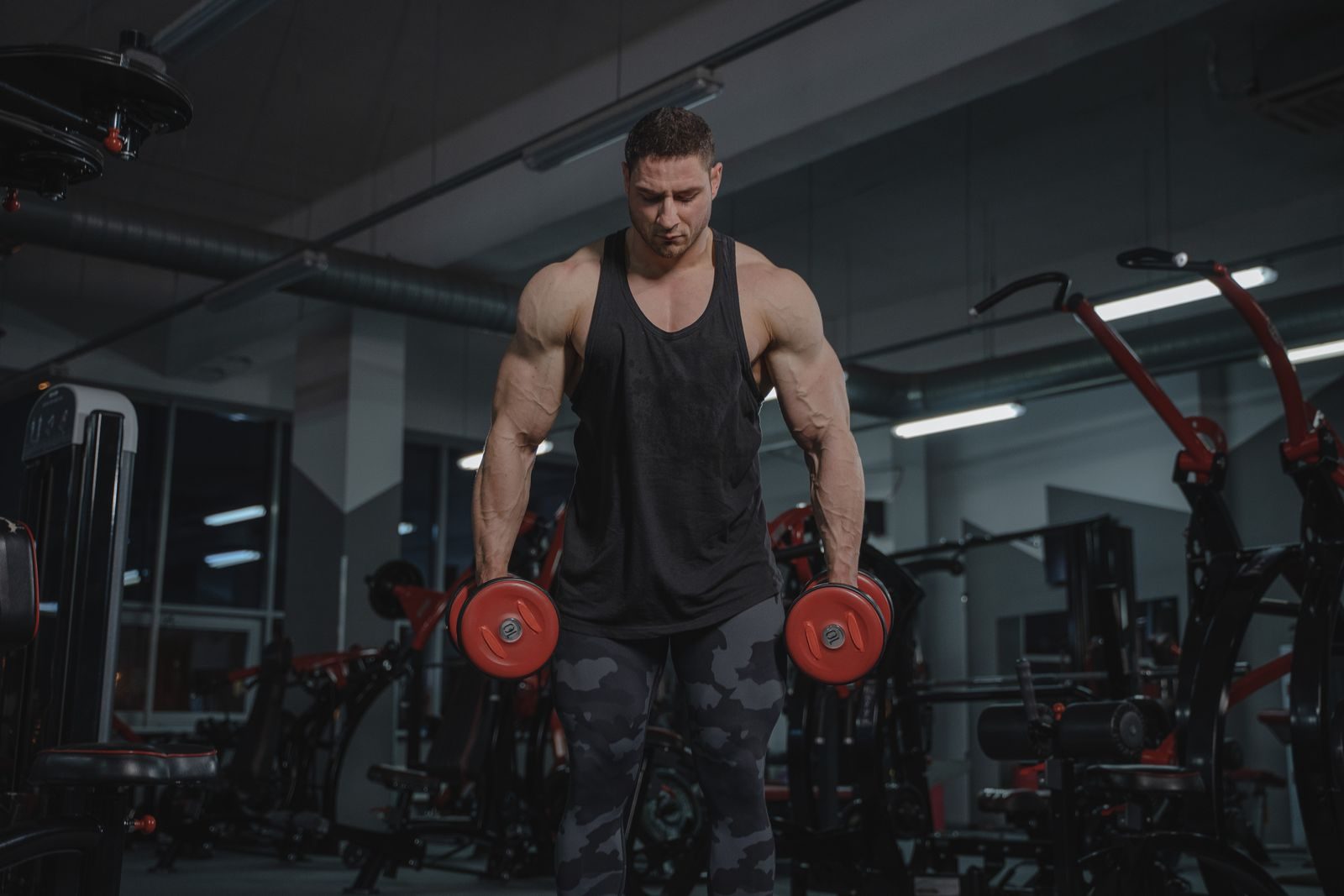
Dumbbell hammer curls are a neutral-grip arm exercise that trains the biceps, brachialis, and brachioradialis while the palms remain facing each other. They are easy to add to an arm, pull, upper-body, or full-body workout, but their effectiveness depends on controlling the dumbbells rather than swinging heavy weights.
This guide explains proper dumbbell hammer curl form, the muscles worked, common mistakes, useful variations, and practical programming for beginners and experienced trainees.
Dumbbell Hammer Curls at a Glance
| Category | Recommendation |
|---|---|
| Exercise type | Mostly single-joint elbow-flexion exercise |
| Main purpose | Build the elbow flexors of the upper arm and forearm |
| Primary muscles | Biceps brachii, brachialis, and brachioradialis |
| Grip | Neutral grip with the palms facing each other |
| Equipment | One or two dumbbells |
| Difficulty | Beginner-friendly |
| Typical sets | 2–3 |
| Typical repetitions | 8–15 |
| Rest | 60–120 seconds |
| Effort | Finish with approximately 1–3 controlled repetitions remaining |
What Are Dumbbell Hammer Curls?
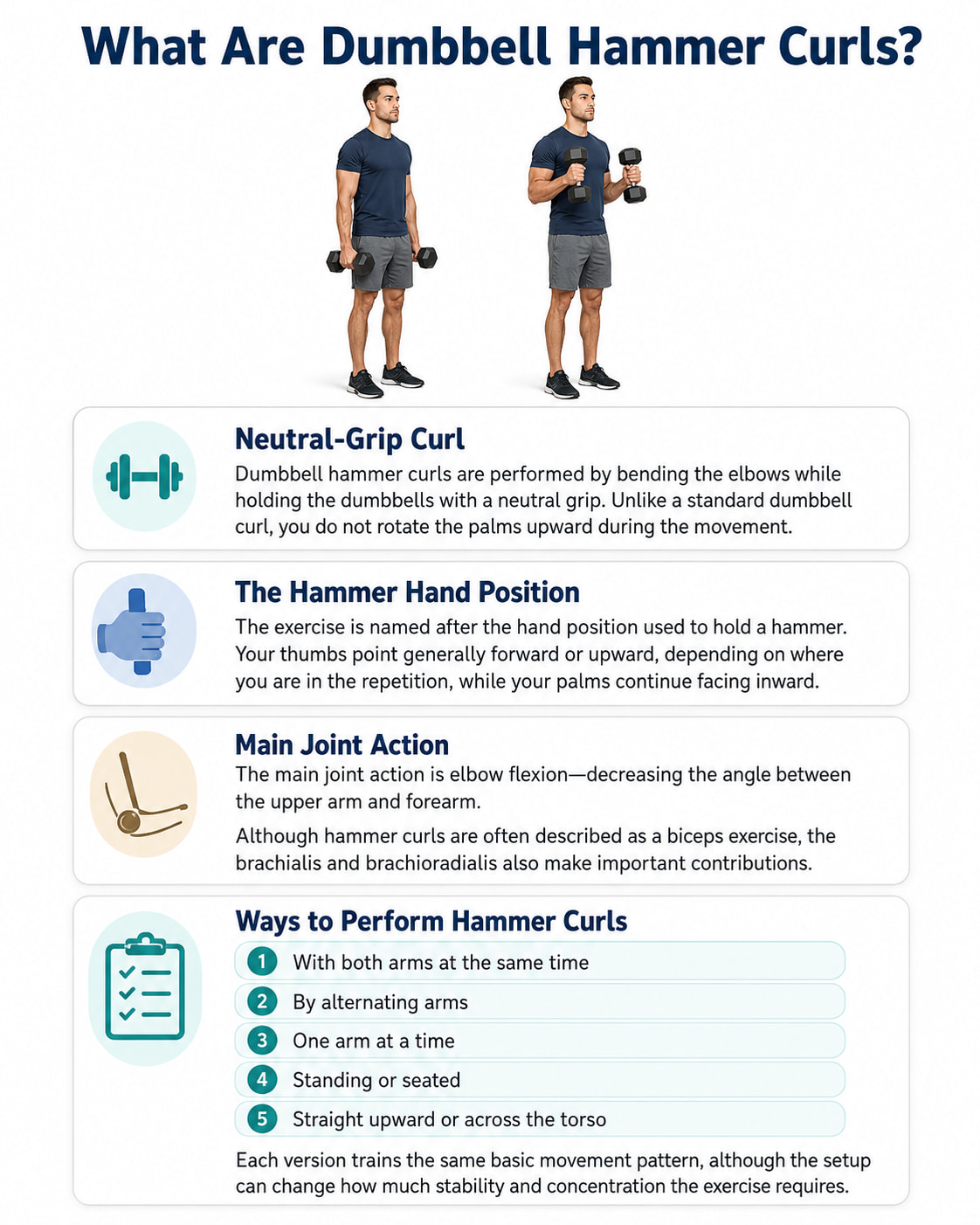
Dumbbell hammer curls are performed by bending the elbows while holding the dumbbells with a neutral grip. Unlike a standard dumbbell curl, you do not rotate the palms upward during the movement.
The exercise is named after the hand position used to hold a hammer. Your thumbs point generally forward or upward, depending on where you are in the repetition, while your palms continue facing inward.
The main joint action is elbow flexion—decreasing the angle between the upper arm and forearm. Although hammer curls are often described as a biceps exercise, the brachialis and brachioradialis also make important contributions.
Hammer curls can be performed:
- With both arms at the same time
- By alternating arms
- One arm at a time
- Standing or seated
- Straight upward or across the torso
Each version trains the same basic movement pattern, although the setup can change how much stability and concentration the exercise requires.
How to Do Dumbbell Hammer Curls
Best for: Directly training the upper-arm and forearm elbow flexors with a neutral grip.
Equipment needed: One or two dumbbells.
Sets, repetitions, and rest: Start with 2–3 sets of 8–15 repetitions. Rest for 60–120 seconds between sets.
Step-by-Step Instructions
- Choose manageable dumbbells. Use weights you can lift without leaning, swinging, shrugging, or bending your wrists.
- Set your stance. Stand with your feet approximately hip-width apart. A small staggered stance can provide additional stability.
- Hold the dumbbells with a neutral grip. Let your arms hang beside your body with your palms facing your thighs. Wrap your thumbs securely around the handles.
- Brace your torso. Stand tall with your head aligned over your shoulders, ribs controlled, and abdominal muscles lightly braced.
- Begin the curl. Bend one or both elbows and bring the dumbbells toward the front of your shoulders. Keep your palms facing inward.
- Control the top position. Stop when you have fully flexed your elbows without pushing them far forward or forcing the dumbbells into your shoulders.
- Lower the weights slowly. Return the dumbbells to the starting position until your arms are comfortably straight.
- Repeat without resetting your posture. Keep your torso, wrists, and shoulders controlled for the entire set.
The American Council on Exercise similarly recommends a closed neutral grip, braced torso, straight wrists, controlled elbow flexion, and minimal forward elbow movement.
Breathing
Exhale as you curl the dumbbells upward and inhale as you lower them. Avoid holding your breath through the entire repetition.
Range of Motion
Lower the dumbbells until your arms are straight through a comfortable range. You do not need to forcefully lock the elbows.
At the bottom, the dumbbells do not have to press tightly against your thighs. The American Council on Exercise also notes that individual differences around the elbow can affect the most comfortable starting position, so prioritize keeping the wrists aligned with the forearms rather than forcing the dumbbells against your sides.
Coaching cue: Curl the dumbbells without moving your shoulders toward them.
Dumbbell Hammer Curls Muscles Worked
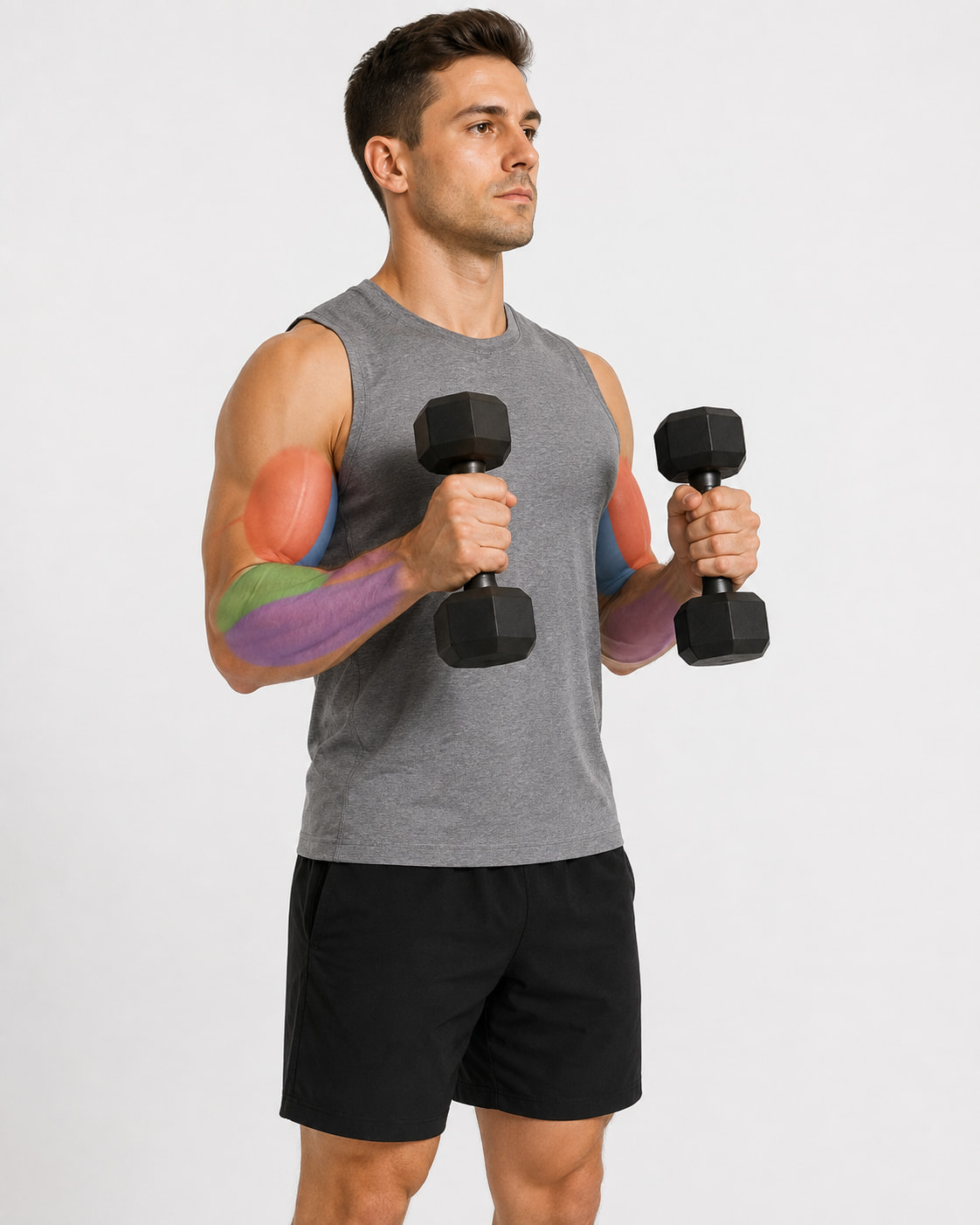
Hammer curls train several muscles that work together to bend and stabilize the elbow.
Biceps Brachii
The biceps brachii is the large muscle on the front of the upper arm. It helps flex the elbow and rotate the forearm into a palm-up position.
Because hammer curls keep the forearms neutral, the biceps does not perform its full supination function. However, it still contributes significantly to elbow flexion.
The NCBI Bookshelf describes the biceps as both a forearm supinator and an elbow flexor.
Brachialis
The brachialis lies underneath the biceps and attaches to the ulna, one of the two bones of the forearm. Its primary job is bending the elbow.
Because the brachialis does not rotate the forearm, it remains involved whether the palms face upward, inward, or downward. An NCBI Bookshelf anatomy reference identifies the brachialis as an important elbow flexor across normal forearm positions.
Brachioradialis
The brachioradialis runs along the thumb side of the forearm and crosses the elbow joint. It assists elbow flexion and helps stabilize the forearm during curls.
Another NCBI Bookshelf anatomy overview explains that the brachioradialis contributes to elbow flexion with the forearm in supinated, neutral, and pronated positions.
Assisting and Stabilizing Muscles
The muscles of the hands and forearms help maintain your grip and wrist position. The shoulder muscles stabilize the upper arms, while the abdominal and back muscles help prevent the torso from leaning or rotating.
These muscles should support the movement rather than create it. If your shoulders, hips, or lower back are driving the dumbbells upward, the weight is probably too heavy.
Benefits of Dumbbell Hammer Curls
Directly Trains the Elbow Flexors
Rows, pulldowns, and pull-ups involve the elbow flexors, but those exercises also rely heavily on the back and shoulders. Hammer curls let you add focused work for the biceps, brachialis, and brachioradialis.
Provides a Neutral-Grip Curl Option
The neutral hand position adds variety to a program that already includes palm-up curls. Using more than one comfortable grip can expose the elbow flexors to slightly different joint positions and loading patterns.
This does not mean hammer curls isolate a special part of the arm or are automatically better than standard curls. They are simply another useful form of resisted elbow flexion.
Requires Minimal Equipment
You need only one or two dumbbells. Hammer curls can be performed in a commercial gym, home gym, or small workout area.
Works Well Unilaterally or Bilaterally
Training one arm at a time can help you concentrate on technique and notice side-to-side differences. Curling both dumbbells simultaneously saves time and requires more total-body stability.
Is Easy to Progress
Hammer curls can be progressed by adding repetitions, increasing the dumbbell weight, improving control, or advancing from an alternating version to simultaneous curls.
May Feel Comfortable for Some Trainees
Some people find a neutral grip more comfortable than fully rotating their palms upward. This is an individual preference, not evidence that hammer curls treat wrist, elbow, or shoulder problems.
Hammer Curls vs. Standard Biceps Curls
Both exercises bend the elbow and train the biceps, brachialis, and brachioradialis. The main difference is the forearm position.
| Feature | Hammer curl | Standard dumbbell curl |
|---|---|---|
| Grip | Neutral, palms facing inward | Supinated, palms facing upward |
| Main action | Elbow flexion | Elbow flexion with a palm-up position |
| Biceps involvement | Yes | Yes |
| Brachialis involvement | Yes | Yes |
| Brachioradialis involvement | Yes | Yes |
| Best use | Neutral-grip variation | Palm-up curl variation |
| Equipment | Dumbbells | Dumbbells |
Neither exercise is universally better. Standard curls train elbow flexion while placing the forearm in a position that uses the biceps’ supination function. Hammer curls train elbow flexion while maintaining a neutral forearm.
A small 2023 study available through the National Library of Medicine compared supinated, neutral, and pronated cable curls in 10 competitive male bodybuilders. The supinated variation produced greater biceps and brachioradialis surface-EMG activity during the lifting phase than the neutral variation. However, the study measured immediate muscle excitation, used cable exercises rather than dumbbell hammer curls, and did not measure long-term muscle growth. It therefore does not prove that one grip will build more muscle for everyone.
A practical approach is to use both:
- Perform standard curls when you want a palm-up curl.
- Perform hammer curls when you want a neutral-grip variation.
- Keep the version that feels comfortable and allows steady progress.
- Avoid adding several curl variations that all serve the same purpose in one workout.
Common Dumbbell Hammer Curl Mistakes
Using Too Much Weight
Heavy dumbbells often cause swinging, leaning, shortened repetitions, and uncontrolled lowering. Reduce the weight when you cannot keep your torso stable.
The final repetition can be challenging, but it should still look similar to the first.
Leaning Backward
Leaning away from the dumbbells uses momentum to move the weight. Keep your hips, ribs, and shoulders stacked instead of turning the exercise into a backward rocking motion.
A slight natural adjustment is not the same as repeatedly throwing the torso backward to begin every repetition.
Moving the Elbows Too Far Forward
Allowing the elbows to travel far in front of the body increases shoulder movement and changes the curl.
Keep your upper arms reasonably close to their starting position. They do not have to be painfully pinned against your ribs, but they should not swing forward to finish the repetition.
Bending the Wrists
Keep your knuckles, wrists, and forearms aligned. Do not curl the wrists inward or allow the dumbbells to pull the hands backward.
Wrist movement often appears when the dumbbells are too heavy or when the trainee is trying to lift them higher than their available elbow range allows.
Shrugging the Shoulders
Do not raise your shoulders toward your ears as the weights move upward. Keep the neck relaxed and the shoulder blades controlled.
Rotating the Palms
A hammer curl uses a neutral grip throughout the repetition. If you rotate the palms upward, the movement becomes closer to a standard supinating curl.
Rotation is not necessarily wrong, but it is a different variation.
Dropping the Dumbbells
Lowering the weights quickly reduces control and may pull the elbows into an uncomfortable bottom position. Guide the dumbbells down over approximately two seconds rather than letting them fall.
Forcing the Dumbbells Against the Thighs
Your anatomy may not allow the dumbbells to rest flat against your sides while the wrists remain straight. Prioritize neutral wrists instead of forcing a specific dumbbell position.
Alternating vs. Simultaneous Hammer Curls
Alternating Hammer Curls
Curl one dumbbell while the other arm remains extended.
This version is useful for beginners because it lets you focus on one arm at a time. It may also make torso control easier because only one dumbbell is moving.
Avoid leaning toward or away from the working arm.
Simultaneous Hammer Curls
Curl both dumbbells at the same time.
This version is more time-efficient and requires greater torso stability. It may also reveal when the dumbbells are too heavy because swinging both arms is harder to hide.
Use simultaneous repetitions only when you can maintain the same wrist, elbow, and torso control used during alternating curls.
Which Should You Choose?
Start with alternating curls when you are learning the movement. Progress to simultaneous curls when you can control both arms without leaning or rushing.
Both versions can build strength and muscle when programmed consistently.
Beginner Modifications and Hammer Curl Variations
Seated Hammer Curl
Sit on a stable bench with your feet flat and curl the dumbbells from your sides.
Sitting reduces the opportunity to use the legs, although you can still lean or swing the torso. A bench with back support can provide additional stability.
Best for: Beginners who struggle to keep their hips and lower back still.
Single-Arm Hammer Curl
Hold one dumbbell and complete the set with one arm before changing sides.
The free hand can rest lightly on a bench or stable support, but it should not be used to push the working arm through the repetition.
Best for: Practicing technique or concentrating on one side.
Cross-Body Hammer Curl
Curl the dumbbell diagonally toward the opposite side of your upper chest rather than straight toward the same-side shoulder.
Keep the palm inward and avoid rotating the torso.
Best for: Adding a different but still neutral-grip curling path.
Incline Dumbbell Hammer Curl
Sit against an inclined bench with your arms hanging beside your torso. Curl the dumbbells without allowing the elbows to move far forward.
The position may make the bottom range more demanding, so lighter weights are usually appropriate.
Best for: Intermediate trainees who can control a longer starting position.
Supported Hammer Curl
Sit against an upright bench or perform the exercise with your upper back lightly supported against a wall.
Do not push the hips forward or create a large lower-back arch.
Best for: Reducing momentum and improving torso awareness.
How Many Sets and Reps Should You Do?
A useful starting point is:
- Beginners: 2 sets of 10–15 repetitions
- Intermediate trainees: 2–3 sets of 8–15 repetitions
- Rest: 60–120 seconds between sets
- Effort: Stop with approximately 1–3 good repetitions remaining
- Frequency: Include direct curl work 1–2 times per week, depending on the rest of your program
Hammer curls are usually an accessory exercise, so they do not need to be performed with extremely heavy weights or very low repetitions.
The 2026 American College of Sports Medicine resistance-training guidance emphasizes progressive, individualized resistance training and reports that training to momentary muscular failure is not consistently necessary for improving results in healthy adults.
You can therefore finish most hammer-curl sets before your form breaks down. Reaching failure is not required for the exercise to be productive.
How to Progress Dumbbell Hammer Curls
Use a simple double-progression method:
- Select a repetition range, such as 8–12.
- Choose dumbbells you can control for at least 8 repetitions.
- Keep the same weight until you can complete all planned sets at the top of the range.
- Confirm that your wrists remain straight and your torso does not swing.
- Increase to the next manageable dumbbell.
- Begin again near the lower end of the range.
For example:
- Week 1: 10, 9, and 8 repetitions
- Week 2: 11, 10, and 9 repetitions
- Week 3: 12, 12, and 11 repetitions
- Week 4: 12 repetitions on all three sets
- Next workout: Increase the weight and return to approximately 8–10 repetitions
When the next dumbbell is too large a jump, continue adding controlled repetitions or include a brief pause at the top before increasing the weight.
Do not progress by shortening the range, swinging harder, or allowing the wrists to bend.
Where Hammer Curls Fit in a Workout
Hammer curls usually work best after larger pulling exercises because rows and pulldowns require more total-body effort and coordination.
A practical workout order is:
- Compound back exercise
- Main palm-up curl or another pulling exercise
- Hammer curl
- Triceps exercise
You can also use hammer curls as your only direct biceps exercise when the workout already contains substantial pulling volume.
Simple Dumbbell Arm and Back Workout
Perform this workout once or twice per week, with at least one recovery day before repeating it.
| Exercise | Sets | Repetitions | Rest |
|---|---|---|---|
| One-arm dumbbell row | 3 | 8–12 per side | 90–120 seconds |
| Standard dumbbell curl | 2 | 8–12 | 60–90 seconds |
| Dumbbell hammer curl | 2–3 | 10–15 | 60–90 seconds |
| Dumbbell overhead triceps extension | 3 | 10–15 | 60–90 seconds |
Finish most sets with 1–3 controlled repetitions remaining.
Beginners can omit the standard curl and perform only the row, hammer curl, and triceps extension. This reduces unnecessary overlap while still training the front and back of the upper arms.
Safety Tips
Warm up with 5–10 minutes of easy general activity, followed by one or two lighter practice sets of your first upper-body exercise.
Use a weight that allows you to:
- Maintain straight wrists
- Keep your torso stable
- Control the lowering phase
- Complete a comfortable range
- Breathe normally
- Place the dumbbells down safely
The Mayo Clinic recommends lowering the weight or repetition target when proper form cannot be maintained, moving weights under control, and stopping exercises that cause pain.
Stop the exercise and seek appropriate professional guidance if you experience sharp pain, numbness, dizziness, chest pain, sudden weakness, or other unusual symptoms. Persistent elbow, wrist, or shoulder discomfort should not be trained through.
Frequently Asked Questions
Do hammer curls work the biceps?
Yes. The biceps brachii helps flex the elbow during hammer curls. The brachialis and brachioradialis also contribute, so the exercise should not be described as working only the biceps.
Are hammer curls better than standard curls?
Neither is universally better. Hammer curls use a neutral grip, while standard curls use a palm-up grip. Both train the elbow flexors and can be included in the same program when the additional volume is appropriate.
Do hammer curls build the forearms?
Hammer curls train the brachioradialis, which contributes to the visible muscle on the thumb side of the upper forearm. Other forearm and hand muscles also work to grip and stabilize the dumbbells.
However, hammer curls do not train every forearm function. Wrist flexion, wrist extension, and grip-specific exercises may still be useful when forearm development is a major goal.
How heavy should dumbbell hammer curls be?
Choose a weight that lets you complete approximately 8–15 repetitions without leaning, swinging, shrugging, shortening the movement, or bending your wrists.
The weight is too heavy when your torso must initiate most repetitions.
Should your elbows stay pinned to your sides?
Your elbows should remain relatively stable, but they do not need to be forced tightly against your ribs. Keep the upper arms close to their starting position while allowing a comfortable, natural path.
Should the dumbbells touch your shoulders?
No. Curl until the elbows are fully flexed through your available range. Forcing the dumbbells into the shoulders often causes the elbows to move forward or the wrists to bend.
Can beginners perform hammer curls?
Yes. Beginners can start with light dumbbells, alternate arms, or perform the exercise seated with back support.
Practice control before increasing the weight.
Can you do hammer curls every day?
Daily hammer curls are usually unnecessary. The biceps and other elbow flexors also work during rows, pulldowns, and similar pulling exercises.
Most trainees can make progress with direct curl work once or twice per week while allowing time for recovery.
Conclusion
Dumbbell hammer curls are a practical neutral-grip exercise for training the biceps, brachialis, and brachioradialis. Their main advantage is not that they isolate one special muscle, but that they provide a simple curl variation that can be performed with minimal equipment.
Start with a weight you can control for 10–15 repetitions. Keep your palms inward, wrists straight, torso stable, and lowering phase controlled. Add weight only after you can reach the top of your repetition range without changing your form.
This content is for informational purposes only and is not a substitute for medical advice.
References
- American Council on Exercise (ACE): Hammer Curl Exercise Guide
- NCBI Bookshelf: Anatomy of the Brachialis Muscle
- NCBI Bookshelf: Anatomy of the Brachioradialis Muscle
- PubMed Central: Biceps and Brachioradialis Excitation With Different Curl Grips
- PubMed: ACSM 2026 Resistance Training Position Stand
- Mayo Clinic: Weight Training Technique and Safety