The dumbbell hamstring curl is a lying leg exercise that trains the hamstrings by bending the knees against the weight of a dumbbell held between the feet. It offers a practical alternative to a leg-curl machine, but the dumbbell must be positioned securely and controlled throughout every repetition.
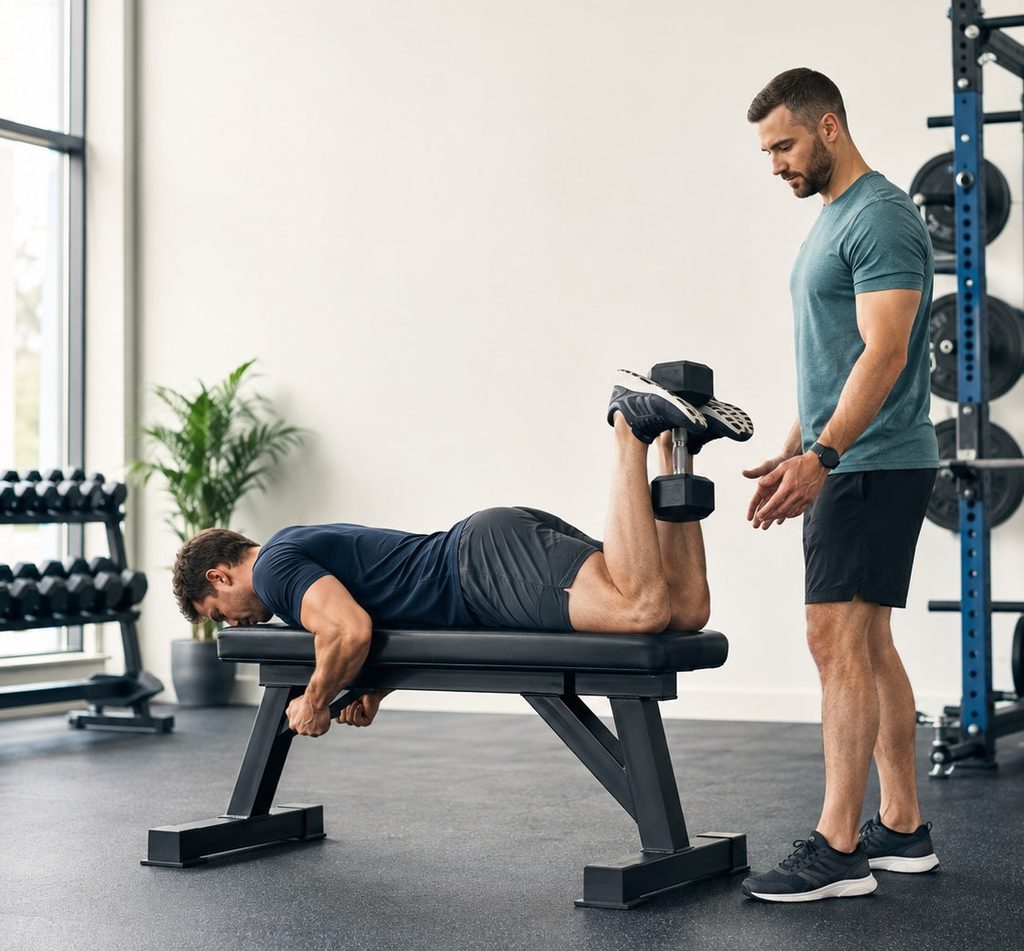
This guide explains the correct bench setup, muscles worked, weight selection, common mistakes, beginner modifications, progression, and how to include dumbbell hamstring curls in a lower-body workout.
Dumbbell Hamstring Curl at a Glance
| Detail | Recommendation |
|---|---|
| Best for | Direct hamstring training with minimal equipment |
| Primary muscles | Biceps femoris, semitendinosus, semimembranosus |
| Assisting muscles | Gastrocnemius, popliteus, and other lower-leg muscles |
| Equipment needed | Fixed dumbbell, flat bench, supportive shoes, training partner |
| Beginner sets and reps | 2–3 sets of 8–15 controlled repetitions |
| Rest | 60–90 seconds |
| Effort level | Finish with 2–3 good repetitions still possible |
| Tempo | Lower for 2–4 seconds and curl up under control |
| Workout placement | After the main squat, lunge, or hip-hinge exercise |
| Main safety concern | The dumbbell slipping from between the feet |
What Is a Dumbbell Hamstring Curl?
The dumbbell hamstring curl—also called a lying dumbbell leg curl—is a prone exercise performed while lying face down on a flat bench. A dumbbell is secured between the feet, and the knees bend and straighten while the hips and upper body remain still.
The exercise is an open-chain knee-flexion movement, meaning the lower legs move freely while the thighs remain supported. A published Strength & Conditioning Journal technique guide describes it as a lower-body isolation exercise intended to increase the muscular capacity of the hamstrings.
This is different from a dumbbell Romanian deadlift or good morning. Those exercises train the hamstrings mainly as the hips bend and extend. The dumbbell hamstring curl trains them mainly by bending the knees.
Both movement patterns can be useful in the same program:
- Dumbbell hamstring curl: Knee-flexion emphasis
- Romanian deadlift: Hip-extension and hip-hinge emphasis
- Glute bridge: Hip-extension emphasis with more direct glute involvement
The curl is best used as an accessory exercise rather than the only hamstring movement in your routine.
How to Do the Dumbbell Hamstring Curl
Best for: Training knee flexion and adding direct hamstring work after compound lower-body exercises.
Muscles worked: Hamstrings primarily, with assistance from the gastrocnemius and other lower-leg muscles.
Equipment needed: Flat bench, fixed dumbbell, supportive shoes, and a training partner.
Sets, reps, and rest: Begin with 2–3 sets of 8–15 repetitions. Rest for 60–90 seconds and stop each set while you can still perform 2–3 controlled repetitions.
The following steps are based on the published Strength & Conditioning Journal technique, adjusted into practical beginner instructions.
Step-by-Step Instructions
- Place the dumbbell beside the bench.
Choose a light weight and leave enough clear space behind the bench for the dumbbell to move. - Lie face down on the bench.
Support your chest, abdomen, hips, and thighs. Position your knees near the end of the pad so your lower legs can move freely. - Hold the bench securely.
Grasp the sides or front of the bench. Keep your chest, hips, and thighs in contact with the pad. - Bend your knees to approximately 90 degrees.
Bring your feet together and gently pull your toes toward your shins. - Have your partner position the dumbbell.
The handle should sit vertically between the middle of both feet, approximately midway between the toes and heels. Squeeze both feet firmly into the handle. - Confirm that the weight is secure.
Do not begin until the dumbbell is centered and both feet can maintain even pressure. - Lower the dumbbell slowly.
Straighten your knees over approximately 2–4 seconds. Keep the feet pressed together and allow the toes to point slightly away if this helps stabilize the dumbbell. - Stop near full knee extension.
Keep a small amount of control at the bottom rather than letting the weight pull the knees suddenly straight. - Curl the dumbbell upward.
Bend your knees and bring your lower legs back toward vertical. Keep the hips down and the lower back neutral. - Stop at approximately 90 degrees.
Do not continue curling the dumbbell toward the glutes if doing so makes your hips lift, back arch, or grip weaken. - Complete the set under control.
After the final repetition, return to the 90-degree position and have your partner remove the dumbbell before you leave the bench.
Coaching Cue
“Squeeze the shoes together, keep the hips heavy, and move only at the knees.”
How the Exercise Should Feel
You should feel controlled muscular tension through the backs of the thighs. Some lower-calf involvement can be normal because the gastrocnemius assists with knee flexion and the feet must hold the dumbbell.
You should not feel:
- Sharp pain behind or inside the knee
- Strong pressure in the kneecaps
- Pinching in the lower back
- Numbness or tingling
- The dumbbell moving or slipping
- Your hamstrings cramping immediately with a very light load
Stop the set if you lose control of the weight or feel unusual symptoms.
Dumbbell Hamstring Curl Muscles Worked
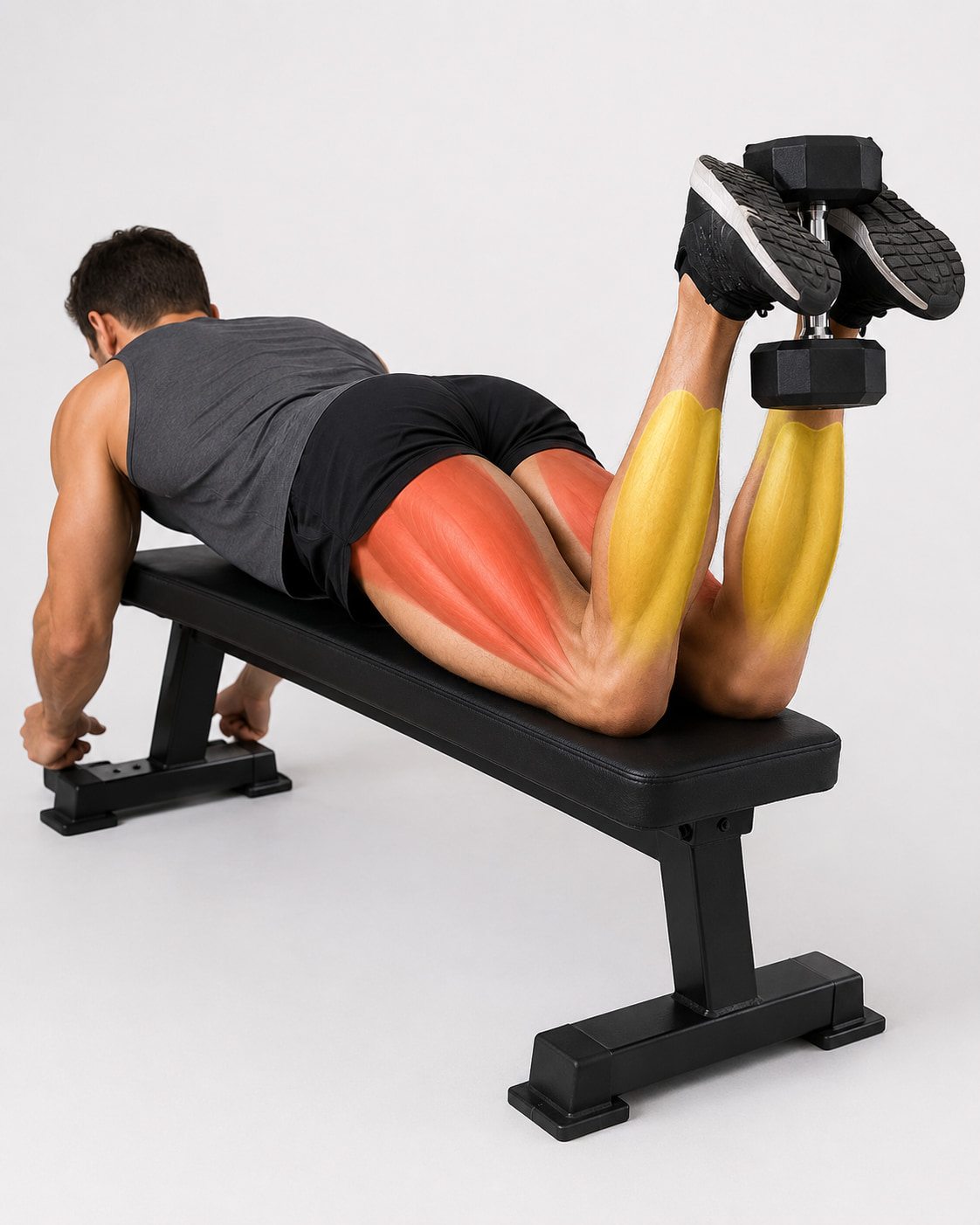
Hamstrings
The hamstrings are the primary muscles worked. This group includes:
- Biceps femoris
- Semitendinosus
- Semimembranosus
These muscles run along the back of the thighs. Their main functions include bending the knees and helping extend the hips. During the dumbbell hamstring curl, knee flexion is their primary job.
The NCBI Bookshelf overview of hamstring anatomy identifies the biceps femoris, semitendinosus, and semimembranosus as the main hamstring muscles and describes knee flexion and hip extension as their major actions.
You should feel most of the muscular effort through the middle and lower portions of the backs of your thighs.
Gastrocnemius and Other Lower-Leg Muscles
The gastrocnemius crosses the knee and assists with knee flexion. It may contribute more when you actively press the feet together and control the dumbbell.
The popliteus and other muscles around the lower leg and ankle provide additional assistance and stability. They should not feel like the primary limiting muscles.
Glutes and Core
The glutes and abdominal muscles help stabilize the pelvis and trunk. They are not the main target of the exercise.
A light glute contraction can help keep the hips against the bench, while abdominal bracing can reduce excessive lower-back arching.
Equipment and Safe Setup
You will need:
- A flat, stable weight bench
- One light fixed-weight dumbbell
- Supportive training shoes
- A training partner to place and remove the dumbbell
A fixed dumbbell is usually more suitable than an adjustable dumbbell with removable plates. Do not use equipment with loose plates, collars, or damaged handles.
Choose a bench long enough to support your torso and hips without rocking. Position it on a level floor with enough open space below your feet for the dumbbell to move.
Use a Training Partner
The published dumbbell-curl technique uses a spotter to position the dumbbell, check that it is secure, and remove it after the set. This is particularly important for beginners.
Trying to reach backward and trap the dumbbell between your feet by yourself can place you in an awkward position. It also increases the chance that the weight will not be centered properly.
When no training partner is available, a resistance-band curl, ankle-weight curl, or leg-curl machine is a more practical choice.
Common Dumbbell Hamstring Curl Mistakes
Using Too Much Weight
A heavy dumbbell may cause your hips to lift, your lower back to arch, or your feet to separate.
Start lighter than you think you need. The first goal is not lifting the heaviest possible dumbbell—it is completing every repetition without changing your body position or losing your grip.
Trying to Place the Dumbbell Alone
Reaching backward to position a free weight between your feet can be awkward and unstable.
Use a training partner for placement and removal. Choose a band, ankle weight, or machine when you train alone.
Failing to Secure the Dumbbell
The dumbbell should be centered between both feet, with equal pressure from each side.
Do not continue the set when:
- One foot begins sliding
- The dumbbell becomes tilted
- Your shoes lose contact with the handle
- You must move your legs suddenly to catch the weight
Have your partner remove it immediately.
Curling Too Far
Bringing the heels as close as possible to the glutes is not necessary in this version. Curling beyond approximately 90 degrees may make the dumbbell harder to control while adding little useful resistance.
Finish each repetition when the lower legs are approximately vertical and the hamstrings remain under control.
Arching the Lower Back
Lower-back arching often occurs when the weight is too heavy or the hips begin lifting from the bench.
Brace your abdomen lightly, keep your ribs controlled, and press the front of your hips into the pad. ACE’s prone hamstring-curl instructions similarly emphasize keeping the thigh down and ending the range when the hips or lower back begin to move.
Dropping the Weight Quickly
Letting the lower legs fall removes muscular control and increases the chance of the dumbbell slipping.
Lower for at least two seconds. The downward phase should be as controlled as the curl.
Separating the Knees
Allowing the knees to spread can change the position of the feet and weaken your hold on the dumbbell.
Keep the knees and feet close together without forcing them painfully inward.
Holding Your Breath
Breathe normally throughout the set. Inhale while lowering the weight and exhale as you curl it upward.
Do not use breath holding to compensate for an excessive load.
Benefits of the Dumbbell Hamstring Curl
Provides Direct Hamstring Training
Squats, lunges, deadlifts, and bridges involve the hamstrings, but they do not all train knee flexion directly.
The dumbbell curl makes bending the knees the main movement, giving you a practical way to add focused hamstring work.
Complements Hip-Hinge Exercises
The hamstrings cross both the hip and knee, except for the short head of the biceps femoris, which crosses only the knee.
Combining a knee-flexion exercise with a hip-hinge exercise allows you to train the hamstrings through different functions. For example, a workout can include both dumbbell Romanian deadlifts and dumbbell hamstring curls.
Requires Minimal Equipment
You need only a bench and one dumbbell, making the exercise useful in small gyms that do not have a lying or seated leg-curl machine.
However, minimal equipment does not mean minimal setup. A partner remains the safer option for placing and removing the dumbbell.
Allows Measurable Progression
You can progress by:
- Performing more repetitions with the same weight
- Slowing the lowering phase
- Adding a brief controlled pause
- Adding one set
- Increasing the dumbbell by the smallest practical amount
Progress only when the dumbbell remains stable and your hips, torso, and lower back stay still.
Fits Easily Into Lower-Body Training
The exercise creates relatively little overall fatigue compared with a heavy squat or deadlift. It can work well near the middle or end of a lower-body session.
It can also be included in a short home hamstring workout when a leg-curl machine is unavailable.
How to Choose the Right Dumbbell Weight
There is no universal starting weight. Foot size, shoe grip, hamstring strength, dumbbell design, and previous training experience all affect what you can control.
Start with a weight that allows at least 8 smooth repetitions without:
- Arching your back
- Lifting your hips
- Separating your knees
- Speeding through the lowering phase
- Losing pressure between your feet
- Curling beyond the controlled range
A suitable working weight should leave approximately 2–3 repetitions in reserve at the end of the set.
The published technique specifically advises against testing a one-repetition maximum on this exercise. It recommends reducing the load whenever lower-back arching occurs.
Simple Progression Rule
Use the following progression:
- Select a repetition range, such as 10–15.
- Keep the same dumbbell until you can complete all sets at the top of the range.
- Confirm that every repetition uses the same controlled form.
- Increase the weight by the smallest available amount.
- Return to the lower end of the repetition range.
Do not increase the weight simply because the hamstrings feel capable of more. Your ability to secure the dumbbell must progress as well.
Can You Do Dumbbell Hamstring Curls Without a Bench?
You can perform a limited version while lying face down on the floor, but it is not identical to the bench variation.
On the floor, the lower dumbbell head may touch down before your knees reach full extension. This shortens the available range and may interrupt tension between repetitions.
A floor variation may be workable when:
- You use a very light dumbbell
- The weight clears your body comfortably
- You use a training partner
- You lower the weight without striking the floor
- You stop immediately if the dumbbell shifts
For most beginners without a bench, a prone resistance-band curl or ankle-weight curl is easier to set up and control.
Avoid lying across an unstable bed, chair, or soft couch with your legs hanging over the edge.
Beginner Regressions
Prone Resistance-Band Hamstring Curl
Attach a band securely behind you and connect it to an ankle cuff. Lie face down, brace your abdomen, and curl one heel toward the glutes without lifting the thigh.
This removes the need to hold a free weight between the feet. It also allows each leg to work independently.
Prone Ankle-Weight Curl
Secure a light ankle weight around each lower leg and perform the same knee-bending motion.
This is a useful option when gripping a dumbbell is uncomfortable or unreliable.
Leg-Curl Machine
A lying or seated leg-curl machine supports the body and secures the resistance through a padded lever.
The machine is often a better choice when you want to train the hamstrings harder without your foot grip limiting the set.
Unloaded Prone Knee Curl
Lie face down and practice bending and straightening both knees without resistance.
Use this version to learn how to keep the pelvis still before adding a band, ankle weights, or dumbbell.
Progressions and Alternatives
Slower Dumbbell Hamstring Curl
Lower the dumbbell for three to four seconds while keeping the upward phase controlled.
This increases difficulty without immediately requiring a heavier load.
Paused Dumbbell Hamstring Curl
Pause for one second when the lower legs reach approximately vertical.
Do not relax or let the weight settle during the pause.
Heavier Machine Leg Curl
When your hamstrings can handle more resistance than your feet can safely secure, move to a seated or lying leg-curl machine.
Changing equipment is often a better progression than forcing a heavy dumbbell between the feet.
Stability-Ball Hamstring Curl
This face-up variation combines knee flexion with hip extension and requires greater trunk and pelvic control.
It is a useful alternative, but it is not necessarily easier than the prone dumbbell curl.
Slider Hamstring Curl
Lie on your back with the heels on sliders or towels. Lift the hips and slide the feet away and back.
This is another combined hip-extension and knee-flexion movement. Begin with a limited range because the exercise can be demanding.
Sets, Reps, Rest, and Frequency
A practical beginner starting point is:
- Sets: 2–3
- Repetitions: 8–15
- Rest: 60–90 seconds
- Frequency: 1–2 times per week
- Effort: Approximately 2–3 repetitions in reserve
- Tempo: 2–4 seconds down and 2–3 seconds up
These are starting guidelines rather than fixed rules. Your training experience, recovery, goals, and ability to secure the dumbbell should determine the final plan.
The American College of Sports Medicine’s 2026 resistance-training guidance emphasizes consistency, individualization, appropriate effort, and training programs that match the person’s goals and ability. It also notes that effective resistance training can use free weights, machines, bands, or home-based exercise.
Where to Put It in a Workout
Perform dumbbell hamstring curls after exercises that require more coordination and total-body effort.
A practical order is:
- Squat or split-squat variation
- Romanian deadlift or another hip hinge
- Dumbbell hamstring curl
- Calf or core exercise
Placing curls later allows you to isolate the hamstrings without tiring them before your main lifts.
Beginner Hamstring Workout
Perform this routine once or twice per week, depending on the rest of your training schedule.
1. Dumbbell Romanian Deadlift
- Sets: 3
- Reps: 8–10
- Rest: 90 seconds
- Effort: Finish with 2–3 repetitions in reserve
Push the hips backward and keep the dumbbells close to the legs. Stop when you reach the deepest position you can control without rounding your back.
2. Dumbbell Hamstring Curl
- Sets: 2–3
- Reps: 10–15
- Rest: 60–90 seconds
- Effort: Finish with 2–3 repetitions in reserve
Use a partner to place and remove the dumbbell. Keep the hips against the bench and stop the curl at approximately 90 degrees.
3. Glute Bridge
- Sets: 2
- Reps: 10–15
- Rest: 60 seconds
- Effort: Finish with 2–3 repetitions in reserve
Drive through the feet and lift the hips without overextending the lower back.
How to Progress the Routine
First, add repetitions within the recommended ranges. Once you reach the top of each range with consistent form, increase the resistance slightly.
Do not progress all three exercises at the same time. Changing one variable at a time makes it easier to judge how your body responds.
Dumbbell Hamstring Curl Safety Tips
- Warm up with a few minutes of easy lower-body activity.
- Perform one practice set without a dumbbell or with a light band.
- Use a fixed dumbbell with secure heads.
- Wear supportive shoes with dry, nonslip soles.
- Use a stable flat bench.
- Have a training partner place and remove the dumbbell.
- Keep the floor below and behind the bench clear.
- Do not test your maximum weight.
- End the set as soon as the dumbbell begins slipping.
- Reduce the weight if your hips lift or your lower back arches.
- Never allow the dumbbell to drop rapidly toward the floor.
Stop exercising and seek appropriate professional guidance if you experience sharp pain, numbness, dizziness, chest pain, or other unusual symptoms.
Anyone recovering from a hamstring, knee, hip, or lower-back injury should follow the exercise and loading recommendations provided by their qualified healthcare professional rather than using a general workout plan.
Frequently Asked Questions
Are dumbbell hamstring curls suitable for beginners?
The knee-curling movement is easy to understand, but securing the dumbbell can be challenging. Beginners should use a very light weight and have a partner position and remove it.
A resistance-band or ankle-weight curl is a better starting option when the dumbbell cannot be held confidently.
How heavy should a dumbbell hamstring curl be?
Use a weight you can control for 8–15 repetitions while keeping the hips down, lower back neutral, feet together, and lowering phase slow.
Finish with approximately 2–3 good repetitions still possible. Do not use this exercise for one-repetition-maximum testing.
How high should I curl the dumbbell?
Curl until your knees reach approximately 90 degrees and your lower legs are close to vertical.
Curling farther is unnecessary if it causes the hips to lift, lower back to arch, or dumbbell to become unstable.
Why do I feel dumbbell hamstring curls in my calves?
The gastrocnemius assists with bending the knee, and your lower-leg muscles help stabilize the ankles and dumbbell.
Some calf involvement is normal, but the hamstrings should remain the main working muscles. Reduce the weight if foot and calf fatigue end the set before your hamstrings are challenged.
Do dumbbell hamstring curls work the glutes?
The glutes help stabilize the pelvis, but they are not the primary target. Hip-extension exercises such as Romanian deadlifts and bridges provide more direct glute training.
Should I do hamstring curls and Romanian deadlifts?
They can work well together because they emphasize different hamstring functions.
Romanian deadlifts train the hamstrings through hip movement, while curls train them through knee bending. Perform the Romanian deadlift first and the curl afterward.
Are dumbbell hamstring curls better than a leg-curl machine?
Neither version is automatically better.
The dumbbell variation requires minimal equipment and works well for lighter home training. A machine secures the resistance more reliably and generally makes heavier loading easier.
Choose the version you can perform consistently, comfortably, and with controlled form.
Conclusion
The dumbbell hamstring curl can provide effective direct hamstring work when you have a stable bench, a suitable dumbbell, and a partner to manage the weight.
Start light, keep your hips and torso still, lower the dumbbell slowly, and stop each curl at approximately 90 degrees. When holding the dumbbell feels unreliable, use a band, ankle weights, or a leg-curl machine instead of forcing the movement.
For more complete hamstring training, combine the curl with a controlled hip-hinge exercise such as the dumbbell Romanian deadlift.
References
- Snarr, R., and Esco, M. R. Lying Hamstring Curl With a Dumbbell. Strength & Conditioning Journal
- American Council on Exercise: Prone Lying Hamstring Curl
- NCBI Bookshelf: Hamstring Muscle Anatomy and Function
- American College of Sports Medicine: Updated Resistance Training Guidelines
- American Council on Exercise: Lying Hamstring Curl Machine
This content is for informational purposes only and is not a substitute for medical advice.