Hamstring exercises strengthen the muscles on the back of your thighs so you can hinge, squat, run, climb, and control your lower body more effectively. The best hamstring exercises do more than build size; they train hip extension, knee flexion, single-leg stability, and eccentric control.
In this guide, you’ll learn the best hamstring exercises for strength and control, how to perform each one, which muscles they work, common mistakes to avoid, and how to use them in a real workout.
What Are the Hamstrings?
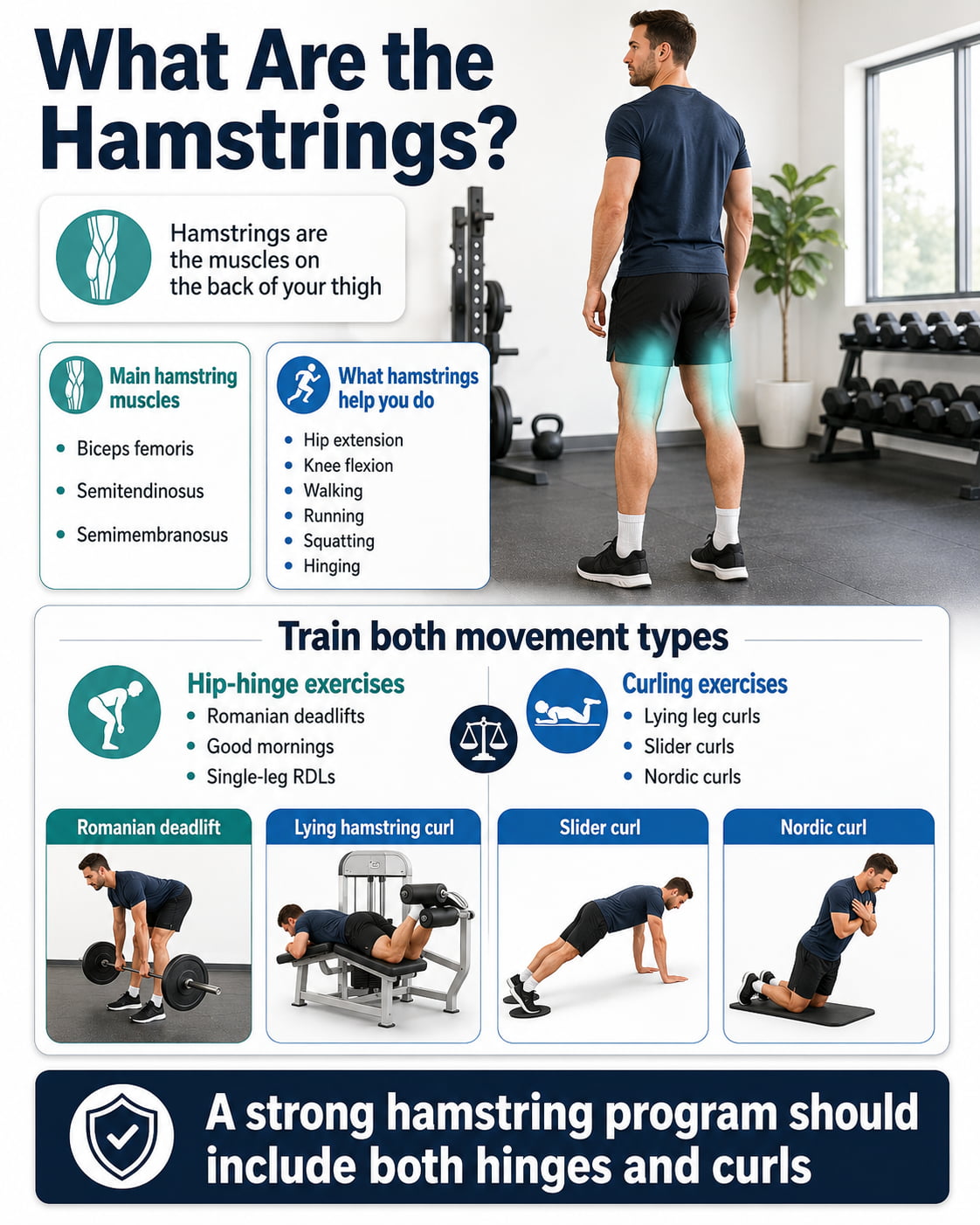
The hamstrings are the muscles on the back of your thigh. The hamstring group includes the biceps femoris, semitendinosus, and semimembranosus. The NCBI Bookshelf explains that this muscle group plays an important role in hip extension and knee flexion, which is why hamstrings are involved in walking, running, squatting, hinging, and many athletic movements.
That also means one exercise is not enough for complete hamstring training. Hip-hinge exercises such as Romanian deadlifts train the hamstrings while the hips move. Curling exercises such as lying leg curls, slider curls, and Nordic curls train the hamstrings while the knees bend.
A strong hamstring program should include both.
Why Hamstring Exercises Matter for Strength and Control
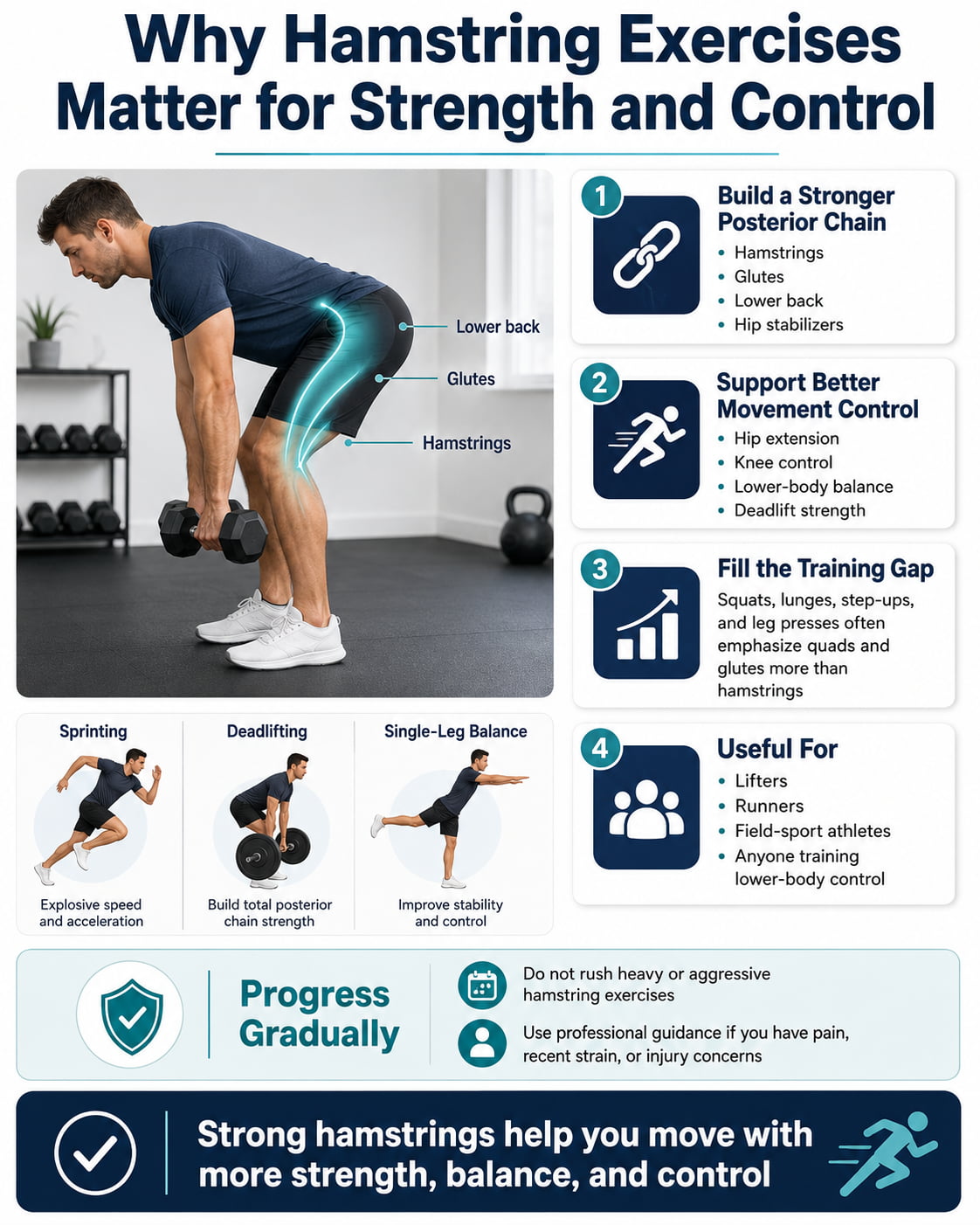
Hamstring exercises help build a stronger posterior chain, which includes the hamstrings, glutes, lower back, and supporting hip muscles. Stronger hamstrings may help improve hip extension, knee control, sprint mechanics, deadlift strength, and lower-body balance.
They are also useful because many people train their quads more than their hamstrings. Squats, lunges, step-ups, and leg presses all involve the hamstrings to some degree, but they often emphasize the quads and glutes more. Direct hamstring work helps fill that gap.
Hamstring training can be especially useful for lifters, runners, field-sport athletes, and anyone who wants better lower-body control. If you have a current injury, recent strain, or pain during hamstring exercises, use professional guidance. The American Academy of Orthopaedic Surgeons notes that strengthening is usually added gradually after hamstring injury care, which is a good reminder not to rush heavy or aggressive progressions.
The 13 Best Hamstring Exercises for Strength and Control
A complete hamstring workout should include a mix of hip hinges, leg curls, bodyweight control drills, unilateral movements, and eccentric exercises. The American Council on Exercise has highlighted exercises such as Romanian deadlifts, prone leg curls, and swing-style hinge movements as useful hamstring-focused options.
1. Romanian Deadlift
Best for: Building strong hamstrings through a loaded hip hinge.
Muscles worked: Hamstrings, glutes, spinal erectors, adductors, core, upper back, and grip.
Equipment needed: Barbell, dumbbells, or kettlebells.
Why it stands out: The Romanian deadlift loads the hamstrings while they lengthen, making it one of the best hamstring exercises for strength, muscle growth, and posterior-chain control. The NASM exercise library describes the Romanian deadlift as a hip hinge performed with a neutral spine and slightly bent knees, lowering until you feel a controlled hamstring stretch.
Suggested sets and reps: Use 3 to 4 sets of 6 to 10 reps.
Beginners: Start with a light kettlebell or dumbbells and practice the hip hinge before using a barbell.
Intermediate: Use moderate weight and a slow lowering phase of 2 to 3 seconds.
Advanced: Use heavier barbell loading, tempo reps, or paused reps near the bottom position.
Rest: Rest 90 to 150 seconds between sets.
How to do it:
- Stand tall with your feet about hip-width apart and the weight in front of your thighs.
- Brace your core and keep your shoulders pulled gently down and back.
- Push your hips behind you while keeping a slight bend in your knees.
- Lower the weight close to your legs until you feel a strong but controlled hamstring stretch.
- Drive your hips forward to stand tall again without leaning back.
- Repeat with control and keep the weight close to your body.
Common mistakes: Squatting the movement, rounding the lower back, letting the weight drift away from the legs, locking the knees, or forcing the weight too low.
Expert tip: Think “hips back, ribs down, weight close.” The goal is not to touch the floor; the goal is to keep tension on the hamstrings.
Exercise variations: Barbell Romanian deadlift, dumbbell Romanian deadlift, kettlebell Romanian deadlift, landmine Romanian deadlift, and B-stance Romanian deadlift.
Easier variation: Bodyweight hip hinge or kettlebell Romanian deadlift from a raised block.
Harder variation: Deficit Romanian deadlift, paused Romanian deadlift, or slow eccentric Romanian deadlift.
2. Dumbbell Romanian Deadlift
Best for: Beginner-to-intermediate hamstring strength with simple equipment.
Muscles worked: Hamstrings, glutes, spinal erectors, core, forearms, and upper back.
Equipment needed: Dumbbells.
Why it stands out: The dumbbell Romanian deadlift is easier to set up than the barbell version and works well for home workouts, small gyms, and lifters who want a more joint-friendly hinge. Dumbbells also let your arms move naturally at your sides, which can feel better for some people.
Suggested sets and reps: Use 3 sets of 8 to 12 reps.
Beginners: Use light dumbbells and stop the set when your hinge position starts to break down.
Intermediate: Use heavier dumbbells and control the lowering phase.
Advanced: Try single-leg, B-stance, or tempo dumbbell Romanian deadlifts.
Rest: Rest 60 to 120 seconds between sets.
How to do it:
- Hold a dumbbell in each hand in front of your thighs or slightly at your sides.
- Stand with your feet hip-width apart and knees softly bent.
- Brace your core and push your hips back.
- Keep the dumbbells close to your legs as you lower.
- Stop when you feel your hamstrings stretch without losing back position.
- Drive through your feet and bring your hips forward to stand.
Common mistakes: Turning it into a squat, dropping the chest, shrugging the shoulders, or reaching the dumbbells toward the floor instead of hinging at the hips.
Expert tip: Let your hips decide the range of motion. If your back starts to round, you have gone too low.
Exercise variations: Two-dumbbell Romanian deadlift, one-dumbbell Romanian deadlift, B-stance dumbbell Romanian deadlift, and suitcase Romanian deadlift.
Easier variation: Bodyweight good morning or light kettlebell deadlift.
Harder variation: Single-leg dumbbell Romanian deadlift.
3. Single-Leg Romanian Deadlift
Best for: Hamstring strength, balance, hip stability, and left-to-right control.
Muscles worked: Hamstrings, glutes, glute medius, spinal erectors, calves, core, and foot stabilizers.
Equipment needed: Dumbbells, kettlebell, or bodyweight.
Why it stands out: The single-leg Romanian deadlift trains the hamstrings while also challenging balance and hip control. It is especially useful for athletes and lifters who want better control on one leg.
Suggested sets and reps: Use 2 to 4 sets of 6 to 10 reps per side.
Beginners: Start with bodyweight and hold a wall, rack, or bench for support.
Intermediate: Use one dumbbell in the opposite hand of the working leg.
Advanced: Use two dumbbells, a slower tempo, or a longer range of motion.
Rest: Rest 60 to 120 seconds between sets.
How to do it:
- Stand on one leg with a soft bend in the knee.
- Hold the weight in one or both hands.
- Brace your core and keep your hips square.
- Push your free leg behind you as your torso tips forward.
- Lower until you feel a stretch in the working hamstring.
- Drive through the standing foot and return to the starting position.
Common mistakes: Opening the hips to the side, rounding the back, rushing the rep, bending the knee too much, or turning the movement into a reach instead of a hinge.
Expert tip: Imagine your back leg and torso moving like one long line.
Exercise variations: Bodyweight single-leg Romanian deadlift, supported single-leg Romanian deadlift, contralateral dumbbell single-leg Romanian deadlift, and two-dumbbell single-leg Romanian deadlift.
Easier variation: Kickstand Romanian deadlift.
Harder variation: Deficit single-leg Romanian deadlift or tempo single-leg Romanian deadlift.
4. Lying Hamstring Curl
Best for: Direct hamstring isolation and knee-flexion strength.
Muscles worked: Hamstrings, calves, and lower-leg stabilizers.
Equipment needed: Lying leg curl machine, cable, or resistance band.
Why it stands out: Lying hamstring curls train the hamstrings through knee flexion, which complements hip-hinge exercises. The American Council on Exercise describes the prone lying hamstring curl setup with trunk bracing, feet hip-width apart, and controlled curling against resistance.
Suggested sets and reps: Use 3 sets of 10 to 15 reps.
Beginners: Use light resistance and focus on smooth control.
Intermediate: Pause for one second at the top of each rep.
Advanced: Use slow eccentrics or single-leg reps.
Rest: Rest 45 to 90 seconds between sets.
How to do it:
- Lie face down on the machine with the pad above your heels.
- Keep your hips down and brace your core.
- Curl your heels toward your glutes.
- Squeeze the hamstrings at the top without lifting your hips.
- Lower the weight slowly until your legs are nearly straight.
- Repeat without bouncing.
Common mistakes: Lifting the hips, using momentum, curling too fast, arching the lower back, or letting the weight stack slam down.
Expert tip: Control the lowering phase. The eccentric part of the rep is where many people lose tension.
Exercise variations: Machine lying leg curl, banded lying hamstring curl, cable prone hamstring curl, and single-leg lying curl.
Easier variation: Light banded lying hamstring curl.
Harder variation: Single-leg lying curl with a slow 3-second lowering phase.
5. Seated Hamstring Curl
Best for: Machine-based hamstring isolation with strong control.
Muscles worked: Hamstrings and calves.
Equipment needed: Seated leg curl machine.
Why it stands out: The seated hamstring curl trains knee flexion while your hips are bent. This gives you a controlled way to load the hamstrings without needing to hinge, balance, or hold heavy weights.
Suggested sets and reps: Use 3 to 4 sets of 8 to 15 reps.
Beginners: Use a light weight and learn to control the full range of motion.
Intermediate: Use moderate weight with a pause in the curled position.
Advanced: Use heavier sets, drop sets, or single-leg reps.
Rest: Rest 60 to 90 seconds between sets.
How to do it:
- Sit on the machine with your knees aligned with the machine’s pivot point.
- Adjust the thigh pad so your legs stay secure.
- Place the lower-leg pad just above your heels.
- Brace your trunk and curl the pad down and back.
- Squeeze the hamstrings at the bottom.
- Return slowly until your knees are nearly straight.
Common mistakes: Setting the machine incorrectly, lifting the hips, bouncing the weight, shortening the range too much, or letting the knees flare out.
Expert tip: Keep your thighs pinned down and move only at the knees.
Exercise variations: Two-leg seated curl, single-leg seated curl, tempo seated curl, and partial-range finisher.
Easier variation: Use a lighter load and reduce the range slightly if full range feels too intense.
Harder variation: Single-leg seated curl with a 2-second squeeze.
6. Stability Ball Hamstring Curl
Best for: Bodyweight hamstring strength, core control, and home workouts.
Muscles worked: Hamstrings, glutes, calves, core, and hip stabilizers.
Equipment needed: Stability ball.
Why it stands out: The stability ball hamstring curl combines a bridge with knee flexion. It trains the hamstrings to curl the ball while the glutes and core help keep the hips lifted. The American Council on Exercise lists the stability ball hamstring curl as an intermediate exercise for the butt, hips, and thighs.
Suggested sets and reps: Use 2 to 4 sets of 8 to 12 reps.
Beginners: Start with stability ball bridges before adding the curl.
Intermediate: Keep the hips lifted for every rep.
Advanced: Try single-leg stability ball curls.
Rest: Rest 60 to 90 seconds between sets.
How to do it:
- Lie on your back with your heels on top of a stability ball.
- Place your arms on the floor for balance.
- Lift your hips into a bridge position.
- Bend your knees and roll the ball toward your glutes.
- Keep your hips lifted as you curl.
- Slowly extend your legs and roll the ball away.
Common mistakes: Dropping the hips, rushing the ball, over-arching the lower back, or letting the knees drift apart.
Expert tip: Keep your ribs down and hips high. The curl should feel controlled, not wobbly.
Exercise variations: Stability ball bridge, stability ball hamstring curl, single-leg stability ball curl, and slow eccentric ball curl.
Easier variation: Stability ball hip bridge.
Harder variation: Single-leg stability ball hamstring curl.
7. Slider Hamstring Curl
Best for: Home hamstring training with minimal equipment.
Muscles worked: Hamstrings, glutes, calves, and core.
Equipment needed: Sliders, towels, paper plates, or socks on a smooth floor.
Why it stands out: Slider hamstring curls are simple, cheap, and effective. They train knee flexion while the hamstrings also help control the hips. They are a great bridge between basic hamstring walkouts and harder Nordic curls.
Suggested sets and reps: Use 2 to 4 sets of 6 to 12 reps.
Beginners: Start with eccentric-only reps by sliding out slowly and resetting.
Intermediate: Curl both legs in and out with hips lifted.
Advanced: Use single-leg slider curls or slow tempo reps.
Rest: Rest 60 to 120 seconds between sets.
How to do it:
- Lie on your back with your heels on sliders.
- Bend your knees and lift your hips into a bridge.
- Slowly slide your heels away from your body.
- Keep your hips from dropping.
- Curl your heels back toward your glutes.
- Repeat with control.
Common mistakes: Letting the hips sag, sliding too far too soon, arching the back, or pulling mostly with the calves.
Expert tip: Start with a smaller range of motion and earn more range as you get stronger.
Exercise variations: Two-leg slider curl, eccentric slider curl, single-leg slider curl, and alternating slider curl.
Easier variation: Hamstring walkout.
Harder variation: Single-leg slider hamstring curl.
8. Nordic Hamstring Curl
Best for: Advanced eccentric hamstring strength.
Muscles worked: Hamstrings, calves, glutes, and core.
Equipment needed: Partner, Nordic curl bench, anchored feet, or a secure setup with padding.
Why it stands out: The Nordic hamstring curl is one of the hardest bodyweight hamstring exercises because your hamstrings must resist your body as you lower forward. A 2019 systematic review in the British Journal of Sports Medicine found that programs including the Nordic hamstring exercise reduced hamstring injury rates in athletes, but the exercise must be progressed carefully because it is demanding.
Suggested sets and reps: Use 2 to 4 sets of 3 to 6 controlled reps.
Beginners: Do not start with full Nordics. Use assisted Nordics, short-range reps, or slider curls first.
Intermediate: Lower slowly, catch yourself with your hands, and push lightly back up.
Advanced: Use longer eccentrics, less hand assistance, or full-range reps.
Rest: Rest 90 to 180 seconds between sets.
How to do it:
- Kneel on a soft pad with your feet securely anchored.
- Keep your body in a straight line from knees to head.
- Brace your core and squeeze your glutes lightly.
- Slowly lower your body forward as far as you can control.
- Catch yourself with your hands before you lose control.
- Push lightly with your hands and use your hamstrings to return.
Common mistakes: Starting too advanced, bending at the hips, losing body alignment, dropping suddenly, or doing too many reps too soon.
Expert tip: Treat Nordics like heavy strength work, not a high-rep finisher.
Exercise variations: Assisted Nordic curl, band-assisted Nordic curl, eccentric-only Nordic curl, short-range Nordic curl, and full Nordic curl.
Easier variation: Slider hamstring curl or band-assisted Nordic curl.
Harder variation: Full-range Nordic curl with minimal hand push.
9. Glute-Ham Raise
Best for: Advanced hamstring strength through knee flexion and hip control.
Muscles worked: Hamstrings, glutes, calves, spinal erectors, and core.
Equipment needed: Glute-ham developer machine.
Why it stands out: The glute-ham raise trains the hamstrings hard while your body moves around the knee and hip. It is useful for lifters and athletes who already have a good strength base and want a demanding hamstring exercise that builds control.
Suggested sets and reps: Use 3 to 4 sets of 5 to 10 reps.
Beginners: Start with assisted reps or partial range if you have access to a machine.
Intermediate: Perform controlled full reps with bodyweight.
Advanced: Add a slow eccentric, hold a plate, or pause near the hardest point.
Rest: Rest 90 to 150 seconds between sets.
How to do it:
- Set up on the glute-ham developer with your knees supported and feet locked in.
- Start with your body tall and your core braced.
- Lower your torso forward under control.
- Keep your hips extended as much as possible.
- Use your hamstrings to pull your body back up.
- Finish tall without overextending your lower back.
Common mistakes: Bending sharply at the hips, using the lower back to finish, rushing the bottom position, or using a machine setup that does not fit your body.
Expert tip: Keep the movement smooth. If you have to jerk yourself up, use assistance or reduce the range.
Exercise variations: Assisted glute-ham raise, bodyweight glute-ham raise, weighted glute-ham raise, and eccentric-only glute-ham raise.
Easier variation: Assisted glute-ham raise or stability ball hamstring curl.
Harder variation: Weighted glute-ham raise.
10. Kettlebell Swing
Best for: Explosive hip extension, hamstring power, and posterior-chain conditioning.
Muscles worked: Hamstrings, glutes, spinal erectors, core, lats, shoulders, and grip.
Equipment needed: Kettlebell.
Why it stands out: The kettlebell swing trains the hamstrings dynamically through a fast hip hinge. It is not a squat with a front raise. The NASM notes that kettlebell swings should be treated as a hip-hinge movement with little knee bend, a straight back, and the hips driving the motion.
Suggested sets and reps: Use 3 to 6 sets of 10 to 20 reps.
Beginners: Learn the deadlift and hip hinge first before doing swings.
Intermediate: Use moderate weight and crisp reps.
Advanced: Use heavier swings, EMOM sets, or power-focused sets of 10.
Rest: Rest 45 to 90 seconds between sets.
How to do it:
- Place the kettlebell slightly in front of your feet.
- Hinge at your hips and grip the handle.
- Hike the kettlebell back between your legs.
- Drive your hips forward to swing the bell to about chest height.
- Let the kettlebell float while your arms guide it.
- Hinge again as the bell returns between your legs.
Common mistakes: Squatting the swing, lifting with the arms, rounding the back, leaning too far back at the top, or letting the kettlebell drop too low.
Expert tip: Your hips create the power. Your arms guide the bell.
Exercise variations: Two-hand kettlebell swing, dead-stop swing, single-arm swing, and banded swing.
Easier variation: Kettlebell deadlift.
Harder variation: Heavy dead-stop swing.
11. Good Morning
Best for: Hamstring strength, hip-hinge practice, and posterior-chain control.
Muscles worked: Hamstrings, glutes, spinal erectors, core, and upper back.
Equipment needed: Barbell, safety squat bar, resistance band, or bodyweight.
Why it stands out: The good morning trains the hip hinge with the load on your upper back instead of in your hands. This makes it a useful accessory for squats, deadlifts, and hinge mechanics, but it should be loaded carefully.
Suggested sets and reps: Use 2 to 4 sets of 6 to 12 reps.
Beginners: Start with a bodyweight or banded good morning.
Intermediate: Use a light barbell and focus on perfect control.
Advanced: Use heavier loading only if your hinge mechanics are strong.
Rest: Rest 90 to 150 seconds between sets.
How to do it:
- Place a barbell across your upper back or loop a band behind your neck and under your feet.
- Stand with your feet about hip-width apart.
- Brace your core and keep your knees slightly bent.
- Push your hips back as your torso leans forward.
- Stop when you feel a controlled hamstring stretch.
- Drive your hips forward to return to standing.
Common mistakes: Loading too heavy, rounding the back, bending the knees too much, dropping the chest, or turning it into a squat.
Expert tip: Keep the weight light enough that every rep feels controlled and repeatable.
Exercise variations: Bodyweight good morning, band good morning, barbell good morning, safety-bar good morning, and seated good morning.
Easier variation: Bodyweight hip hinge.
Harder variation: Paused barbell good morning.
12. Hamstring Walkout
Best for: Beginner-friendly bodyweight hamstring control.
Muscles worked: Hamstrings, glutes, calves, and core.
Why it stands out: The hamstring walkout teaches your hamstrings to control the legs as they move farther away from your body. It is a useful starting point before slider curls, stability ball curls, or Nordic curl progressions.
Suggested sets and reps: Use 2 to 3 sets of 4 to 8 walkouts.
Beginners: Keep the steps small and stop before your hips drop.
Intermediate: Walk farther out and return slowly.
Advanced: Pause at the longest position or move toward slider curls.
Rest: Rest 45 to 90 seconds between sets.
How to do it:
- Lie on your back with your knees bent and feet flat.
- Lift your hips into a bridge.
- Take small steps forward with your heels.
- Walk out until your legs are almost straight or your hips start to drop.
- Walk your heels back toward your body.
- Lower your hips and reset if needed.
Common mistakes: Letting the hips sag, walking out too far, rushing the steps, or arching the lower back.
Expert tip: Smaller steps make the exercise easier to control and more effective.
Exercise variations: Short-range walkout, full walkout, paused walkout, and single-leg bridge walkout.
Easier variation: Glute bridge.
Harder variation: Slider hamstring curl.
13. Banded or Cable Standing Hamstring Curl
Best for: Simple hamstring isolation, warm-ups, and accessory work.
Muscles worked: Hamstrings and calves.
Equipment needed: Resistance band, cable machine, and ankle cuff when using a cable.
Why it stands out: The standing hamstring curl is easy to adjust, joint-friendly for many people, and useful when you want direct hamstring work without heavy spinal loading. It also lets you train one leg at a time.
Suggested sets and reps: Use 2 to 4 sets of 12 to 20 reps per side.
Beginners: Use a light band and hold a wall or rack for balance.
Intermediate: Use a cable or stronger band and pause at the top.
Advanced: Use slow eccentrics, higher reps, or add it after heavy hinge work.
Rest: Rest 30 to 60 seconds between sides or sets.
How to do it:
- Attach a band or cable cuff around one ankle.
- Stand tall and hold a stable support.
- Keep your thighs close together.
- Curl your heel toward your glutes.
- Squeeze the hamstring at the top.
- Lower slowly and repeat.
Common mistakes: Swinging the leg, leaning forward, letting the knee drift ahead, or rushing the lowering phase.
Expert tip: Keep your thigh still. The movement should happen at the knee.
Exercise variations: Banded standing curl, cable standing curl, single-leg curl, and high-rep pump sets.
Easier variation: Light banded curl.
Harder variation: Cable curl with a 2-second squeeze and 3-second lowering phase.
How to Choose the Right Hamstring Exercises
The best hamstring exercises depend on your goal, equipment, and training level.
| Goal | Best options |
|---|---|
| Beginner hamstring strength | Dumbbell Romanian deadlift, hamstring walkout, banded standing curl |
| Home hamstring workout | Slider curl, stability ball curl, single-leg Romanian deadlift, hamstring walkout |
| Gym strength | Romanian deadlift, seated curl, lying curl, glute-ham raise |
| Athletic control | Single-leg Romanian deadlift, Nordic curl progression, kettlebell swing |
| Muscle growth | Romanian deadlift, seated curl, lying curl, slider curl |
| Eccentric strength | Nordic curl, slow Romanian deadlift, slider curl, glute-ham raise |
For most people, the best setup is simple: choose one hip-hinge exercise and one knee-flexion exercise in the same workout. For example, pair Romanian deadlifts with seated hamstring curls, or pair dumbbell Romanian deadlifts with slider curls.
Sample Hamstring Workout for Strength and Control
Use these routines 1 to 2 times per week. Leave at least one recovery day between hard hamstring sessions.
Beginner Hamstring Workout
| Exercise | Sets | Reps | Rest |
|---|---|---|---|
| Dumbbell Romanian Deadlift | 3 | 8 to 10 | 90 sec |
| Hamstring Walkout | 2 | 4 to 6 | 60 sec |
| Banded Standing Hamstring Curl | 2 | 12 to 15 per side | 45 sec |
Effort level: Use an effort of about 6 to 7 out of 10. Finish each set with 2 to 4 reps still in reserve.
Progression: Add reps first. When you can complete the top end of the rep range with good form, increase the load slightly.
Intermediate Hamstring Workout
| Exercise | Sets | Reps | Rest |
|---|---|---|---|
| Romanian Deadlift | 4 | 6 to 8 | 120 sec |
| Seated Hamstring Curl | 3 | 10 to 12 | 75 sec |
| Single-Leg Romanian Deadlift | 3 | 8 per side | 75 sec |
| Slider Hamstring Curl | 2 | 8 to 10 | 60 sec |
Effort level: Use an effort of about 7 to 8 out of 10. Keep 1 to 3 reps in reserve on most sets.
Progression: Add a small amount of weight to the Romanian deadlift when all sets are smooth and your back position stays strong.
Advanced Hamstring Workout
| Exercise | Sets | Reps | Rest |
|---|---|---|---|
| Tempo Romanian Deadlift | 4 | 5 to 6 | 150 sec |
| Nordic Hamstring Curl | 3 | 3 to 6 | 150 sec |
| Glute-Ham Raise | 3 | 6 to 8 | 120 sec |
| Cable Standing Hamstring Curl | 2 | 12 to 15 per side | 60 sec |
Effort level: Use an effort of about 8 out of 10, but do not grind every set.
Progression: Add difficulty slowly. For Nordic curls, improve control before increasing range or volume.
The American College of Sports Medicine notes that resistance training variables should match the goal: heavier loads are useful for strength, higher weekly volume can support muscle growth, and bodyweight or elastic-band training can still improve strength and function.
Common Hamstring Exercise Mistakes
Only Doing Deadlifts
Deadlifts and Romanian deadlifts are valuable, but they do not train knee flexion as directly as curls. Include both hinges and curls for more complete hamstring development.
Turning Hinges Into Squats
A hip hinge should move mostly at the hips. If your knees bend too much and your torso stays too upright, you may shift the work away from the hamstrings.
Forcing Range of Motion
You do not need to touch the floor on Romanian deadlifts or good mornings. Go as low as you can while keeping a neutral spine, controlled hips, and hamstring tension.
Rushing the Lowering Phase
Many hamstring exercises become more effective when you control the eccentric phase. Lower the weight or your body slowly instead of dropping into the bottom position.
Progressing Nordic Curls Too Quickly
Nordic curls are advanced. Start with assisted reps, short range, or easier curl variations before attempting full reps.
Ignoring Pain Signals
Muscle effort and a controlled stretch are normal. Sharp pain, sudden pulling, numbness, dizziness, chest pain, or unusual symptoms are not normal. Stop the exercise and seek professional help if those occur.
How Often Should You Train Hamstrings?
Most people can train hamstrings 1 to 3 times per week, depending on workout intensity, recovery, and total leg training volume.
If you train hamstrings hard with Romanian deadlifts, Nordics, or glute-ham raises, 1 to 2 focused sessions per week may be enough. If you use lighter band curls, walkouts, or low-volume accessory work, you may be able to include hamstring exercises more often.
A practical weekly plan looks like this:
| Training goal | Weekly hamstring plan |
|---|---|
| Beginner strength | 1 to 2 sessions per week |
| Muscle growth | 2 sessions per week with 6 to 12 total hard sets |
| Athletic control | 2 sessions per week with hinges, single-leg work, and curls |
| Advanced strength | 1 to 2 hard sessions with careful recovery |
Start with less volume than you think you need. Add sets, reps, or load gradually when your form is strong and soreness is manageable.
FAQs About Hamstring Exercises
What is the best hamstring exercise?
The Romanian deadlift is one of the best hamstring exercises for overall strength because it loads the hamstrings through a hip hinge. However, the best complete approach is to combine Romanian deadlifts with a knee-flexion exercise such as a seated curl, lying curl, slider curl, or Nordic curl.
Can I do hamstring exercises at home?
Yes. Good home hamstring exercises include dumbbell Romanian deadlifts, single-leg Romanian deadlifts, hamstring walkouts, slider curls, stability ball curls, and banded standing hamstring curls.
Are squats enough for hamstrings?
Squats train the lower body, but they usually emphasize the quads and glutes more than direct hamstring work. For stronger hamstrings, add hip-hinge exercises and hamstring curls.
Should hamstring exercises feel like stretching?
Hip-hinge exercises such as Romanian deadlifts should create a controlled stretch in the back of the thigh. That stretch should not feel sharp, sudden, or painful. Curling exercises usually feel more like a muscle squeeze or burn.
Are Nordic hamstring curls good for beginners?
Full Nordic curls are usually too advanced for beginners. Start with hamstring walkouts, slider curls, stability ball curls, or band-assisted Nordic curls before progressing to full reps.
How many hamstring exercises should I do in one workout?
Most people only need 2 to 4 hamstring exercises in one workout. A strong session might include one hinge, one curl, and one single-leg or bodyweight control exercise.
Do hamstring exercises also work the glutes?
Many hamstring exercises also train the glutes, especially Romanian deadlifts, single-leg Romanian deadlifts, kettlebell swings, good mornings, and glute-ham raises. Leg curl variations focus more directly on the hamstrings.
Conclusion
Hamstring exercises work best when you train more than one movement pattern. Use hip hinges for loaded strength, curls for direct knee-flexion work, single-leg movements for control, and eccentric progressions when you are ready for a bigger challenge.
Start with the exercises that match your level, keep your form clean, and progress gradually. Strong hamstrings are built through consistent reps, smart loading, and controlled movement.
References
- NCBI Bookshelf: Anatomy, Bony Pelvis and Lower Limb, Hamstring Muscle
- American Council on Exercise: ACE-Sponsored Research on Hamstring Exercises
- NASM: Romanian Deadlift Barbell
- American College of Sports Medicine: Updated Resistance Training Guidelines
- PubMed: Including the Nordic Hamstring Exercise in Injury Prevention Programs
3 thoughts on “13 Best Hamstring Exercises for Strength and Control”