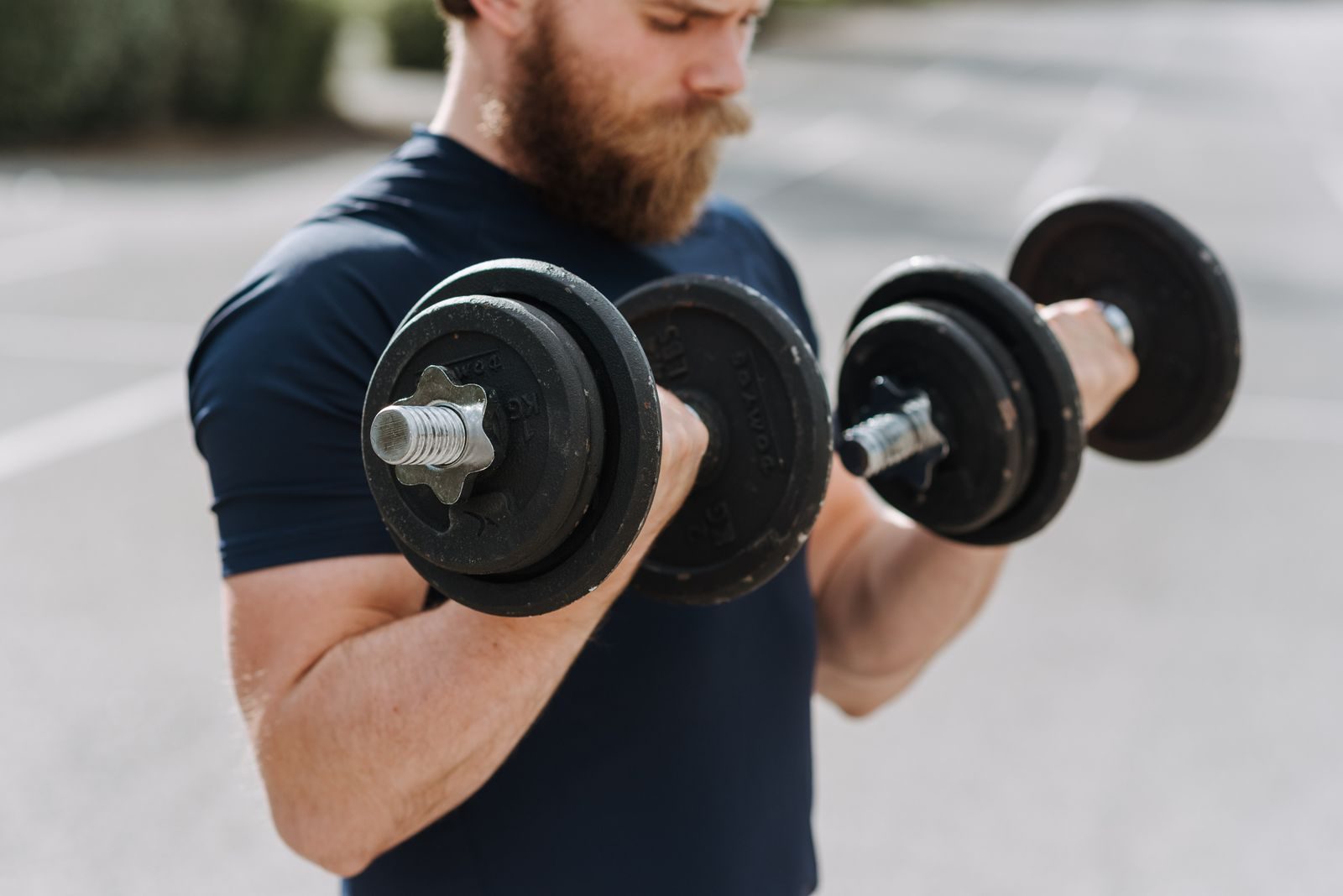
Dumbbell bicep curls are a single-joint strength exercise used to train the biceps and other muscles that bend the elbow. They require only a pair of dumbbells, work each arm independently, and fit easily into home or gym workouts.
The movement may look simple, but using too much weight can turn a controlled curl into a combination of swinging, leaning, and shoulder movement. This guide explains correct dumbbell curl form, the muscles worked, common mistakes, useful variations, and practical ways to program the exercise.
What Are Dumbbell Bicep Curls?
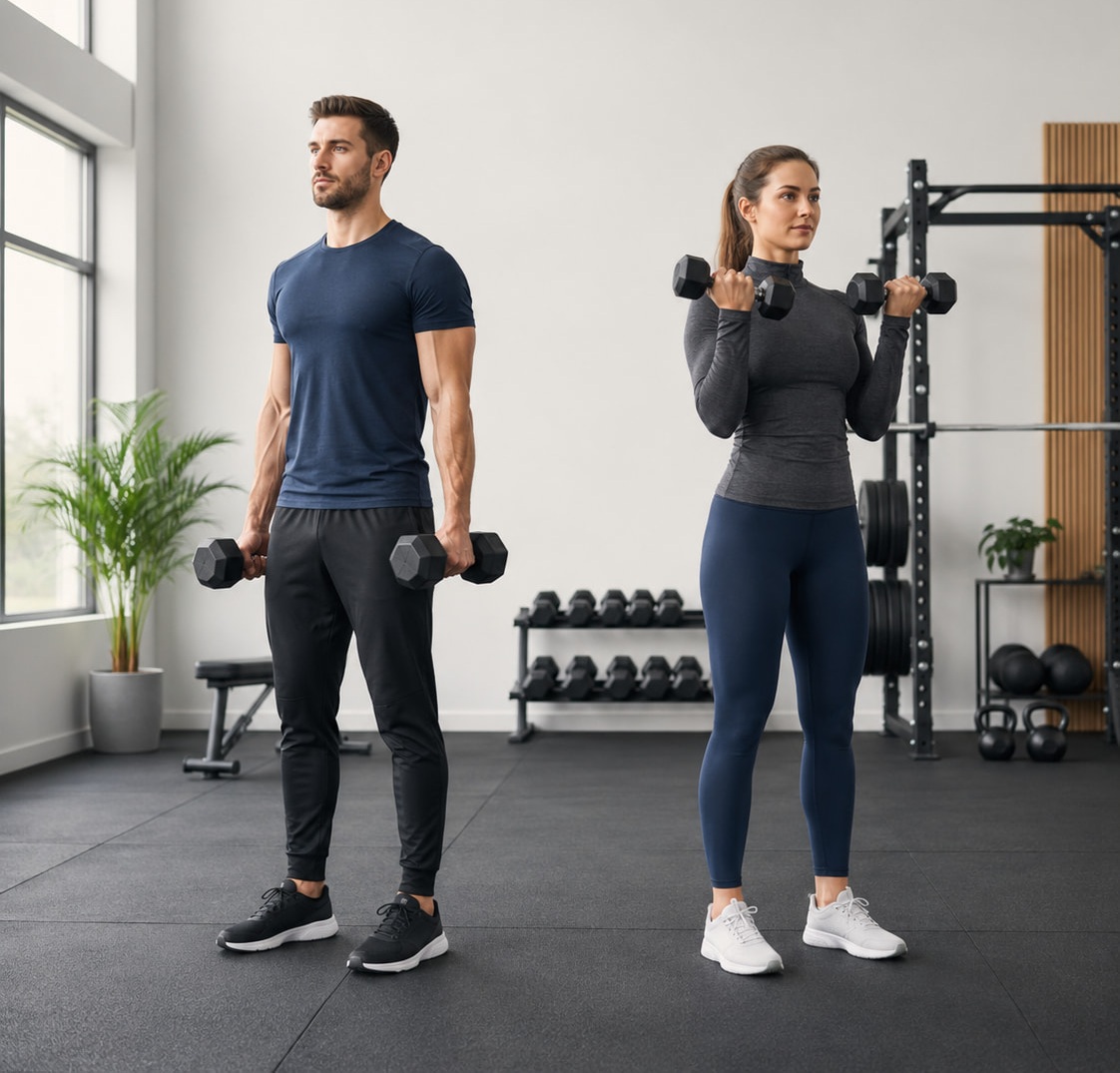
Dumbbell bicep curls involve holding a dumbbell in each hand and bending the elbows to bring the weights toward the shoulders. The weights are then lowered under control until the arms return to the starting position.
This article uses the standing, palms-up dumbbell curl as the standard version:
- One dumbbell is held in each hand.
- The palms face forward.
- The upper arms remain mostly beside the torso.
- Most of the visible movement comes from the elbows.
- The wrists remain aligned with the forearms.
Hammer curls, rotating curls, incline curls, concentration curls, and preacher curls use the same general elbow-flexion pattern, but they change the grip, shoulder position, support, or resistance challenge.
The American Council on Exercise teaches the dumbbell curl with a closed palms-up grip, stable shoulders, neutral wrists, and a controlled lifting and lowering motion.
Dumbbell Bicep Curls at a Glance
| Training detail | Recommendation |
|---|---|
| Best for | Direct arm training, elbow-flexor strength, and building upper-arm muscle |
| Primary target | Biceps brachii |
| Assisting muscles | Brachialis and brachioradialis |
| Supporting muscles | Forearm, grip, shoulder, and trunk stabilizers |
| Equipment needed | Two dumbbells |
| Difficulty | Beginner-friendly |
| Suggested starting range | 2–3 sets of 8–15 repetitions |
| Rest between sets | 60–90 seconds |
| General frequency | 1–2 times per week |
| Effort | Finish with approximately 2–3 controlled repetitions remaining |
| Typical workout placement | After rows, pulldowns, or other compound pulling exercises |
Dumbbell Bicep Curls Muscles Worked
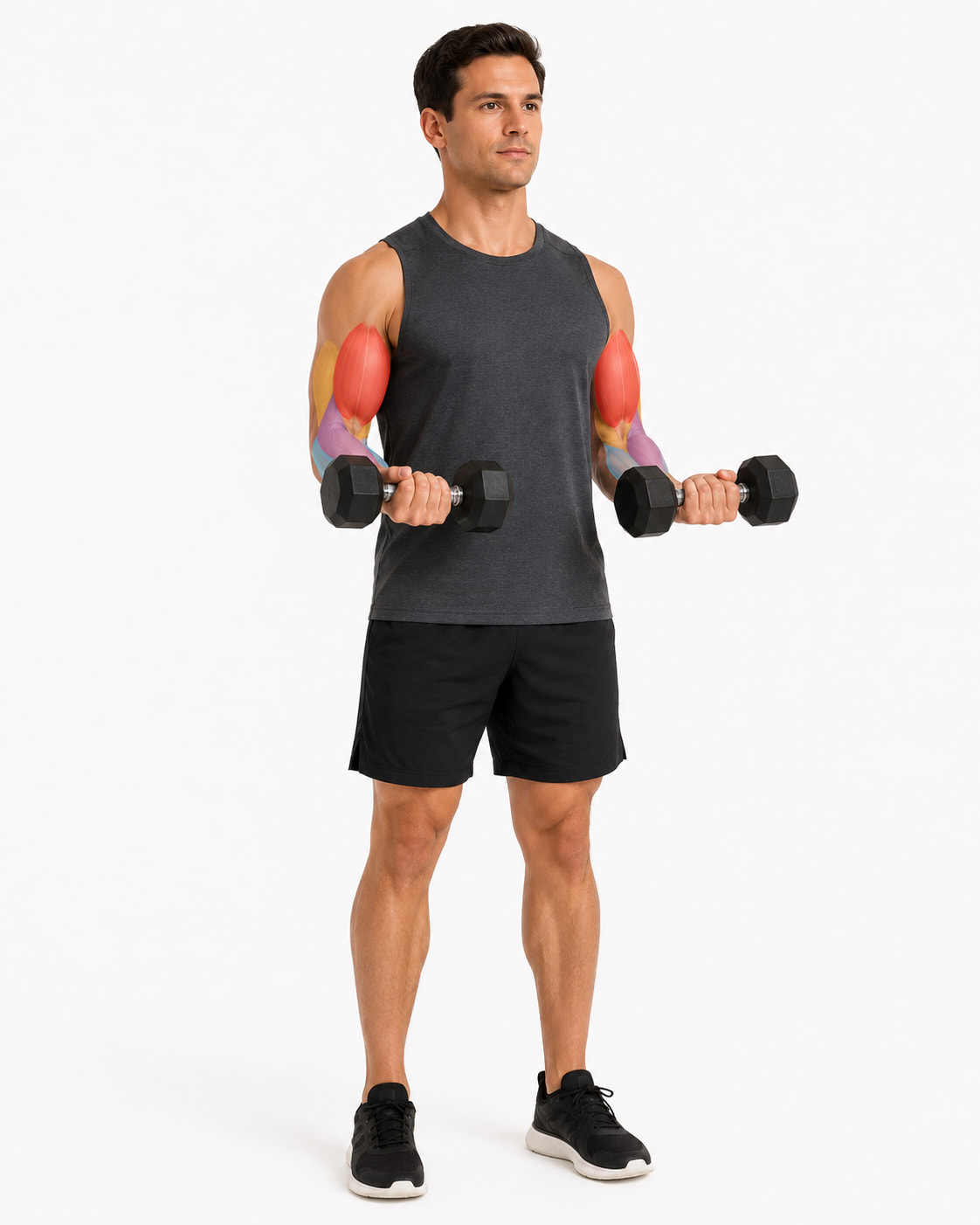
Dumbbell bicep curls mainly train the elbow flexors, with the forearms and trunk helping stabilize the movement.
- Biceps brachii: The main target. Both the long and short heads help bend the elbow and turn the forearm into a palms-up position. The NCBI Bookshelf describes the biceps as an elbow flexor and forearm supinator.
- Brachialis: Sits underneath the biceps and is a strong elbow flexor. It works regardless of whether the palm faces up, inward, or down.
- Brachioradialis: Runs along the thumb side of the forearm and assists with elbow flexion while helping stabilize the forearm.
- Forearm and grip muscles: Help hold the dumbbells securely and keep the wrists aligned.
- Core, shoulders, and upper back: Work as stabilizers to keep the torso upright and limit unwanted swinging.
Tip: If your lower back, shoulders, or legs are doing most of the work, reduce the weight and focus on controlled curls.
How to Do Dumbbell Bicep Curls
Sets, reps, and rest: Begin with 2–3 sets of 8–15 repetitions. Rest for 60–90 seconds between sets.
Starting Position
- Stand with your feet approximately hip-width apart.
- Hold one dumbbell in each hand with your palms facing forward.
- Wrap your thumbs securely around the handles.
- Allow your arms to hang comfortably beside your body.
- Keep your wrists straight and aligned with your forearms.
- Stand tall with your ribs controlled over your pelvis.
- Gently brace your midsection and relax your shoulders away from your ears.
You do not have to force the dumbbells tightly against your legs. Differences in elbow structure can make a slightly wider or more forward starting position feel more natural. Choose the hand position that allows you to keep your wrists straight.
Curl the Dumbbells
- Exhale as you bend your elbows.
- Bring the dumbbells toward the fronts of your shoulders.
- Keep your upper arms mostly beside your torso.
- Avoid leaning backward, shrugging, or driving your elbows far forward.
- Continue until you reach the top of your controllable range.
The dumbbells do not have to touch your shoulders. Stop when further movement would require your shoulders to roll forward or your wrists to bend.
Lower the Dumbbells
- Inhale as you slowly straighten your elbows.
- Keep your torso and upper arms controlled.
- Lower the dumbbells until your arms are nearly straight.
- Avoid forcefully snapping or locking the elbows.
- Begin the next repetition without bouncing or swinging.
A practical tempo is approximately one to two seconds to lift and two to three seconds to lower. An exact tempo is less important than keeping the movement smooth and controlled.
Coaching cue: Keep your elbows heavy and curl your palms toward your shoulders.
Should Your Elbows Stay Completely Still?
During a standard dumbbell curl, the upper arms should remain mostly stable, but they do not need to be rigidly pinned against the ribs.
A small amount of natural elbow movement can occur as you approach the top. The problem is excessive forward movement that turns the curl into a shoulder-flexion exercise.
Use these checks:
- Your elbows should not repeatedly travel several inches forward.
- Your shoulders should not roll toward the dumbbells.
- Your upper arms should not swing backward to start each repetition.
- Your torso should remain upright.
Deliberately bringing the elbows forward can be used as a separate curl variation, but it should not happen accidentally because the dumbbells are too heavy.
How Much Weight Should You Use?
Choose dumbbells that allow you to complete your target repetitions without changing your posture or wrist position.
For example, when performing 8–12 repetitions, select a weight that lets you finish the set with approximately two or three good repetitions still possible.
The weight is probably too heavy when:
- You cannot reach the bottom of the planned repetition range.
- You must swing the dumbbells to start each repetition.
- You lean backward as the weights rise.
- Your wrists bend toward your shoulders.
- Your shoulders shrug or roll forward.
- The lowering phase becomes uncontrolled.
- One arm consistently moves faster than the other.
The weight may be too light when you can exceed the top of the repetition range by several repetitions without slowing down or losing control.
Avoid testing a one-repetition maximum with dumbbell curls. Curls are generally more useful as a controlled accessory exercise than as a maximal-strength test.
How to Progress Dumbbell Bicep Curls
Use a simple double-progression method:
- Select a repetition range, such as 8–12.
- Begin with a weight you can curl for at least eight clean repetitions.
- Keep the same weight until you can complete 12 repetitions on every set.
- Repeat that performance for another workout if you are uncertain about your form.
- Increase to the next available dumbbell weight.
- Return to the lower end of the repetition range.
For example:
- Workout 1: 10, 9, 8 repetitions
- Workout 2: 11, 10, 9 repetitions
- Workout 3: 12, 11, 10 repetitions
- Workout 4: 12, 12, 12 repetitions
- Next workout: Increase the weight and aim for at least 8 repetitions per set
When the next dumbbell is a large jump, continue using the lighter weight while adding a slower lowering phase, a brief pause, or one additional repetition. Do not sacrifice form simply to use the next dumbbell.
Benefits of Dumbbell Bicep Curls
Directly Train the Elbow Flexors
Rows and pulldowns involve the biceps, but they also require substantial work from the back and shoulders. Dumbbell curls allow you to add more direct training for the biceps, brachialis, and brachioradialis.
Allow Each Arm to Work Independently
Each arm controls its own dumbbell. This can make side-to-side differences in strength, coordination, or range of motion easier to notice.
The goal is not to force both arms to look identical during every repetition. Instead, use a weight each arm can control and avoid letting the stronger side perform extra repetitions.
Require Minimal Equipment
Dumbbell curls can be performed in a commercial gym, home gym, or other clear training space. A bench is useful for seated variations but is not required for the standing curl.
Are Easy to Modify
The exercise can be performed:
- Standing or seated
- With both arms together
- One arm at a time
- With a palms-up or neutral grip
- With the arms unsupported or supported
These options make it easy to match the exercise to your experience, equipment, and comfort.
Fit Easily Into Upper-Body Workouts
Dumbbell curls require little setup and usually work well near the end of a back, pull, or upper-body session. They can add direct arm training without requiring a separate workout day.
Common Dumbbell Bicep Curl Mistakes
Swinging the Weights
Swinging usually happens when the dumbbells are too heavy or the set has continued beyond the point where controlled repetitions are possible.
How to fix it: Reduce the weight, soften your knees, brace your torso, and pause briefly at the bottom before beginning each repetition.
Leaning Backward
Leaning backward shortens the curl’s effective range and transfers some of the work away from the elbow flexors. Excessive lower-back arching may also make the movement uncomfortable.
How to fix it: Keep your ribs stacked over your pelvis. Perform the exercise with your back supported against an upright bench if you cannot remain stable while standing.
Driving the Elbows Forward
When the elbows move far forward, the front of the shoulders begins contributing more to the lift.
How to fix it: Keep your upper arms mostly beside your torso and stop the curl before your shoulders roll forward. A small amount of natural movement is acceptable; an exaggerated forward swing is not.
Bending the Wrists
Curling the wrists toward the shoulders does not improve biceps training. It can make the grip less stable and may create unnecessary wrist or forearm discomfort.
How to fix it: Keep your knuckles, wrists, and forearms aligned. Reduce the load if you cannot hold that position.
Forcing the Dumbbells Against Your Sides
Not everyone can hold the dumbbells tightly against the hips while keeping the wrists straight.
How to fix it: Allow the dumbbells to sit slightly wider or slightly forward. Wrist alignment is more important than forcing a perfectly narrow starting position.
Dropping the Dumbbells Quickly
The lowering phase is part of the repetition. Letting gravity pull the weights down reduces control and can make the next repetition more likely to begin with momentum.
How to fix it: Lower the dumbbells for approximately two to three seconds and maintain tension until the arms are nearly straight.
Using an Incomplete Range
Heavy dumbbells often lead to short repetitions at the top or bottom.
How to fix it: Use the largest comfortable range you can control. Lower until the arms are nearly straight and curl until further movement would require the elbows or shoulders to swing.
Curling Unevenly
One arm may rise faster, move farther, or begin swinging before the other.
How to fix it: Use alternating curls so you can focus on one side at a time, or choose the weight based on what the less-controlled arm can perform correctly.
Standing vs. Seated Dumbbell Curls
Neither version is automatically better. The right choice depends on the type of support you need and how well you control the movement.
| Version | Main advantage | Main consideration |
|---|---|---|
| Standing curl | Simple setup and natural arm position | Makes it easier to use the hips or lower back for momentum |
| Seated unsupported curl | Reduces leg involvement | You can still lean backward |
| Seated back-supported curl | Provides more torso stability | Requires a stable bench with a backrest |
| Incline dumbbell curl | Places the upper arms behind the torso | Requires more shoulder extension and may not feel comfortable for everyone |
Choose standing curls when you can maintain a stable posture. Use a seated back-supported version when standing curls repeatedly turn into a swinging movement.
Alternating vs. Simultaneous Dumbbell Curls
Alternating Curls
Alternating curls involve lifting one dumbbell while the other arm remains at the bottom.
They may be useful for:
- Concentrating on one arm at a time
- Improving coordination
- Monitoring side-to-side differences
- Reducing the total load moving at one time
However, each arm receives a short rest while the other side works, so the set takes longer.
Simultaneous Curls
Simultaneous curls involve lifting both dumbbells together.
They may be useful for:
- Completing the exercise more quickly
- Comparing both arms during the same movement
- Creating a greater overall demand on posture and bracing
Neither method consistently produces better results for everyone. Use the version that allows the most controlled repetitions.
Beginner Modifications
Seated Back-Supported Curl
Sit against an upright bench with your head, upper back, and hips supported. Keep your feet flat and curl without allowing your back to lift away from the pad.
This is a useful regression when standing curls cause excessive leaning.
Alternating Dumbbell Curl
Curl one arm at a time while keeping the other arm straight. This allows you to watch the working wrist and elbow more closely.
Single-Arm Supported Curl
Hold one dumbbell and use the opposite hand to lightly support yourself on a stable bench or rack. The support can make it easier to keep your torso still.
Lighter Dumbbells
Using less weight is the simplest regression. It is especially useful when your wrists bend, your elbows swing, or you cannot control the lowering phase.
Hammer Curl
Hold the dumbbells with your palms facing inward. The neutral grip continues to train the elbow flexors while changing the relative contribution of the biceps and brachioradialis.
A hammer curl may feel more comfortable when full palms-up rotation feels restricted, but it should not be used to train through pain.
Dumbbell Bicep Curl Progressions and Variations
Heavier Strict Curl
Increase the dumbbell weight only after reaching the top of your repetition range with consistent form. This is the most direct progression.
Paused Dumbbell Curl
Pause for one second near the top without resting the dumbbells against your shoulders. The pause discourages bouncing and makes the position more difficult to control.
Slow-Lowering Curl
Take three to four seconds to lower each repetition. This increases the difficulty without requiring heavier dumbbells.
Incline Dumbbell Curl
Sit against an inclined bench and allow the arms to hang slightly behind the torso. This changes the starting length and resistance challenge experienced by the biceps.
A Journal of Sports Science and Medicine study comparing curl positions found that traditional and incline dumbbell curls both produced substantial biceps activity across the movement. This does not mean either variation is universally superior; each simply challenges the exercise from a different shoulder position.
Concentration Curl
Sit with your legs apart and support the back of one upper arm against the inside of the thigh. Curl one dumbbell without allowing the torso to rotate.
This variation limits momentum and can help you focus on one arm, but the supported position does not automatically make it more effective than a well-performed standing curl.
Dumbbell Bicep Curl Sets, Reps, Rest, and Frequency
Use your training goal and experience to choose a starting range.
| Goal | Sets per session | Repetitions | Rest | Suggested effort |
|---|---|---|---|---|
| Learning the exercise | 2–3 | 10–15 | 60–90 seconds | 2–3 repetitions remaining |
| Building muscle | 3–4 | 8–15 | 60–120 seconds | 1–3 repetitions remaining |
| Strength-focused accessory work | 3–4 | 6–10 | 90–120 seconds | 1–3 repetitions remaining |
Most beginners can start with 2–3 sets once or twice per week. Increase volume only when you are recovering well and your performance remains stable.
The 2026 guidance from the American College of Sports Medicine emphasizes consistent training, individualized volume, and regular training of the major muscle groups. It also notes that reaching complete muscular failure is not necessary for the average healthy adult.
Do Pulling Exercises Count as Biceps Training?
Rows, chin-ups, and pulldowns require elbow flexion, so the biceps and other elbow flexors already receive work during those exercises.
Someone performing several challenging pulling movements may need fewer direct curl sets than someone who does little upper-body pulling. Do not automatically add a large amount of curl volume without considering the rest of your program.
Do You Need to Train to Failure?
No. A set does not have to continue until you physically cannot complete another repetition.
Stopping with one to three controlled repetitions remaining can provide a strong training effort while making it easier to maintain form. Beginners should generally end the set before swinging, leaning, or wrist bending begins.
Where Should Dumbbell Curls Go in a Workout?
For most general workouts, perform dumbbell curls after compound pulling exercises such as:
- Dumbbell rows
- Cable rows
- Lat pulldowns
- Assisted chin-ups
Training curls first may fatigue the elbow flexors and limit your performance during the larger pulling exercises.
You may place curls earlier when arm development is a specific priority, but the exercise should still be performed with controlled technique.
Sample Beginner Dumbbell Curl Routine
This routine provides two short sessions rather than placing all direct biceps work into one workout.
Day 1: After a Back Workout
Standing dumbbell bicep curl
- 3 sets
- 8–12 repetitions
- 60–90 seconds of rest
- Stop with approximately 2 repetitions remaining
Day 2: After an Upper-Body Workout
Seated alternating dumbbell curl
- 2 sets per arm
- 10–15 repetitions
- 60–90 seconds of rest
- Stop with approximately 2–3 repetitions remaining
Separate the sessions by at least one or two recovery days.
When you reach the top of the repetition range on every set with straight wrists, stable elbows, and no swinging, increase to the next available dumbbell weight. Return to the lower end of the repetition range after increasing the load.
Dumbbell Bicep Curl Safety Tips
- Begin with one or two lighter warm-up sets before using your working weight.
- Keep the area around your feet clear.
- Wrap your thumbs around the dumbbell handles.
- Use a weight you can lower without dropping.
- Keep the wrists aligned rather than bent.
- Use a comfortable arm position instead of forcing the dumbbells against your sides.
- Increase the weight gradually.
- Avoid forcefully locking the elbows at the bottom.
- Do not continue a set once your technique breaks down.
Stop exercising and seek appropriate professional guidance if curls cause sharp pain, numbness, sudden weakness, dizziness, chest pain, or other unusual symptoms. Persistent shoulder, elbow, forearm, or wrist discomfort should not be ignored.
Frequently Asked Questions
How many dumbbell curls should a beginner do?
Begin with 2–3 sets of 8–15 repetitions once or twice per week. Choose a weight that leaves approximately two or three controlled repetitions possible at the end of each set.
Your total biceps workload should also account for rows, pulldowns, and other pulling exercises.
Should I curl both dumbbells together or alternate arms?
Both methods can work. Simultaneous curls are quicker, while alternating curls make it easier to concentrate on one arm at a time.
Choose the version that lets you keep your torso stable, wrists straight, and repetitions even.
Should my elbows remain pinned to my sides?
Keep your upper arms mostly stable, but do not force your elbows rigidly against your ribs. A small amount of natural movement is acceptable.
Avoid driving the elbows far forward or swinging the upper arms backward to create momentum.
Are hammer curls the same as dumbbell bicep curls?
No. Standard dumbbell curls use a palms-up grip, while hammer curls use a neutral grip with the palms facing each other.
Both train the elbow flexors, but the change in hand position alters the relative contribution of the biceps, brachialis, and brachioradialis.
Why do my wrists bend during curls?
Wrist bending commonly occurs when the weight is too heavy, the grip is unstable, or the dumbbells are being forced into an uncomfortable starting position.
Reduce the weight and keep your knuckles aligned with your forearms. Allow the dumbbells to sit slightly wider if necessary.
Can I Perform Dumbbell Curls Every Day?
Daily curls are unnecessary for most people. The muscles also need time to recover from rows, pulldowns, and other pulling exercises.
One or two direct biceps sessions per week is a practical starting point. Add volume only when you are recovering and progressing consistently.
Are Dumbbell Curls Enough to Build Your Arms?
Dumbbell curls train the muscles on the front of the upper arm, but they are not a complete arm workout. The triceps form a large portion of the upper arm and require pressing or elbow-extension exercises.
A balanced upper-body program should also include pulling, pressing, shoulder, and triceps movements.
Conclusion
Dumbbell bicep curls are most effective when they are treated as a controlled elbow-flexion exercise rather than a test of how much weight you can swing.
Keep your wrists straight, upper arms mostly stable, and torso upright. Use a comfortable range of motion, lower the dumbbells slowly, and increase the load only after you can complete the top of your repetition range with consistent form.
This content is for informational purposes only and is not a substitute for professional medical advice.
References
- American Council on Exercise: Seated Biceps Curl
- NCBI Bookshelf: Anatomy of the Biceps Brachii
- NCBI Bookshelf: Anatomy of the Brachialis
- American College of Sports Medicine: Resistance Training Prescription for Healthy Adults
- Effect of Shoulder Position on Biceps Activity During Dumbbell Curls
- Biceps and Brachioradialis Activity During Curls With Different Handgrips
- Resistance Training to Failure Versus Non-Failure: Systematic Review and Meta-Analysis