The straight arm pulldown is a cable exercise that primarily trains the latissimus dorsi by moving the upper arms from an elevated position toward the thighs while keeping the elbows nearly fixed.
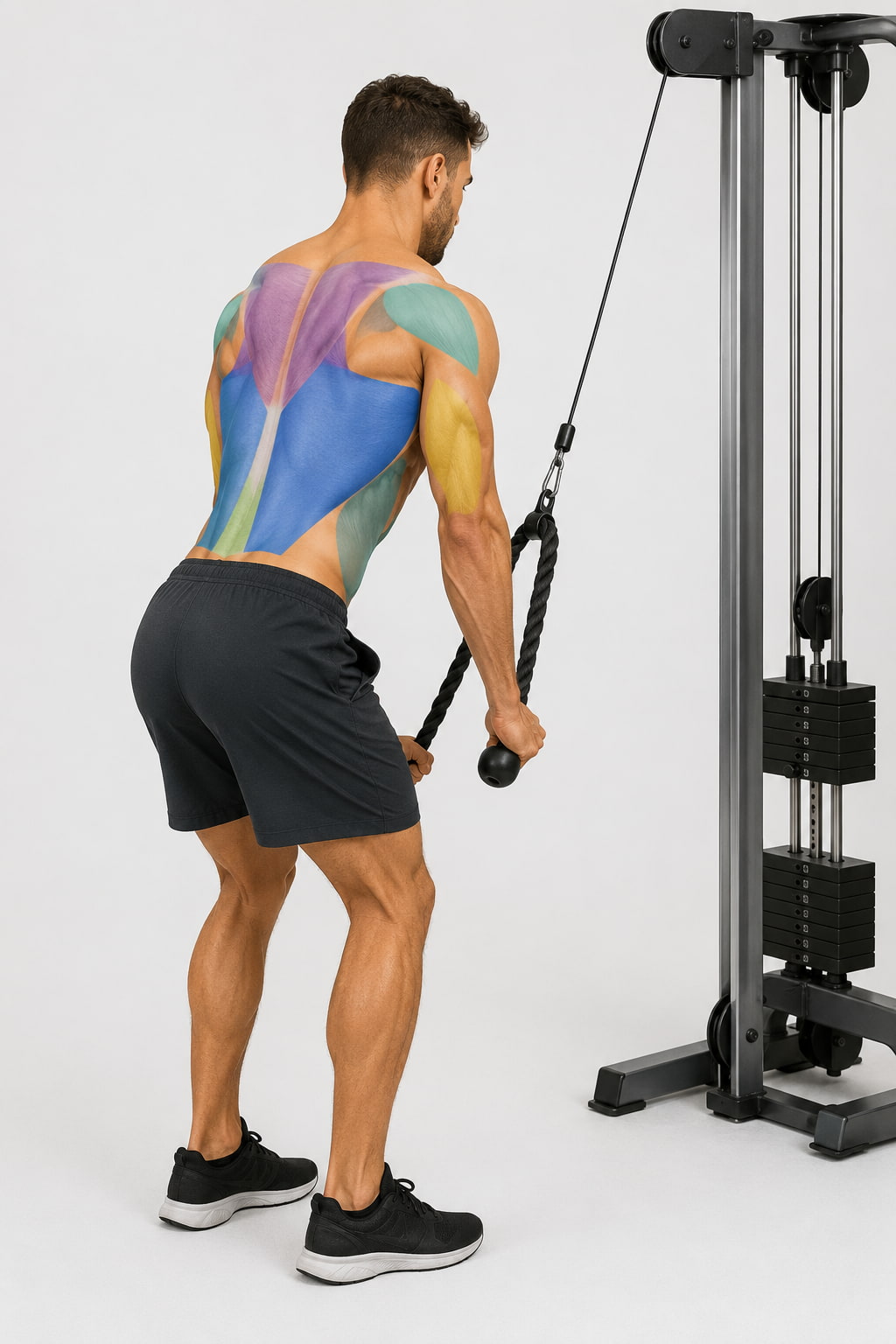
It is commonly used after rows, pull-ups, or regular lat pulldowns to add focused lat training without relying heavily on elbow flexion. This guide covers proper form, muscles worked, benefits, mistakes, variations, and practical programming.
Straight Arm Pulldown at a Glance
| Training detail | Recommendation |
|---|---|
| Primary muscle | Latissimus dorsi |
| Assisting muscles | Teres major, long head of the triceps, posterior deltoid |
| Stabilizers | Rotator cuff, scapular muscles, abdominals, spinal stabilizers |
| Equipment | High cable pulley with a rope, bar, or handles |
| Movement pattern | Shoulder extension |
| Beginner range | 2 sets of 12–15 repetitions |
| General working range | 2–4 sets of 8–15 repetitions |
| Rest | 60–120 seconds |
| Best workout position | After a heavier row, pull-up, or lat pulldown |
| Main form cue | Move your upper arms toward your thighs |
What Is a Straight Arm Pulldown?
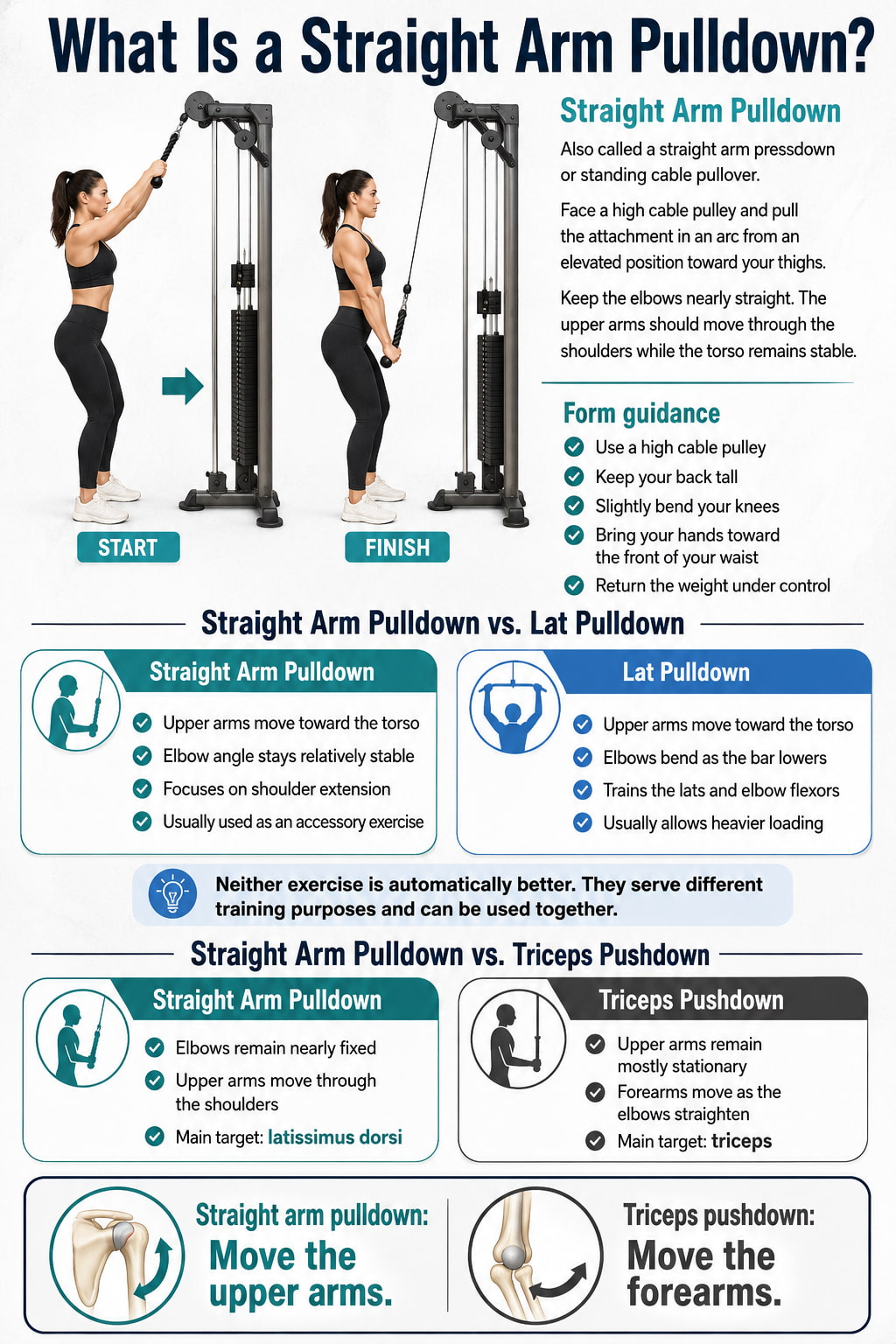
The straight arm pulldown, also called a straight arm pressdown or standing cable pullover, is performed while facing a high cable pulley. You begin with your arms elevated and pull the attachment in an arc toward your thighs.
Your elbows remain nearly straight with a small fixed bend. Most of the movement should come from the shoulders as the upper arms travel toward the torso.
Unlike a conventional lat pulldown, your elbows do not actively bend during each repetition. This makes the exercise useful for adding lat-focused accessory work after heavier pulling movements.
How to Do the Straight Arm Pulldown
Best for: Focused lat training, practicing shoulder extension, and adding back volume after compound pulling exercises.
Muscles worked: Latissimus dorsi, teres major, long head of the triceps, posterior deltoid, rotator cuff, scapular muscles, and trunk stabilizers.
Equipment needed: A cable machine with a high pulley and a rope, straight bar, curved bar, or individual handles.
Sets, reps, and rest: Perform 2–4 sets of 8–15 repetitions. Beginners can start with 2 sets of 12–15 repetitions. Rest for 60–120 seconds between sets.
How to do it
- Attach a rope, bar, or handles to the highest cable setting.
- Face the machine and step backward until the cable is under light tension.
- Stand with your feet about hip- to shoulder-width apart and slightly bend your knees.
- Use a small hip hinge if needed while keeping your spine neutral and torso stable.
- Elevate your arms to a comfortable starting position.
- Keep a slight bend in your elbows and maintain that angle throughout the repetition.
- Brace your core and move your upper arms down in an arc toward your thighs.
- Finish when your hands reach your thighs or lower waist.
- Pause briefly without pulling your shoulders behind your body.
- Return your arms slowly until you feel a comfortable stretch through the lats.
Common mistakes: Avoid repeatedly bending and straightening the elbows, swinging the torso, flaring the ribs, pulling too far behind the hips, or allowing the cable to snap upward.
Progression or regression: Reduce the cable weight or use a resistance band for an easier option. Progress by adding repetitions, increasing the load slightly, slowing the return, or performing the movement one arm at a time.
Coaching cue: Move your upper arms toward your thighs rather than pushing the attachment straight toward the floor.
The American Council on Exercise exercise library similarly recommends using a high pulley, maintaining a tall back, slightly bending the knees, and returning the resistance under control.
Straight Arm Pulldown Muscles Worked
The straight arm pulldown primarily trains the lats, but several assisting and stabilizing muscles are also active.
| Muscle | Role during the exercise |
|---|---|
| Latissimus dorsi | Pulls the upper arms toward the torso through shoulder extension |
| Teres major | Assists the lats with shoulder extension and adduction |
| Triceps brachii | Maintains the nearly straight elbow position |
| Posterior deltoid | Assists with moving the upper arm backward |
| Rotator cuff | Helps control and stabilize the shoulder joint |
| Scapular muscles | Coordinate movement of the shoulder blades |
| Abdominals and spinal stabilizers | Resist excessive arching and torso movement |
| Forearms and hands | Maintain the grip on the attachment |
Latissimus Dorsi
The latissimus dorsi is the main target. Its functions include extending, adducting, and internally rotating the upper arm, according to the NCBI Bookshelf overview of latissimus dorsi anatomy.
During the straight arm pulldown, the lats help move your upper arms from an elevated position toward your torso.
Why the Triceps Are Active
Feeling some triceps effort does not automatically mean your technique is incorrect.
The triceps help keep the elbows extended, while the long head can also assist with shoulder extension. A small electromyography study found substantial activity in both the latissimus dorsi and triceps brachii during straight arm pulldowns.
The movement becomes more triceps-dominant when the elbows repeatedly bend at the top and straighten at the bottom.
Stabilizing Muscles
The rotator cuff and muscles around the shoulder blades help control the shoulder complex as the arms move. The abdominals and spinal stabilizers resist rib flare, lower-back extension, and torso swinging.
Do not force your shoulder blades to remain pinned down throughout the repetition. Allow them to move smoothly and naturally with the arms while maintaining control.
Benefits of Straight Arm Pulldowns
Provides Focused Lat Training
The straight arm pulldown trains shoulder extension without requiring repeated elbow flexion. This may make it easier to concentrate on moving the upper arms with the lats.
It is not a complete isolation exercise because the triceps, shoulders, and stabilizing muscles also contribute.
Complements Rows and Lat Pulldowns
Rows and conventional pulldowns allow heavier loading and train several muscles together. The straight arm pulldown adds a different movement pattern and can provide additional lat volume without performing another demanding compound exercise.
Uses Smooth, Adjustable Resistance
A cable machine provides consistent resistance and allows the load to be changed in small increments. This makes it easier to choose a weight that supports controlled technique.
Works Well With Moderate Loads
You do not need to use heavy resistance for the exercise to be challenging. Moderate or light loads can work well when each repetition is controlled through a comfortable range.
Can Be Performed With Resistance Bands
A securely anchored resistance band can reproduce the general movement pattern at home. The resistance becomes stronger as the band stretches, so the exercise may feel more difficult near the bottom.
The American College of Sports Medicine recognizes elastic bands and home-based resistance training as useful options for improving strength and physical function.
Common Straight Arm Pulldown Mistakes
Bending and Straightening the Elbows
A slight elbow bend is acceptable. The mistake is changing that angle substantially during the repetition.
Fix: Set your elbow position before beginning and keep it nearly unchanged.
Using Too Much Weight
Excessive resistance often causes torso swinging, elbow movement, reduced range of motion, or lower-back arching.
Fix: Lower the weight until your torso remains still and each repetition follows the same path.
Pushing the Attachment Straight Down
Pressing vertically toward the floor can turn the exercise into a triceps pushdown.
Fix: Sweep the attachment toward your thighs in an arc while concentrating on moving the upper arms.
Flaring the Ribs
Some people create extra overhead range by extending the lower back.
Fix: Keep your ribs stacked over your pelvis and stop the return before your back begins to arch.
Squatting During Each Repetition
Repeatedly bending and straightening the knees uses momentum and reduces the demand on the target muscles.
Fix: Keep your knees softly bent but stable throughout the set.
Pulling Too Far Behind the Body
The repetition is usually complete when the hands reach the thighs and the upper arms are beside the torso.
Fix: Do not force the attachment behind your hips or pull the shoulders excessively backward.
Allowing the Weight to Snap Up
A rapid return reduces control and may pull your shoulders and torso out of position.
Fix: Take approximately two or three seconds to return to the starting position.
How to Feel Straight Arm Pulldowns in Your Lats
Use Less Weight
Reducing the load makes it easier to maintain a fixed elbow angle and move primarily through the shoulders.
Lead With Your Upper Arms
Imagine that your hands are only connecting you to the cable. Focus on moving your upper arms toward your sides.
Use a Comfortable Grip
Start with your hands approximately shoulder-width apart. A much wider grip is not automatically better for lat engagement.
One straight arm pulldown study compared grips equal to 100% and 150% of shoulder width and found no significant difference in the activity of the muscles measured.
Control the Overhead Position
Raise your arms until you feel a comfortable lat stretch without flaring your ribs or arching your back.
Pause Near Your Thighs
Hold the bottom position briefly while keeping your shoulders comfortable and torso stable. Do not force the attachment behind your hips.
Rope vs. Straight-Bar Straight Arm Pulldown
Neither attachment has been proven universally better for building the lats.
| Attachment | Potential advantage | Possible limitation |
|---|---|---|
| Rope | Allows greater wrist freedom and lets the hands separate slightly | Easy to turn into a triceps-style press |
| Straight bar | Provides a stable and repeatable grip | Fixed hand position may feel uncomfortable for some people |
| Curved bar | Offers several grip-width options | Both hands remain on the same fixed path |
| Individual handles | Allow each shoulder to move independently | Require more coordination |
| Resistance band | Convenient for home workouts | Resistance changes noticeably through the range |
Choose the attachment that allows you to keep your shoulders comfortable, torso stable, and elbows nearly fixed.
Straight Arm Pulldown Variations
Rope Straight Arm Pulldown
Best for: Wrist comfort and a flexible hand position.
Use a rope attached to the high pulley. Allow the hands to separate slightly near the thighs, but avoid aggressively pressing the rope apart.
Straight-Bar Straight Arm Pulldown
Best for: A stable grip and consistent setup.
Hold the bar at approximately shoulder width and keep your wrists neutral throughout the movement.
Single-Arm Cable Straight Arm Pulldown
Best for: Training each side independently and allowing a natural shoulder path.
Keep your hips and shoulders facing forward. Do not rotate your torso to pull the handle lower.
Resistance-Band Straight Arm Pulldown
Best for: Home training and lighter resistance.
Attach the band securely above head height. Inspect the band and anchor before every workout.
Kneeling Straight Arm Pulldown
Best for: Reducing momentum from the legs.
Perform the exercise from a tall-kneeling position with your core braced. Use padding under your knees and choose a load that does not pull you forward.
Two-Handle Straight Arm Pulldown
Best for: Independent wrist and shoulder movement.
Attach two individual handles and allow each arm to follow a comfortable path while moving at the same speed.
Straight Arm Pulldown Progressions and Regressions
Beginner Regression
Use a light cable setting or resistance band. Shorten the overhead range if raising your arms farther causes your ribs to flare or lower back to arch.
You can also use one arm at a time if that feels more comfortable.
Double Progression
Use a repetition range such as 10–15:
- Begin with a load you can perform for 10 controlled repetitions.
- Add repetitions gradually across future workouts.
- Once every set reaches 15 repetitions with stable form, increase the weight slightly.
- Return to the lower end of the range.
Tempo Progression
Pull the attachment toward your thighs in one or two seconds, pause briefly, and return over three seconds.
Single-Arm Progression
Perform the exercise one side at a time to increase the need for torso stability and train each side independently.
How to Program Straight Arm Pulldowns
| Goal | Sets | Repetitions | Rest | Effort |
|---|---|---|---|---|
| Learn the exercise | 2 | 12–15 | 60–90 seconds | 3–4 reps in reserve |
| Lat accessory work | 2–4 | 8–15 | 60–120 seconds | 1–3 reps in reserve |
| High-repetition finisher | 2–3 | 15–20 | 45–75 seconds | 1–3 reps in reserve |
| Light warm-up or primer | 1–2 | 12–20 | 45–60 seconds | Easy effort |
| Single-arm variation | 2–3 | 10–15 per side | 60–90 seconds | 1–3 reps in reserve |
Where to Place It in a Workout
The straight arm pulldown usually works best after heavier compound back exercises.
A practical order is:
- Pull-up or lat pulldown
- Row variation
- Straight arm pulldown
- Rear-delt or upper-back accessory exercise
You can also perform one or two light sets before your main pulling exercise to practice lat engagement. Keep these sets easy enough that they do not reduce your performance.
How Often Should You Perform It?
One to three sessions per week can work, depending on your total back-training volume and recovery.
The exercise does not need to appear in every back workout. Use it as one option alongside rows, pull-ups, pulldowns, and other pulling movements.
Should You Train to Failure?
Training every set to complete failure is unnecessary for most people. Stop with approximately one to three good repetitions still possible.
End the set when you can no longer prevent elbow bending, rib flare, torso swinging, or reduced range of motion.
Sample Back Workout With Straight Arm Pulldowns
| Exercise | Sets | Repetitions | Rest |
|---|---|---|---|
| Lat pulldown or assisted pull-up | 3 | 6–10 | 2 minutes |
| Chest-supported row | 3 | 8–12 | 90–120 seconds |
| Straight arm pulldown | 3 | 10–15 | 60–90 seconds |
| Reverse fly or face pull | 2 | 12–20 | 60 seconds |
Perform the workout once or twice per week. Start with loads that allow you to complete the lower end of each repetition range with approximately two repetitions in reserve.
Add repetitions gradually before increasing the weight.
Straight Arm Pulldown vs. Lat Pulldown
A conventional lat pulldown combines shoulder movement with active elbow flexion:
- The upper arms move toward the torso.
- The elbows bend as the bar approaches the upper chest.
During a straight arm pulldown, the elbow angle stays relatively stable while the upper arms move through shoulder extension.
| Straight arm pulldown | Lat pulldown |
|---|---|
| Elbows remain nearly fixed | Elbows bend during the pull |
| Uses lighter or moderate loads | Usually allows heavier loading |
| Places less emphasis on the elbow flexors | Trains the biceps and other elbow flexors more |
| Commonly used as an accessory | Often used as a main back exercise |
Neither movement is automatically better. They train the lats differently and can be included in the same program.
Straight Arm Pulldown vs. Triceps Pushdown
Both exercises use a high cable, but the main joint movement is different.
During a triceps pushdown, the upper arms stay relatively still while the elbows bend and straighten. During a straight arm pulldown, the elbows remain nearly fixed while the upper arms move through the shoulders.
Straight arm pulldown: Move the upper arms.
Triceps pushdown: Move the forearms.
Safety Tips
Use a load you can control through the full repetition. Check that the attachment is secured and the cable is functioning correctly before starting.
Do not force your arms into a deeper overhead position than you can comfortably control. A mild muscular stretch may be expected, but sharp pain, pinching, numbness, or tingling is not.
Stop exercising and seek appropriate professional guidance if you experience sharp pain, numbness, dizziness, chest pain, unusual shortness of breath, or other unexpected symptoms.
People with a current shoulder, elbow, neck, or back problem should seek individualized guidance before adding or modifying the exercise.
Frequently Asked Questions
What muscles do straight arm pulldowns work?
The latissimus dorsi is the primary target. The teres major, long head of the triceps, posterior deltoid, rotator cuff, scapular muscles, and trunk stabilizers assist.
Why do I feel straight arm pulldowns in my triceps?
The triceps help maintain the nearly straight elbow position, and the long head can assist shoulder extension. Some triceps activity is normal.
Reduce the weight if your elbows repeatedly bend and straighten.
Should the elbows be completely locked?
No. Keep a slight natural bend in the elbows and maintain that angle throughout the repetition.
Is a rope or straight bar better?
Neither is universally better. A rope offers more wrist freedom, while a straight bar provides a stable grip. Choose the attachment that feels comfortable and allows controlled technique.
How heavy should straight arm pulldowns be?
Use a load that allows at least 8–10 controlled repetitions without torso swinging, elbow movement, or lower-back arching.
How many sets and reps should I perform?
A practical starting point is 2–4 sets of 8–15 repetitions. Beginners can start with 2 sets of 12–15 repetitions.
Can I perform straight arm pulldowns at home?
Yes. Use a resistance band attached to a secure anchor above head height. Inspect the band and anchor before each workout.
Conclusion
The straight arm pulldown is a useful accessory exercise for training the lats through shoulder extension. Proper form depends on maintaining a stable torso, keeping the elbow angle nearly fixed, and moving the upper arms toward the thighs.
Use moderate resistance, control both phases of the repetition, and progress only when your technique remains consistent. Include the exercise alongside rows, pull-ups, or conventional pulldowns for a balanced back-training program.
References
- American Council on Exercise: Straight Arm Pressdown
- Comparison of Electromyographic Activity During Barbell Pullover and Straight Arm Pulldown Exercises
- NCBI Bookshelf: Anatomy of the Latissimus Dorsi
- NCBI Bookshelf: Anatomy of the Triceps Brachii
- NCBI Bookshelf: Anatomy of the Teres Major
- American College of Sports Medicine: Resistance Training Guidelines
This content is for informational purposes only and is not a substitute for professional medical advice.
3 thoughts on “Straight Arm Pulldown: Muscles Worked, Form, and Tips”