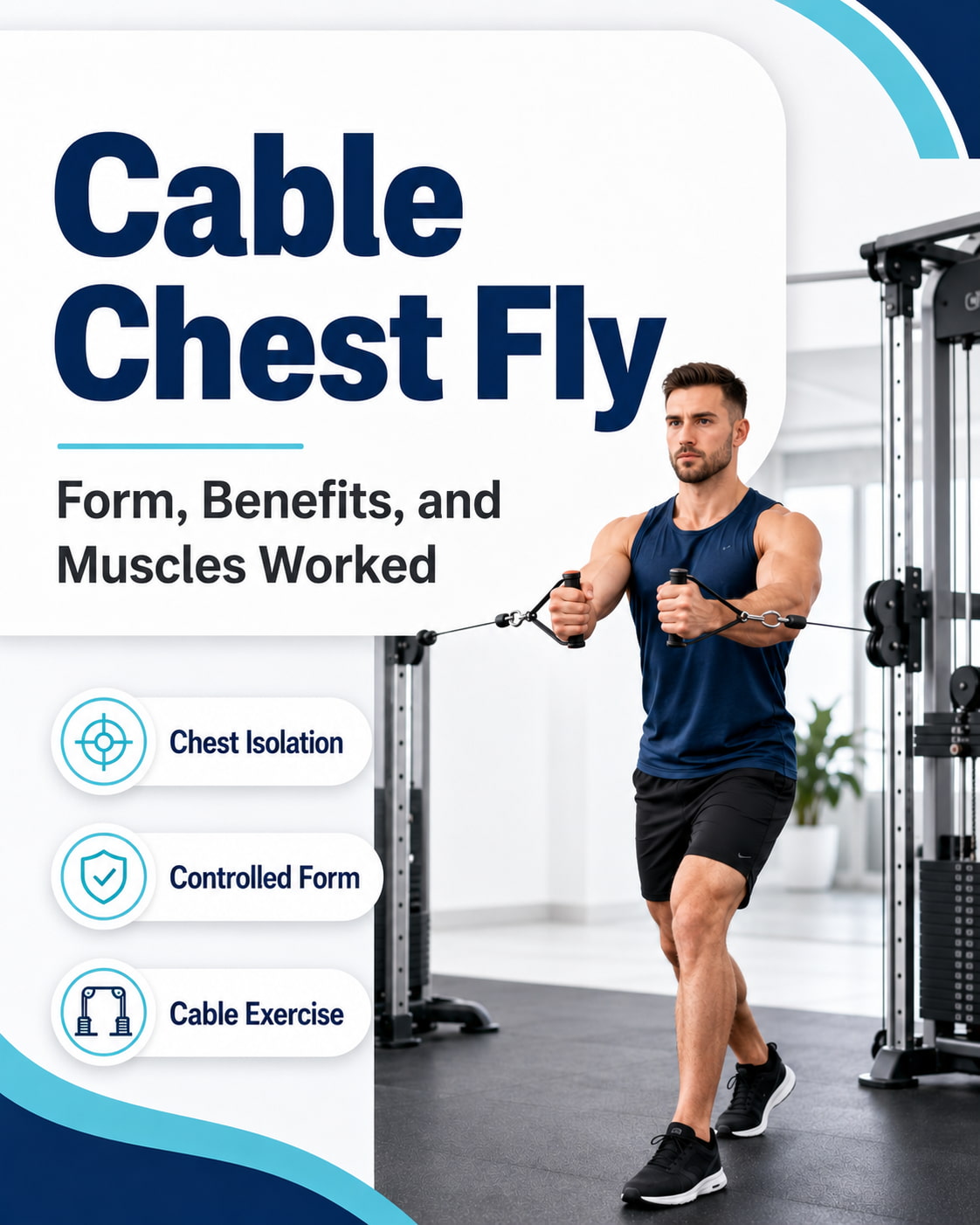
The cable chest fly is a chest-isolation exercise that trains the pectoral muscles by bringing the upper arms toward each other against cable resistance. It works best when you use a manageable load, maintain a small fixed bend in the elbows, and move through a comfortable shoulder range.
Unlike a chest press, the movement involves very little elbow extension. This reduces the contribution of the triceps and places more emphasis on the chest and shoulder muscles.
This guide explains proper cable chest fly form, the muscles worked, benefits, common mistakes, pulley-height variations, sets and reps, and how to include the exercise in a complete chest workout.
Cable Chest Fly at a Glance
| Training detail | Recommendation |
|---|---|
| Primary muscle | Pectoralis major |
| Supporting muscles | Anterior deltoids, rotator cuff, biceps, core |
| Movement pattern | Shoulder horizontal adduction |
| Equipment | Dual adjustable cable machine and handles |
| Difficulty | Beginner to intermediate |
| Suggested repetitions | 8–20 per set |
| Suggested sets | 2–4 |
| Rest | 60–120 seconds |
| Best workout position | Usually after compound chest presses |
| Main goal | Chest isolation and hypertrophy-focused training |
What Is a Cable Chest Fly?
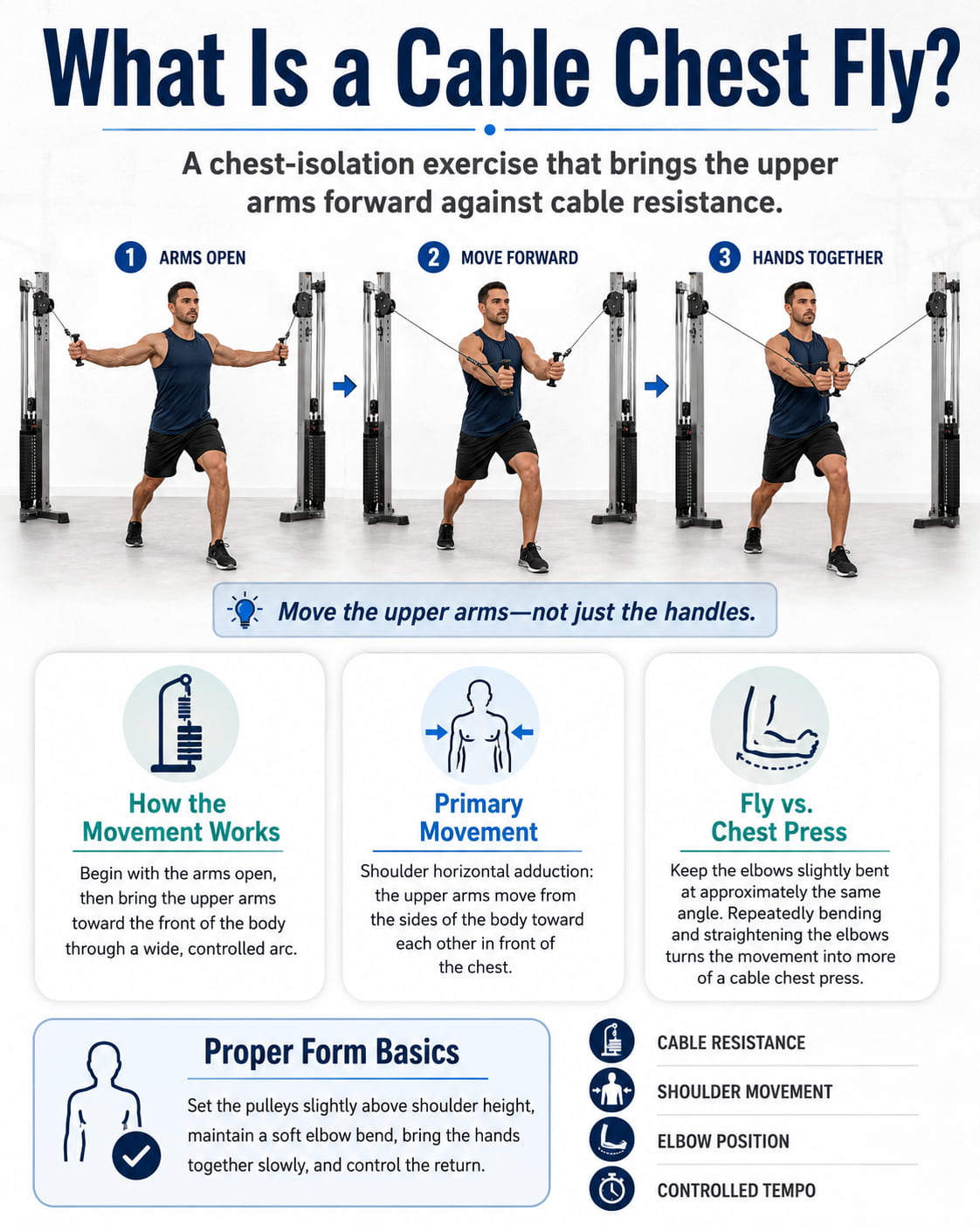
The cable chest fly is a resistance exercise performed between two cable pulleys. You begin with your arms open and then bring your upper arms toward the front of your body through a wide, controlled arc.
The primary movement is shoulder horizontal adduction. This means the upper arms move from the sides of the body toward one another in front of the chest.
During a fly, your elbows remain slightly bent and maintain approximately the same angle throughout the repetition. If the elbows repeatedly bend and straighten, the movement begins to resemble a cable chest press rather than a fly.
The American Council on Exercise standing chest fly guide recommends positioning the pulleys slightly above shoulder height, maintaining a small elbow bend, bringing the hands together slowly, and controlling the return.
Cable Chest Fly vs. Cable Crossover
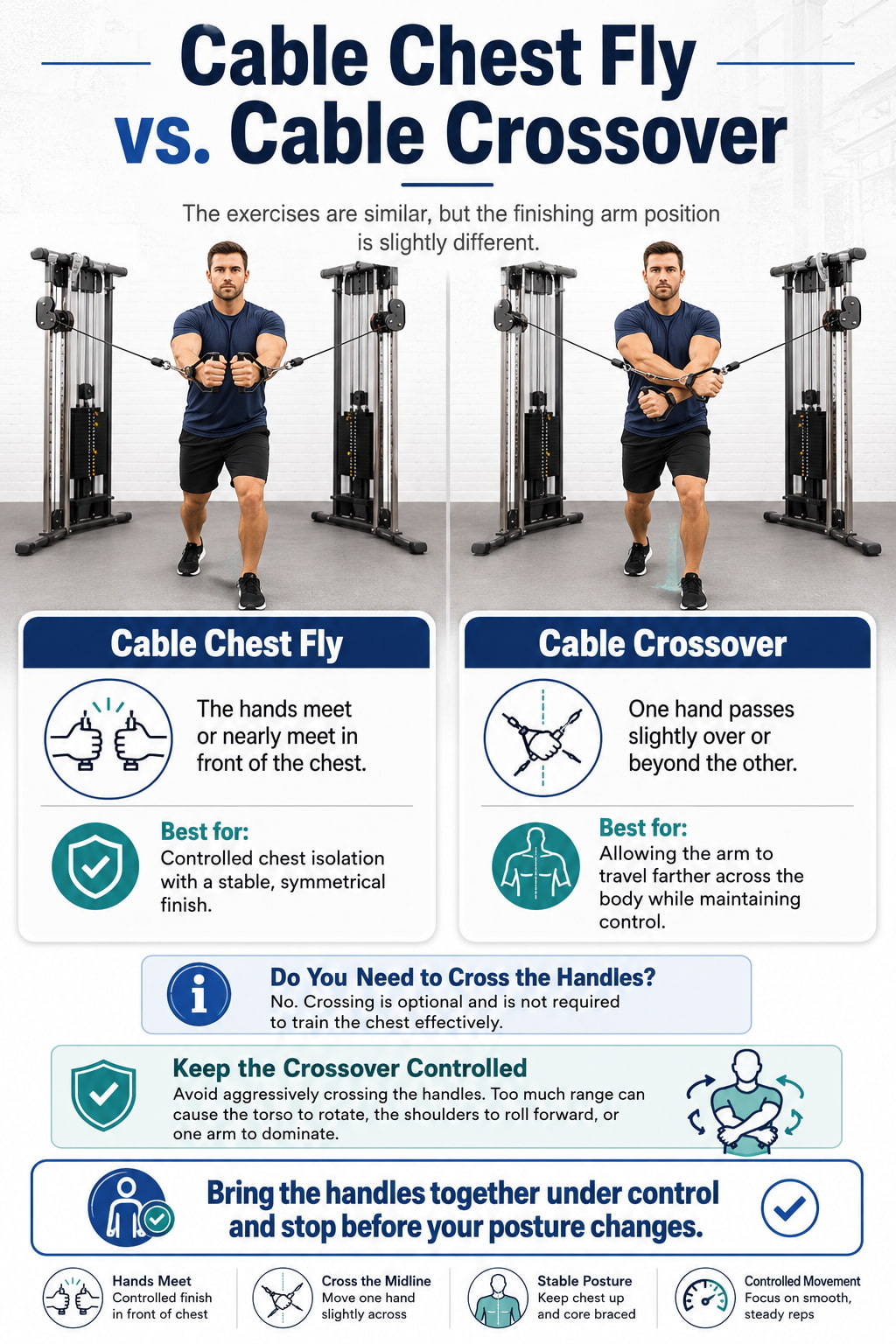
The terms cable fly and cable crossover are often used interchangeably, but there is a small practical difference.
During a cable chest fly, the hands usually meet or nearly meet in front of the chest. During a crossover, one hand passes over or beyond the other so the arms travel farther across the body’s midline.
Crossing the handles is optional. It may create a stronger sensation in the shortened position, but it is not required to train the chest effectively.
Aggressively crossing the handles can cause the torso to rotate, the shoulders to roll forward, or one arm to dominate the movement. Most lifters will get better results by bringing the handles together under control and stopping when they can no longer shorten the chest without losing posture.
How to Do the Cable Chest Fly
Best for: Isolating the chest, adding hypertrophy-focused chest volume, and training the pectorals with less triceps involvement than a press.
Muscles worked: The pectoralis major is the primary muscle. The anterior deltoids, rotator-cuff muscles, biceps, forearms, abdominal muscles, spinal stabilizers, hips, and legs assist or stabilize the position.
Equipment needed: A dual adjustable cable machine and two single-grip handles.
Why it stands out: The cable setup allows you to adjust the pulley height, body position, resistance, arm path, and range of motion. It is also easy to perform bilaterally or one arm at a time.
Suggested sets and reps: Perform 2–4 sets of 8–20 controlled repetitions. A range of 10–15 repetitions works well for most muscle-building workouts.
Beginners: Start with 2 sets of 12–15 repetitions. Use a light resistance that lets you pause briefly when the handles meet without leaning or bending the elbows further.
Intermediate: Perform 3 sets of 10–15 repetitions, stopping with approximately 1–3 good repetitions still possible.
Advanced: Perform 3–4 sets of 8–15 repetitions. Advanced lifters can also use a slower lowering phase, unilateral variations, or a longer comfortable range rather than simply adding more weight.
Rest: Rest for 60–90 seconds between moderate-repetition sets. Use up to 120 seconds when lifting heavier or when your breathing and posture have not fully recovered.
How to do it:
- Attach one handle to each side of a dual cable machine.
- Set both pulleys around shoulder height or slightly above it.
- Hold one handle in each hand and stand in the center of the machine.
- Step forward until the weight stacks rise slightly and the cables become tensioned.
- Use a staggered stance or place your feet about hip-width apart.
- Bend your knees slightly and brace your abdominal muscles.
- Keep your chest tall without excessively arching your lower back.
- Open your arms with a small bend in each elbow.
- Stop when your upper arms are approximately in line with your torso or when you feel a comfortable chest stretch.
- Bring your upper arms forward and inward through a broad arc.
- Keep the elbow angle nearly unchanged as the handles approach each other.
- Pause briefly when the hands meet or nearly meet in front of your chest.
- Slowly open your arms and return to the starting position.
- Maintain control until you complete the final repetition and then step back toward the machine before releasing the handles.
Common mistakes: The most frequent errors are using too much weight, bending and straightening the elbows, allowing the shoulders to roll forward, opening the arms too far behind the torso, leaning the entire body into the movement, and letting the weight stacks pull the arms backward.
Expert tip: Think about moving your upper arms toward each other rather than pushing the handles forward. This cue helps keep the movement at the shoulder and prevents the exercise from becoming a cable press.
Exercise variations: Useful options include the mid-height cable fly, low-to-high cable fly, high-to-low cable fly, single-arm cable fly, seated cable fly, and bench-supported cable fly.
Easier variation: Perform the exercise seated or use a staggered stance with less resistance. A pec-deck machine can also provide more external stability.
Harder variation: Use a controlled single-arm cable fly, add a two- or three-second lowering phase, or gradually increase the resistance while preserving the same range and technique.
Cable Chest Fly Muscles Worked
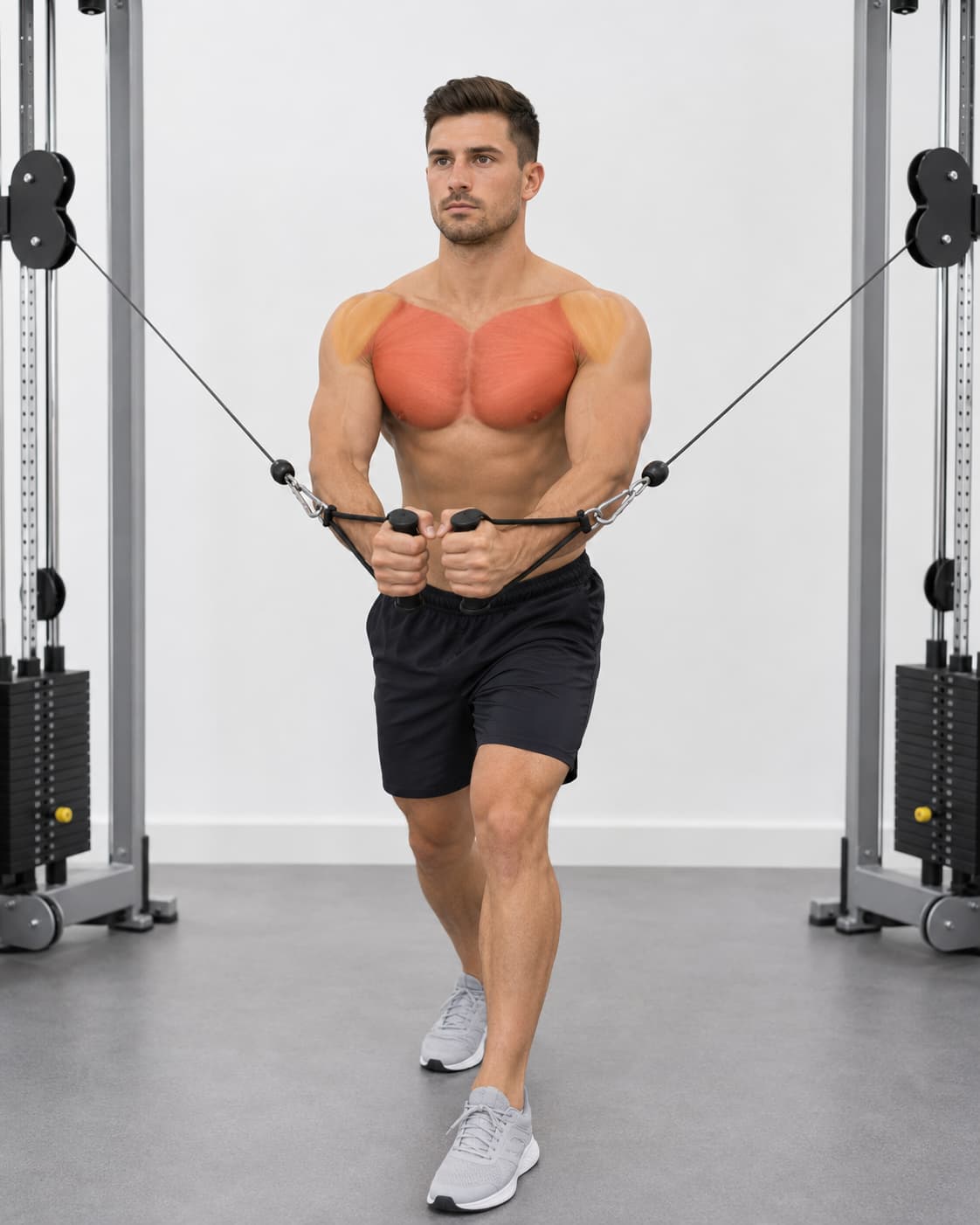
The cable chest fly mainly works the pectoralis major, which is the large fan-shaped muscle covering most of the front of the chest.
The pectoralis major has clavicular and sternocostal regions. Both contribute to moving the upper arm toward the body, although changing the arm path may alter the relative contribution of different fibers.
Pectoralis Major
The pectoralis major is the primary mover during the cable chest fly. Its main role is bringing the upper arm forward and inward across the torso.
The chest generally works hardest when you actively move the upper arms toward each other without allowing the front of the shoulders to roll forward.
Anterior Deltoids
The anterior deltoids at the front of the shoulders assist the chest. Their involvement often increases when the hands travel upward, as in a low-to-high cable fly.
Feeling some front-shoulder effort is normal. However, the shoulders should not completely dominate the exercise. Excessive resistance, an arm path that is too high, or shoulders that roll forward can reduce the quality of the chest contraction.
Rotator-Cuff Muscles
The rotator-cuff muscles help stabilize the shoulder joint as the arms move through the fly. They are not the main muscles producing the movement, but they help maintain control of the upper arm.
This stabilizing role is one reason controlled repetitions are important. Fast or overloaded repetitions can make it harder to maintain a stable shoulder position.
Biceps and Forearms
The biceps work isometrically to help maintain the small bend in the elbows. The forearm and hand muscles maintain your grip and keep your wrists aligned with your forearms.
The biceps should not actively curl the handles. Their role is mainly to hold the elbow angle steady.
Core, Hips, and Legs
During the standing cable chest fly, your abdominal muscles, spinal stabilizers, hips, and legs keep the body still while the arms move.
If the resistance pulls you backward or causes your torso to rock, the load is probably too heavy for controlled chest isolation.
Benefits of the Cable Chest Fly
Provides Direct Chest Training
The cable chest fly allows you to train the pectorals without depending heavily on elbow extension. This makes it useful after bench presses, push-ups, or machine presses, when the triceps may already be tired.
The fly does not remove the shoulders and arms completely, but it reduces their role compared with most pressing exercises.
Adds Chest Volume Without Another Heavy Press
Pressing exercises are effective for building the chest, shoulders, and triceps. However, repeatedly adding heavy presses can also increase overall fatigue.
Cable flyes let you add direct chest work with lighter loads. This can make them useful as a secondary or finishing exercise in a chest, push, or upper-body workout.
A 2023 systematic review of pectoralis-major muscle activity found that the traditional bench press produced high chest activation compared with many alternative chest movements. This supports using cable flyes as a complement to pressing rather than assuming they must replace compound presses. (Applied Sciences systematic review)
Offers an Adjustable Line of Resistance
You can change the pulley height to alter the direction in which the arms travel.
A shoulder-height setup creates a mostly horizontal path. A low pulley creates an upward path, while a high pulley creates a downward path.
These changes may emphasize different regions of the chest, but they do not completely isolate a separate part of the muscle. All versions still involve the pectoralis major.
Maintains Resistance Near the Closed Position
With dumbbell flyes, gravity pulls the weights vertically toward the floor. As the arms approach a vertical position above the chest, the external challenge to horizontal adduction generally decreases.
Cable resistance continues to pull outward as the hands approach each other. This can make the shortened or closed-arm portion feel more challenging.
However, the phrase “constant tension” can be misleading. The cable continues applying external resistance, but the difficulty experienced by the muscle still changes with cable direction, body position, arm angle, and joint leverage.
Makes Unilateral Training Easy
A single-arm cable fly allows you to train one side at a time. This can help you focus on each arm’s path and prevent the stronger side from controlling both handles.
The unilateral version also challenges your trunk to resist rotation. Use a lighter load than you would for a two-arm fly and keep your shoulders and hips facing forward.
Allows Small Load Adjustments
Most cable machines allow smaller resistance increases than fixed dumbbell jumps. This can make progression more manageable, especially for an isolation exercise where a small weight increase may feel significant.
Provides Several Stable Setup Options
You can perform cable flyes standing, seated, kneeling, or supported on a bench.
A supported setup may be useful when balance or body movement limits your ability to focus on the chest. It does not automatically make the exercise better, but it can reduce the amount of stabilization required.
Are Cable Chest Flyes Better Than Bench Presses?
Cable chest flyes and bench presses serve different purposes.
The bench press is a compound movement that trains the chest, anterior deltoids, and triceps while allowing relatively heavy loads. It is generally the better choice for developing pressing strength.
The cable chest fly is an isolation-focused movement that uses lighter loads and minimizes elbow extension. It is generally better suited to adding targeted chest volume after your main presses.
You do not have to choose only one. A productive chest workout can include a press for heavier compound training and a cable fly for more direct pectoral work.
Muscle-activation results should also be interpreted cautiously. Electrical muscle activity measured during one workout does not prove that one exercise will cause more long-term muscle growth than another.
Cable Chest Fly vs. Dumbbell Fly
| Feature | Cable chest fly | Dumbbell fly |
|---|---|---|
| Resistance source | Cable stack | Gravity |
| Standing option | Yes | Usually no |
| Resistance near hands-together position | Usually higher | Usually lower |
| Stability demand | Adjustable | Requires bench and shoulder control |
| Unilateral setup | Easy | Possible but less convenient |
| Load adjustments | Often small increments | Depends on available dumbbells |
| Best use | Chest isolation with adjustable line of pull | Chest isolation with free weights |
Neither variation is automatically superior. Choose the one that feels comfortable, fits your equipment, and lets you train through a controlled range.
Common Cable Chest Fly Mistakes
Using Too Much Weight
A heavy stack may make the exercise look more challenging, but it often causes the torso to lean, the elbows to bend, and the shoulders to roll forward.
Reduce the weight until your torso remains still and the upper arms control the movement.
Turning the Fly Into a Press
If you bend the elbows during the return and then straighten them as the handles move forward, you are performing a hybrid press.
Maintain a small, comfortable elbow bend and keep that angle nearly unchanged throughout the repetition.
Opening the Arms Too Far
An extreme stretch is not required. Letting the cables pull the upper arms far behind the torso can place the shoulders in a position that is difficult to control.
Stop when your upper arms are approximately level with your torso or earlier if your shoulders feel strained.
A biomechanics study comparing bench-press and cable-pulley exercises found that the tested cable exercises could produce substantial shoulder-joint moments. This does not make cable flyes unsafe, but it reinforces the need for appropriate resistance and controlled shoulder positioning. (PubMed)
Rounding the Shoulders at the Finish
Bringing the handles together should not require the shoulders to collapse forward.
Keep your chest controlled, neck relaxed, and shoulder blades moving naturally around the rib cage. Stop the repetition before your posture breaks down.
Shrugging Toward the Ears
Shrugging can shift unnecessary effort toward the upper trapezius and neck.
Keep the shoulders away from the ears while allowing them to move naturally. Do not force the shoulder blades into a rigidly pinned position for the entire repetition.
Leaning Too Far Forward
A small forward body angle may be comfortable, especially with a staggered stance. However, the torso should remain fixed.
If your entire body moves forward during every repetition, reduce the load and reset your stance.
Bending the Wrists
Allowing the wrists to fold backward can make the handles uncomfortable and reduce force transfer.
Keep the wrists neutral and aligned with the forearms.
Slamming the Weight Stack
Letting the plates crash together removes control and can pull the shoulders into the next repetition.
Lower the resistance slowly and keep slight tension on the stack throughout the set.
Crossing the Handles Aggressively
Crossing farther does not necessarily mean greater chest development.
Stop when the hands meet, or use a small alternating crossover only when you can maintain a square torso and controlled shoulder position.
Cable Chest Fly Variations
Mid-Height Cable Chest Fly
Set the pulleys around shoulder height or slightly above it and bring the handles forward in a mostly horizontal path.
This is the best starting variation for learning the exercise. It provides a straightforward arm path and trains the chest without requiring a pronounced upward or downward motion.
Low-to-High Cable Fly
Set the pulleys below hip level and bring the handles upward and inward toward the upper chest.
The upward path includes more shoulder flexion and may place greater emphasis on the clavicular, or upper, fibers of the pectoralis major. The anterior deltoids also assist more strongly.
Use light resistance and avoid turning the movement into a front raise.
High-to-Low Cable Fly
Set the pulleys above shoulder height and bring the handles downward and inward toward the lower chest or upper abdomen.
This direction may place greater emphasis on the sternocostal fibers, but it still trains the chest as a whole.
The ACE standing decline cable fly guide uses handles positioned around head level for a downward arm path.
Single-Arm Cable Fly
Stand with one side closer to the machine and hold one cable handle.
Bring the working arm toward the center of your chest while resisting rotation through your trunk. The arm may travel slightly across the body if your shoulder remains comfortable and your torso stays square.
Seated Cable Fly
Place a stable upright bench between the cable columns and perform the fly while seated.
The bench reduces the ability to use leg drive or body momentum. It can be helpful for beginners or anyone who struggles to remain stable during the standing version.
Bench-Supported Cable Fly
Place a flat or slightly inclined bench between low cable pulleys.
This creates a movement similar to a dumbbell fly while maintaining cable resistance near the top. Setup can vary between machines, so check that the cables move freely and the bench is securely positioned.
Resistance-Band Fly
Attach a resistance band securely behind you and perform the same hugging motion.
Band tension increases as the band stretches, so the resistance profile is not identical to a cable machine. It is still a useful home-training alternative.
How to Choose the Correct Pulley Height
Start with the pulleys around shoulder height. This creates a general chest-focused movement and is normally the easiest version to control.
Use low pulleys when you want an upward arm path. Use high pulleys when you want a downward arm path.
The best pulley height is not determined only by which part of the chest you want to train. Your shoulder comfort, machine design, arm length, and training goal also matter.
A good setup allows your hands, elbows, and shoulders to follow the same general line without forcing the wrists to bend or the shoulders to rotate into an uncomfortable position.
How Much Weight Should You Use?
Choose a resistance that lets you complete the planned repetitions while keeping your torso still, elbows nearly fixed, and shoulders controlled.
For most sets, stop when you feel you could complete approximately one to three additional technically sound repetitions. This is often described as leaving 1–3 repetitions in reserve.
The final repetitions should feel challenging, but your range of motion and posture should remain consistent.
The weight is too heavy when you must shorten the movement, bend the elbows more, lean forward, rotate the torso, or use momentum to bring the handles together.
Cable Chest Fly Sets, Reps, and Rest
| Goal | Sets | Repetitions | Rest | Effort |
|---|---|---|---|---|
| Beginner technique | 2 | 12–15 | 60–90 seconds | 3–4 reps in reserve |
| General muscle building | 3–4 | 8–15 | 60–120 seconds | 1–3 reps in reserve |
| High-repetition accessory work | 2–3 | 15–20 | 45–90 seconds | 1–3 reps in reserve |
| Single-arm training | 2–3 per side | 10–15 | 30–60 seconds between sides | Controlled, no rotation |
These are starting ranges rather than fixed rules. Your total weekly chest training, recovery, experience, and other exercises should determine how much cable-fly volume you need.
The American College of Sports Medicine’s 2026 resistance-training update emphasizes individualized programming, consistent training, and sufficient weekly volume. It also reports that momentary muscular failure and a particular equipment type are not consistently required for results in healthy adults.
How Often Should You Do Cable Chest Flyes?
Most lifters can perform cable chest flyes one or two times per week.
Training them once weekly may be enough when you already perform several chest presses and push-up variations. Two weekly sessions can work well when you divide your chest volume across multiple workouts.
Consider your total chest workload rather than looking only at cable flyes. Bench presses, dumbbell presses, machine presses, push-ups, dips, and fly variations all contribute to weekly chest training.
The ACSM update suggests that approximately 10 weekly sets per muscle group can be a useful hypertrophy target, but individual needs vary. Those sets should include all challenging chest exercises, not 10 sets of cable flyes in addition to every other movement.
When Should You Perform Cable Flyes in a Workout?
Cable flyes usually work best after your main compound pressing exercise.
Beginning with a bench press, dumbbell press, or machine chest press allows you to train pressing strength while fresh. The cable fly can then add more direct chest work without requiring another heavy compound movement.
You may place cable flyes earlier when improving the fly itself is your main goal. However, pre-fatiguing the chest before heavy presses may reduce the amount of weight or repetitions you can perform on those presses.
For most general muscle-building workouts, use this order:
Heavy or moderate compound press, secondary press, cable chest fly, and then optional triceps or shoulder work.
Sample Chest Workout With Cable Flyes
| Exercise | Sets | Repetitions | Rest | Effort |
|---|---|---|---|---|
| Barbell or dumbbell bench press | 3 | 6–10 | 2–3 minutes | 2 reps in reserve |
| Incline dumbbell press | 3 | 8–12 | 90–120 seconds | 1–3 reps in reserve |
| Cable chest fly | 3 | 10–15 | 60–90 seconds | 1–2 reps in reserve |
| Push-up | 2 | Controlled repetitions | 60–90 seconds | Stop before form fails |
Perform this workout once or twice weekly depending on your total training schedule and recovery.
Beginners may use only two sets per exercise. Experienced lifters can add volume gradually when performance remains stable and soreness does not interfere with later workouts.
How to Progress the Cable Chest Fly
Use double progression rather than adding weight every workout.
Choose a repetition range, such as 10–15 repetitions. Begin with a weight you can control for approximately 10–12 repetitions.
Continue using the same resistance until you can complete 15 repetitions in every set with consistent posture, elbow position, and range of motion.
Then increase the resistance by the smallest available amount and return to the lower end of the repetition range.
You can also progress by improving control. A slower two- or three-second return, a brief pause when the handles meet, and a more consistent range can make the exercise harder without immediately increasing the weight.
Do not count shorter, faster, or momentum-assisted repetitions as progress.
Cable Chest Fly Safety Tips
Warm up before using challenging resistance. A few minutes of general movement followed by light chest presses, band movements, or light cable flyes can help you practice the motion before your working sets.
Start with less range than you think you need. Increase the opening position gradually only when the shoulder feels stable and comfortable.
Do not allow the cables to pull your upper arms forcefully behind the torso. Step back toward the machine before releasing the handles at the end of a set.
Avoid forcing your shoulders into a fixed position. The shoulder blades should move naturally around the rib cage as the arms open and close.
Reduce the weight or stop the exercise if you experience shoulder pinching, loss of control, or symptoms that worsen with each repetition.
Stop exercising and seek professional help if the movement causes sharp pain, numbness, dizziness, chest pain, weakness, or unusual symptoms.
Frequently Asked Questions
Are cable chest flyes effective for building muscle?
Yes. Cable chest flyes can be useful for adding direct training volume to the pectoralis major.
They work best as part of a complete program that also includes progressive resistance, sufficient weekly volume, recovery, and often at least one pressing movement.
What muscles do cable chest flyes work?
The pectoralis major is the primary muscle. The anterior deltoids, rotator cuff, biceps, forearms, abdominal muscles, back muscles, hips, and legs assist or stabilize the movement.
Should the cables be high or low for chest flyes?
Shoulder-height cables are the best general starting point.
Low cables create an upward arm path that may emphasize the upper chest. High cables create a downward path that may emphasize more of the sternocostal chest fibers.
These positions bias different regions rather than completely isolating them.
Should you cross your hands during a cable fly?
You do not need to cross your hands.
Bringing the handles together is normally enough. A small controlled crossover can be used, but avoid rotating your torso, rolling the shoulders forward, or aggressively pulling one arm over the other.
Why do I feel cable flyes in my shoulders?
The anterior deltoids naturally assist the chest, so some shoulder involvement is expected.
Excessive shoulder effort may come from using too much weight, setting the pulleys too low, lifting the hands too high, opening the arms too far, or allowing the shoulders to roll forward.
Try reducing the resistance and using a slightly lower, more comfortable arm path.
Is the cable chest fly better than the dumbbell fly?
Neither is universally better.
Cables maintain outward resistance near the hands-together position and make pulley-angle changes easy. Dumbbells are simple, widely available, and provide a different resistance profile.
Choose the variation that feels comfortable and fits your workout.
Can beginners do cable chest flyes?
Yes, but beginners should start with light resistance and learn to keep the elbows, torso, and shoulders controlled.
A seated cable fly or pec-deck machine may be easier when balance and stability make the standing version difficult.
Can cable flyes replace bench presses?
They can train the chest, but they do not fully replace the strength and coordination demands of a compound press.
Use cable flyes as your primary chest movement only when pressing is unavailable, uncomfortable, or does not match your goal. For general chest and upper-body development, combining a press and a fly is often more practical.
Conclusion
The cable chest fly is an effective chest-isolation exercise when you control the resistance, maintain a consistent elbow angle, and move through a comfortable shoulder range.
Start with the pulleys near shoulder height, use 2–4 sets of 8–20 repetitions, and stop most sets before technique breaks down. Progress by adding repetitions and then making small weight increases rather than sacrificing control.
Use cable flyes alongside presses, push-ups, and other upper-body exercises to build a balanced chest-training program.
This content is for informational purposes only and is not a substitute for professional medical advice.
References
- American Council on Exercise: Standing Chest Fly
- American Council on Exercise: Standing Incline Cable Flyes
- American Council on Exercise: Standing Decline Cable Flyes
- American College of Sports Medicine: Updated Resistance Training Guidelines
- PubMed: Movement and Loading of Shoulder, Elbow, and Wrist Joints During Bench Press and Cable Pulley Exercises
- Applied Sciences: Pectoralis Major Activity During Bench Press and Other Chest Exercises
- NCBI Bookshelf: Anatomy of the Pectoralis Major