Chest workouts at home can absolutely build strength and muscle when you train hard enough, use the right exercise progressions, and stay consistent. Current ACSM resistance-training guidance notes that bodyweight exercise, elastic bands, and home-based routines can all improve strength, hypertrophy, and physical function, which makes home chest training a legitimate option, not a backup plan.

This guide covers the best chest workouts at home, how to do them with good form, which muscles they train, the most common mistakes to avoid, and how to build a simple routine whether you are a beginner or more advanced, using practical exercise guidance from ACE.
What Makes a Good Home Chest Workout?
A good home chest workout does three things well: it gives you enough resistance, lets you progress over time, and keeps tension on the chest instead of dumping stress into the shoulders or low back. ACSM also supports a simple approach: traditional gym equipment is not required for results, and many people do well with straightforward programming rather than overly complex methods.
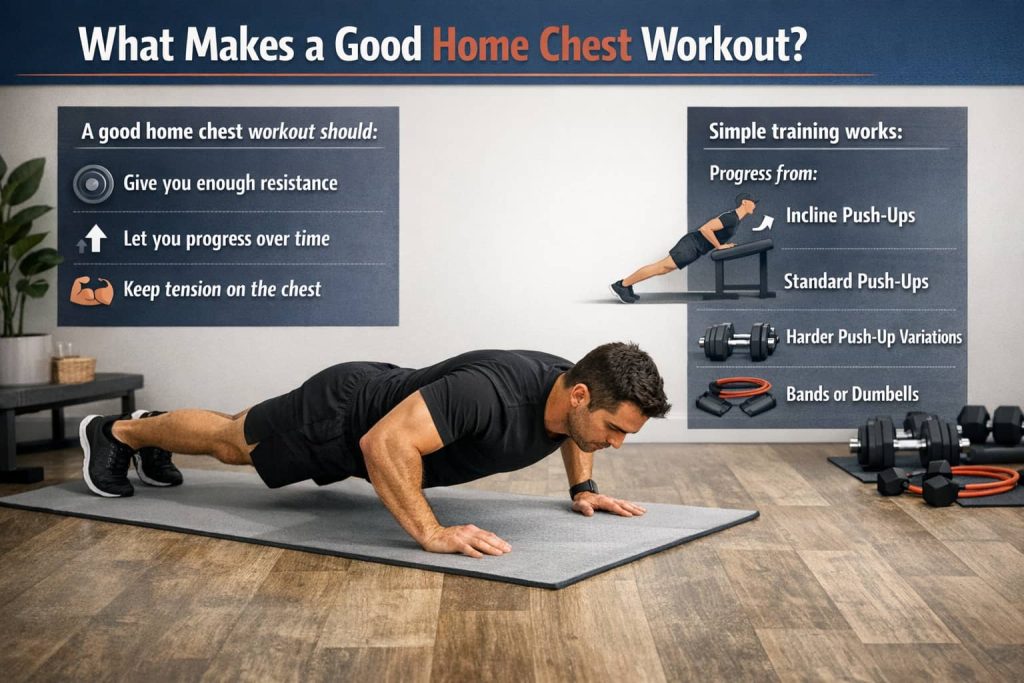
For most people, the easiest way to progress home chest training is to move from easier push-up variations to harder ones, and then add bands or dumbbells when available. NASM notes that incline push-ups reduce loading, while lowering the incline increases the strength demand. Narrower hand placement also increases the challenge for the triceps, and advanced options like single-leg or more complex push-up variations raise the load further.
How Often to Train Chest at Home
Adults should do muscle-strengthening work for all major muscle groups at least two days per week, according to ACSM. For muscle growth, ACSM’s 2026 update notes that around 10 weekly sets per muscle group is a useful benchmark for hypertrophy. A practical way to apply that at home is to train chest 2 to 3 times per week and accumulate roughly 8 to 12 hard sets across the week to start.
12 Best Chest Workouts at Home
The exercises below are some of the most effective choices for home chest training because they are simple, scalable, and results-focused. Whether your goal is strength, muscle size, or better definition, these movements give you a strong place to start.
1) Bent-Knee Push-Up
- Best for: beginners building pressing strength
- Muscles worked: chest, shoulders, arms, core
Why it stands out
This is one of the best regressions for learning push-up mechanics without having to handle full bodyweight. ACE lists it as a beginner no-equipment movement for the arms, chest, and shoulders.
Suggested sets and reps
2 to 4 sets of 8 to 15 reps
How to do it
- Kneel on the floor with your hands about shoulder-width apart.
- Shift forward until your shoulders are stacked over your hands.
- Brace your core and keep your body in a straight line from knees to head.
- Lower under control until your chest gets close to the floor.
- Press back up without letting the hips sag.
Common mistakes: letting the low back sag, pushing the hips up, shortening the range, or rushing the lowering phase. ACE specifically warns against letting the low back sag or the hips hike up.
Coaching cue: Move as one piece from knees to head.
Exercise variations
Wall push-up, high-incline push-up, slow-tempo bent-knee push-up
How to use in a workout
Use this as your main press if you cannot yet do clean full push-ups.
2) Incline Push-Up
- Best for: beginners and intermediates who want full-body push-up mechanics with less load
- Muscles worked: chest, shoulders, triceps, core
- Equipment needed: chair, bench, couch, countertop, or sturdy box
Why it stands out
Incline push-ups are one of the smartest home progressions because you can make them easier or harder by changing the height of the surface. NASM specifically notes that lowering the surface gradually increases the load. ACE also highlights incline push-ups as a strong chest option.
Suggested sets and reps
3 to 4 sets of 8 to 15 reps
How to do it
- Place your hands on a stable elevated surface slightly wider than shoulder width.
- Walk your feet back until your body forms a straight line.
- Brace your abs and glutes.
- Lower your chest toward the edge with control.
- Press back to the top without shrugging your shoulders.
Common mistakes: using a surface that is too low too soon, losing body alignment, or bouncing off the edge.
Coaching cue: Bring your chest to the surface, not your face.
Exercise variations
Wall push-up, lower-incline push-up, feet-staggered incline push-up
How to use in a workout
Great as a first main exercise in a beginner chest session or as a warm-up pattern before harder push-ups.
3) Standard Push-Up
- Best for: full body chest training with no equipment
- Muscles worked: arms, chest, shoulders, core, glutes, quads
Why it stands out
The standard push-up is the foundation of home chest training. ACE lists it as a no-equipment movement for the arms, chest, and shoulders, and its setup demands core, glute, and quad tension to keep the body aligned.
Suggested sets and reps
3 to 5 sets of 6 to 20 reps
How to do it
- Start in a straight-arm plank with hands shoulder-width apart.
- Set your shoulders over your hands.
- Brace your abs, squeeze your glutes, and keep your head aligned with your spine.
- Lower until your chest or chin reaches the floor.
- Press back up and think about pushing the floor away.
Common mistakes: sagging through the low back, hips rising early, partial reps, and flaring the elbows without control. ACE specifically warns against low-back sag and hips hiking upward.
Coaching cue: Push the floor away and keep ribs down.
Exercise variations
Tempo push-up, pause push-up, band-resisted push-up, feet-elevated push-up
How to use in a workout
This should be the main movement in most no-equipment chest workouts.
4) Close-Grip Push-Up
- Best for: extra triceps involvement while still training the chest
- Muscles worked: chest, triceps, shoulders, core
Why it stands out
ACE notes that changing hand and elbow position can shift emphasis away from the chest toward the triceps and may reduce shoulder stress for some lifters. That makes the close-grip push-up a useful second press after your main chest movement.
Suggested sets and reps
2 to 4 sets of 6 to 15 reps
How to do it
- Set up as for a standard push-up.
- Bring your hands in slightly narrower than usual.
- Keep your elbows closer to your ribs as you lower.
- Pause just above the floor.
- Press back up without losing torso tension.
Common mistakes: placing the hands too close together, letting the shoulders round forward, or turning it into a shallow half rep.
Coaching cue: Keep the elbows brushing the ribs.
Exercise variations
Bent-knee close-grip push-up, incline close-grip push-up
How to use in a workout
Use this as your second pressing movement for moderate reps after standard or incline push-ups.
5) Decline Push-Up
- Best for: making bodyweight chest training harder without extra equipment
- Muscles worked: chest, shoulders, arms, core
- Equipment needed: bench, couch, step, or sturdy box
Why it stands out
Once standard push-ups feel easy, decline push-ups are one of the cleanest progressions. NASM includes decline work in its push-up progression path, and ACE notes that decline push-ups train the chest, shoulders, arms, and core.
Suggested sets and reps
3 to 4 sets of 6 to 12 reps
How to do it
- Put your feet on a stable elevated surface.
- Place your hands on the floor just wider than shoulder width.
- Brace hard before each rep.
- Lower your chest under control.
- Press to full lockout without letting the hips drop.
Common mistakes: using too much elevation, shrugging the shoulders, or rushing through short reps.
Coaching cue: Stay long from heels to head.
Exercise variations
Low-decline push-up, one-leg decline push-up
How to use in a workout
Use this as the first exercise in an advanced no-equipment chest session.
6) Negative Push-Up
- Best for: building strength for your first full push-up or improving control
- Muscles worked: chest, shoulders, triceps, core
Why it stands out
The lowering phase is where many people lose control. A negative push-up lets you overload that part of the movement and build the strength needed for standard reps. This fits well with NASM guidance to manipulate body alignment and difficulty to build strength with push-up progressions.
Suggested sets and reps
3 to 5 sets of 3 to 6 reps with 3 to 5 seconds down
How to do it
- Start at the top of a standard push-up.
- Brace hard.
- Lower as slowly as possible for 3 to 5 seconds.
- When you reach the floor, reset from the knees or stand back up.
- Repeat with the same control.
Common mistakes: dropping at the bottom, losing alignment, or trying to do too many reps and turning the set sloppy.
Coaching cue: Own the way down.
Exercise variations
Negative incline push-up, negative close-grip push-up
How to use in a workout
Use it before full push-ups if you are still building the strength to perform clean reps.
7) Pause Push-Up
- Best for: increasing difficulty without extra load
- Muscles worked: chest, shoulders, triceps, core
Why it stands out
Adding a pause removes momentum and makes each rep more honest. It is a simple way to make home chest workouts harder when you do not have heavier equipment. That fits ACSM guidance that results do not require fancy methods, only enough training stimulus.
Suggested sets and reps
2 to 4 sets of 5 to 10 reps with a 1 to 2 second pause near the bottom
How to do it
- Perform a standard push-up descent.
- Stop just above the floor for 1 to 2 seconds.
- Keep your body rigid during the pause.
- Press back up under control.
Common mistakes: relaxing at the bottom, collapsing through the shoulders, or pausing too high.
Coaching cue: Freeze, then drive.
Exercise variations
Incline pause push-up, decline pause push-up
How to use in a workout
Great after your main push-up variation when regular reps are too easy.
8) Spiderman Push-Up
- Best for: advanced bodyweight chest work with extra core demand
- Muscles worked: chest, shoulders, triceps, core, hip flexors
Why it stands out
NASM includes the Spiderman push-up as a progression where you pull one knee toward the elbow during the descent. It adds complexity and anti-rotation demand without needing extra equipment.
Suggested sets and reps
2 to 4 sets of 4 to 8 reps per side
How to do it
- Start in a standard push-up.
- As you lower, drive one knee toward the same-side elbow.
- Briefly hold that position.
- Press back up and return the foot.
- Alternate sides.
Common mistakes: rushing the knee drive, twisting the torso too much, or shortening the pressing range.
Coaching cue: Bring the knee up without rotating the chest open.
Exercise variations
Incline Spiderman push-up, slow Spiderman push-up
How to use in a workout
Use as an advanced accessory after your main pressing movement.
9) Single-Leg Push-Up
- Best for: advanced lifters who need more upper-body loading and stability demand
- Muscles worked: chest, shoulders, triceps, core, glutes
Why it stands out
NASM specifically recommends lifting one foot during push-ups to challenge core and shoulder stability. This is a smart way to make home chest work tougher before jumping to very unstable equipment.
Suggested sets and reps
2 to 4 sets of 5 to 10 reps, alternating which leg is raised
How to do it
- Set up in a standard push-up.
- Lift one foot slightly off the floor.
- Keep the hips level as you lower.
- Press back up without twisting.
- Switch legs on the next rep or set.
Common mistakes: rotating the pelvis, kicking the leg too high, or losing rib position.
Coaching cue: Level hips, quiet torso.
Exercise variations
Single-leg incline push-up, single-leg decline push-up
How to use in a workout
Use when standard push-ups are too easy and you want more challenge without changing equipment.
10) Standing Band Chest Press
- Best for: adding resistance and training the chest through multiple angles at home
- Muscles worked: chest, shoulders, triceps, core
- Equipment needed: resistance band and a secure anchor point
Why it stands out
ACE notes that resistance bands allow a standing chest press with the band anchored behind you, and that you can push at slightly different angles to challenge the chest in different ways. ACE’s chest training material also highlights the standing resistance-band chest press as a favorite home-friendly chest exercise.
Suggested sets and reps
3 to 5 sets of 8 to 15 reps
How to do it
- Anchor the band behind you at about chest height.
- Hold the handles or ends and step forward into tension.
- Set a split or balanced stance and brace your core.
- Press straight forward until the arms extend.
- Return with control, keeping the shoulders down.
Common mistakes: using a weak band, letting the shoulders shrug, or losing stance stability.
Coaching cue: Press forward, ribs down.
Exercise variations
High-to-low band press, low-to-high band press, staggered-stance band press
How to use in a workout
Make this your main chest exercise when push-ups bother the wrists or when you want easier overload.
11) Single-Arm Band Chest Press
- Best for: unilateral chest work and anti-rotation strength
- Muscles worked: chest, shoulder, triceps, core
- Equipment needed: resistance band and secure anchor point
Why it stands out
ACE explains that the single-arm chest press keeps the anchor at shoulder height and asks you to brace the trunk while pressing one arm at a time. That makes this variation especially useful for balancing sides and adding extra core demand.
Suggested sets and reps
2 to 4 sets of 8 to 12 reps per side
How to do it
- Anchor the band behind you at shoulder height.
- Stand tall with a slight knee bend.
- Hold one handle in one hand and brace the abs.
- Press the arm straight forward.
- Pause, then return slowly.
Common mistakes: twisting the torso, leaning into the press, or letting the elbow drift too high.
Coaching cue: Press the handle, not your body.
Exercise variations
Half-kneeling single-arm band press, split-stance single-arm band press
How to use in a workout
Use after bilateral pressing or when one side clearly feels weaker.
12) Dumbbell Floor Press or Chest Press
- Best for: building chest strength and size at home with dumbbells
- Muscles worked: arms, chest, shoulders
- Equipment needed: dumbbells
Why it stands out
Hospital for Special Surgery notes that chest press work can be done on the floor or on a bench, which makes it ideal for home training. ACE also emphasizes shoulder position, controlled lowering, and pressing back up without excessive back arching.
Suggested sets and reps
3 to 5 sets of 6 to 12 reps
How to do it
- Lie on your back on the floor with dumbbells at chest level.
- Set your shoulders down and back.
- Press the dumbbells up in a straight path.
- Lower under control until your upper arms lightly contact the floor.
- Press back up without bouncing.
Common mistakes: flaring the elbows too aggressively, rushing the lowering phase, or arching hard through the low back.
Coaching cue: Pin the shoulders, then press.
Exercise variations
Neutral-grip floor press, alternating dumbbell floor press, one-arm floor press
How to use in a workout
Use this as your first exercise when you have dumbbells and want a more strength-focused chest session.
Common Mistakes in Chest Workouts at Home
The biggest mistake is choosing exercises that are either too easy or too advanced. If you can do 25 sloppy reps, the movement is probably not challenging enough. If you cannot keep your torso rigid or control the lowering phase, it is probably too advanced. NASM is a good reminder that difficulty should increase gradually by changing body angle, hand or foot position, or stability demands.
The next mistake is poor body alignment. ACE repeatedly emphasizes a rigid torso, head aligned with the spine, and avoiding a sagging low back or hips hiking upward during push-ups. That applies to nearly every bodyweight chest exercise in this article.
Another common issue is forgetting progression. Home chest workouts work best when you make them harder over time by reducing incline height, adding reps, slowing the lowering phase, adding pauses, elevating the feet, or adding band or dumbbell resistance, which is exactly the kind of progression NASM recommends.
How to Build a Chest Workout at Home
A simple chest workout at home usually works best with one main press, one secondary press, and one accessory movement. That gives you enough quality work without turning the session into random fatigue. ACSM supports tailoring load and volume to your goal while also keeping the program simple enough to do consistently.
Beginner Option
- Incline push-up — 3 sets of 8 to 12
- Bent-knee push-up — 2 sets of 8 to 12
- Standing band chest press or wall push-up — 2 to 3 sets of 10 to 15
This gives you 7 to 8 chest-focused sets in one session, which is plenty for a beginner starting out twice per week under the general weekly framework recommended by ACSM.
Intermediate Option
- Standard push-up — 4 sets of 8 to 15
- Close-grip push-up — 3 sets of 8 to 12
- Standing band chest press — 3 sets of 10 to 15
- Standing chest fly — 2 sets of 12 to 15
ACE lists the standing chest fly as a solid chest accessory with bands or cables, especially after your pressing work.
Advanced Option
- Decline push-up — 4 sets of 6 to 10
- Dumbbell floor press — 4 sets of 6 to 10
- Spiderman push-up — 2 to 3 sets of 6 per side
- Single-arm band chest press — 2 to 3 sets of 8 to 12 per side
This option gives you more mechanical tension, more unilateral work, and enough weekly volume to support strength and size if you perform it 2 times per week and recover well, which aligns with broader programming principles from ACSM.
Accessory Finisher Option
Do 2 to 3 rounds of:
- 8 to 12 push-ups
- 12 to 15 band chest presses
- 12 to 15 band chest fly reps
Keep rest short and focus on clean reps and continuous tension. This is best used at the end of an upper-body day, not every session.
Progression Tips for Better Results
The fastest way to stall is to repeat the same easy version forever. Instead, progress one variable at a time: increase reps, reduce the incline, add a pause, elevate the feet, use a stronger band, or add dumbbells. NASM supports using body angle and hand or foot placement to scale difficulty, while ACSM reinforces that outcomes improve when training is matched to your goal and progressed over time.
A good rule is to stay within a target rep range and move to a harder variation once you can hit the top of that range with clean technique on all sets. That keeps your chest workouts at home challenging enough for continued strength and hypertrophy under the basic progression model supported by ACSM.
FAQs
Are chest workouts at home effective for building muscle?
Yes. ACSM states that bodyweight exercise, elastic bands, and home-based routines can produce meaningful improvements in strength and hypertrophy. The key is using enough effort, enough weekly volume, and progressive overload.
Are push-ups enough for chest growth?
Push-ups can be enough for a while, especially if you use progressions like incline, standard, pause, decline, or single-leg versions. But once high-rep standard push-ups become too easy, adding bands, dumbbells, or harder variations usually makes growth easier, as explained by NASM.
What is the best chest workout at home for beginners?
For most beginners, incline push-ups and bent-knee push-ups are the best starting point because they teach proper alignment and pressing mechanics with less load than standard floor push-ups. ACE and Hospital for Special Surgery both support starting with modified push-up patterns before progressing to the classic version.
How many times per week should I train chest at home?
A practical target is 2 to 3 times per week. ACSM says adults should train the major muscle groups at least two days per week, and its 2026 update suggests around 10 weekly sets per muscle group is a useful benchmark for hypertrophy.
Do I need dumbbells for a good home chest workout?
No. Push-ups and resistance-band presses are enough to build a strong foundation. Dumbbells simply give you another way to load the chest more directly through floor presses and related variations, which fits the flexible home-training approach supported by ACSM.
Should chest workouts at home hurt my shoulders?
No. Muscle fatigue and effort are normal, but sharp pain is not. ACE emphasizes bracing the torso and maintaining alignment, and improper setup is a common reason pressing variations bother the shoulders or low back. If an exercise causes sharp pain, numbness, dizziness, or unusual symptoms, stop and get qualified medical advice.
Conclusion
The best chest workouts at home are the ones you can perform well, progress consistently, and recover from. Start with a push-up variation that matches your level, add a band or dumbbell press when you can, and aim to build your week around 2 to 3 chest-focused sessions with clean technique and enough total work to improve, following the practical progression approach outlined by NASM.
Pick 3 to 5 exercises from this list, build them into a simple routine, and focus on doing them better and harder over time. That is how home chest training turns into real strength, size, and definition.
References
- American College of Sports Medicine (ACSM) — ACSM Publishes Updated Resistance Training Guidelines
- American College of Sports Medicine (ACSM) — Physical Activity Guidelines
- American Council on Exercise (ACE) — Push-Up Exercise Library
- American Council on Exercise (ACE) — Bent-Knee Push-Up Exercise Library
- American Council on Exercise (ACE) — Chest Press Exercise Library
- National Academy of Sports Medicine (NASM) — NASM Guide to Push-Ups: Strength and Hypertrophy
- National Academy of Sports Medicine (NASM) — Push-Up Progressions
- Hospital for Special Surgery (HSS) — A Guide to Your Chest Muscles: Anatomy and Exercises
1 thought on “12 Best Chest Workouts at Home for Strength, Size & Definition”