Cable tricep exercises are some of the best movements for building bigger, stronger upper arms because they keep steady tension on the triceps through a controlled range of motion. The cable machine also lets you train the triceps from different angles, including pushdowns, overhead extensions, single-arm variations, and lying extensions.
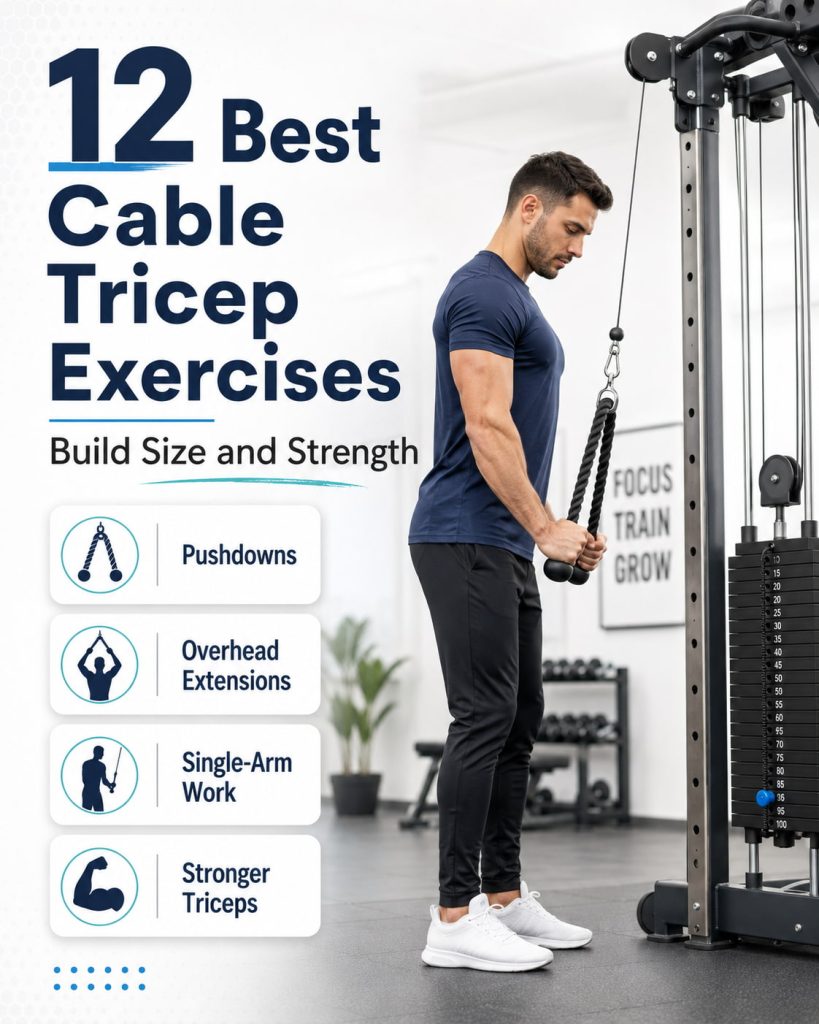
This guide covers the best cable tricep exercises, how to do each one correctly, which muscles they target, common mistakes to avoid, and how to build a practical triceps workout for size and strength.
Muscles Worked by Cable Tricep Exercises
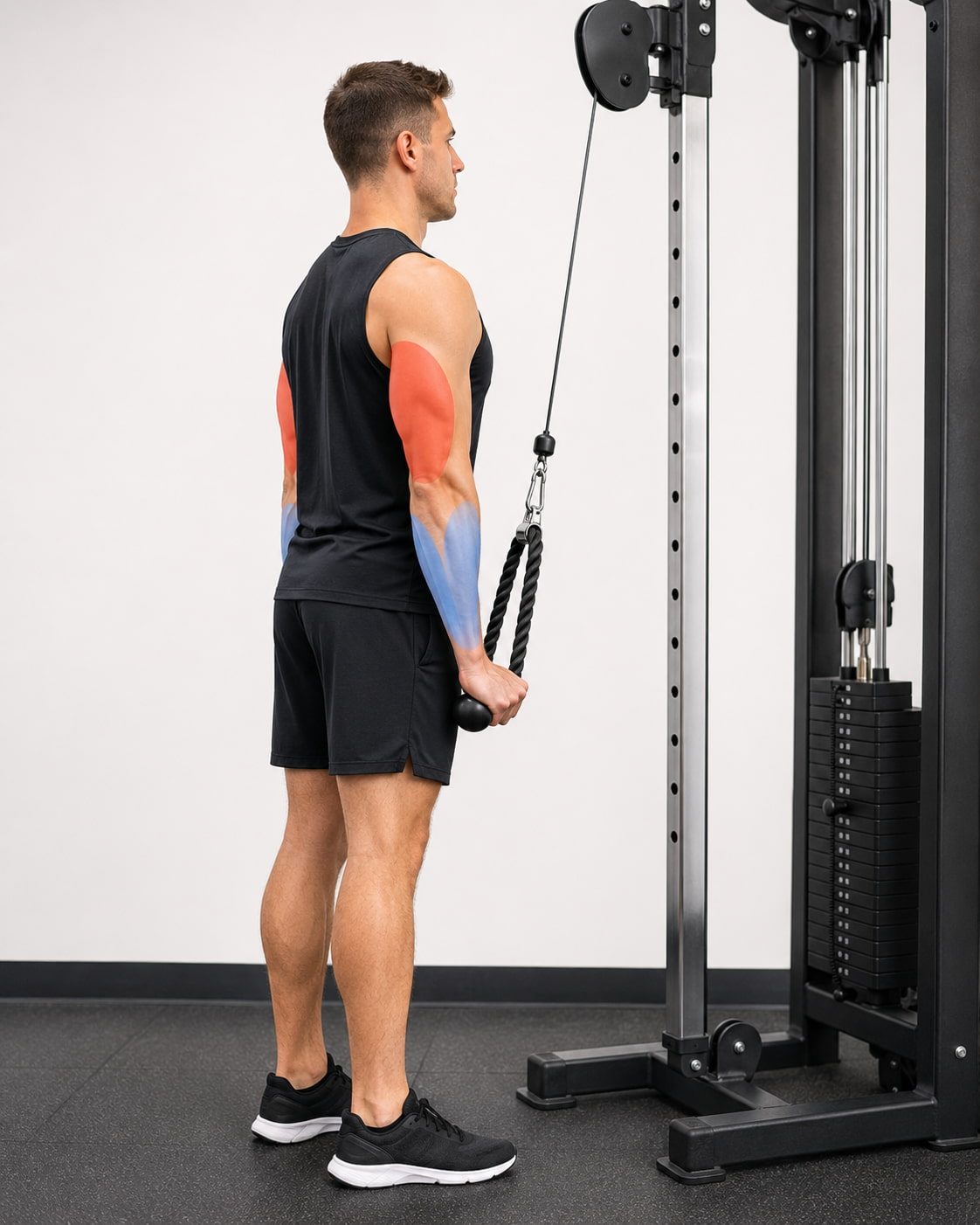
The main muscle worked is the triceps brachii, the large muscle on the back of the upper arm. According to NCBI Bookshelf’s triceps anatomy overview, the triceps has three heads: the long head, lateral head, and medial head.
The long head crosses the shoulder joint, so it is strongly involved when the arm is overhead or behind the body. That is why overhead cable extensions are important for complete triceps development.
The lateral head is the outer part of the triceps and often gives the arm a strong, defined look from the side.
The medial head sits deeper and helps with elbow extension across many pressing and extension movements.
Cable tricep exercises also involve smaller stabilizers in the shoulders, upper back, forearms, grip, and core, especially when you use single-arm or standing variations.
Why Cable Tricep Exercises Are Effective
Cable tricep exercises are effective because they let you train the triceps with control, constant tension, and many joint-friendly setup options.
A standard rope pushdown is easy to learn, making it useful for beginners. A straight-bar or V-bar pushdown allows heavier loading, which can support strength. Overhead cable extensions train the triceps in a stretched position, which may be especially useful for building the long head. A PubMed-indexed study found greater triceps growth after overhead cable elbow extension training compared with neutral-arm cable elbow extension training, especially in the long head.
Cable exercises also make it easy to adjust the movement. If one grip bothers your elbows or wrists, you can switch from a straight bar to a rope, single handle, or cross-body setup without leaving the cable station.
12 Best Cable Tricep Exercises for Size and Strength
These 12 cable tricep exercises help you train the long, lateral, and medial heads of the triceps with steady tension and controlled form.
Use them to build stronger arms with pushdowns, overhead extensions, single-arm variations, and cable movements that fit beginner to advanced workouts.
1. Rope Cable Triceps Pushdown
Best for: Beginners, high-rep triceps work, clean elbow extension, and learning cable tricep control.
Muscles worked: Triceps brachii, especially the lateral and medial heads, with help from the forearms, shoulders, upper back, and core for stability.
Equipment needed: Cable machine and rope attachment.
Why it stands out: The rope pushdown is one of the most useful cable tricep exercises because it is simple, joint-friendly, and easy to adjust. The rope allows a more natural wrist position than a fixed straight bar, which can feel better for many lifters.
Suggested sets and reps: Do 2–4 sets of 10–15 reps. Use a weight that lets you control the full movement without leaning hard into the cable.
Rest: Rest 45–75 seconds between sets for muscle growth or 75–90 seconds if using heavier loads.
How to do it:
- Set the cable pulley above head height and attach a rope.
- Stand facing the machine with your feet hip-width apart or in a staggered stance.
- Hold the rope with a neutral grip and bring your elbows close to your sides.
- Brace your core, keep your chest tall, and pull your shoulders down and back.
- Push the rope down by straightening your elbows.
- Separate the rope slightly at the bottom if you can do it without twisting your wrists.
- Slowly return until your elbows bend, then repeat.
Common mistakes: Using too much weight, leaning forward, letting the elbows drift in front of the body, shrugging the shoulders, bending the wrists, or bouncing the stack.
Expert tip: Think “elbows pinned, hands down.” The more your upper arms move, the less strict the triceps work becomes.
2. Straight-Bar Cable Triceps Pushdown
Best for: Building triceps strength with a stable grip and heavier pushdown loading.
Muscles worked: Triceps brachii, forearms, grip, shoulders, and core.
Equipment needed: Cable machine and straight-bar attachment.
Why it stands out: The straight-bar pushdown is easier to load heavily than many rope variations. Because both hands stay fixed on the bar, it can feel stable and powerful when your wrists tolerate the grip.
Suggested sets and reps: Do 3–4 sets of 8–12 reps. For strength-focused accessory work, use 6–10 controlled reps.
Rest: Rest 60–90 seconds between sets.
How to do it:
- Set the pulley at the highest position and attach a straight bar.
- Grip the bar with your palms facing down.
- Stand tall with your elbows tucked close to your sides.
- Brace your core and keep your shoulders down.
- Push the bar down until your elbows are straight.
- Control the bar back up without letting your elbows move forward.
- Repeat for the target reps.
Common mistakes: Letting the wrists bend back, turning it into a chest-and-shoulder press, flaring the elbows, and using body momentum.
Expert tip: Do not chase a heavy stack if your elbows or wrists lose position. A slightly lighter weight with stricter reps will usually build the triceps better.
3. V-Bar Cable Triceps Pushdown
Best for: Strong pushdowns, comfortable wrist positioning, and controlled heavy triceps work.
Muscles worked: Triceps brachii, forearms, grip, shoulders, and core.
Equipment needed: Cable machine and V-bar attachment.
Why it stands out: The V-bar gives you a semi-neutral grip that often feels stronger and more comfortable than a straight bar. It is a good option for lifters who want to push heavier weight without forcing the wrists into a fully pronated position.
Suggested sets and reps: Do 3–4 sets of 8–12 reps.
Rest: Rest 60–90 seconds between sets.
How to do it:
- Attach a V-bar to the high pulley.
- Stand close enough that the cable moves straight down.
- Hold the handles with a firm semi-neutral grip.
- Keep your elbows close to your ribs and your torso still.
- Push the handle down until your arms are straight.
- Return slowly until your elbows bend.
- Repeat without letting the weight stack slam.
Common mistakes: Standing too far away, rolling the shoulders forward, overextending the wrists, or cutting the top half of the rep short.
Expert tip: Keep the upper arm quiet and let the elbow do the work.
4. Reverse-Grip Cable Pushdown
Best for: Lighter triceps isolation, controlled reps, and lifters who want a different grip angle.
Muscles worked: Triceps brachii, especially the medial head, plus forearms and grip.
Equipment needed: Cable machine with straight-bar, EZ-bar, or single-handle attachment.
Why it stands out: The reverse-grip pushdown uses a palms-up grip. It usually requires less weight than standard pushdowns, but it can help you slow down and feel the triceps working without as much momentum.
Suggested sets and reps: Do 2–3 sets of 10–15 reps.
Rest: Rest 45–75 seconds between sets.
How to do it:
- Attach a straight bar or EZ-bar to a high pulley.
- Hold the bar with your palms facing up.
- Stand tall and keep your elbows close to your sides.
- Brace your core and keep your wrists straight.
- Extend your elbows to push the bar down.
- Squeeze briefly at the bottom.
- Return slowly and repeat.
Common mistakes: Going too heavy, curling the wrists, letting the elbows drift forward, or turning the movement into a pulldown.
Expert tip: Use this exercise for control, not ego. The reverse grip works best when every rep is smooth.
5. Single-Arm Cable Pushdown
Best for: Improving triceps control, balancing left and right sides, and training around wrist discomfort.
Muscles worked: Triceps brachii, forearms, grip, shoulder stabilizers, and core.
Equipment needed: Cable machine with single handle or no attachment.
Why it stands out: Single-arm work helps you notice whether one side is stronger, smoother, or more controlled than the other. It also lets your hand move naturally, which can feel better on the elbow and wrist.
Suggested sets and reps: Do 2–4 sets of 10–15 reps per side.
Rest: Rest 30–60 seconds between sides or 60–75 seconds after both arms.
How to do it:
- Set the pulley high and attach a single handle, or hold the cable end.
- Stand facing the cable machine.
- Hold the handle with one hand and tuck that elbow close to your side.
- Brace your core and keep your shoulder still.
- Push down until your elbow is straight.
- Slowly return to the starting position.
- Complete all reps, then switch sides.
Common mistakes: Twisting the torso, letting the shoulder roll forward, using too much weight, or shortening the range of motion.
Expert tip: Start with your weaker arm and copy the same reps, tempo, and range of motion on your stronger arm.
6. Overhead Rope Cable Triceps Extension
Best for: Long-head triceps growth, stretched-position training, and hypertrophy-focused arm workouts.
Muscles worked: Triceps brachii, especially the long head, plus core, shoulders, and upper back.
Equipment needed: Cable machine and rope attachment, usually from a low pulley.
Why it stands out: The overhead position places the long head of the triceps in a lengthened position. This makes the overhead rope extension one of the most valuable cable tricep exercises for size.
Suggested sets and reps: Do 3–4 sets of 10–15 reps.
Rest: Rest 60–90 seconds between sets.
How to do it:
- Attach a rope to a low cable pulley.
- Face away from the machine and hold the rope behind your head.
- Step forward into a split stance.
- Brace your core and keep your ribs down.
- Keep your elbows pointing mostly forward.
- Extend your elbows until your arms are straight.
- Lower slowly until you feel a controlled stretch in the triceps.
Common mistakes: Arching the lower back, letting the elbows flare too wide, turning it into a shoulder press, or using a range that irritates the shoulders.
Expert tip: Keep your ribs stacked over your pelvis. If your lower back arches hard, the weight is probably too heavy.
7. Single-Arm Overhead Cable Triceps Extension
Best for: Long-head focus, left-right balance, and controlled overhead triceps training.
Muscles worked: Triceps brachii, especially the long head, with core and shoulder stabilizers.
Equipment needed: Cable machine and single handle, or cable without a handle.
Why it stands out: This variation lets each arm move independently. It can be easier to adjust the elbow path and shoulder angle compared with a two-arm overhead extension.
Suggested sets and reps: Do 2–3 sets of 10–15 reps per side.
Rest: Rest 30–60 seconds between sides or 60–90 seconds after both arms.
How to do it:
- Set the cable to a low position and attach a single handle.
- Face away from the machine with the handle behind your head.
- Step forward and brace your core.
- Keep your working elbow pointed forward or slightly outward.
- Extend your elbow until your arm is straight.
- Lower slowly into a comfortable stretch.
- Finish the set, then switch sides.
Common mistakes: Twisting the torso, shrugging the shoulder, forcing too much stretch, or letting the elbow wander.
Expert tip: Your shoulder position should feel stable before you start the rep. Adjust your stance and pulley distance before adding weight.
8. Cable Triceps Pushaway
Best for: Long-head tension, overhead-style training, and lifters who want a strong stretched triceps movement without standing fully upright.
Muscles worked: Triceps brachii, especially the long head, plus shoulders, upper back, and core.
Equipment needed: Cable machine and rope attachment.
Why it stands out: The pushaway uses a forward-leaning body angle. It feels like a blend between an overhead extension and a cable skull crusher, giving you a strong stretch without needing to stand directly overhead.
Suggested sets and reps: Do 2–4 sets of 10–15 reps.
Rest: Rest 60–90 seconds between sets.
How to do it:
- Attach a rope to a low or mid-low cable pulley.
- Face away from the machine and hold the rope near the sides of your head.
- Step forward and lean slightly away from the cable.
- Keep your core braced and elbows pointing forward.
- Extend your elbows to push the rope forward and slightly upward.
- Lower slowly until your elbows bend and the triceps stretch.
- Repeat without letting your torso swing.
Common mistakes: Turning it into a chest press, losing core tension, flaring the elbows too wide, or standing too close to the machine.
Expert tip: Keep your upper arms angled forward and steady. The cable should pull your triceps into a loaded stretch, not pull your whole body backward.
9. Lying Cable Triceps Extension
Best for: Strict triceps training, strength-focused isolation, and lifters who want a cable version of skull crushers.
Muscles worked: Triceps brachii, shoulders, upper back stabilizers, forearms, and grip.
Equipment needed: Cable machine, flat bench, and EZ-bar, straight-bar, or rope attachment.
Why it stands out: Lying cable triceps extensions keep steady tension on the triceps while the bench limits body movement. This makes it easier to train hard without turning the exercise into a full-body movement.
Suggested sets and reps: Do 3–4 sets of 8–12 reps.
Rest: Rest 75–120 seconds between sets.
How to do it:
- Place a flat bench near a low cable pulley.
- Attach a rope, EZ-bar, or straight bar.
- Lie on the bench with your head closest to the cable.
- Hold the attachment above your chest or slightly behind your head.
- Keep your upper arms steady.
- Bend your elbows to lower the attachment under control.
- Extend your elbows to return to the starting position.
Common mistakes: Letting the upper arms swing, lowering too fast, flaring the elbows aggressively, or turning the movement into a pullover.
Expert tip: Keep the movement at the elbow. A small upper-arm angle is fine, but the main action should be elbow flexion and extension.
10. Incline Cable Triceps Extension
Best for: Deep triceps stretch, long-head hypertrophy, and strict form.
Muscles worked: Triceps brachii, especially the long head, with shoulder and upper-back stabilizers.
Equipment needed: Cable machine, incline bench, and rope or EZ-bar attachment.
Why it stands out: The incline bench supports your torso, making it easier to control your ribs and shoulder position. The cable keeps tension on the triceps while the incline angle allows a strong stretch.
Suggested sets and reps: Do 2–4 sets of 10–15 reps.
Rest: Rest 60–90 seconds between sets.
How to do it:
- Set an incline bench in front of a low cable pulley.
- Attach a rope or EZ-bar.
- Lie back on the bench with the attachment held above or behind your head.
- Brace your core and keep your upper arms steady.
- Bend your elbows slowly into a stretch.
- Extend your elbows until your arms are straight.
- Repeat with smooth, controlled reps.
Common mistakes: Setting the bench too far away, losing shoulder position, using too much weight, or letting the cable pull the arms out of control.
Expert tip: Use the bench to stay strict. If your body starts sliding or your shoulders feel unstable, reset the setup.
11. Cable Cross-Body Triceps Extension
Best for: Joint-friendly single-arm triceps work, control, and finishing sets.
Muscles worked: Triceps brachii, forearms, grip, shoulder stabilizers, and core.
Equipment needed: Cable machine and single handle, or no handle.
Why it stands out: The cross-body path often feels natural for the elbow and shoulder. Instead of pushing straight down, you extend your arm across the body, which can help some lifters feel the triceps without wrist strain.
Suggested sets and reps: Do 2–3 sets of 12–20 reps per side.
Rest: Rest 30–60 seconds between sides or 60 seconds after both arms.
How to do it:
- Set the pulley around upper-chest to head height.
- Stand sideways to the cable machine.
- Hold the cable or handle with the far hand.
- Start with your elbow bent and your hand near the opposite side of your chest.
- Extend your elbow across and down until your arm is straight.
- Return slowly to the start.
- Repeat, then switch sides.
Common mistakes: Rotating the whole torso, rushing the reps, shrugging the shoulder, or using a weight that pulls you out of position.
Expert tip: Keep your body quiet and let the triceps finish the movement.
12. Cable Triceps Kickback
Best for: Light isolation, peak contraction, and triceps finishers.
Muscles worked: Triceps brachii, rear delts, upper back stabilizers, core, and forearms.
Equipment needed: Cable machine and single handle, or no handle.
Why it stands out: Cable kickbacks keep tension on the triceps better than many dumbbell kickback setups, especially when the cable line matches your arm path. This is not the best heavy triceps exercise, but it is excellent for controlled finishing work.
Suggested sets and reps: Do 2–3 sets of 12–20 reps per side.
Rest: Rest 30–60 seconds between sides or 60 seconds after both arms.
How to do it:
- Set the pulley low and attach a single handle, or hold the cable end.
- Stand facing the machine or slightly angled away.
- Hinge at the hips with a flat back.
- Keep your upper arm close to your side and slightly behind your torso.
- Extend your elbow until your arm is straight behind you.
- Squeeze the triceps briefly.
- Bend your elbow slowly and repeat.
Common mistakes: Swinging the arm, rotating the torso, going too heavy, dropping the elbow, or shortening the squeeze.
Expert tip: Keep the weight light enough that the triceps, not momentum, finishes every rep.
How to Choose the Best Cable Tricep Exercises
The best choice depends on your goal.
For beginners, start with rope pushdowns, V-bar pushdowns, and single-arm cable pushdowns. These are easier to learn and usually easier to control.
For size, include at least one overhead or stretched-position cable triceps exercise, such as the overhead rope extension, single-arm overhead extension, cable pushaway, or incline cable extension.
For strength, use stable variations that allow controlled heavier loading, such as straight-bar pushdowns, V-bar pushdowns, and lying cable triceps extensions.
For elbow comfort, use rope pushdowns, single-arm pushdowns, and cross-body extensions. Keep the load moderate and avoid forcing a hard lockout.
For a complete triceps workout, combine one pushdown, one overhead or stretched-position movement, and one single-arm or finishing exercise.
Common Cable Tricep Exercise Mistakes
Using Too Much Weight
If the weight makes you lean, swing, shrug, or lose elbow position, it is too heavy. Cable tricep exercises work best when the triceps control the rep from start to finish.
Letting the Elbows Drift Forward
During pushdowns, the elbows should usually stay close to your sides. ACE’s triceps pushdown exercise guidance also emphasizes keeping the elbows close and controlling the movement rather than letting the body take over.
Turning Extensions Into Shoulder Exercises
Your shoulders will stabilize the movement, but the main action should happen at the elbow. If your upper arms move too much, the exercise becomes less focused on the triceps.
Cutting the Range of Motion Short
You do not need to force a painful stretch, but most people should use a controlled range that bends and straightens the elbows fully enough to challenge the triceps.
Rushing the Lowering Phase
The lowering phase helps you control tension. Use a smooth 2–3 second eccentric on most cable tricep exercises.
Ignoring Joint Feedback
Mild muscle burn is normal during hard sets. Sharp pain, numbness, tingling, dizziness, chest pain, or unusual symptoms are not normal. Stop and seek professional help if those symptoms happen.
Cable Tricep Workout Routine
Beginner Cable Tricep Workout
Use this routine 1–2 times per week after your upper-body workout.
| Exercise | Sets | Reps | Rest |
|---|---|---|---|
| Rope Cable Triceps Pushdown | 2–3 | 10–15 | 60 sec |
| Single-Arm Cable Pushdown | 2 | 10–12 per side | 45–60 sec |
| Overhead Rope Cable Triceps Extension | 2 | 10–15 | 60 sec |
Effort level: Finish most sets with 2–3 reps in reserve.
Progression: Add reps first. When you can complete the top of the rep range with clean form, increase the weight slightly.
Intermediate Cable Tricep Workout
Use this routine 1–2 times per week depending on how much pressing you already do.
| Exercise | Sets | Reps | Rest |
|---|---|---|---|
| V-Bar Cable Triceps Pushdown | 3 | 8–12 | 75–90 sec |
| Overhead Rope Cable Triceps Extension | 3 | 10–15 | 75–90 sec |
| Cable Cross-Body Triceps Extension | 2–3 | 12–20 per side | 45–60 sec |
Effort level: Finish most sets with 1–2 reps in reserve.
Progression: Add one rep per set before increasing load. Keep your elbows and shoulders comfortable.
Advanced Cable Tricep Workout
Use this as a focused triceps session or after a lighter push workout.
| Exercise | Sets | Reps | Rest |
|---|---|---|---|
| Straight-Bar Cable Triceps Pushdown | 3–4 | 6–10 | 90 sec |
| Lying Cable Triceps Extension | 3 | 8–12 | 90–120 sec |
| Single-Arm Overhead Cable Triceps Extension | 2–3 | 10–15 per side | 60 sec |
| Cable Triceps Kickback | 2 | 15–20 per side | 45–60 sec |
Effort level: Most sets should stop with 0–2 reps in reserve, but form must stay strict.
Progression: Add load only when you can keep the same range of motion, elbow position, and tempo.
Weekly Programming Tips
For most lifters, cable tricep exercises work well 1–3 times per week. Your total triceps volume should include both direct triceps isolation and indirect work from pressing exercises such as bench presses, push-ups, dips, and overhead presses.
The American College of Sports Medicine notes that resistance-training variables should match the goal. For muscle growth, higher weekly volume is often useful. For strength, heavier loading and longer rest may be more appropriate.
A practical weekly target for many lifters is:
Beginners: 4–6 direct triceps sets per week.
Intermediate lifters: 8–12 direct triceps sets per week.
Advanced lifters: 10–16 direct triceps sets per week, only if recovery and elbow comfort are good.
More sets are not automatically better. If your elbows feel irritated, your pressing strength drops, or your reps get sloppy, reduce volume before adding more exercises.
FAQs About Cable Tricep Exercises
Are cable tricep exercises good for building muscle?
Yes. Cable tricep exercises are useful for building muscle because they provide steady resistance, allow many angles, and make it easy to train close to fatigue with control.
What is the best cable tricep exercise?
There is no single best option for everyone. Rope pushdowns are best for beginners, straight-bar and V-bar pushdowns are useful for heavier loading, and overhead rope extensions are excellent for long-head triceps development.
Are overhead cable extensions better than pushdowns?
They are not better for everything, but they train the triceps differently. Overhead cable extensions place the long head in a stretched position, while pushdowns are usually easier to load and control. A complete triceps plan can include both.
How many cable tricep exercises should I do in one workout?
Most people only need 2–4 cable tricep exercises in one workout. A good structure is one pushdown, one overhead or stretched-position extension, and one single-arm or finisher movement.
How often should I train triceps?
Most lifters can train triceps 1–3 times per week. If you already do a lot of chest and shoulder pressing, you may need fewer direct triceps sets.
Why do my elbows hurt during cable tricep exercises?
Elbow discomfort can happen when the load is too heavy, the range is forced, the wrists are bent, or total triceps volume is too high. Switch to a lighter weight, try a rope or single-arm variation, slow the reps down, and stop if pain continues.
Should I lock out my elbows on cable tricep exercises?
You can straighten your elbows under control, but do not snap or jam the joint. Think about squeezing the triceps at the end of the rep rather than forcing a harsh lockout.
Conclusion
Cable tricep exercises are a practical way to build stronger, bigger arms because they let you train the triceps with steady tension and many adjustable angles. For the best results, use a mix of pushdowns, overhead extensions, and single-arm variations.
Start with clean form, progress gradually, and choose exercises that feel strong on your elbows and shoulders. A simple plan done consistently will beat a complicated routine done with sloppy reps.
This content is for informational purposes only and is not a substitute for professional medical advice.
References
- American Council on Exercise: Triceps Pushdowns
- American Council on Exercise: Triceps Extension
- NCBI Bookshelf: Anatomy, Shoulder and Upper Limb, Triceps Muscle
- PubMed: Triceps Brachii Hypertrophy Is Greater After Overhead Versus Neutral Cable Elbow Extension Training
- PMC: The Different Role of Each Head of the Triceps Brachii Muscle in Elbow Extension
- PubMed: ACSM Position Stand on Progression Models in Resistance Training for Healthy Adults