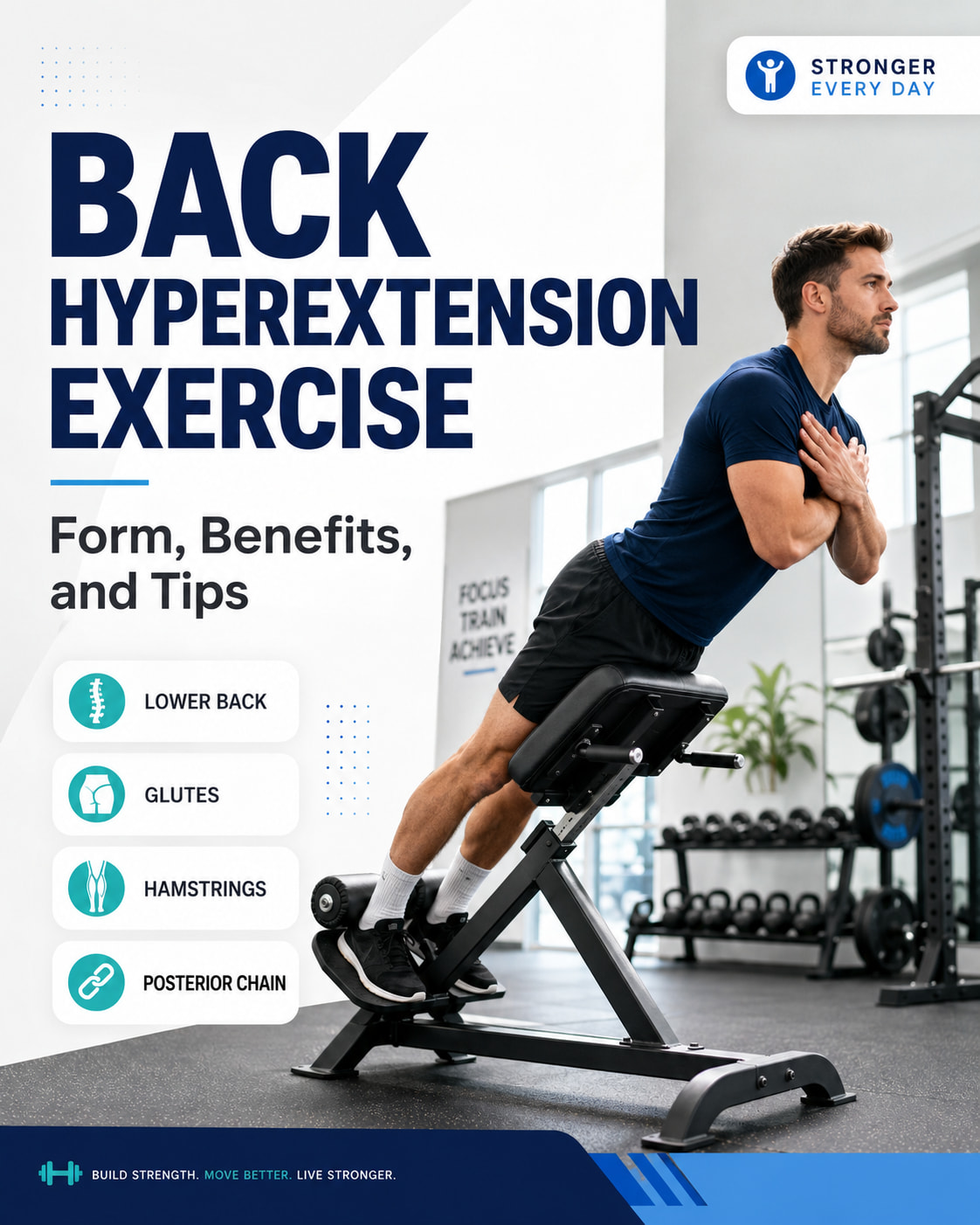
The back hyperextension exercise is a posterior-chain movement that strengthens the lower back, glutes, and hamstrings when performed with controlled form. Although many people call it a “hyperextension,” the goal is usually to extend your body to a strong neutral line, not force your spine into an aggressive arch.
This guide explains how to do the back hyperextension exercise correctly, which muscles it works, common mistakes to avoid, beginner-friendly options, progressions, and how to add it to a safe workout routine.
What Is the Back Hyperextension Exercise?
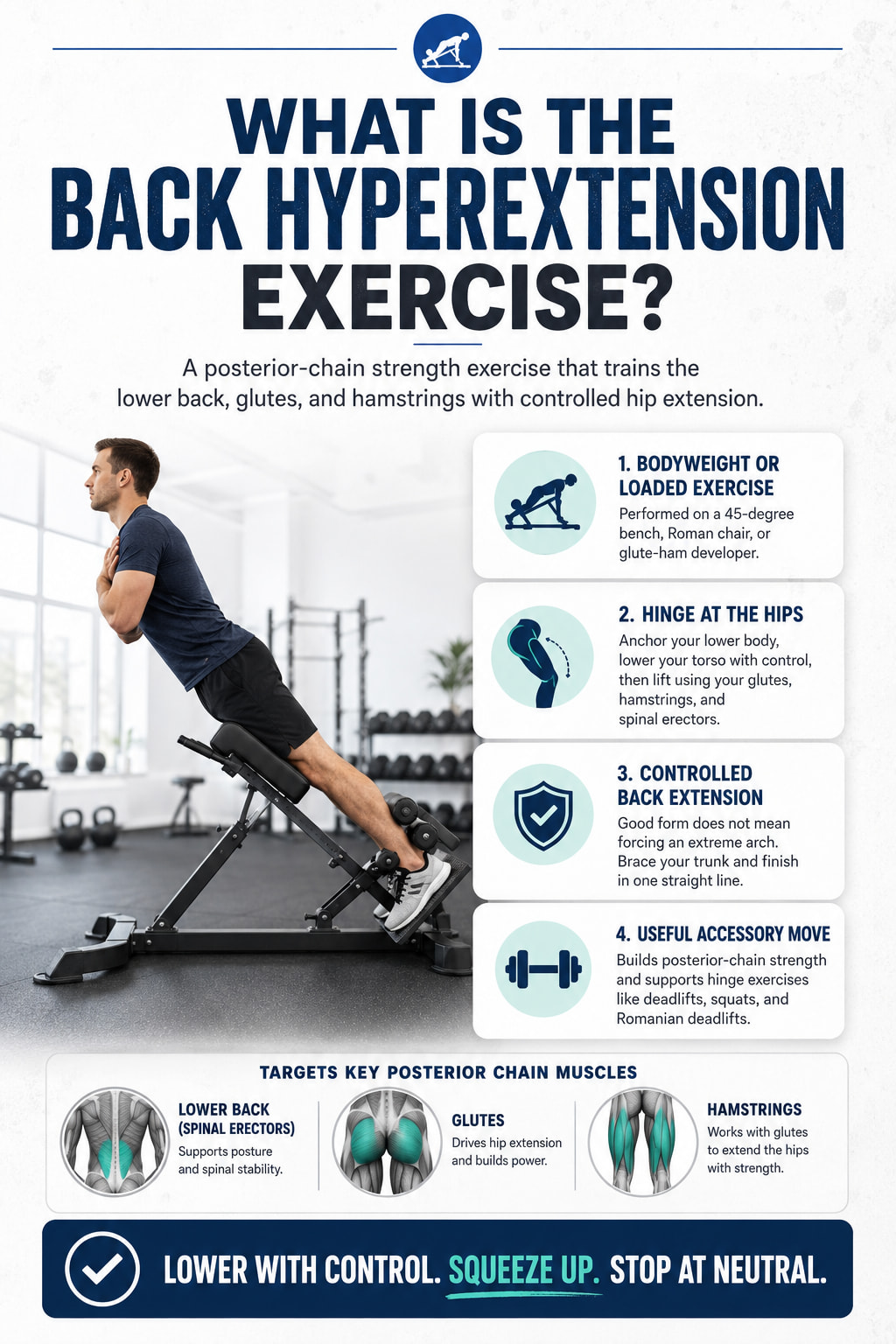
The back hyperextension exercise is a bodyweight or loaded strength exercise usually performed on a 45-degree hyperextension bench, Roman chair, or glute-ham developer. You anchor your lower body, hinge at the hips, lower your torso under control, then lift back up using your glutes, hamstrings, and spinal erectors.
Despite the name, good form does not mean throwing your back into extreme extension. For most lifters, the better coaching goal is a controlled back extension: lower with control, brace your trunk, squeeze your glutes, and finish with your shoulders, hips, and legs in one straight line.
This makes the movement useful for building posterior-chain strength, improving hip-hinge control, and adding accessory work after deadlifts, squats, Romanian deadlifts, or lower-body training.
Back Hyperextension Exercise Muscles Worked
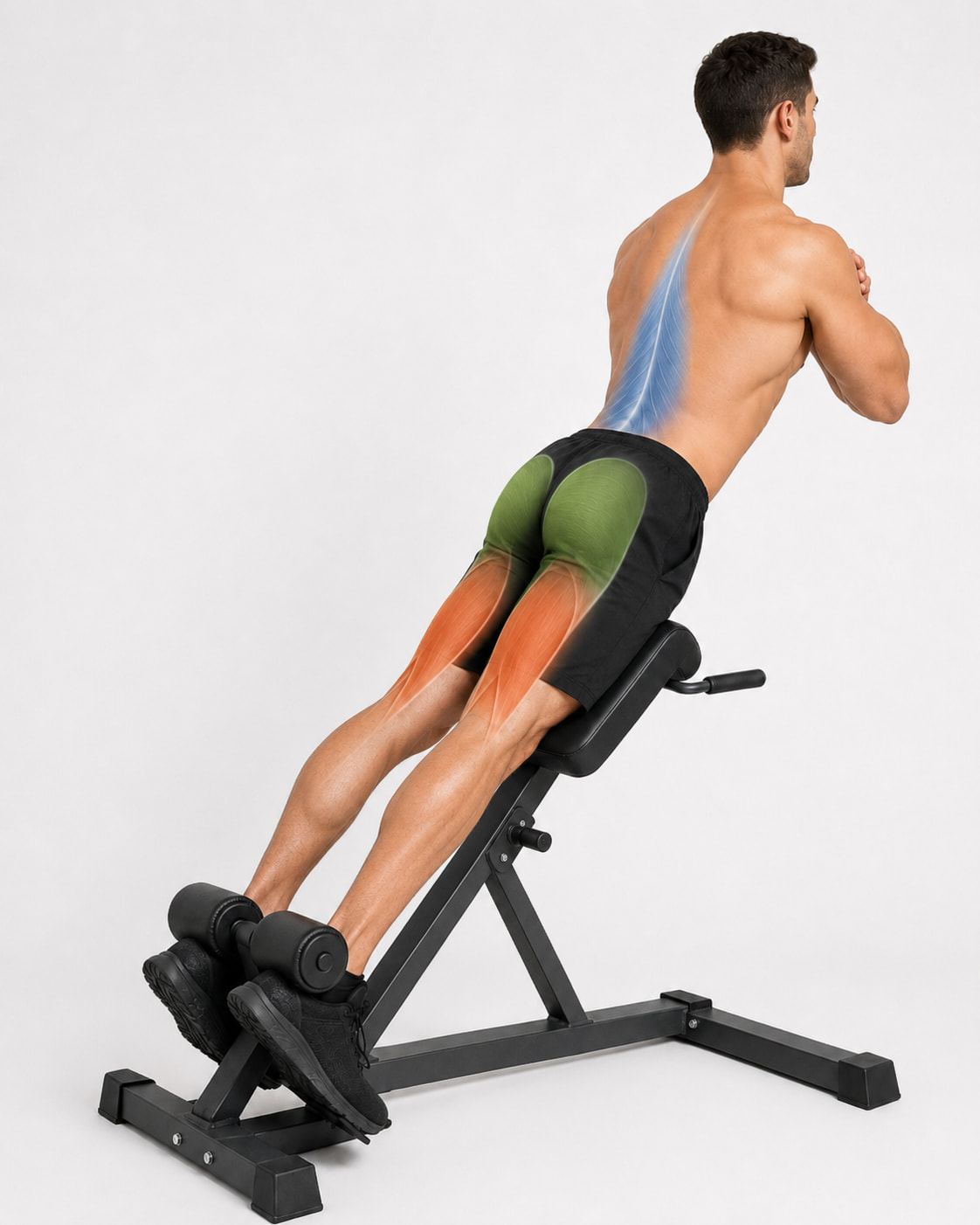
The back hyperextension exercise mainly trains the muscles on the back side of the body, often called the posterior chain.
The main muscles worked are the erector spinae, which run along the spine and help extend and stabilize the back. Your gluteus maximus helps extend the hips as you lift your torso. Your hamstrings, especially the biceps femoris, assist with hip extension and help control the lowering phase.
Your deep core muscles also work to keep the trunk stable. The abs are not the prime movers, but they help prevent excessive arching and keep your ribs and pelvis controlled.
A muscle-activation study comparing the Romanian deadlift, 45-degree Roman chair back extension, and seated machine back extension found that the Roman chair back extension produced strong gluteus maximus and biceps femoris activation, while all three exercises were appropriate choices for activating the lower-back muscles.
Benefits of the Back Hyperextension Exercise
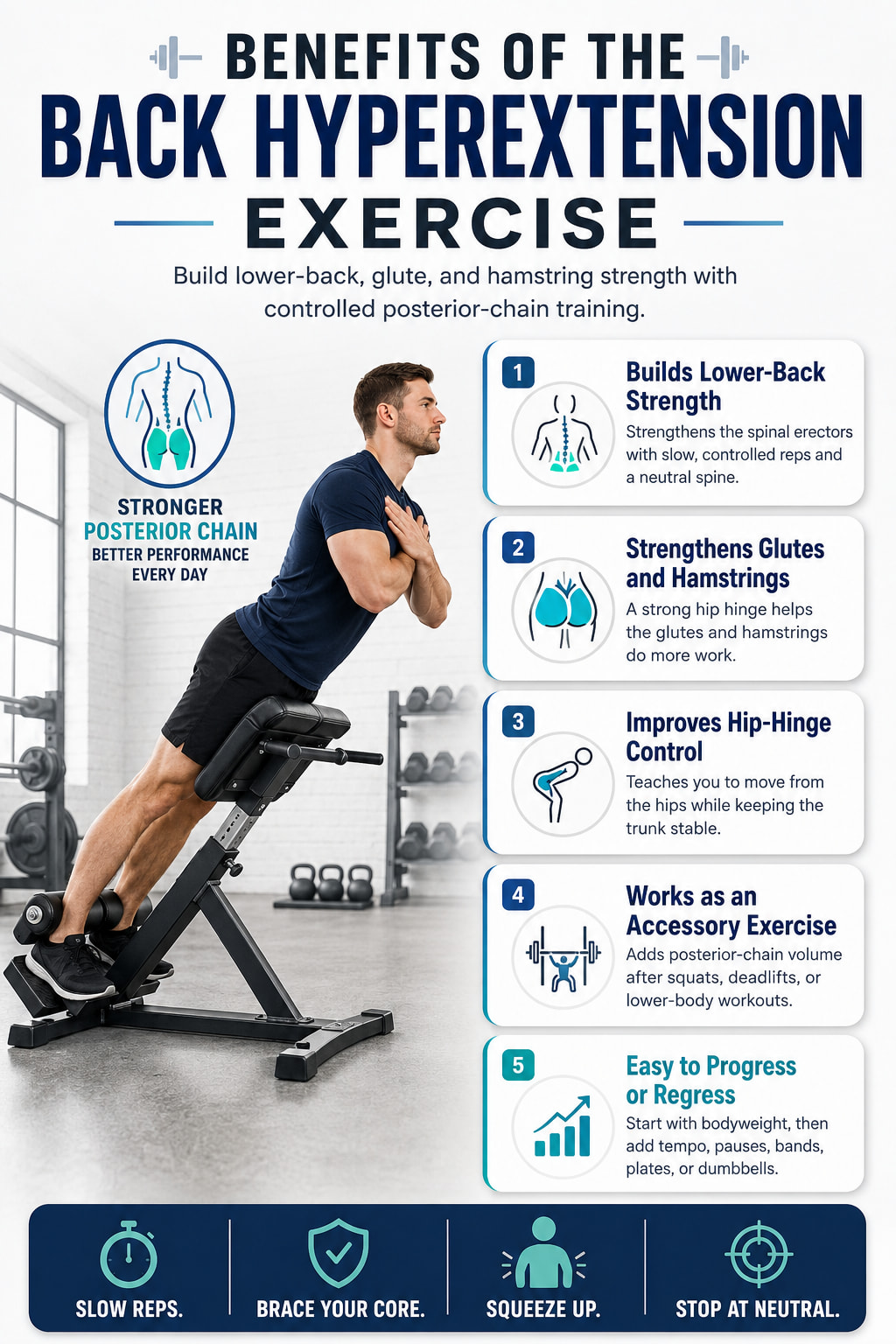
- Builds lower-back strength: Helps strengthen the spinal erectors that support your spine during lifting, hinging, and carrying.
- Strengthens glutes and hamstrings: A proper hip hinge makes this exercise useful for the entire posterior chain, not just the lower back.
- Improves hip-hinge control: Helps you practice moving from the hips while keeping your trunk stable.
- Works well as an accessory exercise: Easy to add after squats, deadlifts, Romanian deadlifts, or lower-body workouts.
- Easy to progress or regress: Beginners can start with bodyweight, while advanced lifters can add tempo, pauses, bands, or weight.
- Versatile for different goals: Can be used for strength, muscle-building, glute focus, hamstring work, or lower-back endurance.
How to Do the Back Hyperextension Exercise With Proper Form
Best for: Building lower-back strength, glute and hamstring strength, hip-hinge control, and posterior-chain accessory work.
Muscles worked: Erector spinae, gluteus maximus, hamstrings, deep core stabilizers, and hip stabilizers.
Equipment needed: 45-degree hyperextension bench, Roman chair, or glute-ham developer. A weight plate, dumbbell, or resistance band can be added later.
Why it stands out: The back hyperextension exercise lets you train the posterior chain through a controlled hip-hinge pattern without needing a heavy barbell. It can be adjusted for beginners or progressed for stronger lifters, making it useful for strength, muscle building, and movement control.
Suggested sets and reps: Start with 2–3 sets of 8–12 controlled reps. For muscle-building accessory work, use 2–4 sets of 10–15 reps. For higher-rep glute and hamstring work, use 12–20 reps with clean technique.
Beginners: Start with bodyweight only. Use a short, pain-free range of motion and stop at a straight body line. Do not add weight until you can control every rep without swinging or over-arching.
Intermediate: Use full controlled reps, a 2–3 second lowering phase, and a short pause at the top. Add light external load only when your form stays consistent.
Advanced: Progress with a plate held to the chest, dumbbell goblet hold, band resistance, slower tempo, pauses, or single-leg variations. Keep the load moderate and avoid turning it into a max-effort lower-back lift.
Rest: Rest 60–90 seconds for higher-rep accessory work and 90–120 seconds when using heavier resistance.
How to do it:
- Adjust the pad so it sits across your upper thighs, just below the hips, allowing your hips to hinge freely.
- Secure your feet under the foot pads and keep your knees slightly soft.
- Cross your arms over your chest, place your hands lightly behind your head, or hold the handles if you are learning.
- Brace your core and keep your neck in line with your spine.
- Lower your torso slowly by hinging at the hips.
- Stop when you feel a controlled stretch through your hamstrings and glutes, or when you can no longer maintain position.
- Drive your hips into the pad and lift your torso by squeezing your glutes and hamstrings.
- Finish when your body forms a straight line from shoulders to hips and legs.
- Pause briefly, then repeat without bouncing.
Common mistakes: Avoid swinging, bouncing from the bottom, looking up, over-arching at the top, setting the pad too high, dropping too low without control, or holding heavy weight before mastering bodyweight reps.
Expert tip: Think “hinge down, squeeze up, stop at neutral.” The top of the rep should feel strong and controlled, not jammed into the lower back.
Exercise variations: Common variations include 45-degree back hyperextensions, 90-degree Roman chair back extensions, glute-focused back extensions, weighted back extensions, banded back extensions, and single-leg back extensions.
Easier variation: Use a floor back extension, bird dog, stability ball reverse extension, or short-range bodyweight back extension. ACE notes that the bird dog is useful for training low-back stability during arm and leg movement, and it recommends staying within the range you can control.
Harder variation: Hold a plate or dumbbell against your chest, slow the lowering phase, pause at the top, add a resistance band, or perform controlled single-leg reps.
Key Form Cues for Better Back Hyperextensions
Use the bench as a hinge tool, not a launching pad. Your hips should be able to move around the pad freely. If the pad is too high against your stomach, it can block the hinge and make the movement feel awkward.
Keep your ribs and pelvis controlled. If your ribs flare hard at the top, you are probably overextending through the lower back instead of finishing with the hips.
Keep your neck neutral. Looking up can encourage excessive spinal extension. Instead, keep your gaze slightly down and let your head follow your torso.
Move slowly. A good rep should feel smooth from top to bottom. If you need to swing to get up, the range is too large, the weight is too heavy, or fatigue is too high.
45-Degree vs. 90-Degree Back Hyperextension
Both versions can be effective, but they feel different.
A 45-degree back hyperextension is usually easier for beginners because the angle is more forgiving and the range of motion is simple to control. It is a good option for glute-focused and hamstring-focused accessory work.
A 90-degree Roman chair back extension places your body more parallel to the floor at the start and can feel harder at the bottom. It often requires more control and may not be the best first choice for beginners.
Use the version that allows the best setup, most control, and no sharp pain. For most general fitness readers, the 45-degree bench is the easiest place to start.
Back Hyperextension Common Mistakes to Avoid
Overarching at the Top
This is the biggest mistake. You do not need to lean back past neutral to make the exercise effective. Stop when your torso lines up with your legs.
ACE gives a similar safety cue for stability ball reverse extensions: avoid low-back hyperextension by not lifting past parallel alignment with the torso.
Swinging Through the Reps
Momentum reduces muscle control and can make the movement feel rough on the lower back. Lower slowly, pause if needed, then lift with your glutes and hamstrings.
Setting the Pad Too High
If the pad presses into your stomach or blocks your hips, you may end up bending mostly from the spine. Lower the pad so your hips can hinge.
Using Weight Too Soon
Weighted back hyperextensions are useful, but only after bodyweight reps are solid. Add load gradually and stop if your technique changes.
The ACSM resistance-training progression model recommends increasing load by about 2–10% when a person can perform one to two reps above the desired target with good control.
Turning Every Rep Into a Lower-Back Max Effort
This is an accessory exercise for most people. You should usually finish with 2–3 reps in reserve rather than pushing to sloppy failure.
Back Hyperextension Regressions for Beginners
Start with a regression if the bench version feels uncomfortable, if you cannot control your torso, or if your lower back takes over immediately.
A floor back extension is the simplest option. Lie face down, gently brace, lift your chest slightly, and lower with control. Keep the range small.
A bird dog helps build trunk control with less loading. It teaches you to move your arms and legs while keeping the low back stable.
A stability ball reverse extension trains the glutes, hamstrings, and back with a different setup. Use a small range and avoid lifting the legs past the torso line.
A short-range 45-degree back extension is also useful. Lower only halfway, return to neutral, and increase depth over time as control improves.
Back Hyperextension Progressions
Once you can perform 2–3 sets of 12–15 bodyweight reps with clean form, you can make the exercise harder.
A tempo back hyperextension uses a slow lowering phase, usually 3 seconds down and 1 second up. This increases control without adding weight.
A pause back hyperextension adds a one-second hold at the top. This teaches you to finish with the glutes instead of the lower back.
A weighted back hyperextension uses a plate, dumbbell, or kettlebell held against the chest. Keep the weight close to your body and avoid holding it far out in front unless you are advanced.
A banded back hyperextension adds resistance that becomes harder near the top. This can be useful for glute-focused work.
A single-leg back hyperextension is an advanced option that adds more hip stability demand. Use it only after mastering standard reps.
How Many Back Hyperextensions Should You Do?
For most lifters, back hyperextensions work best as an accessory exercise 1–3 times per week.
Use this simple guide:
Beginner: 2 sets of 8–12 reps, bodyweight only, 1–2 times per week.
Intermediate: 2–4 sets of 10–15 reps, bodyweight or light load, 1–3 times per week.
Glute and hamstring focus: 2–4 sets of 12–20 reps, controlled tempo, 60–90 seconds rest.
Strength accessory focus: 3–4 sets of 6–10 reps with light-to-moderate load, 90–120 seconds rest.
The CDC recommends muscle-strengthening activities on 2 or more days per week that work all major muscle groups, and ACSM also supports strength and endurance work at least two days per week for adults.
Sample Back Hyperextension Workout
Use this after your main lower-body lift or as part of a posterior-chain accessory day.
Beginner Posterior-Chain Routine
Frequency: 1–2 times per week
Effort level: Stop each set with 2–3 reps in reserve
Rest: 60–90 seconds between sets
- Bodyweight Back Hyperextension: 2–3 sets of 8–12 reps
- Glute Bridge: 2–3 sets of 10–15 reps
- Bird Dog: 2 sets of 6–8 reps per side
- Side Plank: 2 sets of 15–30 seconds per side
Progress by adding reps first. When you can complete all sets at the top of the rep range with clean form, add a slower tempo or a light weight.
Intermediate Posterior-Chain Accessory Routine
Frequency: 1–2 times per week after squats, deadlifts, or Romanian deadlifts
Effort level: 1–3 reps in reserve
Rest: 60–120 seconds
- Romanian Deadlift: 3 sets of 6–10 reps
- Back Hyperextension Exercise: 3 sets of 10–15 reps
- Seated or Lying Hamstring Curl: 2–3 sets of 10–15 reps
- Pallof Press or Dead Bug: 2–3 sets of controlled reps
Keep the back hyperextension clean and controlled. It should add useful posterior-chain volume, not exhaust your lower back so much that the rest of your training suffers.
Safety Tips for the Back Hyperextension Exercise
Stop the exercise if you feel sharp pain, numbness, tingling, dizziness, chest pain, or unusual symptoms. Mild muscle effort is normal, but nerve-like symptoms or sharp pain are not something to push through.
Be cautious if you currently have back pain, a recent spine injury, disc symptoms, sciatica-like symptoms, or a medical condition affecting the spine or hips. In those cases, get guidance from a qualified healthcare professional before adding back hyperextensions.
Mayo Clinic recommends immediate medical care for severe low-back pain that is constant or intense, causes weakness, numbness, or tingling in one or both legs, is linked with new bowel or bladder problems, comes with fever, or includes unexplained weight loss.
Use a controlled range of motion, start with bodyweight, and progress slowly. The exercise should feel like a strong hip and posterior-chain movement, not a pinching or jamming feeling in the spine.
Back Hyperextension Exercise Tips for Better Results
Use slow reps before heavy reps. A controlled 3-second lowering phase can make bodyweight back hyperextensions much more effective.
Keep your feet secure. If your feet slide or your ankles are uncomfortable, adjust the machine before starting.
Match the technique to your goal. For more glute and hamstring emphasis, hinge from the hips and squeeze the glutes at the top. For more spinal erector emphasis, keep the movement strict and avoid turning it into a loose hip swing.
Do not chase excessive range. More range is only useful if you can control it.
Place the exercise correctly in your workout. Most people should do back hyperextensions after heavier lifts, not before a heavy deadlift or squat session that requires a fresh posterior chain.
FAQs About the Back Hyperextension Exercise
Are back hyperextensions good for your lower back?
Back hyperextensions can be useful for strengthening the lower-back muscles when performed with control and appropriate range of motion. They are not a cure for back pain, and they are not right for everyone. If the movement causes sharp pain, nerve symptoms, or unusual discomfort, stop and seek professional guidance.
What muscles do back hyperextensions work?
Back hyperextensions mainly work the erector spinae, gluteus maximus, and hamstrings. The deep core muscles also help stabilize the trunk during the movement.
Should I round my back during back hyperextensions?
Most beginners should keep a neutral, controlled spine. Some advanced lifters use a more rounded upper-back style to bias the glutes, but that should be done intentionally and carefully. If you are unsure, use neutral-spine form first.
How high should I come up on a back hyperextension?
Come up until your shoulders, hips, and legs form a straight line. Do not lean back aggressively past neutral. The top should feel like a controlled glute squeeze, not a hard lower-back arch.
Are 45-degree or 90-degree back hyperextensions better?
Neither is automatically better. The 45-degree version is usually easier to learn and more beginner-friendly. The 90-degree Roman chair version can be harder and may require more control. Choose the option that lets you move well without discomfort.
Can beginners do the back hyperextension exercise?
Yes, many beginners can do back hyperextensions if they start with bodyweight, use a short range of motion, and focus on control. Beginners who feel discomfort can start with bird dogs, floor back extensions, or stability ball variations.
How often should I do back hyperextensions?
Most people can train them 1–3 times per week depending on recovery, total lower-body volume, and training goals. Start with 1–2 times per week and increase only if your form and recovery stay consistent.
Conclusion
The back hyperextension exercise is a practical way to train the lower back, glutes, and hamstrings when you use controlled form. Set the pad correctly, hinge from the hips, brace your core, avoid excessive arching, and progress gradually.
Start with bodyweight reps, master the neutral top position, then add tempo or light resistance when you are ready. Used correctly, back hyperextensions can be a valuable accessory exercise for building a stronger posterior chain.
This content is for informational purposes only and is not a substitute for professional medical advice.
References
- Journal of Sports Science & Medicine: Comparison of Muscle Activity in Three Single-Joint Hip Extension Exercises
- ACE Fitness: Stability Ball Reverse Extensions
- ACE Fitness: Bird Dog
- Mayo Clinic: Low Back Pain in Adults
- CDC: Adult Physical Activity Guidelines
- ACSM: Physical Activity Guidelines
- PubMed: ACSM Progression Models in Resistance Training for Healthy Adults