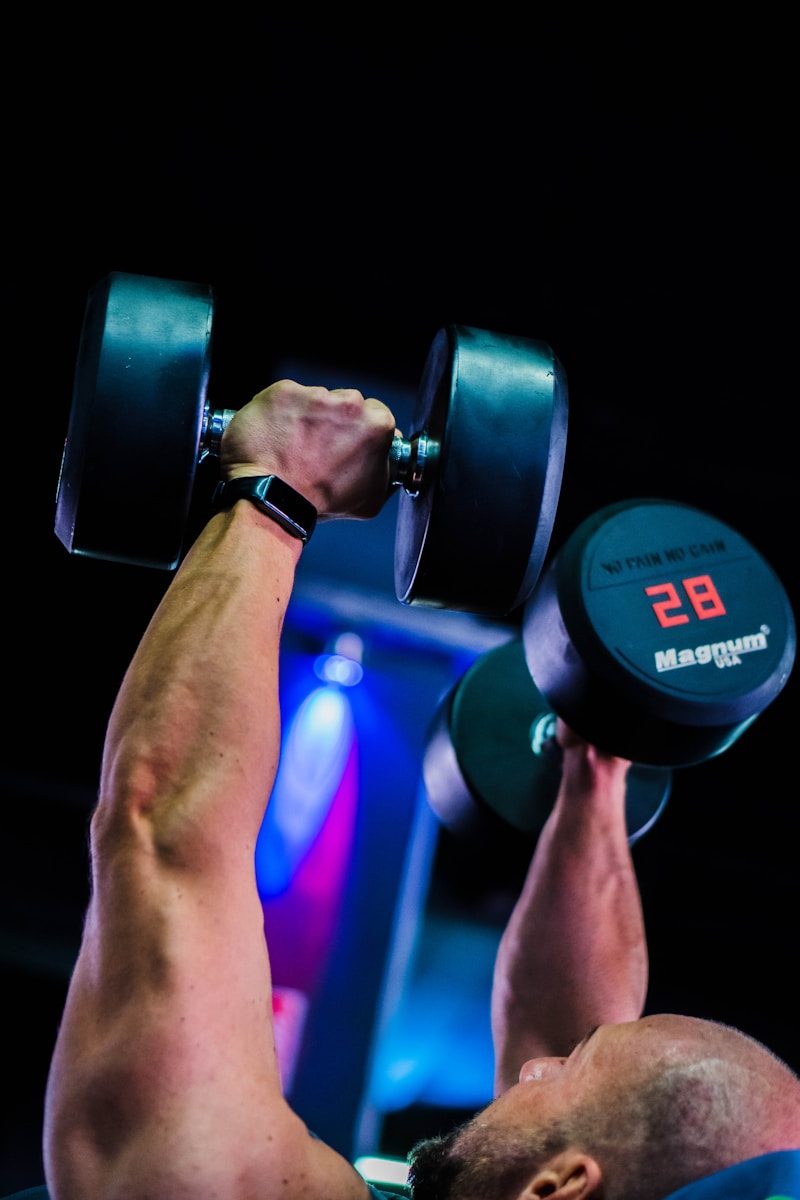
The dumbbell push press is a standing power exercise that uses a shallow knee-and-hip dip followed by an explosive leg drive to help press two dumbbells overhead. Unlike a strict shoulder press, the lower body deliberately starts the movement before the shoulders and triceps finish it.
Performed correctly, the dumbbell push press can help develop full-body power, overhead strength, coordination, and independent control of each dumbbell. This guide explains proper form, muscles worked, common mistakes, beginner progressions, and practical ways to program the exercise.
Dumbbell Push Press at a Glance
| Category | Recommendation |
|---|---|
| Exercise type | Compound strength-and-power exercise |
| Main movement | Shallow dip, rapid leg drive, and overhead press |
| Primary muscles | Quadriceps, glutes, deltoids, and triceps |
| Supporting muscles | Hamstrings, calves, upper back, serratus anterior, rotator cuff, forearms, and core |
| Equipment | Two matching dumbbells |
| Best for | Overhead power, whole-body coordination, and general strength |
| Typical working range | 3–4 sets of 3–8 repetitions |
| Rest | 90–180 seconds |
| Difficulty | Beginner to intermediate, once basic overhead control is established |
| Main coaching cue | Dip straight down, drive tall, then press |
What Is a Dumbbell Push Press?
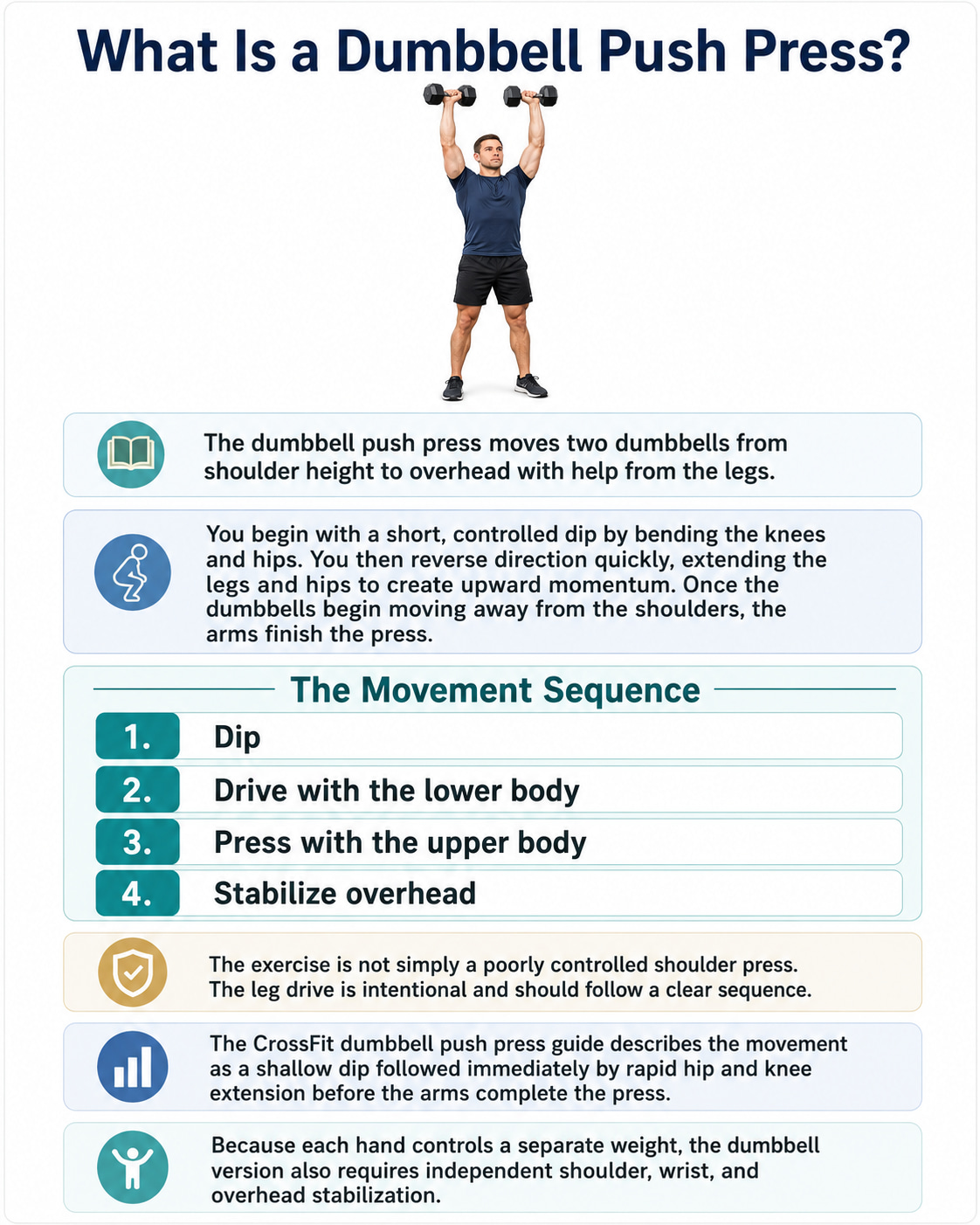
The dumbbell push press moves two dumbbells from shoulder height to overhead with help from the legs.
You begin with a short, controlled dip by bending the knees and hips. You then reverse direction quickly, extending the legs and hips to create upward momentum. Once the dumbbells begin moving away from the shoulders, the arms finish the press.
The exercise is not simply a poorly controlled shoulder press. The leg drive is intentional and should follow a clear sequence:
- Dip
- Drive with the lower body
- Press with the upper body
- Stabilize overhead
The CrossFit dumbbell push press guide describes the movement as a shallow dip followed immediately by rapid hip and knee extension before the arms complete the press.
Because each hand controls a separate weight, the dumbbell version also requires independent shoulder, wrist, and overhead stabilization.
How to Do the Dumbbell Push Press
Best for: Developing explosive overhead power, coordinated leg-to-arm force transfer, and full-body strength.
Muscles worked: Quadriceps, glutes, anterior and lateral deltoids, triceps, hamstrings, calves, upper-back muscles, serratus anterior, rotator cuff, abdominals, obliques, and spinal stabilizers.
Equipment needed: Two matching dumbbells and enough overhead space to press safely.
Sets, reps, and rest: Start with 2–3 sets of 5–6 repetitions. Rest for 90–120 seconds and finish each set while your movement is still quick and controlled.
Step-by-Step Instructions
- Bring the dumbbells to your shoulders.
Stand approximately hip- to shoulder-width apart. Hold one dumbbell at each shoulder with your palms facing inward or angled slightly forward. Keep a full grip and stack your wrists over your forearms. - Set your starting position.
Keep your chest comfortably lifted, ribs controlled, and abdomen braced. Position your elbows slightly in front of your torso rather than pointing directly out to the sides. - Perform a shallow dip.
Bend your knees and hips slightly, as though beginning a quarter squat. Keep pressure across the whole foot, allow the knees to track in the same direction as the toes, and keep your torso tall. - Drive through the floor.
Immediately reverse the dip by extending your knees and hips quickly. The leg drive should create enough upward force for the dumbbells to begin moving away from your shoulders. - Finish the press.
Once the legs and hips have extended, use your shoulders and triceps to press the already-moving dumbbells overhead. Do not rely on the arms to start the lift. - Stabilize overhead.
Finish with your arms extended and the dumbbells approximately over your shoulders and midfoot. Keep your ribs controlled and avoid leaning backward. Allow the shoulder blades to rotate upward naturally while keeping your neck relaxed. - Lower with control.
Bring the dumbbells back to your shoulders without allowing them to crash downward. Reset your balance and breathing before beginning the next repetition.
Coaching cue:
“Short dip, hard drive, strong finish.”
The Most Important Form Details
Keep the Dip Short
The dip should resemble a quick quarter squat, not a full squat.
A deep dip takes longer to reverse and can turn the exercise into something closer to a thruster. It may also make it harder to keep the torso upright and transfer force vertically into the dumbbells.
You only need enough knee-and-hip bend to create a strong, fast drive.
Keep Your Torso Tall
Folding forward during the dip sends the dumbbells away from a vertical path. It can also shift your balance toward the toes and make the overhead finish less stable.
Think about lowering your body between your feet rather than pushing your hips far behind you.
A small amount of individual variation is normal, but the chest should not collapse toward the floor.
Let the Legs Start the Movement
The lower body should initiate the lift. The arms finish it.
Pressing too early prevents the full force of the leg drive from reaching the dumbbells. A useful drill is to dip and drive without pressing. When the movement is timed correctly, the dumbbells should rise slightly from the shoulders before the arms take over.
Finish in a Stacked Position
At the top, the dumbbells should be approximately over your shoulders rather than far in front of your face.
A strong finish generally includes:
- Feet balanced on the floor
- Knees and hips extended
- Abdomen braced
- Ribs controlled
- Arms extended
- Dumbbells over the shoulders and midfoot
- Head and neck in a comfortable position
Do not force your shoulders downward at the top. The shoulder blades need to rotate upward naturally during overhead lifting.
Dumbbell Push Press Muscles Worked
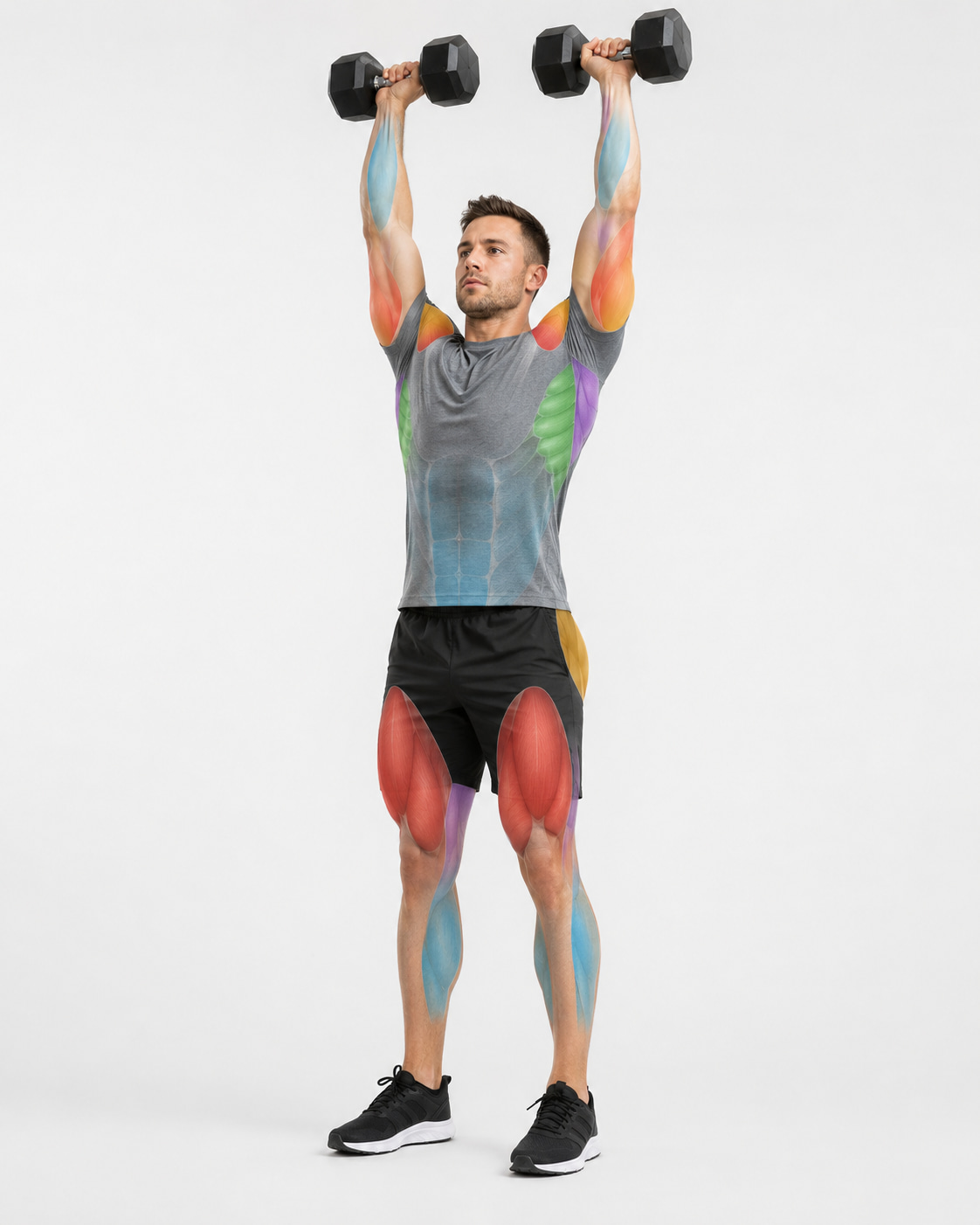
The dumbbell push press trains muscles throughout the body, but their roles change during different parts of the repetition.
| Movement phase | Main muscles involved | Primary role |
|---|---|---|
| Dip | Quadriceps, glutes, hamstrings, and core | Control the shallow descent and maintain position |
| Leg drive | Quadriceps and glutes, assisted by the hamstrings and calves | Rapidly extend the knees and hips |
| Overhead press | Anterior and lateral deltoids and triceps | Guide the dumbbells upward and complete elbow extension |
| Overhead stabilization | Trapezius, serratus anterior, rotator cuff, forearms, and core | Stabilize the shoulder blades, arms, wrists, and trunk |
Quadriceps
The quadriceps straighten the knees during the drive. They are major contributors to the rapid lower-body extension that begins the upward movement of the dumbbells.
According to NCBI Bookshelf, the quadriceps group’s primary joint action is knee extension.
Glutes and Hamstrings
The gluteus maximus helps extend the hips as you drive out of the dip. The hamstrings assist hip extension and help control the lower-body position.
An anatomical overview from NCBI Bookshelf identifies the gluteus maximus as a major hip extensor, with the hamstrings also contributing to hip extension.
Deltoids
The anterior and lateral portions of the deltoids help move and stabilize the upper arms as the dumbbells travel overhead.
The NCBI Bookshelf overview of shoulder anatomy explains that the anterior deltoid contributes to shoulder flexion while the middle fibers contribute strongly to abduction. Both actions can be involved depending on your elbow and dumbbell position.
Triceps
The triceps straighten the elbows and complete the press. Their contribution becomes especially important near the top of the movement as the arms approach full extension.
According to NCBI Bookshelf, elbow extension is the primary function of the triceps brachii.
Trapezius and Serratus Anterior
The trapezius and serratus anterior help rotate and control the shoulder blades as the arms move overhead.
The NCBI Bookshelf overview of the serratus anterior explains that it works with the trapezius to support upward scapular rotation during overhead movement.
Core Muscles
The abdominals, obliques, and spinal stabilizers help keep the torso rigid enough to transfer force from the legs into the dumbbells.
The core should resist excessive arching, twisting, or side bending rather than creating large visible movement.
Benefits of the Dumbbell Push Press
Develops Full-Body Power
The push press requires you to produce force rapidly through the legs and hips before transferring that force into the upper body.
This makes it more power-focused than a slow, strict overhead press. The goal is not simply to complete the repetition but to drive the dumbbells upward quickly while maintaining control.
Research indexed by PubMed on barbell push presses found that the movement can produce substantial mechanical power. However, those findings should not be used to prescribe exact dumbbell loads because the equipment and stabilization demands are different.
Trains Leg-to-Arm Coordination
A successful repetition depends on the correct handoff between the lower and upper body.
The sequence should be:
- Legs initiate
- Trunk transfers force
- Arms finish
- Shoulders stabilize
This coordinated timing is one of the main reasons to choose the push press instead of using random momentum during a shoulder press.
Allows More Load Than a Strict Press
Most people can push press more weight than they can strict press because the leg drive helps overcome the most difficult lower portion of the lift.
That does not make the push press automatically better for every goal. A strict press provides more direct upper-body loading, while a push press places greater emphasis on power and whole-body coordination.
Challenges Independent Dumbbell Control
Each arm must guide and stabilize its own dumbbell.
This can help reveal differences in control between sides, but the exercise should not be described as a guaranteed way to correct strength imbalances. Significant differences may require additional unilateral exercises and more focused programming.
Provides Efficient Compound Training
The push press combines a lower-body drive, overhead press, trunk stabilization, and balance challenge in one exercise.
It can fit well into:
- Full-body workouts
- Power-focused sessions
- Athletic strength programs
- Dumbbell-only workouts
- Carefully programmed conditioning sessions
Builds Overhead Strength and Stability
The deltoids and triceps still work hard to finish the press, while the shoulder girdle and trunk must stabilize the dumbbells overhead.
However, the push press should not completely replace strict pressing if your main goal is shoulder or triceps development. The two exercises have different purposes and can be used together.
Common Dumbbell Push Press Mistakes
| Mistake | Why it causes problems | How to correct it |
|---|---|---|
| Dipping too deeply | Slows the reversal and turns the movement toward a thruster | Use a short quarter-squat dip |
| Leaning forward | Sends the dumbbells forward and shifts balance toward the toes | Keep the chest tall and dip between the feet |
| Pressing too early | Prevents the full leg drive from reaching the dumbbells | Extend the legs and hips before finishing with the arms |
| Pausing at the bottom | Reduces the speed and efficiency of the drive | Reverse direction immediately but under control |
| Rising onto the toes too early | Reduces balance and can send the weights forward | Keep the heels down until the knees and hips have extended |
| Knees collapsing inward | Reduces lower-body control | Track the knees in the same direction as the toes |
| Arching the lower back | Replaces overhead movement with trunk extension | Brace the abdomen and keep the ribs controlled |
| Finishing forward | Creates an unstable overhead position | Finish the dumbbells over the shoulders and midfoot |
| Uneven lockout | Usually indicates poor timing, balance, or excessive load | Reduce the weight and practice controlled repetitions |
| Dropping the weights to the shoulders | Makes the next repetition unstable and difficult to control | Lower the dumbbells smoothly and reset |
| Using too much weight | Slows the drive and causes compensations | Use a load that remains fast and technically consistent |
Dumbbell Push Press vs. Similar Exercises
| Exercise | Lower-body contribution | Main difference |
|---|---|---|
| Dumbbell shoulder press | None | The upper body performs the entire press |
| Dumbbell push press | Shallow dip and rapid drive | Legs start the movement; arms finish it |
| Dumbbell thruster | Deep squat followed by a press | Uses a much larger squat range |
| Dumbbell push jerk | Dip, drive, and second knee bend | The lifter moves under the dumbbells to receive them |
Push Press vs. Shoulder Press
A shoulder press is performed without deliberate leg assistance. The knees and hips remain extended while the upper body presses the weight.
The CrossFit shoulder press guide identifies the lack of leg assistance as a defining feature of the strict press.
Choose a shoulder press for more direct upper-body strength work. Choose a push press when you want to train power, timing, or heavier overhead loading.
Push Press vs. Thruster
A thruster combines a front squat with an overhead press. The hips typically descend much lower than they do during a push press.
The CrossFit thruster guide describes the exercise as a combination of a front squat and a push press.
Push Press vs. Push Jerk
Both exercises use a dip and explosive leg drive.
The push press finishes by continuing to press the dumbbells while the legs remain extended. The push jerk includes a second knee bend so the lifter can move underneath and receive the dumbbells in a partial squat.
The CrossFit dumbbell push jerk guide identifies this second dip as a defining feature of the movement.
The push jerk is more technical and should generally be learned after the push press.
How to Choose the Right Dumbbell Weight
Use a lighter pair than your ego may initially suggest. Proper timing matters more than the number printed on the dumbbells.
The weight is appropriate when you can:
- Hold both dumbbells securely at shoulder height
- Keep your wrists stacked over your forearms
- Maintain a short, upright dip
- Drive the dumbbells upward quickly
- Finish both arms at approximately the same time
- Stabilize the weights overhead without leaning backward
- Lower the dumbbells under control
- Complete the planned set without obvious slowing or loss of position
For general training, finish most sets with approximately two or three technically good repetitions still available.
For power training, end the set earlier if the dumbbells begin moving noticeably more slowly. A grinding repetition is no longer serving the same power goal.
Dumbbell Push Press Sets, Reps, and Rest
The best repetition range depends on why you are using the exercise.
| Training goal | Sets and reps | Rest | Effort |
|---|---|---|---|
| Technique practice | 2–3 sets of 4–6 reps | 90–120 seconds | Very light and controlled |
| Power development | 3–5 sets of 3–5 reps | 2–3 minutes | Moderate load moved quickly |
| General strength | 3–4 sets of 5–8 reps | 90–150 seconds | Finish with 2–3 good reps available |
| Light conditioning | 2–4 sets of 6–10 reps | 60–90 seconds | Light load with consistent form |
The American College of Sports Medicine recommends moderate loads moved as quickly as possible during the lifting phase when power is the main goal in its 2026 resistance-training guidance. The organization also emphasizes adjusting training variables to the individual rather than relying on one rigid prescription.
You do not need to test a dumbbell push press one-repetition maximum. Select your load by observing movement speed, stability, and repeatable technique.
How Often Should You Do Dumbbell Push Presses?
One or two sessions per week is enough for most general training programs.
Frequency depends on:
- Your total shoulder and triceps training
- Other overhead exercises in your program
- Your recovery
- The weight and volume used
- Whether the exercise is trained for power or conditioning
Avoid placing heavy push presses on several consecutive days.
When Should You Do Them in a Workout?
For power development, perform push presses near the beginning of the workout after warming up. This allows you to practice the movement before your legs, shoulders, and core become fatigued.
A practical order is:
- General warm-up
- Push press technique sets
- Dumbbell push press working sets
- Main lower-body or pulling exercise
- Additional strength exercises
- Optional accessories or conditioning
How to Progress the Dumbbell Push Press
Increase the load only after your movement remains consistent from the first repetition to the last.
A simple progression method is:
- Select a repetition range, such as 5–8.
- Begin with a weight you can perform for 5 clean repetitions.
- Add one repetition over later workouts.
- Once you complete every set for 8 repetitions with good speed and control, increase each dumbbell by the smallest available amount.
- Return to the lower end of the repetition range.
Do not increase the weight when you are:
- Pressing before finishing the leg drive
- Leaning backward at the top
- Losing balance
- Locking out one arm well before the other
- Dropping the dumbbells onto the shoulders
- Grinding through the last repetitions
Beginner Regressions and Learning Drills
Bodyweight Dip-and-Drive Drill
Stand with your hands near your shoulders. Practice a shallow dip followed by rapid leg and hip extension.
Keep the torso tall and finish standing fully extended.
Perform 2 sets of 5 controlled repetitions.
Dumbbell Dip and Drive
Hold very light dumbbells at your shoulders. Dip and drive without actively pressing.
When the timing is correct, the leg drive should make the dumbbells rise slightly. This teaches you to avoid pressing too early.
Perform 2–3 sets of 3–5 repetitions.
Light Dumbbell Push Press
Complete the full exercise with very light dumbbells.
Pause briefly after each repetition instead of immediately cycling into the next. This gives you time to check your balance, rack position, and overhead finish.
Separate Strict-Press Practice
A light dumbbell shoulder press can help build the upper-body strength and overhead control needed to finish the push press.
It does not teach the dip-and-drive timing, so use it alongside movement drills rather than as a complete replacement.
Dumbbell Push Press Progressions and Variations
Single-Arm Dumbbell Push Press
Hold one dumbbell at one shoulder and perform the same dip-and-drive sequence.
The single-arm version reduces the total external load but increases the trunk’s anti-rotation demand. It is not automatically easier than the two-dumbbell version.
Alternating Dumbbell Push Press
Press one dumbbell at a time while the other remains near the shoulder.
This variation requires additional coordination and may be useful with lighter loads. Avoid turning it into an uncontrolled side-to-side movement.
Kettlebell Push Press
Kettlebells change the rack position and how the weight sits around the forearm.
The movement pattern remains similar, but the equipment may require a separate learning period.
Barbell Push Press
The barbell version connects both hands to one implement and usually allows heavier total loading.
It also requires the bar to travel past the face, making the rack position and bar path different from the dumbbell version.
Dumbbell Push Jerk
The push jerk adds a second knee bend to receive the dumbbells overhead.
Progress to it only after you can consistently maintain a vertical drive, stable lockout, and correct leg-to-arm timing.
Sample Dumbbell Push Press Workout
Beginner Full-Body Workout
Perform this workout one or two times per week, leaving at least one recovery day before repeating it.
| Exercise | Sets and reps | Rest | Effort |
|---|---|---|---|
| Dumbbell push press | 3 sets of 5–6 reps | 2 minutes | Finish with 3 good reps available |
| Goblet squat | 3 sets of 8–10 reps | 90 seconds | Controlled repetitions |
| One-arm dumbbell row | 3 sets of 8–12 reps per side | 60–90 seconds | Avoid torso rotation |
| Dumbbell Romanian deadlift | 3 sets of 8–10 reps | 90 seconds | Maintain a controlled hip hinge |
| Front plank | 2–3 sets of 20–40 seconds | 60 seconds | Stop before the lower back sags |
Warm-Up
Begin with 5–8 minutes of easy movement. Then perform:
- 8 bodyweight squats
- 8 controlled arm circles in each direction
- 6 light dumbbell shoulder presses
- 5 dumbbell dip-and-drive repetitions
- 3–5 light dumbbell push presses
Complete one or two gradual warm-up sets before using your working weight.
Workout Progression
Add repetitions before adding weight. Once you reach the top of the listed range for every set with good form, increase the dumbbells by the smallest practical amount.
Safety Tips
- Check that you have enough ceiling and surrounding space.
- Use matching dumbbells that you can control at shoulder height and overhead.
- Train on a stable, nonslip surface.
- Keep a full grip around each dumbbell.
- Avoid testing maximum loads while learning the exercise.
- Do not continue a set when the dumbbells begin drifting forward or your lower back starts arching.
- Lower the weights under control instead of allowing them to crash onto the shoulders.
- Use a qualified coach when you need help learning the dip-and-drive timing.
- Stop exercising and seek professional help if you experience sharp pain, numbness, dizziness, chest pain, or other unusual symptoms.
People with an existing shoulder, elbow, wrist, back, hip, or knee concern should obtain individualized guidance before adding an explosive overhead exercise.
Frequently Asked Questions
Is the dumbbell push press a shoulder exercise?
It trains the shoulders, but it is better classified as a full-body power exercise.
The deltoids and triceps finish the press, while the quadriceps and glutes generate much of the initial force. The core and shoulder stabilizers help transfer and control that force.
Is a push press better than a shoulder press?
Neither exercise is universally better.
Use the shoulder press when you want strict upper-body strength and more direct shoulder loading. Use the push press when you want to train explosive leg drive, whole-body coordination, or heavier overhead movement.
A balanced program can include both.
Why do I feel the push press mostly in my legs?
Some lower-body involvement is expected because the legs initiate the exercise.
However, the shoulders and triceps should still work to guide and finish the dumbbells. When the legs perform nearly all the work and the arms barely press, you may be turning the movement into a jerk by bending the knees again under the weights.
Can beginners perform dumbbell push presses?
Yes, provided they can hold light dumbbells at shoulder height, perform a controlled shallow dip, and reach a comfortable overhead position.
Beginners should first practice the dip-and-drive sequence with no weight or very light dumbbells. Heavy loads and fast, high-repetition sets should come later.
Should my palms face forward or inward?
A neutral or slightly angled grip is usually practical with dumbbells.
Choose the grip that allows you to keep your wrists stacked over your forearms and the dumbbells controlled at the shoulders. The grip can rotate slightly as the weights travel overhead.
How deep should I dip?
Use a shallow quarter-squat depth.
The dip should be deep enough to create leg drive but short enough to reverse quickly. When the hips descend toward a full squat, the movement begins to resemble a thruster.
How many dumbbell push presses should I do?
For most strength and power workouts, use 3–8 repetitions per set.
Lower repetitions with longer rest are generally better for power. Sets of 6–10 can be used with lighter weights for general fitness, but stop before fatigue changes your timing or overhead position.
Conclusion
The dumbbell push press is most effective when it is treated as a coordinated power exercise rather than a shoulder press performed with uncontrolled momentum.
Start with a stable shoulder-level rack, use a short vertical dip, drive forcefully through the legs, and let the arms finish the already-moving dumbbells. Keep the load light enough to maintain speed, balance, and a stacked overhead position.
Once those details remain consistent, progress gradually by adding repetitions or using slightly heavier dumbbells.
References
- CrossFit — The Dumbbell Push Press
The Dumbbell Push Press - American College of Sports Medicine — 2026 Resistance Training Guidelines
ACSM 2026 Resistance Training Guidelines - National Strength and Conditioning Association — Weightlifting for Sports Performance Position Statement
NSCA Position Statement on Weightlifting for Sports Performance - Soriano MA, Suchomel TJ, Comfort P. — Weightlifting Overhead Pressing Derivatives: A Review of the Literature
Weightlifting Overhead Pressing Derivatives — PMC - Lake JP, Mundy PD, Comfort P. — Power and Impulse Applied During Push Press Exercise
Power and Impulse Applied During Push Press Exercise — PubMed - Sæterbakken AH, Fimland MS. — Effects of Body Position and Loading Modality on Muscle Activity and Strength in Shoulder Presses
Shoulder Press Muscle Activity and Strength — PubMed
This content is for informational purposes only and is not a substitute for medical advice.