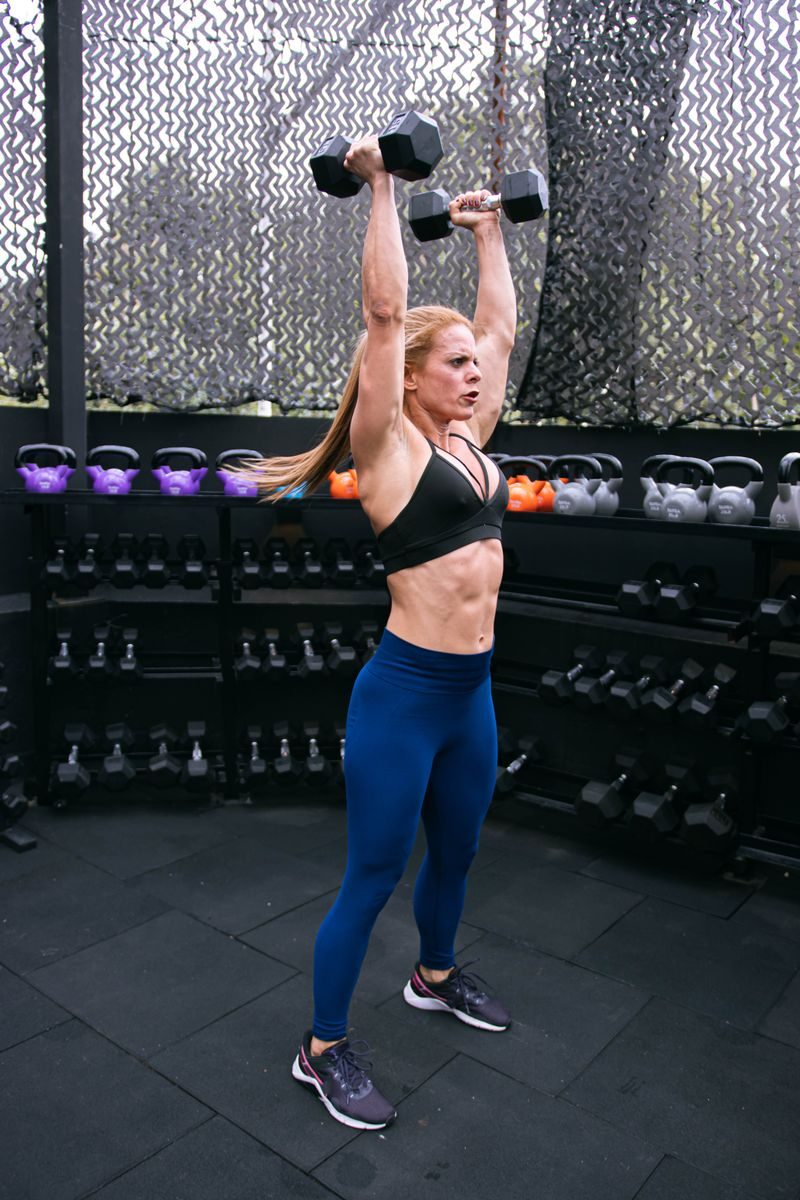
Dumbbell thrusters are a full-body exercise that combines a front-loaded squat with a leg-assisted overhead press. Proper form requires you to control the squat, drive upward with your legs, and use that momentum to begin pressing the dumbbells overhead.
This guide explains how to perform dumbbell thrusters, which muscles they work, common mistakes to avoid, and how to program them for strength, power, muscular endurance, or conditioning.
Dumbbell Thrusters at a Glance
| Training detail | Recommendation |
|---|---|
| Best for | Full-body coordination, power, muscular endurance, and conditioning |
| Primary muscles | Quadriceps, gluteus maximus, anterior deltoids, and triceps |
| Assisting muscles | Adductors, hamstrings, calves, upper trapezius, and core |
| Equipment needed | Two dumbbells |
| Difficulty | Intermediate; beginners should learn the squat and push press first |
| Suggested starting range | 2–3 sets of 6–10 repetitions |
| General rest | 90–120 seconds |
| Effort | Finish with approximately 2–3 controlled repetitions remaining |
| Workout placement | Early for power or technique; later for conditioning |
What Are Dumbbell Thrusters?
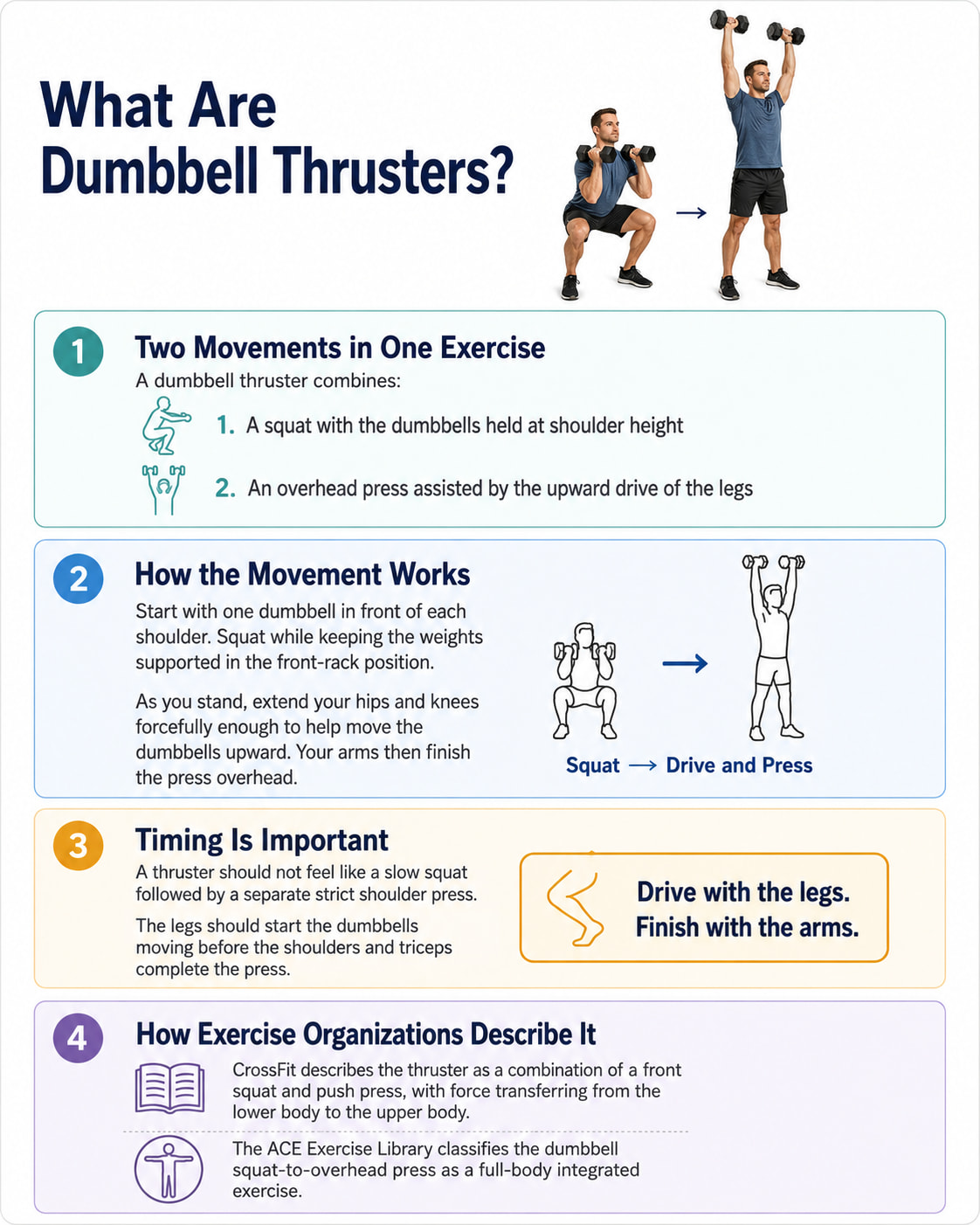
A dumbbell thruster combines two movements:
- A squat with the dumbbells held at shoulder height
- An overhead press assisted by the upward drive of the legs
The exercise begins with one dumbbell in front of each shoulder. You squat while keeping the weights supported in this front-rack position. As you stand, you extend your hips and knees forcefully enough to help move the dumbbells away from your shoulders. Your arms then finish the press overhead.
This timing separates a thruster from a slow squat followed by a strict shoulder press. The legs should start the dumbbells moving before the shoulders and triceps complete the press.
The CrossFit thruster guide describes the movement as a combination of a front squat and push press, with force transferring from the lower body to the upper body. The ACE Exercise Library classifies its dumbbell squat-to-overhead press as a full-body integrated exercise.
How to Do Dumbbell Thrusters
Equipment needed: Two matching dumbbells and enough overhead clearance.
Suggested starting prescription: Perform 2–3 sets of 6–10 controlled repetitions. Rest for 90–120 seconds and stop each set before your timing or posture deteriorates.
Step-by-Step Instructions
- Set your stance. Stand with your feet approximately hip- to shoulder-width apart. Turn your toes slightly outward if that allows your knees and hips to move comfortably.
- Rack the dumbbells. Hold one dumbbell in front of each shoulder with your palms facing inward or slightly forward. Keep your wrists straight and your elbows slightly forward rather than flared directly sideways.
- Brace your trunk. Keep your ribs positioned over your pelvis and maintain pressure through your whole foot.
- Lower into the squat. Bend your hips, knees, and ankles together. Let your knees track in the same general direction as your toes while lowering your hips between your legs.
- Drive upward. Push the floor away and extend your knees and hips. Keep the dumbbells close to your shoulders during the early part of the ascent.
- Transfer into the press. As your legs finish driving you upward and the dumbbells begin to rise, press them overhead.
- Finish in control. End with the dumbbells balanced over your shoulders and midfoot. Keep your trunk controlled rather than leaning backward.
- Return to the rack. Lower the dumbbells to your shoulders. Let them settle into a stable position before beginning the next squat.
The most important timing cue is:
Drive with the legs; finish with the arms.
The legs should initiate the movement of the dumbbells. Pressing too early makes the shoulders work harder and usually causes fatigue to build faster.
How Deep Should You Squat?
Use the deepest squat you can control while keeping:
- Your whole foot planted
- Your knees aligned with your feet
- The dumbbells securely supported
- Your trunk stable
- Your movement free from pain
You do not have to force your hips below your knees simply because some competition standards require that depth.
The National Academy of Sports Medicine recommends squatting to a depth that can be controlled without compensations. Reduce the depth if your heels lift, knees collapse inward, feet lose stability, or lower back noticeably rounds or arches.
As mobility, balance, and strength improve, you may be able to squat deeper without losing control.
Breathing During Dumbbell Thrusters
Take a breath and brace before lowering into the squat. Begin exhaling as you drive through the most difficult part of the ascent and complete the press.
During longer sets, take a short breath at the top or while the dumbbells are settled at your shoulders. Avoid rushing the next repetition before you have regained control.
Dumbbell Thrusters Muscles Worked
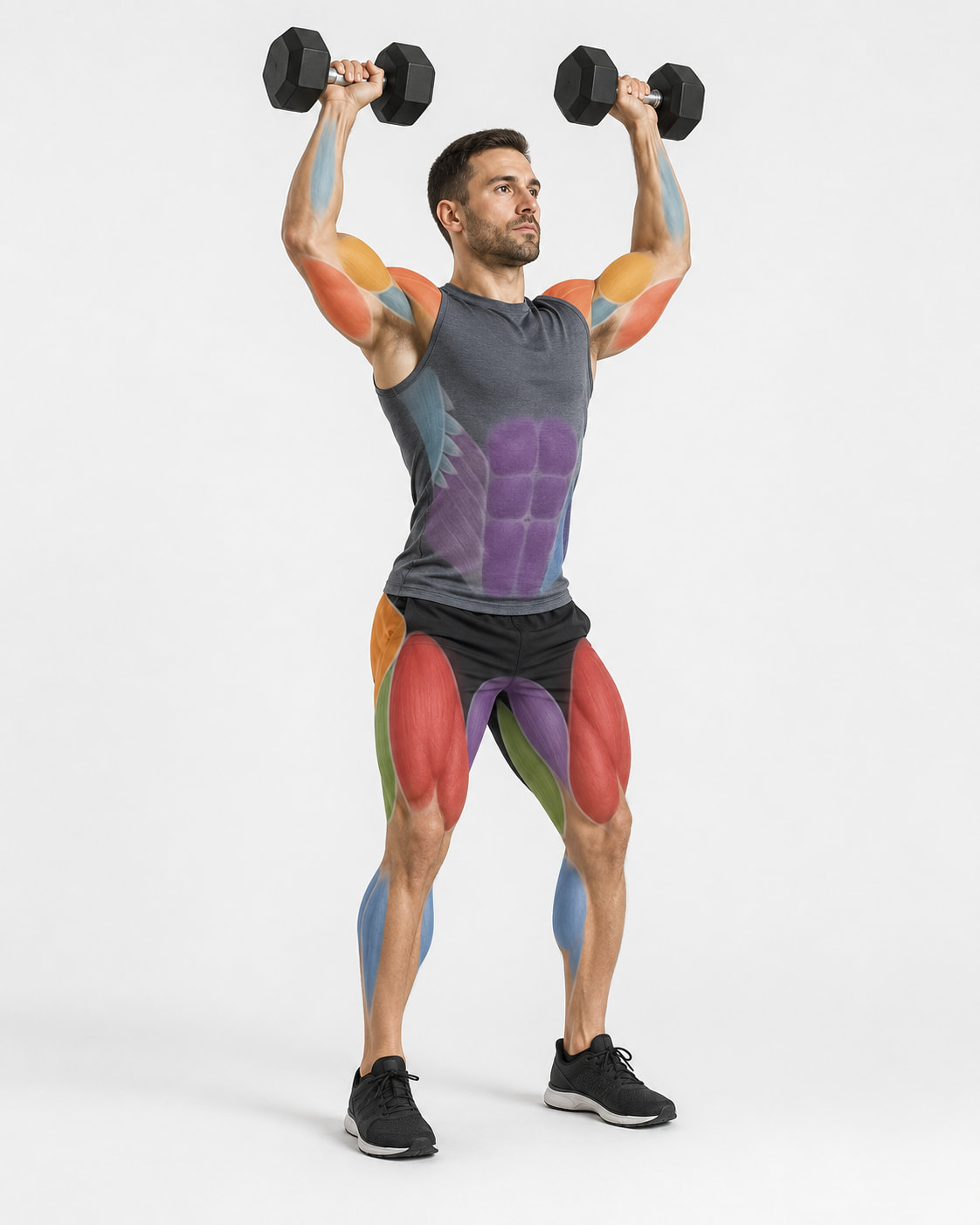
Dumbbell thrusters train several muscle groups because the hips, knees, shoulders, and elbows all move during each repetition.
Quadriceps
The quadriceps on the fronts of your thighs straighten your knees as you rise from the squat.
They work during every repetition and usually receive more demand when you use a meaningful but controlled amount of knee bend.
Gluteus Maximus
The gluteus maximus extends your hips as you stand from the bottom of the squat.
It also helps create the upward force that transfers into the overhead press.
Adductor Magnus and Other Hip Muscles
Part of the adductor magnus assists hip extension during the ascent. The other hip adductors and smaller hip muscles help control the position of your thighs and pelvis.
Anterior and Middle Deltoids
The deltoids raise and stabilize the upper arms as the dumbbells move overhead.
The anterior deltoids usually perform most of the pressing work, while the middle deltoids assist and help control the dumbbells.
Triceps Brachii
The triceps straighten your elbows during the final part of the overhead press.
They become more involved after the leg drive has already started the dumbbells moving.
Core and Spinal Stabilizers
Your abdominal muscles, obliques, and spinal erectors help maintain trunk position and transfer force from the legs into the arms.
They work to prevent excessive back arching, forward collapse, and unwanted rotation between the two dumbbells.
Upper Back and Shoulder-Blade Muscles
The upper trapezius, serratus anterior, rotator cuff, and other shoulder-blade stabilizers help control the overhead position.
These muscles support the shoulders as the arms move upward and the dumbbells become balanced over the body.
Hamstrings, Calves, and Grip
The hamstrings assist with hip control and help stabilize the knees. The calves contribute as the ankles move during the squat and upward drive.
Your forearms and grip muscles keep the dumbbells secure throughout the rack, press, and lowering phases.
The thruster therefore trains the legs, core, shoulders, upper back, and arms together rather than isolating one muscle.
Benefits of Dumbbell Thrusters
Trains the Lower and Upper Body Together
Dumbbell thrusters combine a squat and overhead press in one continuous repetition.
This allows you to train the legs, shoulders, triceps, and core when workout time or equipment is limited.
Develops Full-Body Coordination
The exercise teaches you to transfer force from the lower body into the upper body.
You must coordinate the squat, leg drive, press, overhead finish, and return to the shoulders. Performing these stages in the correct order makes the movement smoother and more efficient.
May Improve Power and Muscular Endurance
Low-repetition sets performed with controlled but forceful upward movement can be useful for developing power.
Lighter dumbbells and moderate-to-high repetitions place more emphasis on muscular endurance and conditioning. The result depends on the weight, repetition range, rest periods, and how close each set comes to fatigue.
Challenges Each Side Independently
Each arm must stabilize its own dumbbell. One side cannot rely on a bar to remain connected to the other side.
This independent loading may make differences in shoulder control, coordination, or strength easier to notice. It does not automatically correct those differences, but it can help you identify when one side is moving differently.
Offers a Flexible Rack and Hand Position
Dumbbells allow you to adjust your hand angle instead of being locked into a fixed barbell grip.
A neutral or slightly angled grip may feel more comfortable for some lifters. The two dumbbells may also allow more freedom when finding a stable shoulder position.
Works Well in Different Types of Workouts
Dumbbell thrusters can be used as:
- A main full-body exercise
- A power exercise near the beginning of a workout
- Part of a dumbbell circuit
- A muscular-endurance exercise
- A short conditioning finisher
The weight and repetition range should change according to the purpose.
Are Dumbbell Thrusters Good for Building Strength and Muscle?
Dumbbell thrusters can contribute to full-body strength and muscle development, particularly for the quadriceps, glutes, shoulders, and triceps.
However, they are not always the best choice for maximizing one specific training outcome.
Your shoulders may fatigue before your legs, or your breathing may limit the set before the target muscles receive enough work. Separate dumbbell squats and overhead presses allow you to choose a more appropriate load and volume for each movement.
Use thrusters when you want coordination, power-endurance, or time-efficient full-body training. Use separate squats and presses when your priority is maximizing strength or muscle development in one area.
Common Dumbbell Thruster Mistakes
Pressing Before the Legs Finish Driving
Beginning the press too early turns the exercise into a difficult shoulder press performed from the middle of a squat.
Correction: Continue driving through your feet until your hips and knees are nearly extended. Let the leg drive start the dumbbells moving before your arms finish the press.
Squatting Before the Dumbbells Reach the Shoulders
Starting the next squat while the dumbbells are still descending can pull your torso forward and make the weights land heavily.
Correction: Return the dumbbells securely to your shoulders before bending your hips and knees for the next repetition.
Letting the Dumbbells Drift Forward
Pressing the weights in front of the body increases the demand on the shoulders and makes the overhead position harder to control.
Correction: Guide the dumbbells upward so they finish balanced over your shoulders and midfoot.
Excessively Arching the Lower Back
Leaning backward to complete the press often happens when the dumbbells are too heavy, the trunk loses tension, or the arms cannot reach a comfortable overhead position.
Correction: Brace your abdomen, keep your ribs controlled, and finish tall. Reduce the weight or use a smaller overhead range if you cannot maintain that position.
Allowing the Knees to Collapse Inward
The knees should generally move in the same direction as the feet during the squat and ascent.
Correction: Use a stance that allows comfortable movement, maintain pressure through the whole foot, and reduce the load or depth if your knees repeatedly collapse inward.
Lifting the Heels
Losing heel contact may indicate that the weight has shifted too far forward or that the squat depth exceeds your current control.
Correction: Maintain pressure through the heel, base of the big toe, and base of the little toe. Use a slightly shallower squat if needed.
Using Too Much Weight
Heavy dumbbells can disrupt the rack position, squat depth, press path, and movement timing.
Correction: Start lighter than you think you need. CrossFit’s dumbbell-specific guidance recommends refining technique with light weights before increasing the load.
Rushing After Form Breaks Down
High-repetition thrusters can become demanding quickly. Continuing after your timing changes may turn each repetition into an uncontrolled squat and press.
Correction: End the set when the dumbbells drift, your trunk position changes, or you can no longer transfer smoothly from the squat into the press.
Beginner Dumbbell Thruster Regressions
Dumbbell thrusters require more coordination than a basic squat or shoulder press. Beginners should first become comfortable with the component movements.
Bodyweight Squat
Practice controlling your feet, knees, hips, and trunk without an external load.
Progress when you can squat to a comfortable depth without losing balance or changing your spinal position.
Dumbbell Front Squat
Hold two light dumbbells at your shoulders and practice the squat without pressing.
This builds familiarity with the front-rack position and teaches you to keep the dumbbells stable during the descent.
Dumbbell Push Press
Start with the dumbbells at your shoulders. Use a shallow knee and hip bend, drive upward, and press overhead.
This teaches the transfer of force from the legs into the arms without adding a full squat.
Squat to a Box or Target
Use a stable box or bench as a depth reference. Lightly touch the target rather than dropping onto it or relaxing at the bottom.
Choose a height that allows you to maintain balance and control.
Single-Dumbbell Goblet Thruster
Hold one dumbbell vertically in front of your chest. Squat and then drive the weight overhead with both hands.
The centrally positioned load can be easier to balance than two independently moving dumbbells.
A useful learning sequence is:
- Bodyweight squat
- Dumbbell front squat
- Dumbbell push press
- Goblet thruster
- Two-dumbbell thruster
The front squat and push press establish the movement skills needed for a full thruster.
Dumbbell Thruster Progressions
Add Repetitions
Increase the number of repetitions within your planned range before increasing the weight.
For example, progress from three sets of six to three sets of eight while maintaining the same form and effort.
Increase the Dumbbell Weight
Add the smallest practical increase after you can complete every repetition with:
- Stable foot pressure
- Consistent squat depth
- Correct leg-to-arm timing
- A controlled overhead position
- Two or more good repetitions still available
Do not increase the weight and repetitions at the same time.
Paused Dumbbell Thruster
Pause briefly at the bottom of the squat before driving upward.
This removes some rebound and requires you to create force from a controlled position. Use lighter dumbbells than you would for a standard thruster.
Tempo Dumbbell Thruster
Lower into the squat over two or three seconds, then stand and press with controlled speed.
A slower descent can improve positional awareness, but the upward phase should still flow smoothly into the press.
Single-Arm Dumbbell Thruster
Hold one dumbbell at one shoulder and perform the exercise one side at a time.
The uneven load increases the demand on your core to resist leaning and rotation. It may provide more freedom for the working shoulder, but it is not automatically easier than the two-dumbbell version.
Sets, Reps, Rest, and Weight Selection
Choose your repetition range according to your training goal.
| Goal | Sets and reps | Rest | Load and effort |
|---|---|---|---|
| Technique practice | 2–3 sets of 5–6 reps | 90–120 seconds | Light; finish with 3–4 reps remaining |
| Full-body strength | 3–4 sets of 4–6 reps | 2–3 minutes | Moderate; finish with 2–3 reps remaining |
| Power | 3–5 sets of 3–5 reps | 2–3 minutes | Moderate; stop if upward speed decreases |
| Muscular endurance | 2–4 sets of 8–12 reps | 60–90 seconds | Light to moderate |
| Conditioning | 5–8 rounds of 5–8 reps | 45–75 seconds | Light enough to maintain consistent form |
These ranges are practical starting points rather than rigid rules.
The American College of Sports Medicine’s 2026 resistance-training guidance emphasizes matching load and volume to the individual’s goal. It recommends moderate loads moved with fast intent for power and notes that reaching muscular failure is not necessary for the average healthy adult.
How to Choose Your Starting Weight
Choose dumbbells that allow you to complete the entire set without:
- Pausing before every press
- Leaning backward
- Losing squat depth
- Pressing one arm before the other
- Dropping the dumbbells heavily onto your shoulders
- Holding your breath for several repetitions
- Slowing dramatically near the end of the set
The correct thruster weight is usually lighter than the weight you could use for dumbbell squats alone. Your overhead strength, coordination, and ability to stabilize two weights may become the limiting factors.
How Often Should You Perform Dumbbell Thrusters?
One or two sessions per week is enough for most recreational lifters.
Consider the rest of your program. Thrusters add work for both the legs and shoulders, so they should be counted alongside your other squats, lunges, presses, and conditioning exercises.
Leave at least one recovery day between demanding thruster sessions, particularly when you are also performing heavy lower-body or overhead training.
Where to Place Dumbbell Thrusters in a Workout
For Technique or Power
Perform thrusters near the beginning of your workout, after warming up but before fatigue builds.
Use low repetitions, longer rest periods, and a weight that moves quickly.
For General Strength
Place them early or in the middle of a full-body session.
Avoid performing them immediately after heavy squats or overhead presses if those exercises leave you too fatigued to maintain good timing.
For Conditioning
Use light dumbbells later in the workout as part of a short circuit or finisher.
Keep the repetitions low enough that you can maintain your rack position, squat mechanics, and overhead control.
Sample Beginner Dumbbell Thruster Workout
Perform this full-body session once or twice per week with at least one recovery day between sessions.
Warm-Up
Complete two controlled rounds:
- Bodyweight squat: 8 repetitions
- Light dumbbell push press: 6 repetitions
- Very light dumbbell thruster: 5 repetitions
Rest as needed while practicing the movement sequence.
Workout
| Exercise | Sets and reps | Rest |
|---|---|---|
| Dumbbell thruster | 3 sets of 6–8 reps | 90–120 seconds |
| One-arm dumbbell row | 3 sets of 8–12 reps per side | 60–90 seconds |
| Dumbbell Romanian deadlift | 3 sets of 8–12 reps | 90 seconds |
| Dead bug | 2 sets of 6–10 reps per side | 45–60 seconds |
Use approximately RPE 6–7, meaning the sets feel moderately challenging and you finish with about three controlled repetitions available.
Begin with three sets of six thrusters. Add one repetition per set as the movement becomes more consistent. Once you can perform three sets of eight without losing form, increase the dumbbell weight slightly and return to six repetitions.
Dumbbell Thruster Safety Tips
- Warm up your ankles, hips, upper back, and shoulders before using challenging weights.
- Make sure the ceiling is high enough for full overhead extension.
- Keep the floor around you clear of benches, plates, and other equipment.
- Wear stable training shoes and avoid exercising on a slippery surface.
- Learn the dumbbell front squat and push press separately before combining them.
- Never force squat depth or an overhead position you cannot control.
- Lower the dumbbells to your shoulders rather than allowing them to crash into the rack position.
- Stop the set when coordination, balance, or overhead control begins to deteriorate.
- Do not train to failure when doing so would make it difficult to lower the dumbbells safely.
Stop exercising and seek appropriate professional help if you experience sharp pain, numbness, dizziness, chest pain, or other unusual symptoms.
Frequently Asked Questions
Are Dumbbell Thrusters Suitable for Beginners?
Beginners can perform dumbbell thrusters, but they should first learn a controlled bodyweight squat, dumbbell front squat, and dumbbell push press.
The combined exercise demands more coordination than either component alone. Start with very light dumbbells or a single goblet-style weight.
Should Dumbbell Thrusters Be Performed Quickly?
The upward drive should be purposeful, but the exercise should not be rushed.
Lower into the squat under control. Stand forcefully enough to transfer momentum into the press, then lower the dumbbells securely before starting another repetition.
Speed should never come at the expense of balance, squat mechanics, or overhead control.
Do Dumbbell Thrusters Build Muscle?
They can help build the quadriceps, glutes, shoulders, and triceps when performed with progressive resistance and enough training volume.
However, separate squats and presses may be more effective when you want to target those muscles with heavier loads or more focused sets.
Are Dumbbell Thrusters a Strength or Cardio Exercise?
They can serve either purpose.
Heavier weights, fewer repetitions, and longer rest periods place more emphasis on strength and power. Lighter weights, more repetitions, and shorter rest periods increase the conditioning and muscular-endurance demand.
Why Do My Shoulders Fatigue Before My Legs?
Your shoulders may be the weaker part of the movement, but early fatigue can also happen when you press before finishing the leg drive.
Reduce the weight and focus on extending the hips and knees before the arms take over. You can also practice push presses to improve the timing.
Can I Perform Dumbbell Thrusters Every Day?
Daily hard thruster sessions are unnecessary for most people.
The exercise trains both the lower and upper body and can create considerable fatigue. One or two well-planned weekly sessions usually provide enough practice while leaving room for recovery and other exercises.
Conclusion
Dumbbell thrusters are most effective when the squat, leg drive, and overhead press work as one coordinated movement. Begin with manageable weights, keep the dumbbells supported at your shoulders, and let your legs initiate every press.
Prioritize consistent technique over heavier weights or faster repetitions. Once you can complete every set with stable squat mechanics and a controlled overhead finish, progress gradually by adding repetitions or a small amount of weight.
This content is for informational purposes only and is not a substitute for medical advice.
References
- CrossFit: The Dumbbell Thruster
- CrossFit: Thruster—Instruction, Benefits, and Technique
- American Council on Exercise: Squat to Overhead Press
- A Biomechanical Review of the Squat Exercise
- Effects of Body Position and Loading Modality on Muscle Activity During Shoulder Presses
- ACSM Position Stand: Resistance Training Prescription for Healthy Adults
- Effects of Resistance Training Performed to Failure or Not to Failure