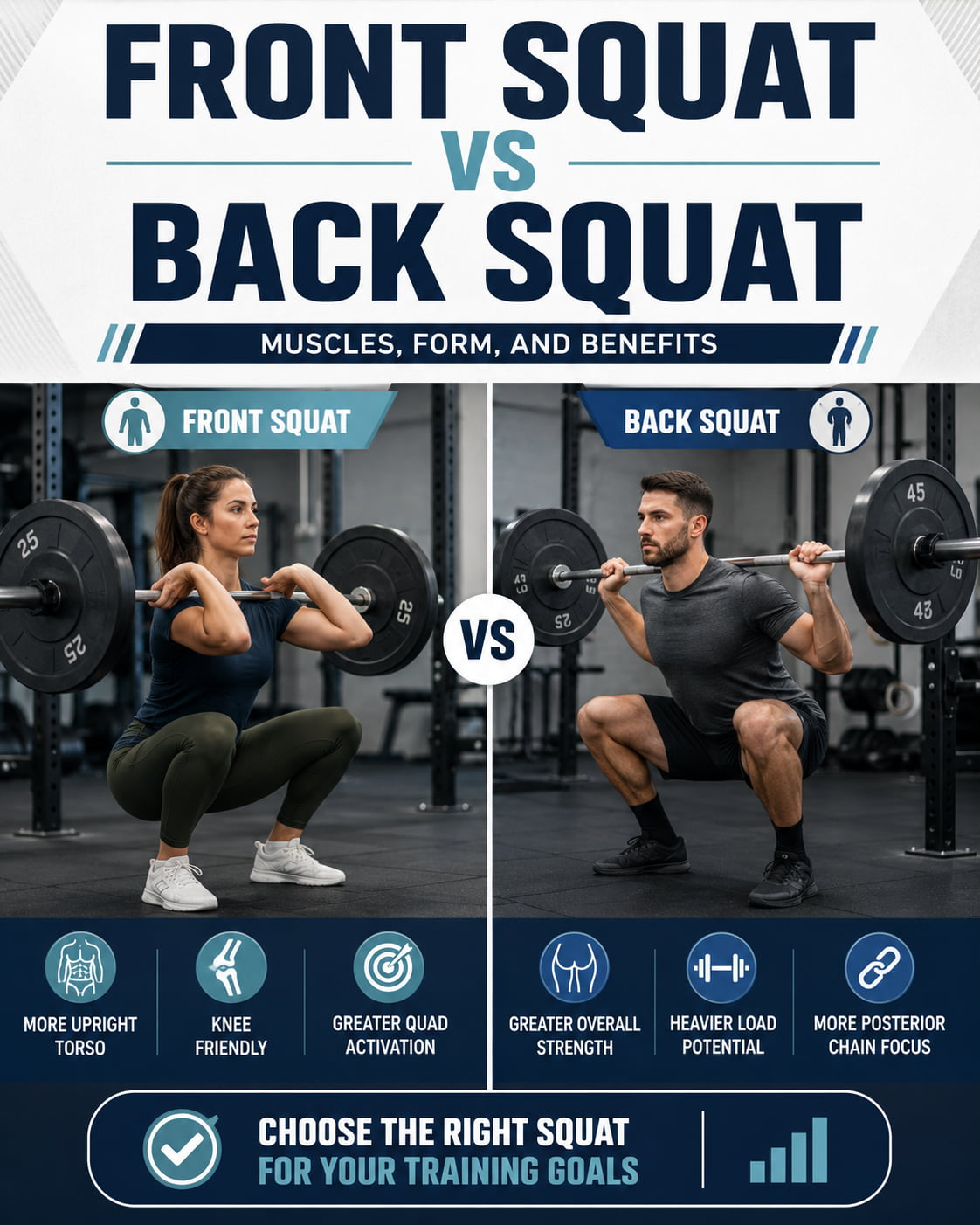
Front squat vs back squat comes down to bar position, torso angle, muscle emphasis, mobility demands, and training goal. Both exercises build lower-body strength, but the front squat usually challenges the quads, core, and upper back more, while the back squat usually allows heavier loading and more overall lower-body strength work.
This guide explains the key differences between the front squat and back squat, how to perform each lift, which muscles they train, common mistakes to avoid, and how to use both in a smart workout plan.
Front Squat vs Back Squat: Quick Comparison
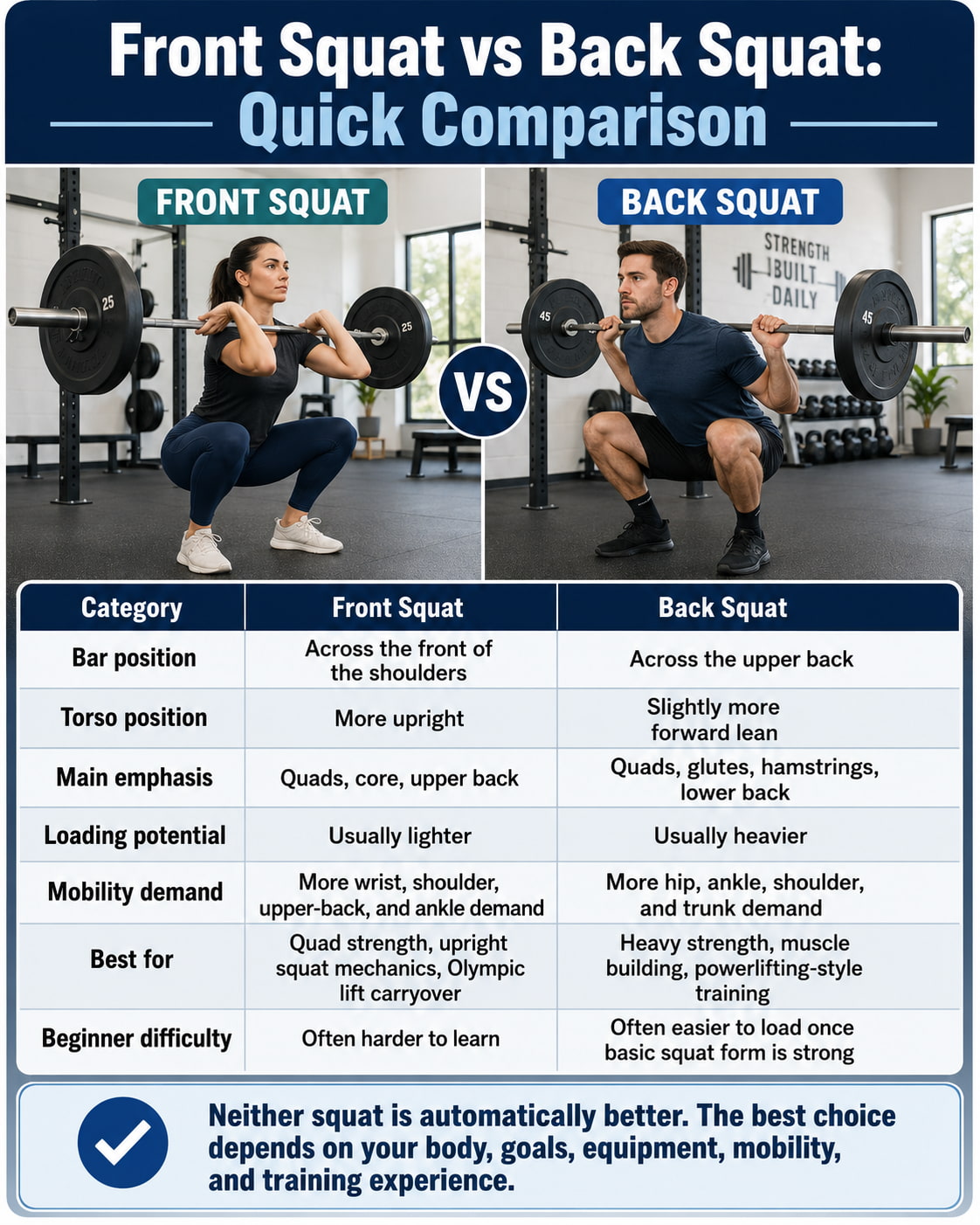
| Category | Front Squat | Back Squat |
|---|---|---|
| Bar position | Across the front of the shoulders | Across the upper back |
| Torso position | More upright | Slightly more forward lean |
| Main emphasis | Quads, core, upper back | Quads, glutes, hamstrings, lower back |
| Loading potential | Usually lighter | Usually heavier |
| Mobility demand | More wrist, shoulder, upper-back, and ankle demand | More hip, ankle, shoulder, and trunk demand |
| Best for | Quad strength, upright squat mechanics, Olympic lift carryover | Heavy strength, muscle building, powerlifting-style training |
| Beginner difficulty | Often harder to learn | Often easier to load once basic squat form is strong |
Neither squat is automatically better. The best choice depends on your body, goals, equipment, mobility, and training experience.
What Is the Front Squat?
The front squat is a barbell squat variation where the bar rests across the front of your shoulders in a front-rack position. Your elbows stay lifted, your torso stays tall, and your core works hard to keep the bar from pulling you forward.
The ACE front squat guide teaches a controlled squat pattern with the load held in front of the body, while the CrossFit front squat guide highlights the importance of the front rack, upright torso, and strong midline control.
Front Squat
Best for: Quad strength, upright squat mechanics, front-rack strength, core control, and Olympic lifting carryover.
Muscles worked: The front squat trains the quadriceps, glutes, hamstrings, adductors, calves, spinal erectors, abs, obliques, traps, and upper back. The quads often feel more involved because the torso stays more upright and the knees usually travel forward more than they do in many back squat styles.
Equipment needed: Barbell, weight plates, squat rack, and safety pins. Dumbbells, kettlebells, or a goblet squat setup can be used for beginner regressions.
Why it stands out: The front squat forces you to stay tall. If your elbows drop, your upper back rounds, or your brace relaxes, the bar quickly becomes harder to control. That makes it useful for building strong squat posture, quad strength, and trunk stability.
Suggested sets and reps: For strength, use 3–5 sets of 3–6 reps. For muscle building, use 3–4 sets of 6–10 reps. For technique practice, use 2–4 sets of 3–5 controlled reps with lighter weight.
Beginners: Start with a goblet squat or light front squat to a box. Focus on keeping the chest tall, elbows lifted, feet flat, and knees tracking over the toes before adding heavier loads.
Intermediate: Use the barbell front squat as a main lift or secondary squat after back squats. Work in the 4–8 rep range and stop sets before your elbows drop or your torso collapses.
Advanced: Use paused front squats, tempo front squats, or heavy triples to build position-specific strength. Advanced lifters can also use the front squat to support clean receiving positions.
Rest: Rest 2–3 minutes for heavy strength sets and 90–150 seconds for moderate hypertrophy sets.
How to do it:
- Set the bar in a squat rack at about upper-chest height.
- Step under the bar and place it across the front of your shoulders.
- Lift your elbows so your upper arms are close to parallel with the floor.
- Brace your core, unrack the bar, and step back into your squat stance.
- Keep your chest tall, ribs down, and feet flat.
- Squat down by bending your knees and hips under control.
- Keep your knees tracking in the same direction as your toes.
- Descend as low as you can while keeping a strong brace and upright posture.
- Drive through your midfoot and stand up without letting your elbows drop.
- Reset your breath and brace before the next rep.
Common mistakes: Letting the elbows drop, holding the bar in the hands instead of resting it on the shoulders, losing the brace, rounding the upper back, letting the heels lift, and allowing the knees to cave inward.
Expert tip: Think “elbows high, ribs down, knees forward.” This cue helps you stay upright without overextending your lower back.
Exercise variations: Paused front squat, tempo front squat, zombie squat, double-pause front squat, clean-grip front squat, cross-arm front squat, and front squat to box.
Easier variation: Goblet squat. It keeps the load in front of the body but is easier to hold and more beginner-friendly than a barbell front squat.
Harder variation: Paused front squat. Pause for 2–3 seconds at the bottom while keeping your elbows high and torso stable.
What Is the Back Squat?
The back squat is a barbell squat variation where the bar rests across your upper back. It is one of the most common strength exercises because it can be loaded heavily and trained for strength, muscle, and athletic power.
The ACE back squat guide explains the basic setup, stance, descent, and standing phase. The CrossFit back squat guide also emphasizes bracing, knee tracking, bar position, and maintaining a strong spine position.
Back Squat
Best for: Heavy lower-body strength, general muscle building, glute and hamstring involvement, powerlifting-style training, and total-body bracing.
Muscles worked: The back squat trains the quadriceps, glutes, hamstrings, adductors, calves, spinal erectors, abs, obliques, traps, and upper back. Depending on bar position and torso angle, many lifters feel more hip, glute, and posterior-chain involvement than they do in the front squat.
Equipment needed: Barbell, weight plates, squat rack, and safety pins. A lifting belt, squat shoes, or safety squat bar may be useful for some lifters, but they are not required for everyone.
Why it stands out: The back squat usually allows more weight than the front squat. That makes it one of the best lower-body lifts for progressive overload, especially when the goal is maximum strength or total leg development.
Suggested sets and reps: For strength, use 3–5 sets of 3–6 reps. For muscle building, use 3–5 sets of 6–10 reps. For general fitness, use 2–4 sets of 5–8 controlled reps.
Beginners: Learn the bodyweight squat, goblet squat, and box squat first. Move to the barbell back squat once you can keep your feet flat, knees controlled, spine neutral, and depth consistent.
Intermediate: Use the back squat as a main lift 1–2 times per week. Add weight slowly and keep 1–3 reps in reserve on most working sets.
Advanced: Use heavy triples, paused back squats, tempo squats, high-bar squats, low-bar squats, or planned training blocks. Advanced lifters should adjust volume based on recovery, sport needs, and total weekly lower-body work.
Rest: Rest 2–4 minutes for heavy strength sets and 90–180 seconds for moderate muscle-building sets.
How to do it:
- Set the bar in a squat rack around upper-chest height.
- Step under the bar and position it across your upper back.
- Pull your shoulder blades together and grip the bar firmly.
- Brace your core, unrack the bar, and step back carefully.
- Set your feet about shoulder-width apart or slightly wider.
- Keep your chest controlled, ribs stacked, and feet flat.
- Squat down by bending your knees and hips together.
- Keep your knees tracking over your toes.
- Reach a depth you can control without losing your brace.
- Drive through your midfoot and stand tall without overextending your hips.
- Reset your brace before the next rep.
Common mistakes: Squatting with a loose brace, letting the knees cave inward, lifting the heels, rounding the back, cutting depth short without reason, bouncing out of the bottom without control, and loading too heavy before technique is ready.
Expert tip: Think “brace, sit between the feet, drive the floor away.” This keeps the squat controlled instead of turning it into a loose good morning.
Exercise variations: High-bar back squat, low-bar back squat, paused back squat, tempo back squat, box squat, safety-bar squat, and pin squat.
Easier variation: Box squat. It gives you a clear depth target and can help beginners control the bottom position.
Harder variation: Paused back squat. Pause in the bottom position for 2–3 seconds, stay braced, then stand without bouncing.
Muscles Worked: Front Squat vs Back Squat
Both squats train the same major muscle groups, but the emphasis changes because the bar sits in a different place.
The front squat places the load in front of the body. To keep the bar balanced, you need a more upright torso and strong front-rack posture. This often increases the demand on the quads, abs, obliques, upper back, and spinal erectors.
The back squat places the load across the upper back. This usually lets lifters handle more total weight. Depending on whether you use a high-bar or low-bar position, the back squat may involve more hip drive, glute contribution, hamstring assistance, and trunk stiffness.
A biomechanical comparison published on PubMed found that front squats produced similar overall muscle recruitment to back squats while using less load and producing lower compressive forces and knee extensor moments. A later open-access biomechanics study in PMC also supports the idea that load placement changes squat mechanics, including trunk and lower-body joint demands.
In practical training terms, use the front squat when you want upright control and quad emphasis. Use the back squat when you want heavier loading and broader lower-body strength.
Form Differences That Matter
The biggest difference is where the bar sits.
In the front squat, the bar pulls you forward if your elbows drop or your core relaxes. That is why front squats reward a tall torso, strong upper back, and controlled knee bend.
In the back squat, the bar is more stable across the upper back, so most lifters can use more weight. However, heavier loading also requires strong bracing, stable knees, controlled depth, and a consistent bar path.
An NSCA coaching article on front-loaded versus back-loaded squatting explains that changing load placement changes stabilization demands. That is exactly why the front squat and back squat can feel so different even though both are squat patterns.
Benefits of Front Squats
Front squats are useful when you want to build strong quads and better upright squat posture. Because the bar sits in front of the body, your abs and upper back have to work hard to prevent your torso from folding forward.
They also carry over well to Olympic weightlifting because the front squat builds the receiving position for the clean. Even if you do not perform Olympic lifts, front squats can improve your ability to stay braced and controlled under load.
Front squats may also be a smart option for lifters who want a challenging squat variation with less total weight than they typically use in the back squat. That does not make the front squat easy. It simply means the position limits how much most lifters can load.
Benefits of Back Squats
Back squats are one of the most effective barbell lifts for building lower-body strength. Because the bar is supported across the upper back, many lifters can use heavier loads than they can in the front squat.
That heavier loading makes the back squat valuable for strength progress, muscle building, and athletic development. It trains the quads, glutes, hamstrings, hips, trunk, and upper back as one connected system.
The back squat is also easier to modify for different goals. A high-bar back squat often keeps the torso more upright and may feel more quad-focused. A low-bar back squat usually creates more forward torso lean and may allow heavier strength-focused lifting.
Which Squat Should You Choose?
Choose the front squat if your goal is quad strength, upright torso control, core strength, upper-back strength, or clean carryover. It is also useful if you want a squat variation that forces clean technique because poor posture usually makes the lift fail quickly.
Choose the back squat if your goal is maximum strength, heavier loading, general leg development, glute and hamstring involvement, or powerlifting-style training. It is usually the better choice when you want to move the most weight safely with good form.
Use both if you can perform both well. A simple approach is to make back squats your main heavy squat and front squats your secondary squat for technique, quads, and trunk strength. Another option is to focus on one variation for 4–8 weeks, then rotate the other into the main lift slot.
Common Front Squat Mistakes
The most common front squat mistake is letting the elbows drop. When that happens, the bar rolls forward, the upper back rounds, and the lift becomes harder to control.
Another mistake is holding the bar with the hands instead of letting it rest on the shoulders. Your hands help guide the bar, but your shoulders should support most of the load.
Many lifters also lose their brace at the bottom. Keep your ribs down, breathe into your trunk, and stay tight before every rep. If your torso collapses, reduce the load and rebuild the position.
Common Back Squat Mistakes
The most common back squat mistake is loading the bar before the squat pattern is ready. Heavy weight can hide small technique issues until they become bigger problems.
Knees caving inward is another common issue. Your knees do not need to point perfectly straight ahead, but they should generally track in the same direction as your toes.
Some lifters also turn the back squat into a hinge by letting the hips shoot up faster than the chest. Keep your brace strong and drive your upper back into the bar as you stand.
Front Squat and Back Squat Workout
This sample workout uses both lifts without overloading beginners or intermediate lifters.
| Exercise | Sets | Reps | Rest | Effort |
|---|---|---|---|---|
| Back squat | 4 | 4–6 | 2–3 minutes | 1–3 reps in reserve |
| Front squat | 3 | 5–8 | 90–150 seconds | 2–3 reps in reserve |
| Romanian deadlift | 3 | 8–10 | 90–150 seconds | Controlled |
| Split squat | 2–3 | 8–10 per side | 60–90 seconds | Smooth reps |
| Plank or dead bug | 2–3 | 30–45 seconds or 8–12 reps | 45–60 seconds | Strong brace |
Train this type of squat session 1–2 times per week depending on your recovery and total lower-body training. Add weight only when every rep stays controlled, your depth is consistent, and your brace does not break down.
The ACSM 2026 resistance-training update emphasizes matching training variables to your goal. For strength, heavier loads and lower reps are useful. For muscle growth, weekly volume matters. For power, moderate loads moved with intent can be effective.
Beginner Progressions
If you are new to squatting, do not rush straight into heavy barbell work. Start with bodyweight squats, goblet squats, and box squats. These variations help you learn foot pressure, knee tracking, bracing, and depth without needing to manage a heavy barbell.
Once your squat pattern is consistent, try a light front squat or back squat with safety pins set in a rack. Keep the weight easy enough that you could perform several more reps if needed.
A good beginner goal is not to max out. It is to make every rep look similar.
Intermediate and Advanced Progressions
Intermediate lifters can use both front squats and back squats in the same program. One lift can be the main strength movement, while the other can be used for volume, technique, or a different muscle emphasis.
Advanced lifters can use tempo reps, pauses, pin squats, heavy triples, or planned training blocks. The key is to progress one variable at a time. Do not increase load, volume, depth demands, and intensity all in the same week.
Safety Tips
Use a squat rack with safety pins when training with a barbell. Set the pins slightly below the bottom of your squat so you can safely exit a missed rep.
Start with a load you can control. Keep your feet flat, brace before each rep, and stop the set if your technique changes sharply.
Do not force a squat depth that your body cannot control. A strong squat uses the deepest range of motion you can own with stable feet, knees, hips, and spine.
Stop and seek professional guidance if squats cause sharp pain, numbness, dizziness, chest pain, or unusual symptoms.
Frequently Asked Questions
Is front squat better than back squat?
The front squat is not automatically better than the back squat. It is better for some goals, such as quad emphasis, upright posture, and front-rack strength. The back squat is usually better for heavier loading and maximum lower-body strength.
Does front squat work quads more than back squat?
The front squat often feels more quad-focused because the torso stays more upright and the knees usually travel forward more. However, both squats train the quads hard when performed with good depth and control.
Does back squat build glutes better than front squat?
The back squat often allows heavier loading and more hip involvement, which can make it useful for glute development. Front squats still train the glutes, but they usually emphasize the quads and trunk more.
Why is my front squat weaker than my back squat?
Most lifters front squat less because the front-rack position is harder to hold, the torso must stay more upright, and the bar is less forgiving if posture breaks down. That is normal.
Can beginners do front squats?
Beginners can learn front squats, but many should start with goblet squats first. The goblet squat teaches a similar upright pattern without requiring the wrist, shoulder, and upper-back mobility of the barbell front rack.
Should I do both front squats and back squats?
Yes, if you can perform both with good form. Back squats can be your heavier strength lift, while front squats can build quads, bracing, and upright control.
Which squat is better for lower-back comfort?
It depends on the lifter. Some people prefer front squats because they use less load and encourage a more upright torso. Others feel better with back squats because the rack position is easier. Choose the variation you can perform with the best control and no unusual symptoms.
Conclusion
Front squat vs back squat is not a battle where one lift wins for everyone. The front squat is excellent for quad strength, upright posture, core control, and front-rack skill. The back squat is excellent for heavier loading, lower-body strength, and long-term strength progression.
Use the squat that matches your goal, train it with clean form, and progress gradually. If you can do both well, combining them can give you a stronger and more complete lower-body program.
2 thoughts on “Front Squat vs Back Squat: Muscles, Form, Benefits”