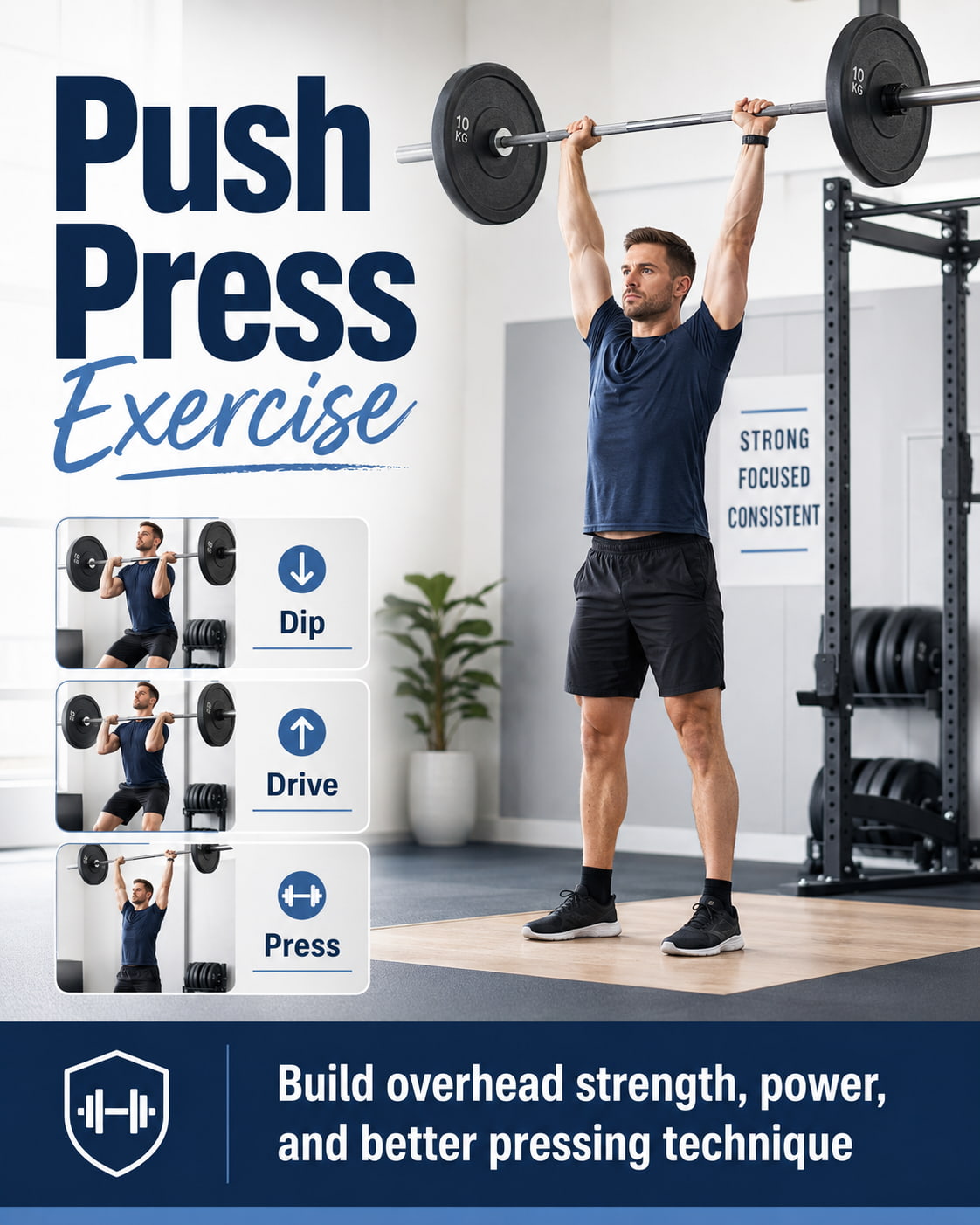
The push press exercise is a leg-assisted overhead press that helps you build shoulder strength, full-body power, and better force transfer from your legs to your upper body. Unlike a strict overhead press, the push press uses a short dip and explosive leg drive to help move the weight overhead.
This guide explains how to do the push press with proper form, which muscles it works, why it is useful, common mistakes to avoid, the best variations, and how to add it to a real workout routine.
What Is the Push Press Exercise?
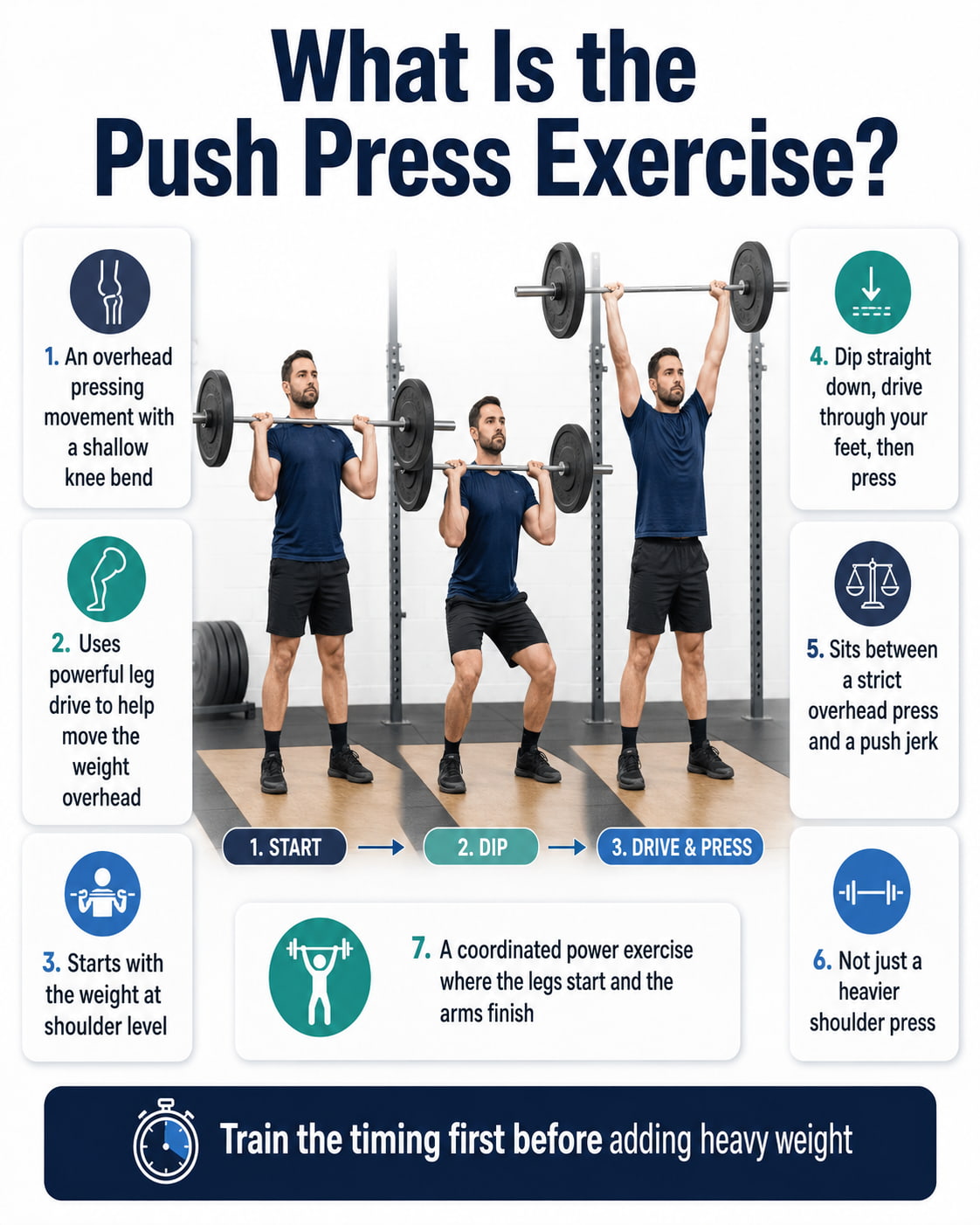
The push press exercise is an overhead pressing movement that combines a shallow knee bend, a powerful leg drive, and a strong arm finish. You start with the weight at shoulder level, dip straight down, drive through your feet, then press the weight overhead as your legs help create momentum.
The movement sits between a strict overhead press and a push jerk. A strict press uses only upper-body strength. A push jerk uses leg drive plus a second dip under the bar. The push press uses leg drive, but you finish the lift by pressing the weight overhead without re-bending under it.
CrossFit’s push press guide describes the lift as a dynamic pressing exercise that develops upper-body strength, core strength, hip extension, and core-to-extremity timing. The American Council on Exercise also classifies the push press as a full-body integrated movement rather than a shoulder-only exercise.
That is the key idea: the push press is not just a heavier shoulder press. It is a coordinated power exercise where your legs start the movement and your arms finish it.
Push Press Exercise Muscles Worked
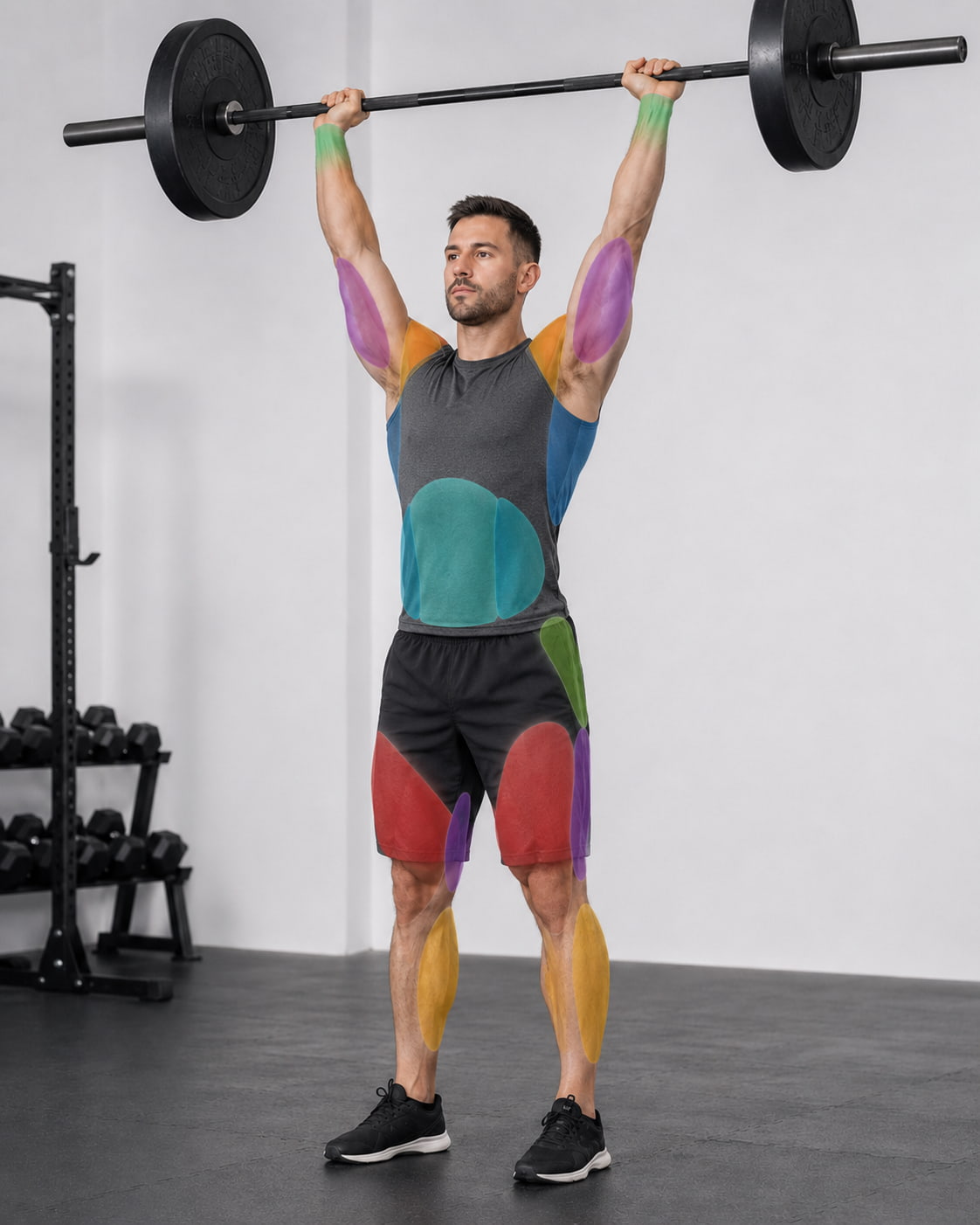
The push press trains your shoulders, triceps, legs, hips, upper back, and core together. The shoulders and triceps finish the press, but the lower body creates the initial drive that moves the weight off the shoulders.
The deltoids are the main shoulder muscles used during the press. The front and side delts help move the weight overhead, while the rear delts and upper back help keep the shoulders stable.
The triceps straighten the elbows and help lock the weight out overhead. If your lockout is weak, your triceps may be one of the limiting factors.
The quadriceps work during the dip and drive. They help bend and extend the knees so you can push hard through the floor.
The glutes help extend the hips as you drive upward. A strong glute contraction helps transfer force from the lower body into the bar or dumbbells.
The hamstrings assist with hip control and help stabilize the lower body during the dip and drive.
The upper back, including the traps, rhomboids, and supporting scapular muscles, helps control the front rack position and stabilize the weight overhead.
The core works hard to keep your ribs down, spine braced, and torso vertical. A strong brace helps prevent the movement from turning into a lower-back extension exercise.
Your calves and grip also assist. The calves help finish the leg drive, while the hands and forearms keep the weight controlled from the rack to the overhead position.
How to Do the Push Press Exercise With Proper Form
Best for: The push press is best for building overhead strength, explosive pressing power, shoulder and triceps strength, and full-body coordination. It is especially useful for lifters who already understand basic overhead pressing and want to add controlled leg drive.
Muscles worked: The main muscles worked are the deltoids, triceps, quadriceps, glutes, hamstrings, upper traps, upper back, spinal erectors, and core. The shoulders and triceps finish the press, while the legs and hips create the drive.
Equipment needed: You can do the push press with a barbell, dumbbells, kettlebells, or a landmine setup. A barbell allows heavier loading, while dumbbells and kettlebells can be more shoulder-friendly for some lifters.
Why it stands out: The push press stands out because it teaches you to use your legs and upper body together. It builds pressing strength while also training timing, bracing, balance, and explosive force production.
Suggested sets and reps: For technique, use 3 to 5 sets of 3 to 5 reps with a light to moderate load. For strength and power, use 3 to 5 sets of 2 to 5 reps with full rest. For muscle-building accessory work, use 2 to 4 sets of 6 to 8 reps with a weight you can control.
Beginners: Start with a PVC pipe, light dumbbells, or an empty barbell. Focus on dipping straight down, keeping the torso tall, and driving with the legs before pressing with the arms.
Intermediate: Use moderate loads for 3 to 6 reps per set. Keep 1 to 3 reps in reserve and stop the set before your timing breaks down.
Advanced: Use the push press as a heavy overhead strength movement, a power exercise, or an accessory lift for weightlifting and strongman-style training. Advanced lifters can use heavier triples, doubles, or complex variations, but only with strong overhead stability and clean bar path.
Rest: Rest 2 to 3 minutes for heavy strength or power sets. Rest 60 to 90 seconds for lighter accessory sets. For conditioning workouts, use lighter loads and maintain clean reps.
How to do it:
- Stand with your feet about hip-width apart and the weight at shoulder level.
- Set the bar or dumbbells close to your shoulders with your elbows slightly in front of the weight.
- Brace your core, squeeze your glutes lightly, and keep your ribs stacked over your pelvis.
- Dip straight down by bending your knees slightly while keeping your torso vertical.
- Drive hard through your feet and extend your knees and hips quickly.
- Let the leg drive move the weight upward, then press with your arms to finish overhead.
- Lock the weight out with your biceps near your ears and your body stacked tall.
- Lower the weight back to your shoulders under control, reset your brace, and repeat.
Common mistakes: The most common mistakes are dipping too low, leaning forward during the dip, pressing with the arms too early, letting the weight drift forward, overextending the lower back, and using too much weight before the timing is consistent.
Expert tip: Think “dip straight, drive tall, press through.” The dip should be short and vertical, the drive should be explosive, and the press should finish with the weight stacked over your shoulders, hips, and midfoot.
Exercise variations: Useful variations include the dumbbell push press, single-arm dumbbell push press, kettlebell push press, landmine push press, and push jerk. Each variation changes the stability demand and loading style.
Easier variation: The easiest versions are the PVC pipe push press, empty barbell push press, light dumbbell push press, or landmine press. These options help you learn the dip-drive pattern without heavy overhead loading.
Harder variation: Harder options include the heavy barbell push press, pause push press, single-arm kettlebell push press, push press from blocks, and push jerk. These require stronger bracing, better timing, and more overhead control.
Push Press Form Cues That Matter
A good push press starts with a strong rack position. The weight should sit close to your shoulders, not floating out in front of your body. With a barbell, your hands should grip just outside shoulder width for most lifters. Your elbows should point slightly forward, but they do not need to be as high as a front squat rack.
The dip should be shallow. Think quarter squat, not full squat. If you dip too low, you lose speed and turn the movement into a slow grind. A short dip lets you reverse direction quickly and use elastic force from the legs.
The torso should stay vertical. If your chest drops forward, the weight usually travels forward too. That makes the lift less efficient and puts more stress on your shoulders and lower back.
The drive should come from the floor. Push your feet into the ground, extend your knees and hips, then finish with the arms. The NSCA technique article on the push press breaks the movement into the dip, drive, and elbow extension, which is a useful way to understand the lift.
The finish should be stacked. At lockout, the weight should be over your shoulders, ribs, hips, and midfoot. If the weight is in front of you, bring it back into a stronger overhead line instead of chasing it with your lower back.
Benefits of the Push Press Exercise
The push press is useful because it trains strength, power, and coordination at the same time. It can fit into strength programs, athletic training, Olympic lifting accessory work, CrossFit-style workouts, and general gym routines.
One major benefit is stronger overhead pressing. Because your legs help start the lift, you can usually train with more load than you would use for a strict overhead press. This can help your shoulders, triceps, and upper back adapt to heavier overhead positions when your technique is solid.
The push press also builds explosive lower-body drive. The short dip and fast extension teach you to push forcefully through the floor, then transfer that force into the weight.
Another benefit is better full-body coordination. The lift rewards good timing. If you press too early, you lose the leg drive. If you dip too low, you slow the lift down. If your torso tips forward, the weight drifts away from the best path. Learning the push press helps you connect your legs, core, and arms into one smooth movement.
It may also support athletic power. Many sports require force to move from the ground through the hips and trunk into the upper body. The push press trains that same general idea in the weight room.
The push press is also efficient. One exercise can train the shoulders, arms, core, legs, hips, and upper back. That makes it useful when you want a powerful compound lift without adding too many separate exercises.
Common Push Press Mistakes and How to Fix Them
Dipping Too Low
A deep dip usually makes the push press slower. The goal is not to squat the weight. The goal is to create a quick, powerful leg drive. Fix it by dipping only a few inches and immediately driving back up.
Leaning Forward During the Dip
Leaning forward sends the weight away from the body. This often happens when the lifter unlocks the hips too much or shifts onto the toes. Fix it by keeping the chest tall, knees slightly forward, and weight balanced through the whole foot.
Pressing Too Early
If your arms press before your legs finish driving, you lose power. The push press should feel like the legs launch the weight and the arms finish it. Fix it by thinking “legs first, arms second.”
Letting the Bar Drift Forward
A forward bar path makes the lift harder and can irritate the shoulders. Fix it by keeping the bar close to your face as it passes your forehead, then finishing with the weight directly overhead.
Overarching the Lower Back
Some lifters lean back to finish the press instead of stacking the ribs and pelvis. This can place unnecessary stress on the lower back. Fix it by bracing before the dip, squeezing the glutes at lockout, and keeping your ribs down.
Using Too Much Weight
The push press can let you move more weight than a strict press, but that does not mean you should rush the load. If your knees cave in, the bar path loops forward, or you cannot control the lockout, reduce the weight and rebuild your timing.
Lowering the Weight Carelessly
The lowering phase matters. Dropping the weight too hard onto your shoulders can throw off your position and irritate your wrists or collarbone area. Lower the weight with control, absorb it with a soft knee bend if needed, and reset before the next rep.
Push Press Variations and Modifications
The barbell push press is the standard strength version. It allows the most load and works well for low to moderate reps.
The dumbbell push press is a great option if you want more freedom at the shoulders. It also challenges each side more evenly because both arms must stabilize their own weight.
The single-arm dumbbell push press adds an anti-rotation demand. Your core has to work harder to stop your torso from leaning or twisting.
The kettlebell push press changes the weight position because the bell sits outside the forearm. Many lifters like it for shoulder control, but it requires good wrist and rack-position awareness.
The landmine push press is a helpful regression for people who struggle with a straight overhead path. The angled press path can feel more comfortable and easier to control.
The strict overhead press is a useful foundation. If you cannot control a strict press with light weight, spend time building that pattern before loading the push press.
The push jerk is a progression from the push press. In a push jerk, you drive the weight up and then dip under it to receive the load with locked arms. It allows more lower-body contribution but requires more coordination.
Behind-the-neck push press variations should be used cautiously. They are not necessary for most general fitness goals and may not be appropriate if you lack shoulder mobility or overhead control.
Push Press vs. Overhead Press vs. Push Jerk
| Exercise | Main difference | Best for |
|---|---|---|
| Overhead Press | Pressed overhead without leg drive | Strict shoulder strength and upper-body control |
| Push Press | Uses a shallow dip and leg drive, then arms finish the press | Overhead strength, power, and full-body coordination |
| Push Jerk | Uses leg drive and a second dip under the weight | Heavier overhead lifting and Olympic lifting skill transfer |
The strict overhead press is slower and more upper-body dominant. The push press is more explosive and allows help from the legs. The push jerk is more technical because you must drive the weight up and quickly move under it.
How to Program the Push Press Exercise
The push press works best early in a workout, after your warm-up and before high-fatigue accessory work. Because it is a power-based overhead lift, your technique should stay sharp.
For strength and power, train the push press 1 to 2 times per week. Use lower reps, full rest, and high-quality sets. Most lifters should stop a set before reps become slow, unstable, or grindy.
For muscle-building accessory work, use moderate reps and controlled weight. The goal is not to turn every set into a max-effort lift. Keep your reps smooth and your lockout stable.
For conditioning, use lighter weights only after your technique is consistent. Fatigue can quickly turn a good push press into a messy overhead press with poor bracing.
| Goal | Sets and reps | Rest | Effort |
|---|---|---|---|
| Technique | 3 to 5 sets of 3 to 5 reps | 90 to 120 seconds | Light, crisp reps |
| Power | 4 to 6 sets of 2 to 4 reps | 2 to 3 minutes | Explosive, no grinding |
| Strength | 3 to 5 sets of 3 to 6 reps | 2 to 3 minutes | 1 to 3 reps in reserve |
| Muscle-building accessory | 2 to 4 sets of 6 to 8 reps | 60 to 90 seconds | Controlled reps |
| Conditioning | 3 to 5 rounds of 6 to 10 reps | As programmed | Light to moderate load |
The American College of Sports Medicine notes that resistance training variables should match the goal, with heavier loading used for strength and faster lifting emphasized for power. For general health, the CDC recommends muscle-strengthening activity at least 2 days per week.
Sample Push Press Workout Routine
Use this routine once per week as an overhead strength and power session. It works best after a general warm-up and a few light ramp-up sets.
| Exercise | Sets | Reps | Rest |
|---|---|---|---|
| Push Press | 5 | 3 | 2 to 3 minutes |
| Strict Dumbbell Press | 3 | 8 | 90 seconds |
| Chest-Supported Row | 3 | 8 to 10 | 90 seconds |
| Half-Kneeling Landmine Press | 3 | 8 per side | 60 to 90 seconds |
| Farmer Carry | 3 | 30 to 45 seconds | 60 seconds |
Use a push press load that feels powerful and controlled. A good starting target is a weight you can lift for 3 clean reps while still keeping 1 to 3 reps in reserve.
Progress by adding a small amount of weight when all sets are fast, stable, and technically clean. If the bar path starts drifting forward or your lower back takes over, keep the same weight or reduce the load.
Beginner Push Press Workout
A beginner should treat the push press as a skill first. The goal is to learn the timing before chasing heavy weight.
| Exercise | Sets | Reps | Rest |
|---|---|---|---|
| PVC Pipe or Empty Bar Push Press | 4 | 5 | 60 seconds |
| Dumbbell Push Press | 3 | 6 | 90 seconds |
| Seated Dumbbell Shoulder Press | 2 | 8 to 10 | 90 seconds |
| Plank | 3 | 20 to 40 seconds | 60 seconds |
Do this workout 1 time per week at first. When the dip, drive, and overhead lockout feel consistent, you can gradually increase load or move to the intermediate routine.
Who Should Do the Push Press?
The push press can be useful for intermediate lifters, athletes, Olympic weightlifting trainees, CrossFit athletes, and general gym users who want to build overhead power.
It is also useful if you already perform overhead presses and want to learn how to use your legs to move weight more explosively.
Beginners can still learn the movement, but they should start light. A PVC pipe, empty barbell, light dumbbells, or landmine setup is usually better than jumping straight into heavy barbell work.
Who Should Be Careful With the Push Press?
Be careful with the push press if you have poor overhead mobility, uncontrolled lower-back extension, shoulder pain during pressing, wrist discomfort in the rack position, or difficulty balancing weight overhead.
That does not always mean you can never do the exercise. It means you may need a regression, a different implement, a lighter load, or help from a qualified coach.
Stop the exercise and seek professional help if you feel sharp pain, numbness, dizziness, chest pain, sudden weakness, or unusual symptoms.
Mayo Clinic’s strength training guidance emphasizes using proper form, choosing manageable weight, and stopping an exercise if it causes pain.
FAQs About the Push Press Exercise
Is the Push Press Good for Building Shoulders?
Yes, the push press can help build stronger shoulders, especially when used with good form and appropriate loading. The deltoids and triceps still work hard to finish the press, even though the legs help start the movement.
Is the Push Press Better Than the Overhead Press?
It depends on your goal. The strict overhead press is better for isolating upper-body pressing strength. The push press is better for training leg drive, power, heavier overhead loading, and full-body coordination. Most lifters can benefit from using both at different times.
How Heavy Should I Go on the Push Press?
Use a weight you can move fast and control overhead. For strength work, stop with 1 to 3 reps in reserve. For power work, use a load that feels explosive. If the rep turns into a slow grind, it is probably too heavy for that purpose.
How Many Reps Should I Do?
For power and strength, use 2 to 6 reps per set. For accessory work, use 6 to 8 reps. Higher reps can work for conditioning, but only with lighter loads and solid technique.
Can Beginners Do the Push Press?
Yes, but beginners should start with light versions. The best starting options are a PVC pipe push press, empty barbell push press, light dumbbell push press, or landmine press. The timing matters more than the load.
Is the Push Press Bad for Your Back?
The push press should not be a lower-back exercise. If your lower back takes over, you may be leaning back, losing your brace, or using too much weight. Keep your ribs down, brace your core, squeeze your glutes at lockout, and finish with the weight stacked overhead.
Can I Do the Push Press With Dumbbells?
Yes. Dumbbell push presses are a strong variation. They allow each arm to move naturally, challenge shoulder stability, and can be easier to set up than a barbell. They are also useful for moderate-rep workouts.
Conclusion
The push press exercise is one of the best overhead movements for building strength, power, and full-body coordination. The key is simple: dip straight down, drive hard with your legs, then finish the press with your arms.
Start light, master the timing, keep your core braced, and progress only when each rep stays fast and controlled. Used correctly, the push press can become a powerful tool for stronger shoulders, better overhead stability, and more athletic pressing strength.
This content is for informational purposes only and is not a substitute for professional medical advice.
4 thoughts on “Push Press Exercise: Form, Muscles Worked and Benefits”