The dumbbell overhead press is a compound shoulder exercise that builds overhead pressing strength while training the deltoids, triceps, and upper-body stabilizers. It is performed by pressing two dumbbells from shoulder height to a controlled overhead position.
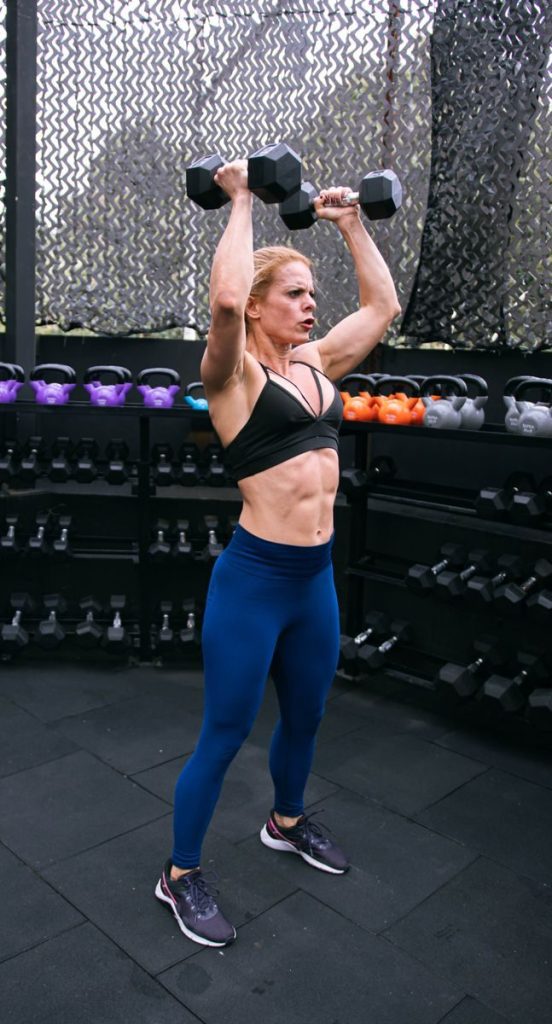
This guide focuses on the standing strict dumbbell overhead press. Your hips and knees remain still throughout each repetition. When you bend your knees and use leg drive, the movement becomes a dumbbell push press rather than a strict overhead press.
Dumbbell Overhead Press at a Glance
| Training detail | Recommendation |
|---|---|
| Best for | Building shoulder and triceps strength |
| Primary muscles | Anterior deltoids, middle deltoids, and triceps |
| Supporting muscles | Trapezius, serratus anterior, rotator cuff, core, and glutes |
| Equipment needed | Two matched dumbbells |
| Difficulty | Beginner to intermediate |
| Starting position | Standing with dumbbells at shoulder height |
| Suggested repetitions | 6–12 per set for most goals |
| Suggested sets | 2–4 working sets |
| Rest | 90 seconds to 3 minutes |
| Frequency | Once or twice per week |
| Main regression | Seated back-supported dumbbell press |
| Main progression | Standing single-arm dumbbell overhead press |
What Is a Dumbbell Overhead Press?
The dumbbell overhead press is a vertical pressing exercise performed with one dumbbell in each hand. Each repetition begins with the dumbbells near your shoulders and finishes with your arms extended overhead.
“Dumbbell overhead press” and “dumbbell shoulder press” are often used as names for the same basic movement. However, shoulder presses are frequently performed seated, while the term overhead press often refers to a standing version.
Using dumbbells allows each arm to move independently. This can make differences in strength, control, or range of motion easier to notice, although the exercise does not automatically correct those differences.
A traditional barbell overhead press locks both hands onto one bar. Dumbbells provide more freedom to adjust your hand angle and arm path, but they also require you to stabilize two independently moving weights.
How to Do the Dumbbell Overhead Press
Best for: Developing shoulder strength, triceps strength, and a controlled overhead pressing pattern.
Muscles worked: Anterior and middle deltoids, triceps, trapezius, serratus anterior, rotator cuff, abdominals, spinal stabilizers, and glutes.
Equipment needed: Two dumbbells of equal weight.
Sets, reps, and rest: Start with 2–3 sets of 8–12 repetitions. Rest for 90–120 seconds between sets and finish each set with approximately 2–3 technically good repetitions still available.
Step-by-Step Instructions
- Stand securely.
Place your feet approximately hip- to shoulder-width apart. Keep your weight balanced across both feet. - Bring the dumbbells to shoulder height.
Hold one dumbbell in each hand with your palms facing forward or angled slightly toward each other. Keep your wrists straight and stacked above your forearms. - Position your elbows.
Keep your elbows slightly forward of your torso rather than pointing them directly out to the sides. Your forearms should be approximately vertical when viewed from the front. - Brace your body.
Tighten your abdominal muscles and glutes. Keep your ribs positioned over your pelvis without excessively arching your lower back. - Press the dumbbells overhead.
Exhale as you press both dumbbells upward. Allow them to travel slightly inward while keeping each weight balanced over its forearm. - Finish in a controlled overhead position.
Extend your elbows without forcefully snapping them straight. The dumbbells should finish approximately above your shoulders rather than far in front of your body. - Lower the weights slowly.
Inhale as you bend your elbows and return the dumbbells toward shoulder height. Stop at the deepest position you can control without shoulder discomfort, wrist bending, or excessive back arching.
The American Council on Exercise similarly emphasizes firm foot support, abdominal bracing, neutral wrists, a rigid torso, and keeping the elbows somewhat forward for comfort.
Coaching cue: Press yourself away from the dumbbells while keeping your ribs stacked over your hips.
Key Form Checkpoints
Keep Your Wrists Over Your Forearms
Avoid allowing the dumbbell handles to sit behind your wrists. Excessive wrist extension makes the weights harder to control and can reduce the support provided by your forearms.
Use a closed grip with your thumbs wrapped around the handles. From the front, your wrists, forearms, and elbows should remain reasonably aligned.
Keep Your Elbows Slightly Forward
Your elbows do not need to point directly sideways. A slightly forward elbow position usually creates a more natural arm path and helps keep the forearms under the dumbbells.
Do not force your elbows tightly against your torso, either. The exact angle will vary with your grip, shoulder structure, and arm length.
Keep Your Ribs Over Your Pelvis
A small natural curve in the lower back is normal. The problem occurs when you lean far backward, lift your rib cage, and turn the movement into an exaggerated incline press.
Brace before every repetition. If you cannot press without leaning back, use lighter dumbbells or switch temporarily to the seated back-supported version.
Let Your Shoulder Blades Move Naturally
Do not forcefully pin your shoulder blades down for the entire repetition. During normal overhead arm elevation, the shoulder blades rotate upward along the rib cage. Research available through the National Library of Medicine describes how the serratus anterior and trapezius help produce and control this movement.
Keep the shoulders controlled, but allow the shoulder blades to rotate naturally as the dumbbells rise.
Use a Controlled Overhead Finish
At the top, the dumbbells should be balanced over your shoulders and approximately over the middle of your feet.
Do not force your arms farther backward than your available range allows. If reaching a vertical arm position causes your ribs to flare or your lower back to arch, reduce the weight or use a more comfortable range.
Dumbbell Overhead Press Muscles Worked
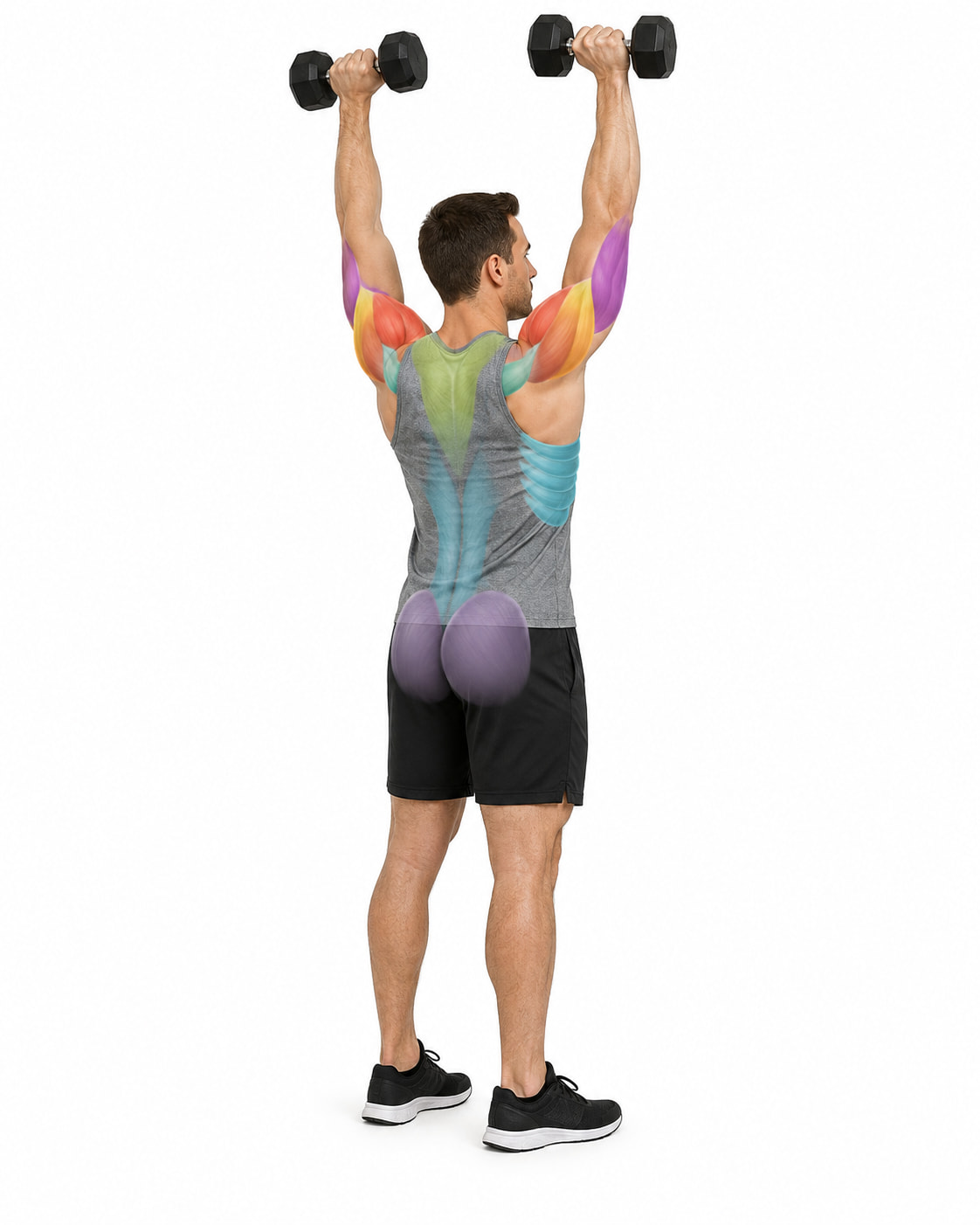
The dumbbell overhead press primarily trains the shoulders and triceps. Several additional muscles stabilize the shoulder blades, upper arms, trunk, and hips.
Anterior Deltoids
The anterior deltoids are the front portions of the shoulder muscles. They help raise the upper arms forward and overhead.
A study indexed by PubMed comparing common shoulder exercises found high anterior-deltoid activity during the shoulder press. This supports its use as a compound front-deltoid exercise, although muscle-activation measurements during a repetition do not directly guarantee long-term muscle growth.
Middle Deltoids
The middle, or lateral, deltoids assist as the upper arms move outward and upward. Their contribution can change according to your elbow position, grip, and pressing path.
The overhead press trains the middle deltoids, but it should not be treated as a complete replacement for lateral raises when side-delt development is a major goal.
Triceps Brachii
The triceps on the backs of your upper arms extend your elbows as you press the dumbbells upward.
All three triceps heads contribute to elbow extension. The exercise may feel more triceps-dominant near the upper portion of the repetition, where straightening the elbows becomes especially important. The NCBI Bookshelf anatomy overview describes elbow extension as the muscle group’s primary function.
Trapezius and Serratus Anterior
The trapezius and serratus anterior help move and stabilize the shoulder blades during overhead arm elevation.
These muscles do not press the dumbbells by extending your elbows, but they help create a controlled base from which the shoulders and arms can work.
Rotator-Cuff Muscles
The supraspinatus, infraspinatus, teres minor, and subscapularis help stabilize the upper-arm bone within the shoulder joint while the arms move.
The rotator cuff works as a stabilizing system rather than as the main force producing the press. Research indexed by PubMed describes its role in controlling and stabilizing the glenohumeral joint during upper-body movements.
Core and Glutes
During the standing press, the abdominals, spinal stabilizers, and glutes work isometrically to control the trunk and pelvis.
Their job is not to create momentum. They help prevent excessive leaning, twisting, and lower-back arching as the weights move overhead.
Dumbbell Overhead Press Benefits
Builds Shoulder and Triceps Strength
The exercise trains the shoulders and triceps together through a compound pressing movement. This makes it useful when you want to develop multiple upper-body muscles without performing a separate exercise for each one.
Trains an Overhead Pressing Pattern
The movement helps you practice producing and controlling force above your head. That pattern is relevant to many gym exercises and everyday tasks involving objects placed overhead.
Allows Each Arm to Work Independently
Each arm controls its own dumbbell. One side cannot directly move the other dumbbell in the way both arms can contribute to one barbell.
This does not guarantee perfectly equal development, but it can make side-to-side differences easier to identify.
Offers Several Grip Options
You can use a palms-forward, angled, or neutral grip. This flexibility allows you to choose the hand position that provides the best combination of control, comfort, and range.
No single grip is universally best or safest for everyone.
Challenges Whole-Body Stability
The standing version requires you to control your trunk, pelvis, and lower body while pressing. This creates a larger stability demand than a back-supported seated press.
A shoulder-press study indexed by PubMed found that the standing dumbbell condition produced high muscle activity but allowed less maximal load than more stable positions. The study was small, and its muscle-activation results should not be interpreted as proof that the standing version is always superior.
Requires Minimal Equipment
A pair of dumbbells and enough overhead space are all you need. The exercise can fit into a home workout or a full gym program.
Common Dumbbell Overhead Press Mistakes
Leaning Too Far Back
Excessive backward leaning shifts some of the work away from a true vertical press and increases movement through the lower back.
Fix: Reduce the weight, brace your abdominals before each repetition, tighten your glutes, and keep your ribs stacked over your pelvis.
Using Leg Drive
Bending your knees and quickly extending your legs helps launch the weights upward. That is a valid technique for a dumbbell push press, but it is not a strict overhead press.
Fix: Keep your knees and hips still. End the set when you can no longer press without using momentum.
Flaring the Elbows Directly Sideways
Starting with your elbows in a straight line across your shoulders may feel awkward and can make it harder to keep your forearms under the dumbbells.
Fix: Bring your elbows slightly forward and use an angled or neutral grip when needed.
Bending the Wrists Backward
When the dumbbells sit behind your wrists, the weights become less stable.
Fix: Keep the handles across the lower palm, wrap your thumbs around them, and stack your wrists over your forearms.
Pressing the Dumbbells Forward
Finishing with the dumbbells far in front of your head often accompanies lower-back arching or limited overhead control.
Fix: Use a lighter weight and press upward so the dumbbells finish approximately over your shoulders.
Forcing the Dumbbells Together
The dumbbells do not need to touch at the top. Colliding them can disturb your balance and encourage unnecessary inward movement.
Fix: Finish with the dumbbells separated and stable.
Lowering Too Far
A deeper bottom position is not automatically better. Lowering until your elbows move far behind your torso may cause you to lose wrist, shoulder, or trunk position.
Fix: Lower to shoulder height or to the deepest comfortable position you can control.
Using More Weight Than You Can Control
Common signs of excessive loading include uneven arm speed, leg drive, wrist bending, shortened repetitions, and leaning backward.
Fix: Choose a load that lets you maintain the same technique from the first repetition to the last.
Standing vs. Seated Dumbbell Overhead Press
Neither version is universally better. Choose according to your current ability and training goal.
| Feature | Standing press | Seated back-supported press |
|---|---|---|
| Balance demand | Higher | Lower |
| Trunk-stability demand | Higher | Lower |
| Potential loading | Often lower | Often higher |
| Leg and glute involvement | More stabilization required | Reduced |
| Beginner suitability | Suitable after basic control is learned | Often easier to learn |
| Best use | Strict full-body stabilization and overhead strength | Focused pressing with added support |
The seated version is useful when balance or trunk control limits your shoulder training. Keep your head, upper back, and hips supported, and avoid sliding forward on the bench.
The standing version is appropriate when you can press without leaning, twisting, or using your legs.
Palms Forward vs. Neutral Grip
Palms-Forward Grip
With a palms-forward grip, your elbows generally remain somewhat farther from your torso. This is the traditional dumbbell press position.
Use it when you can maintain comfortable shoulders, straight wrists, and vertical forearms.
Neutral Grip
With a neutral grip, your palms face each other and your elbows remain slightly closer to your sides.
Some lifters find this position more comfortable, but it is not guaranteed to prevent shoulder discomfort. The best grip is the one that allows you to press smoothly without pain, wrist bending, or forced joint positions.
Angled Grip
An angled grip sits between palms-forward and fully neutral. It is often a practical default because it allows the arms to move in a natural plane without forcing either extreme.
How Low Should You Lower the Dumbbells?
Lower the dumbbells until the handles reach approximately shoulder height or slightly below, provided you can maintain control.
Your ideal depth depends on:
- Shoulder comfort
- Arm length
- Grip position
- Mobility
- Dumbbell shape
- Ability to keep your wrists and forearms aligned
Do not force the dumbbells into a deeper position simply to create more range. Stop the descent when your elbows begin moving far behind your torso, your shoulders roll forward, or your wrists lose position.
Use the largest comfortable range you can control. A reduced range is better than forcing a painful or unstable position.
How Many Sets and Reps Should You Do?
The following ranges are practical starting points rather than rigid rules.
| Goal | Sets | Repetitions | Rest | Effort |
|---|---|---|---|---|
| Learn the exercise | 2–3 | 8–12 | 90–120 seconds | Keep 2–4 good reps available |
| Build muscle | 3–4 | 6–12 | 90–150 seconds | Keep 1–3 good reps available |
| Build strength | 3–5 | 4–8 | 2–3 minutes | Stop before form breaks |
| Accessory shoulder work | 2–3 | 10–15 | 60–90 seconds | Use a lighter, controlled load |
“Good reps available” refers to repetitions in reserve. Finishing with two repetitions in reserve means you likely could have completed two more repetitions without losing form.
The American College of Sports Medicine emphasizes regular resistance training, individualization, sufficient effort, and matching load and volume to the training goal. Its guidance also notes that advanced methods and training to complete failure are not required for most healthy adults.
How Often Should You Overhead Press?
Most people can perform a dumbbell overhead-press variation once or twice per week.
Consider your other pressing exercises. Bench presses, incline presses, push-ups, dips, and machine presses also train the anterior deltoids and triceps.
A person already completing several weekly pressing exercises may need only a few overhead-press sets. Someone using it as the main upper-body press may benefit from training it twice weekly with manageable volume.
Where Should It Go in a Workout?
Place the overhead press near the beginning of your workout when overhead strength is a priority.
A practical order is:
- General warm-up
- Light overhead-press warm-up sets
- Dumbbell overhead press
- Rows or pulldowns
- Lateral- and rear-deltoid exercises
- Arm accessories
When the overhead press is only accessory work, place it after your main bench or incline press.
How to Progress the Dumbbell Overhead Press
Use a simple double-progression method:
- Choose a repetition range, such as 8–12.
- Start with a weight you can lift for at least eight controlled repetitions.
- Add repetitions over several workouts.
- Once you reach 12 repetitions on every set with consistent form, increase the weight by the smallest practical amount.
- Return to the lower end of the repetition range and repeat.
Increase the load only when you can maintain:
- Stable ribs and pelvis
- No leg drive
- Straight wrists
- Even arm speed
- A controlled lowering phase
- A comfortable range
- Approximately 1–3 repetitions in reserve
When the jump between dumbbell sizes is too large, add one repetition per set, slow the lowering phase, or pause briefly at the bottom before increasing the weight.
Dumbbell Overhead Press Regressions
Seated Back-Supported Dumbbell Press
This is the most direct regression. The bench supports your trunk, reducing the balance and stabilization demands.
Keep your feet planted and maintain contact between the bench and your head, upper back, and hips.
Seated Neutral-Grip Press
Turn your palms toward each other and keep your elbows somewhat closer to your torso. Use this version when it provides a smoother and more comfortable pressing path.
Reduced-Range Dumbbell Press
Lower only as far as you can maintain control. Gradually increase the range when you can do so without pain, instability, or compensation.
One-Dumbbell Two-Hand Press
Hold one light dumbbell securely with both hands and press it overhead. This reduces the challenge of controlling two independently moving weights.
Landmine Press
A landmine press uses an angled path rather than a fully vertical one. It is a close alternative when a straight overhead press is not currently comfortable or controllable.
Dumbbell Overhead Press Progressions
Standing Single-Arm Dumbbell Press
Press one dumbbell at a time while resisting the tendency to lean sideways. This increases the trunk’s anti-rotation and anti-lateral-flexion demands.
Alternating Dumbbell Overhead Press
Hold one dumbbell at shoulder height while pressing the other. Alternate sides without twisting your torso.
Paused Overhead Press
Pause for one or two seconds near shoulder height before pressing. This removes momentum and makes the starting position more demanding.
Tempo Overhead Press
Take two to three seconds to lower each repetition. This can improve control without requiring an immediate weight increase.
Heavier Strict Press
Progress to heavier dumbbells only while preserving the same strict technique. The exercise should not gradually turn into a push press as the weight increases.
Warm-Up Before the Dumbbell Overhead Press
The American Academy of Orthopaedic Surgeons recommends warming up with 5–10 minutes of low-impact activity and advises against ignoring pain during exercise.
A practical overhead-press warm-up can include:
- Three to five minutes of easy walking, cycling, or similar movement.
- Several controlled arm circles or unloaded overhead reaches.
- One light set of 10–12 overhead presses.
- One or two gradually heavier sets of 5–8 repetitions.
- Your planned working sets.
Warm-up sets should prepare you rather than tire you out.
Sample Dumbbell Shoulder Workout
Use this routine once or twice per week, leaving at least one recovery day between similar upper-body sessions.
| Exercise | Sets | Repetitions | Rest |
|---|---|---|---|
| Dumbbell overhead press | 3 | 6–10 | 2 minutes |
| Chest-supported dumbbell row | 3 | 8–12 | 90 seconds |
| Dumbbell lateral raise | 2–3 | 10–15 | 60–90 seconds |
| Rear-delt dumbbell raise | 2–3 | 10–15 | 60–90 seconds |
| Dumbbell triceps extension | 2 | 10–15 | 60–90 seconds |
Finish most sets with approximately 1–3 controlled repetitions available.
When you reach the top of the repetition range for every set with consistent form, increase the dumbbell weight by the smallest available amount. You can also add one set to a priority exercise when you are recovering well and your performance remains consistent.
Dumbbell Overhead Press Safety Tips
- Check that you have enough clearance above and around you.
- Use two dumbbells of equal weight.
- Begin with a load you can safely bring to shoulder height.
- Keep your thumbs wrapped around the handles.
- Do not attempt maximum-effort repetitions without appropriate supervision.
- Stop the set when you need leg drive, excessive back arching, or momentum.
- Do not continue through sharp or worsening shoulder pain.
- Use a seated or reduced-range variation when the standing version cannot be controlled.
Stop exercising and seek professional help if you experience sharp pain, numbness, tingling, dizziness, chest pain, unusual weakness, or a feeling that the shoulder is unstable.
Anyone with a previous shoulder injury, recurrent instability, recent surgery, or a medical restriction involving overhead movement should obtain individualized guidance from a qualified healthcare professional.
Frequently Asked Questions
Is the dumbbell overhead press the same as the shoulder press?
The names are commonly used interchangeably. “Overhead press” often describes a standing strict press, while “shoulder press” may refer to either a seated or standing version.
Both involve pressing weights from shoulder level to overhead.
Is the standing or seated dumbbell overhead press better?
The standing version requires more balance and trunk stabilization. The seated back-supported version reduces those demands and may allow you to focus more directly on pressing.
Choose standing when you can maintain a stable torso. Choose seated when balance or trunk control limits your shoulder training.
Which muscles does the dumbbell overhead press work most?
The anterior deltoids, middle deltoids, and triceps perform most of the pressing work. The trapezius, serratus anterior, and rotator cuff help control the shoulder blades and shoulder joints.
The abdominals, spinal stabilizers, and glutes help stabilize your body during the standing version.
Should the dumbbells touch at the top?
No. The dumbbells can finish separated above your shoulders.
Touching them is unnecessary and may cause the weights to collide or move out of balance.
How low should I lower the dumbbells?
Lower them to approximately shoulder height or to the deepest comfortable position you can control.
Stop before your elbows move far behind your torso, your wrists bend, your shoulders become uncomfortable, or your lower back begins to arch.
Is a neutral grip better than a palms-forward grip?
Neither grip is best for everyone. A neutral grip may feel more comfortable for some people, while others prefer a palms-forward or slightly angled grip.
Use the position that allows straight wrists, controlled forearms, and a comfortable range.
Why does my lower back arch during the press?
Common reasons include using too much weight, losing abdominal tension, limited overhead range, or pressing the dumbbells too far forward.
Reduce the load, tighten your abdominals and glutes, keep your ribs over your pelvis, and use a seated back-supported variation when necessary.
Conclusion
The dumbbell overhead press is most effective when you treat it as a controlled vertical press rather than an attempt to move the heaviest possible dumbbells.
Keep your wrists over your forearms, position your elbows slightly forward, brace your trunk, and allow your shoulder blades to move naturally. Start with a manageable load, build repetitions with consistent form, and increase the weight only when every repetition remains controlled.
This content is for informational and educational purposes only and is not intended as a substitute for professional medical advice, diagnosis, or treatment.
References
- American College of Sports Medicine: Resistance Training Prescription for Muscle Function, Hypertrophy, and Physical Performance
- Effects of Body Position and Loading Modality on Muscle Activity and Strength in Shoulder Presses
- Different Shoulder Exercises Affect the Activation of Deltoid Portions in Resistance-Trained Individuals
- Scapular and Rotator-Cuff Muscle Activity During Arm Elevation
- American Council on Exercise: Seated Overhead Press
- American Academy of Orthopaedic Surgeons: Rotator Cuff and Shoulder Conditioning Program
6 thoughts on “Dumbbell Overhead Press: Form, Muscles Worked, Tips”