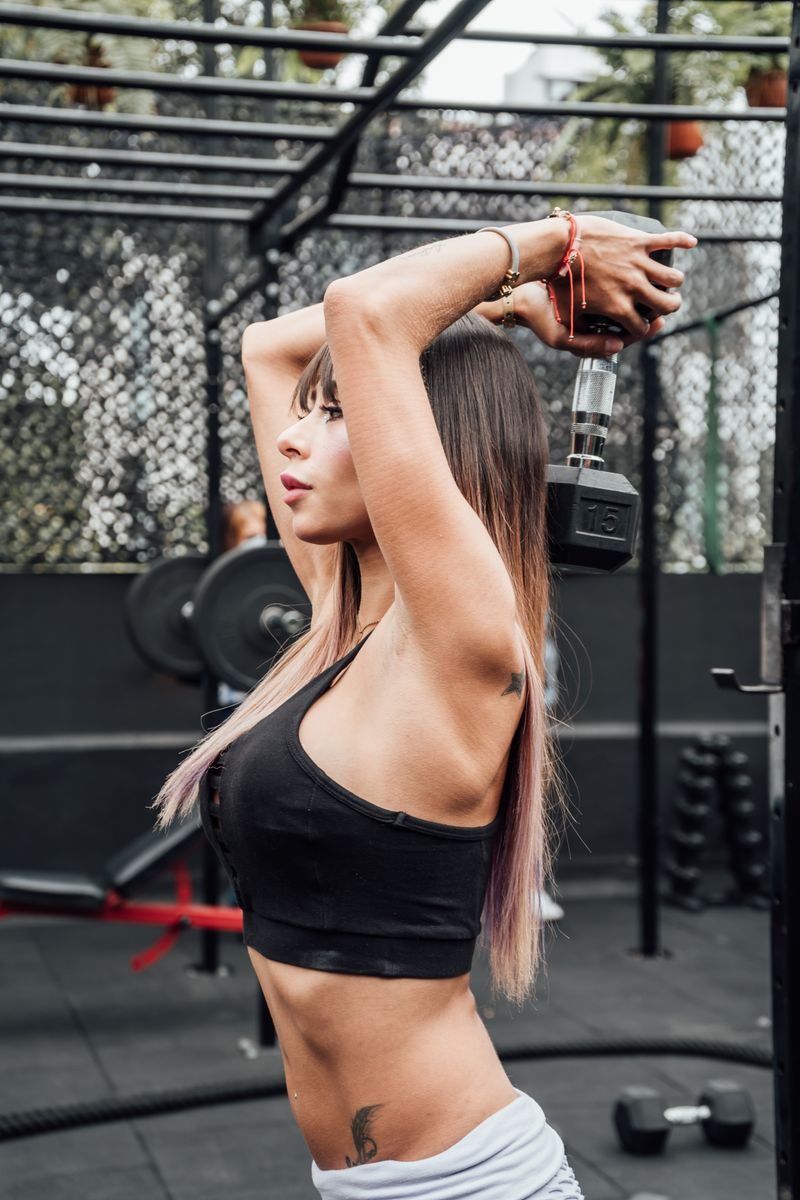
The dumbbell overhead extension is a single-joint exercise that trains all three heads of the triceps while placing the long head in an overhead, lengthened position. It is a practical choice for building stronger arms with one dumbbell, provided you can hold your arms overhead comfortably and control the weight without arching your back.
This guide explains proper form, muscles worked, useful variations, common mistakes, programming, progression, and safer alternatives.
Dumbbell Overhead Extension at a Glance
| Category | Recommendation |
|---|---|
| Exercise type | Single-joint triceps exercise |
| Main movement | Elbow extension |
| Primary muscle | Triceps brachii |
| Equipment | One dumbbell and an optional bench |
| Best for | Direct triceps training in an overhead position |
| Difficulty | Beginner–intermediate |
| Starting volume | 2–3 sets of 8–15 repetitions |
| Rest | 60–120 seconds |
| Typical workout placement | After presses or later in an upper-body workout |
What Is a Dumbbell Overhead Extension?
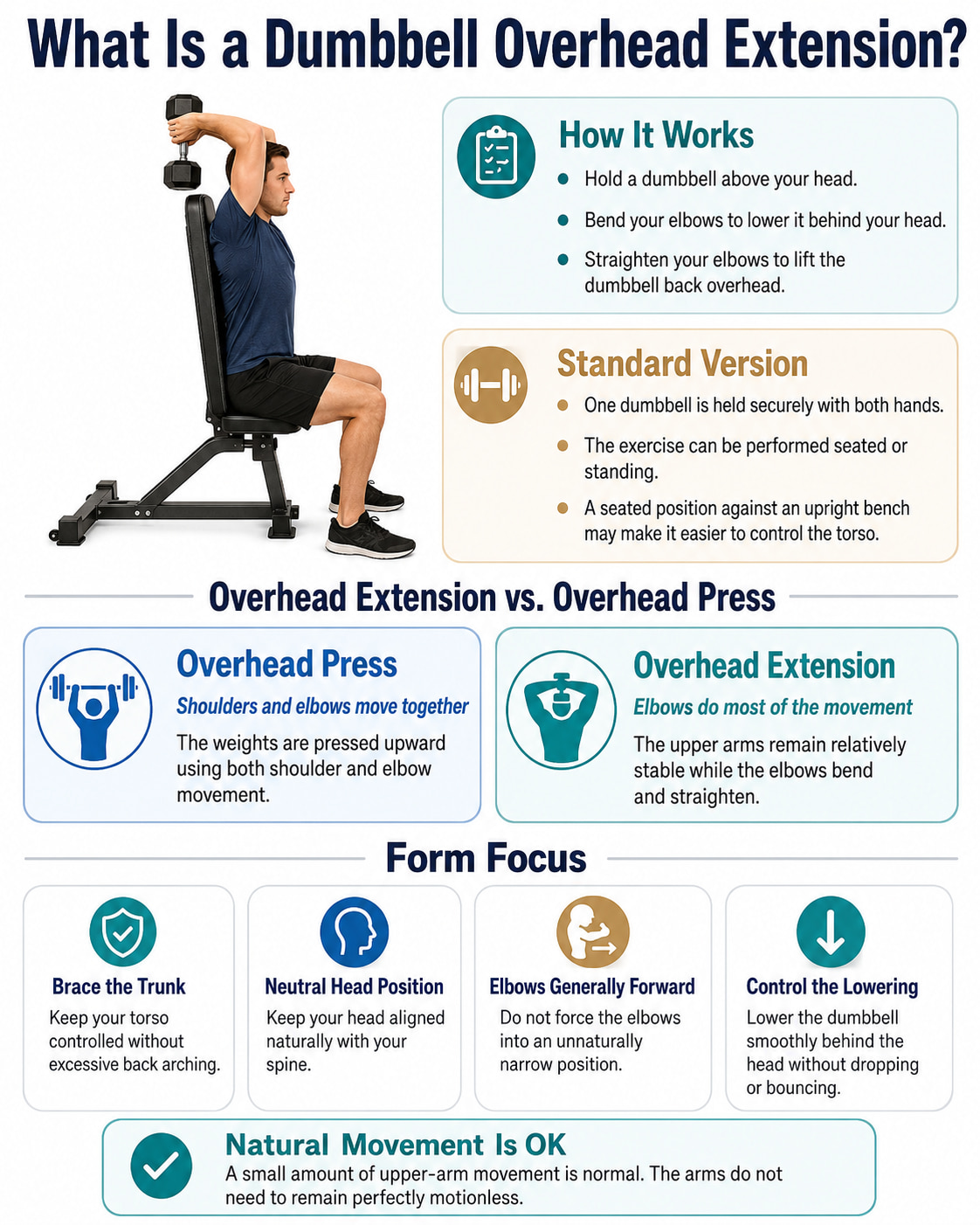
The dumbbell overhead extension involves holding a dumbbell above your head, bending your elbows to lower the weight behind your head, and then straightening your elbows to lift it again.
The standard version uses one dumbbell held securely with both hands. You can perform it seated or standing, although sitting against an upright bench generally makes it easier to control your torso.
This is different from a dumbbell overhead press:
- During an overhead press, the shoulders and elbows move together to press the weights upward.
- During an overhead extension, the upper arms remain relatively stable while the elbows bend and straighten.
The American Council on Exercise demonstrates the movement with a braced trunk, neutral head position, elbows directed generally forward, and controlled lowering behind the head.
A small amount of natural upper-arm movement is normal. You do not need to force your elbows into a perfectly fixed or unusually narrow position.
Dumbbell Overhead Extension Muscles Worked
| Muscle | Role in the Exercise |
|---|---|
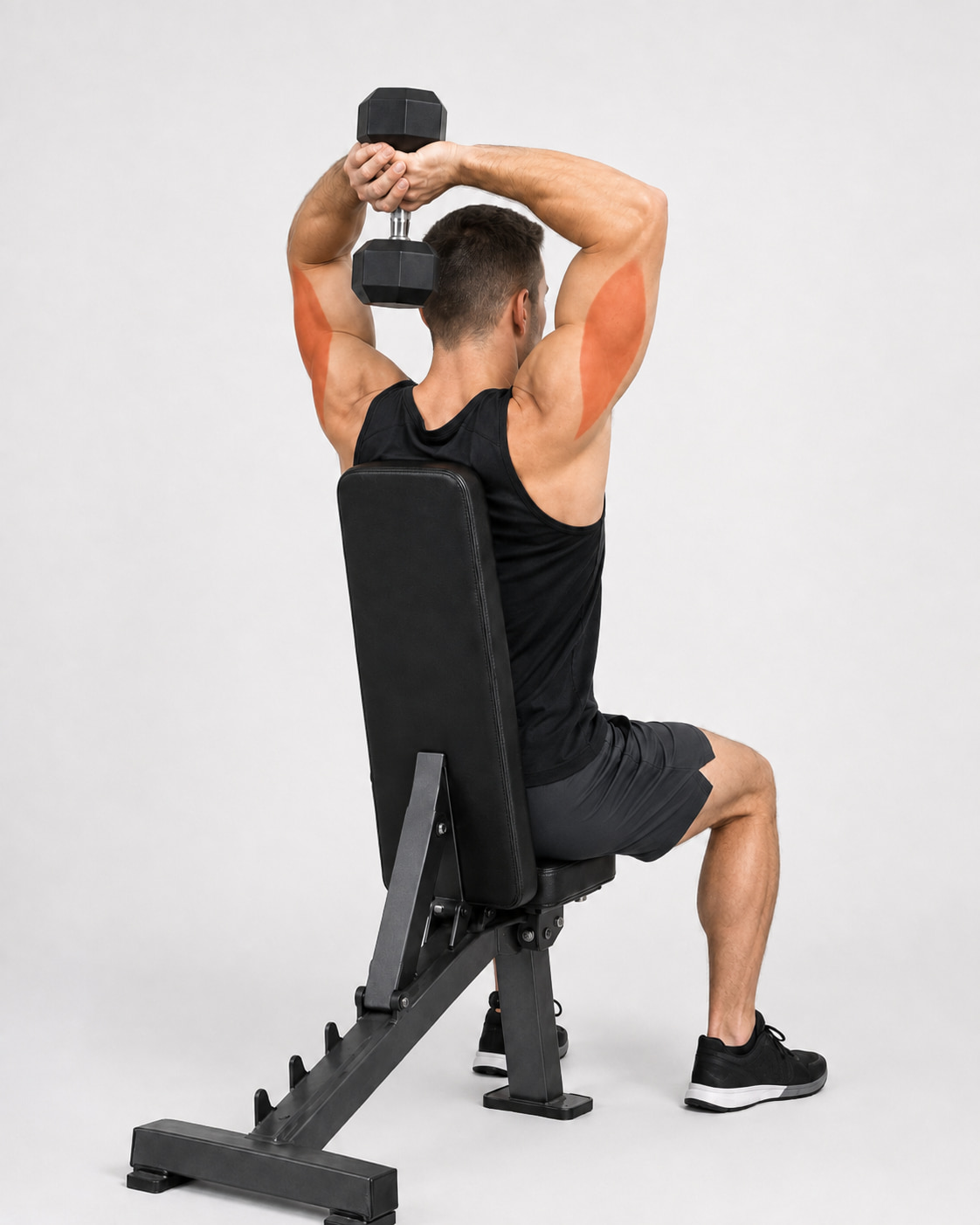
| Triceps brachii | Primary muscle responsible for straightening the elbow |
| Long head of the triceps | Works during elbow extension and is placed in a more lengthened position with the arm overhead |
| Lateral head of the triceps | Assists strongly with elbow extension |
| Medial head of the triceps | Contributes to elbow extension throughout the movement |
| Shoulder muscles | Help stabilize the upper arms in the overhead position |
| Upper-back muscles | Help control the shoulder blades and maintain position |
| Forearms and grip muscles | Keep the dumbbell secure and wrists controlled |
| Core muscles | Stabilize the torso and help limit excessive back arching |
Benefits of Dumbbell Overhead Extensions
- Direct triceps training: Makes elbow extension the main movement, so the triceps do more of the work than in presses or push-ups.
- Overhead triceps position: Places the long head of the triceps in a more lengthened position and complements pushdowns, kickbacks, and presses.
- Minimal equipment: Requires only one dumbbell and can be performed seated or standing at home or in the gym.
- Easy to progress: Add repetitions, increase the weight, add a set, use one arm at a time, or slow the lowering phase.
- Fits upper-body workouts: Works well after bench presses, overhead presses, push-ups, or close-grip presses, and can also be used in an arm workout.
How to Do a Dumbbell Overhead Extension
Equipment needed: One securely assembled dumbbell and an optional upright bench.
Sets, reps, and rest: Start with 2–3 sets of 8–15 repetitions. Rest for 60–120 seconds between sets.
Step-by-Step Instructions
- Choose a manageable dumbbell. Use a weight you can raise overhead, lower behind your head, and return safely without swinging.
- Set your position. Sit against an upright bench with both feet planted, or stand with your feet approximately hip- to shoulder-width apart.
- Grip the dumbbell securely. Hold it vertically using both hands around the upper head or handle, depending on the dumbbell’s design. Use a full grip rather than supporting it with only your fingertips.
- Bring the weight overhead. Keep your wrists aligned with your forearms and position the dumbbell above your head. Your elbows should point generally forward and remain approximately shoulder-width apart.
- Brace your torso. Keep your ribs controlled, abdomen firm, and head aligned with your spine. Avoid leaning backward.
- Lower the dumbbell. Inhale as you bend your elbows and slowly lower the weight behind your head. Keep your upper arms mostly vertical rather than allowing them to drift far backward.
- Use a comfortable depth. Lower until you feel the triceps working and can maintain your shoulder, wrist, and torso positions. An elbow bend of roughly 90 degrees is a useful starting reference, but you may be able to use a slightly larger range comfortably.
- Extend your elbows. Exhale as you straighten your arms and return the dumbbell above your head. Finish with control rather than snapping your elbows into lockout.
- Repeat without rushing. Keep the lowering and lifting paths consistent throughout the set.
Coaching cue: Keep your upper arms tall while your forearms move.
Suggested Tempo
Use approximately two to three seconds to lower the dumbbell. Raise it smoothly without bouncing out of the bottom position.
A slower lowering phase can help you feel whether your elbows, wrists, and torso are staying controlled.
Common Dumbbell Overhead Extension Mistakes
Using Too Much Weight
A heavy dumbbell often causes the elbows to spread, the lower back to arch, and the range of motion to shorten.
Reduce the weight if you cannot lower it smoothly or if another person would need to help you complete ordinary repetitions.
Arching the Lower Back
Some lifters compensate for limited shoulder mobility by pushing the ribs forward and leaning backward.
Brace your abdomen and keep your rib cage stacked over your pelvis. A seated, back-supported version can make this easier.
Moving the Entire Upper Arm
If the upper arms repeatedly swing backward and forward, the movement begins to resemble a pullover rather than an elbow extension.
Some natural movement is acceptable, but most of the visible motion should occur at the elbows.
Forcing the Elbows Together
The elbows should generally face forward, but they do not need to touch or remain unnaturally narrow.
Allow them to sit in a position that lets your shoulders and wrists remain comfortable. Excessive flaring can reduce control, but forcing the elbows inward can also feel uncomfortable.
Lowering Too Far
A deeper range is not automatically better. Stop before your shoulders roll, your elbows drift far backward, or your lower back begins to arch.
Use the largest range you can control comfortably rather than chasing a predetermined depth.
Bending the Wrists
Keep the wrists relatively straight and aligned with the forearms. Excessive wrist bending may indicate that the dumbbell is too heavy or that your grip is insecure.
Dropping Into the Bottom Position
Lowering quickly can make the exercise harder to control and may create unnecessary stress at the elbows or shoulders.
Use a deliberate lowering phase and reverse direction without bouncing.
Seated vs. Standing Dumbbell Overhead Extensions
| Variation | Best for | Main consideration |
|---|---|---|
| Seated with back support | Learning the exercise and limiting torso movement | Usually the easiest version for controlling back arch |
| Seated without back support | Triceps training with more trunk stabilization | Requires greater posture control |
| Standing | Whole-body stability and limited equipment setups | Makes leaning and lower-back arching easier |
| Single-arm | Using lighter weights and training each arm separately | Requires more independent shoulder and elbow control |
| Two-dumbbell | Independent loading for each arm | More demanding to stabilize overhead |
Best Version for Beginners
A seated, back-supported extension with one dumbbell is usually the most accessible starting option.
The bench helps support the torso, while holding one dumbbell with both hands allows you to learn the elbow movement before progressing to more demanding versions.
Single-Arm Dumbbell Overhead Extension
Hold one dumbbell in one hand with the arm overhead. Bend and extend the working elbow while keeping the upper arm mostly vertical.
Your free hand can rest gently near the working upper arm to provide a position reference. Do not pull or force the arm into place.
This variation is useful when:
- The available two-hand dumbbell is too heavy
- You want to train each arm independently
- One arm needs a slightly different setup
- You want to use smaller load increases
Standing Dumbbell Overhead Extension
The standing version does not necessarily train the triceps more effectively. Its main difference is the additional trunk and lower-body stabilization required.
Use a balanced stance and avoid turning the movement into a backward lean.
Sets, Reps, Rest, and Weight
Starting Recommendations
| Training goal | Sets | Repetitions | Rest | Suggested effort |
|---|---|---|---|---|
| Learning the movement | 2 | 10–15 | 60–90 seconds | Finish with 3–4 good reps possible |
| General triceps training | 2–3 | 8–15 | 60–120 seconds | Finish with 1–3 good reps possible |
| Muscle-building accessory work | 3–4 | 8–15 | 60–120 seconds | Finish with 1–2 good reps possible |
These are starting ranges rather than fixed requirements. Your appropriate volume depends on your experience, recovery, workout structure, and the amount of pressing already in your program.
How Heavy Should You Go?
Choose a dumbbell that allows you to:
- Control the entire lowering phase
- Keep your ribs and lower back stable
- Maintain a secure grip
- Complete at least eight repetitions
- Finish the set without swinging or shortening the range excessively
The final repetitions should feel noticeably harder than the first, but they should still look like the same exercise.
How Often Should You Perform It?
One or two sessions per week is a reasonable starting point. You may need fewer direct triceps sets if your program already contains substantial bench pressing, overhead pressing, push-ups, or close-grip pressing.
The American College of Sports Medicine emphasizes consistency, individualized training volume, and gradual progression. Its 2026 guidance identifies approximately 10 weekly sets per muscle group as a useful hypertrophy target while noting that complex programming and routine training to failure are not necessary for most healthy adults.
That does not mean you need 10 weekly sets of overhead extensions. Your total can come from a combination of compound presses and direct triceps exercises.
How to Progress the Dumbbell Overhead Extension
Use a simple repetition-based progression:
- Choose a range such as 8–15 repetitions.
- Begin with a weight you can control for at least eight repetitions.
- Keep the same weight until you reach 15 repetitions on every set.
- Increase to the next manageable dumbbell.
- Return to the lower end of the repetition range.
- Build the repetitions again over the following workouts.
Increase the weight only when you can complete your current sets without excessive elbow flare, back arching, shortened range, or assistance.
When the next dumbbell is too large a jump, progress by:
- Adding one or two repetitions
- Slowing the lowering phase
- Improving your range of motion
- Adding one set
- Switching to a single-arm version with a lighter dumbbell
Beginner Regressions
Use a Back-Supported Bench
Sit against a stable upright bench to reduce the torso control required. Keep your upper back in contact with the support rather than arching away from it.
Use One Arm at a Time
A single-arm version allows you to use a lighter dumbbell. This can be easier than controlling one heavier dumbbell with both hands.
Shorten the Range
Lower only as far as you can without shoulder discomfort, wrist bending, or loss of torso position.
A shorter controlled range is more useful than a deeper range performed with poor form.
Choose a Non-Overhead Alternative
Do not force the overhead position when it consistently feels uncomfortable. A pushdown, close-grip press, or lying triceps extension may suit you better.
Sample Triceps Workout
Perform this routine after a chest or upper-body workout, or use it as a short arm session.
| Exercise | Sets | Reps | Rest | Effort |
|---|---|---|---|---|
| Dumbbell close-grip floor press | 3 | 8–12 | 90–120 seconds | About 2 reps in reserve |
| Dumbbell overhead extension | 3 | 10–15 | 60–90 seconds | About 1–3 reps in reserve |
| Single-arm dumbbell kickback | 2 per arm | 12–15 | 60 seconds | About 2 reps in reserve |
Perform the routine once or twice per week, depending on your other upper-body training.
When you reach the top of the repetition range for every set with controlled form and approximately two repetitions still possible, increase the weight by the smallest practical amount.
Dumbbell Overhead Extension Alternatives
Cable Overhead Triceps Extension
This keeps the arms overhead but provides continuous cable resistance. It may also allow smaller and more convenient load adjustments than dumbbells.
Lying Dumbbell Triceps Extension
Lie on a bench or the floor and lower the dumbbells toward the sides of your head by bending your elbows.
The supported position reduces the need to stabilize your torso, although you still need to control the shoulders and elbows.
Cable or Resistance-Band Pushdown
A pushdown trains elbow extension with the arms closer to the sides. It may be more comfortable for people who do not tolerate an overhead shoulder position.
Dumbbell Kickback
Kickbacks train the triceps with the upper arm beside or slightly behind the torso. They generally require lighter weights but can be useful as a controlled finishing exercise.
Close-Grip Push-Up or Press
These compound exercises train the triceps along with the chest and shoulders. They are useful when you want an exercise that involves more total upper-body musculature.
Safety Tips
Warm up before using challenging weights. The American Academy of Orthopaedic Surgeons recommends five to 10 minutes of light activity before strengthening exercises and advises against ignoring pain during exercise.
Before performing dumbbell overhead extensions:
- Check that adjustable dumbbell plates and collars are secure.
- Use a stable bench rather than a chair that can move or tip.
- Start with a light practice set.
- Bring the dumbbell overhead under control rather than swinging it.
- Keep the weight clear of the back of your head.
- Use only a comfortable shoulder and elbow range.
- Do not continue through sharp or worsening pain.
Stop exercising and seek appropriate professional help if you experience sharp pain, numbness, tingling, dizziness, chest pain, unusual weakness, or other concerning symptoms.
Frequently Asked Questions
What muscles do dumbbell overhead extensions work?
They primarily train the triceps brachii, including the long, lateral, and medial heads. The shoulders, upper back, forearms, and trunk help stabilize the dumbbell and your body position.
Do overhead extensions isolate the long head?
No. All three triceps heads contribute to elbow extension.
The overhead arm position places the long head at a longer muscle length, which is why the exercise is often associated with long-head training. However, it should not be described as a long-head-only exercise.
Is the seated or standing version better?
Neither is universally better.
The seated, back-supported version is generally easier for learning the movement and controlling lower-back arching. The standing version requires more trunk and lower-body stability but does not automatically provide a better triceps stimulus.
Should I use one dumbbell or two?
One dumbbell held with both hands is the simplest setup and often allows greater stability.
Two dumbbells let each arm work independently, but they require more overhead control. A single-arm version may be the better progression when independent training is the goal.
Should my elbows stay completely still?
Keep your upper arms relatively stable, but do not expect them to remain perfectly motionless.
A small amount of natural movement is acceptable. The main concern is excessive swinging that turns the exercise into a pullover or allows momentum to lift the weight.
Why does my lower back arch during overhead extensions?
The dumbbell may be too heavy, your trunk may not be adequately braced, or you may be compensating for limited overhead shoulder motion.
Reduce the load, use a back-supported bench, shorten the range, and keep your ribs controlled. Choose a non-overhead triceps exercise when you cannot maintain the position comfortably.
Are overhead extensions better than pushdowns or skull crushers?
Each exercise loads the triceps differently.
Overhead extensions train the triceps with the arms raised. Pushdowns keep the arms closer to the torso, while skull crushers support the body on a bench or floor. The best option is the one you can perform comfortably, progressively, and with consistent control.
Conclusion
The dumbbell overhead extension is an effective way to add direct triceps work with minimal equipment. Start with a manageable dumbbell, keep your upper arms mostly stable, lower the weight under control, and avoid compensating with your lower back.
A seated, back-supported version is a strong starting point. Build repetitions before adding weight, and use another triceps exercise when the overhead position does not feel comfortable.
This content is for informational purposes only and is not a substitute for medical advice.