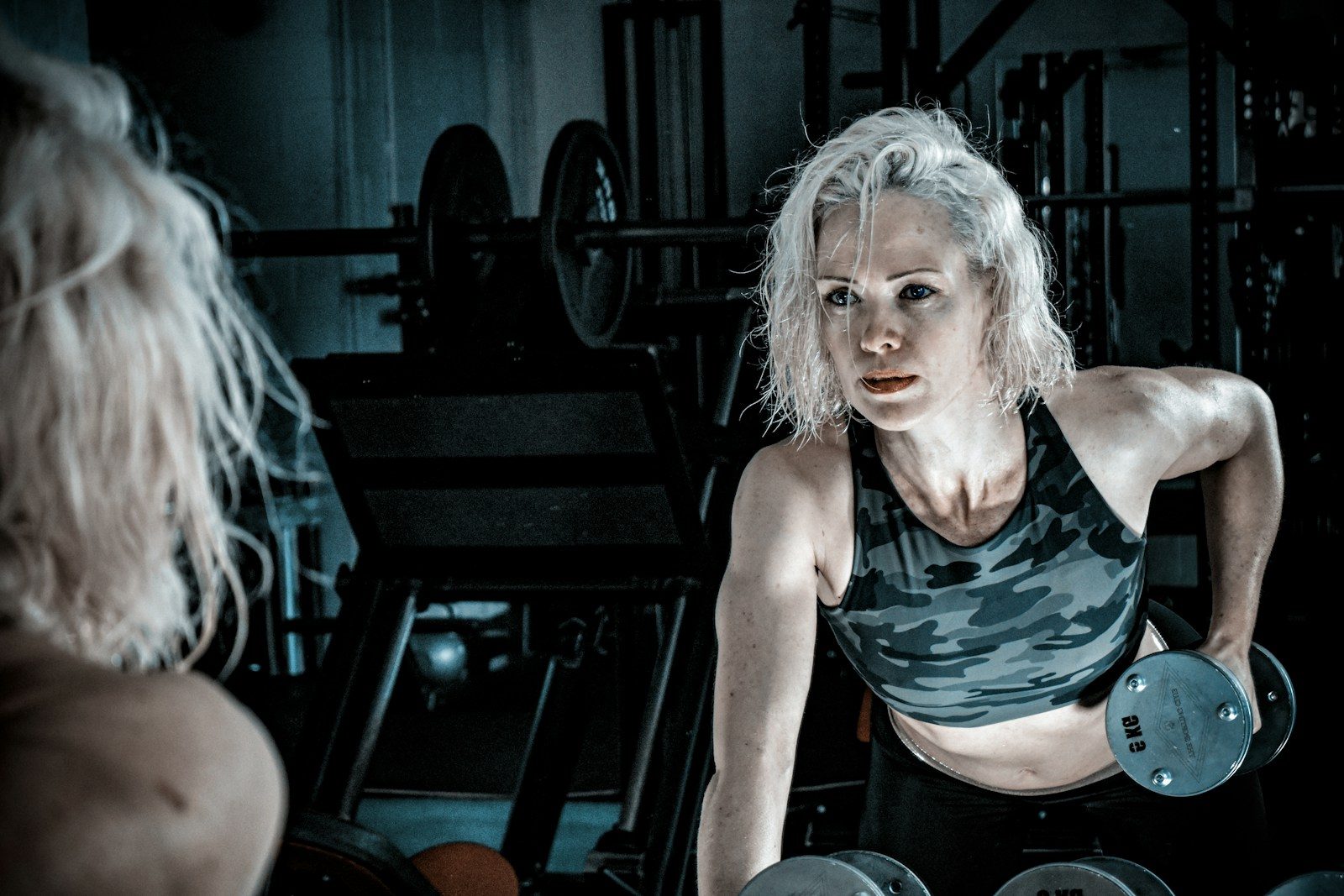
The best arm exercises for women combine biceps curls, triceps extensions, shoulder exercises, and upper-body pushing and pulling movements to build stronger, more defined arms. Most can be performed at home or in the gym using dumbbells and a few basic pieces of equipment.
You don’t need to train all 12 exercises in one session. This guide explains proper form, muscles worked, common mistakes, and how to combine the movements into a simple workout that fits your strength level.
12 Best Arm Exercises for Women
These exercises target the biceps, triceps, shoulders, and supporting upper-body muscles. The first six emphasize direct arm training, while the remaining movements develop broader upper-body strength.
Start with manageable resistance. The suggested sets and repetitions are practical starting points, not requirements to complete every exercise in one workout.
1. Dumbbell Biceps Curl
Best for: Building foundational biceps strength and improving control when lifting objects.
Muscles worked: Biceps brachii, brachialis, and brachioradialis.
Equipment: Two dumbbells.
Sets, reps, and rest: 2 sets of 8–12 reps; rest 60 seconds.
How to Do It:
- Stand with feet hip-width apart, holding a dumbbell in each hand with palms facing forward.
- Keep your elbows near your sides, shoulders relaxed, and core engaged.
- Bend your elbows to curl the dumbbells toward your shoulders without swinging.
- Slowly lower the weights until your arms are nearly straight.
Common mistakes: Swinging your torso, moving your elbows too far forward, or bending your wrists. Choose a weight that allows controlled movement.
Make it easier: Perform the curls seated with lighter dumbbells.
Make it harder: Increase the resistance gradually while keeping your upper arms stable.
2. Hammer Curl
Best for: Strengthening the upper arms and forearms while using a comfortable neutral grip.
Muscles worked: Brachialis, brachioradialis, and biceps brachii.
Equipment: Two dumbbells.
Sets, reps, and rest: 2 sets of 10–12 reps; rest 60 seconds.
How to Do It:
- Stand upright with a dumbbell in each hand, palms facing your thighs.
- Keep your elbows close to your torso and wrists straight.
- Curl the dumbbells upward while keeping your palms facing inward.
- Lower the weights slowly without rotating your wrists.
Common mistakes: Turning the palms upward, swinging the shoulders, or leaning backward to lift heavier dumbbells.
Make it easier: Curl one arm at a time.
Make it harder: Increase the weight once you can complete every repetition without swinging.
3. Concentration Curl
Best for: Training each biceps muscle individually while limiting help from the torso.
Muscles worked: Biceps brachii, assisted by the brachialis and brachioradialis.
Equipment: One dumbbell and a stable bench or chair.
Sets, reps, and rest: 2 sets of 10–12 reps per arm; rest 45–60 seconds.
How to Do It:
- Sit on a bench with your feet flat and legs comfortably apart.
- Hold a dumbbell in your right hand and brace the back of your upper arm against your inner right thigh.
- Curl the dumbbell toward your shoulder without lifting your upper arm from your thigh.
- Slowly lower the weight through a comfortable range, then switch arms.
Common mistakes: Bouncing the weight, moving the upper arm, or pushing against the thigh to lift the dumbbell.
Make it easier: Use a lighter dumbbell and focus on smooth repetitions.
Make it harder: Add resistance or briefly pause near the top without relaxing your arm.
4. Overhead Dumbbell Triceps Extension
Best for: Strengthening the back of the upper arms, including the long head of the triceps.
Muscles worked: Triceps brachii.
Equipment: One dumbbell.
Sets, reps, and rest: 2 sets of 8–12 reps; rest 60–90 seconds.
How to Do It:
- Stand with feet hip-width apart and hold one dumbbell securely with both hands.
- Raise the dumbbell overhead with your upper arms positioned near your head.
- Bend your elbows to lower the dumbbell behind your head through a comfortable range.
- Straighten your elbows to return the weight overhead while keeping your ribs controlled.
Common mistakes: Flaring the elbows excessively, arching the lower back, or lowering the dumbbell beyond your comfortable shoulder range.
Make it easier: Use a lighter dumbbell or perform the movement seated with appropriate back support.
Make it harder: Increase resistance once you can stabilize your shoulders throughout the set.
5. Dumbbell Triceps Kickback
Best for: Isolating the triceps with light resistance and controlled elbow extension.
Muscles worked: Triceps brachii.
Equipment: One dumbbell and a stable bench.
Sets, reps, and rest: 2 sets of 10–15 reps per arm; rest 45–60 seconds.
How to Do It:
- Support your left hand and knee on a bench while holding a dumbbell in your right hand.
- Keep your back neutral and position your right upper arm close to your torso.
- Straighten your right elbow to move the dumbbell backward.
- Slowly bend the elbow to return to the starting position, then switch arms.
Common mistakes: Swinging the weight, allowing the upper arm to drop, or rotating the torso. This exercise works well with relatively light dumbbells.
Make it easier: Use less weight and keep the movement small until your upper arm stays stable.
Make it harder: Gradually increase resistance without adding momentum.
6. Lying Dumbbell Triceps Extension
Best for: Building triceps strength while the bench supports your torso.
Muscles worked: Triceps brachii.
Equipment: Two dumbbells and a flat weight bench.
Sets, reps, and rest: 2 sets of 8–12 reps; rest 60–90 seconds.
How to Do It:
- Lie faceup on a flat bench with your feet firmly planted.
- Hold a dumbbell in each hand above your chest, palms facing inward.
- Keep your upper arms relatively stationary as you bend your elbows and lower the weights beside or slightly behind your head.
- Straighten your elbows to return the dumbbells to the starting position.
Common mistakes: Letting the elbows flare widely, moving the shoulders excessively, or lowering heavy dumbbells too close to the face.
Make it easier: Use lighter dumbbells or perform a single-arm lying triceps extension with the other hand helping stabilize the upper arm.
Make it harder: Increase the load gradually while maintaining control.
7. Close-Grip Incline Push-Up
Best for: Building triceps, chest, and shoulder strength using bodyweight resistance.
Muscles worked: Triceps, pectoralis major, anterior deltoids, and core stabilizers.
Equipment: A stable countertop or securely positioned workout bench.
Sets, reps, and rest: 2 sets of 6–12 reps; rest 60–90 seconds.
How to Do It:
- Place your palms on a stable elevated surface, approximately shoulder-width apart or slightly narrower.
- Step your feet backward until your body forms a straight line from head to heels.
- Brace your core and bend your elbows backward at a comfortable angle, lowering your chest toward the surface.
- Push through your palms to straighten your arms and return to the starting position.
Common mistakes: Allowing the hips to sag, flaring the elbows excessively, or using a slippery or unstable surface.
Make it easier: Use a higher countertop or a wall.
Make it harder: Progress to a lower, stable surface and eventually a floor push-up.
8. Seated Dumbbell Shoulder Press
Best for: Building pressing strength and developing the front and side shoulders.
Muscles worked: Anterior and lateral deltoids, triceps, and supporting shoulder muscles.
Equipment: Two dumbbells and a bench with back support.
Sets, reps, and rest: 2 sets of 8–12 reps; rest 90 seconds.
How to Do It:
- Sit on a supported bench with your feet flat on the floor.
- Hold the dumbbells just above shoulder height, keeping your elbows slightly forward and wrists straight.
- Engage your core and press both dumbbells overhead until your arms are comfortably extended.
- Slowly lower the weights toward shoulder height without excessively arching your back.
Common mistakes: Flaring the elbows straight outward, leaning backward, or pushing the weights too far forward.
Make it easier: Use lighter dumbbells or press one arm at a time with controlled posture.
Make it harder: Increase resistance while maintaining a steady torso and comfortable shoulder movement.
9. Dumbbell Lateral Raise
Best for: Strengthening the side deltoids and improving overall shoulder development.
Muscles worked: Lateral deltoids, assisted by the supraspinatus and other shoulder stabilizers.
Equipment: Two light dumbbells.
Sets, reps, and rest: 2 sets of 12–15 reps; rest 60 seconds.
How to Do It:
- Stand upright with a dumbbell in each hand, palms facing inward.
- Keep a slight bend in your elbows and gently brace your core.
- Raise your arms outward and slightly forward until approximately shoulder height.
- Slowly lower the dumbbells without swinging or shrugging.
Common mistakes: Using weights that are too heavy, raising the shoulders toward the ears, or rocking the torso.
Make it easier: Use lighter dumbbells and lift only through a comfortable range.
Make it harder: Add a small amount of resistance while maintaining a controlled lowering phase.
10. Bent-Over Reverse Fly
Best for: Strengthening the rear shoulders and supporting balanced upper-body development.
Muscles worked: Posterior deltoids, rhomboids, and middle trapezius.
Equipment: Two light dumbbells.
Sets, reps, and rest: 2 sets of 12–15 reps; rest 60 seconds.
How to Do It:
- Stand with feet hip-width apart and hold a dumbbell in each hand.
- Bend your knees slightly and hinge forward from your hips, maintaining a neutral spine.
- Allow the dumbbells to hang beneath your shoulders with palms facing each other.
- Raise both arms outward with slightly bent elbows until they are approximately in line with your torso.
- Slowly lower the weights while keeping your torso stable.
Common mistakes: Rounding the back, lifting the chest during each repetition, or pulling the weights upward with momentum.
Make it easier: Use very light dumbbells or perform a chest-supported reverse fly on an incline bench.
Make it harder: Increase resistance only while maintaining the same torso angle and arm control.
11. Single-Arm Dumbbell Row
Best for: Strengthening the upper back and lats while providing additional biceps training.
Muscles worked: Latissimus dorsi, rhomboids, trapezius, posterior deltoids, and biceps.
Equipment: One dumbbell and a stable bench.
Sets, reps, and rest: 2 sets of 8–12 reps per arm; rest 60–90 seconds.
How to Do It:
- Place your left hand and knee on a flat bench and plant your right foot firmly beside it.
- Hold a dumbbell in your right hand with your arm extended toward the floor.
- Keep your spine neutral and pull your right elbow toward your hip.
- Lower the dumbbell slowly without twisting your torso.
- Complete your repetitions before switching sides.
Common mistakes: Rotating the body to lift the weight, shrugging the working shoulder, or pulling the elbow excessively high.
Make it easier: Use a lighter dumbbell.
Make it harder: Increase resistance or briefly pause at the top while keeping your torso stable.
12. Neutral-Grip Dumbbell Floor Press
Best for: Building practical upper-body pressing strength while training the triceps and chest.
Muscles worked: Pectoralis major, triceps, and anterior deltoids.
Equipment: Two dumbbells and an exercise mat.
Sets, reps, and rest: 2 sets of 8–12 reps; rest 60–90 seconds.
How to Do It:
- Lie faceup on a mat with your knees bent and feet flat on the floor.
- Hold a dumbbell in each hand above your chest with palms facing each other.
- Keep your wrists straight and elbows relatively close to your torso.
- Lower the dumbbells until your upper arms gently touch the floor.
- Press the weights upward without bouncing your elbows or lifting your head.
Common mistakes: Bending the wrists backward, flaring the elbows excessively, or using momentum to press the weights.
Make it easier: Use lighter dumbbells or perform the movement one arm at a time with your torso stable.
Make it harder: Gradually increase resistance without sacrificing control.
Simple Arm Workout Plan for Women
You do not need to perform all 12 exercises to build stronger arms. A shorter routine combining pushing, pulling, shoulder training, and direct arm exercises can provide an effective starting point.
This workout uses six movements from the list and can be completed at home or in a gym.
Beginner-Friendly Arm Workout
| Exercise | Sets | Reps |
|---|---|---|
| 1. Close-Grip Incline Push-Up | 2 | 6–10 |
| 2. Single-Arm Dumbbell Row | 2 | 8–12 per arm |
| 3. Seated Dumbbell Shoulder Press | 2 | 8–12 |
| 4. Dumbbell Biceps Curl | 2 | 10–12 |
| 5. Overhead Dumbbell Triceps Extension | 2 | 10–12 |
| 6. Dumbbell Lateral Raise | 1–2 | 12–15 |
Workout guidelines:
- Frequency: Twice weekly on nonconsecutive days, such as Monday and Thursday.
- Warm-up: 5 minutes of easy walking or marching, shoulder circles, and a few light practice repetitions.
- Rest: Approximately 60–90 seconds between sets; take longer when necessary.
- Effort: Finish most sets feeling that you could complete another 2–3 good repetitions.
- Duration: Approximately 25–35 minutes, depending on rest and setup.
- Progression: Increase repetitions first, then resistance when the prescribed range becomes manageable.
If you are completely new to strength training, begin with one set of each exercise and add another as your tolerance improves.
After several weeks, you can replace a movement with a similar exercise from the list. For example, swap standard biceps curls for hammer curls, or alternate overhead triceps extensions with lying extensions.
Important: This is an upper-body workout, not a complete strength-training program. Include lower-body and core exercises elsewhere in your week.
The CDC recommends muscle-strengthening exercise at least two days per week, covering the major muscle groups.
How to Choose the Right Dumbbell Weight
The best starting weight is not the same for every woman or every exercise.
A dumbbell that feels appropriate for biceps curls might be too heavy for lateral raises and too light for rows. Choose your resistance separately for each movement.
A practical test is to select a weight that lets you complete your planned repetitions while maintaining good technique. The final few repetitions should feel challenging, but they should not require swinging, jerking, or changing your posture.
For example, if your target is 12 repetitions:
- If you struggle to complete eight with good form, reduce the weight.
- If you finish 12 with another two or three good reps available, the load is suitable.
- If you could easily perform many additional repetitions, consider a small weight increase.
The Mayo Clinic’s weight-training guidance also emphasizes controlled movement, an appropriate starting weight, and gradual progression.
How to Progress Without Overtraining
Use a straightforward progression method:
- Start with a resistance you can control.
- Build toward the upper end of the recommended repetition range.
- Once you consistently reach that number with good form, increase the weight slightly.
- Return to the lower end of the repetition range and build up again.
For example, if you perform dumbbell curls for two sets of 8–12 reps, work toward completing two sets of 12 before increasing the weight.
You can also improve by using a more challenging push-up angle, increasing your controlled range of motion, or adding a set when appropriate.
The American College of Sports Medicine’s 2026 resistance-training position stand supports progressive, individualized strength training and recognizes that home-based exercise and elastic resistance can improve strength.
Can Arm Exercises Help Women Build More Defined Arms?
Yes. Resistance exercises can strengthen and build the muscles that contribute to arm shape, especially the biceps, triceps, and deltoids.
However, muscle development and body-fat reduction are different processes. Performing triceps extensions does not guarantee that fat specifically covering the triceps will disappear.
The American Council on Exercise’s guidance on spot reduction explains why exercising one body part should not be treated as a reliable way to selectively reduce fat there.
For women who want stronger, more defined arms, a realistic approach includes consistent resistance training, adequate recovery, balanced nutrition, and patience.
You also do not need to avoid challenging weights out of concern that ordinary strength training will automatically produce excessively large arms. Muscle development is gradual and influenced by training, nutrition, genetics, and individual physiology.
Common Arm Training Mistakes to Avoid
The most important mistakes are usually related to exercise technique and programming rather than choosing the wrong exercise.
Using momentum instead of muscle control: Swinging curls and lateral raises makes it harder to keep the intended muscles working through the movement.
Training only the biceps: Include triceps exercises and upper-body pushing and pulling movements for more balanced development.
Choosing weights that are too heavy: If you must arch your back, shrug your shoulders, or rush repetitions to finish a set, reduce the resistance.
Doing too many exercises in one workout: Completing all 12 movements is unnecessary for most beginners. Focus on a few well-selected exercises performed consistently.
Ignoring recovery: Give heavily trained muscles adequate recovery before repeating a challenging session. Avoid repeatedly training through significant soreness or worsening discomfort.
Before training, check that your weights, bench, and supporting surfaces are secure. Stop exercising and seek professional help if you experience sharp pain, numbness, dizziness, chest pain, or other unusual symptoms. Chest pain or severe symptoms may require urgent medical attention.
Frequently Asked Questions
1. What are the best arm exercises for women at home?
Dumbbell biceps curls, hammer curls, overhead triceps extensions, lateral raises, and neutral-grip floor presses are practical home options. Close-grip incline push-ups are also useful because they require no weights.
Choose exercises that train both the front and back of your upper arms rather than relying on curls alone.
2. How often should women train their arms?
For most beginners, two sessions per week on nonconsecutive days are a good starting point.
Women already following a full-body strength program may not need separate arm sessions because rows, presses, and other upper-body movements also train the arm muscles.
3. What dumbbell weight should beginners use for arm exercises?
There is no universal starting weight. Some beginners may find 2–5 lb dumbbells useful for raises or isolation exercises, while others can comfortably handle considerably more.
Select weights based on the movement, your strength, and your ability to complete the repetitions with proper technique.
4. Can women build strong arms without lifting heavy weights?
Yes. Lighter dumbbells, resistance bands, and bodyweight exercises can help build strength and muscle when the exercises provide enough challenge.
As you improve, gradually increase resistance, repetitions, or exercise difficulty to continue progressing.
5. Can arm exercises reduce flabby arms?
Arm exercises can strengthen and develop the muscles underneath the skin, which may improve arm appearance over time.
However, they cannot guarantee targeted fat loss from the upper arms. Overall body composition, genetics, and other factors influence visible definition.
6. How long does it take to see results from arm workouts?
Some people notice improvements in exercise control and strength within the first several weeks of consistent training.
Visible muscle changes often take longer and depend on training consistency, resistance, nutrition, recovery, and starting body composition. There is no guaranteed timeline.
Conclusion
The best arm exercises for women are the ones you can perform consistently with good technique and gradually increasing resistance.
Begin with the six-exercise workout, train twice weekly, and focus on improving your repetitions and strength. As you become more confident, rotate in other exercises from the list to challenge your biceps, triceps, and shoulders without making your workouts unnecessarily complicated.
This content is for informational purposes only and is not a substitute for medical advice.