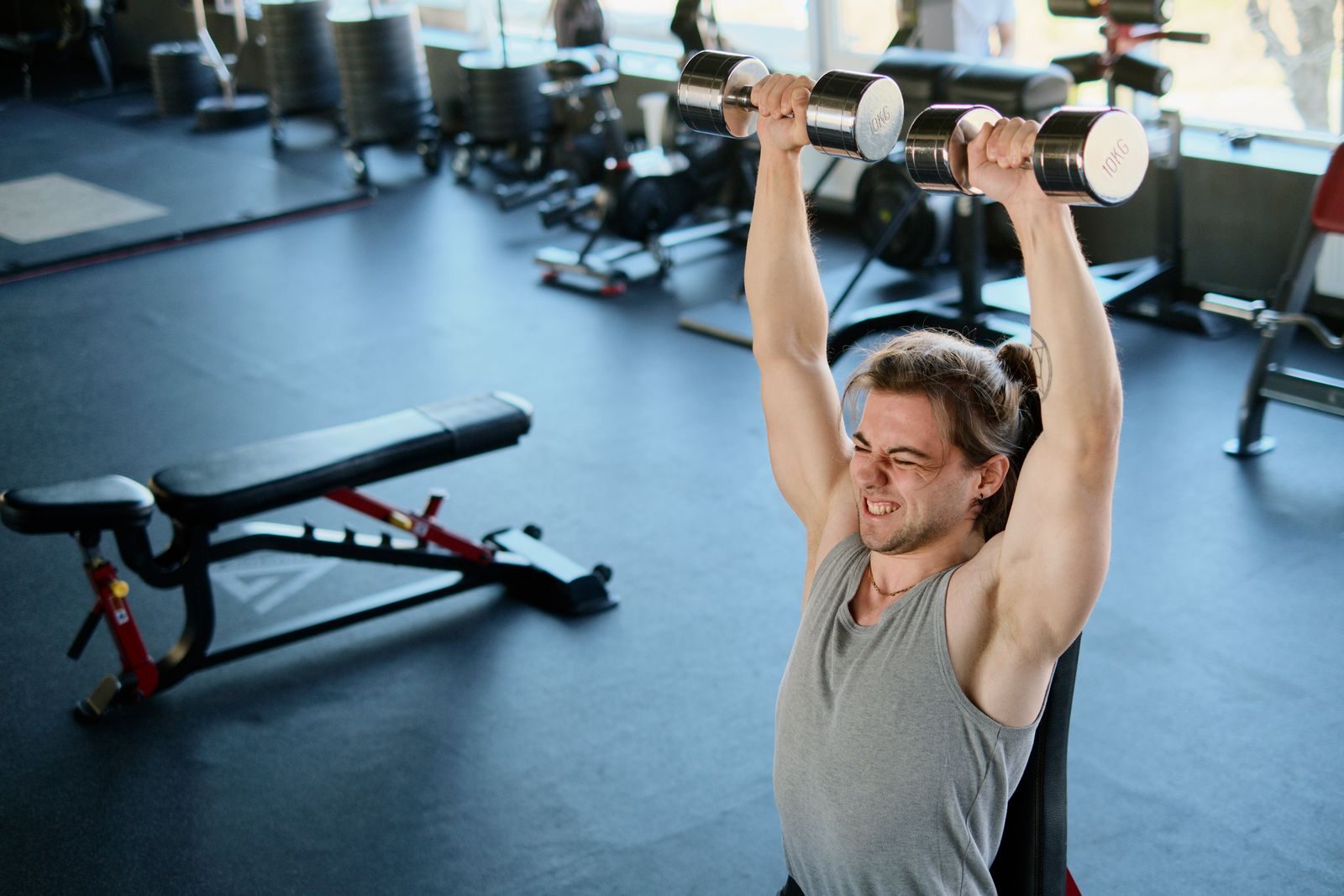
The dumbbell Arnold press is a rotating overhead press that primarily trains the front and middle deltoids, with assistance from the triceps and shoulder-stabilizing muscles. It can be an effective shoulder exercise when you use a manageable weight, rotate smoothly, and keep your torso controlled.
This guide explains how to perform the dumbbell Arnold press, which muscles it works, common mistakes to avoid, beginner modifications, useful progressions, and how to program it in a real workout.
Dumbbell Arnold Press at a Glance
| Category | Recommendation |
|---|---|
| Exercise type | Vertical upper-body press |
| Main purpose | Shoulder strength and muscle development |
| Primary muscles | Anterior deltoid and middle deltoid |
| Assisting muscles | Triceps, upper trapezius, serratus anterior, rotator cuff |
| Equipment | Two dumbbells; upright bench optional |
| Starting grip | Palms facing the body |
| Finishing grip | Palms generally facing forward |
| Beginner starting point | 2–3 sets of 8–12 repetitions |
| Rest between sets | 90–120 seconds |
| Suggested effort | Finish with 2–3 repetitions in reserve |
| Best placement | Early in a shoulder workout or after a heavier press |
| Main form priority | Rotate through the arms while keeping the wrists straight |
Repetitions in reserve, or RIR, refers to how many more controlled repetitions you believe you could complete before reaching failure.
What Is a Dumbbell Arnold Press?
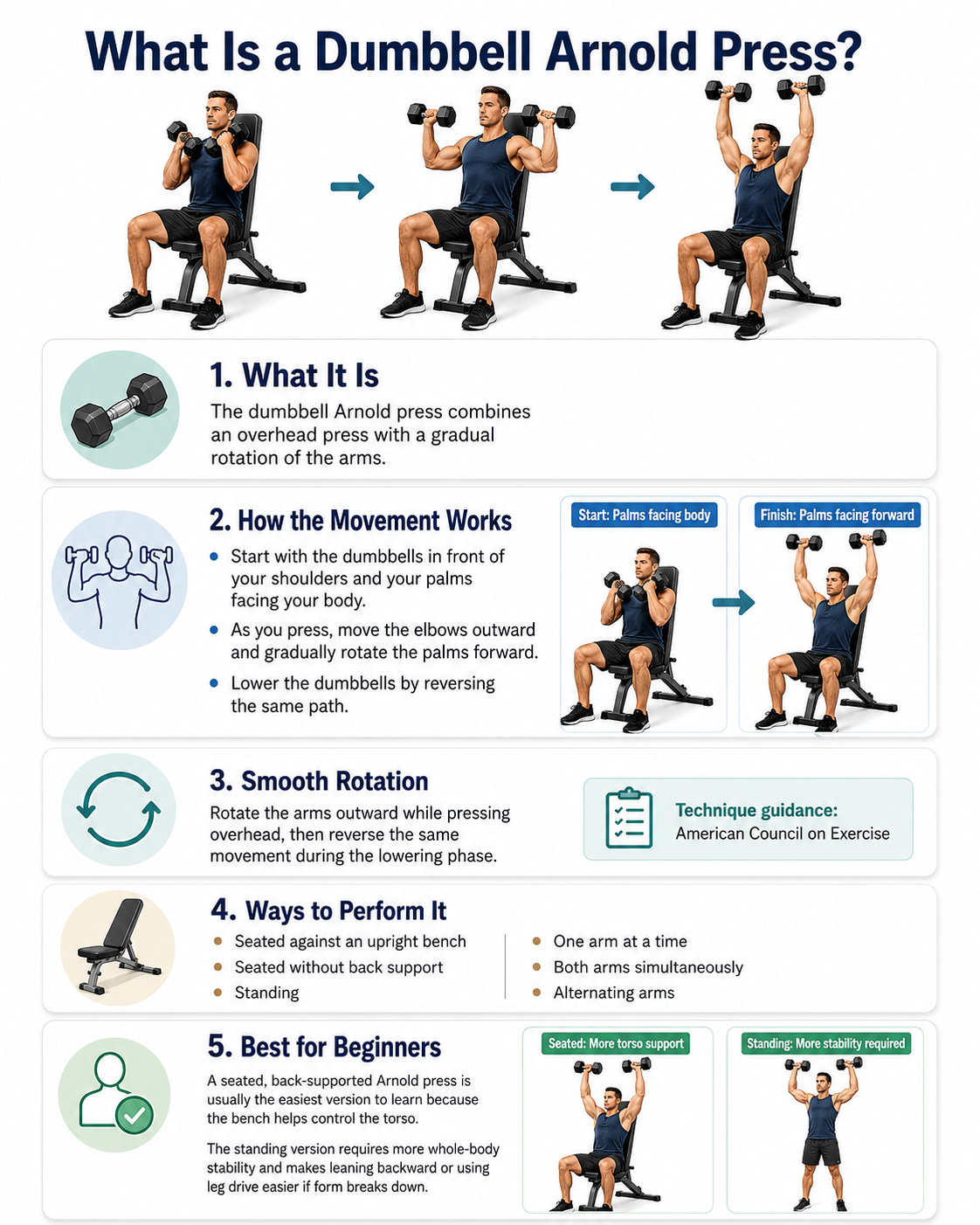
The dumbbell Arnold press combines an overhead press with a gradual rotation of the arms.
You begin with the dumbbells in front of your shoulders and your palms facing your body. As you press, your elbows move outward and the palms rotate forward. You then reverse the motion as the dumbbells return to the starting position.
The American Council on Exercise describes the exercise as rotating the arms outward while pressing overhead, then reversing the same path during the lowering phase.
The Arnold press can be performed:
- Seated against an upright bench
- Seated without back support
- Standing
- One arm at a time
- With both arms simultaneously
- By alternating arms
A seated, back-supported Arnold press is usually the easiest version for learning the movement because the bench helps you control your torso. The standing version requires more whole-body stability and makes it easier to compensate by leaning backward or using leg drive.
How to Do the Dumbbell Arnold Press
Sets, reps, and rest: Start with 2–3 sets of 8–12 repetitions. Rest for 90–120 seconds and finish each set with approximately 2–3 good repetitions remaining.
Step-by-Step Instructions
- Set up the bench.
Place the backrest in a near-upright position. Sit with your upper back supported, feet flat on the floor, and dumbbells resting safely near your thighs. - Bring the dumbbells to your shoulders.
Hold one dumbbell in each hand in front of your shoulders. Your palms should face your body, similar to the top position of a dumbbell curl. - Establish your starting posture.
Keep your wrists straight, elbows bent, and elbows slightly in front of your torso. Do not force the elbows to touch. Brace your abdominal muscles and keep your ribs controlled. - Open and press.
Begin pressing the dumbbells upward while gradually moving the elbows outward. Rotate your palms forward as the weights rise. - Finish overhead.
Extend your arms in a comfortable overhead position. The dumbbells should finish approximately above your shoulders rather than far in front of your body. - Lower under control.
Bend your elbows and lower the dumbbells while rotating the palms back toward your body. Bring the elbows forward as you return to the starting position. - Repeat without rushing.
Keep the rotation smooth and coordinated. Avoid pausing midway to twist the dumbbells only through your wrists.
The National Strength and Conditioning Association recommends learning vertical pressing with stable feet, back support during the seated version, and a controlled vertical pressing path before progressing to standing variations.
Coaching Cue
“Open and press, then reverse the same path.”
Breathing
Breathe in as you lower the dumbbells. Breathe out as you press if that helps you maintain a steady rhythm. Avoid holding your breath unnecessarily during moderate-load sets.
Suggested Tempo
Use approximately:
- One to two seconds to press
- A brief controlled finish overhead
- Two to three seconds to lower
A slower lowering phase can help you control the rotation and notice when your elbows, wrists, or torso move out of position.
Dumbbell Arnold Press Muscles Worked
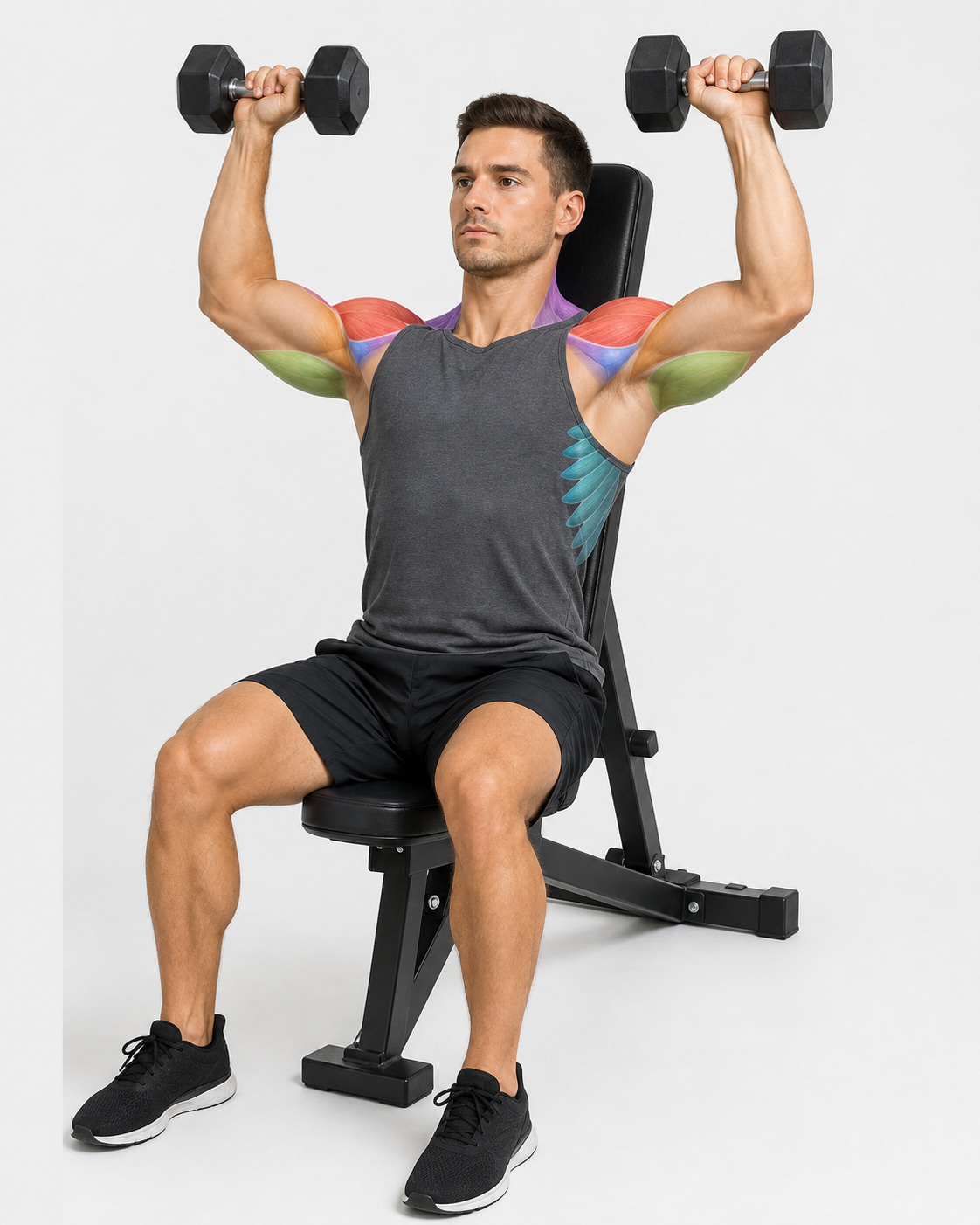
Anterior Deltoid
The anterior deltoid is the front portion of the shoulder and is usually the primary shoulder muscle emphasized during the Arnold press.
It helps raise the upper arm forward and contributes strongly as the dumbbells move from in front of the shoulders to overhead. The NCBI Bookshelf identifies the anterior deltoid as an important contributor to shoulder flexion and describes the deltoid’s broader role in raising and stabilizing the arm.
Middle Deltoid
The middle, or lateral, deltoid assists as your elbows move outward and your arms rise overhead.
The Arnold press involves this region, but the front deltoid generally remains more heavily involved. A lateral raise can still be useful when direct middle-deltoid training is a priority.
Triceps Brachii
The triceps straighten the elbows during the pressing portion of the exercise. Their involvement increases as you approach the top of each repetition.
The Arnold press trains the triceps, but it is primarily considered a shoulder exercise rather than a direct triceps isolation movement.
Upper Trapezius and Serratus Anterior
The upper trapezius and serratus anterior help rotate and control the shoulder blades as your arms move overhead.
Do not try to hold your shoulder blades rigidly “down and back” throughout the repetition. Some upward rotation is a normal part of raising the arms overhead. The NCBI Bookshelf describes the trapezius and serratus anterior as important contributors to upward rotation of the shoulder blades.
You should avoid an exaggerated shrug, but you should not force the shoulders downward while pressing overhead.
Rotator Cuff
The rotator cuff consists of the:
- Supraspinatus
- Infraspinatus
- Teres minor
- Subscapularis
These muscles help stabilize the upper-arm bone within the shoulder joint while the arms rotate and press. They are important stabilizers, but they are not the main muscles the Arnold press is intended to build.
The NCBI Bookshelf also describes the rotator cuff’s role in controlling shoulder movement and maintaining joint stability.
Does the Arnold Press Work the Rear Deltoids?
The posterior, or rear, deltoids may assist with shoulder control, but they are not primary movers during the Arnold press.
The exercise should not be treated as a complete replacement for rear-deltoid training. Reverse fly variations, rear-delt rows, and similar pulling movements provide more direct posterior-deltoid work.
What Research Says About Arnold Press Muscle Activity
A small 2017 study available through Indian Journals compared the Arnold dumbbell press with a conventional overhead dumbbell press.
Ten healthy young men performed five repetitions of each exercise while surface electromyography recorded activity in the anterior and middle deltoids. The Arnold press produced greater measured activity in both regions, and the anterior deltoid showed more activity than the middle deltoid during both exercises.
These results should be interpreted cautiously.
The study:
- Included only 10 participants
- Measured five repetitions
- Examined short-term electrical activity
- Did not measure muscle growth
- Did not measure long-term strength development
- Did not test the posterior deltoid
Research available through PubMed Central also warns that a higher acute surface EMG reading should not automatically be interpreted as proof that an exercise will produce greater long-term muscle growth.
The practical conclusion is that the Arnold press effectively involves the front and middle deltoids, but current evidence does not prove that it builds more muscle than every regular shoulder-press variation.
Benefits of the Dumbbell Arnold Press
1. Trains the Front and Middle Shoulders
The combination of shoulder flexion, outward elbow movement, and overhead pressing makes the anterior and middle deltoids important contributors.
This can make the exercise useful as a primary moderate-load shoulder press or as a secondary press after a heavier movement.
2. Provides a Different Pressing Path
A regular dumbbell press normally begins with the dumbbells beside the shoulders. The Arnold press begins with the weights farther in front of the body and adds a gradual rotation.
This provides variety without requiring a different machine or specialized equipment.
3. Allows Each Arm to Move Independently
Each hand controls its own dumbbell. This allows you to make small adjustments to the path of each arm instead of having both hands fixed to one bar.
Independent dumbbells can also make obvious left-to-right differences in control easier to notice. They do not automatically correct those differences, however.
4. Develops Movement Control
The Arnold press requires you to coordinate three actions:
- Pressing the dumbbells upward
- Moving the elbows from forward to outward
- Rotating the palms without bending the wrists
This makes it more technically demanding than a basic dumbbell shoulder press.
5. Works in Home and Commercial Gyms
The exercise requires only dumbbells. A bench is helpful but not essential, making the movement practical for many training environments.
6. Offers Seated and Standing Options
A seated version can emphasize controlled shoulder work, while a standing version adds more demand on the abdominal muscles, glutes, and other torso stabilizers.
Neither variation is automatically better. The best choice is the one you can perform through a comfortable range without leaning, using momentum, or losing control.
Dumbbell Arnold Press vs. Regular Shoulder Press
| FeatureArnold pressRegular dumbbell shoulder press | ||
|---|---|---|
| Starting hand position | Palms face the body | Palms face forward or inward |
| Movement path | Rotation plus overhead press | More direct overhead press |
| Coordination demand | Higher | Lower |
| Typical working weight | Usually lighter | Often heavier |
| Main muscles | Front and middle deltoids, triceps | Front and middle deltoids, triceps |
| Learning difficulty | More complex | Easier to learn |
| Best use | Moderate-load variation or accessory | Primary strength or hypertrophy press |
| Beginner suitability | Better after basic pressing is learned | Usually the better starting point |
Which One Is Better?
Neither exercise is universally superior.
Choose the Arnold press when you:
- Enjoy the rotating movement
- Can perform it without discomfort
- Want a different dumbbell pressing variation
- Can control the movement with moderate weights
Choose a regular dumbbell shoulder press when you:
- Are learning overhead pressing
- Want a simpler movement
- Want to use heavier dumbbells
- Find the rotation uncomfortable
- Have difficulty maintaining wrist or elbow position
You can also use both exercises in the same training program, although they do not need to be performed in the same workout.
Seated vs. Standing Arnold Press
Seated Arnold Press
The seated version is generally better for learning the exercise and limiting unnecessary lower-body movement.
Advantages:
- Easier torso control
- Less temptation to use leg drive
- Simple to learn with light dumbbells
- Useful for shoulder-focused training
Use a stable bench and keep both feet firmly planted. Back support can help, but it does not mean you should relax your abdominal muscles or exaggerate your lower-back arch.
Standing Arnold Press
The standing variation requires more control from the abdominal muscles, glutes, and spinal stabilizers.
Advantages:
- Requires greater whole-body stability
- Needs no bench
- Can be performed in limited training spaces
The standing version is not a push press. Your knees and hips should remain stable rather than driving the dumbbells overhead.
Progress to standing only when you can complete the seated version without excessive arching, rushed rotation, or loss of balance.
Common Dumbbell Arnold Press Mistakes
Using Too Much Weight
The Arnold press is more complex than a standard shoulder press and usually works better with lighter dumbbells.
Signs that the weight is too heavy include:
- Leaning backward
- Using leg drive
- Dropping the weights quickly
- Losing wrist position
- Shortening the range of motion
- Struggling to coordinate the rotation
Reduce the load until every repetition follows the same controlled path.
Rotating Only Through the Wrists
Your palms should change direction because your arms are opening and rotating—not because you are bending or twisting only the wrists.
Keep each wrist aligned with its forearm throughout the repetition.
Forcing the Elbows Together
Your elbows do not need to touch in the starting position.
Bring them forward only as far as you can comfortably control. Forcing them inward may create an awkward shoulder or wrist position without improving the exercise.
Arching the Lower Back
A small natural spinal curve is normal. Excessive arching usually means the load is too heavy, the abdominal muscles are no longer controlling the torso, or the dumbbells are drifting too far forward.
Keep your ribs controlled and reduce the weight when needed.
Turning the Exercise Into a Push Press
Do not bend your knees and use your legs to launch the dumbbells upward.
A push press is a separate exercise with a different purpose. During an Arnold press, the shoulders and arms should produce the pressing movement.
Pressing the Dumbbells Too Far Forward
The weights should finish approximately over your shoulders. Leaving them far in front makes the position harder to control and often encourages lower-back extension.
Forcing the Shoulder Blades Down
Avoid trying to keep your shoulders pulled firmly down throughout the entire press.
The shoulder blades need to move as the arms rise. Allow natural upward rotation while avoiding an unnecessary, exaggerated shrug.
Lowering Too Quickly
The downward phase is where many people lose their wrist and elbow positions.
Lower the dumbbells slowly enough to reverse the rotation and return to the starting position without dropping the weights.
Using a Painful Range
You do not need to force the elbows as low or as far forward as possible.
Use the deepest starting position you can control comfortably. A shorter pain-free range is preferable to forcing a larger range with poor positioning.
Beginner Regressions
Seated Neutral-Grip Dumbbell Press
Begin with the palms facing each other and press without rotating the dumbbells.
This keeps the basic vertical-press pattern while removing the most complicated part of the Arnold press.
Light Back-Supported Arnold Press
Use very light dumbbells and an upright bench. Concentrate on making the rotation smooth rather than trying to fatigue the shoulders.
Single-Arm Seated Press
Press one dumbbell at a time while keeping the other hand free or resting safely.
This lets you focus on the path of one arm, although you still need to prevent the torso from leaning or rotating.
Reduced-Range Arnold Press
Begin with your elbows slightly farther apart and stop the lowering phase before you reach an uncomfortable position.
Gradually increase the range only when the movement remains comfortable and controlled.
Resistance-Band Overhead Press
A light band press can help you practice a basic vertical-press pattern before adding dumbbells and rotation. The NSCA includes band pressing as an early step before seated and standing overhead presses.
Progressions and Variations
Standing Arnold Press
Move from seated to standing when you can keep your ribs, hips, and knees stable throughout every repetition.
Alternating Arnold Press
Press one dumbbell while the other remains in the starting position. Alternate sides until both arms complete the target number of repetitions.
This version increases the time required to complete a set and demands continued torso control.
Single-Arm Standing Arnold Press
Use one dumbbell while resisting the tendency to lean or rotate toward either side.
Choose a lighter weight than you would use for a two-arm press.
Paused Arnold Press
Pause briefly in the starting position or overhead position without relaxing your posture.
A pause can improve control without requiring heavier dumbbells.
Slow-Eccentric Arnold Press
Take three to four seconds to lower each repetition. This is useful when your available dumbbells are becoming easy but you are not ready for a large increase in weight.
Sets, Reps, Rest, and Frequency
| Training goal | Sets and reps | Rest | Suggested effort |
|---|---|---|---|
| Learning the movement | 2 sets of 8–10 | 90–120 seconds | 3–4 RIR |
| Beginner strength and muscle | 2–3 sets of 8–12 | 90–120 seconds | 2–3 RIR |
| Intermediate muscle development | 3–4 sets of 6–12 | 90–180 seconds | 1–3 RIR |
| Accessory shoulder work | 2–3 sets of 10–15 | 60–120 seconds | 2–3 RIR |
Train the Arnold press once or twice per week depending on your total shoulder workload, recovery, and the other presses in your program.
The American College of Sports Medicine emphasizes regular resistance training and training all major muscle groups at least twice weekly rather than relying on an unnecessarily complicated program. That does not mean you must perform Arnold presses twice per week; different shoulder and upper-body exercises can contribute to your weekly training.
How to Progress
Use a simple repetition-range progression:
- Choose a range such as 8–12 repetitions.
- Begin with a weight you can perform for at least 8 controlled repetitions.
- Keep the same weight until you can complete 12 repetitions on every set.
- Maintain approximately two repetitions in reserve and consistent form.
- Increase to the next manageable dumbbell weight.
- Return to the lower end of the repetition range.
Do not increase the weight when the extra load causes you to arch, rush the rotation, use your legs, or shorten the range.
Where to Put Arnold Presses in a Workout
Place the exercise early in your workout when it is your main shoulder press.
Use it later when you have already performed a heavier compound press, such as a regular dumbbell or machine shoulder press.
Examples:
- Main exercise: Arnold press followed by lateral raises and rear-deltoid work
- Secondary exercise: Regular shoulder press followed by lighter Arnold presses
- Full-body workout: Arnold press after lower-body work and before smaller arm exercises
Avoid adding several similar pressing exercises without considering your total shoulder and triceps workload.
Sample Dumbbell Shoulder Workout
This routine balances overhead pressing with side- and rear-shoulder work.
Warm-Up
Complete 5–10 minutes of easy activity, followed by controlled arm movements and one or two light practice sets. The American Academy of Orthopaedic Surgeons recommends 5–10 minutes of low-impact activity before shoulder exercise.
Workout
| Exercise | Sets | Reps | Rest |
|---|---|---|---|
| Dumbbell Arnold press | 3 | 8–12 | 90–120 seconds |
| One-arm dumbbell row | 3 | 8–12 per side | 90 seconds |
| Dumbbell lateral raise | 2–3 | 10–15 | 60–90 seconds |
| Dumbbell reverse fly | 2–3 | 10–15 | 60–90 seconds |
Keep approximately two repetitions in reserve during most sets. Perform the workout once weekly at first. Add another weekly upper-body or shoulder session only when you are recovering well and maintaining performance.
Dumbbell Arnold Press Safety Tips
- Start with lighter dumbbells than you use for a standard shoulder press.
- Use a stable bench that will not slide or tip.
- Keep the area around your feet clear.
- Control how you bring the dumbbells into and out of the starting position.
- Do not force the elbows together.
- Keep your wrists aligned with your forearms.
- Use only a comfortable overhead range.
- Avoid leg drive unless you are intentionally performing a different exercise.
- Stop the set when you can no longer control the rotation.
- Substitute a neutral-grip shoulder press when the Arnold rotation feels uncomfortable.
Stop exercising and seek appropriate professional help if you experience sharp pain, numbness, dizziness, chest pain, instability, or other unusual symptoms.
People with an existing shoulder or neck injury, painful overhead movement, or a history of shoulder instability should obtain individualized guidance from a qualified healthcare professional before performing Arnold presses.
Frequently Asked Questions
Is the Arnold press good for building shoulders?
The Arnold press can help build the front and middle deltoids when it is performed with sufficient effort and progressed over time. It should be combined with other exercises when balanced shoulder development is the goal, particularly lateral raises and rear-deltoid movements.
Does the Arnold press work all three deltoid heads?
It mainly emphasizes the anterior and middle deltoids. The rear deltoid may assist with control, but it is not an equal primary mover. Include reverse fly variations or rear-delt rows for more direct posterior-deltoid training.
Is the Arnold press better than a normal shoulder press?
Not necessarily. The Arnold press provides a different movement path and more coordination demand. A regular shoulder press is simpler and often allows more weight. Exercise comfort, progression, and total programming matter more than choosing one supposedly superior variation.
Should beginners do Arnold presses?
Beginners can perform Arnold presses, but learning a seated neutral-grip shoulder press first is often easier. Once the basic press is controlled, add the rotation with light dumbbells.
Should I perform Arnold presses seated or standing?
Use the seated, back-supported version when learning the exercise or focusing on the shoulders. Use the standing version when you can maintain a stable torso without leaning, leg drive, or loss of balance.
How heavy should Arnold presses be?
Use a weight that allows at least 8 controlled repetitions without wrist bending, lower-back arching, leg drive, or rushed rotation. Most people need less weight than they use for a regular dumbbell shoulder press.
Why does the Arnold press bother my shoulder?
Possible contributors include excessive weight, a forced starting position, too much range, poor control, or simply an uncomfortable movement path for your shoulder structure. Do not try to diagnose or push through the discomfort. Reduce the range or use a neutral-grip press, and seek professional guidance if pain continues.
Conclusion
The dumbbell Arnold press is a useful shoulder-press variation when you treat it as a controlled movement rather than a heavy momentum exercise. Begin with the palms facing you, open the elbows while rotating the arms, press the dumbbells overhead, and reverse the same path slowly.
Use a manageable weight, keep your wrists straight, allow natural shoulder-blade movement, and stop before your torso or leg drive takes over. Combine the Arnold press with lateral raises, rows, and rear-deltoid exercises for more balanced upper-body training.
References
- American Council on Exercise (ACE) — Arnold Press Technique
- Raizada & Bagchi — EMG Comparison of Arnold Press vs. Dumbbell Shoulder Press
- American College of Sports Medicine (ACSM) — Resistance Training Prescription for Strength and Hypertrophy
- National Strength and Conditioning Association (NSCA) — Resistance Training Movement Patterns
- NCBI Bookshelf — Deltoid Muscle Anatomy and Function
- American Academy of Orthopaedic Surgeons (AAOS) — Rotator Cuff and Shoulder Conditioning Program
This content is for informational purposes only and is not a substitute for medical advice.