The dumbbell high pull is an explosive full-body exercise that uses the legs and hips to accelerate the weights before the upper back, shoulders, and arms guide them toward the lower chest. The key to proper form is to create momentum with your lower body instead of trying to lift the dumbbells with your arms alone.
This guide focuses on the bilateral dumbbell hang high pull. The movement begins with one dumbbell in each hand near the thighs, includes a shallow hip hinge, and finishes with the dumbbells near the lower chest or upper ribs. It does not include an overhead press or a catch at the shoulders.
What Is a Dumbbell High Pull?
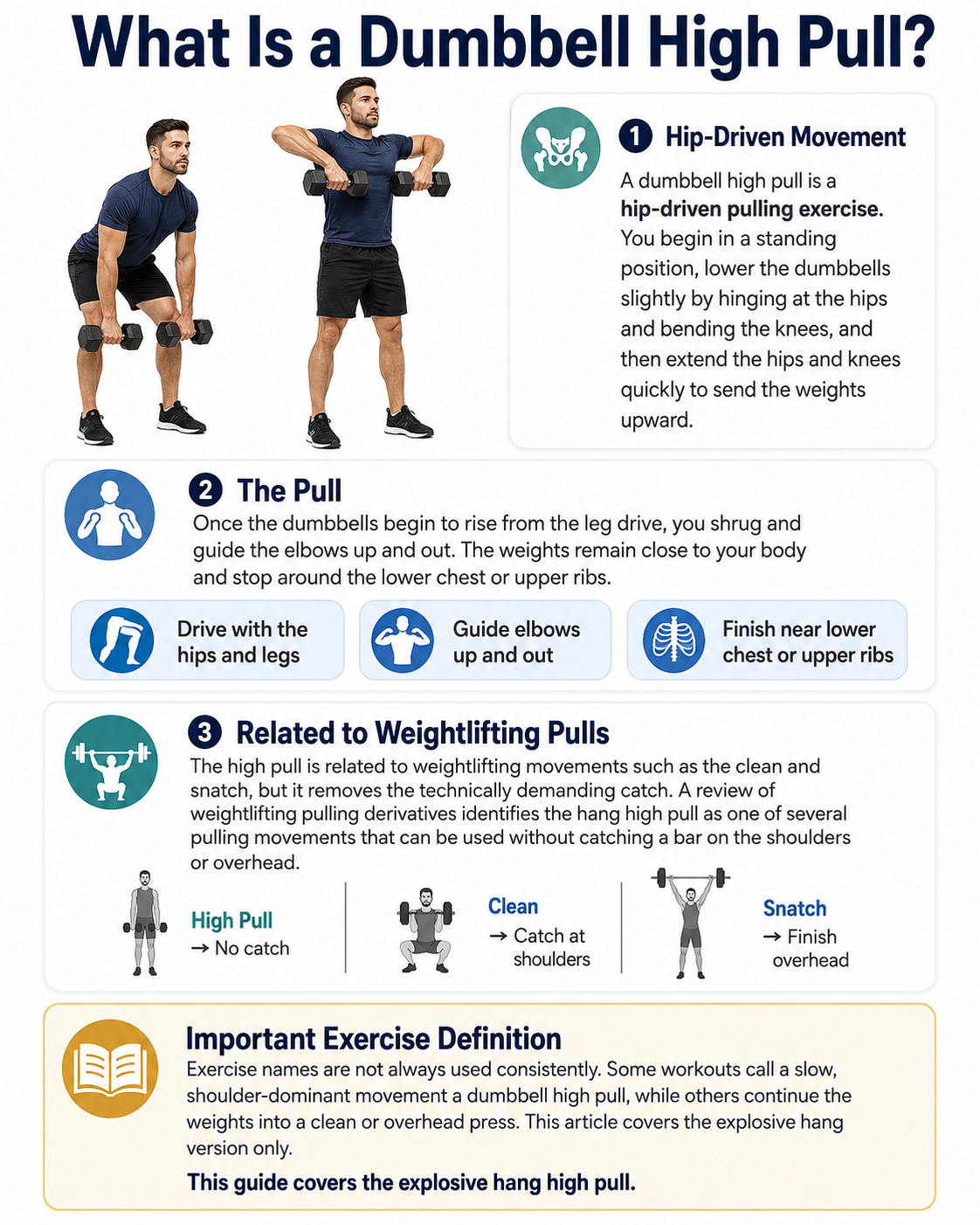
A dumbbell high pull is a hip-driven pulling exercise. You begin in a standing position, lower the dumbbells slightly by hinging at the hips and bending the knees, and then extend the hips and knees quickly to send the weights upward.
Once the dumbbells begin to rise from the leg drive, you shrug and guide the elbows up and out. The weights remain close to your body and stop around the lower chest or upper ribs.
The high pull is related to weightlifting movements such as the clean and snatch, but it removes the technically demanding catch. A review of weightlifting pulling derivatives identifies the hang high pull as one of several pulling movements that can be used without catching a bar on the shoulders or overhead.
Exercise names are not always used consistently. Some workouts call a slow, shoulder-dominant movement a dumbbell high pull, while others continue the weights into a clean or overhead press. This article covers the explosive hang version only.
Dumbbell High Pull at a Glance
| Category | Recommendation |
|---|---|
| Exercise type | Explosive full-body pull |
| Main training goal | Muscular power and movement coordination |
| Primary muscles | Glutes, quadriceps, hamstrings, upper trapezius, and deltoids |
| Supporting muscles | Calves, elbow flexors, core, spinal erectors, forearms, and grip muscles |
| Equipment needed | One matching pair of dumbbells |
| Difficulty level | Beginner-to-intermediate technique; early-intermediate power exercise |
| Starting position | Dumbbells close to the front or outer-front of the thighs |
| Finishing position | Dumbbells near the lower chest or upper ribs |
| Recommended reps | 3–5 per set |
| Recommended sets | 2–5 |
| Rest between sets | 90 seconds to 3 minutes |
| Tempo | Explosive upward pull, controlled return |
| Best workout placement | Near the beginning, after warming up |
How to Do a Dumbbell High Pull
Sets, reps, and rest: Begin with 2–3 sets of 3–5 repetitions. Rest for 90–150 seconds while learning the exercise. More experienced lifters can use 3–5 sets with up to 3 minutes of rest.
Step 1: Set Your Starting Position
- Stand with your feet approximately hip-width apart.
- Hold one dumbbell in each hand near the front or outer-front of your thighs.
- Keep your palms facing your body or slightly inward, depending on the shape of the dumbbells.
- Let your arms hang long with the wrists straight.
- Keep your head aligned with your spine and look forward or slightly downward.
- Brace your midsection without lifting your ribs or arching your lower back.
The dumbbells should begin close to your body. Avoid holding them several inches in front of your thighs.
Step 2: Load the Hips and Legs
- Soften your knees.
- Push your hips backward into a shallow hinge.
- Allow the dumbbells to travel toward the tops of your knees.
- Keep your spine neutral and your chest controlled.
- Maintain pressure through the whole foot.
This should look like the beginning of a shallow Romanian deadlift, not a deep squat. Your hips move backward while your knees bend only enough to help load the legs.
Step 3: Drive Into the Floor
- Push forcefully through the floor.
- Extend your knees and hips quickly.
- Keep your arms long during the initial drive.
- Allow your heels to rise naturally if the upward force brings you onto the balls of your feet.
Do not begin by bending your elbows. The lower body should create the initial acceleration.
Step 4: Shrug and Guide the Dumbbells Up
- As the dumbbells begin to float upward, shrug your shoulders.
- Bend your elbows and guide them up and out.
- Keep the dumbbells close to your torso.
- Let the elbows lead the movement instead of curling the weights toward your shoulders.
- Keep the wrists aligned with the forearms.
The American Council on Exercise high-pull instructions similarly emphasize that the lower body generates the force while the arms and shoulders control the path of the load.
Step 5: Finish Around the Lower Chest
Stop the pull when the dumbbells reach approximately the lower chest or upper ribs.
Your elbows may finish around shoulder height and should remain higher than your wrists. Do not force the weights toward your chin if doing so causes your shoulders to roll forward, your wrists to bend, or your torso to lean backward.
The exact finishing height may vary slightly based on your arm length, shoulder structure, mobility, and the dumbbells you are using.
Step 6: Lower and Reset
- Guide the dumbbells downward under control.
- Soften your hips and knees as the weights return to the thighs.
- Reestablish your posture and balance.
- Reset your breath before starting the next repetition.
Avoid letting the dumbbells drop freely or pull your shoulders forward at the bottom.
Coaching cue: Legs launch; arms guide.
Dumbbell High Pull Muscles Worked
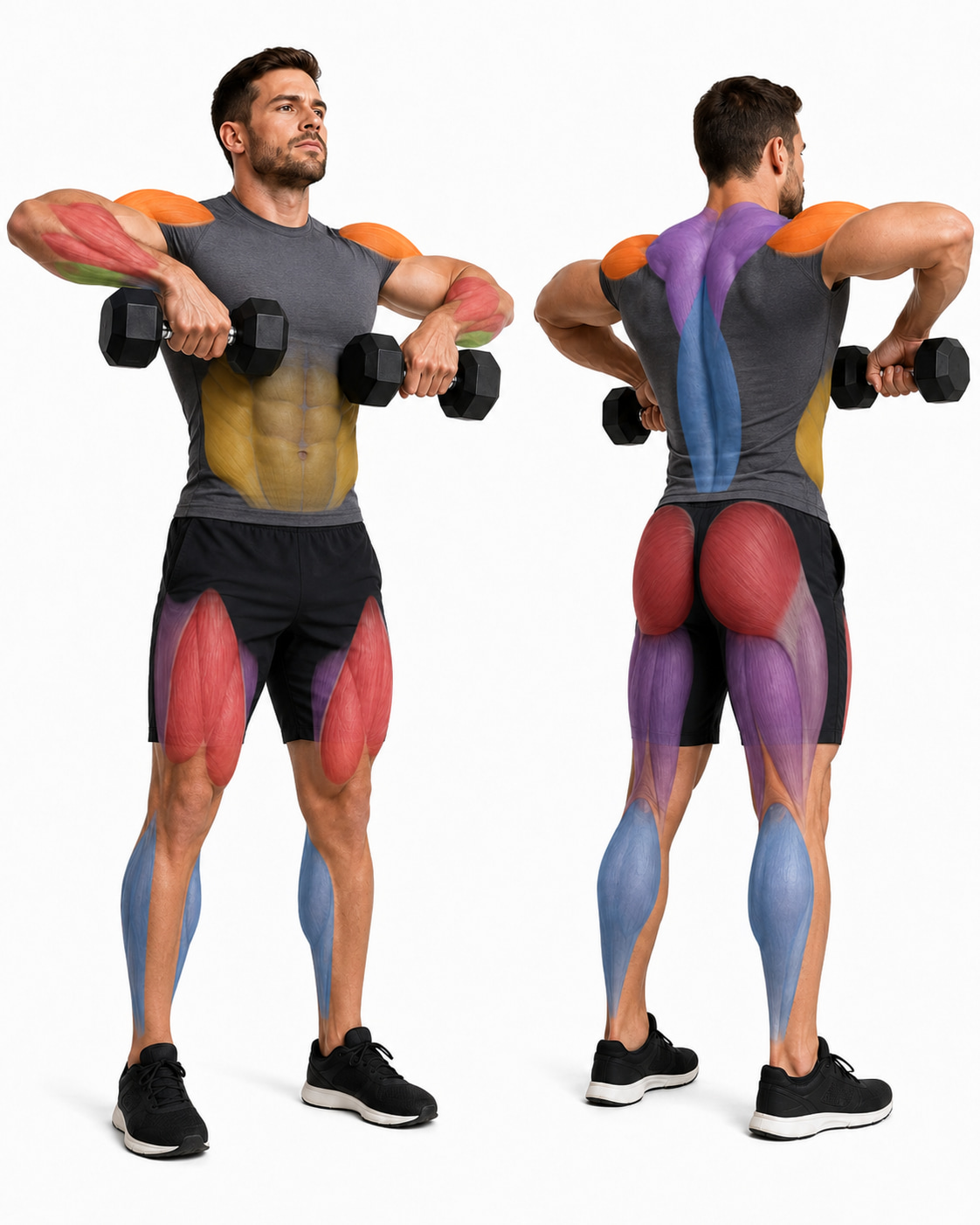
The dumbbell high pull uses muscles throughout the lower body, trunk, upper back, shoulders, and arms. The muscles do not all perform the same job, so it is useful to separate the main power producers from the muscles that guide and stabilize the movement.
Gluteus Maximus
The gluteus maximus extends the hips as you rise from the hinged position. A fast, forceful hip extension helps create the upward momentum that moves the dumbbells.
The glutes should help you stand tall, but you should not finish by pushing the hips excessively forward or arching the lower back.
Quadriceps
The quadriceps extend the knees during the upward drive. They work with the glutes to push your body away from the floor.
A deeper knee bend generally increases quadriceps involvement, but the standard dumbbell high pull uses a shallow hinge or dip rather than a full squat.
Hamstrings
The hamstrings help control the hip hinge and assist the glutes with hip extension.
They also help stabilize the hips as you change direction from the downward loading phase to the explosive pull.
Calves
The calf muscles contribute as the ankles extend near the top of the drive. Your heels may rise naturally as force transfers through the floor.
A deliberate jump is not required. The emphasis should remain on coordinated extension rather than trying to leave the ground as high as possible.
Upper Trapezius
The upper trapezius elevates the shoulder girdle during the shrugging portion of the exercise.
The shrug follows the hip and leg drive. Starting with an aggressive shrug before the lower body extends often makes the movement slower and more arm-dominant.
Deltoids
The lateral and posterior portions of the deltoids help move and control the upper arms as the elbows travel up and out.
The front deltoids may also assist, but the dumbbell high pull should not feel like a front raise.
Biceps, Brachialis, and Other Elbow Flexors
The elbow flexors assist as the elbows bend near the top of the pull.
They are supporting muscles rather than the main source of power. Trying to curl the dumbbells from the starting position reduces the contribution from the hips and legs.
Core and Spinal Erectors
The abdominal muscles, obliques, and spinal erectors work to keep the trunk stable as force moves from the lower body into the dumbbells.
Your torso should become upright during the pull without collapsing forward or leaning excessively backward.
Forearms and Grip Muscles
The forearms and hand muscles keep the dumbbells secure throughout the rapid upward pull and controlled descent.
Use a weight you can hold without losing wrist position or allowing the dumbbells to rotate unpredictably.
Research on related hang pulling movements has measured substantial involvement from the gluteus maximus, vastus lateralis, trapezius, rectus abdominis, and spinal erectors. However, these studies generally use barbells, so their results should not be treated as exact muscle-activation measurements for the dumbbell version.
Benefits of Dumbbell High Pulls
1. Develops Explosive Full-Body Power
The exercise requires you to generate force quickly through the hips and legs before transferring that force into the upper body.
The 2026 American College of Sports Medicine resistance-training guidelines recommend moderate loads and fast lifting intent when power is the goal. The dumbbell high pull fits that purpose when the load remains light enough to move quickly.
2. Trains Coordinated Hip, Knee, and Ankle Extension
High pulls teach you to extend the lower body in a coordinated sequence.
This pattern is often called triple extension because the hips, knees, and ankles contribute to the upward drive. You do not need to exaggerate each joint action; the movement should feel like one fast, connected effort.
3. Connects Lower-Body Force to an Upper-Body Pull
The dumbbell high pull teaches the body to transfer force from the floor through the legs and trunk into the arms.
That coordination makes the exercise different from a strict upright row, lateral raise, or shrug, where the lower body remains relatively still.
4. Removes the Catch Used in Cleans
A dumbbell clean requires you to rotate the elbows under the weights and catch the dumbbells near the shoulders. The high pull ends before that catch.
Removing the catch can make it easier to practice the explosive pulling phase before learning more advanced clean variations.
5. Allows Each Arm to Move Independently
Unlike a barbell, two dumbbells do not lock your hands into one fixed position.
This allows each shoulder and elbow to follow a slightly more individualized path. However, independent movement does not make the exercise automatically suitable for every shoulder. Use a comfortable range and stop if the movement causes pain.
6. Requires Limited Equipment
You need only two dumbbells and enough clear space to perform the exercise safely.
That makes the high pull practical for a home gym, commercial gym, or small training space where a barbell and lifting platform are unavailable.
Common Dumbbell High Pull Mistakes
Pulling With the Arms Too Early
This is the most common technique problem.
If your elbows bend before your hips and knees extend, the exercise becomes a heavy arm pull. Keep the arms long during the initial drive and wait for the dumbbells to begin rising before guiding the elbows upward.
Using Dumbbells That Are Too Heavy
A weight may be too heavy if:
- The dumbbells move slowly
- You cannot keep them close to your body
- You lean backward to complete the pull
- The elbows bend before the legs extend
- Each repetition finishes at a different height
Reduce the weight until all repetitions look and feel consistent.
Turning the Hinge Into a Deep Squat
The standard dumbbell hang high pull uses a shallow hinge or dip.
Dropping into a deep squat changes the movement and may make the dumbbells swing away from the body. Push the hips backward and bend the knees only as much as needed to load the legs.
Letting the Dumbbells Drift Forward
Weights that travel several inches away from your torso become harder to control and place more demand on the shoulders and lower back.
Keep the dumbbells close enough that they almost trace the front or outer-front of your body.
Leaning Back at the Top
Excessive backward lean usually means the weight is too heavy or you are trying to pull the dumbbells higher than your shoulders can comfortably manage.
Finish tall with the ribs controlled and the pelvis beneath the torso.
Pulling Toward the Chin
The dumbbells do not need to reach your chin.
Pulling to the lower chest or upper ribs is generally enough to train the movement. Stop earlier if a higher position causes shoulder discomfort, wrist bending, or loss of control.
Bending the Wrists
Keep the wrists straight and aligned with the forearms.
Do not allow the dumbbells to hang from bent wrists at the top. A neutral wrist position provides a more secure connection between the hands and forearms.
Dropping the Dumbbells Too Quickly
The upward phase is explosive, but the return should remain controlled.
Guide the weights back to the thighs and absorb their downward momentum with the hips and knees.
Performing Too Many Repetitions
Power exercises depend on speed and coordination. Both usually decline as fatigue increases.
ACE recommends six or fewer repetitions for explosive exercises and adequate rest between sets. End the set when the dumbbells become noticeably slower, even when you feel capable of completing more repetitions.
How Many Dumbbell High Pulls Should You Do?
Choose your sets, repetitions, and rest according to your experience and training goal.
| Goal | Sets | Reps | Rest | Suggested effort |
|---|---|---|---|---|
| Learning the technique | 2–3 | 3–5 | 90–150 seconds | RPE 5–6 |
| Developing power | 3–5 | 3–5 | 2–3 minutes | RPE 6–8 |
| Warm-up for cleans or snatches | 2–3 | 2–3 | 60–90 seconds | Very light and fast |
RPE is a 1–10 effort scale. An RPE of 6 means the set feels relatively comfortable, while an RPE of 8 is challenging but still leaves room for more repetitions.
Do not take dumbbell high pulls to muscular failure. Your set should end because you have completed the planned repetitions, not because you can no longer lift the weights.
How to Choose the Correct Dumbbell Weight
A high-pull one-repetition maximum is unnecessary for most recreational lifters.
Although ACSM recommends moderate relative loads for power training, those percentages are most useful when a reliable maximum has already been established. For dumbbell high pulls, a technique-based test is usually more practical.
Your dumbbells are appropriate when you can:
- Complete 3–5 repetitions at a consistent speed
- Keep the weights close to your torso
- Delay elbow bending until after the leg drive begins
- Finish without leaning backward
- Maintain straight wrists
- Control the descent
- Stop the set with energy remaining
Your dumbbells are too heavy when the exercise turns into a slow grind.
Simple Progression Method
- Choose a weight you can perform for 3 controlled, explosive repetitions.
- Gradually build toward 5 repetitions per set.
- Keep the same finishing height and speed on every rep.
- Once all sets of 5 remain crisp for several workouts, use the smallest available weight increase.
- Return to 3 repetitions with the new load.
Do not add weight and repetitions at the same time.
When to Do Dumbbell High Pulls
Perform the dumbbell high pull near the beginning of your workout:
- Complete your general and movement-specific warm-up.
- Practice one or two light rehearsal sets.
- Perform your working high-pull sets.
- Continue with slower strength and muscle-building exercises.
Avoid saving high pulls for the end of a demanding workout when your grip, balance, trunk control, and hip-drive timing are already fatigued.
Most general lifters can practice the movement once or twice per week. More frequent practice may be useful while learning, but those sessions should use light weights and very low volume.
Beginner Dumbbell High Pull Regressions
Hip Hinge to Fast Stand
Practice pushing the hips backward and then standing quickly without using dumbbells.
Keep your arms relaxed and focus on finishing tall without leaning backward.
Dumbbell Jump Shrug
Hold light dumbbells at your sides or in front of your thighs.
Use the same shallow hinge and explosive leg drive, but keep your elbows straight. Shrug at the top and lower the weights under control.
This regression teaches lower-body timing before adding the high elbow pull.
High Pull From the Power Position
Begin with the dumbbells at the upper thighs and use only a shallow knee and hip dip.
This reduces the hinge range and can make it easier to coordinate the leg drive, shrug, and elbow movement.
Return to the above-knee hang position after you can keep the dumbbells close and delay the arm pull.
Dumbbell High Pull Progressions and Variations
Single-Arm Dumbbell High Pull
Hold one dumbbell near one thigh and perform the same hip-driven pull.
Keep your hips and shoulders facing forward rather than rotating toward the working arm. This variation reduces the total load but increases the demand on your core to resist rotation.
Dumbbell High Pull to Clean
Perform the high pull, then rotate the elbow underneath the dumbbell and catch it near the shoulder.
Use lighter weights than you would for a standard high pull. Practice the catch separately before combining both phases.
Dumbbell Clean
The dumbbell clean uses a similar lower-body drive but finishes with the weights supported at the shoulders.
It requires additional timing, wrist control, and coordination.
Dumbbell Snatch
The dumbbell snatch continues the weight overhead instead of finishing at the chest.
This is a more advanced progression that requires overhead mobility, control, and confidence. Learn it with light weight and qualified coaching when available.
Heavier Dumbbell High Pull
Increasing the load is a progression only when you can maintain speed and positioning.
A heavier but slower repetition is not automatically better for power development.
Dumbbell High Pull vs. Upright Row
Although the movements can look similar near the top, they have different purposes.
| FeatureDumbbell High PullDumbbell Upright Row | ||
|---|---|---|
| Speed | Explosive | Controlled |
| Lower-body involvement | Significant hip and leg drive | Minimal or none |
| Starting position | Shallow hinge or dip | Standing upright |
| Arm timing | Elbows bend after the lower-body drive | Elbows bend from the beginning |
| Main purpose | Full-body power and coordination | Shoulder and upper-trap resistance training |
| Typical repetitions | 3–5 | Often 8–15 |
The dumbbell high pull should not be performed like a fast upright row. The hips and legs create the initial momentum.
Likewise, an upright row should not use an unplanned hip swing simply to move a heavier weight.
Dumbbell High Pull vs. Dumbbell Clean
Both exercises use explosive lower-body extension, but they finish differently.
During a high pull, the elbows travel up and out while the dumbbells finish near the chest.
During a clean, the elbows rotate underneath the dumbbells so the weights can be received at the shoulders.
The high pull may be useful for practicing the explosive pull without having to learn the catch at the same time.
Sample Dumbbell High Pull Workout
This full-body session places the high pull first so you can practice it before fatigue affects your speed and coordination.
Warm-Up
Complete 5–8 minutes of easy movement followed by:
- Bodyweight hip hinge: 2 sets of 8
- Calf raise: 1 set of 10
- Unweighted shrug: 1 set of 10
- Light dumbbell jump shrug: 1 set of 5
- Light dumbbell high pull: 2 sets of 3
Workout
| Exercise | Sets | Reps | Rest | Effort |
|---|---|---|---|---|
| Dumbbell high pull | 4 | 3–5 | 2 minutes | RPE 6–7 |
| Goblet squat | 3 | 8–10 | 90 seconds | 2–3 reps in reserve |
| Dumbbell floor press | 3 | 8–12 | 75–90 seconds | 2–3 reps in reserve |
| One-arm dumbbell row | 3 | 8–12 per side | 75–90 seconds | 2–3 reps in reserve |
| Suitcase carry | 2 | 30–45 seconds per side | 60 seconds | Controlled posture |
Perform this workout once or twice per week with at least one recovery day between sessions.
For the dumbbell high pull, progress only when all repetitions remain fast and technically consistent. For the other exercises, reach the top of the recommended repetition range before adding a small amount of weight.
Dumbbell High Pull Safety Considerations
The dumbbell high pull is optional. You do not need to perform it to build strength, muscle, or general fitness.
A row, shrug, squat, Romanian deadlift, or controlled shoulder exercise may be more appropriate when explosive movements do not match your experience or goals.
Use these safety guidelines:
- Learn a basic hip hinge before adding speed.
- Begin with lighter dumbbells than you expect to need.
- Use secure dumbbells with no loose plates or collars.
- Keep the floor around you clear.
- Do not perform the exercise under a low ceiling or near another person.
- Use a finishing height that feels comfortable for your shoulders.
- Stop the set when speed or coordination declines.
- Avoid maximal attempts and training to failure.
- Seek qualified coaching when you are unfamiliar with explosive lifting.
The National Strength and Conditioning Association recommends mastering foundational movement patterns, progressing gradually, using lighter technical variations, and monitoring fatigue when introducing more complex or explosive resistance exercises.
Stop exercising and seek appropriate professional help if you experience sharp pain, numbness, dizziness, chest pain, loss of balance, or other unusual symptoms.
Frequently Asked Questions
Are dumbbell high pulls a back or shoulder exercise?
They train both areas, but they are best classified as a full-body power exercise.
The upper traps and deltoids help guide the dumbbells, while the glutes, quadriceps, and hamstrings create much of the initial force.
Should dumbbell high pulls be fast or slow?
The upward phase should be fast and explosive.
The downward phase should be controlled so you can maintain balance, manage the weights, and reset your position. A deliberately slow upward pull becomes a different, more shoulder-dominant exercise.
How high should I pull the dumbbells?
Aim for approximately the lower chest or upper ribs.
Do not force the dumbbells toward your chin. Stop at the highest position you can reach while keeping your wrists straight, torso controlled, and shoulders comfortable.
Can beginners perform dumbbell high pulls?
Beginners can learn the movement with very light weights, but they should first be able to perform a stable hip hinge.
A dumbbell jump shrug or high pull from a shallow dip can make the timing easier to learn.
Can I perform a high pull with one dumbbell?
Yes. A single-arm dumbbell high pull uses the same lower-body drive and elbow path.
Keep your hips and shoulders square and resist rotating toward the working side.
Is a dumbbell high pull the same as an upright row?
No.
The high pull is explosive and driven by the hips and legs. An upright row is generally slower and performed without deliberate lower-body assistance.
Are dumbbell high pulls good for building muscle?
They can contribute to training the upper traps, shoulders, hips, and legs, but their main purpose is power and coordination.
For muscle growth, combine high pulls with controlled exercises that make it easier to accumulate quality volume, such as rows, shrugs, lateral raises, squats, and Romanian deadlifts.
Conclusion
The dumbbell high pull is most effective when you treat it as a power exercise rather than a heavy arm pull. Use a shallow hinge, drive forcefully through the floor, keep your arms long during the initial extension, and then guide the dumbbells toward the lower chest with your elbows leading.
Start lighter than you think you need, keep the repetitions low, rest fully between sets, and stop before fatigue changes your technique. Once the movement remains fast and consistent, progress gradually with small increases in load.
References
- American College of Sports Medicine: 2026 Resistance-Training Guidelines
- American Council on Exercise: Explosive Upper-Body Exercises and High-Pull Programming
- PubMed: Weightlifting Pulling Derivatives—Rationale for Implementation and Application
- PubMed: Muscle Activity During Hang Pulling and Catching Derivatives
- National Strength and Conditioning Association: Resistance-Training Safety and Progression
- REP Fitness: Dumbbell High Pull Technique and Variations
This content is for informational purposes only and is not a substitute for medical advice.