The dumbbell floor press is a no-bench pressing exercise that trains the chest, triceps, and front shoulders through a shortened range of motion. Because the floor stops your upper arms, you cannot lower the dumbbells as deeply as you can during a standard dumbbell bench press.
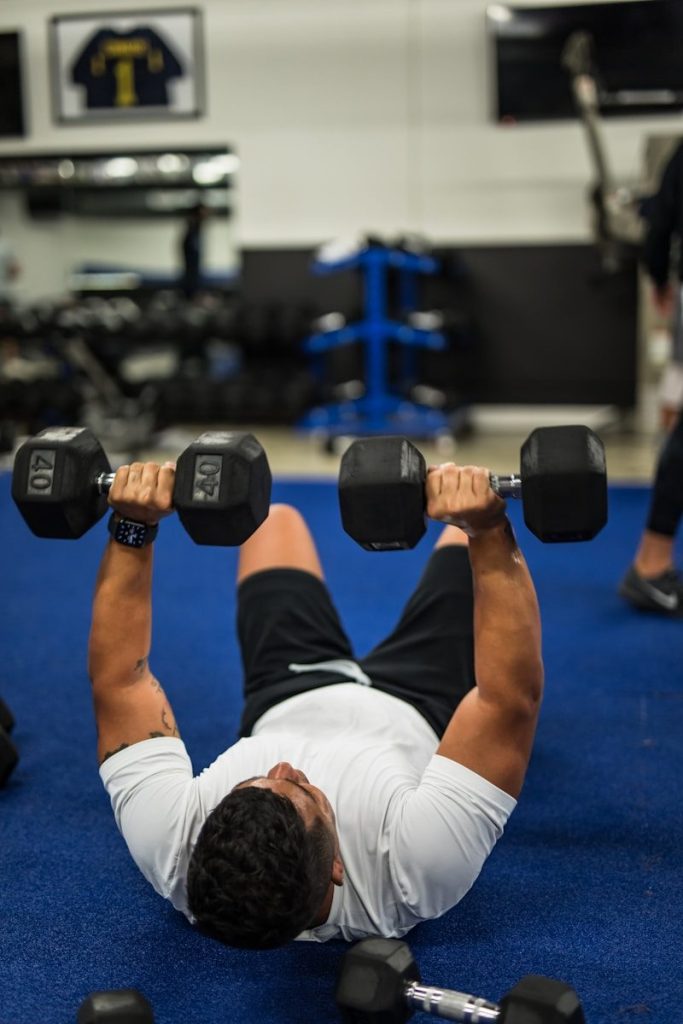
This makes the exercise useful for home workouts, upper-body strength training, and lifters who want a clearly controlled bottom position. However, the shorter range does not make the floor press automatically safer, easier, or better than bench pressing.
This guide explains proper dumbbell floor press form, the muscles worked, common mistakes, grip options, programming, progressions, and how to use the exercise in a workout.
Dumbbell Floor Press at a Glance
| Training detail | Recommendation |
|---|---|
| Best for | Home workouts, chest and triceps training, and shortened-range pressing |
| Primary muscle | Pectoralis major |
| Assisting muscles | Triceps brachii and anterior deltoids |
| Stabilizing muscles | Rotator cuff, upper back, core, and forearms |
| Equipment needed | Two matched dumbbells and clear floor space |
| Suggested starting range | 2–3 sets of 8–12 repetitions |
| Rest | 60–120 seconds for moderate sets |
| Effort | Finish most sets with approximately 1–3 good reps in reserve |
| Training level | Beginner to intermediate |
| Main movement | Horizontal press with elbow extension |
What Is a Dumbbell Floor Press?
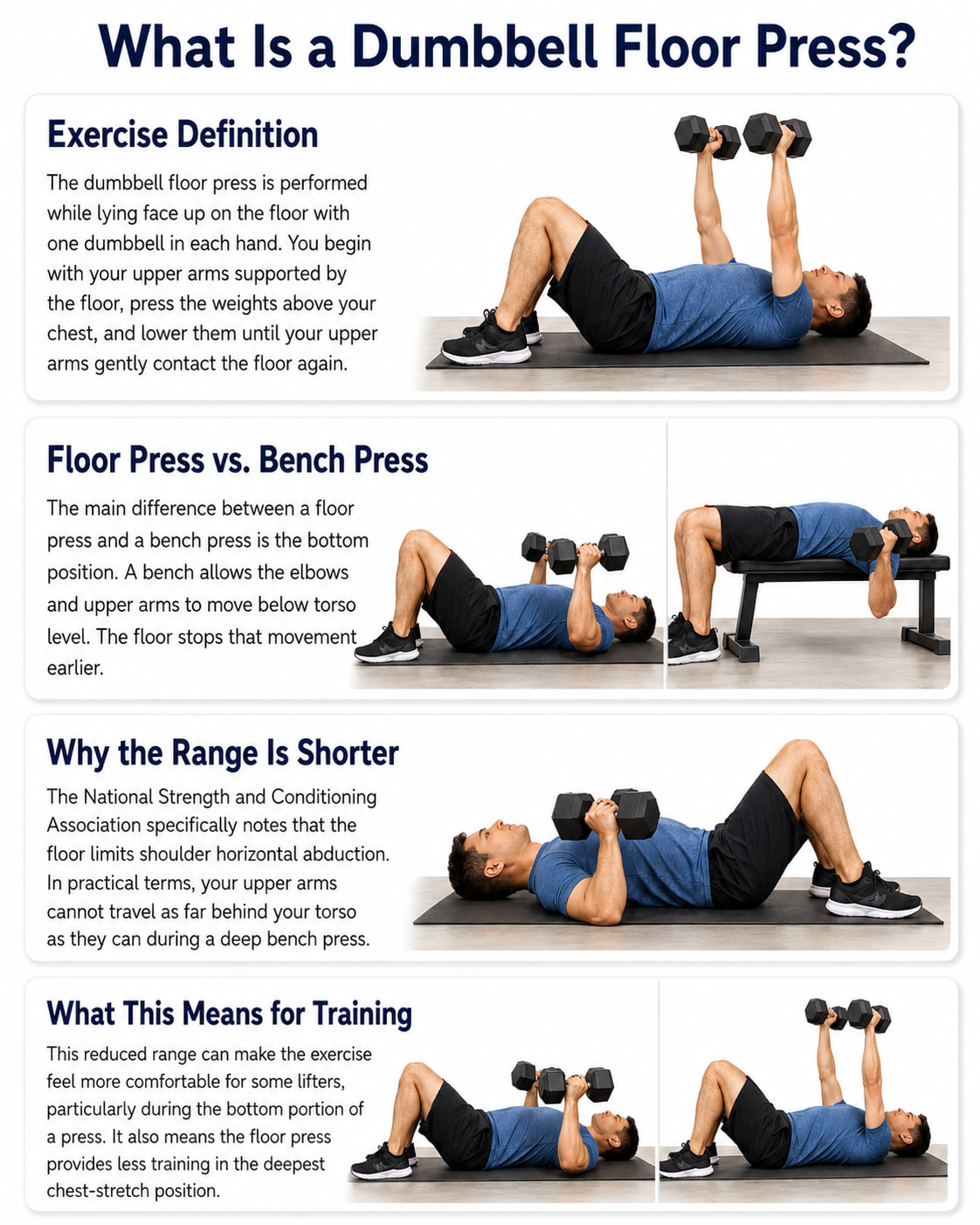
The dumbbell floor press is performed while lying face up on the floor with one dumbbell in each hand. You begin with your upper arms supported by the floor, press the weights above your chest, and lower them until your upper arms gently contact the floor again.
The main difference between a floor press and a bench press is the bottom position. A bench allows the elbows and upper arms to move below torso level. The floor stops that movement earlier.
The National Strength and Conditioning Association specifically notes that the floor limits shoulder horizontal abduction. In practical terms, your upper arms cannot travel as far behind your torso as they can during a deep bench press.
This reduced range can make the exercise feel more comfortable for some lifters, particularly during the bottom portion of a press. It also means the floor press provides less training in the deepest chest-stretch position.
Dumbbell Floor Press Muscles Worked
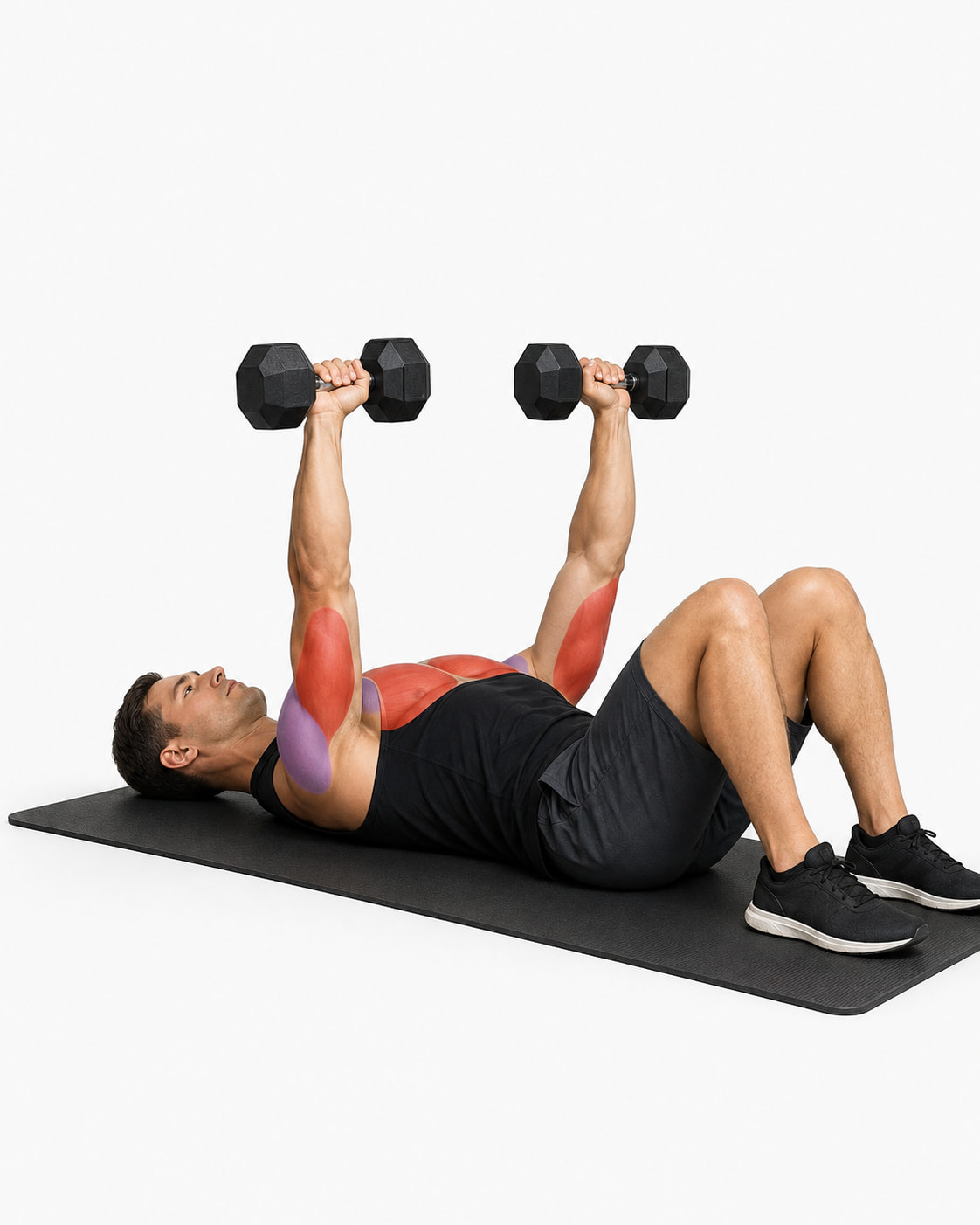
The dumbbell floor press is a compound upper-body exercise. Several muscles work together to move and stabilize the dumbbells.
Pectoralis Major
The pectoralis major is the large muscle covering most of the chest. It helps move the upper arms toward the center of the body during the pressing phase.
The floor press still trains the chest even though the floor limits the bottom range. However, you will generally experience less chest stretch than you would during a controlled dumbbell bench press.
The NCBI Bookshelf overview of pectoralis major anatomy describes arm flexion, adduction, and internal rotation as major functions of the muscle. These actions contribute to horizontal pressing.
Triceps Brachii
The triceps on the backs of your upper arms straighten your elbows as you press the dumbbells upward.
Because the floor press removes part of the deepest pressing range, elbow extension becomes especially important through the middle and top portions of the repetition. This is why the exercise is commonly used to strengthen the lockout portion of a press.
The NCBI Bookshelf overview of the triceps identifies elbow extension as the muscle’s primary function.
A 2025 bench-press study published through PubMed found greater triceps excitation during an upper-half range than during full- or lower-half conditions. That supports the idea that shortened-range pressing can place substantial demand on the triceps. However, the study examined barbell bench pressing, not long-term dumbbell floor-press training, so it does not prove that the floor press produces superior triceps growth.
Anterior Deltoids
The anterior deltoids are the front portions of the shoulder muscles. They assist the chest as the upper arms move forward during the press.
Shoulder involvement may increase when the dumbbells drift toward your head, your elbows flare directly sideways, or you lose control of your shoulder position.
Stabilizing Muscles
The rotator-cuff muscles help stabilize the upper arm within the shoulder joint. Your upper back helps control the shoulder blades, while your forearms maintain a secure grip and neutral wrist position.
Your abdominal muscles also brace the torso. Core demand becomes more noticeable during single-arm and alternating floor-press variations because the body must resist rotation.
The NCBI Bookshelf review of rotator-cuff anatomy describes stabilization of the shoulder joint as a primary role of the rotator-cuff muscles.
How to Do the Dumbbell Floor Press
Equipment needed: Two matched dumbbells and a clear, nonslip floor area. An exercise mat is optional, but it should be firm enough to provide stable support.
Sets, reps, and rest: Begin with 2–3 sets of 8–12 repetitions. Rest for approximately 60–120 seconds between sets.
How to Perform It
- Sit with the dumbbells close to your thighs. Bend your knees and keep your feet planted. Use a weight you can position without struggling.
- Roll onto your back under control. Guide the dumbbells toward the sides of your chest as you lie down. Keep the weights close to your body rather than allowing them to fall outward.
- Set your starting position. Keep your head, upper back, hips, and feet supported. Gently brace your abdomen and keep your shoulders controlled against the floor.
- Position your arms. Bend your elbows and place your upper arms approximately 30–60 degrees from your torso. Your forearms should be nearly vertical, with the dumbbells stacked over your elbows.
- Choose a comfortable grip. Use a neutral grip with your palms facing each other, a semi-neutral grip with your palms angled slightly forward, or a palms-forward grip. Keep your thumbs wrapped around the handles.
- Press the dumbbells upward. Straighten your elbows while moving the dumbbells above your chest. Keep your wrists stacked over your forearms and avoid forcing the dumbbells together.
- Lower under control. Bend your elbows and return through the same path. Stop when the backs of your upper arms or triceps gently contact the floor.
- Maintain tension at the bottom. Pause briefly without bouncing, slamming your arms down, or completely relaxing beneath the weights.
- Repeat with an even arm path. Both dumbbells should rise and lower at approximately the same speed.
How to End the Set Safely
After your final repetition, bring the dumbbells close to your chest and rotate to a neutral grip. Carefully guide them toward your thighs and rock forward into a seated position.
Do not throw the dumbbells outward or drop them beside your head. Use a spotter for loads that are difficult to position or remove safely. If you cannot control the setup, the weight is too heavy for the exercise.
Coaching cue: Lower softly, pause, and press over your chest.
Choosing the Right Grip
There is no single grip that is best for every lifter. Choose the position that lets you keep your wrists straight and your shoulders comfortable.
Neutral Grip
Your palms face each other throughout the exercise.
This position usually keeps the elbows somewhat closer to the torso. It is a practical starting option for beginners and for lifters who find a fully palms-forward grip uncomfortable.
Semi-Neutral Grip
Your palms face slightly forward rather than directly forward or directly inward.
This grip often provides a natural compromise between chest involvement, elbow position, and shoulder comfort.
Palms-Forward Grip
Your palms face toward your feet, similar to a traditional dumbbell bench press.
This position may allow the upper arms to move slightly farther away from the torso. Use it only if you can maintain straight wrists and controlled shoulders.
Grip choice should not become a complicated muscle-targeting strategy. The chest, triceps, and anterior deltoids remain involved with all three options. Comfort, control, and repeatable technique are more important.
Common Dumbbell Floor Press Mistakes
Slamming the Upper Arms Into the Floor
The floor should stop the movement, not absorb an uncontrolled drop.
Lower slowly and make gentle contact. Repeatedly striking the elbows or upper arms against a hard surface can create unnecessary discomfort and makes it difficult to maintain tension.
Flaring the Elbows Directly Sideways
Positioning the upper arms at approximately 90 degrees from the torso can make it harder to keep the shoulders controlled.
Aim for a moderate elbow angle, usually somewhere around 30–60 degrees from your sides. The exact angle can vary with your grip, arm length, and shoulder structure.
Bending the Wrists Backward
The dumbbells should remain stacked over the forearms.
If your wrists repeatedly bend backward, the load may be too heavy, your grip may be too loose, or the dumbbells may be positioned too far toward your head.
Lowering the Dumbbells Toward the Face
The weights should travel toward the sides of the chest, not toward the neck or face.
Keep the forearms close to vertical and press the dumbbells above the chest rather than allowing them to drift backward.
Completely Relaxing at the Bottom
Floor contact does not mean you should release all muscular tension.
Keep your grip secure, wrists straight, abdomen braced, and shoulders controlled during the pause. Relaxing fully can make the next repetition unstable.
Lifting the Hips
Keep your hips on the floor during the standard dumbbell floor press.
Raising the hips turns the exercise into a floor-press and glute-bridge combination. That is a separate variation and may make it easier to compensate with excessive lower-back extension.
Using More Weight Than You Can Set Up
A shortened range may allow some people to press heavier weights, but dumbbells still need to be moved into and out of position safely.
Do not judge the exercise only by how much you can press. Use a load that allows a controlled setup, even repetitions, soft floor contact, and a safe finish.
Benefits of the Dumbbell Floor Press
Trains the Chest and Triceps
The exercise combines shoulder movement with elbow extension, allowing the chest, triceps, and anterior deltoids to work together.
It can be used as a main pressing exercise in a home workout or as an accessory after bench pressing or overhead pressing.
Requires No Bench
You only need two dumbbells and enough floor space to lie down.
That makes the floor press practical for home gyms, hotel workouts, small training areas, or situations where every bench is occupied.
Limits the Deepest Pressing Position
The floor stops your upper arms before they move far behind your torso.
This may make the bottom position more comfortable for some people who do not tolerate deep dumbbell bench pressing well. It should not, however, be described as universally safe or as a treatment for shoulder pain.
Creates a Consistent Bottom Position
The floor gives each repetition a clear stopping point.
This can help you practice controlled pauses and reduce the tendency to lower the dumbbells farther than you can control.
Allows Each Arm to Work Independently
Unlike a barbell, dumbbells allow each arm to move separately.
This can reveal differences in pressing control between sides. It also allows you to adjust each wrist and elbow to a position that feels natural.
Emphasizes the Middle and Top of the Press
Because the deepest portion is removed, the floor press places substantial demand on the middle and upper portions of the repetition.
This makes it useful for practicing a controlled pause and strengthening elbow extension. The chest still works, but the exercise provides less training in the deepest stretched position.
Dumbbell Floor Press vs. Dumbbell Bench Press
The two exercises use a similar pressing pattern, but they are not interchangeable in every situation.
| Feature | Dumbbell Floor Press | Dumbbell Bench Press |
|---|---|---|
| Equipment | Dumbbells and floor space | Dumbbells and a stable bench |
| Range of motion | Shorter | Generally longer |
| Bottom position | Upper arms stop at the floor | Elbows may move below torso level |
| Chest stretch | More limited | Usually greater |
| Shoulder horizontal abduction | Limited by the floor | Greater when using a deeper range |
| Triceps contribution | Substantial through the middle and top | Substantial, especially near lockout |
| Setup | No bench, but heavy weights can be awkward to position | Requires a bench; dumbbells can also be difficult to set up |
| Best use | Home workouts, controlled pauses, shortened-range pressing | Longer-range chest training and general pressing strength |
Which One Should You Choose?
Choose the floor press when you do not have a bench, want a clear bottom position, or prefer a shorter pressing range.
Choose the bench press when you want to train through a longer controllable range and can lower the dumbbells without losing shoulder, wrist, or torso position.
Many lifters can use both. For example, the dumbbell bench press can be the main chest exercise, while the floor press can be used later for additional chest and triceps work.
There is much more research on bench pressing and pressing ranges than on the exact two-dumbbell floor press. Claims that one exercise is always better for muscle growth, strength, or shoulder health should therefore be treated cautiously.
How Many Sets and Reps Should You Do?
Use the following ranges as practical starting points rather than rigid rules.
| Goal | Sets | Reps | Rest | Suggested effort |
|---|---|---|---|---|
| Learning the exercise | 2–3 | 8–12 | 60–120 seconds | 2–4 reps in reserve |
| Building muscle | 3–4 | 6–15 | 90–150 seconds | 1–3 reps in reserve |
| Building pressing strength | 3–5 | 4–8 | 2–3 minutes | 1–3 reps in reserve |
| Accessory or finisher | 2–3 | 10–15 | 60–90 seconds | 1–2 reps in reserve |
A repetition in reserve is one good repetition you could still perform before your technique begins to break down.
For example, finishing with two repetitions in reserve means you stopped when you probably could have completed two more controlled repetitions.
The American College of Sports Medicine’s 2026 resistance-training guidance emphasizes consistency, appropriate weekly volume, and adjusting load to the training goal. It also reports that reaching momentary muscular failure is not consistently necessary for healthy adults to improve strength or muscle size.
How Often Should You Do the Dumbbell Floor Press?
Include the exercise one or two times per week, depending on your program and recovery.
Remember that floor presses, bench presses, push-ups, shoulder presses, and triceps exercises all contribute to your total upper-body pressing workload. You do not need to perform every variation in the same session.
How Heavy Should the Dumbbells Be?
Choose a weight that allows you to:
- Position the dumbbells without struggling
- Keep your wrists straight
- Lower both arms evenly
- Touch the floor gently
- Keep your hips down
- Complete the planned repetitions with 1–3 good reps remaining
Beginners should start lighter than they think necessary. The first goal is to establish a repeatable setup and pressing path.
How to Progress the Dumbbell Floor Press
Use a simple double-progression method:
- Choose a repetition range, such as 8–12.
- Begin with a weight you can control for approximately 8 repetitions.
- Keep the same weight until you can complete 12 good repetitions on every set.
- Increase each dumbbell by the smallest practical amount.
- Return to the lower end of the range and build back up.
Increase the weight only when the final repetition still looks similar to the first. Do not progress if the dumbbells become uneven, your wrists bend, your hips rise, or your arms strike the floor.
Dumbbell Floor Press Regressions and Variations
Light Neutral-Grip Floor Press
Best for: Beginners learning the movement.
Use lighter dumbbells with your palms facing each other. Keep the elbows closer to the torso and concentrate on a smooth setup and soft floor contact.
Paused Dumbbell Floor Press
Best for: Improving control and strength from the bottom position.
Pause for one or two seconds after your upper arms gently contact the floor. Maintain tension rather than resting completely.
Tempo Dumbbell Floor Press
Best for: Improving control without immediately adding weight.
Lower the dumbbells over approximately three seconds, pause briefly, and press upward at a controlled speed.
Close-Grip Dumbbell Floor Press
Best for: Increasing the elbow-extension demand.
Hold the dumbbells closer together with a neutral grip and keep your elbows near your sides. Do not force the dumbbells against each other unless you are intentionally performing a squeeze-press variation.
Single-Arm Dumbbell Floor Press
Best for: Unilateral pressing and anti-rotation training.
Press one dumbbell while the other arm remains unloaded. Keep your hips and shoulders level.
This is not automatically easier than the two-arm version. Although you use only one dumbbell, the uneven load increases the demand on your trunk.
Alternating Dumbbell Floor Press
Best for: Coordination and shoulder stability.
Hold both dumbbells above your chest while lowering and pressing one arm at a time. Use lighter weights because one arm must remain extended while the other moves.
Machine Chest Press as a Regression
Best for: People who have difficulty getting down to the floor or safely positioning dumbbells.
A chest-press machine provides more external support and removes the difficult dumbbell setup. It uses a similar horizontal pressing pattern, although it is not an exact floor-press replacement.
Sample No-Bench Upper-Body Workout
Perform this workout one or two times per week on nonconsecutive days.
Before your working sets, complete a brief general warm-up and one or two lighter floor-press sets.
| Exercise | Sets | Reps | Rest |
|---|---|---|---|
| Dumbbell floor press | 3 | 8–12 | 90–120 seconds |
| Supported one-arm dumbbell row | 3 | 8–12 per side | 90 seconds |
| Seated dumbbell shoulder press | 2 | 8–12 | 90 seconds |
| Bent-over dumbbell reverse fly | 2 | 12–15 | 60 seconds |
| Dumbbell triceps extension | 2 | 10–15 | 60 seconds |
Finish most sets with approximately two good repetitions in reserve.
When you reach the top of the repetition range for every set with consistent technique, increase the weight slightly. Progress one exercise at a time rather than increasing everything in the same workout.
Dumbbell Floor Press Safety Tips
Clear enough space around your body before beginning. Keep other weights, furniture, and objects away from the pressing area.
Use a complete grip with your thumbs wrapped around the dumbbell handles. Check that adjustable dumbbell plates or collars are secured before lying down.
Practice the setup and finish with light weights first. Heavy dumbbells can be harder to position safely on the floor than the pressing movement itself.
Use a spotter when handling loads that you cannot bring into or out of position comfortably. Never throw the dumbbells away from your body at the end of a set.
A shorter range does not guarantee that the exercise will be comfortable for every shoulder. Stop the set if you experience sharp pain, numbness, dizziness, chest pain, loss of control, or other unusual symptoms. Seek guidance from a qualified healthcare professional when pain persists or when you are returning from an injury.
Frequently Asked Questions
Is the Dumbbell Floor Press Good for Building the Chest?
Yes. The pectoralis major is a primary contributor during the press, so the exercise can help build chest strength and muscle when it is performed consistently and progressively.
However, the floor limits the deepest range and reduces the stretched position available to the chest. A bench press may provide more complete chest training through a longer range when you can perform it comfortably.
Is the Floor Press More of a Chest or Triceps Exercise?
It trains both.
The chest helps move the upper arms toward the center of the body, while the triceps straighten the elbows. The shortened bottom range can make the middle and top portions—and therefore elbow extension—more noticeable than during a deeper press.
Should Your Elbows Rest on the Floor?
Your upper arms or triceps should make gentle contact with the floor, but you should not completely release tension.
Pause briefly while maintaining your grip, wrist position, abdominal brace, and shoulder control. Do not bounce your arms off the floor.
Is the Dumbbell Floor Press Easier Than the Bench Press?
Not always.
The shorter range may allow some lifters to use more weight or complete repetitions more easily. However, getting dumbbells into position on the floor can be difficult, and the exercise does not automatically feel easier for everyone.
Compare the exercises using controlled repetitions rather than comparing the dumbbell numbers directly.
Is the Dumbbell Floor Press Better for the Shoulders?
The floor limits the deepest horizontal-abduction position, which may feel more comfortable for some people.
That does not make the exercise universally shoulder-friendly or appropriate for every injury. Grip, elbow position, load, training history, and individual anatomy still matter.
Should I Use a Neutral Grip?
A neutral or semi-neutral grip is a practical starting choice because it often makes it easier to keep the elbows moderately tucked and the wrists straight.
A palms-forward grip is also acceptable when it feels comfortable and remains controlled.
Can the Dumbbell Floor Press Replace the Bench Press?
It can replace the bench press when a bench is unavailable or when you deliberately want a shorter pressing range.
It is not an exact substitute because it does not train the deepest portion of the dumbbell bench press. A balanced program can include floor pressing, bench pressing, push-ups, or other presses based on your equipment, comfort, and goals.
Conclusion
The dumbbell floor press is a practical chest and triceps exercise that requires only dumbbells and floor space. Its defining feature is the shortened bottom range created when the upper arms contact the floor.
For effective repetitions, keep your wrists stacked, position your elbows at a comfortable angle, lower the dumbbells softly, maintain tension at the bottom, and use a weight you can set up safely. Progress gradually by adding repetitions before increasing the load.
This content is for informational purposes only and is not a substitute for professional medical advice.
References
- National Strength and Conditioning Association: Exercise Modifications and the Dumbbell Floor Press
- American College of Sports Medicine: Resistance Training Prescription for Healthy Adults
- Fischer et al.: Muscle Excitation Across Different Bench-Press Ranges of Motion
- Pallarés et al.: Effects of Range of Motion on Resistance-Training Adaptations
- Grgic et al.: Resistance Training to Failure Versus Non-Failure
- NCBI Bookshelf: Anatomy and Function of the Pectoralis Major
5 thoughts on “Dumbbell Floor Press: Form, Muscles Worked, and Tips”