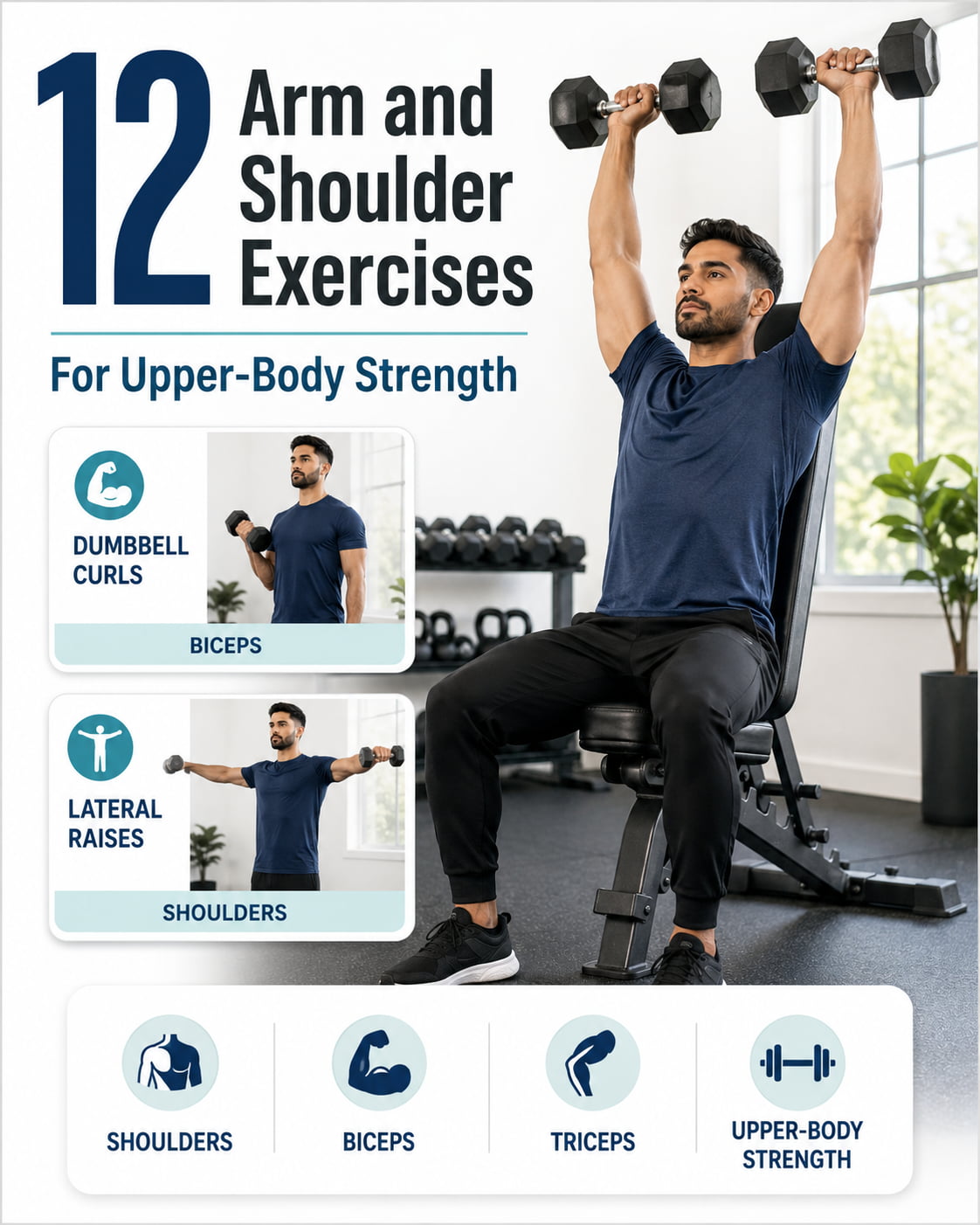
Arm and shoulder exercises help build stronger deltoids, biceps, triceps, upper-back support muscles, and shoulder stabilizers when they are trained with good form and progressive resistance. A balanced routine should include pressing, raising, curling, extending, and shoulder-control work instead of only doing curls or overhead presses.
In this guide, you will learn the best arm and shoulder exercises, which muscles they train, how to do each movement correctly, common mistakes to avoid, and how to build a simple upper-body strength workout.
Arm and Shoulder Exercises: What They Should Train
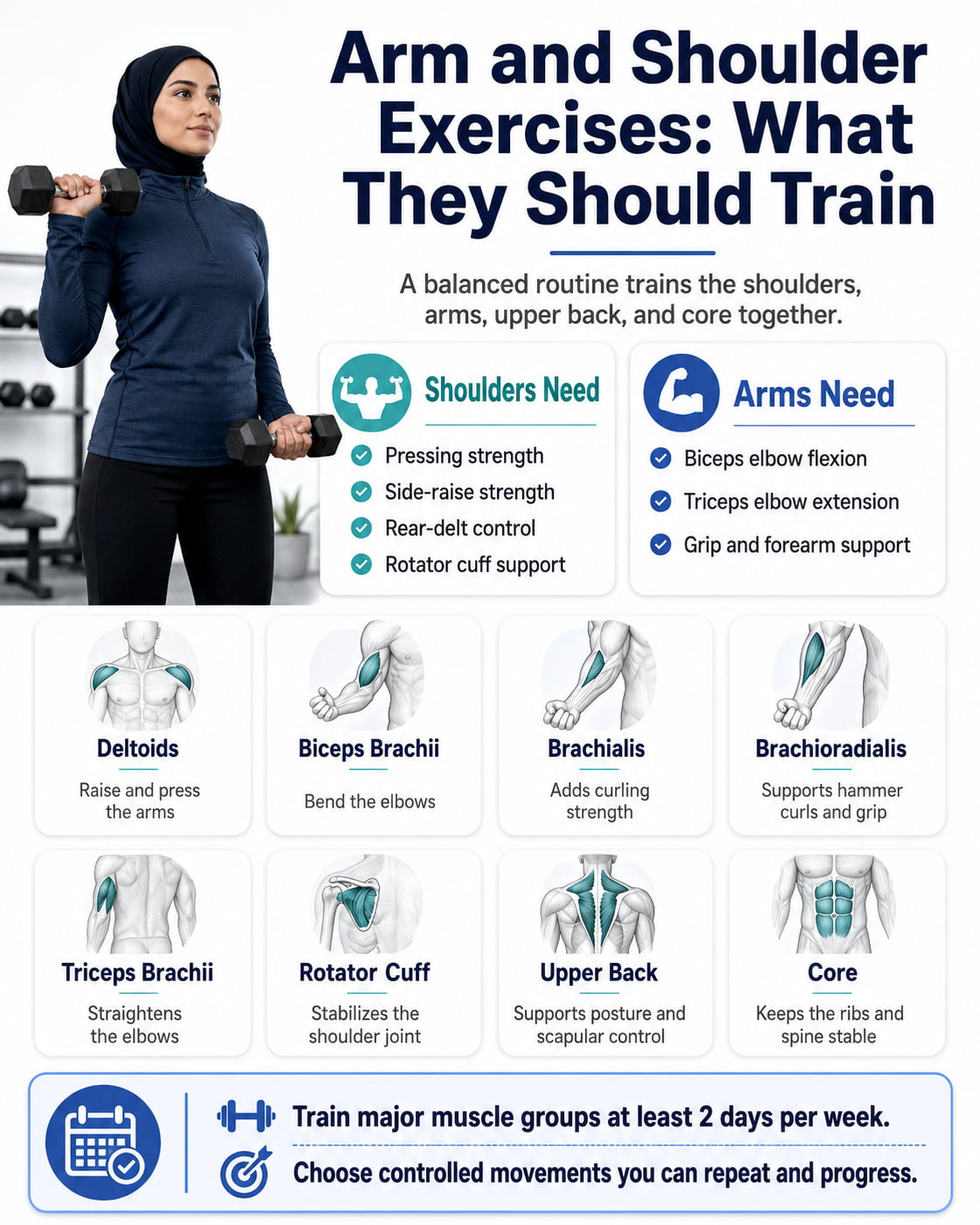
Good arm and shoulder exercises should cover more than one muscle group. Your shoulders need pressing strength, side-raise strength, rear-delt control, and rotator cuff support. Your arms need both elbow flexion work for the biceps and elbow extension work for the triceps.
The main muscles trained include:
| Muscle group | Main role in training |
|---|---|
| Deltoids | Raise and press the arms in different directions |
| Biceps brachii | Bend the elbows and assist forearm rotation |
| Brachialis | Helps elbow flexion and adds curling strength |
| Brachioradialis | Supports hammer curls and grip-related pulling |
| Triceps brachii | Straightens the elbows during presses and extensions |
| Rotator cuff | Helps control and stabilize the shoulder joint |
| Upper back | Supports posture, scapular control, and shoulder position |
| Core | Keeps the ribs, spine, and pelvis stable during upper-body lifts |
The CDC physical activity guidelines recommend muscle-strengthening activities at least 2 days per week for all major muscle groups, including the shoulders and arms. For practical lifting, the goal is not to chase the hardest exercise first. The goal is to choose movements you can control, repeat, and gradually progress.
How to Choose the Best Arm and Shoulder Exercises
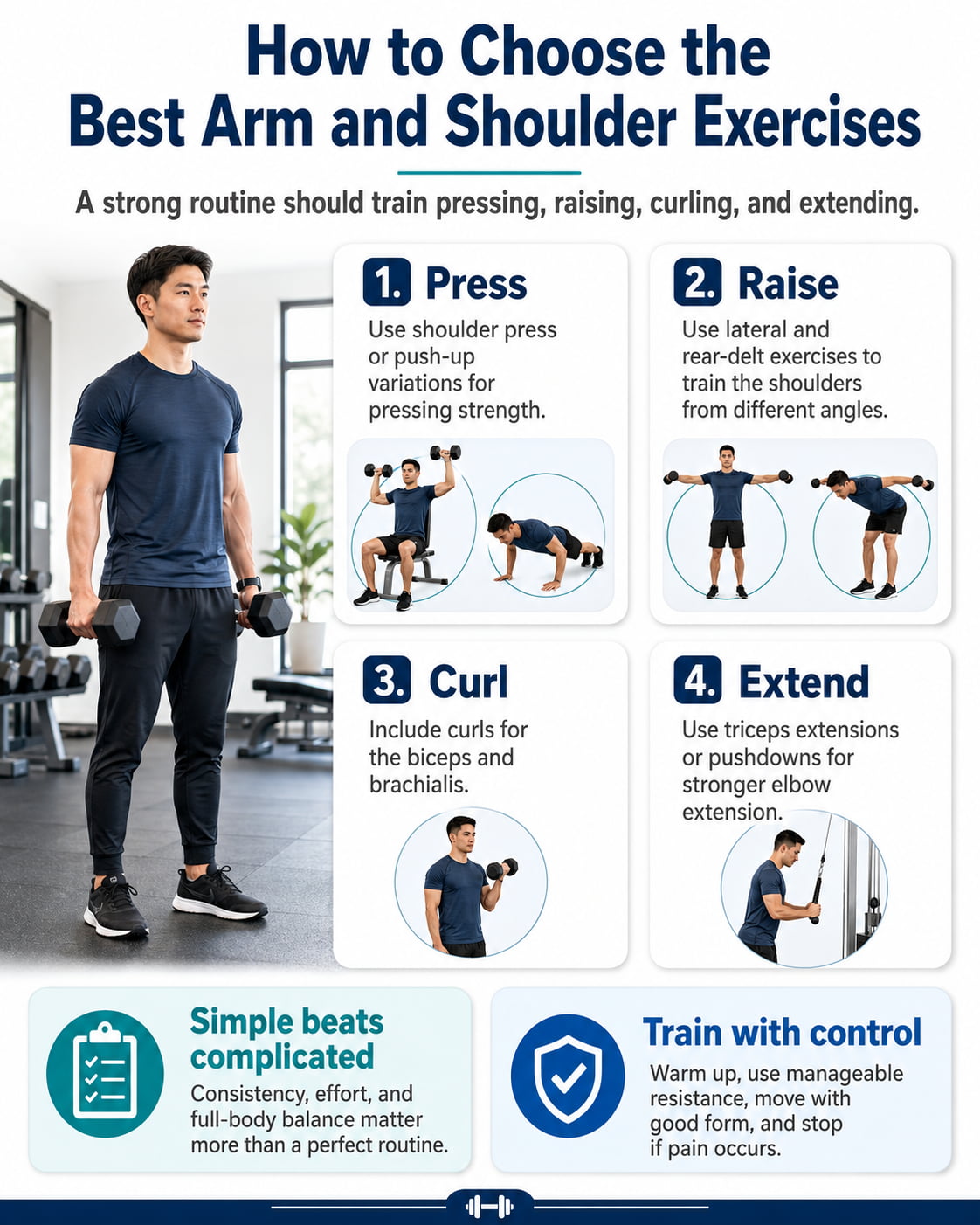
A strong arm and shoulder workout should include four types of movements.
First, use a shoulder press or push-up variation for pressing strength. Second, use lateral and rear-delt exercises to train the shoulders from angles pressing does not fully cover. Third, include curls for the biceps and brachialis. Fourth, include triceps extensions or pushdowns for stronger elbow extension.
The American College of Sports Medicine emphasizes consistency, effort, and training all major muscle groups over chasing a perfect routine. That means a simple plan done well will usually beat a complicated plan done inconsistently.
For safety and technique, the Mayo Clinic strength training guide recommends warming up, using controlled movement, choosing a challenging but manageable resistance, and stopping if an exercise causes pain.
12 Best Arm and Shoulder Exercises
These 12 arm and shoulder exercises help seniors build practical upper-body strength for reaching, lifting, pushing, pulling, and carrying.
Start with light resistance, move slowly, and focus on pain-free control before adding more reps or weight.
1. Dumbbell Shoulder Press
Best for: Building shoulder pressing strength, overhead control, and general upper-body strength.
Muscles worked: Anterior deltoids, lateral deltoids, triceps, upper traps, serratus anterior, and core.
Equipment needed: Dumbbells and a bench or chair if seated.
Why it stands out: The dumbbell shoulder press is one of the most useful arm and shoulder exercises because it trains both shoulders while also making each arm work independently. Research summarized by the American Council on Exercise found the dumbbell shoulder press highly effective for anterior deltoid activation among common shoulder exercises.
Suggested sets and reps: Perform 2 to 4 sets of 6 to 12 reps.
Beginners: Start seated with light dumbbells and a neutral grip. Keep the movement slow and stop before your lower back arches.
Intermediate: Use a standing version or slightly heavier dumbbells while keeping your ribs down and core braced.
Advanced: Use heavier dumbbells, a slow lowering phase, or a one-arm variation to increase core and shoulder control.
Rest: Rest 90 to 120 seconds between sets.
How to do it:
- Sit or stand tall with a dumbbell in each hand at shoulder level.
- Brace your core and keep your wrists stacked over your elbows.
- Press the dumbbells overhead until your arms are straight but not forced back.
- Lower the weights slowly to shoulder level and repeat.
Common mistakes: Avoid leaning back, flaring the ribs, pressing the weights too far forward, shrugging hard at the start, or using weights that make your reps uneven.
Expert tip: Think about pressing the weights up and slightly in, not behind your head. Your arms should finish stacked over your shoulders.
2. Dumbbell Lateral Raise
Best for: Training the side delts and improving shoulder abduction strength.
Muscles worked: Lateral deltoids, supraspinatus, upper traps, and core.
Equipment needed: Dumbbells.
Why it stands out: The lateral raise targets the side of the shoulder more directly than most pressing exercises. It is useful because overhead pressing alone often does not give the lateral delts enough focused work.
Suggested sets and reps: Perform 2 to 4 sets of 10 to 20 reps.
Beginners: Use very light dumbbells and stop around shoulder height. Control the lowering phase.
Intermediate: Add a brief pause at the top while keeping your shoulders away from your ears.
Advanced: Use cable lateral raises, mechanical drop sets, or slow eccentrics for more time under tension.
Rest: Rest 45 to 75 seconds between sets.
How to do it:
- Stand tall with dumbbells at your sides and palms facing in.
- Keep a slight bend in your elbows.
- Raise your arms out to the sides until they reach about shoulder height.
- Lower slowly and repeat without swinging.
Common mistakes: Avoid using momentum, lifting too heavy, shrugging your shoulders, bending and straightening your elbows like a curl, or raising the weights above a comfortable range.
Expert tip: Lead with your elbows instead of your hands. This usually helps keep the tension on the side delts.
3. Seated Rear Delt Raise
Best for: Training the rear delts and improving shoulder balance.
Muscles worked: Posterior deltoids, rhomboids, middle traps, infraspinatus, and teres minor.
Equipment needed: Dumbbells and a bench or chair.
Why it stands out: Many people overtrain pressing and front-delt work while undertraining the rear shoulders. The seated rear delt raise helps balance the shoulder by strengthening the muscles on the back side of the shoulder.
Suggested sets and reps: Perform 2 to 4 sets of 12 to 20 reps.
Beginners: Use light dumbbells and focus on moving from the shoulder, not the lower back.
Intermediate: Pause for one second at the top of each rep.
Advanced: Use chest-supported rear delt raises or cables for stricter tension.
Rest: Rest 45 to 75 seconds between sets.
How to do it:
- Sit on the edge of a bench with dumbbells hanging below your shoulders.
- Hinge forward while keeping your back long and chest angled toward your thighs.
- Raise the dumbbells out and slightly back until your arms are near shoulder height.
- Lower slowly and repeat with control.
Common mistakes: Avoid swinging, turning the movement into a row, shrugging, or lifting so heavy that your torso bounces.
Expert tip: Keep your thumbs slightly lower than your pinkies if that feels comfortable. This can help you feel the rear delts more clearly.
4. Face Pull
Best for: Rear delts, upper-back control, and shoulder-friendly pulling.
Muscles worked: Posterior deltoids, middle traps, lower traps, rhomboids, external rotators, and biceps.
Equipment needed: Cable machine with rope attachment or a resistance band.
Why it stands out: The face pull is a valuable shoulder-support exercise because it combines upper-back work with external rotation. It fits well after pressing, push-ups, or arm training.
Suggested sets and reps: Perform 2 to 4 sets of 12 to 20 reps.
Beginners: Use a band and light resistance. Focus on clean shoulder-blade movement.
Intermediate: Use a cable and pause with the hands near the sides of the face.
Advanced: Use a slower tempo and keep the elbows high without overextending the lower back.
Rest: Rest 45 to 75 seconds between sets.
How to do it:
- Set a cable or band around upper-chest to face height.
- Hold the rope or band with both hands and step back until there is tension.
- Pull toward your face while moving your elbows back and slightly out.
- Pause briefly, then return slowly to the start.
Common mistakes: Avoid pulling too low, leaning back, using too much weight, shrugging, or turning the exercise into a fast row.
Expert tip: Think about pulling the rope apart as it comes toward your face. This helps involve the rear delts and external rotators.
5. Scaption Raise
Best for: Shoulder-friendly raising strength and scapular-plane control.
Muscles worked: Deltoids, supraspinatus, serratus anterior, upper traps, and rotator cuff stabilizers.
Equipment needed: Light dumbbells.
Why it stands out: The scaption raise is performed slightly in front of the body instead of directly out to the side. This angle often feels smoother for the shoulder than a strict side raise and can be useful for building controlled shoulder movement.
Suggested sets and reps: Perform 2 to 3 sets of 10 to 15 reps.
Beginners: Start with very light dumbbells or no weight.
Intermediate: Add a short pause at shoulder height while keeping the neck relaxed.
Advanced: Use a slow 3-second lowering phase or cable scaption raises.
Rest: Rest 45 to 75 seconds between sets.
How to do it:
- Stand tall with light dumbbells by your sides.
- Angle your arms about 30 degrees forward from your body.
- Raise the dumbbells to shoulder height with thumbs slightly up.
- Lower slowly and repeat.
Common mistakes: Avoid shrugging, locking the elbows, raising too high, or forcing a range that feels uncomfortable.
Expert tip: Keep the movement light and clean. This is not an exercise that needs heavy loading to be effective.
6. Band External Rotation
Best for: Rotator cuff strength, shoulder control, and warm-up work.
Muscles worked: Infraspinatus, teres minor, posterior deltoid, and scapular stabilizers.
Equipment needed: Resistance band.
Why it stands out: Band external rotation helps train smaller shoulder stabilizers that support pressing, raising, and pulling movements. The AAOS shoulder conditioning program includes controlled rotation and shoulder-stability work as part of shoulder conditioning.
Suggested sets and reps: Perform 1 to 3 sets of 12 to 20 reps per side.
Beginners: Use the lightest band available and keep your elbow close to your side.
Intermediate: Add a towel between your elbow and ribs to improve position.
Advanced: Use a cable external rotation or perform the movement at different shoulder angles if you can control it pain-free.
Rest: Rest 30 to 60 seconds between sides.
How to do it:
- Attach a light band at elbow height.
- Stand sideways to the anchor and hold the band with your outside hand.
- Keep your elbow bent at 90 degrees and close to your ribs.
- Rotate your forearm away from your body, then return slowly.
Common mistakes: Avoid twisting your torso, letting your elbow drift away, using a band that is too heavy, or rushing the reps.
Expert tip: Treat this like control work, not a max-strength lift. Smooth reps matter more than heavy resistance.
7. Dumbbell Biceps Curl
Best for: Basic biceps strength and elbow-flexion training.
Muscles worked: Biceps brachii, brachialis, brachioradialis, and forearm flexors.
Equipment needed: Dumbbells.
Why it stands out: The dumbbell biceps curl is simple, easy to scale, and effective for training elbow flexion. Because each arm works independently, it can also help you notice strength or control differences from side to side.
Suggested sets and reps: Perform 2 to 4 sets of 8 to 15 reps.
Beginners: Use a light weight and keep your elbows close to your sides.
Intermediate: Use a full range of motion and pause briefly near the top.
Advanced: Use alternating curls, incline curls, or controlled tempo curls.
Rest: Rest 60 to 90 seconds between sets.
How to do it:
- Stand tall with a dumbbell in each hand and palms facing forward.
- Keep your elbows near your sides.
- Curl the weights up without swinging your torso.
- Lower slowly until your elbows are straight but not locked aggressively.
Common mistakes: Avoid swinging, leaning back, letting the elbows drift far forward, or cutting the lowering phase short.
Expert tip: Keep your upper arm still. The cleaner your elbow position, the better the biceps can do the work.
8. Hammer Curl
Best for: Brachialis, brachioradialis, biceps support, and grip-friendly arm strength.
Muscles worked: Brachialis, brachioradialis, biceps brachii, and forearms.
Equipment needed: Dumbbells.
Why it stands out: The hammer curl uses a neutral grip, which many people find comfortable on the wrists and elbows. It also trains arm muscles that regular palms-up curls do not emphasize as much.
Suggested sets and reps: Perform 2 to 4 sets of 8 to 15 reps.
Beginners: Use light dumbbells and keep the wrists straight.
Intermediate: Use alternating reps and control both the lifting and lowering phases.
Advanced: Use cross-body hammer curls or cable rope hammer curls.
Rest: Rest 60 to 90 seconds between sets.
How to do it:
- Stand tall with dumbbells at your sides and palms facing each other.
- Keep your elbows close to your ribs.
- Curl the dumbbells up while keeping the palms facing inward.
- Lower with control and repeat.
Common mistakes: Avoid bending the wrists, swinging the weights, leaning back, or letting the elbows move too far forward.
Expert tip: Imagine your hand, wrist, and forearm are one solid line. This helps keep the curl strict.
9. Incline Dumbbell Curl
Best for: Controlled biceps training with a stronger stretch at the bottom.
Muscles worked: Biceps brachii, brachialis, and forearm flexors.
Equipment needed: Dumbbells and an incline bench.
Why it stands out: The incline dumbbell curl places the arms slightly behind the torso, which increases the stretch on the biceps. It is useful when you want a strict curl that makes cheating harder.
Suggested sets and reps: Perform 2 to 3 sets of 8 to 12 reps.
Beginners: Use a modest incline and very light dumbbells.
Intermediate: Keep the shoulders back against the bench and use a full controlled range.
Advanced: Use a slow lowering phase and stop 1 to 2 reps before form breaks.
Rest: Rest 60 to 90 seconds between sets.
How to do it:
- Set a bench to a moderate incline and sit back with dumbbells at your sides.
- Let your arms hang naturally without forcing the shoulders backward.
- Curl the dumbbells up while keeping your upper arms still.
- Lower slowly until your arms are extended under control.
Common mistakes: Avoid using weights that pull your shoulders into an uncomfortable position, swinging from the shoulder, or bouncing out of the bottom.
Expert tip: Keep the first few sets conservative. The stretched position can feel more demanding than a regular curl.
10. Cable or Band Triceps Pushdown
Best for: Triceps strength with a joint-friendly setup.
Muscles worked: Triceps brachii, especially the lateral and medial heads, with support from forearms and core.
Equipment needed: Cable machine with rope or straight bar, or a resistance band.
Why it stands out: The pushdown is one of the easiest triceps exercises to control because your upper arms stay close to your sides. It gives direct triceps work without requiring overhead mobility.
Suggested sets and reps: Perform 2 to 4 sets of 10 to 15 reps.
Beginners: Use a band or light cable weight and focus on full elbow extension.
Intermediate: Use a cable and pause briefly at the bottom.
Advanced: Use rope pushdowns, single-arm pushdowns, or slower tempo reps.
Rest: Rest 60 to 90 seconds between sets.
How to do it:
- Stand facing a cable or band anchored above you.
- Keep your elbows close to your sides and your chest tall.
- Push the handle down until your elbows are straight.
- Return slowly until your forearms come back up without your elbows drifting forward.
Common mistakes: Avoid leaning your whole body into the movement, moving the shoulders, flaring the elbows, or using momentum.
Expert tip: Keep the upper arms quiet. The triceps should extend the elbows without the shoulders taking over.
11. Overhead Triceps Extension
Best for: Training the long head of the triceps and improving overhead arm strength.
Muscles worked: Triceps brachii, especially the long head, plus shoulders and core for stability.
Equipment needed: Dumbbell, cable, or resistance band.
Why it stands out: The long head of the triceps crosses the shoulder joint, so overhead extension work trains the triceps in a lengthened position. This makes it a useful partner to pushdowns and close-grip push-ups.
Suggested sets and reps: Perform 2 to 4 sets of 8 to 15 reps.
Beginners: Use one light dumbbell with both hands and keep the range comfortable.
Intermediate: Use a cable or dumbbell version with slow lowering.
Advanced: Use single-arm overhead extensions or cable overhead extensions for steady tension.
Rest: Rest 60 to 90 seconds between sets.
How to do it:
- Hold a dumbbell or cable handle overhead with your elbows pointing forward.
- Brace your core and keep your ribs down.
- Bend your elbows to lower the weight behind your head.
- Extend your elbows to return to the starting position.
Common mistakes: Avoid flaring the elbows too wide, arching the lower back, lowering too deep for your shoulder mobility, or turning the movement into a pullover.
Expert tip: Keep the upper arms mostly still. The movement should come from the elbows, not from swinging the shoulders.
12. Close-Grip Push-Up
Best for: Bodyweight triceps strength, shoulder control, chest support, and core stability.
Muscles worked: Triceps, chest, anterior deltoids, serratus anterior, and core.
Equipment needed: None.
Why it stands out: The close-grip push-up trains the arms and shoulders while also requiring full-body tension. It is a practical bodyweight option when you do not have dumbbells, cables, or machines.
Suggested sets and reps: Perform 2 to 4 sets of 6 to 15 reps.
Beginners: Start with hands elevated on a bench, box, or sturdy surface.
Intermediate: Use the floor version and keep your elbows close to your body.
Advanced: Use a slow lowering phase, pause reps, or weighted push-ups if your form stays strong.
Rest: Rest 60 to 120 seconds between sets.
How to do it:
- Start in a high plank with your hands slightly narrower than shoulder-width.
- Brace your core and keep your body in a straight line.
- Lower your chest toward the floor while keeping your elbows close.
- Press back up until your elbows are straight without losing body position.
Common mistakes: Avoid sagging the hips, flaring the elbows, placing the hands too close, dropping the head, or rushing partial reps.
Expert tip: Your hands do not need to touch. A slightly narrow hand position is usually more comfortable and easier to control than a diamond shape.
Sample Arm and Shoulder Workout
This routine uses six exercises from the list. It trains pressing strength, side delts, rear delts, biceps, triceps, and rotator cuff control without making the workout too long.
| Exercise | Sets | Reps | Rest |
|---|---|---|---|
| Dumbbell Shoulder Press | 3 | 8 to 12 | 90 seconds |
| Dumbbell Lateral Raise | 3 | 12 to 15 | 60 seconds |
| Face Pull | 2 to 3 | 12 to 20 | 60 seconds |
| Dumbbell Biceps Curl | 3 | 10 to 15 | 60 to 90 seconds |
| Cable or Band Triceps Pushdown | 3 | 10 to 15 | 60 to 90 seconds |
| Band External Rotation | 1 to 2 | 12 to 20 per side | 30 to 60 seconds |
Train this workout 1 to 2 times per week. Use a weight that lets you finish each set with about 1 to 3 good reps left in reserve. When you can complete the top of the rep range with clean form for every set, increase the weight slightly or add one extra set to one exercise.
Common Arm and Shoulder Training Mistakes
| Mistake | Better approach |
|---|---|
| Using too much weight | Choose resistance you can control through the full range |
| Training only the front shoulders | Include lateral raises, rear delt raises, and face pulls |
| Swinging curls and raises | Slow down and keep the target joint moving cleanly |
| Skipping warm-ups | Start with light sets, band work, or easy reps |
| Ignoring discomfort | Stop if pain feels sharp, unusual, or nerve-like |
| Doing too many exercises at once | Start with 4 to 6 movements and progress gradually |
Arm and shoulder exercises should feel challenging, but they should not feel chaotic. Good reps are controlled, repeatable, and stable.
How Often Should You Train Arms and Shoulders?
Most beginners can train arms and shoulders 1 to 2 times per week. Intermediate lifters may train them 2 times per week, especially if volume is split across upper-body days.
A simple weekly setup could look like this:
| Training level | Weekly frequency | Best approach |
|---|---|---|
| Beginner | 1 to 2 days | Use fewer exercises and focus on form |
| Intermediate | 2 days | Split pressing, raises, curls, and triceps work |
| Advanced | 2 to 3 days | Manage volume carefully and rotate exercise emphasis |
Avoid training the same muscles hard every day. Muscles and joints need time to recover, especially after heavy pressing, high-volume curls, or triceps work.
Safety Tips for Arm and Shoulder Exercises
Warm up before lifting. A good warm-up can include light cardio, shoulder circles, band pull-aparts, light external rotations, and one or two easy sets of your first exercise.
Use a pain-free range of motion. Mild muscle fatigue is normal during strength training, but sharp pain is not. Stop and seek professional help if an exercise causes sharp pain, numbness, dizziness, chest pain, or unusual symptoms.
Keep your reps controlled. The shoulder is mobile, so sloppy form can quickly shift stress away from the target muscles. If you have to swing, twist, or arch hard to finish a rep, the weight is probably too heavy.
FAQ
What are the best arm and shoulder exercises?
The best arm and shoulder exercises include dumbbell shoulder presses, lateral raises, rear delt raises, face pulls, biceps curls, hammer curls, triceps pushdowns, overhead triceps extensions, and close-grip push-ups. A balanced routine should train shoulders from multiple angles and include both biceps and triceps work.
Can I train arms and shoulders on the same day?
Yes. Arms and shoulders work well together because many shoulder exercises also involve the triceps, and many upper-body routines already combine pressing, pulling, curls, and extensions. Keep the workout balanced so you do not overload pressing while ignoring rear delts and shoulder stabilizers.
How many arm and shoulder exercises should I do in one workout?
Most people can start with 4 to 6 exercises in one workout. A simple session might include one shoulder press, one lateral raise, one rear-delt or face-pull exercise, one biceps curl, one triceps exercise, and one rotator cuff or shoulder-control movement.
Are dumbbells enough for arm and shoulder exercises?
Yes. Dumbbells are enough for many effective arm and shoulder exercises, including shoulder presses, lateral raises, rear delt raises, biceps curls, hammer curls, incline curls, and overhead triceps extensions. Cables and bands are useful, but they are not required for a strong routine.
Should beginners do overhead presses?
Many beginners can do overhead presses if they have comfortable shoulder motion and can control the weight. Start with light dumbbells, a seated position, or a neutral grip. If overhead pressing causes pain or feels unstable, use a landmine press, incline push-up, scaption raise, or other comfortable variation.
Why do my shoulders hurt during arm and shoulder exercises?
Shoulder discomfort can come from using too much weight, poor control, limited mobility, excessive pressing volume, or forcing a movement that does not fit your current range. Stop painful exercises and consider getting guidance from a qualified fitness professional or healthcare provider if pain continues.
Conclusion
Arm and shoulder exercises work best when your routine is balanced. Use presses for strength, raises for delt control, curls for the biceps and brachialis, extensions for the triceps, and face pulls or external rotations for shoulder support.
Start with manageable weights, focus on clean reps, and progress slowly. A consistent routine with good form will build stronger arms and shoulders more effectively than rushing through too many exercises at once.
This content is for informational purposes only and is not a substitute for professional medical advice.