
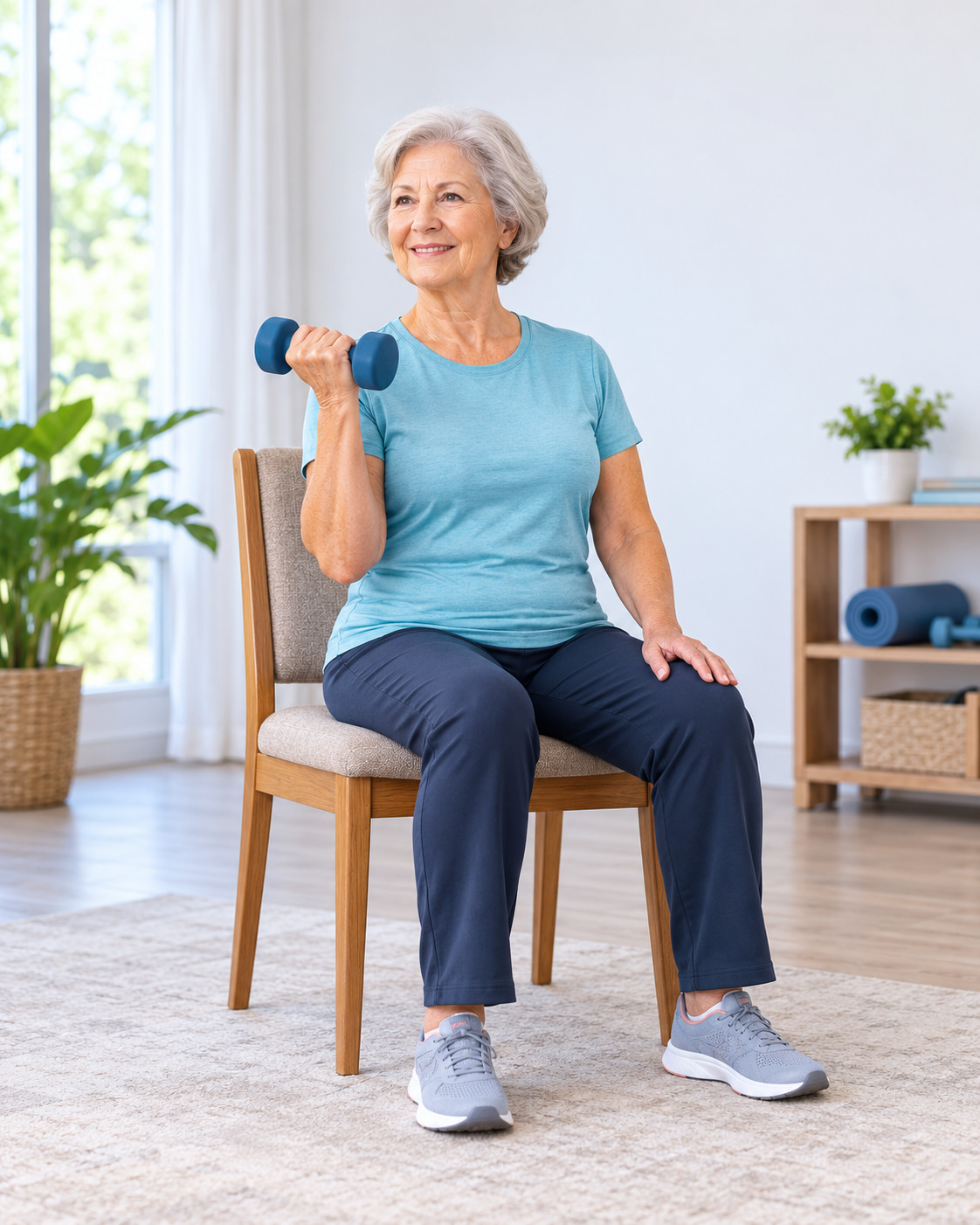
Arm exercises for seniors can help maintain upper-body strength, support everyday activities, and make lifting, pushing, pulling, and carrying objects easier. Whether you prefer exercising in a chair or standing, simple movements with light dumbbells, resistance bands, or bodyweight can help strengthen your arms.
These eight beginner-friendly exercises target the biceps, triceps, shoulders, forearms, and upper back. You’ll learn how to perform each movement correctly, avoid common mistakes, and combine the exercises into a practical home workout.
We will cover
- 4 Seated Arm Exercises for Seniors
- 4 Standing Arm Exercises for Seniors
Before you begin: Prepare a sturdy, non-wheeled chair, light dumbbells or water bottles, and a light resistance band. Warm up for 3–5 minutes with gentle marching, shoulder rolls, and comfortable arm movements.
4 Seated Arm Exercises for Seniors
Seated exercises are useful for older adults who prefer additional stability or find standing workouts tiring. They allow you to concentrate on arm movements without having to maintain standing balance.
For better support, follow the NHS recommendations for chair exercises: choose a stable chair, keep your feet supported, and increase repetitions gradually.
1. Seated Biceps Curl
The seated biceps curl strengthens the muscles at the front of your upper arms. These muscles help you bend your elbows when lifting groceries, holding objects, or bringing a cup toward your mouth.
Best for: Improving everyday lifting strength.
Muscles worked: Biceps brachii, brachialis, and brachioradialis.
Equipment: Light dumbbells or filled water bottles.
Sets, reps, and rest: 1–2 sets of 8–12 repetitions per arm; rest 45–60 seconds.
How to Do It:
- Sit upright in a sturdy chair with both feet flat on the floor.
- Hold a light dumbbell in one hand, keeping your palm facing forward.
- Keep your elbow close to your side and slowly curl the weight toward your shoulder.
- Lower the dumbbell with control without swinging your arm.
- Complete the repetitions, then switch arms.
Common mistakes: Swinging the dumbbell, moving the elbow excessively, or bending the wrist. Keep your upper arm steady and use a weight you can control.
Easier option: Perform the movement without weights.
Progression: Gradually increase the dumbbell weight once you can complete 12 controlled repetitions comfortably.
2. Seated Resistance Band Row
The seated resistance band row strengthens the upper back while also working the biceps. It helps develop the pulling strength used when opening drawers, bringing objects toward your body, or carrying items close to your torso.
Best for: Strengthening the pulling muscles of the upper body.
Muscles worked: Latissimus dorsi, rhomboids, middle trapezius, and biceps.
Equipment: Long resistance band and sturdy chair.
Sets, reps, and rest: 1–2 sets of 8–12 repetitions; rest 60 seconds.
How to Do It:
- Sit upright near the front of your chair with your feet firmly supported.
- Secure the middle of a resistance band beneath the arches of both feet, ensuring it cannot slip.
- Hold one end in each hand and extend your arms forward.
- Pull your elbows backward toward your sides while gently bringing your shoulder blades together.
- Slowly straighten your arms to return to the starting position.
Common mistakes: Rounding the back, shrugging the shoulders, or leaning backward to pull the band. Keep your chest comfortably lifted and let your arms perform the movement.
Easier option: Use a lighter band or reduce its tension.
Progression: Increase band resistance while maintaining an upright seated position.
Safety note: Check the band for damage and make sure it is securely positioned before pulling. Stop if it begins slipping. A properly secured fixed anchor is another option.
3. Seated Lateral Raise
Seated lateral raises strengthen the sides of your shoulders. This exercise can help develop the shoulder strength needed to lift your arms outward during activities such as dressing or reaching for nearby objects.
Best for: Building shoulder strength with a stable seated position.
Muscles worked: Middle deltoids, with assistance from the supraspinatus and other shoulder stabilizers.
Equipment: Light dumbbells or water bottles.
Sets, reps, and rest: 1–2 sets of 8–10 repetitions; rest 45–60 seconds.
How to Do It:
- Sit upright with your feet flat on the floor and a light dumbbell in each hand.
- Let your arms rest beside your body with your palms facing inward.
- Keep a slight bend in your elbows and slowly raise your arms outward and slightly forward.
- Stop at shoulder height or earlier if your comfortable range is smaller.
- Lower both weights slowly to your sides.
Common mistakes: Shrugging the shoulders, swinging the weights, or raising the arms beyond a comfortable range. Avoid using momentum to finish repetitions.
Easier option: Start without weights or lift one arm at a time.
Progression: Add a small amount of resistance once the movement feels controlled.
4. Seated Wrist Curl
Wrist curls target the forearm muscles responsible for bending the wrist. Strengthening these muscles can support everyday gripping and handling activities, including holding cups, carrying small objects, and using household tools.
Best for: Improving forearm and wrist strength.
Muscles worked: Wrist flexors of the forearm.
Equipment: Very light dumbbells.
Sets, reps, and rest: 1–2 sets of 8–12 repetitions; rest 45–60 seconds.
How to Do It:
- Sit on a sturdy chair holding a light dumbbell in each hand.
- Lean forward slightly while maintaining a comfortable, straight back.
- Rest your forearms on your thighs with your palms facing upward and hands extending just beyond your knees.
- Slowly bend your wrists upward, lifting the weights without moving your forearms.
- Lower the weights through a comfortable range and repeat.
Common mistakes: Moving the entire arm, using excessive weight, or forcing the wrists into an uncomfortable position. Keep the movement small and controlled.
Easier option: Perform the exercise without weights or support your forearms on a stable table.
Progression: Increase resistance slightly when you can complete the repetitions without wrist discomfort.
4 Standing Arm Exercises for Seniors
Standing movements provide another way to strengthen the arms while using the shoulders and trunk to maintain body position.
If standing balance is difficult, use a stable support or perform an appropriate seated alternative.
5. Standing Wall Push-Up
The wall push-up is a beginner-friendly pressing exercise that strengthens the chest, shoulders, and triceps without requiring you to get down on the floor.
It can be useful for developing upper-body pushing strength for everyday movements such as pushing doors or moving lightweight objects.
Best for: Beginner-friendly upper-body pushing strength.
Muscles worked: Pectoralis major, triceps, and anterior deltoids.
Equipment: Sturdy wall.
Sets, reps, and rest: 1–2 sets of 6–10 repetitions; rest 60 seconds.
How to Do It:
- Stand facing a wall with your feet approximately hip-width apart.
- Place both palms on the wall at shoulder height, slightly wider than shoulder-width.
- Step your feet backward to create a comfortable forward body incline.
- Bend your elbows and slowly bring your chest toward the wall while maintaining a straight body position.
- Push through your palms to return to the starting position.
Common mistakes: Allowing the hips to sag, flaring the elbows excessively, or lowering too quickly. Keep your body aligned and move only as far as comfortable.
Easier option: Stand closer to the wall.
Progression: Move your feet slightly farther from the wall to increase resistance.
6. Supported Standing Triceps Kickback
The supported triceps kickback strengthens the muscles at the back of your upper arms. These muscles help straighten your elbows during pushing and reaching activities.
Using a countertop or another stable support can make the exercise more manageable for older adults.
Best for: Strengthening the triceps with additional support.
Muscles worked: Triceps brachii.
Equipment: Light dumbbell and sturdy countertop or stable support.
Sets, reps, and rest: 1–2 sets of 8–12 repetitions per arm; rest 45–60 seconds.
How to Do It:
- Stand beside a sturdy countertop, holding a light dumbbell in one hand.
- Place your free hand on the support, bend your knees slightly, and hinge forward from your hips.
- Keep your back neutral and position your working upper arm close to your torso, with the elbow bent.
- Slowly straighten your elbow to move the dumbbell backward, keeping your upper arm still.
- Bend your elbow to return to the starting position, then repeat on the opposite side.
Common mistakes: Swinging the dumbbell, moving the upper arm excessively, or rounding the back. Focus on straightening the elbow rather than lifting the whole arm.
Easier option: Practice the movement without a dumbbell.
Progression: Increase resistance gradually while keeping your torso and upper arm stable.
7. Standing Dumbbell Front Raise
The standing front raise strengthens the front of your shoulders. These muscles contribute to movements such as reaching forward, lifting lightweight objects, and positioning your arms in front of your body.
Performing the exercise one arm at a time makes it easier to concentrate on control.
Best for: Strengthening controlled forward-reaching movements.
Muscles worked: Anterior deltoids, with assistance from the upper chest and shoulder stabilizers.
Equipment: Light dumbbells or water bottles.
Sets, reps, and rest: 1–2 sets of 8–10 repetitions per arm; rest 45–60 seconds.
How to Do It:
- Stand upright with your feet approximately hip-width apart and your knees relaxed.
- Hold a light dumbbell in each hand with your palms facing your thighs.
- Keeping a slight bend in your elbow, slowly raise one arm forward.
- Stop at shoulder height or within your comfortable range.
- Lower the weight slowly, then repeat using the opposite arm.
Common mistakes: Leaning backward, swinging the weights, or raising the arms too high. Keep your torso steady throughout the movement.
Easier option: Perform the exercise seated or without weights.
Progression: Increase resistance slightly once you can control the entire movement without swinging.
8. Standing Resistance Band Pull-Apart
The resistance band pull-apart strengthens the muscles across the upper back and rear shoulders.
It complements pressing and front-shoulder exercises by training muscles involved in pulling the arms outward and controlling shoulder-blade movement.
Best for: Strengthening the rear shoulders and upper back.
Muscles worked: Posterior deltoids, rhomboids, and middle trapezius.
Equipment: Light resistance band.
Sets, reps, and rest: 1–2 sets of 8–12 repetitions; rest 45–60 seconds.
How to Do It:
- Stand upright with your feet hip-width apart and knees slightly relaxed.
- Hold a light resistance band in both hands with your arms extended forward at chest height.
- Keep your elbows slightly bent and your shoulders relaxed.
- Slowly pull your hands outward, stretching the band while gently bringing your shoulder blades together.
- Return your hands toward the starting position with control.
Common mistakes: Shrugging, leaning backward, or snapping the band back quickly. Maintain a steady posture and use manageable resistance.
Easier option: Hold the band with your hands farther apart or perform the movement seated.
Progression: Gradually increase band tension while keeping your arms and shoulders controlled.
How to Build a Simple Arm Workout at Home
You do not need to perform all eight exercises during every workout. A balanced routine can begin with a few pushing, pulling, shoulder, and arm movements.
The CDC’s physical activity recommendations for older adults recommend muscle-strengthening activities at least twice weekly, with 8–12 repetitions being a useful target for many exercises.
Beginner Arm Workout for Seniors
Try this routine on two nonconsecutive days each week.
| Exercise | Sets | Repetitions |
|---|---|---|
| Standing Wall Push-Up | 1 | 6–10 |
| Seated Resistance Band Row | 1 | 8–12 |
| Seated Biceps Curl | 1 | 8–12 per arm |
| Supported Triceps Kickback | 1 | 8–12 per arm |
| Seated Lateral Raise | 1 | 8–10 |
| Seated Wrist Curl | 1 | 8–12 |
Rest: Approximately 45–90 seconds between exercises, or longer if needed.
Frequency: Twice weekly, allowing at least one day of recovery between sessions targeting the same muscles.
Effort: Choose resistance that makes the final few repetitions moderately challenging without causing you to lose control.
Duration: Approximately 15–25 minutes, including a short warm-up and rest periods.
The standing front raise and band pull-apart can be added as optional exercises or used to replace another shoulder exercise for variety.
How to Make the Routine More Challenging
Once you can complete your repetitions comfortably with good form:
- Gradually work toward the upper end of the recommended repetition range.
- Increase from one set to two sets per exercise.
- Add a small amount of resistance when the current weight or band becomes too easy.
- Continue allowing recovery between strength-training sessions.
There is no need to rush progression.
The American College of Sports Medicine’s 2026 resistance training guidance emphasizes that consistent participation and individually appropriate resistance are more important than complicated workout programs.
Why Arm Strength Matters as You Age
Strong arms and shoulders contribute to many activities that help older adults remain active and independent.
Regular resistance training may help support:
- Everyday lifting and carrying: Biceps and forearm strength contribute to carrying bags, holding objects, and lifting lightweight household items.
- Pushing and reaching: Triceps, chest, and shoulder exercises strengthen muscles used when pushing doors or reaching forward.
- Upper-body function: Pulling exercises strengthen the upper back and contribute to controlled shoulder movements.
- Muscle maintenance: Progressive resistance training can help maintain or increase muscle strength as people age.
The National Institute on Aging identifies muscle-strengthening exercise as an important part of maintaining physical function and supporting independence in older adulthood.
However, arm exercises should not replace leg strengthening, walking, or balance training. A complete fitness routine should include several types of physical activity.
Safety Tips for Older Adults
Arm exercises can be adjusted for different strength levels, but proper setup and controlled movement are essential.
Choose stable equipment. Use a sturdy, non-wheeled chair on a nonslip surface. Check resistance bands for damage and use secure supports during standing exercises.
Begin with manageable resistance. You should be able to perform each movement without excessive swinging, straining, or holding your breath.
Use a comfortable range of motion. Do not force your shoulders, elbows, or wrists beyond their comfortable movement range.
Breathe normally. Exhale during the lifting, pushing, or pulling effort and inhale during the controlled return.
Adjust for balance difficulties. Seated exercises are often a more comfortable option when standing balance is limited.
Know when to stop. Stop exercising if you experience sharp pain, numbness, dizziness, chest pain, unusual shortness of breath, or other concerning symptoms. Seek appropriate professional medical help; chest pain or other severe symptoms may require emergency care.
Older adults with significant joint limitations, recent surgery, or medical conditions affecting exercise tolerance should seek individualized advice before beginning a new resistance-training routine.
Frequently Asked Questions
1. What are the easiest arm exercises for seniors?
Seated biceps curls, seated wrist curls, and standing wall push-ups are accessible starting options. They require minimal equipment and can be adjusted by reducing resistance or the number of repetitions.
Choose exercises you can perform comfortably with controlled movements.
2. Can seniors strengthen their arms while sitting?
Yes. Seated exercises can strengthen the biceps, triceps, shoulders, forearms, and upper back when performed with appropriate resistance.
Sitting provides additional stability, which may be helpful for seniors with limited standing endurance or balance concerns.
3. How often should seniors exercise their arms?
Two nonconsecutive strength-training sessions per week are a practical starting point.
Allow recovery between sessions that work the same muscles. As strength and fitness improve, the routine can be adjusted according to individual goals and recovery needs.
4. Can you build arm muscle after age 70?
Yes. Older adults can improve muscle strength and may increase muscle size through appropriately challenging resistance training.
Progress depends on factors such as training consistency, resistance, nutrition, recovery, and overall health.
Starting with light resistance and progressing gradually is more useful than immediately lifting heavy weights.
5. What weight dumbbells should seniors start with?
There is no single ideal dumbbell weight for every older adult.
Some beginners may start with 1–2 lb dumbbells, while others may need no added weight or may comfortably use heavier resistance.
Choose a weight that allows you to complete your repetitions without swinging, straining, or losing control. Different exercises may require different weights.
6. Are arm exercises safe for seniors with arthritis?
Some gentle strengthening exercises may be appropriate for older adults with arthritis, but the best movements and resistance levels depend on the affected joints and individual symptoms.
Avoid forcing painful movements or exercising through worsening joint pain. A healthcare professional or physical therapist can help determine appropriate modifications.
Conclusion
Arm exercises for seniors do not need to be complicated or require heavy weights. Seated biceps curls, resistance band rows, wall push-ups, and other simple movements can help build useful upper-body strength.
Start with four to six comfortable exercises, practice controlled technique, and gradually increase repetitions or resistance as your strength improves.
The goal is steady progress that makes everyday movements feel easier—not lifting the heaviest weight possible.
References
- Centers for Disease Control and Prevention — What Counts as Physical Activity for Older Adults
- National Institute on Aging — Three Types of Exercise Can Improve Your Health and Physical Ability
- American College of Sports Medicine — Updated Resistance Training Guidelines (2026)
- NHS — Strength Exercises
- American Heart Association — Strength and Balance Exercises
- American Council on Exercise — Triceps Kickback Exercise Guide
- PureGym — Seated Lateral Raise Exercise Guide
This content is for informational purposes only and is not a substitute for medical advice.