The dumbbell tricep kickback trains your triceps by keeping the upper arm still while you straighten the elbow against resistance. Proper form requires a light-to-moderate dumbbell, a stable torso, and controlled elbow extension without swinging your shoulder or twisting your body.
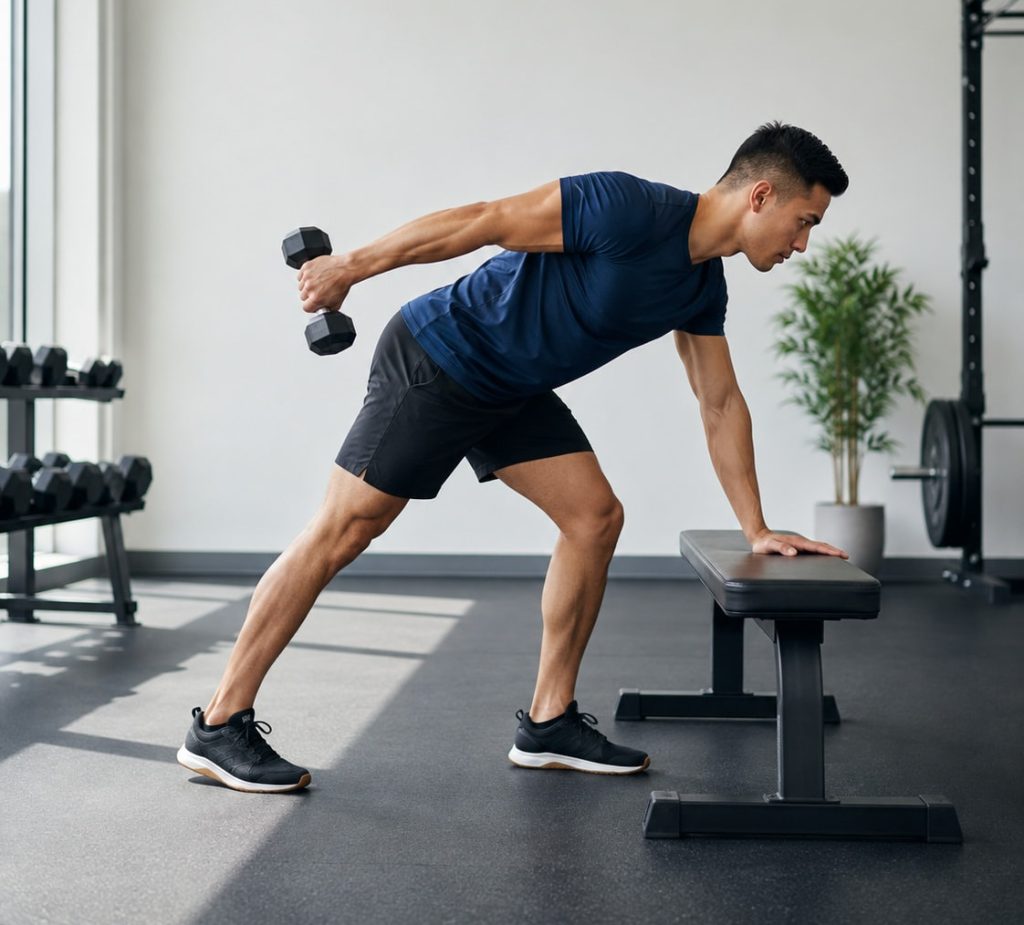
This guide explains how to perform the dumbbell tricep kickback, which muscles it works, how much weight to use, common mistakes to avoid, and how to include it in a practical triceps workout.
Dumbbell Tricep Kickback at a Glance
| Category | Recommendation |
|---|---|
| Exercise type | Single-joint elbow-extension exercise |
| Primary muscle | Triceps brachii |
| Assisting muscles | Anconeus, posterior shoulder, upper-back and core stabilizers |
| Equipment | One dumbbell and an optional bench |
| Difficulty | Beginner to intermediate |
| Best for | Triceps accessory work, unilateral training, and home workouts |
| Starting volume | 2–3 sets per arm |
| Typical rep range | 10–15 controlled repetitions |
| Rest | 60–90 seconds |
| Suggested effort | Finish with 1–3 clean repetitions remaining |
What Is a Dumbbell Tricep Kickback?
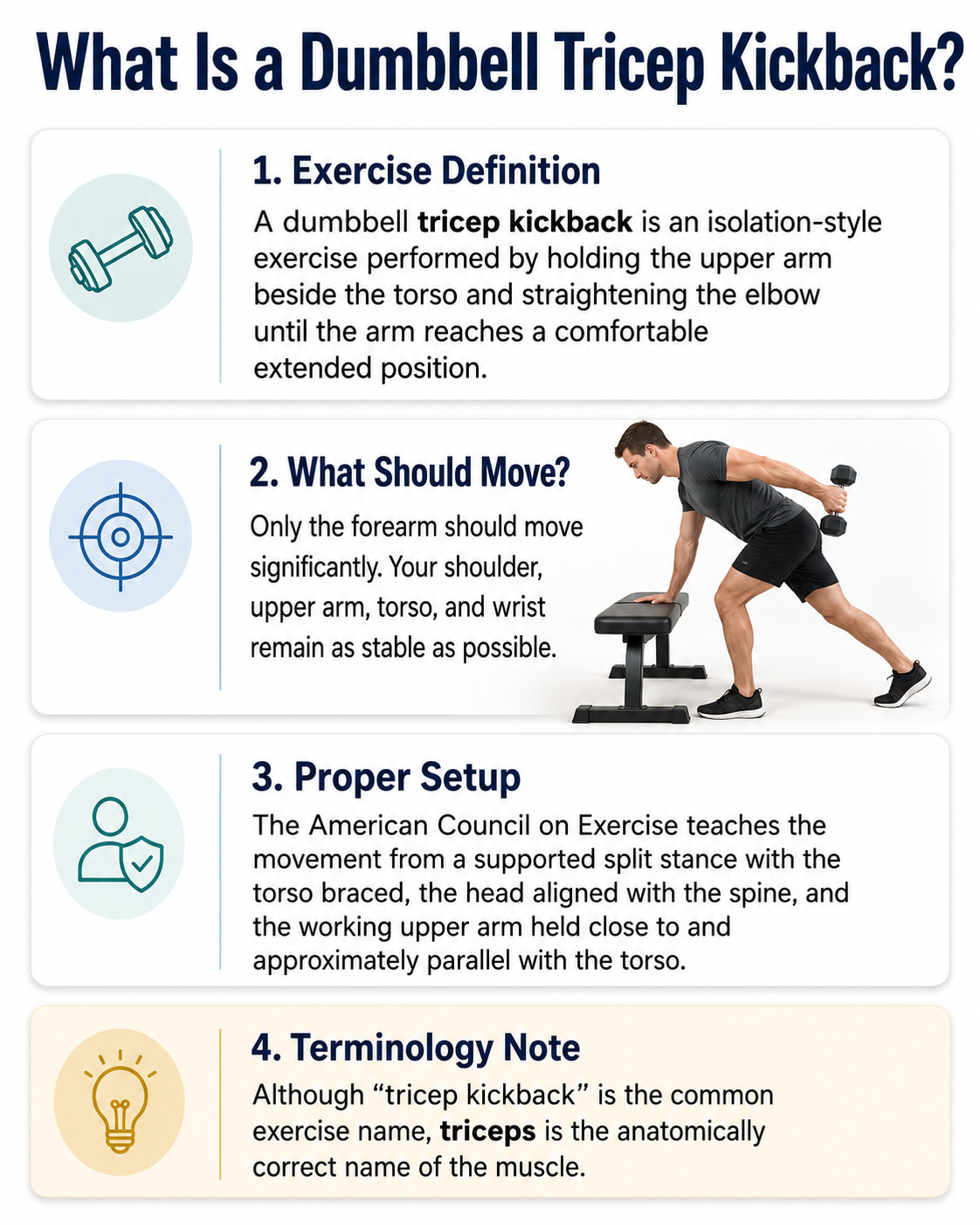
A dumbbell tricep kickback is an isolation-style exercise performed by holding the upper arm beside the torso and straightening the elbow until the arm reaches a comfortable extended position.
Only the forearm should move significantly. Your shoulder, upper arm, torso, and wrist remain as stable as possible.
The American Council on Exercise teaches the movement from a supported split stance with the torso braced, the head aligned with the spine, and the working upper arm held close to and approximately parallel with the torso.
Although “tricep kickback” is the common exercise name, triceps is the anatomically correct name of the muscle.
Dumbbell Tricep Kickback Muscles Worked
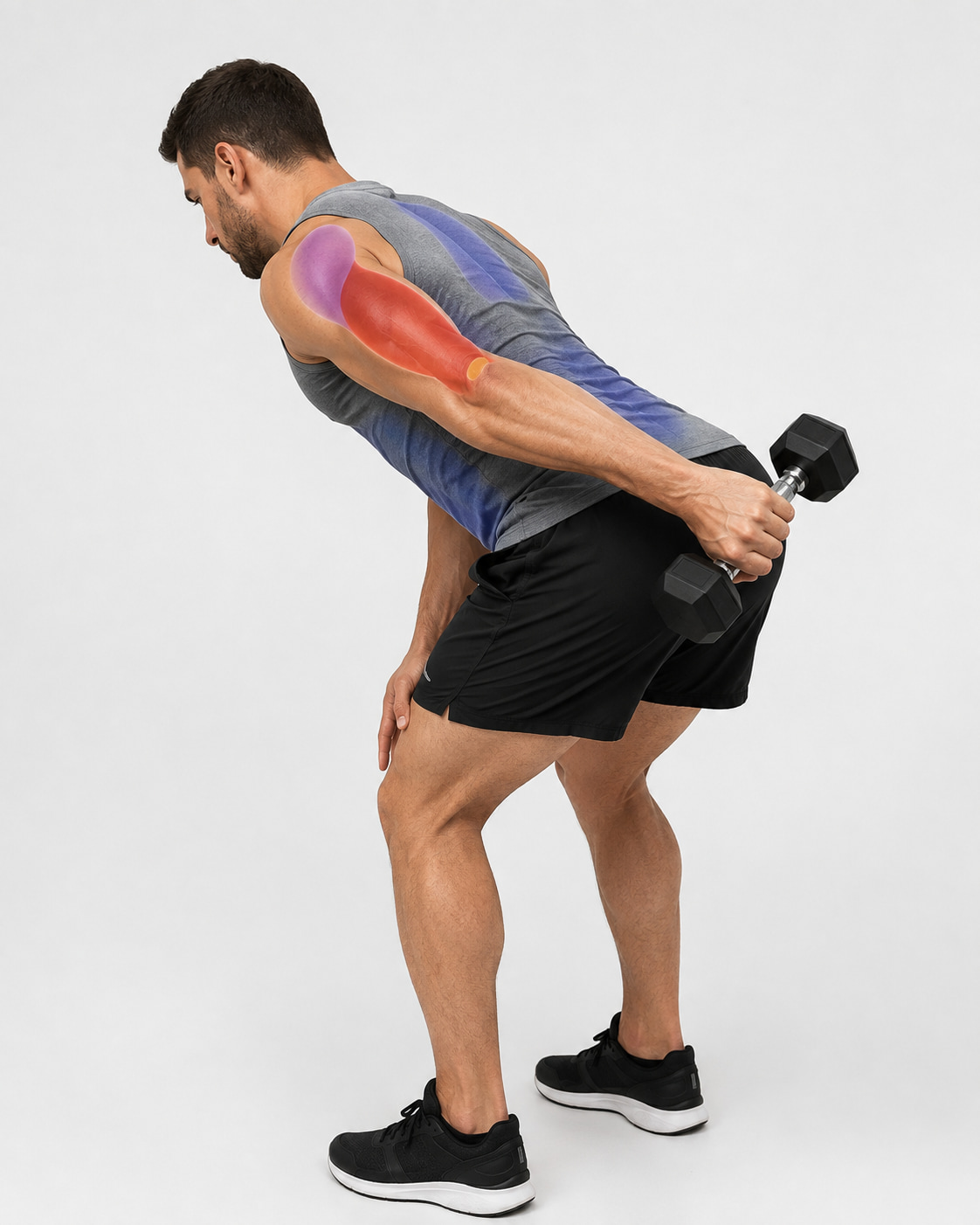
1. Triceps Brachii
The triceps brachii on the back of the upper arm is the primary muscle trained.
It contains three heads:
- Long head
- Lateral head
- Medial head
All three heads contribute to straightening the elbow. The long head also crosses the shoulder joint, while the lateral and medial heads begin on the upper-arm bone.
The NCBI Bookshelf triceps anatomy review describes elbow extension as the triceps’ primary function and confirms that its three heads join into a common tendon near the elbow.
You cannot completely isolate one triceps head during a kickback. Grip, shoulder position, load, and range of motion may change how the exercise feels, but all three heads continue working together to extend the elbow.
2. Anconeus
The anconeus is a small muscle near the back of the elbow. It assists the triceps with elbow extension and contributes to elbow stability.
3. Posterior Shoulder and Upper Back
The posterior deltoid and muscles surrounding the shoulder blade work isometrically to hold the upper arm beside the torso.
They should stabilize the position rather than swing the entire arm backward during each repetition.
4. Core and Lower-Back Muscles
Your abdominal and spinal muscles help maintain the hinged torso position. They should prevent excessive back rounding, arching, or torso rotation.
A supported version reduces the balance and trunk-stability demands, allowing you to focus more directly on the triceps.
How to Do a Dumbbell Tricep Kickback With Proper Form
Equipment needed: One dumbbell and an optional bench or stable support.
Sets, reps, and rest: Begin with 2–3 sets of 10–15 repetitions per arm. Rest for 60–90 seconds between sets or arms.
Step-by-Step Instructions
- Hold a light dumbbell in one hand using a neutral grip, with your palm facing your body.
- Take a staggered stance and hinge forward from your hips. Place your free hand on a bench, sturdy support, or front thigh.
- Brace your abdomen and keep your head, neck, and spine in a neutral position.
- Bring the working upper arm close to your ribs and approximately in line with your torso.
- Bend your elbow to about 90 degrees so the forearm points toward the floor.
- Keep the upper arm still as you straighten the elbow and move the dumbbell backward.
- Finish when the elbow reaches a comfortable extended position. Do not forcefully snap the joint into lockout.
- Pause briefly while keeping your wrist straight and shoulder stable.
- Slowly bend the elbow and lower the dumbbell until the forearm again points toward the floor.
- Complete all repetitions on one side before switching arms.
Breathing
Exhale as you straighten the elbow. Inhale as you return the dumbbell to the starting position.
Continue breathing normally rather than holding your breath throughout the set.
Coaching Cue
“Pin your upper arm beside your ribs and move only your forearm.”
Key Form Checkpoints
Before adding weight, confirm that you can maintain these positions:
- Upper arm close to the torso
- Elbow held at a consistent height
- Wrist straight
- Shoulder relaxed rather than shrugged
- Spine and neck neutral
- Abdomen braced
- No torso twisting
- Controlled lowering phase
- Comfortable full elbow extension
The upper arm does not have to be perfectly horizontal. Hold it as high as you can comfortably maintain without shrugging, rotating your shoulder, or arching your lower back.
Understanding the Dumbbell Kickback Resistance Curve
The dumbbell does not challenge your triceps equally throughout the repetition because gravity always pulls the weight toward the floor.
When your forearm hangs vertically beneath the elbow, the dumbbell has a short horizontal distance from the elbow joint. This creates relatively little external resistance at the elbow.
As you straighten the arm, the dumbbell moves farther behind the elbow and the resistance increases. It is generally highest when the forearm is approximately horizontal, which normally occurs near the top of a properly positioned kickback.
| Arm position | Relative challenge |
|---|---|
| Forearm hanging vertically | Low |
| Forearm moving backward | Increasing |
| Forearm approximately horizontal | Highest |
| Dumbbell lowered toward the start | Decreasing |
This explains why a kickback may feel easy at the bottom but difficult near full extension.
It also explains why swinging through the bottom does not make the exercise more effective. The most important part of the repetition is the controlled final portion, where the resistance is greatest.
Benefits of Dumbbell Tricep Kickbacks
1. Directly Trains Elbow Extension
The main movement is elbow extension, allowing the triceps to perform most of the active work.
Your shoulder and trunk should stabilize the position rather than contribute significant movement.
2. Requires Minimal Equipment
You only need one dumbbell. A bench can make the exercise more stable, but you can also support your free hand on your thigh or another sturdy surface.
This makes kickbacks practical for home workouts and smaller training spaces.
3. Allows Each Arm to Work Independently
The one-arm version prevents your stronger side from helping the weaker side complete a repetition.
It can also make differences in control, strength, or range of motion easier to notice.
4. Emphasizes the Top of Elbow Extension
The exercise becomes more challenging as the forearm approaches horizontal.
That makes it useful for practicing control and maintaining tension near the straight-arm position.
5. Works Well as an Accessory Exercise
Dumbbell kickbacks usually fit best after larger movements such as presses, push-ups, or overhead extensions.
They can add direct triceps work without requiring the heavier loads used in compound pressing exercises.
Are Dumbbell Tricep Kickbacks Effective?
Dumbbell tricep kickbacks can effectively train the triceps when you use enough effort and maintain strict form.
A small University of Wisconsin–La Crosse study involving 15 female college students compared eight triceps exercises. The researchers found no significant difference in combined long- and lateral-head muscle activation among triangle push-ups, dips, and kickbacks. However, the study measured short-term electrical activity rather than long-term muscle growth.
The result shows that kickbacks can strongly engage the triceps, but it does not prove they are the best exercise for every goal.
For more complete triceps development, combine exercises that challenge the muscle in different shoulder positions. A 12-week cable elbow-extension study found greater triceps growth with an overhead arm position than with the arm in a neutral position. The study did not test kickbacks directly, but it supports including more than one type of elbow-extension exercise in a muscle-building program.
A balanced triceps routine might include:
- A pressing movement
- An overhead extension
- A kickback or cable pushdown
Common Dumbbell Tricep Kickback Mistakes
1. Using Too Much Weight
The most common mistake is choosing a dumbbell that is too heavy to control.
Excessive weight can cause the torso to twist, the upper arm to swing, the elbow to drop, or the range of motion to become shorter.
Fix: Reduce the load until you can complete every repetition without momentum.
2. Letting the Elbow Drop
If the elbow drops toward the floor as the dumbbell moves backward, the upper arm is no longer stable.
This often reduces the challenge near full extension.
Fix: Set the elbow beside the torso before each repetition and keep it near the same height throughout the set.
3. Swinging the Entire Arm
Moving the shoulder backward and forward turns the kickback into a combination of shoulder extension and elbow extension.
Some shoulder involvement is necessary to hold the upper arm in position, but it should not create momentum.
Fix: Imagine that your elbow is attached to the side of your body.
4. Rotating the Torso
Twisting your chest as the dumbbell moves backward allows larger muscles to help move the weight.
Fix: Point your chest toward the floor and use your free hand for additional support.
5. Rounding or Overarching the Back
A poorly controlled hip hinge can create unnecessary lower-back movement.
Fix: Push your hips backward, brace your abdomen, and maintain a long line from the top of your head through your spine.
Use a chest-supported variation when maintaining the hinge is uncomfortable.
6. Bending the Wrist
Curling or extending the wrist does not improve triceps involvement and can make the dumbbell harder to control.
Fix: Keep your knuckles, wrist, and forearm aligned.
7. Rushing the Lowering Phase
Dropping the dumbbell quickly removes useful muscular control from part of the repetition.
Fix: Take approximately two seconds to return to the starting position.
8. Snapping the Elbow Straight
Reaching full elbow extension can be appropriate when it feels comfortable, but forcefully slamming into lockout is unnecessary.
Fix: Finish each repetition smoothly and stop before any painful or uncomfortable joint pressure.
How Much Weight Should You Use?
Use a dumbbell that allows you to maintain the same upper-arm, wrist, and torso position from the first repetition to the last.
For many people, this will be lighter than the weight used for presses, rows, or overhead triceps extensions.
The correct dumbbell should allow you to:
- Complete at least 10 controlled repetitions
- Hold the upper arm still
- Reach a comfortable extended position
- Lower the weight without dropping it
- Finish the set with approximately 1–3 good repetitions remaining
A small 2026 study examined different dumbbell loads during a rest-pause kickback protocol in 14 women. Greater exercise force was not linearly related to greater triceps contraction intensity, leading the researchers to recommend careful management of weight increases. Because the study was small and used a specific protocol, it should not be treated as a universal rule, but it reinforces the importance of progressing without sacrificing form.
When to Increase the Weight
Increase the dumbbell only after you can complete the top of your target repetition range for every set while maintaining:
- A stationary upper arm
- A neutral wrist
- A stable torso
- A controlled lowering phase
- A comfortable range of motion
Use the smallest practical weight increase. A large jump can quickly turn a strict kickback into a swinging movement.
Dumbbell Tricep Kickback Sets, Reps, and Rest
| Training goal | Sets | Reps per arm | Rest | Effort |
|---|---|---|---|---|
| Learning proper form | 1–2 | 10–12 | 45–60 seconds | Light and controlled |
| General strength and muscle | 2–3 | 10–15 | 60–90 seconds | 1–3 reps in reserve |
| Higher-rep accessory work | 2–3 | 15–20 | 45–75 seconds | Stop before form breaks |
Kickbacks are not ideal for testing maximum strength because their setup and resistance curve make technique difficult to maintain with very heavy loads.
They normally work better with moderate or higher repetitions performed close enough to fatigue that the final repetitions are challenging but still controlled.
The American College of Sports Medicine’s 2026 resistance-training guidance emphasizes regular participation, individualized training volume, and gradual progression. It also notes that advanced methods and training to complete failure are not required for the average healthy adult to make progress.
How Often Should You Do Kickbacks?
Include dumbbell kickbacks one or two times per week to start.
Your total triceps workload should also account for presses, push-ups, dips, overhead extensions, and other exercises involving elbow extension.
Avoid adding excessive kickback volume simply to reach a particular number of sets. Begin with a manageable amount and add work only when you are recovering and progressing well.
Beginner Modifications and Regressions
Supported One-Arm Kickback
Place your free hand on a bench or stable surface.
This is the best starting variation for most beginners because it reduces balance demands and makes torso rotation easier to control.
Chest-Supported Dumbbell Kickback
Lie face down on a low-incline bench with one dumbbell in each hand.
The bench supports your torso, reducing the work required from your lower back and core.
Keep your upper arms beside your torso and extend both elbows together.
No-Weight Technique Practice
Practice the movement without a dumbbell.
Hold the upper arm beside your torso and repeatedly straighten and bend the elbow while learning to keep the shoulder still.
Shortened Range of Motion
Use a pain-free range that you can control.
Gradually increase the range as your comfort and coordination improve rather than forcing the elbow into an uncomfortable position.
Dumbbell Tricep Kickback Progressions
Paused Kickback
Hold the top position for one or two seconds before lowering the dumbbell.
The pause discourages momentum and makes it easier to confirm that the upper arm remains still.
Slow-Eccentric Kickback
Take three seconds to bend the elbow and lower the dumbbell.
This increases the difficulty without requiring a heavier weight.
Two-Arm Dumbbell Kickback
Hold one dumbbell in each hand and perform both arms simultaneously.
This version is time-efficient, but it requires more trunk stability and makes it harder to support your body.
Cable Kickback
Attach a handle to a low cable and perform the same elbow-extension movement.
Cable resistance may remain more consistent through the repetition, depending on your position relative to the pulley.
Resistance-Band Kickback
Anchor a band in front of you and extend the elbow backward.
Band tension normally increases as the band stretches, creating substantial resistance near the extended position.
Dumbbell vs. Cable Tricep Kickbacks
Neither version is automatically better. They simply load the movement differently.
Dumbbell Kickback
- Requires minimal equipment
- Provides little resistance when the forearm hangs vertically
- Becomes more challenging as the forearm approaches horizontal
- Works well for home training
- Requires careful upper-arm positioning
Cable Kickback
- Can maintain tension through more of the repetition
- Allows easier adjustment of the resistance direction
- Requires a cable machine
- May feel smoother for some people
- Still requires a stable elbow and torso
Choose the version you can perform comfortably and progress without losing control.
Sample Triceps Workout With Dumbbell Kickbacks
Use this short routine after a general upper-body warm-up.
Beginner Triceps Routine
- Close-Grip Dumbbell Floor Press
3 sets of 8–12 repetitions
Rest: 90 seconds
Effort: Finish with approximately 2 repetitions remaining - Seated Dumbbell Overhead Triceps Extension
2 sets of 10–15 repetitions
Rest: 60–90 seconds
Effort: Finish with 1–3 repetitions remaining - Supported Dumbbell Tricep Kickback
2 sets of 12–15 repetitions per arm
Rest: 60 seconds
Effort: Stop before the elbow drops or the torso rotates
Perform the routine once or twice per week, allowing enough recovery between sessions.
When you can complete the top of the repetition range with consistent form, increase the dumbbell slightly or add one repetition per set.
Dumbbell Tricep Kickback Safety Tips
Warm up before your working sets with several minutes of easy activity followed by a very light practice set.
The American Academy of Orthopaedic Surgeons recommends 5–10 minutes of low-impact activity before strengthening exercises and advises exercisers not to ignore pain.
Additional safety guidelines include:
- Use a stable bench or support
- Keep the dumbbell under control
- Do not force your elbow past a comfortable range
- Avoid holding your breath
- Use a chest-supported variation when the bent-over position is uncomfortable
- Keep the training area clear so the dumbbell cannot strike another object
Stop exercising and seek appropriate professional help if you experience sharp pain, numbness, dizziness, chest pain, unusual weakness, or other concerning symptoms.
Frequently Asked Questions
Do dumbbell tricep kickbacks build muscle?
They may help build triceps muscle when performed with sufficient effort, controlled technique, progressive loading, and adequate weekly training volume.
Kickbacks generally work best as one part of a broader program rather than the only triceps exercise you perform.
Do kickbacks work all three triceps heads?
All three heads of the triceps contribute to elbow extension and therefore participate in the movement.
The exercise does not completely isolate the long, lateral, or medial head.
Should your elbow stay still during a tricep kickback?
Your upper arm and elbow should remain as stationary as practical.
A small amount of natural movement is not automatically harmful, but repeated swinging or dropping of the elbow usually indicates that the weight is too heavy or the setup is unstable.
How high should your elbow be?
Position the upper arm close to and approximately in line with your torso.
You do not need to force it higher than your shoulder can comfortably maintain. The goal is a stable position that allows your forearm to become roughly horizontal near the top of the repetition.
Why do I not feel kickbacks in my triceps?
Common reasons include:
- The dumbbell is too heavy
- The elbow drops during the repetition
- The entire arm swings
- You stop before reaching the challenging top portion
- You lower the weight too quickly
- Your torso rotates to move the dumbbell
Reduce the load and pause briefly near full extension.
Is the one-arm or two-arm kickback better?
The one-arm supported version is usually easier to learn because your free hand helps stabilize your torso.
The two-arm version is faster but requires more balance and trunk control. Both can be effective when performed correctly.
Are cable kickbacks better than dumbbell kickbacks?
Cable kickbacks may provide resistance through more of the range, while dumbbells place greater emphasis near the top of the movement.
Neither is universally better. Equipment access, comfort, technique, and your ability to progress should guide your choice.
Conclusion
The dumbbell tricep kickback is most effective when you treat it as a controlled elbow-extension exercise rather than a heavy swinging movement.
Keep your upper arm beside your torso, straighten the elbow through a comfortable range, pause near the top, and lower the weight under control. Start with a conservative dumbbell and progress only when you can complete every repetition without dropping the elbow, twisting the torso, or bending the wrist.
References
- American Council on Exercise: Triceps Kickback
- NCBI Bookshelf: Anatomy of the Triceps Muscle
- American College of Sports Medicine: 2026 Resistance Training Guidelines
- University of Wisconsin–La Crosse: Electromyographic Analysis of Triceps Exercises
- Physical and Engineering Sciences in Medicine: Effects of Dumbbell Weight During Triceps Kickbacks
- PubMed: Triceps Growth With Overhead Versus Neutral-Arm Elbow Extensions
- American Academy of Orthopaedic Surgeons: Exercise Warm-Up and Pain Guidance
This content is for informational purposes only and is not a substitute for medical advice.