
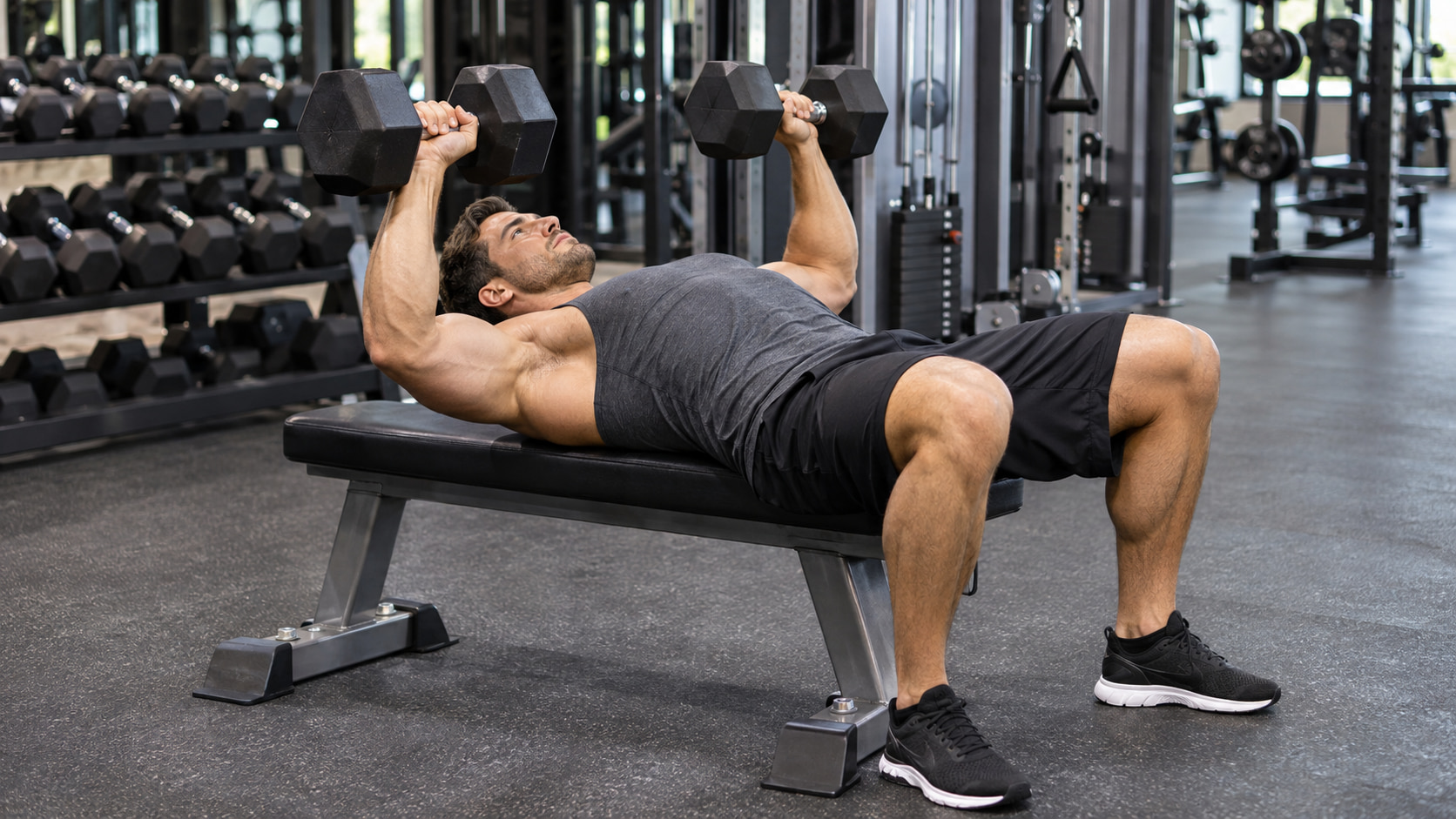
The best chest exercises include bench presses, push-ups, and flys that match your equipment, ability, and training goal. Start with one main press and one complementary movement—not all 12 exercises in a single workout.
Below, you’ll learn how to perform each exercise, avoid common mistakes, and combine your choices into a manageable routine.
How to Choose Chest Exercises for Your Goal
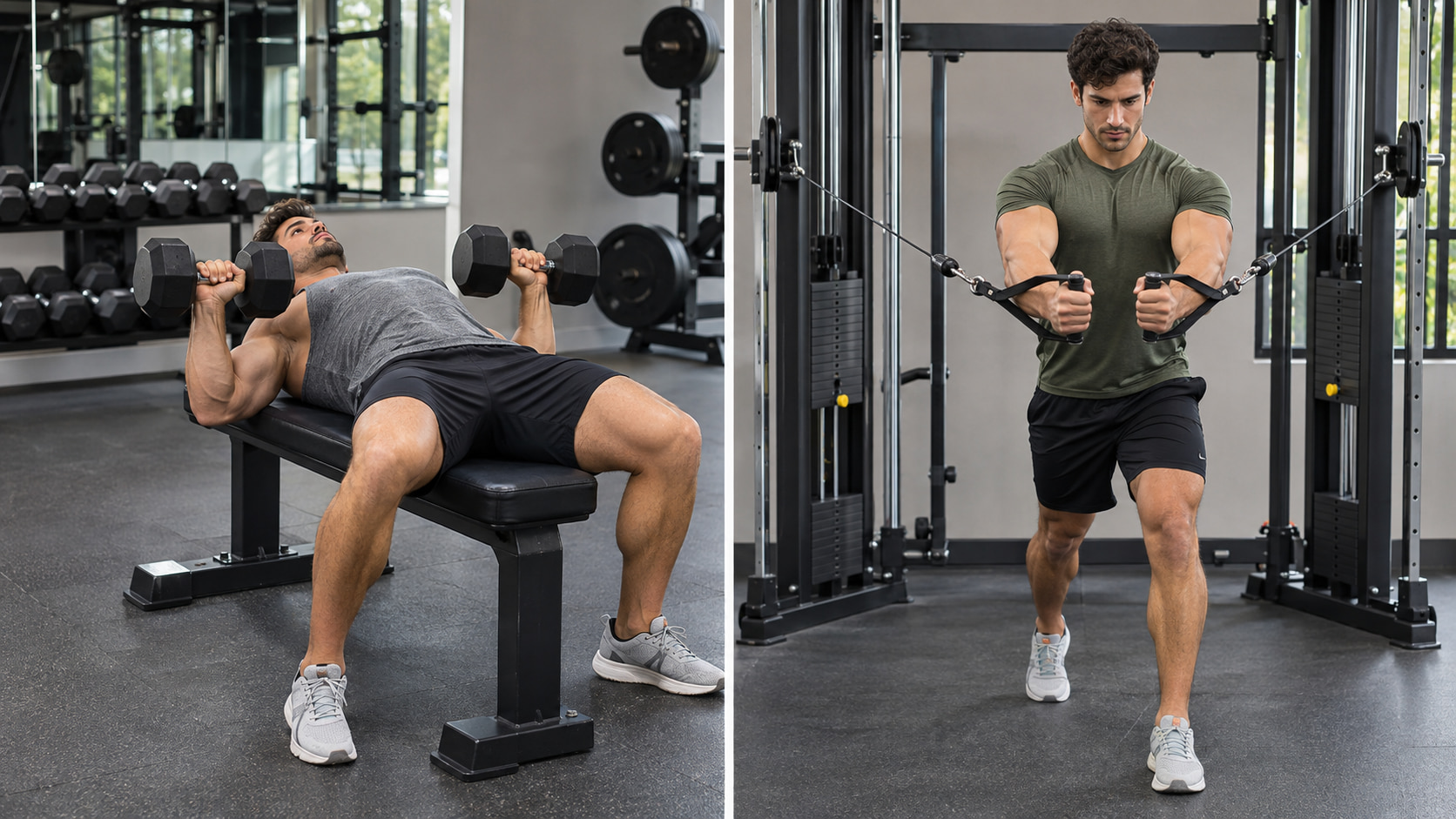
Your pectoralis major, the large muscle across the front of your chest, helps bring your upper arms toward the front of your body. During presses and push-ups, your front shoulder muscles assist while your triceps straighten your elbows. Push-ups also require your trunk muscles to hold your body steady.
The exercises below fall into two main groups:
- Presses and push-ups: Your shoulders and elbows move together. These make practical starting exercises for a chest workout.
- Flys: Your upper arms move together while your elbows stay slightly bent. Use these as an optional second exercise rather than treating them like another heavy press.
Flat and incline presses overlap, but the angle changes how your chest and shoulders contribute. A low incline is commonly used to emphasize the upper portion of the chest; it does not isolate that region. Research measuring muscle activity at different bench angles does not establish a universally best angle for long-term growth.
Choose Based on Your Equipment and Priorities
| Your priority or situation | Practical starting choices |
|---|---|
| Improve barbell bench-press strength | Flat barbell bench press |
| Train with dumbbells and a bench | Flat or low-incline dumbbell press |
| Train with dumbbells but no bench | Dumbbell floor press |
| Find a supported gym exercise | Seated machine chest press |
| Build toward floor push-ups | Hands-elevated push-up |
| Train with minimal equipment | Floor push-up or standing band chest press |
| Add a fly after pressing | Cable, dumbbell, or machine chest fly |
Choose exercises you can set up confidently and perform through a comfortable, controlled range. You do not need flat, incline, machine, and bodyweight presses in every session.
12 Best Chest Exercises
Treat this list as an exercise menu. The repetition ranges are practical starting suggestions, not rigid requirements.
For each exercise you select, begin with two working sets. Usually finish with about two or three good repetitions left, rather than continuing until you cannot complete another rep. Training to failure is not required for progress.
As a starting rest guideline, allow two to three minutes between presses, push-ups, and dips, and one to two minutes between fly sets. Rest longer when needed to repeat the movement with control.
1. Flat Barbell Bench Press
Best use: Practicing barbell pressing strength.
Equipment: Barbell, flat bench, rack, and an appropriate failed-repetition safety setup.
How to do it:
- Lie with your eyes roughly beneath the bar. Plant your feet on the floor or secure foot supports, and keep your head, upper back, and hips on the bench.
- Grip the bar slightly wider than shoulder width with your thumbs wrapped around it. Set your upper back firmly against the bench and unrack the bar.
- Lower toward the middle-to-lower chest under control. Keep your wrists supported over your forearms rather than letting them fold backward.
- Press back above your shoulders without bouncing the bar or lifting your hips. Return it securely to the rack before releasing your grip.
Form check: Use correctly adjusted rack safeties and competent spotting assistance as appropriate. Do not attempt a heavy set without a reliable way to manage a failed repetition.
Suggested reps: 6–10.
2. Flat Dumbbell Bench Press
Best use: Free-weight chest training with a separate weight in each hand.
Equipment: Two dumbbells and a flat bench.
How to do it:
- Sit with the dumbbells supported on your thighs. Carefully lie back and bring them above your chest, using assistance when needed.
- Plant your feet, support your upper back, and turn your palms forward—toward your feet rather than toward each other.
- Lower both dumbbells toward the sides of your chest. Keep your forearms approximately upright and stop before your shoulders roll forward.
- Press both weights upward without knocking them together. After the set, bring them back toward your thighs and sit up under control.
Form check: Do not chase extra depth by letting the weights pull your shoulders far behind your body. Use a load you can control during setup and the finish, not just during the repetitions.
Suggested reps: 8–12.
3. Low-Incline Dumbbell Bench Press
Best use: Adding an inclined pressing angle to your chest training.
Equipment: Two dumbbells and an adjustable bench set to approximately 30 degrees.
How to do it:
- Set the bench to a low incline. Sit with your hips against the seat, then carefully bring the dumbbells into position as you lie back.
- Plant your feet and keep your head, upper back, and hips supported. Hold the weights outside your upper chest with your palms facing forward.
- Press both dumbbells upward, keeping your wrists aligned over your forearms.
- Lower slowly toward the sides of your upper chest. Use a comfortable depth without allowing your shoulders to roll forward.
Form check: Do not slide your hips forward or exaggerate your back arch to turn the movement into a flatter press. The approximately 30-degree setting is a practical starting position, not a guarantee of superior growth.
Suggested reps: 8–12.
4. Dumbbell Floor Press
Best use: Dumbbell pressing when a bench is unavailable.
Equipment: Two dumbbells and clear floor space.
The floor limits how far your upper arms can travel behind your torso. This makes it a shorter-range press than a typical bench press, while still involving your chest and triceps.
How to do it:
- Sit with the dumbbells close to your hips, then carefully lie back while keeping them near your chest.
- Bend your knees and plant your feet. Use a semi-neutral grip, with your palms turned partway toward each other.
- Press both dumbbells above your chest.
- Lower slowly until your upper arms gently contact the floor. Pause without relaxing completely or bouncing, then press again.
Form check: Touch down softly. Hitting the floor hard and rebounding is not the same as controlling the bottom position.
Suggested reps: 8–12.
5. Seated Machine Chest Press
Best use: A supported press with straightforward resistance adjustments.
Equipment: A selectorized chest-press machine.
How to do it:
- Adjust the seat so the handles sit around mid-chest height. Select a manageable weight and fully insert the pin while the stack is resting.
- Sit with your back against the pad and your feet supported. Grip the handles with your wrists aligned.
- Press forward until your arms are nearly straight, without shrugging or lifting your back away from the pad.
- Return slowly through a comfortable range without letting the weight stack slam down.
Form check: The machine should fit you—not force you to arch, reach awkwardly, or shrug. Ask gym staff to check the settings when the handle position feels wrong.
Suggested reps: 8–12.
6. Standard Floor Push-Up
Best use: Chest training without weights and practicing whole-body control.
Equipment: Clear floor space.
How to do it:
- Place your hands approximately shoulder width apart or slightly wider. Extend your legs and brace your abdomen and glutes.
- Maintain a straight line from your head through your hips to your heels. Look slightly ahead of your hands without lifting your chin.
- Bend your elbows and lower your chest toward the floor, letting your elbows travel diagonally rather than straight out to the sides.
- Push the floor away and straighten your arms, moving your chest and hips upward together.
Form check: Stop the set when your hips sag or you must lead with your head to reach the floor. Switch to a hands-elevated push-up rather than practicing increasingly distorted repetitions.
Suggested reps: 6–15.
7. Hands-Elevated Push-Up
Best use: Building toward floor push-ups or adjusting their difficulty.
Equipment: A sturdy bench, fixed bar, or other secure elevated support.
Raising your hands reduces the difficulty compared with a floor push-up. A higher support generally makes the exercise easier; lowering it increases the challenge.
How to do it:
- Place your hands slightly wider than shoulder width on a support that cannot slide or tip.
- Walk your feet back until your body forms a straight line. Keep your feet on the floor throughout.
- Bend your elbows and bring your chest toward the support without dropping your hips.
- Press away until your arms straighten, keeping your trunk steady.
Form check: Bring your chest toward the support, not just your face. Choose a higher surface when you cannot maintain your body position.
Suggested reps: 8–15. Progress by gradually lowering the support rather than immediately attempting floor repetitions.
8. Standing Resistance-Band Chest Press
Best use: Portable chest training without a bench.
Equipment: A resistance band and a secure, compatible anchor at chest height.
How to do it:
- Inspect the band and anchor it securely behind you at chest height, using an attachment method approved for your equipment.
- Face away from the anchor and take a staggered stance. Hold the band or its handles beside your chest, with your elbows slightly below shoulder height.
- Brace your trunk and press both hands straight forward without leaning your whole body into the movement.
- Return slowly, controlling the band’s pull rather than letting it snap your arms backward.
Form check: Keep your stance and anchor distance consistent so you can judge progress. Use a stronger band when appropriate rather than stretching a light one beyond its permitted limit.
Follow the manufacturer’s inspection, anchoring, maximum-stretch, and protective-eyewear instructions. Replace damaged bands rather than continuing to use them.
Suggested reps: 10–15.
9. Machine-Assisted Parallel-Bar Chest Dip
Best use: An optional dip variation with adjustable assistance.
Equipment: An assisted-dip machine with a knee pad.
Unlike a chest-press machine, selecting more weight provides more assistance and makes the dip easier.
How to do it:
- Select enough assistance to control the movement. Hold the parallel handles and place your knees on the pad according to the machine’s instructions.
- Brace your trunk and lean slightly forward.
- Bend your elbows and lower slowly through a comfortable range. Stop before your shoulders roll forward or your position collapses.
- Press through the handles to return upward without bouncing on the pad. Follow the machine’s instructions when stepping off.
Form check: Do not force a deep bottom position. Increase assistance when you cannot control the descent or return without shrugging.
Suggested reps: 6–10. Reduce assistance gradually as your repetitions become consistent.
10. Standing Cable Chest Fly
Best use: Adding a fly after your main press.
Equipment: A dual adjustable cable station and two single-hand handles.
How to do it:
- Set both pulleys around shoulder height or slightly above it. Attach the handles and select equal resistance.
- Hold the handles, step forward, and take a staggered stance. Keep your torso steady with a slight forward lean.
- Maintain a small elbow bend as you sweep your arms together until your hands meet in front of your chest.
- Open your arms slowly, stopping before the cables pull your shoulders into an uncomfortable stretch.
Form check: Keep the elbow bend nearly unchanged. Bending deeply and then straightening your elbows turns the fly into a press. Your hands do not need to cross.
Suggested reps: 10–15.
11. Flat-Bench Dumbbell Fly
Best use: A fly option when you have dumbbells and a bench but no cable machine.
Equipment: Two light dumbbells and a flat bench.
How to do it:
- Carefully lie on the bench with your feet supported. Hold the dumbbells above your chest, palms facing each other.
- Bend your elbows slightly and maintain that bend throughout the repetition.
- Lower the weights out to the sides in a wide arc. Stop around chest or shoulder level, or earlier when needed for a comfortable range.
- Bring your arms back together along the same arc without knocking the dumbbells together.
Form check: Begin substantially lighter than you would for a dumbbell press. If you must bend your elbows more to complete the return, reduce the weight.
Suggested reps: 10–15. Prioritize repeatable control over a bigger stretch.
12. Seated Machine Chest Fly
Best use: A supported alternative to standing cable flys.
Equipment: A handle-type pec-deck machine.
This version uses hand grips with the back against the pad. It is not the elbow-pad version or the reverse-fly position.
How to do it:
- Adjust the seat so the handles are around chest height. Set the starting-arm position so you can reach them without excessive stretching behind your torso.
- Sit with your back supported, grip the handles, and maintain a small elbow bend.
- Bring your arms together in front of your chest without leaning forward.
- Pause briefly, then return slowly while keeping your back against the pad and the weight stack controlled.
Form check: Do not reach your torso forward to make the handles touch. Reduce the load when you cannot complete the movement without leaving the back support.
Suggested reps: 10–15.
How to Build a Chest Workout From This List
A manageable starting plan is two chest-training sessions on nonconsecutive days, with two exercises in each session. For example, train on Monday and Thursday.
This is the chest portion of a broader program—not a replacement for training your back, legs, shoulders, and other major muscle groups. Balanced resistance training and recovery between sessions remain important.
Warm Up Before Your Working Sets
Begin with about five to ten minutes of easy activity. Then perform one or two lighter practice sets of your first exercise, using additional gradual warm-up sets when preparing for heavier lifting.
Keep these practice sets easy enough that they do not tire you out before the main work. Mayo Clinic’s weight-training technique guidance also recommends warming up, controlling the weight, and reducing the load when form breaks down.
Sample Two-Day Chest Routine
The following is a starting example for a generally healthy beginner-to-intermediate lifter.
| Session | Exercise order | Working sets | Repetitions | Rest between sets |
|---|---|---|---|---|
| A | 1. Flat dumbbell bench press | 2 | 8–12 | 2–3 minutes |
| A | 2. Standing cable chest fly | 2 | 10–15 | 1–2 minutes |
| B | 1. Low-incline dumbbell bench press | 2 | 8–12 | 2–3 minutes |
| B | 2. Standard floor push-up | 2 | 6–15 | 2–3 minutes |
This provides eight working sets per week. Warm-up sets are additional and are not included in that total.
Choose resistance or exercise difficulty that leaves approximately two or three controlled repetitions available at the end of each set. Take enough time between exercises to set up properly.
Make Substitutions Instead of Adding Everything
The flat dumbbell press can be replaced by a barbell press, floor press, or seated machine press. Use the repetition range listed for the replacement.
The cable fly can be replaced by the dumbbell fly or machine fly. There is no need to perform all three.
Replace floor push-ups with hands-elevated push-ups when needed. Assisted dips are another optional replacement, provided you can control the movement comfortably.
For a no-bench home setup, repeat dumbbell floor presses plus a suitable push-up variation on both days. A standing band press can replace the dumbbell exercise. Keep two sets per selected movement and use its listed repetition range.
Adjust the Plan for Strength or Muscle Growth
For barbell strength: Once your technique and safety setup are reliable, use the barbell bench press as the first exercise on both days. A practical option is two working sets of 4–6 repetitions with around three minutes of rest. Keep the second exercise moderate rather than turning every movement into a heavy lift.
For muscle growth: Start with the manageable workload above. The ACSM resistance-training position stand found that heavier loading particularly benefits strength, while higher weekly training volume can enhance muscle growth. It does not establish one ideal workload for every person.
Do not add sets simply because more exercises are available. First establish consistent technique, effort, and recovery.
How to Progress Without Losing Your Form
Progress means doing more useful work—not just moving a heavier weight by shortening every repetition.
Add Repetitions Before Increasing Resistance
Use a simple progression rule. For an exercise prescribed at 8–12 repetitions, keep the same weight while gradually adding controlled repetitions.
Once you can complete both sets of 12 with about two good repetitions remaining for two consecutive sessions, increase to the smallest practical weight increment. Your repetitions may return toward the lower end of the range.
This is an example progression method, not a requirement to increase weight on a fixed schedule.
For exercises without conventional weights, adjust the relevant variable: lower the hand support for incline push-ups, reduce assistance on dips, or select a stronger band within its manufacturer’s limits.
Keep the Movement Measurable
Record the resistance, repetitions, and important settings—such as bench angle, machine seat position, or push-up support height.
Try to keep your range of motion and technique consistent when comparing sessions. Twelve shallow repetitions are not directly comparable with twelve controlled repetitions through your usual range.
For most sets, breathe in during the lowering phase and out as you press or bring your arms together. Avoid holding your breath throughout a prolonged struggle.
Add Volume Only When It Serves a Purpose
When the routine is manageable but progress has slowed, first check whether your loads, effort, rest periods, and technique are consistent.
Adding one set to the first exercise on each day would raise the sample plan from eight to ten weekly working sets. That is one possible adjustment—not a mandatory minimum. ACSM identifies higher weekly volume as useful for enhancing hypertrophy, while also emphasizing individualization and sustainable participation.
Reduce the workload when you repeatedly arrive at the next session unable to perform your normal controlled repetitions.
Stop exercising for sharp pain, numbness, dizziness, chest pain, or other concerning symptoms, and seek appropriate professional advice. Chest pressure, fainting, or severe shortness of breath warrants urgent medical help.
For your next workout, choose one press and one complementary movement, record your starting performance, and repeat them consistently before adding more exercises. Build a routine you can progress—not a checklist you have to finish.
References
- American College of Sports Medicine: Resistance Training Prescription for Muscle Function, Hypertrophy, and Physical Performance in Healthy Adults and 2026 resistance-training guidance overview.
- American Council on Exercise: Barbell chest press, dumbbell chest press, push-up, and lying chest fly.
- National Academy of Sports Medicine: Push-up and hands-elevated push-up.
- Rodríguez-Ridao and colleagues: Effect of Five Bench Inclinations on Muscle Activity During the Bench Press.
- PureGym: Incline dumbbell press, seated chest press, cable fly, and machine chest fly.
- Muscle & Strength: Dumbbell floor-press instructions.
- WeightTraining.guide: Machine-assisted chest-dip instructions.
- Performance Health: THERABAND inspection and safety guidance.
- Mayo Clinic: Weight Training: Do’s and Don’ts of Proper Technique.
- NHS: Urgent chest-symptom guidance and dizziness guidance.