The dumbbell rear delt fly is a shoulder isolation exercise that primarily trains the posterior deltoids while also involving muscles around the shoulder blades and upper back. Done correctly, it uses a controlled outward arm motion rather than heavy weights, momentum, or a rowing action.

This guide explains proper dumbbell rear delt fly form, muscles worked, common mistakes, useful variations, and practical ways to program the exercise.
Dumbbell Rear Delt Fly at a Glance
| Category | Recommendation |
|---|---|
| Exercise type | Shoulder isolation/accessory exercise |
| Main movement | Shoulder horizontal abduction |
| Primary muscle | Posterior deltoid |
| Assisting muscles | Trapezius, rhomboids, other posterior shoulder muscles |
| Equipment | Pair of dumbbells |
| Beginner-friendly variation | Chest-supported incline rear delt fly |
| Practical starting volume | 2–3 sets |
| Practical rep range | 10–20 reps |
| Rest | 60–120 seconds |
| Effort | Finish most sets with about 2–3 good reps still possible |
What Is a Dumbbell Rear Delt Fly?
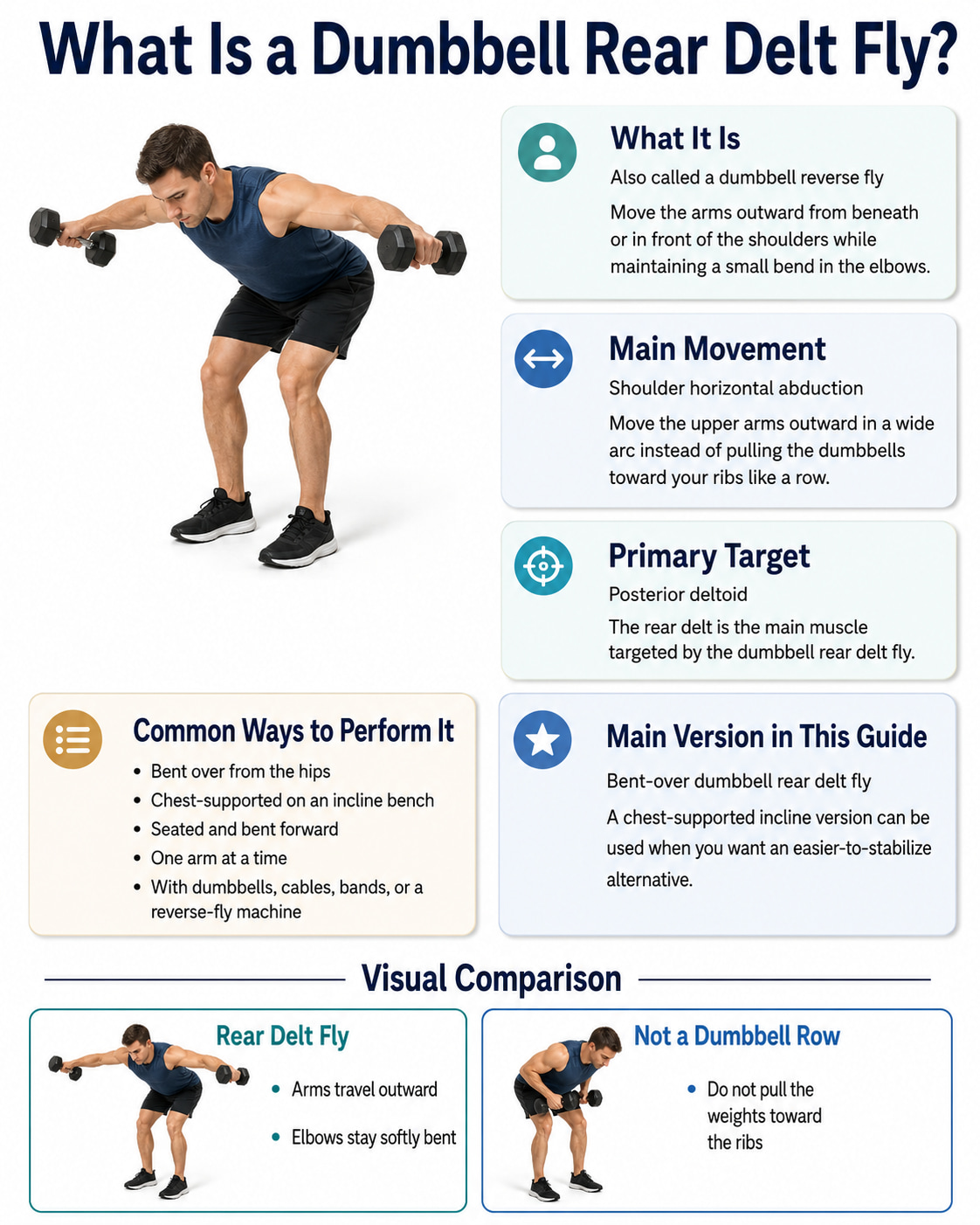
The dumbbell rear delt fly, also commonly called a dumbbell reverse fly, involves moving the arms outward from in front of or underneath the shoulders while maintaining a small bend in the elbows.
The main joint action is horizontal abduction at the shoulder. Instead of pulling the dumbbells toward your ribs as you would during a row, you move the upper arms outward in a wide arc.
Research examining reverse flyes identifies the posterior deltoid as the main muscle people typically aim to train with the exercise. A study published in the Journal of Human Kinetics compared dumbbell and elastic-resistance reverse flyes and measured the posterior deltoid as the target muscle.
You can perform the exercise:
- Bent over from the hips
- Chest-supported on an incline bench
- Seated and bent forward
- One arm at a time
- With dumbbells, cables, bands, or a reverse-fly machine
This guide focuses primarily on the bent-over dumbbell rear delt fly, with the chest-supported version included as an easier-to-stabilize alternative.
Dumbbell Rear Delt Fly Muscles Worked
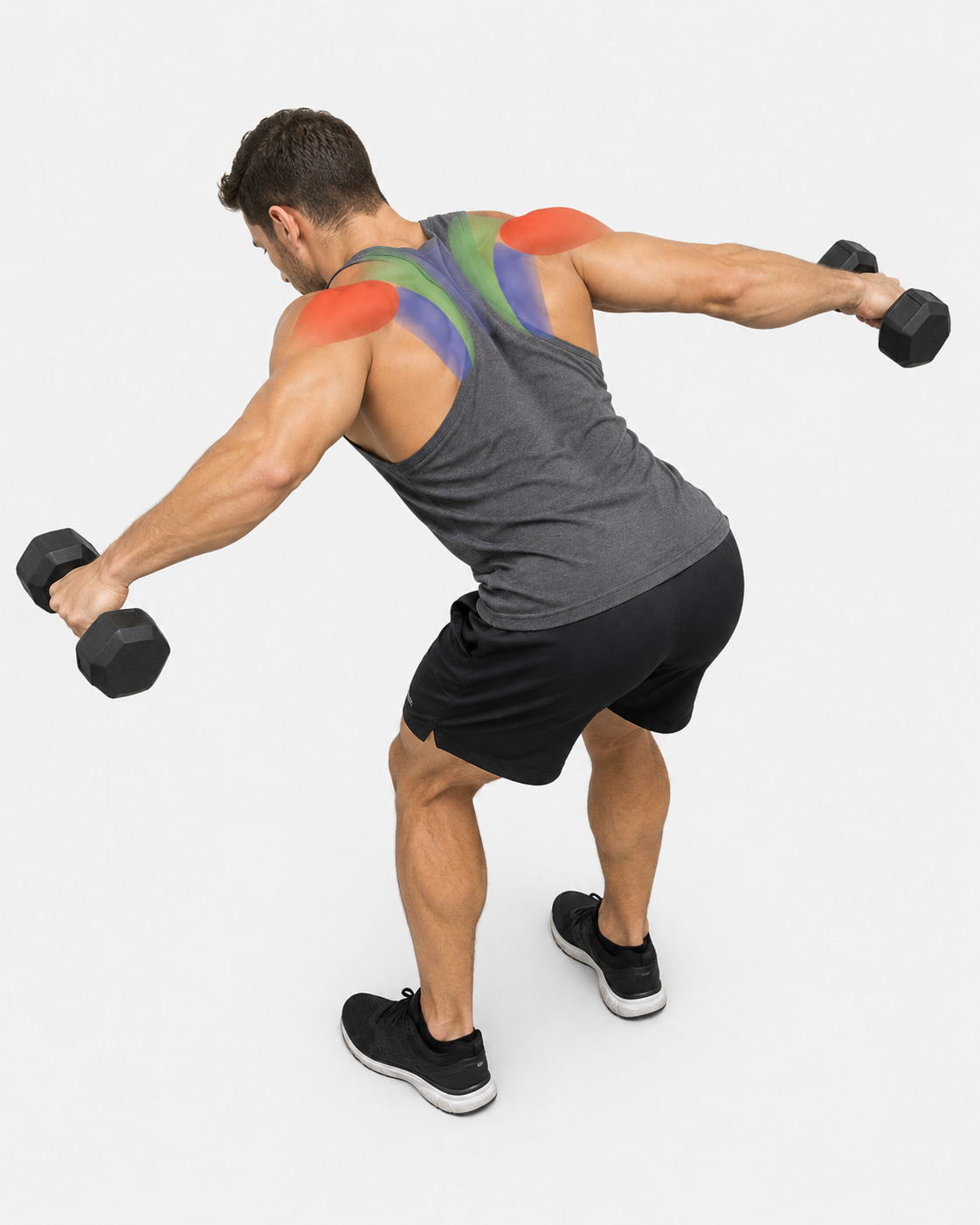
Posterior Deltoid
The posterior deltoid, commonly called the rear delt, is the main target.
It forms the back portion of the shoulder and contributes to moving the upper arm backward and outward. Reverse-fly research consistently uses posterior-deltoid activity as a key measure when evaluating this movement.
Trapezius
The middle region of the trapezius helps control movement of the shoulder blades as the arms move outward.
You should expect some upper-back involvement, but the exercise does not need to become an exaggerated shoulder-blade squeeze or shrug.
Rhomboids
The rhomboids assist with scapular retraction, meaning they help draw the shoulder blades toward one another.
The American Council on Exercise categorizes its incline dumbbell reverse fly as a back-and-shoulder exercise and teaches controlled shoulder-blade movement alongside the arm motion.
Other Posterior Shoulder Muscles
Rotator-cuff muscles may also contribute to shoulder control. One machine-based reverse-fly study found substantial involvement of the infraspinatus as well as the posterior deltoid.
That does not make the rear delt fly a dedicated rotator-cuff exercise. Its main training purpose remains the posterior shoulder.
How to Do the Dumbbell Rear Delt Fly
Sets, reps, and rest: A practical starting point is 2–3 sets of 10–20 controlled reps with 60–120 seconds of rest. Choose a load that lets you keep your torso and elbow position consistent.
How to Do It
- Stand with your feet around hip- to shoulder-width apart while holding a dumbbell in each hand.
- Soften your knees and push your hips backward into a hip hinge.
- Lean your torso forward while keeping your spine comfortably neutral and your abdominal muscles braced.
- Let the dumbbells hang below your shoulders with your palms facing one another.
- Keep a slight bend in your elbows and maintain approximately the same elbow angle throughout the repetition.
- Raise both arms outward in a wide arc.
- Stop around the point where your upper arms approach shoulder level or your comfortable controlled range.
- Pause briefly without shrugging your shoulders.
- Lower the dumbbells slowly to the starting position.
- Reset your position before beginning the next repetition.
The ACE incline reverse fly instructions similarly recommend a slight elbow bend, braced trunk, palms facing one another, and raising the arms outward until they are approximately level with the shoulders.
Coaching Cue
Think “move the elbows wide,” not “pull the dumbbells up.”
That cue can help prevent the movement from turning into a row.
How High Should You Raise the Dumbbells?
You do not need to force the arms far behind your torso.
For its chest-supported reverse fly, ACE recommends finishing with the dumbbells approximately in line with or slightly in front of the ears. ACE also notes that taking the weights excessively behind the head changes the emphasis of the movement.
For a bent-over version, use the same general principle: raise the arms until the rear delts are working strongly while your shoulder position remains controlled.
More range is not automatically better.
If reaching shoulder height requires:
- Shrugging
- Twisting
- Jerking the weights
- Arching your back
- Dramatically bending your elbows
the load or range is probably too demanding.
What Grip Should You Use?
A neutral grip, with the palms facing each other, is a simple starting position.
ACE uses a palms-facing grip in its dumbbell incline reverse fly instructions.
A study of the reverse-fly machine also found greater posterior-deltoid and infraspinatus activity with a neutral hand position than with a pronated grip. However, that research used a machine, so it should not be interpreted as proof that a neutral grip is always superior for every dumbbell variation.
Use a grip that allows your wrists, elbows, and shoulders to remain comfortable and controlled.
Common Dumbbell Rear Delt Fly Mistakes
1. Using Too Much Weight
Heavy dumbbells often make it difficult to keep the movement isolated.
Instead of the rear delts moving the arms, you may start:
- Swinging your torso
- Jerking the dumbbells
- Shrugging
- Bending the elbows excessively
- Cutting the range of motion short
Reduce the weight until every repetition looks similar.
2. Turning the Fly Into a Row
This is one of the most common technique errors.
During a row, the elbows bend significantly and move toward or behind the torso as the weights approach the ribs.
During a rear delt fly, the elbow angle remains relatively constant while the upper arms move outward.
If the dumbbells are traveling toward your abdomen instead of outward to your sides, you are probably rowing them.
3. Shrugging the Shoulders
Avoid intentionally pulling the shoulders toward your ears as you raise the dumbbells.
Keep your neck relaxed and think about creating distance between your shoulders and ears.
Some trapezius activity is normal, but excessive shrugging changes how the movement feels and often accompanies using too much weight.
4. Straightening and Bending the Elbows
Keep a soft bend in the elbows from beginning to end.
Repeatedly bending and straightening the arms adds unnecessary movement and can turn the exercise into something closer to a pulling motion.
5. Swinging the Torso
Your hip-hinged position should remain stable.
If your chest rises every time the dumbbells come up, momentum is helping lift the weight.
Use lighter dumbbells or switch to a chest-supported variation.
6. Rounding the Back
Hinge from the hips rather than collapsing forward through the spine.
Brace your trunk and maintain a comfortable, stable torso position throughout the set.
7. Forcing the Arms Too Far Back
Do not chase an exaggerated end position.
ACE specifically warns against taking its reverse-fly variation too far behind the body because the exercise emphasis begins to change.
Stop where you can maintain control.
Benefits of the Dumbbell Rear Delt Fly
Direct Rear-Shoulder Training
The exercise gives you a straightforward way to emphasize the posterior deltoids.
Research comparing resistance methods during reverse flyes confirms that the posterior deltoid is strongly involved in the exercise.
Easy to Perform With Minimal Equipment
You only need a pair of dumbbells and enough space to hinge forward.
A bench is optional.
Works Well as an Accessory Exercise
The rear delt fly does not require the same total-body effort as heavy rows or presses.
That makes it useful later in a workout when you want more focused shoulder work without adding another large compound exercise.
Easy to Modify
You can adjust the exercise by changing:
- Dumbbell weight
- Repetition range
- Torso position
- Bench support
- One-arm versus two-arm execution
This makes the basic movement adaptable to different ability levels.
Bent-Over vs. Chest-Supported Rear Delt Fly
Both versions train the same general movement pattern, but they place different demands on the rest of the body.
Bent-Over Dumbbell Rear Delt Fly
Best for: Simple dumbbell-only training.
You hold your own hip-hinged position throughout the set.
Advantages include:
- No bench required
- Easy home-gym setup
- Trains your ability to maintain a stable hinge
The main drawback is that fatigue or excessive loading can make it easier to swing the torso.
Chest-Supported Rear Delt Fly
Best for: Beginners or anyone who has difficulty keeping the torso still.
Set an adjustable bench to roughly 45–60 degrees and lie chest-down against it. ACE uses this setup for its incline reverse fly.
The bench removes much of the need to hold a hip hinge, making it easier to focus on the arms and shoulders.
If your bent-over fly repeatedly becomes a swinging exercise, the supported version is a useful regression.
How Much Weight Should You Use?
Use less weight than you would for a dumbbell row.
There is no single correct dumbbell weight because strength and experience vary widely.
Choose a load that allows you to:
- Maintain your hip hinge
- Keep the elbow bend consistent
- Reach a useful range without shrugging
- Lower the weight under control
- Complete every rep without swinging
For most working sets, stopping while you could still perform roughly 2–3 technically sound repetitions is a practical approach.
There is usually no need to force every set to absolute failure. Updated American College of Sports Medicine resistance-training guidance reports that training to momentary muscular failure is not consistently necessary for the average healthy adult.
Dumbbell Rear Delt Fly Sets, Reps, and Rest
A simple starting framework is:
Beginner
- Sets: 2
- Reps: 12–15
- Rest: 60–90 seconds
- Effort: Stop with 2–3 controlled reps remaining
Regular Strength Training
- Sets: 2–4
- Reps: 10–20
- Rest: 60–120 seconds
- Effort: Keep the last few reps challenging without losing form
These are practical exercise-specific starting ranges rather than rigid rules.
The 2026 ACSM resistance-training guidance emphasizes individualizing load and volume based on goals, ability, safety, and adherence instead of relying on one universal prescription.
How to Progress the Dumbbell Rear Delt Fly
Do not automatically increase the dumbbell weight every workout.
First improve repetition quality.
A simple progression method is:
- Choose a weight you can perform for 10–12 controlled reps.
- Gradually add repetitions over subsequent workouts.
- Work toward about 15–20 clean reps.
- Increase the dumbbell weight slightly.
- Return to the lower end of your rep range.
- Repeat the process.
Only add weight if you can maintain the same torso position, elbow angle, and range of motion.
If the heavier dumbbells immediately cause swinging or rowing, return to the previous load.
Dumbbell Rear Delt Fly Regressions
Chest-Supported Incline Rear Delt Fly
Support your chest against an inclined bench.
This reduces the stabilization demands and makes cheating with torso momentum more difficult.
Seated Bent-Over Rear Delt Fly
Sit near the edge of a bench and lean forward.
This removes some lower-body involvement while keeping the dumbbell movement similar.
One-Arm Rear Delt Fly
Perform one side at a time while using the opposite hand for support.
This can make it easier to focus on the movement of one shoulder.
Dumbbell Rear Delt Fly Progressions
Heavier Dumbbells
Increase the load only after you can complete your target repetitions without changing your form.
Slower Lowering Phase
Take approximately 2–3 seconds to lower each repetition.
This increases control without immediately requiring a heavier dumbbell.
Paused Rear Delt Fly
Pause briefly near the top before lowering.
Do not turn the pause into an exaggerated shoulder-blade squeeze.
Cable Rear Delt Fly
Cables provide a different resistance profile and can be useful when you want another way to train the same general horizontal-abduction pattern.
How to Use Rear Delt Flyes in a Workout
The dumbbell rear delt fly usually fits best after larger upper-body exercises.
For example:
- Row or pulldown
- Overhead or chest press
- Dumbbell rear delt fly
- Other smaller shoulder or arm exercises
Performing compound exercises first lets you use your energy for movements that involve more muscle mass and coordination, while the rear delt fly can provide focused accessory work afterward.
You can also place it earlier if rear-delt training is a specific priority and you want to perform the exercise while fresh.
Sample Upper-Body Accessory Routine
Here is a simple example of how the exercise can fit into a workout:
| Exercise | Sets | Reps | Rest |
|---|---|---|---|
| Dumbbell row | 3 | 8–12 | 90–120 sec |
| Dumbbell shoulder press | 2–3 | 8–12 | 90–120 sec |
| Dumbbell rear delt fly | 2–3 | 12–20 | 60–90 sec |
Use controlled repetitions and choose loads you can manage without sacrificing technique.
The American College of Sports Medicine emphasizes that regular participation and individualized programming matter more for most healthy adults than making resistance training unnecessarily complicated.
Safety Tips
Warm up before loading the exercise heavily. A few minutes of general movement followed by easy shoulder movements and lighter practice repetitions can prepare you for the working sets.
During the exercise:
- Keep the movement controlled.
- Do not jerk the dumbbells.
- Avoid forcing your shoulders beyond a comfortable range.
- Keep your wrists neutral.
- Maintain a stable torso.
- Increase resistance gradually.
Stop exercising if you experience sharp pain, numbness, dizziness, chest pain, or other unusual symptoms. If you have an existing shoulder problem or are unsure whether the exercise is appropriate for you, seek individualized guidance from a qualified healthcare or exercise professional.
Frequently Asked Questions
Are dumbbell rear delt flyes good for rear delts?
Yes. The posterior deltoid is a primary target of the reverse-fly movement, and research measuring muscle activation during reverse flyes supports its use as a posterior-shoulder exercise.
Is a rear delt fly the same as a reverse fly?
In general gym terminology, rear delt fly and reverse fly usually describe the same basic movement: moving the arms outward in horizontal abduction to emphasize the posterior shoulder.
Different versions may use dumbbells, cables, bands, or a machine.
Should I squeeze my shoulder blades during a rear delt fly?
Some scapular movement is normal, and ACE instructs users to bring the shoulder blades together near the end of its incline reverse fly.
However, do not make an aggressive shoulder-blade squeeze the entire purpose of the exercise. Focus primarily on moving the upper arms outward while keeping the shoulders controlled.
Should my arms be straight during a dumbbell rear delt fly?
Keep a small bend in the elbows.
Your arms do not need to be completely straight, but the elbow angle should remain fairly consistent during each repetition.
Why do I feel rear delt flyes in my upper back?
That is not necessarily a problem. The trapezius and rhomboid region assists with shoulder-blade control during the movement.
However, if you mostly feel shrugging or heavy upper-back pulling, try reducing the weight and focusing on moving your upper arms outward instead of pulling the dumbbells toward your body.
How heavy should rear delt flyes be?
Use a weight that lets you complete your full set without swinging, shrugging, rowing, or changing your elbow position.
For this exercise, adding more weight is useful only when you can preserve the same movement quality.
Is the chest-supported version better?
Not universally.
The bent-over version is convenient and requires only dumbbells. The chest-supported version reduces the need to stabilize your torso and may make it easier to focus on rear-delt movement.
Choose the version that allows you to perform controlled repetitions most consistently.
Conclusion
The dumbbell rear delt fly is a simple but technique-sensitive way to train the posterior deltoids. Keep the dumbbells relatively light, hinge with a stable torso, maintain a small bend in your elbows, and move the upper arms outward rather than pulling the weights toward your ribs.
If momentum, shrugging, or rowing starts to take over, reduce the load or use a chest-supported variation. Build repetitions with good form first, then increase resistance gradually.
References
- American Council on Exercise — Incline Reverse Fly
- American College of Sports Medicine — 2026 Resistance Training Guidelines
- Bergquist et al. — Muscle Activity in Upper-Body Single-Joint Resistance Exercises With Elastic Resistance Bands vs. Free Weights
- Schoenfeld et al. — Effect of Hand Position on Posterior Shoulder Muscle Activity During Horizontal Abduction
This content is for informational purposes only and is not a substitute for medical advice.