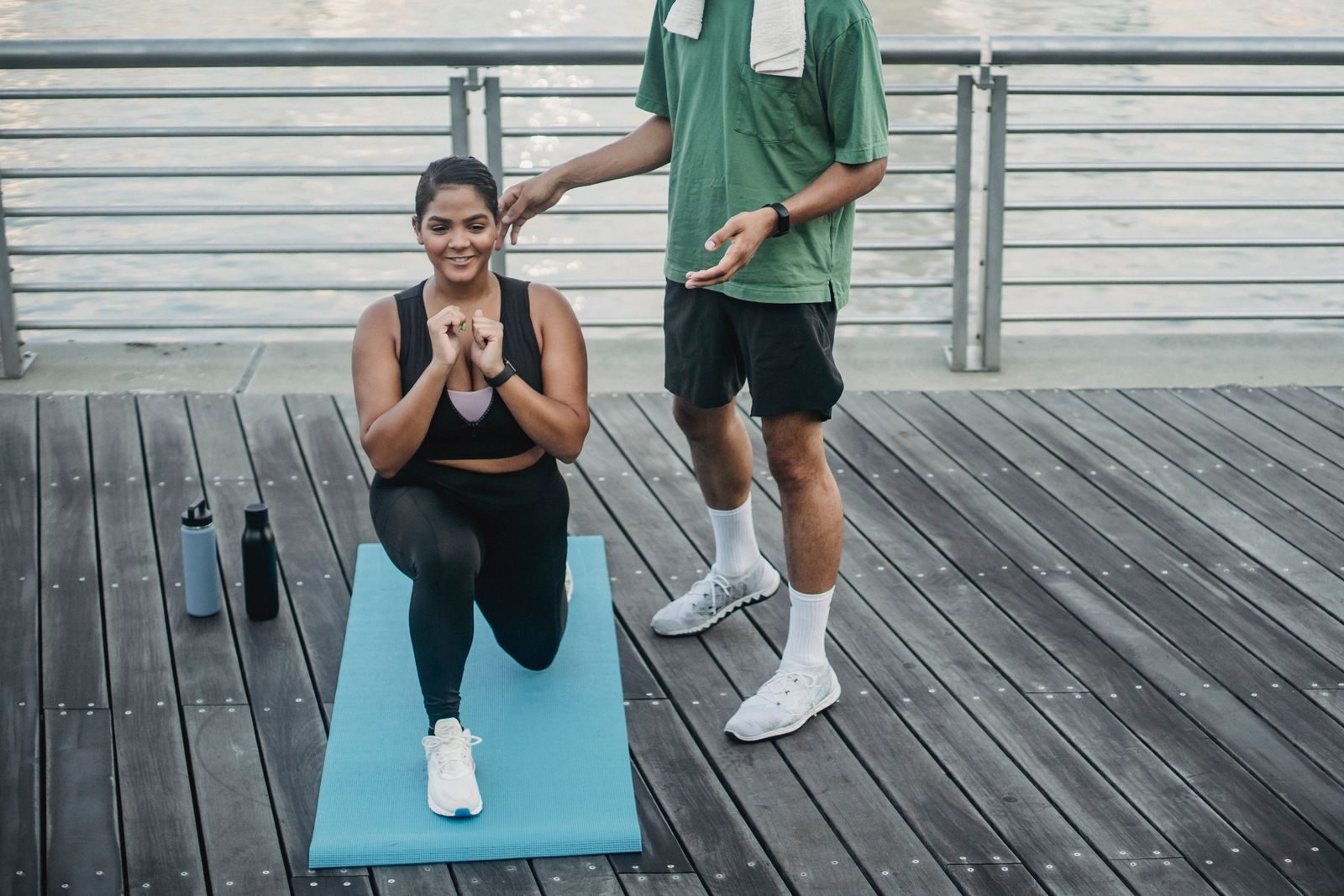
Bodyweight leg exercises can build stronger legs when the movements are challenging enough and become progressively harder over time. You can train your quadriceps, glutes, hamstrings, calves, and hip stabilizers at home with little or no equipment.
The key is to choose a balanced mix of squats, lunges, hip hinges, bridges, calf exercises, and optional jumping movements. This guide explains how to perform 13 effective exercises, adjust them to your ability, and combine them into a practical workout.
Bodyweight Leg Exercises at a Glance
| Exercise | Best For | Main Muscles | Level | Starting Target |
|---|---|---|---|---|
| Bodyweight squat | Foundational two-leg strength | Quadriceps, glutes, adductors | Beginner | 2–3 sets of 8–15 |
| Wall sit | Quadriceps endurance | Quadriceps and glutes | Beginner | 2–3 holds of 20–45 seconds |
| Reverse lunge | Controlled single-leg strength | Quadriceps, glutes, hamstrings | Beginner–intermediate | 2–3 sets of 6–12 per side |
| Split squat | Stationary single-leg training | Quadriceps, glutes, adductors | Beginner–intermediate | 2–3 sets of 6–12 per side |
| Bulgarian split squat | Challenging unilateral strength | Quadriceps, glutes, hamstrings | Intermediate | 2–4 sets of 6–12 per side |
| Step-up | Stair-climbing and single-leg strength | Quadriceps, glutes, hamstrings | Beginner–intermediate | 2–3 sets of 8–12 per side |
| Lateral lunge | Side-to-side strength | Adductors, glutes, quadriceps | Intermediate | 2–3 sets of 6–12 per side |
| Bodyweight hip hinge | Learning the hip-hinge pattern | Hamstrings and glutes | Beginner | 2–3 sets of 10–15 |
| Single-leg Romanian deadlift | Balance and unilateral hip strength | Hamstrings, glutes, hip stabilizers | Intermediate | 2–3 sets of 6–12 per side |
| Glute bridge | Floor-based hip extension | Glutes and hamstrings | Beginner | 2–4 sets of 10–20 |
| Hamstring walkout | Direct bodyweight hamstring challenge | Hamstrings and glutes | Intermediate | 2–3 sets of 4–10 |
| Standing calf raise | Calf and ankle strength | Gastrocnemius and soleus | Beginner | 2–4 sets of 12–25 |
| Squat jump | Lower-body power | Quadriceps, glutes, calves | Intermediate | 3–5 sets of 3–6 |
Repetition targets are starting points rather than fixed rules. Use a variation that lets you maintain control while making the final few repetitions feel challenging.
Can Bodyweight Leg Exercises Build Stronger Legs?
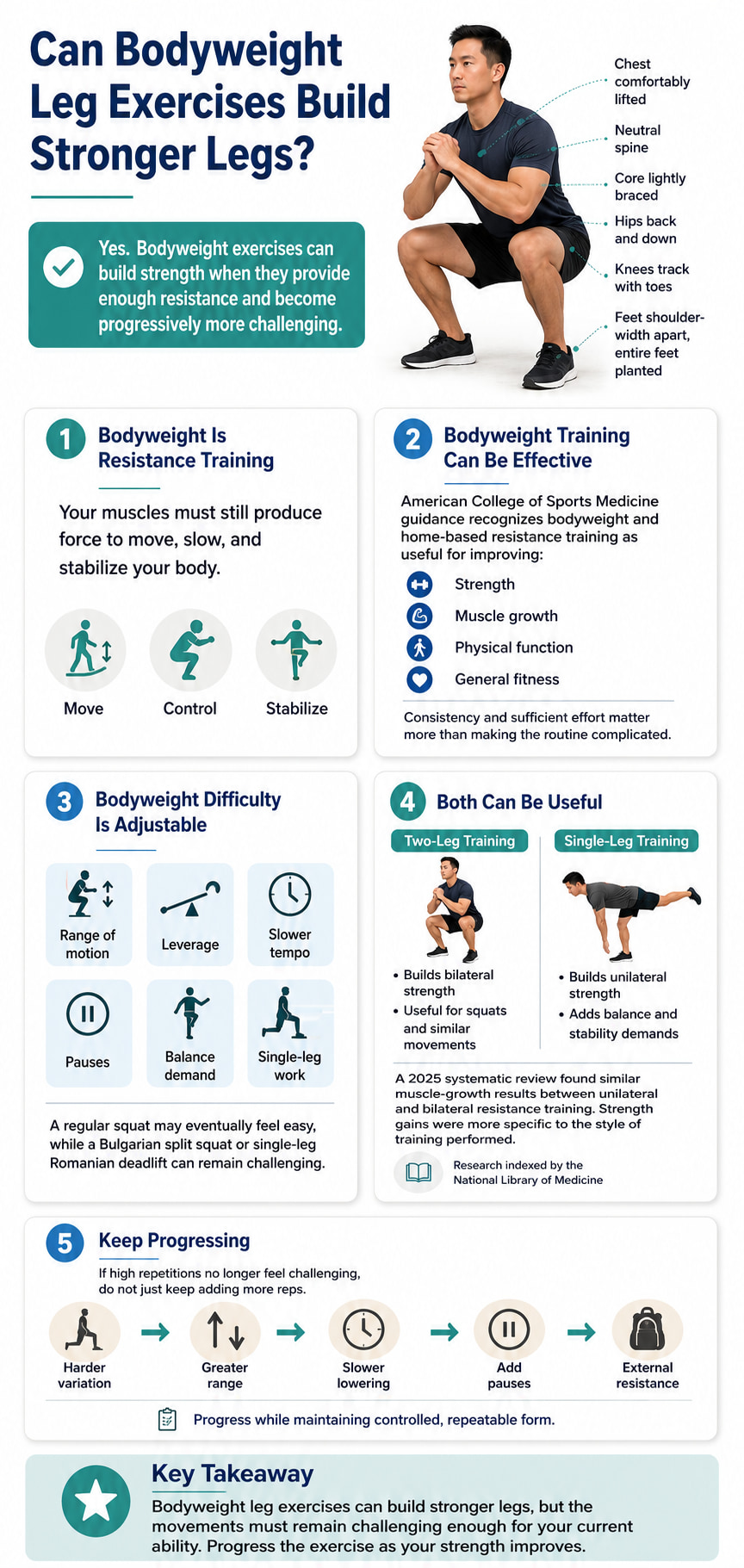
Bodyweight training is a form of resistance training. Your muscles still have to produce force to move, slow, or stabilize your body.
The updated American College of Sports Medicine resistance-training guidelines identify bodyweight exercises and home-based programs as effective options for improving strength, muscle growth, physical function, and general fitness. Consistent training and sufficient effort matter more for most people than following a complicated routine.
The difficulty of a bodyweight exercise depends on more than your total body weight. Range of motion, leverage, tempo, pauses, balance demands, and the number of legs supporting you can substantially change the challenge. A normal squat may become easy, while a controlled Bulgarian split squat or single-leg Romanian deadlift can remain demanding.
You do not need to choose exclusively between two-leg and single-leg exercises. A 2025 systematic review indexed by the National Library of Medicine found similar muscle-growth results between unilateral and bilateral resistance training. Strength improvements were more specific: two-leg training improved two-leg strength more, while one-leg training improved one-leg strength more. A balanced routine can therefore benefit from both.
Bodyweight training does have a practical limit. When you can perform high repetitions without approaching muscular fatigue, use a harder variation, increase the range of motion, slow the movement, add pauses, or eventually introduce external resistance.
13 Best Bodyweight Leg Exercises
These exercises cover the major lower-body movement patterns rather than repeating many nearly identical squat variations. Form recommendations follow practical movement principles used by the American Council on Exercise, including controlled repetitions, stable foot pressure, bracing, and an appropriate range of motion.
1. Bodyweight Squat
Best for: Building foundational leg strength and learning coordinated movement at the hips, knees, and ankles.
Muscles worked: Quadriceps, gluteus maximus, adductors, calves, and core stabilizers.
Equipment needed: None. A stable chair can be used for the beginner variation.
Sets, reps, and rest: Perform 2–3 sets of 8–15 repetitions. Rest 60–90 seconds.
How to Do It
- Stand with your feet approximately shoulder-width apart and your toes pointing slightly outward.
- Brace your midsection and keep your entire foot in contact with the floor.
- Bend your hips and knees together, lowering as far as you can control without your heels lifting.
- Keep your knees moving in the same general direction as your toes.
- Push the floor away and extend your hips and knees to stand.
Your exact stance and squat depth will depend on your proportions and mobility. The American Council on Exercise recommends maintaining core tension, keeping the heels planted, and stopping the descent when position begins to break down.
Common mistakes: Avoid letting the knees collapse inward, lifting the heels, bouncing out of the bottom, or forcing a depth you cannot control. Do not turn the movement into a hip hinge by pushing the hips far backward while barely bending the knees.
Progression or regression: Squat to a stable chair if you need a clear depth target. Progress by adding a pause at the bottom, using a slower lowering phase, or performing one-and-a-half repetitions.
2. Wall Sit
Best for: Training quadriceps endurance without repeatedly moving through a squat.
Muscles worked: Quadriceps, gluteus maximus, calves, and trunk stabilizers.
Equipment needed: A clear wall and a nonslip floor.
Sets, reps, and rest: Perform 2–4 holds of 20–45 seconds. Rest 60–90 seconds.
How to Do It
- Stand with your back against a wall and place your feet in front of you.
- Slide down until you reach a knee angle you can hold comfortably.
- Keep your feet flat and position your knees in line with your toes.
- Maintain gentle pressure through your whole foot.
- Breathe normally while holding the position, then slide back up.
You do not need to reach a perfectly parallel thigh position. A higher position is still useful when it creates appropriate muscular effort.
Common mistakes: Placing the feet too close to the wall can make the position uncomfortable and cause the heels to become light. Also avoid holding your breath, pressing your hands into your thighs, or continuing after your hips begin sliding uncontrollably.
Progression or regression: Start with a higher position or a shorter hold. Progress by lowering slightly, extending the hold, or performing controlled alternating heel raises while maintaining the wall sit.
3. Reverse Lunge
Best for: Developing single-leg strength with less balance demand than many advanced unilateral exercises.
Muscles worked: Quadriceps, gluteus maximus, hamstrings, adductors, calves, and hip stabilizers.
Equipment needed: None. A wall or chair can provide light support.
Sets, reps, and rest: Perform 2–3 sets of 6–12 repetitions per side. Rest 60–90 seconds.
How to Do It
- Stand tall with your feet approximately hip-width apart.
- Step one foot backward, landing on the ball of the rear foot.
- Bend both knees and lower under control.
- Keep the front foot planted and the front knee tracking in line with the toes.
- Press through the front foot to return to standing.
- Complete the repetitions on one side or alternate legs.
A slight forward torso lean is normal and may help you use the front-leg glutes. The goal is a controlled position, not a perfectly vertical torso.
Common mistakes: Avoid stepping directly behind the front foot as though walking on a tightrope. A slightly wider stance provides better balance. Do not push forcefully from the rear foot, let the front heel lift, or drop the rear knee rapidly toward the floor.
Progression or regression: Hold a stable surface and use a shorter range if balance is limiting you. Progress by adding a pause near the bottom or stepping backward from a small, secure platform for a greater range of motion.
4. Split Squat
Best for: Building unilateral strength without stepping on every repetition.
Muscles worked: Quadriceps, gluteus maximus, adductors, hamstrings, and calves.
Equipment needed: None. Optional wall or chair support.
Sets, reps, and rest: Perform 2–4 sets of 6–15 repetitions per side. Rest 60–120 seconds.
How to Do It
- Take a staggered stance with one foot in front and the other behind.
- Keep some side-to-side space between your feet for balance.
- Lift the rear heel and distribute most of your working effort through the front leg.
- Bend both knees and lower your body mostly straight down.
- Keep the front foot flat and the knee aligned with the toes.
- Drive through the front foot to rise without bringing your feet together.
Experiment with stance length. A stance that is too short can make it difficult to keep the front foot planted, while an excessively long stance may restrict your depth.
Common mistakes: Avoid using a very narrow stance, pushing mainly through the rear leg, allowing the front knee to collapse inward, or changing foot position between repetitions.
Progression or regression: Use hand support and a partial range as a regression. Progress with a three- to four-second lowering phase, a bottom pause, or a front-foot-elevated split squat.
5. Bulgarian Split Squat
Best for: Increasing the challenge to the front leg without using external weight.
Muscles worked: Quadriceps, gluteus maximus, adductors, hamstrings, and hip stabilizers.
Equipment needed: A stable bench, chair, couch edge, or low platform that will not move.
Sets, reps, and rest: Perform 2–4 sets of 6–12 repetitions per side. Rest 90–120 seconds.
How to Do It
- Stand in front of a stable platform facing away from it.
- Place the top of one foot or the toes of that foot on the platform behind you.
- Position the front foot far enough forward that you can lower without the heel lifting.
- Brace your trunk and bend the front knee and hip.
- Lower until you reach a controlled depth.
- Press through the front foot to return to the starting position.
Most of the work should come from the front leg. The elevated rear leg mainly assists with balance.
Common mistakes: Avoid using a platform that is unnecessarily high, placing the front foot too close, twisting the pelvis, bouncing at the bottom, or pushing hard from the rear leg. A lower platform is often easier to control.
Progression or regression: Master a normal split squat first. Progress by slowing the lowering phase, pausing at the bottom, increasing the controlled range, or adding repetitions.
6. Step-Up
Best for: Building single-leg strength through a movement similar to climbing stairs.
Muscles worked: Quadriceps, gluteus maximus, hamstrings, calves, and gluteus medius.
Equipment needed: A stable step, exercise box, or staircase.
Sets, reps, and rest: Perform 2–3 sets of 8–12 repetitions per side. Rest 60–90 seconds.
How to Do It
- Place your entire working foot on a stable step.
- Lean forward slightly from the hips while maintaining a controlled spine.
- Press through the elevated foot and lift your body onto the step.
- Finish with the hip and knee of the working leg extended.
- Step down slowly and maintain control.
- Complete all repetitions on one side before switching, or alternate sides.
Start with a step below knee height. A lower step usually makes it easier to use the working leg without pushing excessively from the floor.
Common mistakes: Avoid placing only the toes on the step, using a platform that is too high, pushing forcefully from the trailing foot, allowing the working knee to collapse inward, or dropping quickly during the descent.
Progression or regression: Use a lower step and hold a railing for balance. Progress to a slightly higher stable step or take three to four seconds to lower back to the floor.
7. Lateral Lunge
Best for: Training side-to-side movement and strengthening the inner thighs.
Muscles worked: Adductors, quadriceps, gluteus maximus, gluteus medius, hamstrings, and calves.
Equipment needed: None.
Sets, reps, and rest: Perform 2–3 sets of 6–12 repetitions per side. Rest 60–90 seconds.
How to Do It
- Stand tall with your feet together or approximately hip-width apart.
- Take a controlled step to one side.
- Keep both feet facing mostly forward and plant the stepping foot fully.
- Push your hips backward as you bend the stepping-side knee.
- Keep the opposite leg long without forcing the knee into a locked position.
- Press through the bent leg to return to standing.
You should feel the glutes and quadriceps of the bent leg working, along with a controlled stretch through the inner thigh of the straighter leg.
Common mistakes: Avoid letting the working knee collapse inward, lifting the heel, rotating the stepping foot excessively, or bending forward only at the spine instead of moving the hips backward.
Progression or regression: Begin with a wide stance and shift your weight gently from side to side without stepping. Progress to a deeper lateral lunge or a controlled Cossack squat.
8. Bodyweight Hip Hinge
Best for: Learning how to move through the hips before attempting Romanian deadlifts and other hinge exercises.
Muscles worked: Hamstrings, gluteus maximus, adductor magnus, spinal stabilizers, and abdominal muscles.
Equipment needed: None. A wall can be used as a movement target.
Sets, reps, and rest: Perform 2–3 sets of 10–15 repetitions. Rest 45–60 seconds.
How to Do It
- Stand with your feet approximately hip-width apart and your knees softly bent.
- Brace your midsection and keep your ribs stacked over your pelvis.
- Push your hips backward as though trying to touch a wall behind you.
- Allow your torso to incline while keeping your spine controlled.
- Stop when you feel tension in the hamstrings or can no longer move the hips backward.
- Squeeze your glutes and drive your hips forward to stand.
Unlike a squat, the knees should bend only slightly and the shins should remain relatively still.
Common mistakes: Avoid turning the hinge into a squat, rounding the back to reach lower, looking excessively upward, or leaning backward and arching the lower back at the top.
Progression or regression: Practice by standing a short distance in front of a wall and touching it with your hips. Progress to a single-leg Romanian deadlift.
9. Single-Leg Romanian Deadlift
Best for: Training the hamstrings and glutes while developing balance and hip control.
Muscles worked: Hamstrings, gluteus maximus, gluteus medius, adductors, calves, and trunk stabilizers.
Equipment needed: None. A wall or chair can provide light support.
Sets, reps, and rest: Perform 2–3 sets of 6–12 repetitions per side. Rest 60–90 seconds.
How to Do It
- Stand on one leg with the knee slightly bent.
- Brace your trunk and begin pushing the hips backward.
- Extend the free leg behind you as your torso inclines forward.
- Keep your hips facing mostly toward the floor.
- Stop when you feel hamstring tension or your balance begins to change.
- Press the standing foot into the floor and squeeze the glute to return upright.
The goal is not to touch the floor. The goal is to create a controlled hip hinge. The American Council on Exercise similarly emphasizes pushing the hips backward, maintaining a controlled back position, and working through a comfortable range.
Common mistakes: Avoid opening the pelvis toward the side, locking the standing knee, rounding the back, reaching toward the floor at the expense of control, or twisting during the return.
Progression or regression: Use a kickstand position with the toes of the rear foot lightly touching the floor, or hold a wall. Progress by slowing the movement or pausing in the hinged position.
10. Glute Bridge
Best for: Strengthening hip extension from a stable floor position.
Muscles worked: Gluteus maximus, hamstrings, adductor magnus, and abdominal stabilizers.
Equipment needed: Exercise mat or comfortable floor space.
Sets, reps, and rest: Perform 2–4 sets of 10–20 repetitions. Rest 45–90 seconds.
How to Do It
- Lie on your back with your knees bent and your feet flat.
- Position your feet approximately hip-width apart.
- Brace your abdomen gently and keep your ribs controlled.
- Press through your feet and squeeze your glutes to lift your hips.
- Stop when your shoulders, hips, and knees form a comfortable line.
- Lower slowly without relaxing completely between repetitions.
Do not try to lift your hips as high as possible. The American Council on Exercise advises maintaining abdominal tension and avoiding excessive lower-back arching at the top.
Common mistakes: Avoid pushing primarily through the toes, flaring the ribs, arching the lower back, allowing the knees to collapse inward, or placing the feet so far away that the hamstrings cramp immediately.
Progression or regression: Use a smaller range if necessary. Progress to a single-leg glute bridge, a long-lever bridge with the feet farther away, or a paused bridge.
11. Hamstring Walkout
Best for: Increasing the hamstring challenge without a leg-curl machine.
Muscles worked: Hamstrings, gluteus maximus, calves, and trunk stabilizers.
Equipment needed: A smooth, nonslip floor or exercise mat.
Sets, reps, and rest: Perform 2–3 sets of 4–10 complete walkouts. Rest 60–120 seconds.
How to Do It
- Begin in a glute bridge with your hips lifted.
- Keep your abdomen braced and take a small step forward with one heel.
- Take another small step with the opposite heel.
- Continue walking your feet away while keeping the hips as high as you can control.
- Reverse the steps and walk the heels back toward your body.
- Lower your hips after completing the repetition.
A few small steps may be enough at first. The exercise becomes substantially harder as the knees straighten.
Common mistakes: Avoid taking steps that are too large, letting the hips drop immediately, arching the lower back, rushing the return, or walking so far out that you cannot come back under control.
Progression or regression: Start with a basic bridge hold or perform only one or two steps in each direction. Progress by taking more steps, slowing each step, or pausing in the extended position.
12. Standing Calf Raise
Best for: Strengthening the calves and improving control at the feet and ankles.
Muscles worked: Gastrocnemius, soleus, and smaller foot and ankle stabilizers.
Equipment needed: None. A wall or chair can provide balance support.
Sets, reps, and rest: Perform 2–4 sets of 12–25 repetitions. Rest 45–75 seconds.
How to Do It
- Stand with your feet approximately hip-width apart.
- Hold a stable surface lightly if needed.
- Keep pressure distributed across the base of the big toe, little toe, and heel.
- Raise your heels as high as you can without rolling the ankles outward.
- Pause briefly at the top.
- Lower your heels under control through your available range.
Keep the knees mostly straight to emphasize the gastrocnemius. A slightly bent-knee version can place more emphasis on the soleus.
Common mistakes: Avoid bouncing, rushing the lowering phase, rolling onto the outer edges of the feet, or performing only a small middle portion of the available range.
Progression or regression: Start with both legs and hand support. Progress to a single-leg calf raise or perform the exercise on a secure step so the heel can lower below the forefoot.
13. Squat Jump
Best for: Developing lower-body power after mastering controlled squats and landings.
Muscles worked: Quadriceps, gluteus maximus, calves, hamstrings, and trunk stabilizers.
Equipment needed: Clear floor space and a nonslip surface.
Sets, reps, and rest: Perform 3–5 sets of 3–6 repetitions. Rest 90–180 seconds.
How to Do It
- Stand with your feet in a comfortable squat stance.
- Lower into a shallow or moderate squat while swinging your arms backward.
- Drive through the floor and jump vertically.
- Land quietly through the forefoot and midfoot before allowing the heels to settle.
- Bend the hips and knees to absorb the landing.
- Reset your position before the next repetition.
Start with small jumps. The American Council on Exercise recommends first learning to squat and land, then gradually progressing from small jumps as landing control improves. The National Strength and Conditioning Association describes plyometric exercises as a way to develop lower-body power through a rapid transition from lowering to forceful upward movement.
Common mistakes: Avoid high-repetition jump sets, stiff-legged landings, knees collapsing inward, jumping before you can squat comfortably, or continuing once jump height and landing control deteriorate.
Progression or regression: Replace the jump with a fast squat followed by a calf raise. Progress by increasing jump intent while preserving quiet, balanced landings—not simply by adding more repetitions.
Muscles Worked During Bodyweight Leg Exercises
A complete bodyweight leg workout should train more than the quadriceps.
- Quadriceps: Extend the knees during squats, lunges, split squats, step-ups, wall sits, and jumps.
- Gluteus maximus: Extends the hips during squats, lunges, step-ups, hinges, bridges, and jumps.
- Hamstrings: Assist hip extension and control the knees during hinges, Romanian deadlifts, bridges, and hamstring walkouts.
- Adductors: Help produce hip extension and stabilize the pelvis during squats, split squats, and lateral lunges.
- Gluteus medius and minimus: Help stabilize the pelvis during step-ups, lunges, and single-leg exercises.
- Calves: Produce ankle plantar flexion during calf raises and jumping while assisting balance in standing exercises.
- Core muscles: Stabilize the trunk and pelvis so force can transfer effectively through the legs.
No exercise completely isolates one muscle. The relative contribution changes with your stance, range of motion, speed, balance demands, and individual body proportions.
How to Choose Bodyweight Leg Exercises for a Workout
You do not need to perform all 13 exercises in one session. Select approximately four to six movements that cover different functions.
A balanced workout can include:
- One squat or static knee-dominant exercise: Bodyweight squat or wall sit
- One unilateral exercise: Reverse lunge, split squat, Bulgarian split squat, or step-up
- One hinge or direct hamstring exercise: Hip hinge, single-leg Romanian deadlift, or hamstring walkout
- One hip-extension exercise: Glute bridge
- One calf exercise: Standing calf raise
- One optional lateral or power exercise: Lateral lunge or squat jump
Beginners do not need the most advanced exercise from every category. A normal squat, supported reverse lunge, glute bridge, and calf raise can provide an effective starting session.
Sample Bodyweight Leg Workouts
Beginner Bodyweight Leg Workout
Perform this routine twice per week on nonconsecutive days.
| Exercise | Sets | Repetitions or Time | Rest |
|---|---|---|---|
| Bodyweight squat or chair squat | 2–3 | 8–12 | 60–90 seconds |
| Supported reverse lunge | 2 | 6–10 per side | 60–90 seconds |
| Glute bridge | 2–3 | 10–15 | 60 seconds |
| Standing calf raise | 2–3 | 12–20 | 45–60 seconds |
| Wall sit | 2 | 20–30 seconds | 60 seconds |
Finish most sets with approximately two or three technically controlled repetitions still possible.
Intermediate Bodyweight Leg Workout
Perform this routine two or three times per week, leaving at least one day between demanding leg sessions.
| Exercise | Sets | Repetitions | Rest |
|---|---|---|---|
| Squat jump | 3 | 3–5 | 90–120 seconds |
| Bulgarian split squat | 3 | 8–12 per side | 90–120 seconds |
| Single-leg Romanian deadlift | 3 | 8–12 per side | 60–90 seconds |
| Hamstring walkout | 2–3 | 5–8 | 60–120 seconds |
| Lateral lunge | 2 | 8–12 per side | 60–90 seconds |
| Single-leg calf raise | 3 | 10–20 per side | 60 seconds |
Perform squat jumps first, while you are fresh. Stop a jump set when your landing becomes noisy, unstable, or noticeably slower.
The Centers for Disease Control and Prevention recommends muscle-strengthening activity on at least two days per week. Two well-structured bodyweight sessions are therefore a reasonable starting schedule.
How to Make Bodyweight Leg Exercises Harder
Adding more repetitions is only one progression method. Endless high-repetition sets can become time-consuming and may shift the workout toward muscular endurance rather than your intended strength goal.
Use the following progression order:
- Improve your control: Remove bouncing, wobbling, and unnecessary momentum.
- Add repetitions: Progress toward the top of the recommended range.
- Increase the range of motion: Squat or lunge slightly deeper when you can maintain control.
- Slow the lowering phase: Take three to five seconds to descend.
- Add a pause: Hold the hardest position for one to three seconds.
- Use a harder variation: Progress from two-leg to split-stance or single-leg exercises.
- Reduce assistance: Use less support from a wall or chair.
- Add another set: Increase from two sets to three or four when recovery is good.
A practical rule is to progress when you can complete every set at the top of the repetition range with consistent form and could still perform at least three more repetitions.
When even the advanced bodyweight version is no longer challenging, bands or external weights may provide a more efficient way to continue progressing.
Common Bodyweight Leg-Training Mistakes
Performing Only Squats
Squats are useful, but they do not fully replace hinges, direct hamstring work, calf raises, lateral movement, or single-leg training. Use several movement patterns.
Moving Too Quickly
Speed can hide poor balance and reduce muscular control. Lower yourself deliberately and accelerate only when the exercise is intended to train power.
Making Every Set Easy
A comfortable set may be useful for learning form, but strength-focused working sets should become challenging near the end. Choose a harder variation when you consistently finish with many repetitions remaining.
Progressing Before Mastering the Current Exercise
Do not move from a supported lunge directly to high-volume jumping because the harder exercise looks more athletic. Progress when you can control the setup, full repetition, and finish position.
Forcing the Same Stance on Everyone
Foot width, toe angle, stride length, and comfortable depth vary. Adjust your stance while keeping the feet stable and the knees moving in the same general direction as the toes.
Treating Fatigue as the Only Measure of a Good Workout
Burning muscles and breathlessness do not automatically mean the session was productive. Track repetitions, exercise difficulty, range of motion, tempo, and technique.
Safety and Starting Recommendations
Warm up with five to ten minutes of easy walking, marching, cycling, or similar low-impact movement. Then perform several controlled practice repetitions of the exercises in your workout. The American Academy of Orthopaedic Surgeons also recommends five to ten minutes of low-impact activity before strengthening exercise.
Before training:
- Clear enough floor space to move safely.
- Use a nonslip surface.
- Check that any chair, bench, step, or platform is stable.
- Wear supportive footwear when appropriate.
- Begin with a range of motion you can control.
- Use wall or chair support when balance limits your technique.
- Treat jumping as optional rather than essential.
- Increase volume and difficulty gradually.
Muscular effort and mild temporary fatigue can be normal. Stop exercising if you experience sharp pain, numbness, dizziness, chest pain, loss of balance, or other unusual symptoms.
People returning after an injury, living with a health condition, or unsure which movements are appropriate should seek individual guidance from a qualified healthcare or exercise professional.
Frequently Asked Questions
Can Bodyweight Leg Exercises Build Muscle?
Yes. Bodyweight exercises may help build muscle when the movement provides enough resistance, the working sets are challenging, and the routine progresses over time.
Beginners can often progress with normal squats, lunges, and bridges. More experienced exercisers may need unilateral variations, slower repetitions, pauses, greater ranges of motion, or external resistance.
How Often Should I Perform Bodyweight Leg Exercises?
Two or three strength sessions per week works well for many people. Beginners can start with two nonconsecutive sessions.
Your ideal frequency depends on workout difficulty, total number of sets, other physical activities, and recovery. Avoid repeating a demanding leg workout when your performance and technique are still noticeably reduced from the previous session.
How Many Exercises Should a Bodyweight Leg Workout Include?
Approximately four to six well-chosen exercises are usually enough. Include a squat or lunge, a hinge or hamstring movement, a hip-extension exercise, and calf work. Add lateral movement or jumps when appropriate.
More exercises are not automatically better. The exercises you choose should receive enough effort and attention to produce useful training.
Are Bodyweight Squats Enough for Stronger Legs?
Bodyweight squats are a good starting exercise, but they do not train every lower-body function equally.
Add lunges or split squats for unilateral strength, hinges or hamstring walkouts for the posterior chain, and calf raises for the lower legs. Stronger exercisers will also need a harder squat variation or additional resistance.
Should Beginners Perform Squat Jumps?
Beginners should first learn how to squat and land with control. Squat jumps are optional and are not required to build stronger legs.
A fast bodyweight squat followed by a calf raise is a useful low-impact regression. Introduce small jumps only when you can land quietly with your knees aligned and your balance controlled.
Can I Perform Bodyweight Leg Exercises Every Day?
Easy movement practice, walking, and mobility work can often be performed frequently. Hard strength sessions should be separated enough that you can repeat them with good technique and normal performance.
For most beginners, two or three focused leg workouts per week are more practical than training the same muscles hard every day.
Conclusion
The best bodyweight leg exercises train several movement patterns and become progressively harder as your strength improves. Start with controlled squats, supported lunges, bridges, and calf raises. Add split squats, single-leg hinges, hamstring walkouts, and optional jumps as your technique develops.
Choose four to six exercises, train them consistently, and progress only when you can complete the current variation with stable, repeatable form.
This content is for informational purposes only and is not a substitute for medical advice.
References
- Currier BS, D’Souza AC, Fiatarone Singh MA, et al. (2026).
American College of Sports Medicine Position Stand - Wei W, Zhu J, Ren S, et al. (2023).
View the study on PubMed - Kassiano W, Nunes JP, Costa B, et al. (2025).
View the systematic review on PubMed - Currier BS, McLeod JC, Banfield L, et al. (2023).
View the research on PubMed - Robinson ZP, Pelland JC, Remmert JF, et al. (2024).
View the research on PubMed