A 4 day dumbbell workout can build muscle and improve strength by training the upper and lower body twice per week while gradually increasing the challenge. This program uses two upper-body sessions and two lower-body sessions, giving each area time to recover before it is trained again.
The American College of Sports Medicine emphasizes consistency, progressive training, and working all major muscle groups at least twice per week. A four-day upper/lower split fits those principles without requiring long full-body sessions.
A split routine is not automatically better than full-body training. A 2024 systematic review published in the Journal of Strength and Conditioning Research found similar muscle and strength improvements when total training volume was comparable. The main advantage of this split is practical: it spreads the workload across four manageable sessions.
4 Day Dumbbell Workout Schedule at a Glance
| Day | Workout | Main emphasis |
|---|---|---|
| Monday | Upper Body A | Heavier presses and rows |
| Tuesday | Lower Body A | Squat, hinge, and lunge strength |
| Wednesday | Rest | Recovery or light activity |
| Thursday | Upper Body B | Moderate-rep muscle building |
| Friday | Lower Body B | Unilateral and moderate-rep leg work |
| Saturday | Rest | Recovery or optional easy cardio |
| Sunday | Rest | Full rest or gentle activity |
Training level: Beginner with basic exercise experience to intermediate
Session length: Approximately 45–65 minutes
Equipment: Dumbbells, clear floor space, and an optional adjustable bench
Program length: Follow for 8–12 weeks before making major changes
Working effort: Finish most sets with approximately 1–3 good repetitions remaining
Working sets: The listed sets do not include lighter warm-up sets
The National Strength and Conditioning Association uses upper-body training on Monday and Thursday and lower-body training on Tuesday and Friday as an example of a four-day split. This schedule places several days between sessions that train the same muscle groups.
Who Is This Workout Best For?
This program is a good option when you:
- Can consistently train four days per week.
- Have access to dumbbells that are challenging for both upper- and lower-body exercises.
- Prefer shorter upper- and lower-body sessions instead of longer full-body workouts.
- Know how to perform basic pressing, rowing, squatting, and hinging movements.
- Want to build muscle while also improving general dumbbell strength.
Complete beginners can use the program, but four weekly sessions may be more than they need initially. The NSCA generally recommends two or three nonconsecutive full-body sessions for novice trainees before progressing to three or four days. Beginners using this split should perform two working sets per exercise during the first two weeks.
Teens and anyone new to resistance training should use age-appropriate weights and have a qualified coach, trainer, or experienced adult check their technique.
Equipment You Need
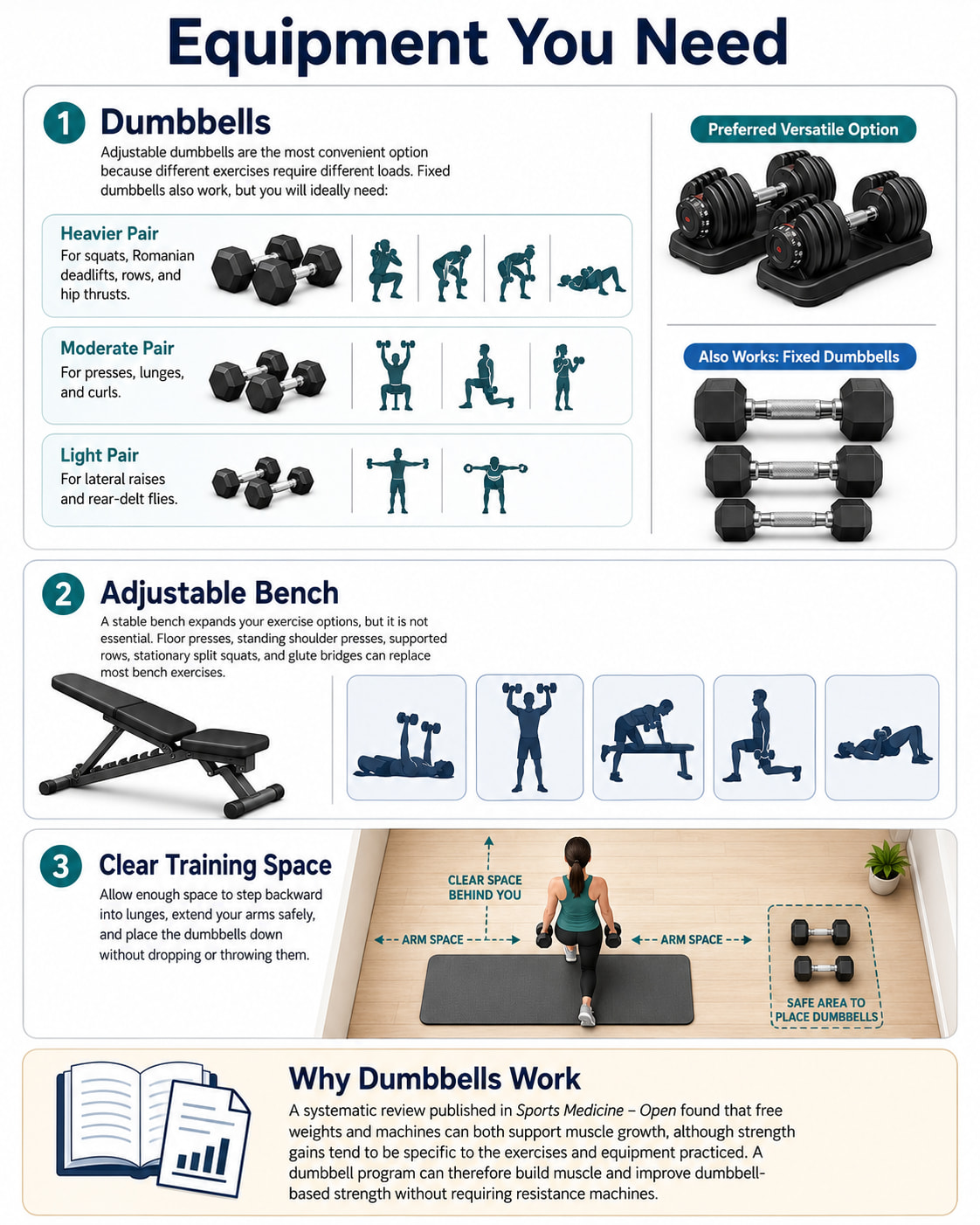
Dumbbells
Adjustable dumbbells are the most convenient option because different exercises require different loads. Fixed dumbbells also work, but you will ideally need:
- A heavier pair for squats, Romanian deadlifts, rows, and hip thrusts.
- A moderate pair for presses, lunges, and curls.
- A light pair for lateral raises and rear-delt flies.
Adjustable Bench
A stable bench expands your exercise options, but it is not essential. Floor presses, standing shoulder presses, supported rows, stationary split squats, and glute bridges can replace most bench exercises.
Clear Training Space
Allow enough space to step backward into lunges, extend your arms safely, and place the dumbbells down without dropping or throwing them.
A systematic review published in Sports Medicine – Open found that free weights and machines can both support muscle growth, although strength gains tend to be specific to the exercises and equipment practiced. A dumbbell program can therefore build muscle and improve dumbbell-based strength without requiring resistance machines.
How the 4-Day Dumbbell Workout Works
The first upper- and lower-body sessions use slightly lower repetition ranges on the main exercises. These workouts emphasize controlled, relatively heavy sets.
The second upper- and lower-body sessions use moderate or higher repetitions. These workouts provide additional training volume without requiring maximal dumbbell loads.
The general repetition ranges are:
| Exercise type | Repetition range |
|---|---|
| Main presses, rows, squats, and hinges | 6–10 reps |
| Secondary compound exercises | 8–15 reps |
| Raises, curls, extensions, and calves | 10–20 reps |
The updated ACSM position stand reports that heavier loading is especially useful for maximizing strength, while higher weekly training volume supports muscle growth. It also emphasizes that exercise prescriptions should be adjusted to the individual rather than treated as rigid rules.
How Hard Should Each Set Feel?
Use a weight that lets you complete the prescribed repetitions with controlled form while leaving approximately:
- 2–3 repetitions in reserve when learning an exercise.
- 1–2 repetitions in reserve on most established working sets.
- At least one good repetition remaining on demanding squats, hinges, and presses.
You do not need to take every set to complete muscle failure. A proximity-to-failure analysis published in Sports Medicine indicates that training closer to failure can support muscle growth, but repeatedly reaching failure is not necessary for most healthy trainees and can create additional fatigue.
How Long Should You Rest?
Rest long enough to repeat the next set with stable technique:
- Main compound exercises: 2–3 minutes.
- Unilateral leg exercises: 90–150 seconds.
- Raises, curls, extensions, and calf exercises: 60–90 seconds.
- Between sides: Take additional time when breathing or grip strength limits performance.
A systematic review available through the National Institutes of Health found a small muscle-growth advantage from resting longer than 60 seconds, potentially because longer rests help trainees maintain repetitions and total workload.
Warm Up Before Each Workout
Spend approximately 5–8 minutes preparing for the session.
Begin with two or three minutes of brisk walking, easy cycling, or marching in place. Follow that with several controlled repetitions of the main movement patterns you will train, such as bodyweight squats, unloaded hip hinges, arm circles, or light rows.
Before the first major exercise, complete one to three lighter warm-up sets. Gradually increase the weight without tiring yourself before the working sets begin.
The exercise instructions below use standard pressing, pulling, squatting, and hinging principles. The National Academy of Sports Medicine Exercise Library provides additional exercise demonstrations and technique guidance.
Day 1: Upper Body A
Day 1 emphasizes heavier upper-body pressing and rowing. Complete the exercises in the order shown.
| Exercise | Sets | Reps | Rest |
|---|---|---|---|
| Dumbbell Bench Press | 3 | 6–10 | 2–3 minutes |
| One-Arm Dumbbell Row | 3 | 6–10 per side | 90–150 seconds |
| Seated Dumbbell Shoulder Press | 3 | 8–10 | 2 minutes |
| Dumbbell Pullover | 2 | 10–15 | 60–90 seconds |
| Dumbbell Lateral Raise | 2 | 12–20 | 60–90 seconds |
1. Dumbbell Bench Press
Best for: Building chest strength and practicing a stable horizontal press.
Muscles worked: Pectoralis major, triceps, and anterior deltoids.
Equipment needed: Two dumbbells and a flat bench.
Sets, reps, and rest: 3 sets of 6–10 reps with 2–3 minutes of rest.
How to do it:
- Sit on the bench with a dumbbell resting on each thigh.
- Use your thighs to help guide the weights into position as you lie back.
- Plant your feet, brace your core, and gently draw your shoulder blades back against the bench.
- Lower the dumbbells toward the sides of your chest with your elbows angled slightly toward your torso.
- Press the weights upward until your arms are extended without forcefully locking the elbows.
Common mistakes: Avoid bending the wrists backward, flaring the elbows directly sideways, bouncing out of the bottom position, or lifting your hips off the bench.
Regression: Use a dumbbell floor press, which limits how far the elbows can travel behind the torso.
2. One-Arm Dumbbell Row
Best for: Building unilateral back strength and addressing differences between sides.
Muscles worked: Latissimus dorsi, rhomboids, middle trapezius, rear deltoids, and biceps.
Equipment needed: One dumbbell and a bench or stable support.
Sets, reps, and rest: 3 sets of 6–10 reps per side with 90–150 seconds of rest.
How to do it:
- Support one hand on a bench and place your feet in a stable staggered stance.
- Hinge forward while keeping your spine neutral and shoulders approximately level.
- Let the dumbbell hang beneath your shoulder without rounding your upper back.
- Pull your elbow toward your hip while keeping your torso still.
- Lower the dumbbell under control until your arm is extended.
Common mistakes: Do not twist the torso, shrug the working shoulder, jerk the weight upward, or turn the exercise into a biceps curl.
Regression: Use your free hand and knee on a bench for greater support.
3. Seated Dumbbell Shoulder Press
Best for: Developing overhead pressing strength with additional torso support.
Muscles worked: Anterior and lateral deltoids, triceps, and upper chest.
Equipment needed: Two dumbbells and an upright bench.
Sets, reps, and rest: 3 sets of 8–10 reps with approximately 2 minutes of rest.
How to do it:
- Sit with your back supported and your feet firmly planted.
- Hold the dumbbells near shoulder height with your wrists stacked over your elbows.
- Brace your abdomen and keep your ribs controlled.
- Press the dumbbells overhead without leaning excessively backward.
- Lower them slowly to a comfortable shoulder position.
Common mistakes: Avoid arching the lower back, pushing your head forward, bending the wrists, or lowering the dumbbells farther than your shoulders comfortably allow.
No-bench option: Perform a standing dumbbell shoulder press with a lighter load.
4. Dumbbell Pullover
Best for: Adding shoulder-extension work for the lats and chest.
Muscles worked: Latissimus dorsi, pectoralis major, serratus anterior, and triceps.
Equipment needed: One dumbbell and a bench.
Sets, reps, and rest: 2 sets of 10–15 reps with 60–90 seconds of rest.
How to do it:
- Lie lengthwise on a bench with your head and upper back supported.
- Hold one dumbbell securely above your chest with both hands.
- Keep a slight, fixed bend in your elbows.
- Lower the weight behind your head only as far as you can control without arching your back.
- Pull the dumbbell back above your chest.
Common mistakes: Do not chase excessive depth, flare the ribs, repeatedly bend and straighten the elbows, or use a weight that is difficult to hold securely.
No-bench option: Perform the movement lying on the floor, understanding that the floor will shorten the range of motion.
5. Dumbbell Lateral Raise
Best for: Directly training the middle portion of the shoulders.
Muscles worked: Lateral deltoids, with assistance from the upper trapezius and other shoulder stabilizers.
Sets, reps, and rest: 2 sets of 12–20 reps with 60–90 seconds of rest.
How to do it:
- Stand tall with light dumbbells beside your thighs.
- Keep your elbows slightly bent and your shoulders relaxed.
- Raise the weights slightly forward and outward until your arms reach approximately shoulder height.
- Pause briefly without shrugging.
- Lower the dumbbells slowly.
Common mistakes: Avoid swinging, raising the weights far above shoulder level, shrugging toward your ears, or choosing a weight that forces you to lean backward.
Progression: Add a brief pause at the top before increasing the weight.
Day 2: Lower Body A
Day 2 combines a squat, hip hinge, reverse lunge, hip-extension exercise, and calf raise.
| Exercise | Sets | Reps | Rest |
|---|---|---|---|
| Goblet Squat | 3 | 8–12 | 2–3 minutes |
| Dumbbell Romanian Deadlift | 3 | 6–10 | 2–3 minutes |
| Dumbbell Reverse Lunge | 3 | 8–10 per side | 90–150 seconds |
| Dumbbell Hip Thrust | 3 | 8–12 | 90–120 seconds |
| Standing Dumbbell Calf Raise | 3 | 10–15 | 60–90 seconds |
1. Goblet Squat
Best for: Developing squat technique, quadriceps strength, and lower-body muscle.
Muscles worked: Quadriceps, glutes, adductors, and core.
Equipment needed: One dumbbell.
Sets, reps, and rest: 3 sets of 8–12 reps with 2–3 minutes of rest.
How to do it:
- Hold one dumbbell vertically close to your chest.
- Stand with your feet approximately shoulder-width apart and toes turned slightly outward.
- Brace your trunk and lower your hips between your legs.
- Keep your knees tracking in the same general direction as your toes.
- Push through your whole feet to stand.
Common mistakes: Avoid letting the knees collapse inward, lifting the heels, losing control at the bottom, or allowing the dumbbell to drift away from your chest.
Progression: Move to a two-dumbbell front squat when one dumbbell no longer provides enough resistance.
2. Dumbbell Romanian Deadlift
Best for: Strengthening the hamstrings and glutes through a hip-hinge movement.
Muscles worked: Hamstrings, glutes, adductors, forearms, and spinal erectors as stabilizers.
Sets, reps, and rest: 3 sets of 6–10 reps with 2–3 minutes of rest.
How to do it:
- Stand with the dumbbells in front of your thighs and your knees slightly bent.
- Push your hips backward while keeping the weights close to your legs.
- Maintain a long, neutral spine as your torso leans forward.
- Stop when you feel strong hamstring tension or before your back begins to round.
- Drive your hips forward to stand tall.
Common mistakes: Do not turn the movement into a deep squat, let the weights drift forward, round your back, or lean backward at the top.
Regression: Practice the hip hinge without weight or use lighter dumbbells with a shorter range.
NASM describes the dumbbell Romanian deadlift as a hip-hinging movement that primarily develops the hamstrings, glutes, and posterior-chain stability.
3. Dumbbell Reverse Lunge
Best for: Building single-leg strength with less forward momentum than a forward lunge.
Muscles worked: Quadriceps, glutes, adductors, and hamstrings.
Sets, reps, and rest: 3 sets of 8–10 reps per side with 90–150 seconds of rest.
How to do it:
- Stand tall with a dumbbell in each hand.
- Step one foot backward and place the ball of that foot on the floor.
- Lower both knees while keeping most of your pressure through the front foot.
- Keep your front knee aligned with your toes.
- Push through the front foot to return to standing.
Common mistakes: Avoid stepping onto a narrow line, letting the front knee collapse inward, slamming the rear knee down, or pushing excessively from the rear foot.
Regression: Perform bodyweight reverse lunges while holding a stable support.
4. Dumbbell Hip Thrust
Best for: Training the glutes through loaded hip extension.
Muscles worked: Gluteus maximus, with assistance from the hamstrings and adductors.
Equipment needed: One dumbbell and a stable bench.
Sets, reps, and rest: 3 sets of 8–12 reps with 90–120 seconds of rest.
How to do it:
- Sit on the floor with your upper back against the side of a bench.
- Position a padded dumbbell across your hips.
- Plant your feet and brace your abdomen.
- Drive through your feet to lift your hips.
- Stop when your hips are extended and your torso is approximately level without arching your lower back.
Common mistakes: Avoid throwing your head backward, overextending the spine, bouncing the weight, or placing your feet so far away that you cannot use your glutes effectively.
No-bench option: Perform a weighted dumbbell glute bridge on the floor.
5. Standing Dumbbell Calf Raise
Best for: Training the calves with a simple standing movement.
Muscles worked: Gastrocnemius and soleus.
Sets, reps, and rest: 3 sets of 10–15 reps with 60–90 seconds of rest.
How to do it:
- Stand tall holding dumbbells at your sides.
- Use a wall or stable support when balance is difficult.
- Rise onto the balls of your feet as high as you can control.
- Pause briefly at the top.
- Lower your heels slowly.
Common mistakes: Avoid bouncing, rolling the ankles outward, shortening the range to lift more weight, or rushing the lowering phase.
Progression: Perform the exercise one leg at a time while holding a support.
Day 3: Rest or Active Recovery
Day 3 allows your upper and lower body to recover before the second half of the training week.
Complete rest is acceptable. You can also use easy walking, relaxed cycling, or comfortable mobility work. Keep the activity light enough that it does not reduce your performance on Day 4.
Do not try to compensate for a missed workout by completing two full sessions on the same day. Continue with the next workout in the sequence.
Day 4: Upper Body B
Day 4 uses moderate repetitions and additional shoulder and arm work.
| Exercise | Sets | Reps | Rest |
|---|---|---|---|
| Incline Dumbbell Bench Press | 3 | 8–12 | 2 minutes |
| Chest-Supported Dumbbell Row | 3 | 8–12 | 90–120 seconds |
| Dumbbell Rear-Delt Fly | 2 | 12–20 | 60–90 seconds |
| Dumbbell Hammer Curl | 2 | 10–15 | 60–90 seconds |
| Overhead Dumbbell Triceps Extension | 2 | 10–15 | 60–90 seconds |
1. Incline Dumbbell Bench Press
Best for: Training the chest and shoulders from a different pressing angle.
Muscles worked: Pectoralis major, particularly the upper portion, anterior deltoids, and triceps.
Equipment needed: Two dumbbells and an adjustable bench.
Sets, reps, and rest: 3 sets of 8–12 reps with approximately 2 minutes of rest.
How to do it:
- Set the bench to a low or moderate incline.
- Lie back with your feet planted and the dumbbells beside your upper chest.
- Keep your wrists over your forearms and your elbows angled slightly toward your torso.
- Press the dumbbells upward and slightly inward.
- Lower them under control until you reach a comfortable depth.
Common mistakes: Avoid setting the bench nearly vertical, arching excessively, flaring the elbows, or allowing the weights to drop quickly.
No-bench option: Use a neutral-grip dumbbell floor press.
NASM’s incline dumbbell press guidance emphasizes stable foot placement, controlled elbow positioning, and keeping the torso supported throughout the press.
2. Chest-Supported Dumbbell Row
Best for: Training the back while reducing the amount of work required from the lower back.
Muscles worked: Latissimus dorsi, rhomboids, middle trapezius, rear deltoids, and biceps.
Equipment needed: Two dumbbells and an adjustable bench.
Sets, reps, and rest: 3 sets of 8–12 reps with 90–120 seconds of rest.
How to do it:
- Set the bench to a low incline and lie face down with your chest supported.
- Let the dumbbells hang beneath your shoulders.
- Brace your trunk and keep your neck aligned with your spine.
- Pull your elbows back and slightly toward your hips.
- Lower the weights until your arms are extended.
Common mistakes: Avoid lifting your chest away from the bench, shrugging, flaring the elbows unnecessarily, or swinging the dumbbells.
No-bench option: Perform a bent-over dumbbell row or repeat the supported one-arm row.
3. Dumbbell Rear-Delt Fly
Best for: Directly training the rear shoulders and upper back.
Muscles worked: Posterior deltoids, rhomboids, and middle trapezius.
Sets, reps, and rest: 2 sets of 12–20 reps with 60–90 seconds of rest.
How to do it:
- Hold light dumbbells and hinge forward with a neutral spine.
- Let your arms hang with a small bend in your elbows.
- Raise your arms outward and slightly backward.
- Stop before your shoulders begin to shrug.
- Lower the weights slowly.
Common mistakes: Avoid using momentum, turning the movement into a row, straightening and bending the elbows repeatedly, or lifting weights that are too heavy to control.
Regression: Perform the exercise with your chest supported on an incline bench.
4. Dumbbell Hammer Curl
Best for: Building the biceps, brachialis, and forearms.
Muscles worked: Biceps brachii, brachialis, and brachioradialis.
Sets, reps, and rest: 2 sets of 10–15 reps with 60–90 seconds of rest.
How to do it:
- Stand tall with your palms facing your thighs.
- Keep your elbows close to your sides.
- Curl the dumbbells upward without rotating your palms.
- Pause when your forearms approach your upper arms.
- Lower the weights to full elbow extension under control.
Common mistakes: Avoid swinging your torso, moving the elbows far forward, bending the wrists, or dropping the dumbbells quickly.
Progression: Curl one arm at a time when heavier dumbbells make it difficult to remain stable.
5. Overhead Dumbbell Triceps Extension
Best for: Directly training the triceps through an overhead position.
Muscles worked: Triceps brachii, with particular emphasis on the long head.
Equipment needed: One dumbbell.
Sets, reps, and rest: 2 sets of 10–15 reps with 60–90 seconds of rest.
How to do it:
- Hold one dumbbell securely with both hands.
- Extend your arms overhead and brace your abdomen.
- Bend your elbows to lower the dumbbell behind your head.
- Keep your upper arms relatively stable.
- Extend your elbows to return the weight overhead.
Common mistakes: Avoid excessively flaring the elbows, arching your lower back, dropping the weight too deeply, or using a dumbbell you cannot grip securely.
Regression: Perform the exercise seated with back support or use one lighter dumbbell.
Day 5: Lower Body B
Day 5 uses unilateral and moderate-repetition exercises to train the legs from different positions.
| Exercise | Sets | Reps | Rest |
|---|---|---|---|
| Dumbbell Bulgarian Split Squat | 3 | 8–12 per side | 90–150 seconds |
| Dumbbell Sumo Squat | 3 | 10–15 | 90–120 seconds |
| Single-Leg Dumbbell Romanian Deadlift | 2 | 8–12 per side | 90–150 seconds |
| Dumbbell Glute Bridge | 3 | 10–15 | 90 seconds |
| Seated Dumbbell Calf Raise | 3 | 12–20 | 60–90 seconds |
1. Dumbbell Bulgarian Split Squat
Best for: Challenging each leg separately when dumbbell weight is limited.
Muscles worked: Quadriceps, glutes, adductors, and hamstrings.
Equipment needed: Two dumbbells and a stable bench.
Sets, reps, and rest: 3 sets of 8–12 reps per side with 90–150 seconds of rest.
How to do it:
- Stand in front of a bench and place the top of one foot behind you.
- Position your front foot far enough forward that you can lower comfortably.
- Keep most of your pressure through the front leg.
- Bend the front knee and lower your hips under control.
- Push through the front foot to stand.
Common mistakes: Avoid placing the feet on one narrow line, pushing mainly through the rear leg, letting the front heel rise, or losing control at the bottom.
Regression: Perform a stationary split squat with both feet on the floor.
2. Dumbbell Sumo Squat
Best for: Training the quadriceps, glutes, and inner thighs with a wider stance.
Muscles worked: Quadriceps, glutes, adductors, and core.
Equipment needed: One heavy dumbbell.
Sets, reps, and rest: 3 sets of 10–15 reps with 90–120 seconds of rest.
How to do it:
- Stand wider than shoulder width with your toes turned slightly outward.
- Hold one dumbbell vertically between your legs.
- Brace your trunk and lower your hips while allowing your knees to track over your toes.
- Descend as far as you can without rounding or losing foot pressure.
- Stand by pushing through your whole feet.
Common mistakes: Avoid using an excessively wide stance, allowing the knees to collapse inward, rounding forward, or letting the dumbbell pull your shoulders down.
Progression: Hold two dumbbells when one no longer provides enough resistance.
3. Single-Leg Dumbbell Romanian Deadlift
Best for: Training the hamstrings and glutes while improving single-leg control.
Muscles worked: Hamstrings, glutes, adductors, core, and hip stabilizers.
Sets, reps, and rest: 2 sets of 8–12 reps per side with 90–150 seconds of rest.
How to do it:
- Stand on one leg with a dumbbell in one or both hands.
- Keep the supporting knee slightly bent.
- Hinge at the hip while extending the other leg behind you.
- Keep your hips approximately square to the floor and the weight close to your body.
- Drive the supporting hip forward to stand.
Common mistakes: Avoid opening the hips to the side, rounding your back, reaching the dumbbell toward the floor instead of hinging, or rushing to regain balance.
Regression: Use a staggered-stance Romanian deadlift or hold a stable support with one hand.
4. Dumbbell Glute Bridge
Best for: Floor-based glute training without a bench.
Muscles worked: Gluteus maximus, with assistance from the hamstrings, adductors, and core.
Equipment needed: One dumbbell and an optional mat.
Sets, reps, and rest: 3 sets of 10–15 reps with approximately 90 seconds of rest.
How to do it:
- Lie on your back with your knees bent and feet flat.
- Position a padded dumbbell securely across your hips.
- Brace your abdomen and press through your feet.
- Lift your hips until your thighs and torso form a straight line.
- Squeeze your glutes briefly and lower under control.
Common mistakes: Avoid pushing mainly through your toes, overextending your lower back, bouncing off the floor, or letting the dumbbell move across your hips.
Progression: Add a pause at the top before attempting a single-leg version.
5. Seated Dumbbell Calf Raise
Best for: Training the calves with bent knees and minimal balance demands.
Muscles worked: Soleus, with assistance from the gastrocnemius.
Equipment needed: Two dumbbells and a bench or chair.
Sets, reps, and rest: 3 sets of 12–20 reps with 60–90 seconds of rest.
How to do it:
- Sit tall with your feet approximately hip-width apart.
- Place the dumbbells on your lower thighs, just above the knees rather than directly on the kneecaps.
- Keep the balls of your feet firmly planted.
- Raise your heels as high as you can control.
- Pause and lower them slowly.
Common mistakes: Avoid bouncing, placing the dumbbells directly on the knees, rolling the feet outward, or rushing through a very short range.
Progression: Place the balls of your feet on a low, stable platform to increase the range of motion.
No-Bench Dumbbell Workout Substitutions
A bench is useful, but you can still follow the program without one.
| Original exercise | No-bench alternative |
|---|---|
| Dumbbell Bench Press | Dumbbell Floor Press |
| Seated Dumbbell Shoulder Press | Standing Dumbbell Shoulder Press |
| Dumbbell Pullover | Floor Dumbbell Pullover |
| Dumbbell Hip Thrust | Dumbbell Glute Bridge |
| Incline Dumbbell Bench Press | Neutral-Grip Dumbbell Floor Press |
| Chest-Supported Dumbbell Row | Bent-Over or One-Arm Dumbbell Row |
| Bulgarian Split Squat | Stationary Dumbbell Split Squat |
Use a sturdy chair only when it cannot slide or tip. Do not use an unstable bed, sofa edge, rolling chair, or lightweight table as an exercise bench.
How to Choose the Right Dumbbell Weight
Choose the weight separately for each exercise. The dumbbells used for Romanian deadlifts should normally be heavier than those used for lateral raises.
A suitable working weight should allow you to:
- Complete at least the lower end of the repetition range.
- Maintain the same movement pattern from the first repetition to the last.
- Keep approximately 1–3 good repetitions in reserve.
- Finish without jerking, bouncing, shortening the range, or losing joint position.
When you cannot reach the minimum repetitions with proper form, reduce the load. When every set reaches the top of the range comfortably, increase it.
How to Progress the 4-Day Dumbbell Workout
Use a simple double-progression method.
For an exercise prescribed for 3 sets of 8–12 reps:
- Start with a weight you can control for approximately 8 reps per set.
- Keep the same weight while gradually adding repetitions.
- Once you can complete 12 controlled reps on all three sets, increase to the next available weight.
- Return to approximately 8 reps and begin building upward again.
Research published in the European Journal of Applied Physiology found that progressing by adding repetitions or increasing resistance can both produce muscle and strength gains.
When Your Dumbbells Are Too Light
Use these options in order:
- Reach the top of the prescribed repetition range.
- Slow the lowering phase to approximately three seconds.
- Add a controlled pause at the hardest position.
- Use a unilateral variation where appropriate.
- Increase the range of motion when it remains comfortable and controlled.
- Add one working set to the exercise.
Do not add more sets, slower repetitions, pauses, and extra workout days simultaneously. Change one variable and monitor your recovery.
Beginner and Intermediate Adjustments
Beginner Starting Option
During the first two weeks:
- Perform 2 working sets per exercise.
- Keep approximately 2–3 repetitions in reserve.
- Use the simpler regression when balance or setup is difficult.
- Focus on repeating the same technique rather than increasing weight immediately.
Move to the listed number of sets when you are recovering comfortably and your form remains consistent.
Intermediate Option
Intermediate trainees can use the program as written and gradually increase resistance. When a muscle group is recovering well but no longer progressing, add one set to one or two relevant exercises rather than adding several new movements.
ACSM’s current guidance identifies higher weekly volume—approximately 10 sets per muscle group—as a useful muscle-growth target, but individual tolerance and training experience still matter. More work is not automatically better when it reduces technique, recovery, or performance.
Common 4-Day Dumbbell Workout Mistakes
Using the Same Weight for Every Exercise
Large lower-body movements usually require more resistance than shoulder raises or arm exercises. Select weights according to the movement, repetition range, and your current ability.
Turning Every Set Into a Maximal Effort
Training to failure on every set can make later exercises and future workouts less productive. Keep most compound sets one to three controlled repetitions away from failure.
Adding Weight Before Repetitions Are Controlled
A heavier dumbbell is not progress when it causes swinging, shortened repetitions, joint discomfort, or loss of posture. Complete the current range with consistent form first.
Rushing the Rest Periods
Beginning the next set while your grip and breathing are still heavily fatigued may reduce performance. Longer rests are especially useful before rows, presses, squats, lunges, and Romanian deadlifts.
Changing the Exercises Every Week
Repeating the same movements allows you to improve technique and measure progress. Keep the main exercises for at least several weeks unless they cause discomfort or your equipment makes them impractical.
Ignoring Pulling Exercises
Presses train the chest, shoulders, and triceps, but they should not replace rows and rear-shoulder work. Keep both upper-body pulling sessions in the program.
A Limitation of Dumbbell-Only Back Training
Rows and pullovers provide useful back training, but dumbbells do not reproduce the same vertical pulling path as a pull-up or lat pulldown.
The program can still build the back with rows and pullovers. However, a pull-up, assisted pull-up, band pulldown, or cable lat pulldown can be added when that equipment is available. Replace the pullover rather than simply adding more exercises to an already long session.
Can You Add Cardio?
Yes. Place easy or moderate cardio:
- On Wednesday or Saturday.
- After an upper-body workout.
- Several hours apart from strength training when possible.
Avoid placing a demanding running, cycling, or interval session immediately before Lower Body A or Lower Body B. Your total workload, sleep, school or work demands, sports practice, and recovery capacity should all influence how much extra training you add. The NSCA recommends considering the combined workload from resistance and endurance exercise when determining training frequency.
Safety Tips
Use dumbbells you can lift, position, and place down safely. Adjustable dumbbells should be locked securely before every set.
Keep the training area clear and use only a bench or support that does not wobble, slide, or tip. Avoid dropping dumbbells near your feet or attempting to throw them aside after a difficult set.
Use a comfortable range of motion. Not everyone will squat to the same depth or lower a press to the same position.
Stop exercising and seek appropriate professional help if you experience sharp pain, numbness, dizziness, chest pain, faintness, or other unusual symptoms. People with an injury, health condition, or significant movement limitation should obtain individualized guidance before beginning the program.
Frequently Asked Questions
Is a 4 day dumbbell workout enough to build muscle?
Yes. Four days provide enough opportunities to train each major muscle group approximately twice per week. Muscle growth still depends on using challenging resistance, completing sufficient weekly work, progressing over time, eating appropriately, and recovering between sessions.
Can beginners follow this workout?
Beginners with basic exercise technique can follow it by performing two sets per exercise and keeping two or three repetitions in reserve. Someone completely new to resistance training may find a two- or three-day full-body program easier to learn and recover from initially.
How heavy should my dumbbells be?
Use a weight that allows you to reach the prescribed range with controlled technique and approximately one to three repetitions remaining. You will need lighter dumbbells for raises and curls and heavier dumbbells for rows, squats, hinges, and hip thrusts.
How long should I follow this program?
Follow the plan for approximately 8–12 weeks. Continue beyond that when you are still progressing and enjoying the routine. Change exercises only when equipment, discomfort, boredom, or a specific training goal gives you a clear reason.
What should I do when I miss a workout?
Complete the missed workout on the next available training day and continue through the sequence. Do not skip directly to the workout assigned to that calendar day, and do not combine two full sessions to catch up.
Can I train four days in a row?
It is possible because upper and lower sessions target different areas, but it is usually more practical to place a rest day after the first two workouts. The standard Monday, Tuesday, Thursday, and Friday schedule provides a better balance between consistency and recovery.
Do I need to change my diet?
Training provides the stimulus, but food intake supports performance and recovery. Eat regular balanced meals containing sufficient protein, carbohydrates, fats, and overall energy. Avoid extreme diets or aggressive restriction, particularly while still growing.
Conclusion
A successful 4 day dumbbell workout does not need complicated exercises or constant program changes. Train the upper and lower body twice per week, use controlled technique, leave a small number of repetitions in reserve, and gradually add weight or repetitions.
Start with manageable volume, record your sets and reps, and give the program enough time to work before changing it.
This content is for informational purposes only and is not a substitute for professional medical advice.
References
- American College of Sports Medicine Position Stand: Resistance Training Prescription for Muscle Function, Hypertrophy, and Physical Performance in Healthy Adults
- Efficacy of Split Versus Full-Body Resistance Training on Strength and Muscle Growth: A Systematic Review With Meta-Analysis
- Resistance Training Prescription for Muscle Strength and Hypertrophy in Healthy Adults: A Systematic Review and Bayesian Network Meta-Analysis
- Machines and Free-Weight Exercises: A Systematic Review and Meta-Analysis Comparing Changes in Muscle Size, Strength, and Power
- Give It a Rest: A Systematic Review With Bayesian Meta-Analysis on Inter-Set Rest Intervals and Muscle Hypertrophy
- Effects of Resistance Training Overload Progression Protocols on Strength and Muscle Mass