The dumbbell pullover is an upper-body accessory exercise that works the chest, lats, serratus anterior, and long head of the triceps as you move a dumbbell through a controlled overhead arc. Proper form requires a secure grip, a stable elbow position, and a range of motion that does not cause your ribs to flare or your lower back to arch.
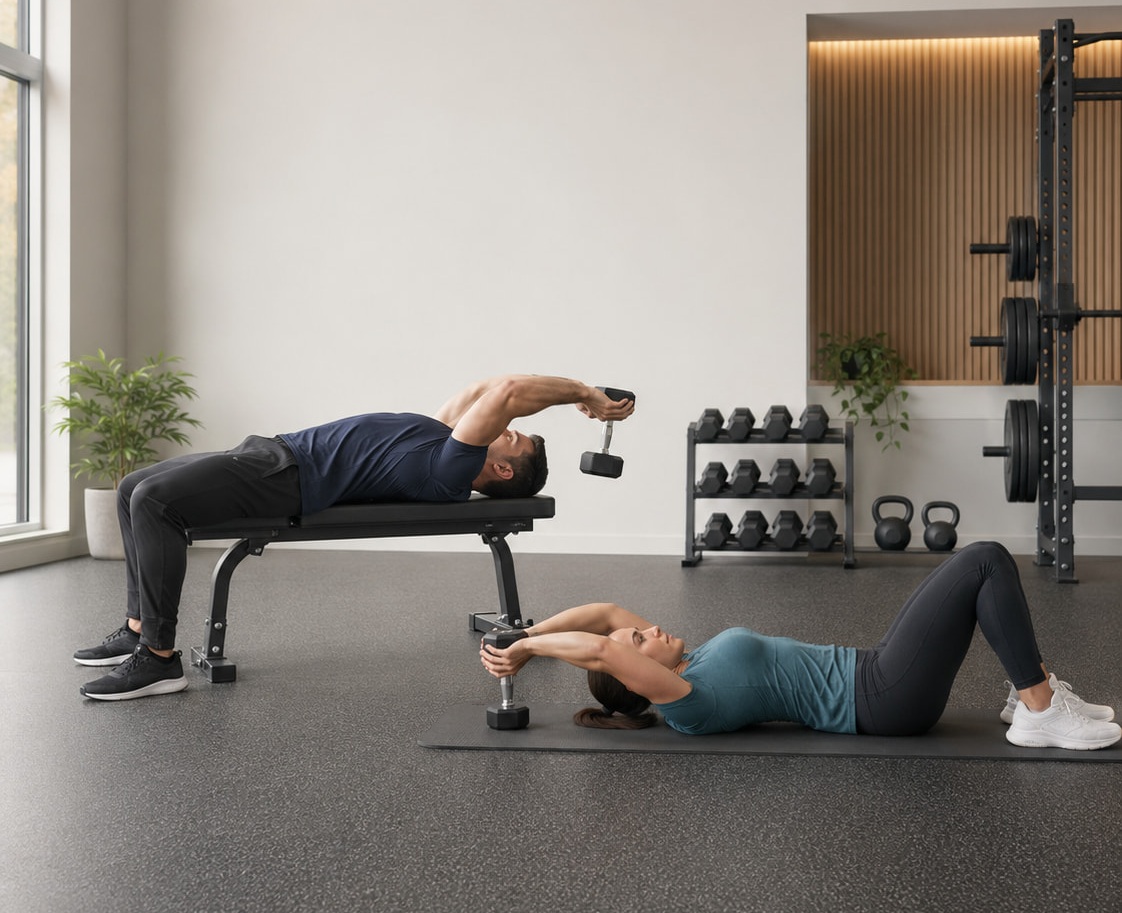
You can include the dumbbell pullover in a chest, back, or general upper-body workout. However, it should complement presses, rows, and pulldowns rather than replace them.
Dumbbell Pullover at a Glance
| Category | Details |
|---|---|
| Best for | Upper-body accessory training, controlled overhead movement, chest or back workouts |
| Main muscles worked | Pectoralis major, latissimus dorsi, long head of the triceps |
| Assisting muscles | Serratus anterior, teres major, shoulder stabilizers, abdominal muscles |
| Equipment needed | One secure dumbbell and a flat bench |
| Suggested range | 2–3 sets of 8–15 repetitions |
| Rest | 60–120 seconds |
| Training level | Beginner to intermediate |
| Main movement | Shoulder extension from an overhead position |
How to Do a Dumbbell Pullover
Best for: Adding a controlled shoulder-extension exercise to chest, back, or upper-body training.
Muscles worked: Pectoralis major, latissimus dorsi, long head of the triceps, serratus anterior, and teres major.
Equipment needed: One fixed-head dumbbell and a stable flat bench. A mat can be used for the floor variation.
Sets, reps, and rest: Start with 2–3 sets of 8–15 repetitions. Rest for 60–120 seconds between sets.
Step-by-Step Instructions
- Sit at the end of a flat bench with a light dumbbell resting securely on your thigh.
- Lie back lengthwise so your head, upper back, and hips remain supported by the bench. Plant both feet firmly on the floor.
- Hold the dumbbell securely with both hands around one end. Position it above your forehead or upper chest.
- Keep a small bend in your elbows. Maintain that elbow angle throughout the repetition.
- Brace your abdominal muscles and keep your ribs controlled without forcing your lower back completely flat.
- Slowly lower the dumbbell behind your head in a smooth arc.
- Stop when you reach the deepest position you can control without shoulder discomfort, rib flare, excessive back arching, or a change in elbow position.
- Pull the dumbbell back along the same path until it is above your forehead or upper chest.
- Reset your ribs and shoulders before beginning the next repetition.
Both the American Council on Exercise and the National Strength and Conditioning Association emphasize a supported position and controlled movement into an overhead range. The NSCA also recommends keeping a slight bend in the elbows and using the floor when a more limited range is needed.
Coaching cue: Keep your elbows quiet and move your upper arms as one unit.
How Far Should You Lower the Dumbbell?
Lower the dumbbell only as far as your shoulders and torso can comfortably control.
For some people, the upper arms may reach approximately level with the torso. Others may need to stop sooner because of their shoulder structure, training experience, or available overhead range.
A productive repetition does not require the dumbbell to approach the floor. End the lowering phase when any of the following occurs:
- Your lower back begins to arch noticeably.
- Your ribs lift away from the bench.
- Your elbows bend further.
- Your shoulders shift into an uncomfortable position.
- You can no longer control the dumbbell’s speed.
A shorter, stable repetition is more useful than a deeper repetition performed with poor control.
Dumbbell Pullover Muscles Worked
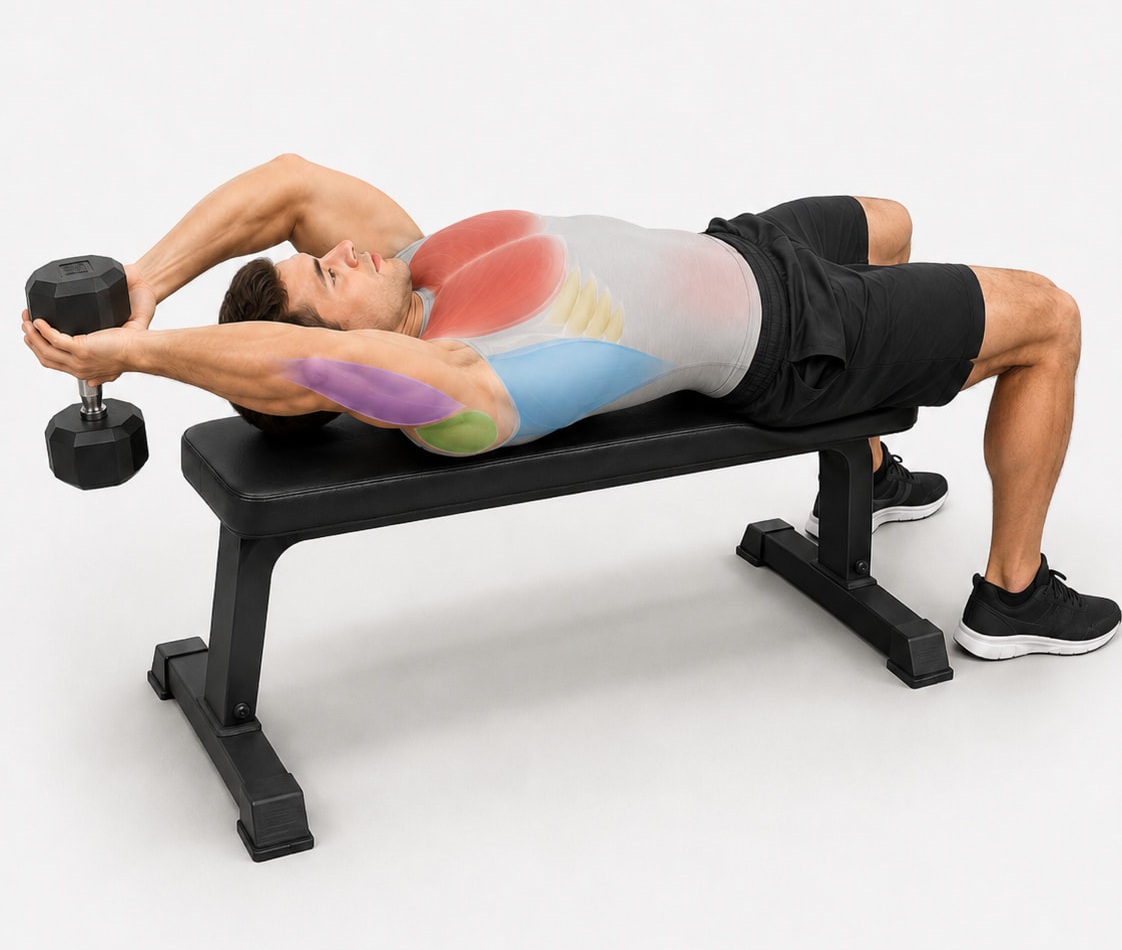
The dumbbell pullover is sometimes described as either a chest exercise or a back exercise. In practice, several muscles contribute to the movement.
Pectoralis Major
The pectoralis major is the large muscle covering the front of the chest. Its sternocostal fibers can help extend the upper arm from a flexed or overhead position, which allows the chest to contribute as the dumbbell moves back toward the torso, as described in the NCBI Bookshelf anatomy reference.
Latissimus Dorsi
The latissimus dorsi extends, adducts, and internally rotates the upper arm. During a pullover, it helps move the upper arm downward from the overhead position.
The amount of lat involvement can vary with shoulder position, technique, range of motion, and individual anatomy.
Long Head of the Triceps
The long head is the only portion of the triceps that crosses both the elbow and shoulder joints. It assists with shoulder extension and adduction while also helping stabilize the elbow as you hold the dumbbell overhead.
Teres Major
The teres major assists the lats with extension, adduction, and internal rotation of the upper arm. It works as a supporting muscle rather than being the main reason to perform the exercise.
Serratus Anterior
The serratus anterior helps control the shoulder blades as the arms move overhead. Its role is primarily scapular movement and stability rather than directly pulling the dumbbell.
Abdominal Muscles
Your abdominal muscles work isometrically to control the rib cage and resist excessive spinal extension. They should stabilize your torso rather than actively crunching your body during the repetition.
Is the Dumbbell Pullover a Chest or Back Exercise?
The dumbbell pullover can train both the chest and back, but it should not be assumed to work them equally.
A small study indexed by PubMed involving eight men found greater pectoralis major activity than latissimus dorsi activity during a free-weight barbell pullover. However, the study used a barbell rather than a dumbbell and measured one set of ten repetitions, so the results should not be treated as definitive proof that every pullover variation is primarily a chest exercise.
The study also measured short-term electrical activity rather than long-term muscle growth.
Your technique and anatomy can influence where you feel the movement. Elbow angle, shoulder position, limb length, load, and range of motion may all affect muscular contribution.
For practical programming:
- Use it after chest presses when you want an additional chest-focused accessory.
- Use it after rows or pulldowns when you want an additional shoulder-extension exercise.
- Use it on an upper-body day when you want to train several contributing muscles with one movement.
The pullover should not be your only chest or back exercise. Presses provide a more direct horizontal pressing pattern, while rows and pulldowns provide more direct back-training patterns.
Benefits of the Dumbbell Pullover
Trains the Upper Body Through an Overhead Arc
The exercise loads the upper body as the arms move from an overhead position toward the torso. This movement differs from standard presses, rows, curls, and lateral raises.
Works Several Muscles in One Exercise
The chest, lats, triceps, serratus anterior, teres major, and torso stabilizers can all contribute. This makes the pullover a useful accessory when you want to train several connected functions without adding multiple isolation exercises.
Requires Minimal Equipment
You need only one dumbbell and a stable bench. A floor variation is also available when a bench is unavailable or when a shorter range is more appropriate.
Can Be Used on Different Training Days
The pullover can fit into:
- Chest workouts
- Back workouts
- Upper-body sessions
- Full-body dumbbell routines
- Short accessory finishers
Its classification matters less than whether its placement supports the rest of your workout.
Provides an Easy-to-Adjust Training Stimulus
You can modify the exercise by changing the dumbbell weight, repetition range, lowering speed, elbow angle, or range of motion. This allows you to make the movement easier without completely changing the exercise.
May Help You Practice Controlled Overhead Movement
A light pullover can help you practice moving into an overhead position while controlling your ribs and spine. It should not be described as a treatment for shoulder problems or as a guaranteed way to improve mobility.
Common Dumbbell Pullover Mistakes
Using Too Much Weight
A heavy dumbbell often causes the elbows to bend, the lower back to arch, or the weight to move too quickly.
Use a weight that allows you to pause at any point during the repetition. The dumbbell pullover is better suited to controlled accessory training than maximal loading.
Lowering the Dumbbell Too Far
Do not chase the deepest possible stretch. Lower only until you reach the end of your controlled range.
Stopping earlier is appropriate when additional depth causes rib flare, back arching, shoulder discomfort, or loss of control.
Turning It Into a Triceps Extension
Your elbows should remain slightly bent but stable. Repeatedly bending and straightening them changes the movement into a combination of a pullover and triceps extension.
Flaring the Ribs
Rib flare usually occurs when the dumbbell travels farther than the shoulders can comfortably manage. Brace your abdominal muscles and shorten the range if your ribs begin lifting.
Arching the Lower Back
A small natural spinal curve is normal. Excessive arching to create more range is not.
Keep your hips supported and avoid forcing the dumbbell lower by extending your spine.
Returning the Dumbbell Too Far Forward
Finish with the dumbbell above your forehead or upper chest. Allowing it to travel over your stomach can reduce control and create an unnecessary resting point between repetitions.
Moving Too Quickly
A fast descent increases the demand on your grip and shoulders. Lower the weight over approximately two or three seconds and reverse the movement smoothly.
Using an Insecure Dumbbell
Inspect the dumbbell before training. Fixed-head dumbbells are generally easier to hold securely for this exercise.
Do not suspend a plate-loaded dumbbell above your face if its plates, collars, or locking mechanism could loosen.
Beginner Dumbbell Pullover Regressions
Floor Dumbbell Pullover
The floor acts as a physical stop when your upper arms reach it, limiting how far the dumbbell can travel behind your head.
How to use it:
- Lie on the floor with your knees bent.
- Hold the dumbbell above your forehead.
- Lower it until your upper arms lightly contact the floor.
- Return without bouncing your arms off the ground.
The floor pullover is useful for beginners and anyone who needs a clearly limited overhead range of motion.
Short-Range Bench Pullover
Use the regular bench setup but stop well before your upper arms reach torso level. Gradually increase the range only when you can maintain your elbow, rib, and spinal positions.
Light Bent-Elbow Pullover
Using a slightly larger elbow bend shortens the lever and can make the dumbbell easier to control. Keep that angle fixed rather than turning the exercise into an elbow-extension movement.
Lower-Load Pullover
Reducing the load is often the best regression. A lighter dumbbell allows you to learn the shoulder path and identify your comfortable range without fighting the weight.
Dumbbell Pullover Progressions
Increase Repetitions
Begin at the lower end of an 8–15 repetition range. Add one or two repetitions over time while maintaining the same depth and control.
Increase the Load Gradually
Once you can complete every set at the top of your repetition range with approximately two controlled repetitions remaining, increase the dumbbell by the smallest practical amount.
Return to the lower end of the repetition range after adding weight.
Use a Slower Lowering Phase
Lower the dumbbell for three or four seconds. A slower descent increases control and makes a light weight more challenging without requiring a large load increase.
Add a Brief Pause
Pause for one second at the end of your comfortable overhead range. Do not relax or allow the dumbbell to pull your shoulders into a deeper position.
Single-Arm Dumbbell Pullover
Performing the exercise with one arm increases the torso’s anti-rotation demand. Use a much lighter dumbbell and keep your ribs, shoulders, and hips level.
This is a progression for experienced lifters, not the best version for learning the movement.
How to Program the Dumbbell Pullover
The dumbbell pullover usually works best near the middle or end of a workout after your heavier pressing and pulling exercises.
Recommended Starting Point
- Sets: 2–3
- Repetitions: 8–15
- Rest: 60–120 seconds
- Effort: Finish with approximately 1–3 controlled repetitions remaining
- Frequency: 1–2 times per week
- Tempo: Lower for 2–3 seconds and return under control
The 2026 American College of Sports Medicine resistance-training guidance emphasizes consistency, gradual progression, individualization, and matching training volume to the goal. It also notes that advanced techniques and taking every set to complete muscular failure are not required for most healthy adults.
Where to Place It in a Workout
For a chest-focused session:
- Perform your main dumbbell or barbell press.
- Complete a second press or fly variation.
- Use the pullover as a controlled accessory.
For a back-focused session:
- Perform your main row or pulldown.
- Complete a second back exercise.
- Use the pullover for additional shoulder-extension work.
Avoid performing challenging pullovers immediately before a heavy bench press, overhead press, pull-up, or pulldown. Fatiguing the chest, lats, triceps, or shoulder stabilizers may reduce your performance in those larger movements.
How to Progress
Use a simple repetition-based progression:
- Select a weight you can perform for 8–10 controlled repetitions.
- Keep the same weight until you can complete 12–15 repetitions on every set.
- Increase the dumbbell by the smallest available amount.
- Return to approximately 8–10 repetitions.
- Build upward again without changing your technique.
Do not increase the weight if you must bend your elbows, shorten the movement unintentionally, arch your back, or move the dumbbell quickly.
Sample Upper-Body Workout With Dumbbell Pullovers
Complete this workout one or two times per week on nonconsecutive days.
| Exercise | Sets | Reps | Rest |
|---|---|---|---|
| Dumbbell bench press | 3 | 6–10 | 90–150 seconds |
| One-arm dumbbell row | 3 per side | 8–12 | 90–120 seconds |
| Dumbbell pullover | 2–3 | 10–15 | 60–120 seconds |
| Dumbbell lateral raise | 2 | 12–15 | 60–90 seconds |
Finish most sets with approximately two good repetitions remaining. Start with two pullover sets and add a third only when you recover comfortably and maintain consistent technique.
Warm up before the first challenging exercise with one or more lighter sets. You generally do not need a separate exhaustive warm-up specifically for the pullover if your chest, back, shoulders, and elbows are already prepared from the earlier exercises.
Dumbbell Pullover Safety Tips
- Use a stable bench that does not wobble or slide.
- Keep your head, upper back, and hips supported.
- Inspect the dumbbell before lifting it over your face.
- Begin with a lighter weight than you expect to need.
- Maintain a secure two-handed grip.
- Control both the lowering and lifting phases.
- Do not force the dumbbell into a painful overhead position.
- Keep the area behind your head free of equipment.
- Use the floor variation when you need a more clearly limited range.
- Ask a qualified trainer to check your setup when you are unsure about your grip or shoulder position.
The pullover may not be appropriate when you cannot comfortably raise your arms overhead or when the movement aggravates an existing shoulder, elbow, neck, or back problem.
Stop the exercise and seek professional help if it causes sharp pain, numbness, dizziness, chest pain, or other unusual symptoms.
Frequently Asked Questions
Are Dumbbell Pullovers Mainly for the Chest or Lats?
Both muscles can contribute. Limited barbell pullover research found greater pectoralis major activity than latissimus dorsi activity, but the study was small and did not test the exact one-dumbbell version commonly performed in gyms.
Use pullovers as an accessory rather than relying on them as your only chest or back exercise.
How Heavy Should a Dumbbell Pullover Be?
Use a light-to-moderate weight that you can control for at least 8 repetitions without changing your elbow angle, arching your lower back, or rushing the lowering phase.
The weight should feel challenging near the end of the set, but you should still have approximately one to three controlled repetitions remaining.
Should Your Arms Be Straight During a Dumbbell Pullover?
Keep a small bend in your elbows rather than locking them completely. The important point is to maintain approximately the same elbow angle throughout the repetition.
Too much elbow movement turns the exercise into a partial triceps extension.
How Low Should the Dumbbell Go?
Lower it only until you reach the end of your comfortable and controlled overhead range. You do not need to bring the dumbbell close to the floor.
Stop when your ribs flare, your back arches, your elbows move, or your shoulders become uncomfortable.
Is a Dumbbell Pullover Better on a Bench or the Floor?
The bench allows a larger potential range of motion. The floor limits the lowering phase when the upper arms contact the ground, making it a useful beginner modification.
Neither version is automatically better. Choose the setup that lets you maintain the most control.
Do Dumbbell Pullovers Expand the Rib Cage?
There is no good evidence that dumbbell pullovers permanently enlarge an adult’s rib cage. The exercise may create a temporary stretching sensation around the chest and upper body, but it should not be promoted as a way to change skeletal structure.
Conclusion
The dumbbell pullover is most useful as a controlled accessory for the chest, lats, serratus anterior, and long head of the triceps. Use a secure dumbbell, support your full torso on the bench, keep your elbows slightly bent, and stop the lowering phase before your ribs or lower back begin to compensate.
Start with two light sets, build toward 8–15 controlled repetitions, and increase the weight only after your technique and comfortable range remain consistent.
This content is for informational purposes only and is not a substitute for professional medical advice.
References
- American Council on Exercise: Lying Pullovers
- National Strength and Conditioning Association: Resistance Training Progressions—Pulls and Rows
- Effects of the Pullover Exercise on the Pectoralis Major and Latissimus Dorsi Muscles
- Electromyographic Activation of the Pectoralis Major and Triceps Brachii During the Dumbbell Pullover
- Differences Between Pullover and Pulldown Exercises in Muscle Activity and Force
- American College of Sports Medicine: Resistance Training Prescription for Healthy Adults
3 thoughts on “Dumbbell Pullover: Proper Form, Muscles Worked & Benefits”