The dumbbell Bulgarian split squat is a rear-foot-elevated single-leg exercise that primarily trains the quadriceps and glutes while also challenging balance, hip stability, and trunk control. Holding a dumbbell in each hand lets you progressively load the movement without requiring a barbell.
This guide explains how to set up the exercise, use proper form, understand the muscles worked, avoid common mistakes, choose an appropriate weight, and add Bulgarian split squats to a lower-body workout.
What Is a Dumbbell Bulgarian Split Squat?
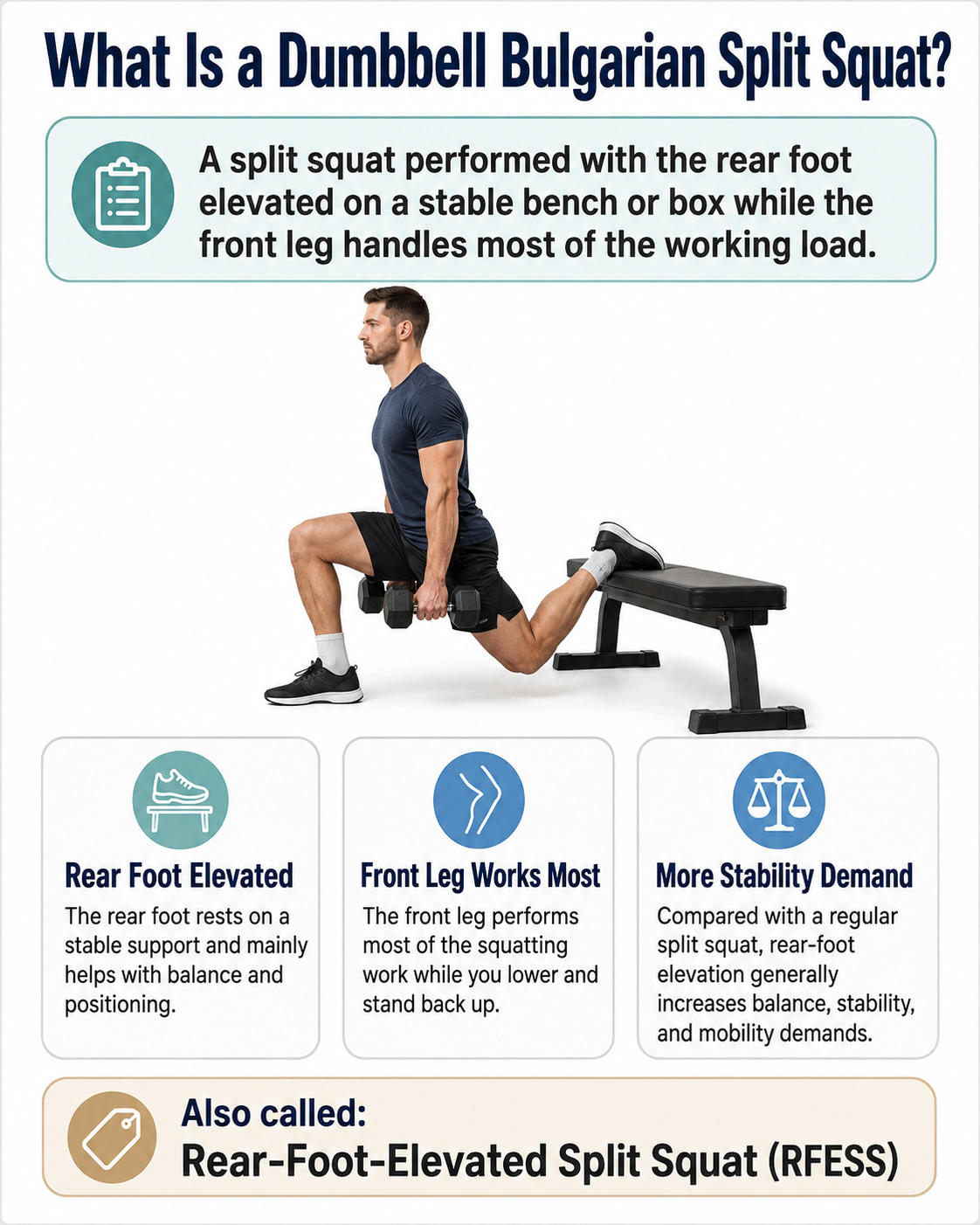
A dumbbell Bulgarian split squat is a split squat performed with the rear foot elevated on a stable bench, box, or similar support. Most of the working load is handled by the front leg while the rear leg helps provide balance and positioning.
Unlike a regular split squat, where both feet remain on the floor, elevating the rear foot generally increases the stability and mobility demands.
The National Academy of Sports Medicine describes the Bulgarian split squat as a unilateral lower-body exercise and includes holding dumbbells at the sides as a way to add resistance.
The exercise is also commonly called a rear-foot-elevated split squat, or RFESS.
Dumbbell Bulgarian Split Squat at a Glance
| Category | Details |
|---|---|
| Exercise type | Unilateral lower-body strength exercise |
| Main muscles | Quadriceps, gluteus maximus |
| Assisting muscles | Hamstrings, adductors, hip stabilizers, core |
| Equipment | Two dumbbells and a stable bench or box |
| Difficulty | Intermediate |
| Typical reps | 6–15 per leg |
| Typical sets | 2–4 |
| Rest | 1–3 minutes |
| Best for | Single-leg strength, muscle development, balance and stability |
Dumbbell Bulgarian Split Squat Muscles Worked
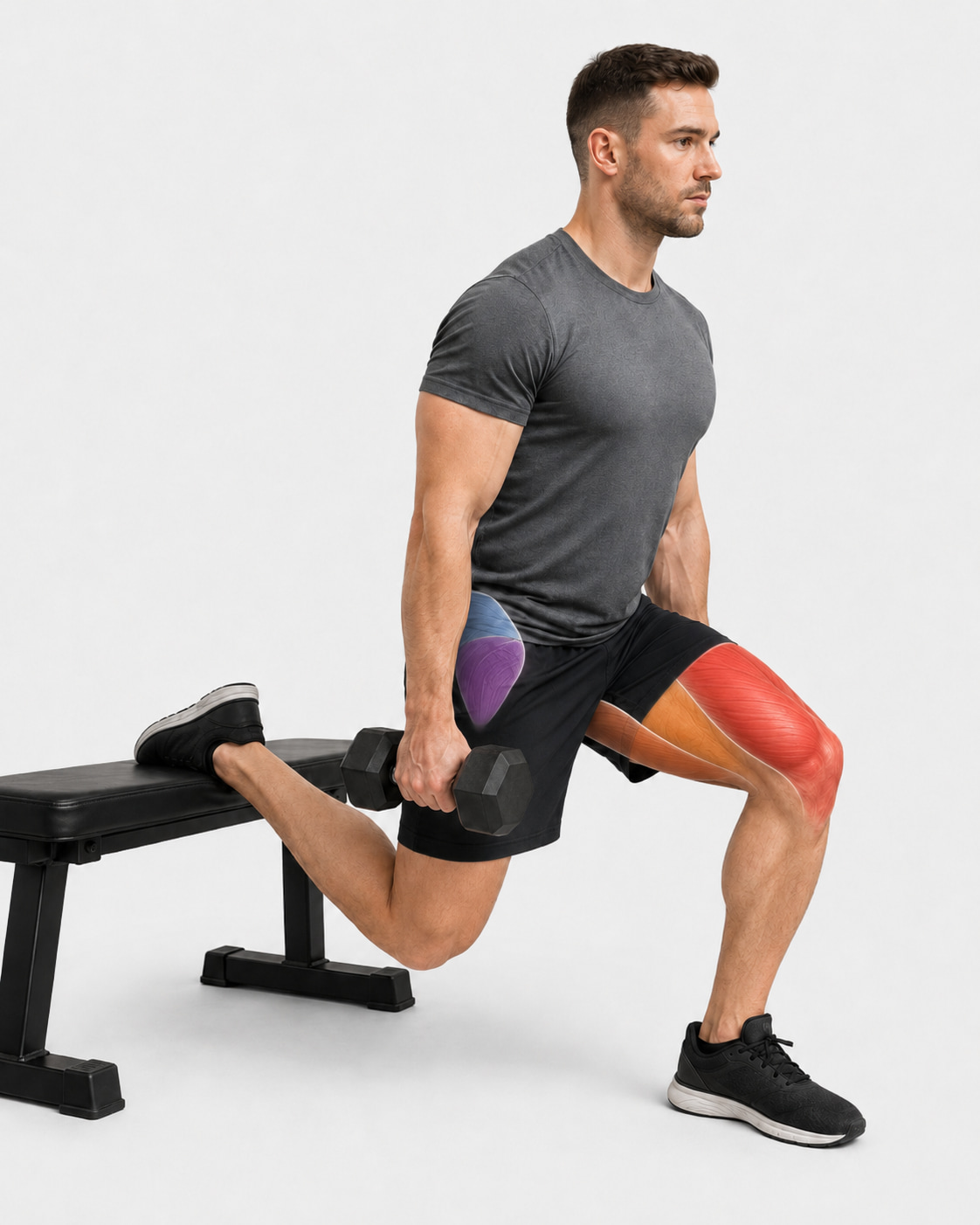
The Bulgarian split squat uses several muscles at the hip and knee rather than isolating a single muscle.
| Muscle | Main Role |
|---|---|
| Quadriceps | Extend the front knee as you stand |
| Gluteus maximus | Extends the hip and helps drive you upward |
| Hamstrings | Assist hip extension and stabilize the front leg |
| Adductors | Help control the hip and stabilize the pelvis |
| Gluteus medius and hip stabilizers | Control the pelvis and reduce side-to-side movement |
| Core and trunk muscles | Keep the torso stable while holding the dumbbells |
Benefits of Dumbbell Bulgarian Split Squats
- Builds Single-Leg Strength
Each leg works independently, helping you develop more balanced lower-body strength. - Trains the Quads and Glutes
The exercise works both the knees and hips, making it effective for strengthening the quads and glutes together. - Improves Balance and Stability
The split stance challenges your hips, core, ankle, and front leg to keep your body controlled. - Easy to Progress With Dumbbells
You can gradually increase the weight as your strength and technique improve without needing a barbell. - Makes Moderate Weights Challenging
Because the front leg handles most of the workload, you can train hard without using extremely heavy dumbbells. - Fits Easily Into Leg Workouts
Use Bulgarian split squats as a main single-leg exercise or after squats, deadlifts, or other lower-body movements.
How to Do a Dumbbell Bulgarian Split Squat
Best for: Building unilateral leg strength and developing the quadriceps and glutes.
Equipment needed: Two dumbbells and a stable bench or box.
Sets, reps, and rest: Start with 2–3 sets of 8–12 reps per leg. Rest about 60–180 seconds between sets depending on the weight and effort.
How to Do It
- Stand about a stride in front of a stable bench or box while holding one dumbbell in each hand.
- Reach one foot behind you and place the top of the foot or toes comfortably on the support.
- Keep the front foot flat, brace your trunk, and square your hips generally forward.
- Bend the front hip and knee while lowering the rear knee toward the floor.
- Descend as far as you can while maintaining control, a stable front foot, and comfortable joint positions.
- Push through the front foot and extend the front hip and knee to return to standing.
- Complete all repetitions on one side, then switch legs.
Coaching cue: Think about lowering your body straight down between your feet rather than pushing dramatically forward or backward.
How to Set Up Your Stance Correctly
There is no single perfect foot distance for everyone. Leg length, mobility, bench height, and training goal all affect the setup.
Start approximately one normal stride away from the bench, then adjust.
Your stance is probably workable when:
- Your front foot stays fully planted.
- You can lower the rear knee comfortably.
- Your front knee tracks naturally with the foot.
- You are not forced onto the front toes.
- You do not feel excessively stretched through the rear hip.
- You can maintain balance without constantly hopping the front foot.
If the front foot is too close, you may feel cramped and struggle to descend comfortably.
If the front foot is too far away, the movement can become awkward and you may have difficulty controlling the bottom position.
Make small adjustments rather than trying to match someone else’s exact stance.
Should Your Front Knee Go Over Your Toes?
It can.
Your knee does not need to remain permanently behind your toes during a Bulgarian split squat. Some forward knee movement is a normal part of squatting for many people.
Instead of trying to prevent all forward knee travel, focus on:
- Keeping the whole front foot planted.
- Allowing the knee to track in the same general direction as the toes.
- Avoiding uncontrolled inward collapse.
- Using a range of motion you can control comfortably.
People with different limb lengths and ankle mobility will naturally show different knee positions.
Should You Keep Your Torso Upright?
A relatively upright torso is a useful starting position, but you do not have to keep your body perfectly vertical.
A small, controlled forward lean from the hips can be normal and may increase the demand on the hip extensors. Research examining Bulgarian split squat variations has found greater gluteus maximus and hamstring activity with a forward-inclined trunk compared with a more neutral trunk position.
The key distinction is control.
A deliberate hip hinge with a neutral spine is different from:
- Rounding your back
- Collapsing forward
- Losing abdominal tension
- Leaning excessively because the weight is too heavy
Use the torso position that matches your goal while maintaining stable technique.
Quad vs. Glute Emphasis
Bulgarian split squats train both the quadriceps and glutes, but small technique changes can influence where you feel the exercise most.
For More Quadriceps Emphasis
Generally:
- Use a comfortable but slightly shorter stance.
- Allow natural forward knee travel.
- Keep the torso relatively upright.
- Use a controlled, deep range of motion.
This usually increases knee flexion and therefore the demand on the quadriceps.
For More Glute Emphasis
Generally:
- Use a stance that allows greater hip flexion.
- Use a small controlled forward torso inclination.
- Sit slightly more into the front hip while keeping the foot planted.
- Avoid turning the movement into an exaggerated lunge backward.
These adjustments may increase hip-extension demands.
Do not try to completely remove either the quads or glutes from the movement. Both are important contributors.
Common Dumbbell Bulgarian Split Squat Mistakes
Using Too Much Weight
Heavy dumbbells are not useful if you cannot control the descent or maintain balance. Reduce the load until every repetition looks consistent.
Front Knee Collapsing Inward
Keep the knee tracking generally with the toes instead of letting it repeatedly fall toward the midline.
Pushing Too Much Through the Rear Leg
The back leg helps with balance, but the front leg should perform most of the work. Avoid deliberately driving hard through the elevated foot.
Losing the Front Foot
Keep the heel, base of the big toe, and base of the little toe firmly supported rather than rolling onto the toes or outside edge.
Dropping Too Quickly
Lower under control. Bouncing into the bottom makes balance harder and reduces your ability to maintain good positioning.
Using an Excessively High Bench
A high support is not automatically better. If the rear hip feels excessively stretched or the setup forces your pelvis into an awkward position, use a lower surface.
Rounding the Back
A forward torso angle can be acceptable, but the spine should remain controlled. Do not confuse intentional hip flexion with spinal collapse.
Cutting Depth to Lift More Weight
Only add load when you can maintain a useful, controlled range of motion. Shortening every rep simply to hold heavier dumbbells usually reduces training quality.
Dumbbell Bulgarian Split Squat Regressions
The full exercise can be difficult for beginners because it combines strength and balance.
Regular Split Squat
Keep both feet on the floor and practice lowering straight down. This removes the rear-foot elevation and makes balance easier.
Supported Split Squat
Lightly hold a squat rack, rail, or other secure support while practicing the split-squat pattern.
Supported Bulgarian Split Squat
Elevate the rear foot but hold a stable object with one hand. This lets you train the movement while reducing the balance requirement.
Bodyweight Bulgarian Split Squat
Once the setup feels stable, practice the exercise without dumbbells before adding external resistance.
Dumbbell Bulgarian Split Squat Progressions
Once you can perform every repetition with good control, progression can come from several places.
Add Repetitions
For example, progress from 8 reps to 12 reps with the same weight.
Increase Dumbbell Weight
When you reach the top of your target rep range with solid technique, use slightly heavier dumbbells.
Add a Controlled Pause
Pause briefly at the bottom without relaxing your front leg.
Slow the Lowering Phase
Take approximately 2–4 seconds to descend while maintaining the same range of motion.
More complicated balance variations are not necessary for effective progression.
How Much Weight Should You Use?
Use dumbbells that allow you to maintain:
- Stable balance
- A controlled descent
- Consistent depth
- A planted front foot
- Good knee tracking
- No excessive push from the rear leg
For muscle-building sets, finishing with roughly 1–3 good repetitions still possible is a practical starting point for many lifters.
If balance fails before your leg muscles become meaningfully challenged, the dumbbells are probably too heavy or your setup needs more practice.
Beginners should first establish the movement with bodyweight or light dumbbells.
Sets, Reps, Rest, and Frequency
Programming should match your training goal rather than using one fixed prescription.
Beginner
- Sets: 2–3
- Reps: 8–12 per leg
- Rest: 90–180 seconds
- Frequency: 1–2 times per week
Start light and prioritize repeatable technique.
Muscle Building
- Sets: 2–4
- Reps: 8–15 per leg
- Rest: 1–3 minutes
- Effort: Usually finish with approximately 1–3 reps in reserve
Gradually increase repetitions or resistance over time.
Strength Emphasis
- Sets: 3–4
- Reps: About 5–8 per leg
- Rest: 2–3 minutes
Use lower repetitions only after you can perform the exercise confidently, because heavier loading increases the balance and stability demand.
The American College of Sports Medicine emphasizes consistent progressive resistance training and sufficient training volume rather than relying on unnecessarily complicated methods.
How to Use Bulgarian Split Squats in a Workout
Bulgarian split squats can be placed early or later in a lower-body session depending on their importance.
If they are one of your main exercises, perform them relatively early while you are fresh.
If squats or deadlifts are your main priority, perform Bulgarian split squats afterward as a unilateral accessory.
A simple exercise order could be:
- Squat or leg press
- Romanian deadlift
- Dumbbell Bulgarian split squat
- Leg curl
- Calf raise
You do not need every lower-body exercise in one session. Choose movements that collectively train the major movement patterns without unnecessary duplication.
Sample Dumbbell Bulgarian Split Squat Leg Workout
Lower-Body Workout
1. Dumbbell Goblet Squat
3 sets × 8–12 reps
Rest 90–120 seconds
2. Dumbbell Romanian Deadlift
3 sets × 8–12 reps
Rest 90–150 seconds
3. Dumbbell Bulgarian Split Squat
3 sets × 8–10 reps per leg
Rest 90–180 seconds
4. Dumbbell Glute Bridge
2–3 sets × 10–15 reps
Rest 60–90 seconds
5. Dumbbell Calf Raise
2–3 sets × 12–20 reps
Rest 60–90 seconds
Perform this type of lower-body workout about 1–2 times per week, depending on your overall program and recovery.
For progression, first increase repetitions within the prescribed range. When you can complete the top end of the range with good form and a few repetitions still available, gradually increase the dumbbell weight.
Safety Tips
Use a stable bench or box that will not slide or tip.
Clear enough space around you that dropping or setting down the dumbbells will not create a hazard.
Practice the setup without weight before using heavy dumbbells.
Stop the set if your balance deteriorates significantly or your technique changes from repetition to repetition.
Muscular effort and fatigue are expected during resistance training, but sharp pain, numbness, dizziness, chest pain, or other unusual symptoms are reasons to stop exercising and seek appropriate professional guidance.
If you have an existing injury, significant balance difficulty, or a condition that affects your ability to perform the movement safely, get individualized guidance before loading the exercise.
Frequently Asked Questions
Are dumbbell Bulgarian split squats good for building muscle?
Yes. They train the quadriceps and glutes through substantial hip and knee motion and can be progressively loaded with dumbbells. Muscle growth still depends on adequate effort, training volume, progressive overload, nutrition, and recovery.
Are Bulgarian split squats mainly for the quads or glutes?
They train both. A more upright position with substantial knee flexion generally increases quadriceps demand, while greater controlled hip flexion and a modest forward torso inclination can increase hip-extensor involvement.
How high should the bench be?
Use a support high enough to comfortably elevate the rear foot without forcing the hip into an awkward position. A standard exercise bench may work well for many people, but a lower box can be more comfortable if your mobility or leg length makes a regular bench difficult.
Should I use one dumbbell or two?
Two dumbbells held at the sides are the standard version covered in this guide. One dumbbell can also be useful if you need less total load or want to keep one hand free for light balance support.
Why do I lose balance during Bulgarian split squats?
Common causes include a stance that is too narrow, excessive load, an unstable bench, rushing the descent, or simply not having enough practice with the movement. Start with bodyweight or light external support and progress gradually.
Should I do Bulgarian split squats before or after squats?
If Bulgarian split squats are your main priority, perform them early. If bilateral squats are the main strength movement in the workout, perform the Bulgarian split squat afterward as an accessory.
Do I need to touch my rear knee to the floor?
No. Descend through the deepest range you can control comfortably while maintaining a stable front foot, good knee tracking, and consistent trunk position. Your individual mobility and proportions determine the appropriate depth.
Conclusion
The dumbbell Bulgarian split squat is an effective unilateral exercise for training the quadriceps, glutes, and supporting hip and trunk muscles. The most important factors are a comfortable stance, a stable front foot, controlled knee tracking, and a range of motion you can repeat consistently.
Start with bodyweight if necessary, master the setup, and then progressively add repetitions or dumbbell weight. Treat balance and control as part of the exercise rather than sacrificing them to lift heavier loads.
References
- National Academy of Sports Medicine — Bulgarian Split Squat
- American Council on Exercise — Bulgarian Split Squat
- PubMed — Muscle Activation During Unilateral Lower-Body Exercises
- International Journal of Exercise Science — Rear-Foot-Elevated Split Squat Biomechanics
- BMC Sports Science, Medicine and Rehabilitation — Trunk Position During Bulgarian Split Squats
- American College of Sports Medicine — 2026 Resistance Training Guidelines
This content is for informational purposes only and is not a substitute for medical advice.