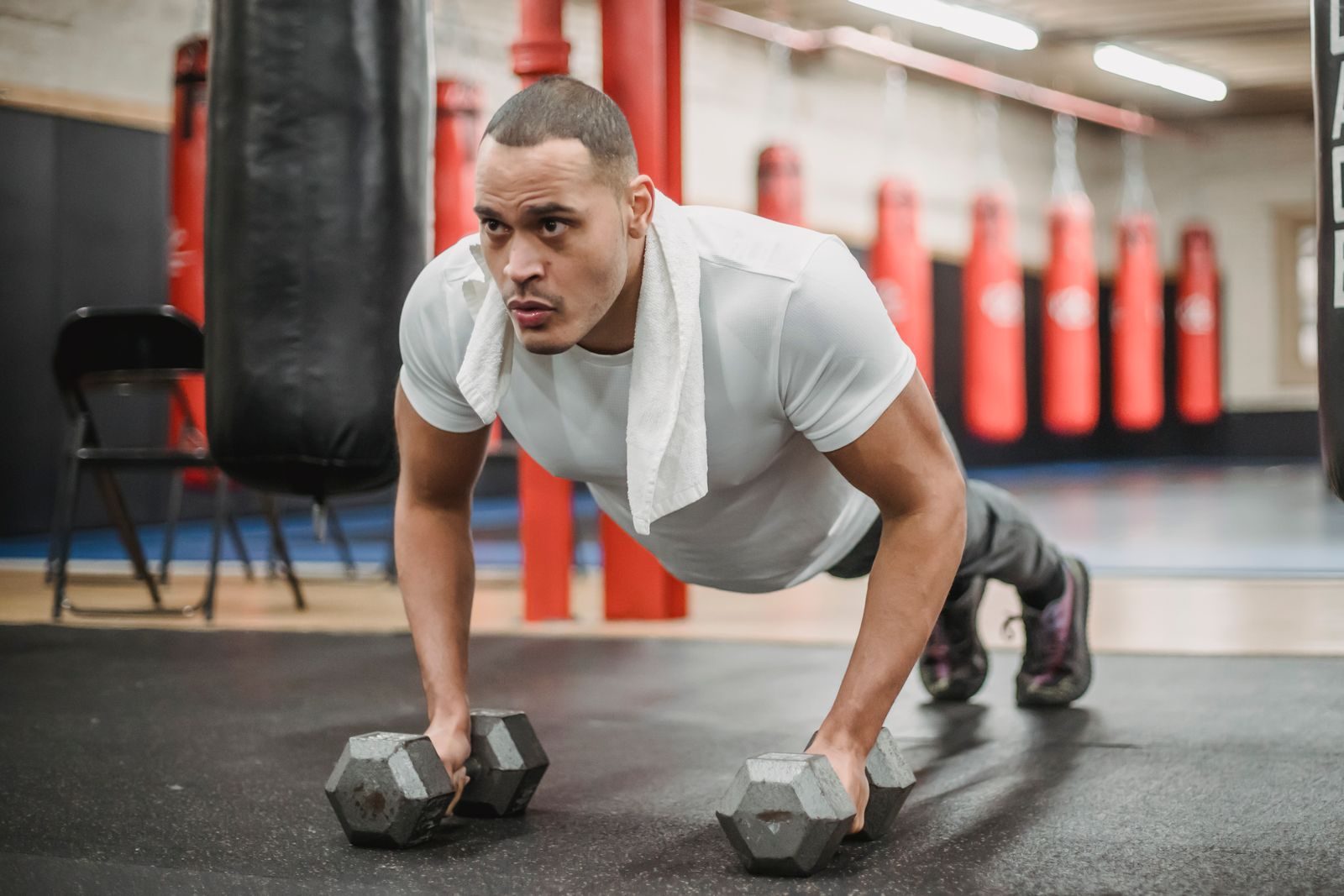
Dumbbell push ups train the chest, triceps, and front shoulders while allowing a neutral hand position and, when appropriate, a greater range of motion than regular floor push-ups. The dumbbells stay on the floor and function as handles; you do not lift them during the exercise.
Proper setup matters. Use two stable, matched dumbbells that cannot roll, keep your body in a strong plank, and lower only as far as your shoulders remain comfortable and controlled.
Dumbbell Push-Ups at a Glance
| Category | Details |
|---|---|
| Exercise type | Bodyweight horizontal press |
| Best for | Chest and triceps training with minimal equipment |
| Primary muscles | Pectoralis major and triceps brachii |
| Assisting muscles | Anterior deltoids, serratus anterior, and shoulder stabilizers |
| Core stabilizers | Abdominals, obliques, spinal stabilizers, glutes, and quadriceps |
| Equipment needed | Two matched, flat-sided dumbbells |
| Difficulty | Beginner to advanced, depending on the variation |
| Suggested starting volume | 2–3 sets of 6–12 repetitions |
| Rest | 60–120 seconds |
| Effort | Finish with approximately 2–3 good repetitions remaining |
| Main cue | Lower your chest between the handles while your body moves as one unit |
The National Academy of Sports Medicine push-up guide identifies the pectoralis major and triceps as primary movers, with the anterior deltoid, serratus anterior, and core muscles providing assistance and stability.
What Are Dumbbell Push-Ups?

Dumbbell push-ups are regular push-ups performed while gripping two dumbbells placed on the floor. The handles allow you to keep your palms facing each other instead of placing them flat on the ground.
The dumbbells do not provide the resistance. Your bodyweight supplies the load while the dumbbells change your hand position and raise your hands slightly above the floor.
This setup creates two possible versions:
- Neutral-grip dumbbell push-up: Use the handles for wrist positioning but stop at approximately normal push-up depth.
- Dumbbell deficit push-up: Lower your chest slightly below the level of the handles to use a larger range of motion.
A dumbbell push-up should not be confused with a renegade row, push-up-to-row, or dumbbell burpee. Those exercises combine the push-up with additional movements, while a basic dumbbell push-up is only a horizontal pressing exercise.
Dumbbell Push-Up Muscles Worked
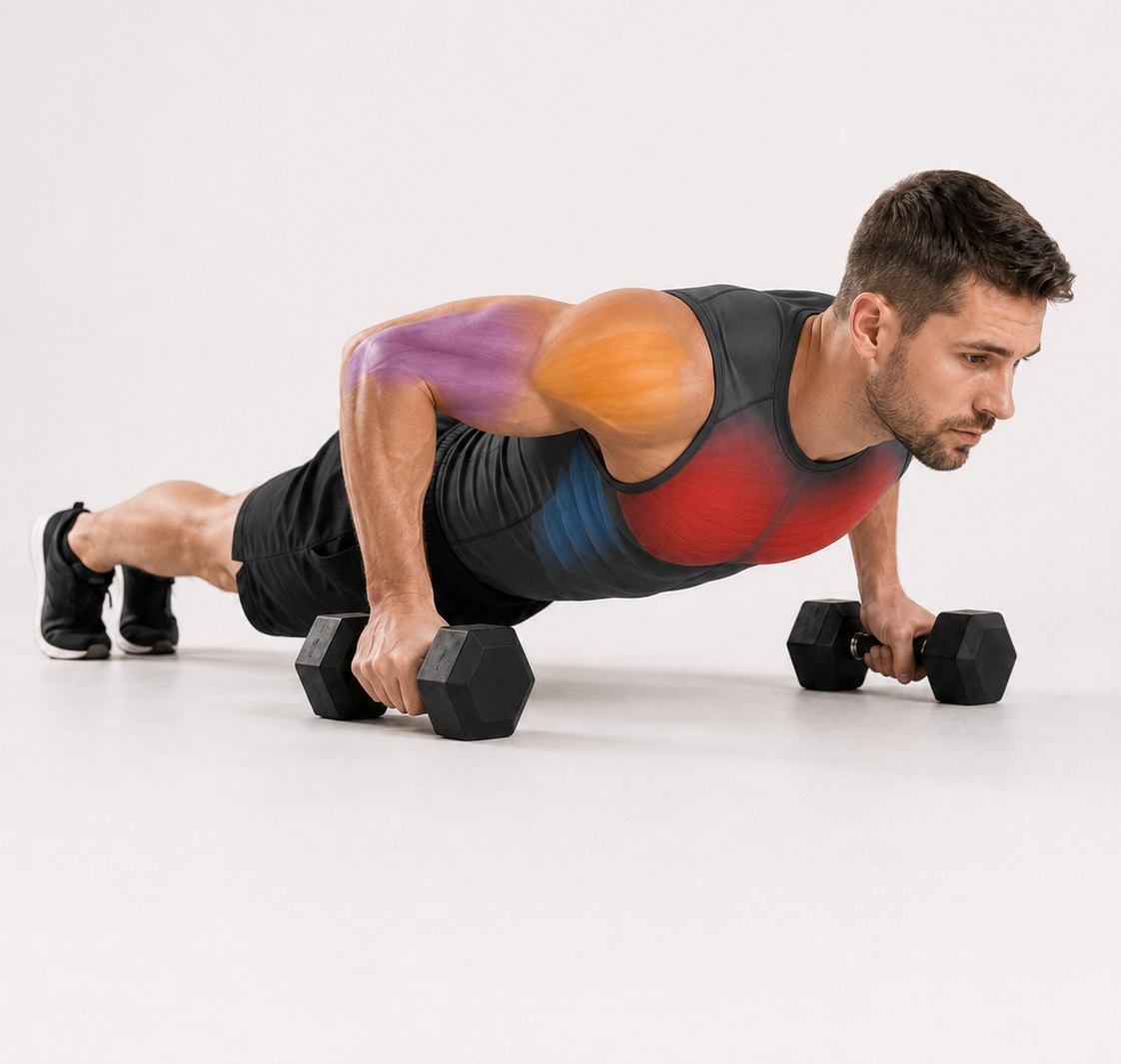
1. Pectoralis Major
The pectoralis major is the large muscle covering the front of the chest. It helps bring the upper arms toward the torso as you press your body away from the floor.
It is the main muscle targeted by dumbbell push-ups.
2. Triceps Brachii
The triceps are located on the backs of the upper arms. They straighten the elbows during the upward phase of each repetition.
Moving the dumbbells slightly closer together generally increases the amount of work performed by the triceps. However, the hands should not be brought so close that the wrists, elbows, or shoulders become uncomfortable.
3. Anterior Deltoids
The anterior deltoids, or front shoulder muscles, assist the chest during the pressing movement. They become more involved when your shoulders move excessively forward or when your feet are elevated.
4. Serratus Anterior and Shoulder Stabilizers
The serratus anterior helps control the shoulder blades against the rib cage. The rotator-cuff muscles, pectoralis minor, trapezius, and other muscles around the shoulder also help maintain a stable pressing position.
Research examining push-ups performed on handles found substantial involvement from the pectoralis major, triceps, and serratus anterior. However, the handles did not automatically produce greater muscle activation than conventional floor push-ups.
5. Core and Lower-Body Stabilizers
The abdominals, obliques, spinal stabilizers, glutes, and quadriceps work isometrically to keep your body in a straight plank.
These muscles should prevent your:
- Lower back from sagging
- Hips from rising
- Torso from rotating
- Ribs from dropping toward the floor before your hips
How to Do Dumbbell Push Ups With Proper Form
Best for: Training the chest and triceps while using dumbbells as neutral-grip handles.
Equipment needed: Two matched, flat-sided hex dumbbells and a firm, non-slip surface.
Sets, reps, and rest: Begin with 2–3 sets of 6–12 controlled repetitions. Rest for 60–120 seconds between sets.
How to Do It
- Place two stable dumbbells parallel to each other, approximately shoulder-width apart or slightly wider.
- Grip the center of each handle firmly and wrap your thumbs around the handles.
- Extend your legs behind you and balance on your hands and toes.
- Position your shoulders over or slightly behind the dumbbells.
- Brace your abdominals, squeeze your glutes, and tighten your legs.
- Maintain a straight line from your head through your hips to your heels.
- Inhale as you bend your elbows and lower your chest between the dumbbells.
- Keep your elbows approximately 30–45 degrees from your torso rather than flaring them directly sideways.
- Stop when you reach the deepest position you can control without shoulder discomfort or loss of body alignment.
- Exhale as you press evenly through both handles and return to the starting plank.
- Finish with your elbows straight without forcefully hyperextending them.
NASM recommends maintaining a neutral spine, bracing the core, lowering under control, and keeping the elbows at approximately 45 degrees during a standard push-up. The American Council on Exercise push-up guide also emphasizes keeping the torso rigid and preventing the hips from sagging or rising.
Coaching cue: Lower your chest between the handles while your head, ribs, hips, and heels move together.
How Low Should You Go?
The dumbbells may allow your chest to travel lower than it would during a floor push-up. However, that extra depth is optional.
For a neutral-grip push-up, lower until your chest reaches approximately the height of the handles or your elbows are bent close to 90 degrees.
For a deficit push-up, allow the chest to move slightly below the handles only when you can maintain:
- Stable dumbbells
- A controlled shoulder position
- Even pressure through both arms
- A braced torso
- A pain-free range of motion
Stop the descent if your shoulders roll excessively forward, your hips sag, your neck reaches toward the floor, or you feel shoulder pinching.
NASM recommends descending until the chest approaches the floor or the elbows reach approximately 90 degrees, depending on mobility, while avoiding excessive depth that compromises alignment.
Dumbbell Push-Ups vs. Regular Push-Ups
| Feature | Dumbbell push-up | Regular push-up |
|---|---|---|
| Hand position | Palms face each other | Palms press into the floor |
| Wrist position | More neutral | Greater wrist extension |
| Available depth | Chest may travel below the hands | Depth is limited by the floor |
| Equipment | Two stable dumbbells | No equipment |
| Stability concern | Dumbbells must remain stationary | Hands contact a stable floor |
| Main resistance | Bodyweight | Bodyweight |
| Muscles worked | Chest, triceps, shoulders, and core | Chest, triceps, shoulders, and core |
| Best use | Neutral grip or controlled deficit training | Simple, equipment-free pressing |
Dumbbell push-ups are not automatically better for chest development. A study comparing conventional push-ups with push-ups performed on specialized handles did not find that the handles consistently increased activation of the chest, triceps, serratus anterior, or posterior deltoids.
Choose the version that fits your equipment, comfort, current strength, and training goal.
Benefits of Dumbbell Push-Ups
1. Train the Chest and Triceps With Minimal Equipment
Dumbbell push-ups provide a practical horizontal pressing exercise for home or gym workouts. The movement trains the same major pressing muscles used in regular push-ups and chest presses.
In a small eight-week study involving 18 young men, push-ups adjusted to provide a load comparable to a low-load bench press produced similar improvements in pectoralis-major and triceps muscle thickness. The study examined push-ups generally rather than dumbbell push-ups specifically, so it supports the push-up movement without proving that dumbbells improve the results.
2. Provide a Neutral Wrist Position
Gripping handles reduces the amount of wrist extension required compared with placing the palms flat on the floor.
A biomechanical study found differences in how forces traveled through the wrist during neutral-wrist and extended-wrist push-ups. This suggests that a neutral grip may be a useful option for some people, but it does not prove that dumbbell push-ups are universally safer or appropriate for every wrist problem.
Dumbbell handles may feel more comfortable, but they should not be used to push through wrist pain.
3. Offer an Optional Larger Range of Motion
The raised hand position allows the chest to move between the dumbbells. This can turn the exercise into a deficit push-up when additional depth is appropriate.
A greater available range can be useful only when you can control it. Dropping as low as possible does not automatically create better chest activation or muscle growth.
4. Build Full-Body Tension
Although the chest and triceps produce most of the pressing action, the core and lower body must keep your torso aligned.
Learning to brace the abdominals, glutes, and legs can improve push-up control and reduce unnecessary movement through the hips and lower back.
5. Make Push-Up Training Easy to Progress
You can adjust dumbbell push-ups without immediately adding heavy equipment. Progressions can include:
- More repetitions
- Slower lowering
- Pauses
- Increased deficit depth
- Foot elevation
- Resistance bands
- A weighted vest
The American College of Sports Medicine’s 2026 resistance-training guidance recognizes bodyweight and home-based resistance exercise as effective training options and emphasizes consistent, individualized programming over unnecessary complexity.
Common Dumbbell Push-Up Mistakes
Using Dumbbells That Can Roll
Round dumbbells can move when force is applied through the handles. Use flat-sided hex dumbbells on a firm, non-slip surface.
Test the setup before extending into the full plank.
Placing the Dumbbells Too Wide
An excessively wide setup may shorten the pressing range and make it harder to control the shoulders.
Start approximately shoulder-width apart or slightly wider. Adjust the position gradually based on your arm length and comfort.
Flaring the Elbows
Allowing the elbows to move directly sideways can make the position harder to control.
Keep them angled approximately 30–45 degrees from the torso. They do not have to remain pressed tightly against your sides.
Letting the Hips Sag
Sagging hips usually indicate that the core and glutes are no longer maintaining the plank.
End the set, use fewer repetitions, or switch to an easier variation rather than continuing with poor alignment.
Raising the Hips First
Your chest and hips should rise together. Lifting the hips before the chest reduces tension on the target muscles and turns the repetition into an uneven pressing movement.
Reaching the Head Toward the Floor
Keep the neck aligned with the spine. Your chest should lead the descent rather than your forehead or chin.
Forcing Excessive Depth
Do not assume that the chest must drop as far below the handles as possible.
Use only the range you can control without shoulder pain, pinching, or loss of posture.
Performing Fast, Bouncing Repetitions
Lower under control and avoid bouncing out of the bottom position. Rushed repetitions often lead to unstable dumbbells, shortened range, and poor torso control.
Pressing Unevenly
Both dumbbells should remain still throughout the set. Uneven pressure may cause one handle to tilt or shift.
Record yourself from the front when necessary to check whether one shoulder rises before the other.
Beginner Dumbbell Push-Up Modifications
Incline Push-Up
Place your hands on a stable bench, countertop, or bar rather than the floor. A higher hand position reduces the amount of bodyweight supported by the upper body.
Do not balance loose dumbbells on a narrow bench. Use the stable surface directly or use secured push-up handles designed for that setup.
Gradually lower the hand height as you become stronger. NASM recommends progressing from incline push-ups after you can perform approximately 12–15 controlled repetitions without excessive fatigue.
Kneeling Dumbbell Push-Up
Place the dumbbells on the floor and support your lower body on your knees.
Maintain a straight line from your head through your hips to your knees. Avoid bending sharply at the hips.
The kneeling version preserves the neutral grip while reducing the resistance. NASM suggests progressing once 12–15 modified push-ups can be performed with consistent form.
Reduced-Depth Dumbbell Push-Up
Use a full plank but lower only partway. Place a pad, yoga block, or other visible target beneath the chest to keep the depth consistent.
Gradually increase the range as your control improves.
Dumbbell Push-Up Progressions
Use the following sequence rather than attempting every progression at once:
- Full dumbbell push-up to normal push-up depth
- Three-second lowering phase
- One-second pause at the bottom
- Slight dumbbell deficit push-up
- Deeper deficit within a comfortable range
- Feet-elevated dumbbell push-up
- Resistance-band or weighted-vest dumbbell push-up
Progress only when you can complete every repetition with stable handles, consistent depth, even pressing, and a controlled plank.
Does Hand Width Change the Emphasis?
A slightly narrower hand position generally increases triceps involvement, but extremely close handles may be uncomfortable.
Research comparing narrow, shoulder-width, and wide push-ups found greater pectoralis-major and triceps activity in the narrow position than in the wide position. That does not mean narrow push-ups are always the best choice; hand spacing should still allow comfortable shoulders and controlled repetitions.
Sets, Reps, Rest, and Frequency
The best repetition range depends on the variation. Choose a version that becomes challenging within your target range without causing your technique to break down.
Beginner Technique Practice
- Sets: 2–3
- Reps: 5–10
- Rest: 90–120 seconds
- Frequency: 2 times per week
- Effort: Keep 2–3 good repetitions in reserve
Chest and Triceps Strength
- Sets: 3–4
- Reps: 5–10
- Rest: 90–180 seconds
- Frequency: 2 times per week
- Effort: Keep approximately 1–3 repetitions in reserve
- Progression: Add a pause, resistance band, weighted vest, or foot elevation when 10 repetitions become comfortable
Muscle-Building Training
- Sets: 3–4
- Reps: 8–20
- Rest: 60–120 seconds
- Frequency: 2–3 times per week
- Effort: Finish most sets with 1–3 controlled repetitions remaining
Muscular-Endurance Training
- Sets: 2–3
- Reps: 15–25
- Rest: 45–90 seconds
- Effort: Stop when body alignment, depth, or dumbbell stability begins to change
These are practical starting ranges rather than rigid rules. ACSM’s current guidance emphasizes training major muscle groups regularly, adjusting volume to the individual goal, and building a program that can be performed consistently. It also notes that reaching momentary muscle failure is not required for most healthy adults to make progress.
How to Progress Dumbbell Push-Ups
Use this simple progression method:
- Select a range, such as 6–12 repetitions.
- Begin with a variation that allows at least six controlled repetitions.
- Keep approximately two repetitions in reserve during most sets.
- Add repetitions over several workouts.
- When you can complete 12 repetitions in every set, increase the difficulty.
- Change only one variable at a time.
Suitable ways to increase difficulty include:
- Adding one or two repetitions
- Slowing the lowering phase
- Pausing at the bottom
- Increasing depth slightly
- Elevating the feet
- Adding light external resistance
Do not increase depth, foot height, added resistance, and total sets at the same time.
Sample Dumbbell Push-Up Chest Workout
Perform this workout two times per week with at least one recovery day between sessions.
Warm-Up
Complete approximately five minutes of easy full-body movement followed by:
- Incline push-ups: 1 set of 8–10
- Easy dumbbell push-ups: 1 set of 5–8
- Controlled shoulder circles: 5–8 in each direction
Workout
| Exercise | Sets | Reps | Rest | Effort |
|---|---|---|---|---|
| Dumbbell push-up | 3 | 6–15 | 90–120 seconds | 1–3 reps in reserve |
| Dumbbell floor press | 3 | 8–12 | 90 seconds | 2 reps in reserve |
| One-arm dumbbell row | 3 | 8–12 per side | 60–90 seconds | 2 reps in reserve |
| Dumbbell lateral raise | 2 | 12–20 | 45–60 seconds | 2–3 reps in reserve |
Begin with the neutral-grip dumbbell push-up. Use the deficit version only after you can perform all sets with consistent depth and stable shoulders.
When you reach the top of the repetition range for every set, add a pause, slow the lowering phase, or progress to a slightly harder variation.
Dumbbell Push-Up Safety Tips
- Use two matched dumbbells of the same height and handle size.
- Choose flat-sided dumbbells that remain stationary.
- Place them on a firm, non-slip surface.
- Check that adjustable plates and collars are secure.
- Keep your hands and the handles dry.
- Wrap your thumbs around the handles.
- Apply pressure through both arms evenly.
- Do not use dumbbells that tilt, wobble, or roll.
- Do not force the chest below the handles.
- Use an incline or kneeling variation when full repetitions cause hip sagging.
- Avoid training through wrist, elbow, or shoulder pain.
Stop the exercise and seek appropriate professional help if it causes sharp pain, numbness, dizziness, chest pain, or other unusual symptoms.
Frequently Asked Questions
What muscles do dumbbell push-ups work?
Dumbbell push-ups primarily work the pectoralis major and triceps. The anterior deltoids, serratus anterior, and other shoulder muscles assist, while the abdominals, glutes, quadriceps, and spinal stabilizers maintain the plank position.
Are dumbbell push-ups better than regular push-ups?
Neither variation is automatically better. Dumbbell push-ups offer a neutral wrist position and the option to use more depth. Regular push-ups require no equipment and provide a more stable hand position.
Research on push-up handles has not shown that handles automatically produce greater chest activation than floor push-ups.
Are dumbbell push-ups easier on the wrists?
They may feel more comfortable because the wrists remain closer to neutral instead of being extended against the floor. However, comfort varies, and the exercise should not be used to train through pain or treat a wrist condition.
How low should you go?
Lower until your chest reaches approximately the height of the handles or until your elbows are bent around 90 degrees. Descend farther only when you can maintain stable shoulders, a braced torso, and a comfortable range.
What type of dumbbells should you use?
Use a matched pair of flat-sided hex dumbbells with secure handles. Avoid round dumbbells, loose adjustable plates, uneven pairs, slippery handles, and unstable flooring.
How many dumbbell push-ups should you do?
A useful starting point is 2–3 sets of 6–12 repetitions. Use a variation that challenges you while leaving approximately 2–3 controlled repetitions in reserve.
Can beginners perform dumbbell push-ups?
Yes, but many beginners should start with incline push-ups, kneeling dumbbell push-ups, or reduced-depth repetitions. Progress to full dumbbell push-ups after you can maintain a stable plank throughout every repetition.
Conclusion
Dumbbell push-ups are a practical chest and triceps exercise that uses dumbbells as neutral-grip handles. Their main advantages are the alternative wrist position and the option to add controlled range of motion.
Begin with stable hex dumbbells, approximately shoulder-width hand placement, and normal push-up depth. Keep your body aligned, lower under control, and increase the difficulty only after you can complete every repetition without sagging, uneven pressing, or shoulder discomfort.
References
- National Academy of Sports Medicine: Push-Up Exercise Guide
- American Council on Exercise: Push-Up Exercise Library
- American College of Sports Medicine: 2026 Resistance-Training Guidelines
- PubMed: Low-Load Bench Press and Push-Up Training Study
- PubMed: Force Transmission Through the Wrist During Push-Ups
- PubMed: Push-Up Hand Position and Muscle Activation
- PubMed: Conventional Push-Ups Compared With Push-Up Handles
This content is for informational purposes only and is not a substitute for medical advice.