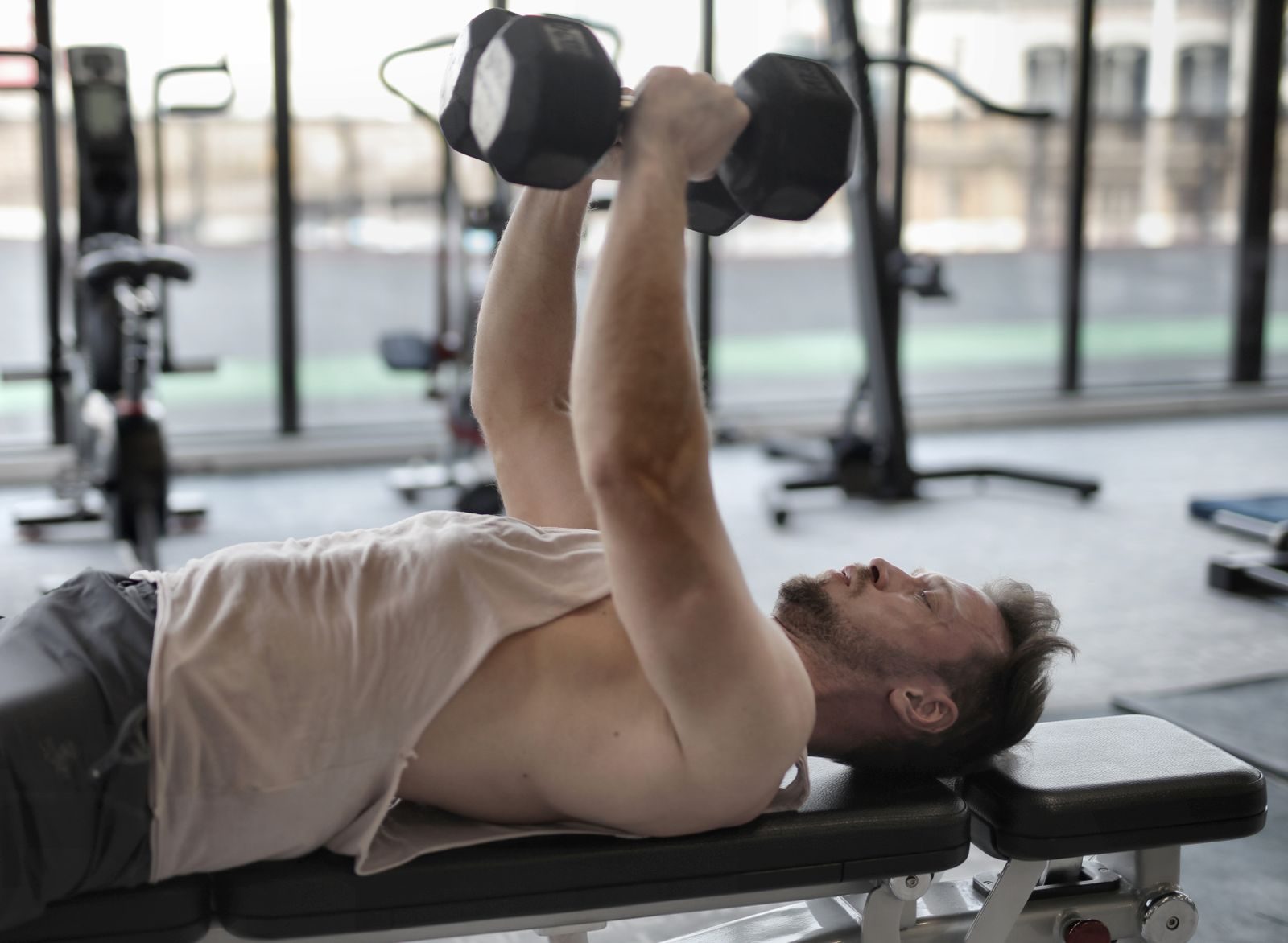
The dumbbell JM press is a triceps-focused exercise that combines elements of a close-grip press and a lying triceps extension. Instead of lowering the dumbbells toward your chest or forehead, you guide them toward the tops of your shoulders while keeping your elbows relatively high.
This hybrid movement can be useful for building stronger triceps, adding direct arm-training volume, and supporting the elbow-extension portion of pressing exercises. However, the dumbbell JM press is more technical than a standard dumbbell press, so it should be learned with light weights and controlled repetitions.
This guide explains proper form, muscles worked, suitable sets and reps, common mistakes, progressions, alternatives, and how to include the exercise in a workout.
Dumbbell JM Press at a Glance
| Category | Details |
|---|---|
| Best for | Triceps strength, muscle growth, and pressing assistance |
| Primary muscles | Triceps brachii |
| Assisting muscles | Pectoralis major, anterior deltoids, forearm stabilizers |
| Equipment | Two dumbbells and a stable flat bench |
| Difficulty | Intermediate |
| Beginner starting volume | 2–3 sets of 10–15 reps |
| General training range | 2–4 sets of 8–15 reps |
| Rest | 60–120 seconds |
| Suggested effort | Finish with 1–3 controlled reps in reserve |
| Workout placement | After your main pressing exercise |
| Main coaching cue | Keep your elbows high and guide the dumbbells toward your shoulders |
What Is a Dumbbell JM Press?
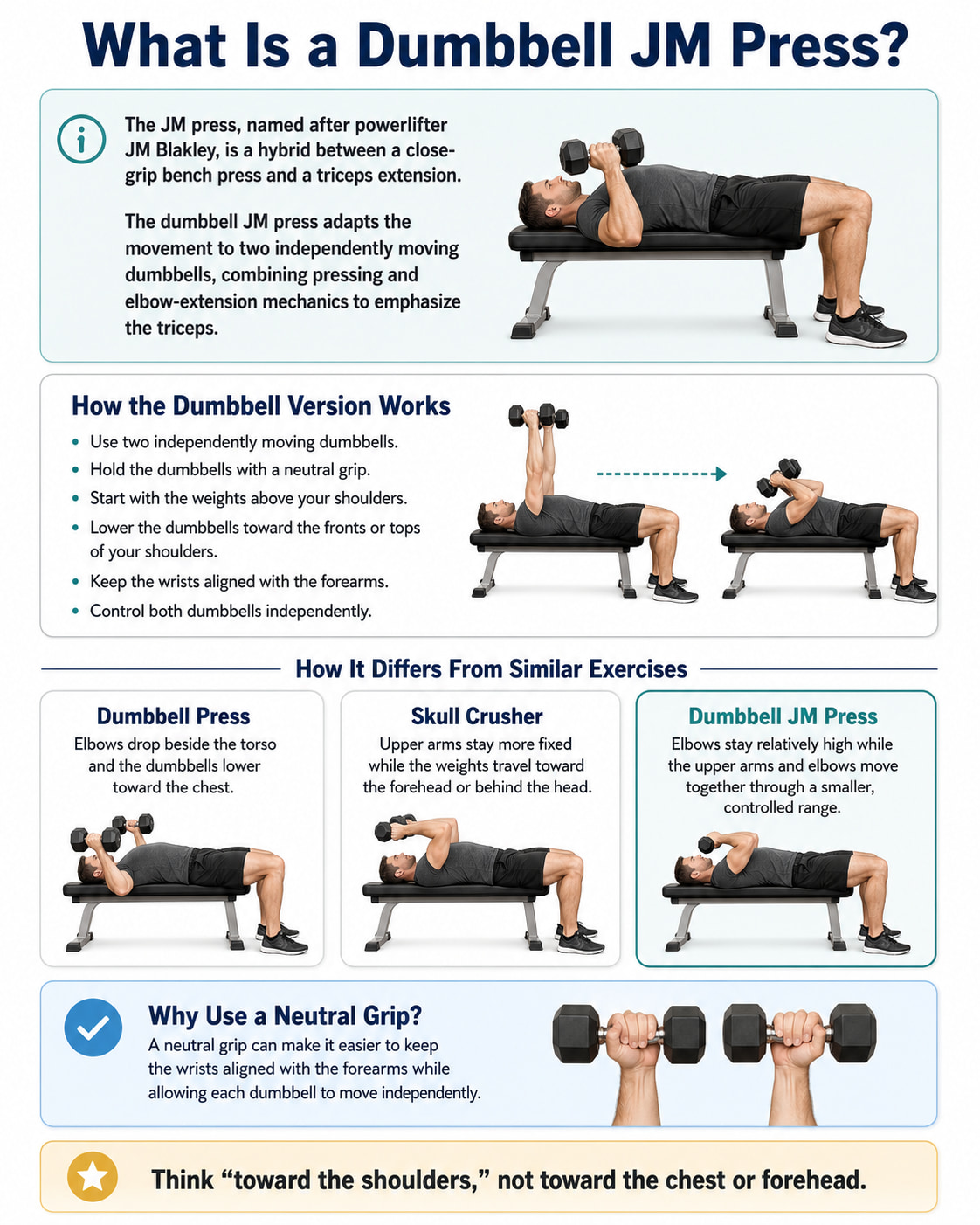
The original JM press is named after powerlifter JM Blakley. It was developed as a hybrid between a close-grip bench press and a triceps extension, allowing the lifter to train the triceps with a movement related to heavy pressing.
The dumbbell JM press adapts that idea to two independently moving weights. You normally use a neutral grip, keep the dumbbells over your shoulders, and lower them toward the fronts or tops of your shoulders.
The exercise should not look exactly like either of these movements:
- In a normal dumbbell press, the elbows drop beside the torso and the dumbbells lower toward the chest.
- In a skull crusher, the upper arms remain more fixed while the weights travel toward the forehead or behind the head.
- In a dumbbell JM press, the elbows stay relatively high while the upper arms and elbows move together through a smaller, controlled range.
There is more than one dumbbell version in use. This guide teaches a neutral-grip variation because it makes it easier to keep the wrists aligned with the forearms and control each dumbbell separately.
Dumbbell JM Press Muscles Worked
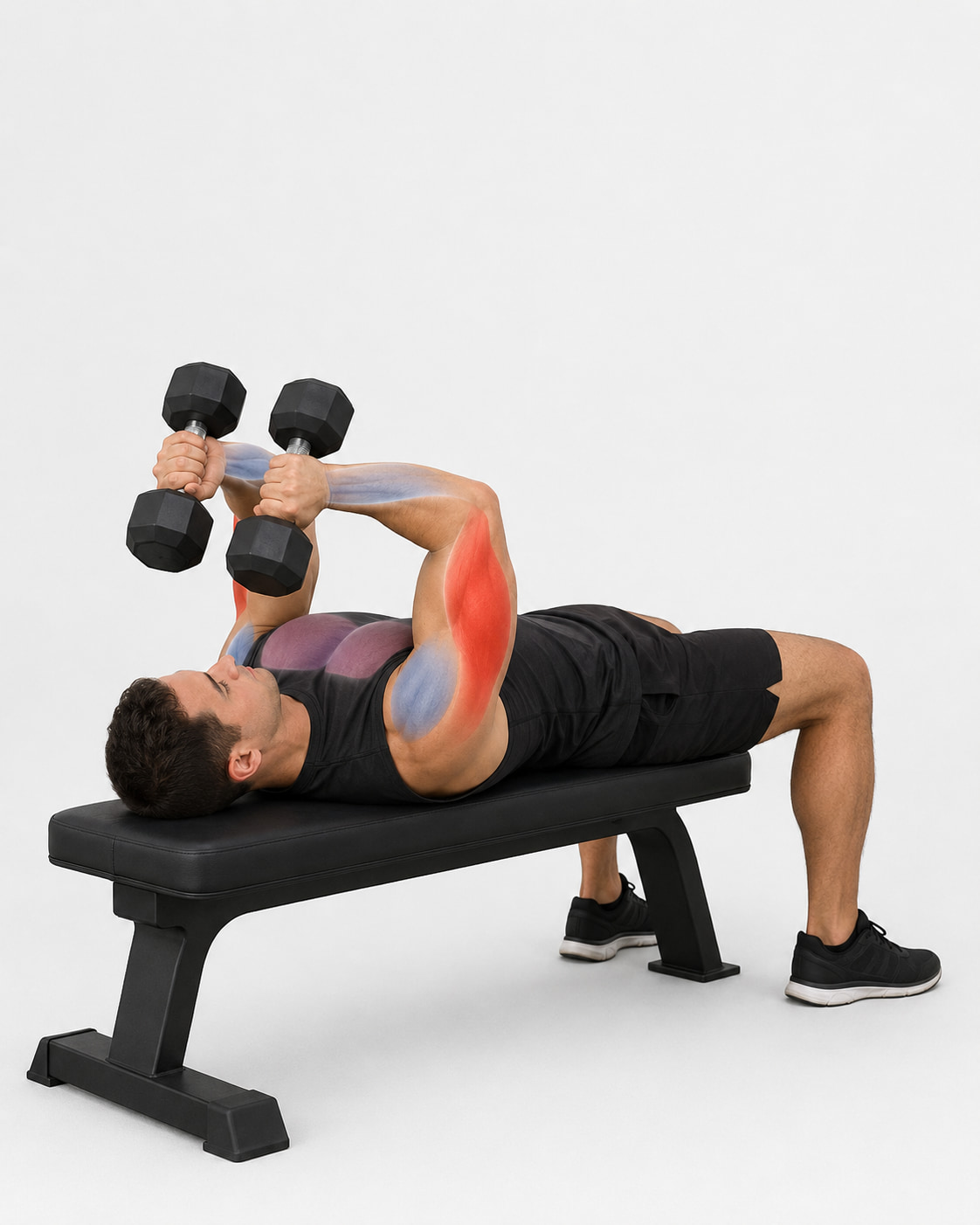
1. Triceps Brachii
The triceps brachii is the main muscle trained by the dumbbell JM press. It contains three heads:
- Long head
- Lateral head
- Medial head
All three heads help extend the elbow, which is the main action used to return the dumbbells to the starting position.
The NCBI Bookshelf overview of triceps anatomy identifies elbow extension as the triceps’ primary function and explains that its three heads join into one tendon near the elbow.
The exercise should not be described as isolating only one triceps head. The exact contribution of each head can vary with arm position, technique, range of motion, and individual anatomy.
2. Pectoralis Major and Anterior Deltoids
The chest and front shoulder muscles can assist because the JM press still includes some pressing mechanics.
Their involvement increases when you:
- Lower the dumbbells toward the middle of your chest
- Allow the elbows to drop beside your torso
- Use more shoulder movement than elbow movement
- Choose weights that are too heavy to control
Some chest and shoulder involvement is normal. However, your triceps should remain the main working muscles.
3. Forearms and Wrist Stabilizers
The muscles of the forearms help keep the dumbbell handles aligned with your wrists. Maintaining a stable wrist position makes the weights easier to control and keeps the movement focused on elbow extension.
Does the Dumbbell JM Press Train the Long Head?
The long head contributes to elbow extension, so it works during the JM press. However, the arms are not positioned fully overhead.
Research comparing cable elbow extensions found greater triceps growth when the exercise was performed overhead rather than with the arms in a neutral position. That study did not test the JM press, so it does not prove that one exercise is universally better. It does suggest that using more than one arm position may provide a more complete triceps program.
For that reason, the dumbbell JM press can be paired with an overhead dumbbell extension if both exercises feel comfortable.
How to Do the Dumbbell JM Press
Equipment needed: Two dumbbells and a stable flat bench.
Sets, reps, and rest: Start with 2–3 sets of 10–15 reps. Rest for 60–90 seconds and finish each set with approximately 2–3 reps in reserve.
Step-by-Step Instructions
- Sit at the end of a flat bench with one dumbbell resting on each thigh.
- Use your thighs to help bring the dumbbells upward as you carefully lie back.
- Press the dumbbells above your shoulders. Hold them with your palms facing each other and your arms approximately shoulder-width apart.
- Place your feet firmly on the floor. Keep your head, upper back, and hips supported by the bench.
- Brace your midsection and keep your wrists straight. Position your elbows approximately 30–45 degrees away from your torso rather than flaring them straight outward.
- Begin lowering the dumbbells by bending your elbows. Allow your upper arms to move slightly, but keep your elbows relatively high instead of dropping them beside your ribs.
- Guide the dumbbells downward and slightly forward toward the fronts or tops of your shoulders.
- Stop when your forearms approach your upper arms, the dumbbells are just above your shoulders, or you reach the deepest comfortable position.
- Extend your elbows and guide the dumbbells back above your shoulders. Finish with straight arms without forcefully snapping your elbows into lockout.
- Reset your wrist and elbow positions before beginning the next repetition.
Coaching Cue
Keep your elbows high and bring the dumbbells toward your shoulders, not your chest or forehead.
Recommended Tempo
Use a controlled tempo while learning the exercise:
- Lower for 2–3 seconds
- Pause briefly near the bottom
- Extend the elbows smoothly
- Reset at the top
The upward phase does not need to be deliberately slow, but it should remain controlled without bouncing or using momentum.
Breathing
Inhale while lowering the dumbbells and exhale as you extend your elbows. Avoid holding your breath through several repetitions.
What Proper Form Should Look Like
A controlled dumbbell JM press should have the following characteristics:
- The dumbbells start and finish above the shoulders or upper chest.
- The palms face each other throughout the movement.
- The wrists remain aligned with the forearms.
- The elbows stay above the bench and do not fall beside the torso.
- The dumbbells move toward the fronts or tops of the shoulders.
- The weights do not rest or bounce on the shoulders.
- The lower back does not arch excessively.
- Both arms move at approximately the same speed.
- The triceps, rather than the chest, perform most of the work.
Your exact bottom position may differ based on arm length, shoulder structure, mobility, and dumbbell size. Do not force the weights to reach a specific point if your elbows or shoulders feel uncomfortable.
Benefits of the Dumbbell JM Press
Directly Trains Elbow Extension
The exercise repeatedly loads elbow flexion and extension, making it a practical triceps accessory for people who already know basic dumbbell pressing movements.
Combines Pressing and Extension Mechanics
The dumbbell JM press provides a middle ground between a close-grip dumbbell press and a lying triceps extension.
The press-like component may allow some lifters to use more resistance than they can during a strict extension. However, increasing the weight is only useful when the dumbbell path and elbow position remain consistent.
May Support Pressing Strength
The JM press has traditionally been used as an assistance exercise for bench pressing because strong elbow extension contributes to completing the upper portion of a press.
The dumbbell variation is not identical to a barbell bench press, and there is limited exercise-specific research showing that it will directly increase your bench press. It is best treated as one possible triceps-strengthening tool rather than a guaranteed solution for a weak lockout.
Trains Each Arm Independently
Each arm must control its own dumbbell. This can make differences in strength, stability, or coordination more noticeable.
Independent loading does not automatically correct an imbalance, but it makes it harder for one arm to directly assist the other.
Allows a Neutral Grip
A palms-in grip often makes it easier to maintain straight wrists and lets each arm follow a slightly individualized path.
A neutral grip should not be described as pain-proof. If the exercise continues to cause discomfort despite reducing the load and adjusting the range, choose another triceps movement.
Requires Minimal Equipment
You only need two dumbbells and a stable bench, making the exercise suitable for many home and commercial gym setups.
Dumbbell JM Press Sets, Reps, and Rest
The dumbbell JM press is generally better suited to controlled moderate-repetition work than maximum-effort lifting. Very heavy weights can quickly turn it into a short-range dumbbell press.
| Goal | Sets and reps | Rest | Suggested effort |
|---|---|---|---|
| Learning proper form | 2–3 sets of 10–15 | 60–90 seconds | 3 reps in reserve |
| Building triceps | 3–4 sets of 8–12 | 60–120 seconds | 1–3 reps in reserve |
| Pressing accessory | 3–4 sets of 6–10 | 90–150 seconds | 1–3 reps in reserve |
| Light finisher | 2–3 sets of 12–15 | 45–75 seconds | 1–2 reps in reserve |
Best Starting Range
For most readers, a good starting prescription is:
2–3 sets of 10–15 reps with 2–3 reps left in reserve.
This range gives you enough repetitions to practice the movement without requiring very heavy dumbbells.
Should You Train to Failure?
You do not need to take every set to complete muscular failure. Stopping with 1–3 controlled repetitions available usually allows you to train the triceps hard while maintaining a consistent dumbbell path.
The 2026 ACSM resistance-training guidance reports that training to momentary failure is not consistently necessary for the average healthy adult to make progress. It also emphasizes matching training volume and load to the individual’s goal.
Weekly Training Volume
The JM press should be counted as part of your total triceps workload. Bench presses, overhead presses, push-ups, extensions, and pushdowns can also contribute.
ACSM identifies approximately 10 weekly sets per muscle group as a broad hypertrophy target, but that is not a requirement for every person and does not mean performing 10 sets of JM presses. Beginners may progress with less, especially when their routine already includes several pressing exercises.
How Often Should You Do Dumbbell JM Presses?
Most people can perform the exercise one or two times per week.
Start with once weekly if:
- You are learning the movement.
- You already perform a high amount of pressing.
- Your elbows are not accustomed to direct triceps training.
- You are also using skull crushers or overhead extensions.
Twice weekly may be appropriate when:
- Your technique is consistent.
- Your elbows recover comfortably.
- You use moderate volume in each session.
- Triceps development is a priority.
Avoid adding more frequency simply because the exercise creates a strong muscle sensation. Your total pressing and triceps workload matters more than how often one exercise appears.
How to Progress the Dumbbell JM Press
The safest progression is to earn heavier weights through repeatable technique.
Use Double Progression
- Choose a repetition range, such as 8–12.
- Select dumbbells you can control for at least eight repetitions.
- Keep the same weight until you reach 12 reps on every set.
- Increase to the next available dumbbell size.
- Return to approximately eight reps and build upward again.
For example:
- Week 1: 20 pounds for 10, 9, and 8 reps
- Week 2: 20 pounds for 11, 10, and 9 reps
- Week 3: 20 pounds for 12, 12, and 11 reps
- Week 4: 20 pounds for 12 reps on all three sets
- Week 5: Increase slightly and return to 8–10 reps
Progress Without Adding Weight
Dumbbell weight jumps can sometimes be too large. Before increasing the load, you can progress by:
- Adding one repetition
- Adding one set
- Slowing the lowering phase
- Pausing for one second near the bottom
- Improving left-to-right control
- Using a slightly greater comfortable range of motion
Increase the load only when you can maintain straight wrists, high elbows, and the same bottom position on every repetition.
Common Dumbbell JM Press Mistakes
1. Using Too Much Weight
Heavy dumbbells often pull the elbows downward and turn the movement into a press.
Fix: Begin much lighter than your normal dumbbell bench-press weight. Use a load that allows at least 10 controlled repetitions while learning.
2. Lowering the Dumbbells Toward the Chest
Bringing the weights toward the middle or lower chest increases chest and shoulder involvement.
Fix: Guide the dumbbells toward the fronts or tops of your shoulders.
3. Turning It Into a Skull Crusher
Keeping the upper arms completely fixed while moving the dumbbells toward your forehead changes the exercise into a lying triceps extension.
Fix: Allow a small, coordinated movement at the shoulders while keeping the elbows relatively high.
4. Dropping the Elbows Beside the Torso
Low elbows create more of a close-grip dumbbell press.
Fix: Keep the elbows above the bench and prevent them from sinking toward your ribs.
5. Flaring the Elbows Too Wide
Allowing the elbows to point directly outward can make the movement harder to control and increase shoulder involvement.
Fix: Keep them approximately 30–45 degrees from the torso. Individual comfort matters more than forcing an exact angle.
6. Bending the Wrists
Letting the dumbbells roll backward places the handles behind the forearms and reduces control.
Fix: Keep your knuckles facing upward and the handles stacked over your wrists.
The original barbell JM press includes wrist-position cues designed around one fixed bar. Do not deliberately copy those cues with independently moving dumbbells.
7. Resting the Dumbbells on the Shoulders
Setting the weights on your shoulders removes tension and can encourage bouncing.
Fix: Stop just above the shoulders and reverse the movement under control.
8. Forcing Too Much Range of Motion
Trying to lower the dumbbells farther than your structure allows can irritate the elbows or shoulders.
Fix: Stop when the forearms approach the upper arms or just before your comfortable range ends.
9. Moving Too Quickly
Fast repetitions make it difficult to maintain the hybrid path.
Fix: Lower for at least two seconds and pause long enough to confirm your position.
Dumbbell JM Press vs. Skull Crusher
| Feature | Dumbbell JM press | Dumbbell skull crusher |
|---|---|---|
| Movement type | Hybrid press and extension | Triceps extension |
| Dumbbell path | Toward the tops of the shoulders | Toward the forehead or behind the head |
| Upper-arm movement | Small, coordinated movement | More fixed |
| Typical load | Moderate | Usually lighter |
| Chest involvement | Small amount | Minimal when performed strictly |
| Learning difficulty | Higher | Moderate |
| Best use | Triceps strength and pressing assistance | Direct elbow-extension training |
Neither exercise is automatically better.
Choose the dumbbell JM press when you want a triceps exercise with some pressing carryover. Choose the skull crusher when you want a more isolated elbow-extension pattern.
Some people find one exercise more comfortable than the other. Use the movement that allows controlled, pain-free training rather than assuming one variation is universally safer.
Dumbbell JM Press vs. Close-Grip Dumbbell Press
| Feature | Dumbbell JM press | Close-grip dumbbell press |
|---|---|---|
| Dumbbell path | Toward the shoulders | Toward the chest |
| Elbow position | Remains relatively high | Drops beside the torso |
| Main emphasis | Triceps | Triceps, chest, and front shoulders |
| Loading potential | Moderate | Usually heavier |
| Technical difficulty | Higher | Lower |
| Best for | Direct triceps and pressing accessory work | General pressing strength |
The close-grip press is usually easier to learn and load. It is often a better starting option for beginners.
The JM press becomes useful when you want more elbow flexion and direct triceps involvement without performing a completely isolated extension.
Regressions and Beginner Alternatives
The dumbbell JM press is not usually the first triceps exercise a beginner needs to learn.
Neutral-Grip Dumbbell Press
Keep your palms facing each other and lower the dumbbells toward your chest. This teaches basic pressing control without the unusual JM press path.
Dumbbell Floor Press
The floor limits how far your elbows can travel behind the torso, making the bottom position easier to control.
Cable or Resistance-Band Pushdown
Pushdowns allow you to practice elbow extension from a stable standing position without balancing weights over your face.
Light Dumbbell Triceps Extension
A lying or overhead dumbbell extension teaches the elbow-extension component separately.
Practice a basic press and a basic extension before combining both patterns if the JM press feels confusing.
Progressions and Variations
Paused Dumbbell JM Press
Pause for one second just above the shoulders. This removes momentum and improves control of the bottom position.
Slow-Eccentric Dumbbell JM Press
Lower the weights for three or four seconds. Use lighter dumbbells because the longer lowering phase makes each repetition harder.
Single-Arm Dumbbell JM Press
Perform the movement with one arm while the other arm remains unloaded. This can help you focus on one elbow path at a time, but it also increases the trunk-stability demand.
Incline Dumbbell JM Press
Use a low incline rather than a flat bench. The altered torso angle changes the arm path, so reduce the weight until the movement feels stable.
Barbell or Smith-Machine JM Press
These versions allow both hands to work against one fixed implement. They are separate variations rather than automatic upgrades.
Use a secure setup, begin light, and learn the correct path before increasing the load.
How to Add Dumbbell JM Presses to a Workout
The best position is usually after your main compound press and before lighter triceps isolation exercises.
A practical order is:
- Main chest press
- Overhead press
- Dumbbell JM press
- Lighter triceps or shoulder work
Placing the JM press after your main press prevents triceps fatigue from limiting your heavier compound exercise. Placing it before lighter extensions lets you practice the more technical movement while you still have reasonable control.
Sample Dumbbell Push Workout
Perform this workout once per week. Keep approximately two repetitions in reserve on the compound exercises.
| Exercise | Sets and reps | Rest |
|---|---|---|
| Dumbbell bench press | 3 sets of 6–10 | 2 minutes |
| Seated dumbbell shoulder press | 3 sets of 8–12 | 90–120 seconds |
| Dumbbell JM press | 3 sets of 8–12 | 60–120 seconds |
| Dumbbell lateral raise | 2 sets of 12–20 | 60 seconds |
| Overhead dumbbell triceps extension | 2 sets of 10–15 | 60–90 seconds |
Progression Advice
Begin the JM press with a weight you can lift for three sets of at least eight clean repetitions.
Add repetitions until you can complete three sets of 12 without changing your elbow position. Then increase to the next manageable dumbbell size.
If the weight increase causes your elbows to drop or your dumbbells to move toward your chest, return to the previous load.
Safety and Elbow-Comfort Tips
The JM press places a meaningful demand on the triceps and the structures around the elbows. The exercise’s inventor recommends starting light and increasing resistance gradually rather than allowing muscle strength to outpace tolerance around the elbow.
Use these precautions:
- Warm up with 5–10 minutes of easy activity.
- Perform one or two light pressing or pushdown sets.
- Use substantially less weight than you use for dumbbell bench presses.
- Keep the lowering phase controlled.
- Do not bounce from the shoulders.
- Avoid aggressively snapping the elbows straight.
- Keep the bench stable and the floor clear.
- Ask for help getting the dumbbells into position when necessary.
- Reduce the range if the deepest position creates discomfort.
- Do not continue through sharp or increasing pain.
Stop the set if you experience sharp pain, numbness, tingling, dizziness, chest pain, sudden weakness, or other unusual symptoms.
Seek medical assessment after a sudden injury involving significant elbow pain, swelling, bruising, or weakness when straightening the arm. The American Academy of Orthopaedic Surgeons’ guidance on triceps tendon injuries identifies these as possible signs of a significant tendon injury.
Frequently Asked Questions
Is the dumbbell JM press suitable for beginners?
It can be learned by beginners, but it is more technical than a close-grip dumbbell press or pushdown. Learn basic pressing and elbow-extension mechanics first, then practice the JM press with light dumbbells.
What muscles does the dumbbell JM press work?
It primarily works the triceps brachii. The chest, anterior deltoids, forearms, and shoulder stabilizers assist with controlling and pressing the weights.
Where should I lower the dumbbells?
Guide them toward the fronts or tops of your shoulders. Stop just before they rest on your body or when your forearms approach your upper arms.
Do not lower them toward the middle of your chest or directly toward your forehead.
Should I use a neutral or palms-forward grip?
A neutral grip, with your palms facing each other, is the best default for the dumbbell version. It makes it easier to keep the wrists aligned and lets each arm follow its own path.
A slightly angled grip is acceptable when it feels more natural, but avoid allowing the wrists to bend backward.
How heavy should dumbbell JM presses be?
Start much lighter than your normal dumbbell bench press. Choose a load that allows at least 10 controlled repetitions while you learn the movement.
Experienced lifters can use sets of 6–10, but only when the elbows stay high and the dumbbells continue moving toward the shoulders.
Are dumbbell JM presses better than skull crushers?
They serve slightly different purposes. The JM press combines pressing and extension mechanics and may allow more load. Skull crushers use a stricter elbow-extension pattern.
Use the exercise you can perform comfortably and progressively with consistent technique.
Why do I feel the dumbbell JM press in my chest?
You may be lowering the weights too far toward your chest, dropping your elbows beside your torso, or using more weight than your triceps can control.
Reduce the weight and guide the dumbbells toward your shoulders while keeping the elbows high.
Should the dumbbell JM press hurt my elbows?
No. Muscle effort and mild fatigue are expected, but sharp, increasing, or persistent elbow pain is not.
Reduce the load and range, review your technique, or replace the exercise. Seek professional guidance if discomfort continues or affects normal daily movement.
Conclusion
The dumbbell JM press can be a valuable triceps exercise when you treat it as a controlled hybrid rather than a heavy dumbbell press. Keep your wrists stable, maintain relatively high elbows, and guide the dumbbells toward your shoulders.
Begin with light weights and moderate-to-high repetitions. Progress only after every set follows the same controlled path. Use the movement after your main presses, and pair it with another comfortable triceps exercise when you want to train the muscle through a different arm position.
References
- EliteFTS: How to Perform the JM Press—A Guide From the Inventor
- American College of Sports Medicine: Updated Resistance-Training Guidelines
- PubMed: ACSM Resistance-Training Position Stand
- NCBI Bookshelf: Triceps Brachii Anatomy and Function
- PubMed: Triceps Growth in Overhead and Neutral Arm Positions
- AAOS: Triceps Tendon Tear at the Elbow
This content is for informational purposes only and is not a substitute for medical advice.