The dumbbell chest press is a compound upper-body exercise that primarily trains the chest while also working the triceps and front shoulders. Because each arm controls its own dumbbell, the exercise can help you develop pressing strength, build upper-body muscle, and identify side-to-side differences in control.
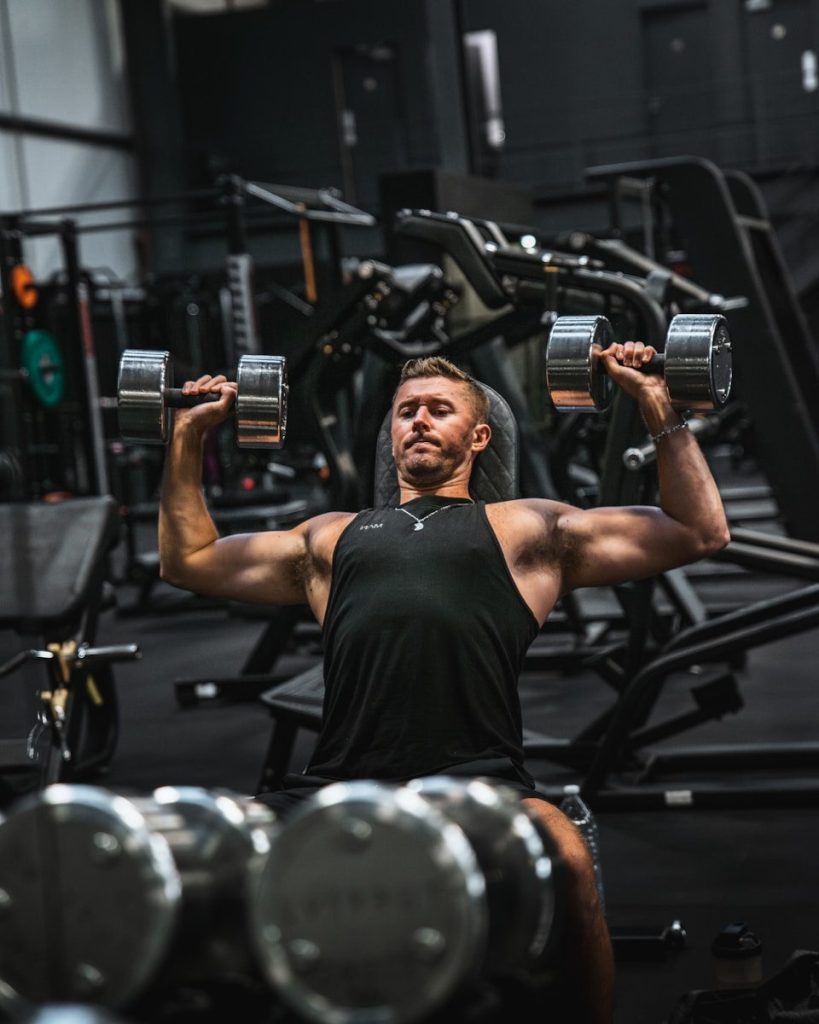
This guide explains how to perform the dumbbell chest press with proper form, choose an appropriate weight, avoid common mistakes, and include the exercise in a practical workout.
Dumbbell Chest Press at a Glance
| Category | Details |
|---|---|
| Exercise type | Compound horizontal press |
| Primary muscle | Pectoralis major |
| Assisting muscles | Triceps and anterior deltoids |
| Equipment | Two dumbbells and a stable flat bench |
| Beginner range | 2–3 sets of 8–12 repetitions |
| General rest | 90–150 seconds |
| Main form goal | Lower and press with stable shoulders, stacked wrists, and controlled elbows |
What Is a Dumbbell Chest Press?
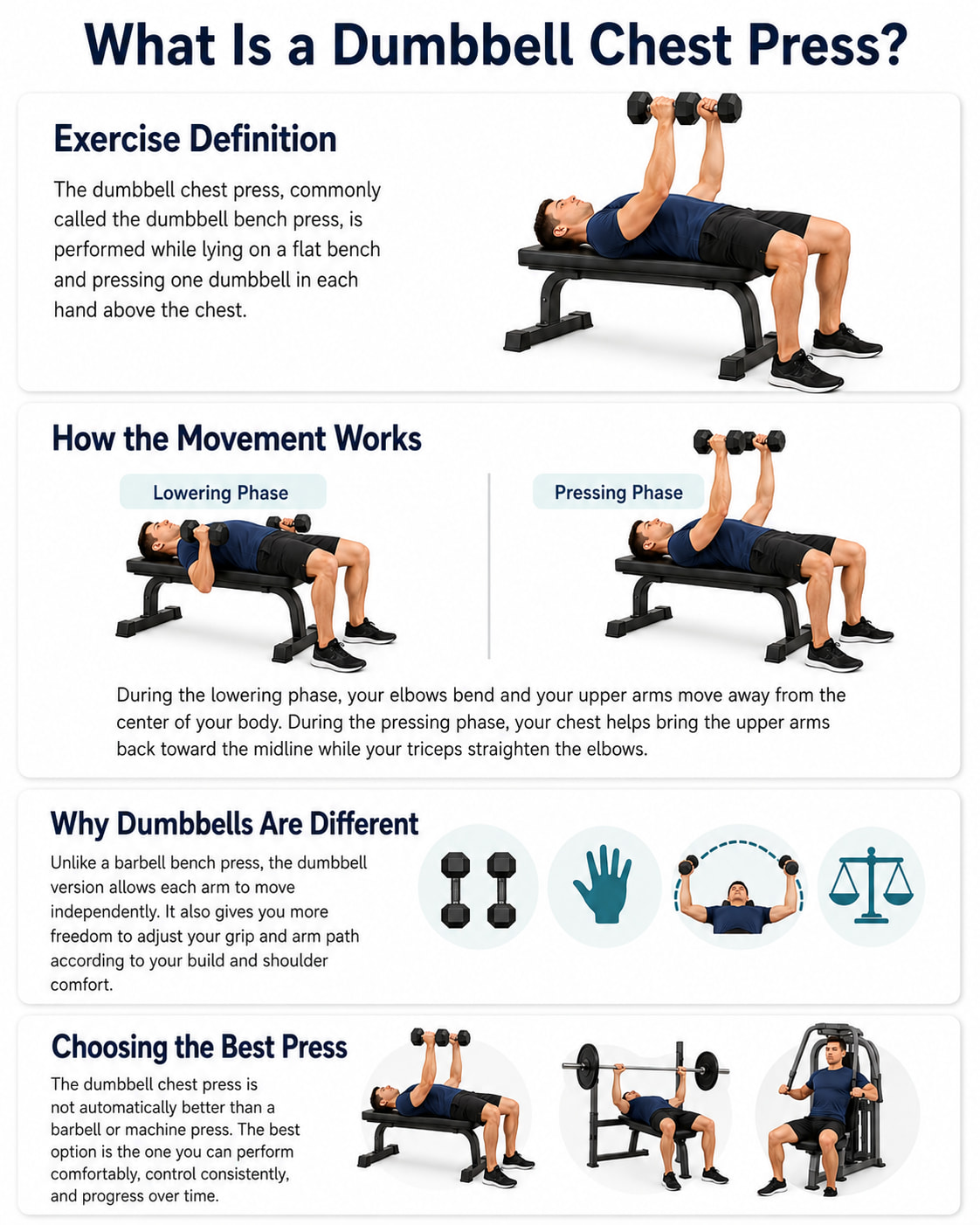
The dumbbell chest press, commonly called the dumbbell bench press, is performed while lying on a flat bench and pressing one dumbbell in each hand above the chest.
During the lowering phase, your elbows bend and your upper arms move away from the center of your body. During the pressing phase, your chest helps bring the upper arms back toward the midline while your triceps straighten the elbows.
Unlike a barbell bench press, the dumbbell version allows each arm to move independently. It also gives you more freedom to adjust your grip and arm path according to your build and shoulder comfort.
The dumbbell chest press is not automatically better than a barbell or machine press. The best option is the one you can perform comfortably, control consistently, and progress over time.
Dumbbell Chest Press Muscles Worked
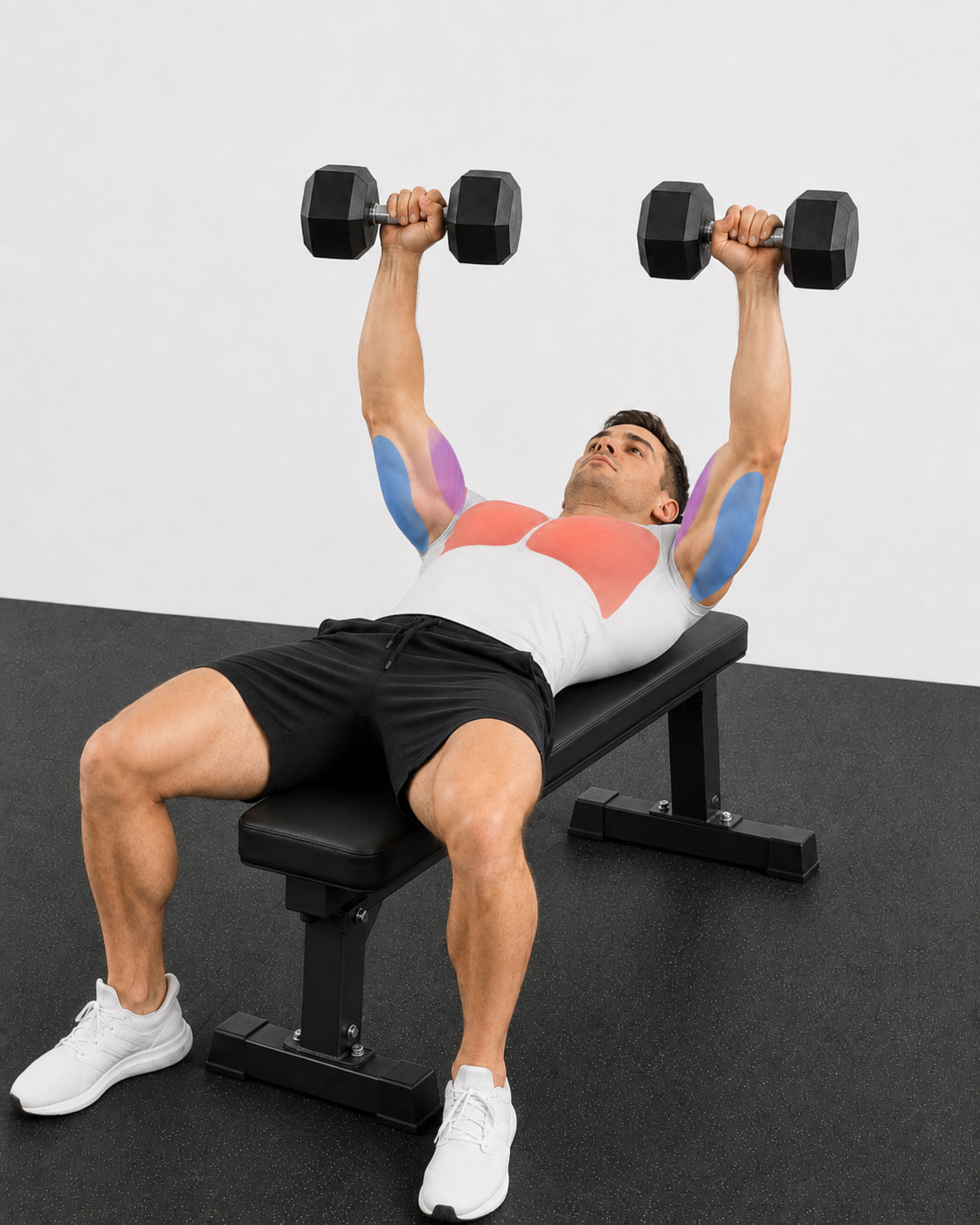
Pectoralis Major
The pectoralis major is the primary muscle worked. It brings the upper arms inward during the press, with both the upper and middle portions contributing.
Triceps Brachii
The triceps straighten the elbows as you press the dumbbells upward. A slightly narrower elbow position can increase their involvement.
Anterior Deltoids
The front shoulders assist the chest during the pressing phase. Excessive shoulder involvement may indicate poor setup, elbow position, range of motion, or weight selection.
Stabilizing Muscles
The rotator cuff, upper back, forearms, and core help stabilize the shoulders, dumbbells, and body throughout each repetition.
The National Academy of Sports Medicine’s bench press biomechanics guide explains the main muscles and joint actions involved in pressing exercises.
How to Do the Dumbbell Chest Press With Proper Form
Equipment needed: Two dumbbells and a stable flat bench.
Sets, reps, and rest: Beginners can start with 2–3 sets of 8–12 repetitions, resting for 90–150 seconds. Choose a weight that allows you to finish each set with approximately two or three controlled repetitions still possible.
How to Do It
- Sit at the end of the bench with one dumbbell resting securely on each thigh.
- Use your thighs to help guide the dumbbells toward your chest as you lie back under control. Do not try to curl heavy dumbbells into position using only your arms.
- Plant your feet firmly on the floor. Keep your head, upper back, and hips supported by the bench. Maintain a small, natural lower-back curve without forcing an exaggerated arch.
- Hold the dumbbells above your chest with your palms facing forward or slightly inward. Wrap your thumbs around the handles and keep your wrists stacked over your forearms.
- Gently draw your shoulder blades back and down. Keep your chest comfortably lifted without shrugging your shoulders.
- Lower the dumbbells toward the sides of your mid-chest. Allow your elbows to travel at a moderate angle from your torso rather than flaring directly outward.
- Stop when you reach the deepest position you can control without shoulder discomfort, forward shoulder movement, or loss of wrist alignment.
- Press the dumbbells upward over your chest. Straighten your elbows under control without aggressively snapping them into lockout.
- Finish the set with the dumbbells stable above your chest. Bring them carefully toward your thighs as you sit up, or use assistance from a spotter when handling heavy weights.
The American Council on Exercise chest press guide also emphasizes stable body contact, neutral wrists, controlled lowering, and appropriate spotter assistance.
Coaching cue: Lower the weights with your wrists above your elbows, then press the dumbbells over your chest.
How Far Should You Lower the Dumbbells?
Lower the dumbbells only as far as you can while maintaining a stable shoulder position and neutral wrists.
Your ideal depth depends on factors such as:
- Arm length
- Shoulder structure
- Bench width
- Grip position
- Mobility
- Previous training experience
The dumbbells do not have to touch your chest, and your elbows do not need to descend far below the bench.
Stop the lowering phase when any of the following occurs:
- Your shoulders begin rolling forward.
- Your wrists bend excessively.
- Your forearms lose their stable position.
- You feel pain or pinching in the shoulder.
- You can no longer control the descent.
A longer range of motion can be useful when it remains comfortable and controlled. However, lowering deeper is not automatically better.
Common Dumbbell Chest Press Mistakes
Using too much weight
A weight is too heavy when you cannot lower it slowly, keep both sides moving evenly, or maintain your body position.
Reduce the load if you have to bounce, twist, shorten the repetition significantly, or receive assistance during most repetitions.
Flaring the elbows directly outward
Positioning the upper arms in a straight line with the shoulders creates an extreme elbow flare. This may make shoulder control more difficult for some lifters.
A moderate elbow angle—often somewhere around 30–60 degrees from the torso—is a useful starting point. The exact angle should be adjusted based on your build and comfort.
Tucking the elbows too tightly
Pressing with the elbows pinned against the ribs turns the movement into a narrower, more triceps-focused press. It can also make it difficult to keep the forearms vertical.
Allow the elbows to move away from your torso enough to maintain a stable pressing position.
Bending the wrists backward
Keep each dumbbell positioned over the base of your palm rather than near your fingers. Your wrist should remain approximately aligned with your forearm.
If your wrists collapse backward, use lighter dumbbells and improve your grip before increasing the load.
Allowing the shoulders to roll forward
The upper back should remain stable against the bench. Avoid reaching the shoulders forward at the top or allowing them to shift excessively at the bottom.
Do not force the shoulder blades together as hard as possible. Use a controlled, comfortable position that creates a stable pressing base.
Excessive lower-back arching
A small natural curve in the lower back is normal. An exaggerated arch that causes the hips to lift or the ribs to flare excessively usually indicates poor control or an overly heavy weight.
Keep your feet planted, hips supported, and core controlled throughout the set.
Crashing the dumbbells together
The dumbbells may move slightly toward each other as you press, but they do not need to collide at the top. Hitting them together can disturb your balance and reduce control.
Ending the set carelessly
Getting heavy dumbbells out of position can be more difficult than completing the repetitions.
Use a spotter when appropriate. Otherwise, bring the dumbbells carefully toward your thighs and use their momentum to help you return to a seated position. Do not throw them onto the floor unless the training area is specifically designed for dropping weights and doing so is necessary for safety.
Benefits of the Dumbbell Chest Press
Builds chest strength and muscle
The dumbbell chest press places the chest under resistance through both the lowering and pressing phases. When performed consistently with progressive resistance, it may help build chest strength and muscle.
Trains each arm independently
Each hand controls a separate weight. Your stronger arm cannot directly move the dumbbell held by your weaker arm.
This can make differences in control, range, or strength easier to notice. The exercise does not automatically correct an imbalance, but it may reduce compensation compared with pressing one shared bar.
Provides grip and movement freedom
Dumbbells allow you to adjust your hand angle and pressing path. A slightly angled or neutral grip may feel more comfortable than a fixed straight-bar position for some lifters.
Works with different training goals
You can use the exercise with moderate repetitions for muscle growth, heavier sets for strength, or lighter controlled sets for technique practice.
Requires less starting weight than a standard barbell
Dumbbells are available in small weight increments, which can make the exercise accessible to beginners who are not ready to press a standard barbell.
The Cleveland Clinic’s bench press form guide provides additional guidance on dumbbell setup, grip, range of motion, and shoulder control.
How Much Weight Should You Use?
Choose a weight that allows you to complete the planned repetitions without changing your technique.
For example, when performing a set of 10 repetitions, a suitable weight should normally allow you to complete all 10 while still having approximately two or three good repetitions available.
The weight is probably too heavy when:
- You cannot get the dumbbells into position safely.
- Your wrists bend backward.
- One arm presses much faster than the other.
- Your elbows or shoulders move unpredictably.
- Your hips lift from the bench.
- You cannot control the lowering phase.
- You regularly need assistance to complete the set.
Beginners should prioritize repeatable form before testing heavy weights.
Before your working sets, complete one to three lighter warm-up sets. Gradually increase the weight without tiring yourself before the main sets.
Sets, Reps, Rest, and Frequency
Use the following ranges as practical starting points rather than strict rules.
| Training goal | Sets | Repetitions | Rest | Suggested effort |
|---|---|---|---|---|
| Learning technique | 2–3 | 8–12 | 90–150 seconds | 3–4 reps in reserve |
| General muscle building | 3–4 | 8–15 | 90–180 seconds | 1–3 reps in reserve |
| General strength | 3–4 | 5–8 | 2–3 minutes | 1–3 reps in reserve |
Training to complete muscular failure is not necessary during every set. Most readers can progress while stopping slightly before form begins to break down.
Use the dumbbell chest press one or two times per week depending on your full training schedule. Beginners should generally include at least one recovery day between demanding chest workouts.
Current American College of Sports Medicine resistance-training guidance emphasizes consistent progressive training, sufficient weekly volume, and regular training of the major muscle groups rather than relying on one mandatory repetition range or equipment type.
How to Progress the Dumbbell Chest Press
A simple double-progression method works well:
- Select a repetition range, such as 8–12.
- Use the same weight until you can complete all planned sets at the upper end of the range.
- Keep approximately one to three good repetitions in reserve.
- Increase to the next available dumbbell weight.
- Return to the lower end of the repetition range.
- Build back toward the upper end.
For example:
- Week 1: 20-pound dumbbells for 10, 9, and 8 repetitions
- Week 2: 20-pound dumbbells for 11, 10, and 9 repetitions
- Week 3: 20-pound dumbbells for 12, 12, and 11 repetitions
- Week 4: 20-pound dumbbells for 12 repetitions on all three sets
- Next session: Move to the next manageable weight and begin near eight repetitions
Do not increase the weight simply because you completed the minimum number of repetitions once. First make sure your range of motion, wrist position, and shoulder control remain consistent across every set.
Beginner Regressions
Dumbbell Floor Press
The dumbbell floor press is performed lying on the floor. The upper arms stop when they reach the ground, limiting the bottom range.
This can make the exercise easier to control, although it provides less chest range of motion than a bench press.
Neutral-Grip Dumbbell Press
Perform the press with your palms facing each other and your elbows somewhat closer to your sides.
Some lifters find this grip more comfortable. It is an alternative position, not a guaranteed solution for shoulder pain.
Reduced-Range Dumbbell Press
Lower the dumbbells only to a position you can control comfortably. Gradually increase the depth as your technique and confidence improve.
Machine Chest Press
A chest press machine provides more external stability and may be easier for beginners who are not yet comfortable controlling two dumbbells.
Dumbbell Chest Press Progressions and Variations
Paused Dumbbell Chest Press
Pause for one or two seconds near the bottom without relaxing your shoulders. This removes some momentum and improves control.
Use lighter dumbbells than you would during regular repetitions.
Slow-Eccentric Dumbbell Chest Press
Lower the dumbbells over approximately three seconds before pressing them upward normally.
This progression increases time under tension and can help you practice a stable lowering path.
Single-Arm Dumbbell Chest Press
Press one dumbbell while holding the other arm still or using only one dumbbell for the entire set.
The uneven load increases the challenge to your torso and requires strong body control. Start lighter than you would during a two-arm press.
Incline Dumbbell Chest Press
Raise the bench to a low incline to place more emphasis on the upper chest and front shoulders.
A bench angle around 15–30 degrees is commonly used. Research on different bench angles suggests that approximately 30 degrees may increase upper-chest involvement, while steeper angles generally shift more demand toward the front deltoids. See the bench-angle muscle-activity study on PubMed.
The incline press is a variation rather than a required progression from the flat press.
Dumbbell Chest Press vs. Barbell Bench Press
| Dumbbell chest press | Barbell bench press |
|---|---|
| Each arm controls a separate weight | Both hands control one bar |
| Allows more freedom in grip and arm path | Uses a fixed hand position |
| May make side-to-side differences easier to notice | Often allows heavier total loads |
| Requires more independent stabilization | Usually easier to set up in a rack |
| Available in smaller starting weights | Standard bars may be too heavy for some beginners |
Neither exercise is universally superior.
Choose the dumbbell press when you value independent arm control, grip freedom, or smaller weight increments. Choose the barbell when your goal includes practicing the barbell bench press or progressing with heavier total loads.
Both can be included in the same training program, but you do not need to perform both during every chest workout.
How to Use the Dumbbell Chest Press in a Workout
Place the dumbbell chest press near the beginning of your session when building chest strength or muscle is a priority. Perform it after your general warm-up and lighter pressing warm-up sets.
Beginner Upper-Body Workout
- Dumbbell chest press: 3 sets of 8–12 repetitions
Rest 90–150 seconds and finish with approximately two repetitions in reserve. - Supported one-arm dumbbell row: 3 sets of 8–12 repetitions per side
Rest 60–90 seconds after each side. - Dumbbell lateral raise: 2 sets of 12–15 repetitions
Rest 60 seconds. - Dumbbell triceps extension: 2 sets of 10–15 repetitions
Rest 60–90 seconds.
Complete this workout once or twice per week, leaving at least one recovery day between sessions.
When all chest-press sets reach the top of the repetition range with consistent form, increase the dumbbell weight slightly.
Safety Tips
Use a stable bench positioned on a level surface. Check that adjustable dumbbell plates and collars are secured before beginning.
When training alone, avoid weights that you cannot safely move into and out of position. A spotter can help with setup and the final repetition during heavy sets.
Stop the exercise if you experience sharp pain, numbness, dizziness, chest pain, or other unusual symptoms. Do not try to press through joint pain.
Persistent shoulder discomfort should be evaluated by a qualified healthcare or rehabilitation professional before you continue loading the exercise.
Frequently Asked Questions
Are the dumbbell chest press and dumbbell bench press the same?
They usually refer to the same exercise when the chest press is performed with dumbbells on a flat bench.
However, “chest press” can also describe a machine chest press or floor press, so the equipment and position should be specified.
Should the dumbbells touch your chest?
No. Lower the dumbbells toward the sides of your chest, but stop at the deepest position you can control without shoulder discomfort or loss of alignment.
Your arm length, shoulder structure, and bench width affect how close the weights come to your torso.
Should the dumbbells touch at the top?
The dumbbells may move closer together, but they do not need to touch. Press them until your arms are extended and the weights are stable over your chest.
Avoid crashing the dumbbells together.
Should your elbows be tucked?
Your elbows should generally remain at a moderate angle from your torso rather than flaring directly outward or being pinned against your ribs.
An angle of approximately 30–60 degrees is a useful starting range, but comfort and stable forearm alignment are more important than one exact number.
Why do I feel the exercise mainly in my shoulders?
Common causes include using too much weight, flaring the elbows, lowering beyond your controlled range, pressing toward your face, or allowing the shoulders to roll forward.
Reduce the weight and practice a stable shoulder position. Stop if the exercise causes pain rather than normal muscular effort.
Can you do a dumbbell chest press without a bench?
Yes. Perform a dumbbell floor press instead.
The floor limits how far your elbows can descend, making the bottom position easier to control. However, it also reduces the available chest range of motion.
Is the dumbbell chest press enough for a complete chest workout?
It can be the main exercise in a simple chest workout, especially for beginners. More experienced lifters may add an incline press, push-up, cable fly, or another chest exercise when additional training volume is appropriate.
More exercises are not automatically better. Total weekly training volume, technique, recovery, and gradual progression matter more than using many variations in one session.
Conclusion
The dumbbell chest press is an effective compound exercise for developing chest, triceps, and front-shoulder strength. Its main advantages are independent arm control, adjustable grip positioning, and easy progression through different dumbbell weights.
Start with a manageable load, keep your feet and upper back stable, lower the dumbbells within a comfortable range, and press with your wrists stacked over your elbows. Progress only when you can repeat the same controlled technique across every set.
References
- American Council on Exercise: Chest Press Exercise Guide
- National Academy of Sports Medicine: Biomechanics of the Bench Press
- Cleveland Clinic: How to Bench Press With Proper Form
- American College of Sports Medicine: 2026 Resistance Training Guidelines
- PubMed: Effects of Bench Inclination on Upper-Body Muscle Activation
This content is for informational and educational purposes only and is not intended as a substitute for professional medical advice, diagnosis, or treatment.
5 thoughts on “Dumbbell Chest Press: Proper Form, Muscles, and Tips”