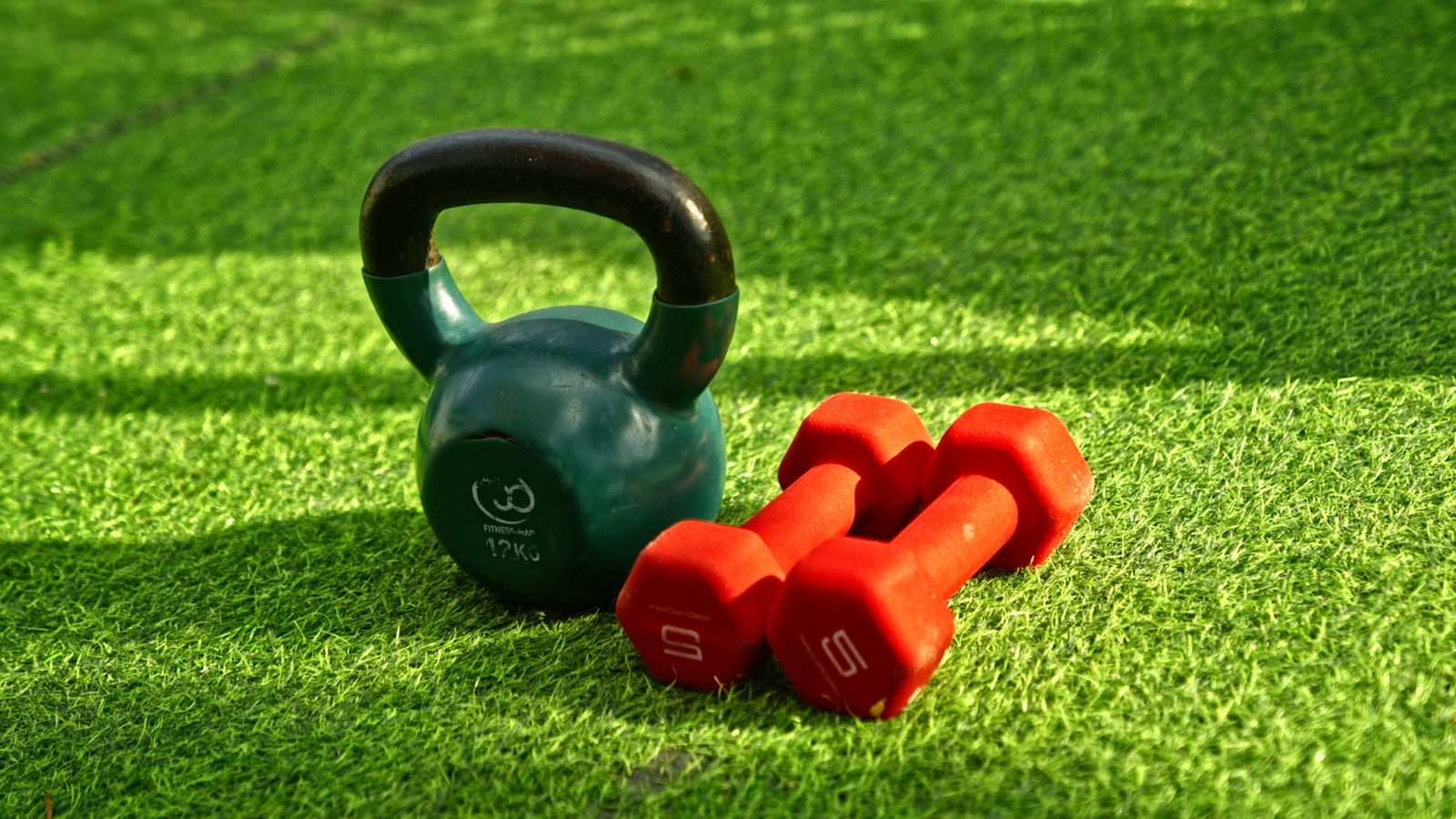
Dumbbells are usually better for controlled strength training, muscle-building exercises, and gradual load progression, while kettlebells are usually better for swings, explosive hip power, and compact conditioning workouts.
The dumbbell vs kettlebell decision does not have one winner for every person. Both are free weights, both can train the entire body, and both can build strength and muscle when you use enough resistance and progress consistently.
The main difference is how each weight is shaped. That difference affects which exercises feel natural, how the load challenges your grip and wrist, and how easily you can perform controlled or momentum-based movements.
Dumbbell vs Kettlebell at a Glance
| Category | Dumbbell | Kettlebell | Better default |
|---|---|---|---|
| Load position | Weight is balanced on both sides of the handle | Center of mass sits beyond the hand | Depends on the exercise |
| Muscle building | Excellent exercise selection and easy loading | Effective when the weight and exercise are appropriate | Dumbbell |
| Traditional strength | Excellent for presses, rows, squats, lunges, and hinges | Effective, but available weight jumps may be limiting | Dumbbell |
| Explosive power | Can be used for push presses and some explosive lifts | Designed well for swings, cleans, and snatches | Kettlebell |
| Conditioning | Works well in circuits | Excellent for swings, carries, and complexes | Kettlebell |
| Isolation exercises | Excellent for curls, raises, flyes, and extensions | Usually less practical | Dumbbell |
| Loaded carries | Excellent | Excellent, with more rack and bottoms-up options | Tie |
| Beginner use | Controlled movements are generally easy to learn | Deadlifts and goblet squats are beginner-friendly; swings require more skill | Dumbbell overall |
| Home-gym versatility | An adjustable pair can cover many exercises and loads | One kettlebell is compact and useful for full-body sessions | Depends on the goal |
| Fat loss | Can support demanding resistance circuits | Can support demanding resistance circuits | Tie |
What Is the Difference Between a Dumbbell and a Kettlebell?
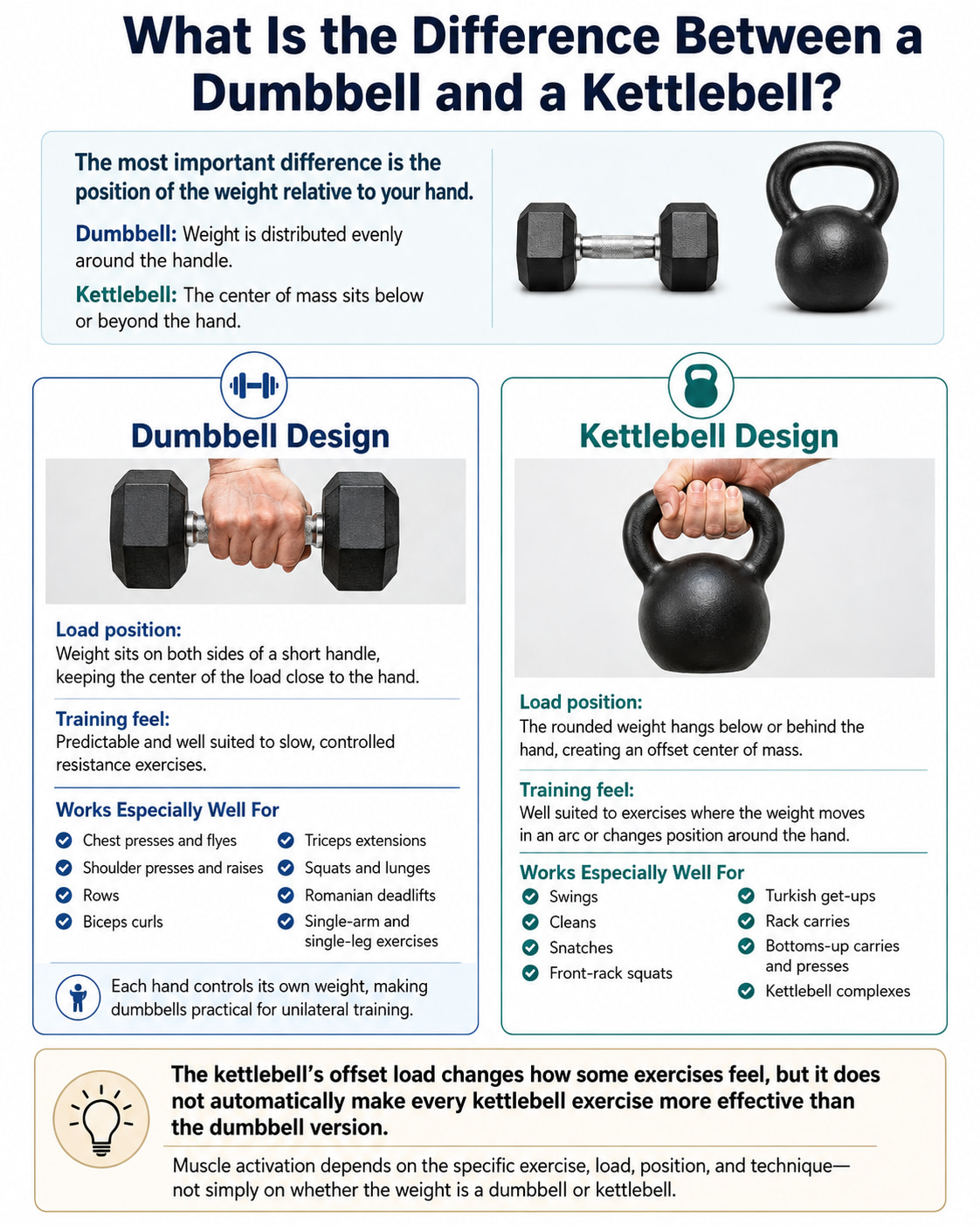
The most important difference is not the brand, material, or color. It is the position of the weight relative to your hand.
The National Strength and Conditioning Association’s resistance-equipment guide explains that dumbbells distribute weight evenly around the handle, while kettlebells have an offset center of mass that supports momentum-based movements such as swings.
Dumbbell Design
A dumbbell places weight on both sides of a short handle. The center of the load remains close to your hand, which usually makes the weight predictable during slow, controlled exercises.
This design works especially well for:
- Chest presses and flyes
- Shoulder presses and raises
- Rows
- Biceps curls
- Triceps extensions
- Squats and lunges
- Romanian deadlifts
- Single-arm and single-leg exercises
Because each hand controls its own weight, dumbbells are also practical for identifying and training side-to-side strength differences.
Kettlebell Design
A kettlebell has a rounded body beneath a larger handle. The load hangs below or behind the hand rather than remaining centered directly inside it.
This offset position makes the kettlebell well suited to exercises in which the weight moves in an arc or changes position around the hand, including:
- Swings
- Cleans
- Snatches
- Front-rack squats
- Turkish get-ups
- Rack carries
- Bottoms-up carries and presses
- Kettlebell complexes
The offset load can also change how a press, carry, or squat feels. However, it does not automatically make every kettlebell exercise more effective than the dumbbell version.
A 2026 electromyography study found that kettlebell, dumbbell, and resistance-band exercises produced different shoulder-muscle activation patterns depending on the exact movement. The differences were generally task-specific rather than proof that one tool always activates more muscle.
Dumbbell vs Kettlebell for Muscle Growth
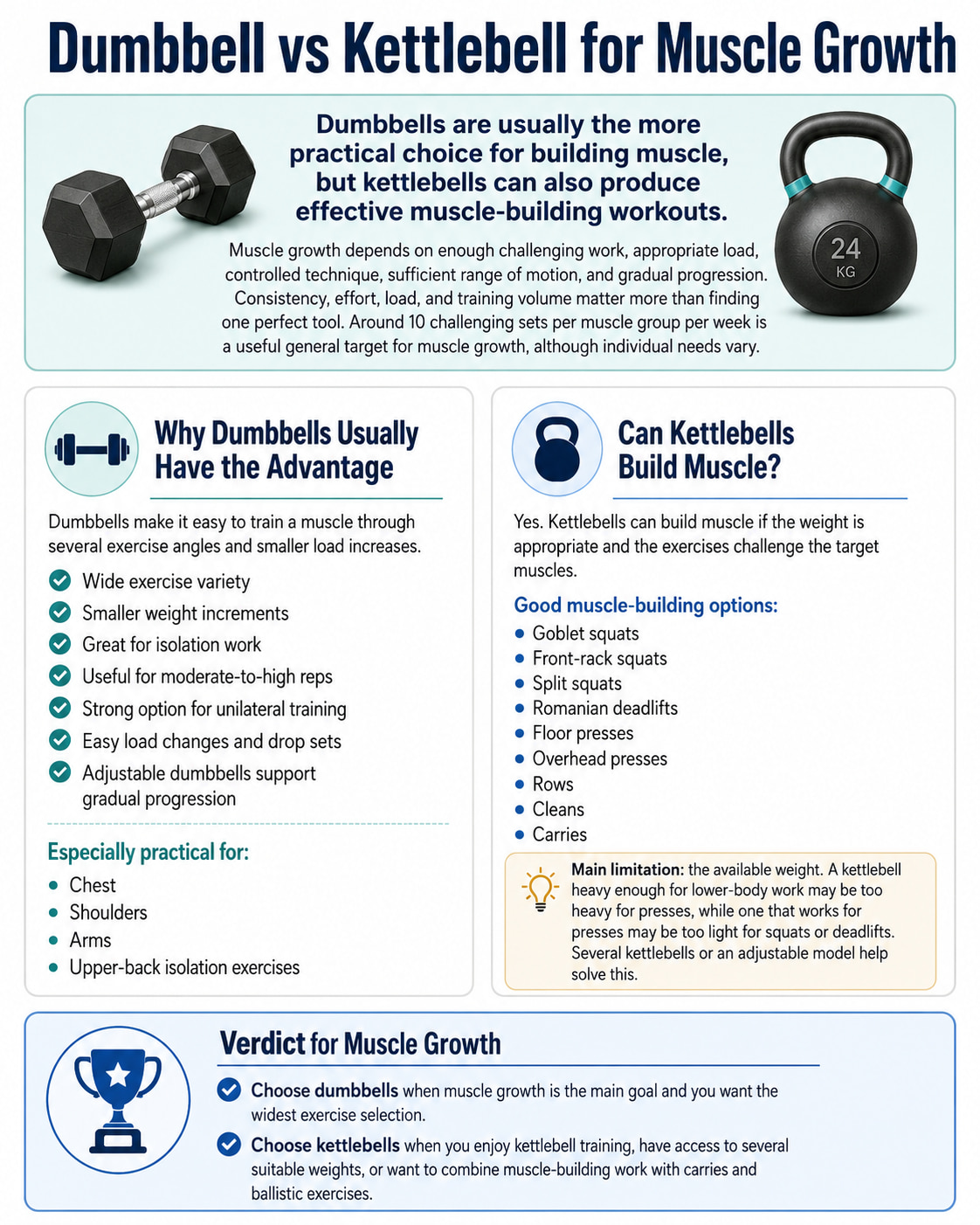
Dumbbells are usually the more practical choice for building muscle, but kettlebells can also produce effective muscle-building workouts.
Muscle growth depends primarily on performing enough challenging work with an appropriate load, controlled technique, sufficient range of motion, and gradual progression. The equipment must allow the target muscles to work hard enough.
The American College of Sports Medicine’s 2026 resistance-training guidance emphasizes that consistency, effort, load, and training volume matter more than finding one supposedly perfect training method. The guidance suggests that higher weekly volume—around 10 challenging sets per muscle group—is a useful general target for muscle growth, although individual needs vary.
Why Dumbbells Usually Have the Advantage
Dumbbells make it easy to train a muscle through several exercise angles. For example, a chest workout can include a flat press, incline press, floor press, fly, and pullover. A shoulder workout can include overhead presses, lateral raises, rear-delt raises, and front raises.
Dumbbells are also available in lighter weights and smaller increments, which is useful for muscles that cannot handle large increases in resistance.
They are especially practical for:
- Chest, shoulder, arm, and upper-back isolation exercises
- Moderate-to-high repetition training
- Unilateral exercises
- Drop sets and other load changes
- Gradual progression with adjustable dumbbells
Can Kettlebells Build Muscle?
Yes. Kettlebells can build muscle through exercises such as:
- Goblet squats
- Front-rack squats
- Split squats
- Romanian deadlifts
- Floor presses
- Overhead presses
- Rows
- Cleans
- Carries
The limitation is usually not the kettlebell itself. The limitation is whether you have a suitable weight.
A kettlebell that challenges your legs may be too heavy for presses. A kettlebell that works well for presses may be too light for squats and deadlifts. Owning several kettlebells or an adjustable model helps solve this problem.
Verdict for Muscle Growth
Choose dumbbells when muscle growth is the main goal and you want the widest selection of exercises.
Choose kettlebells when you enjoy kettlebell training, have access to several suitable weights, or want to combine muscle-building work with carries and ballistic exercises.
Dumbbell vs Kettlebell for Strength
Both tools can build strength. The better option is the one that lets you use enough resistance in the exercises you want to improve.
Dumbbell Strength Training
Dumbbells are especially effective for traditional strength exercises such as:
- Dumbbell bench press
- Dumbbell overhead press
- One-arm row
- Dumbbell squat
- Bulgarian split squat
- Dumbbell Romanian deadlift
- Farmer carry
They also make it easy to train one side at a time. This can prevent the stronger side from taking over a movement.
For strength-focused sets, use a weight that makes approximately 5–8 controlled repetitions challenging while still allowing technically sound form. Resting two to three minutes between demanding compound sets is often more useful than rushing into the next set.
Kettlebell Strength Training
Kettlebells can build strength with:
- Double-kettlebell front squats
- Kettlebell deadlifts
- Single-arm presses
- Rows
- Split squats
- Front-rack carries
- Suitcase carries
- Turkish get-ups
Using two kettlebells can provide more loading potential than holding one kettlebell in a goblet position. However, kettlebell weight jumps are often larger than dumbbell increments, particularly with fixed cast-iron models.
Which Is Better for Maximum Strength?
Dumbbells usually have a practical advantage for conventional pressing and rowing strength because gyms often provide a wider range of dumbbell weights.
For heavy leg training, both implements may eventually become limited by the amount of weight you can hold. At that point, barbells, machines, or heavier specialty equipment may provide a more practical path to continued progression.
Verdict for Strength
Choose dumbbells for traditional strength training, especially upper-body presses and rows.
Choose kettlebells when your strength goals include front-rack positions, carries, single-arm pressing, and strength that transfers into kettlebell-specific movements.
Dumbbell vs Kettlebell for Power
Kettlebells have the clearest advantage for explosive hip-power training.
Power involves producing force quickly. The kettlebell’s offset center of mass and large handle make it suitable for ballistic exercises in which the weight accelerates and then floats through part of the movement.
The most common example is the kettlebell swing.
Research examining the mechanical demands of kettlebell swings found that swings can produce substantial power through rapid hip extension. A separate small randomized trial found improvements in maximal and explosive strength after six weeks of twice-weekly kettlebell swing training. These studies support swings as a useful power exercise, but they do not show that kettlebells are superior for every strength or athletic goal.
Why the Kettlebell Swing Works Well
A properly performed swing is a forceful hip hinge, not a slow squat or shoulder raise.
The hips drive the kettlebell forward. The arms guide the weight rather than lifting it with the shoulders. The bell then returns between the legs as the hips move backward for the next repetition.
The NSCA’s two-arm kettlebell swing guide emphasizes a neutral spine, controlled knee bend, extended arms, and forceful hip and knee extension.
Can Dumbbells Train Power?
Yes. Dumbbells can be used for:
- Push presses
- Dumbbell jump squats
- Dumbbell high pulls
- Dumbbell cleans
- Dumbbell snatches
However, kettlebells usually feel more natural for repeated swings because the handle provides room for both hands and the bell can travel smoothly between the legs.
Verdict for Power
Choose kettlebells for swings and other repeated ballistic exercises.
Choose dumbbells when you want explosive presses, jumps, or single-repetition power exercises without learning kettlebell-specific rack and hand transitions.
Dumbbell vs Kettlebell for Conditioning
Kettlebells are often the more convenient choice for combining resistance training with cardiovascular demand.
Swings, cleans, snatches, squats, presses, and carries can be linked together with limited setup. This makes kettlebells useful for short conditioning sessions and exercise complexes.
A small four-week study involving collegiate soccer players found improved aerobic capacity after a demanding kettlebell-snatch interval program. Because the study included only 17 participants and used a specialized protocol, it should not be interpreted as proof that every kettlebell workout is better than dumbbell circuits or conventional cardio.
Dumbbells can also provide challenging conditioning through exercises such as:
- Dumbbell thrusters
- Reverse lunges
- Renegade rows
- Push presses
- Farmer carries
- Full-body circuits
The kettlebell advantage is mainly convenience. Its shape works well for repeatedly transitioning between swings, cleans, squats, and presses.
Verdict for Conditioning
Choose kettlebells when you enjoy continuous full-body movements and already have reliable ballistic technique.
Choose dumbbells when you prefer controlled circuits, bodybuilding-style exercises, or simpler movement transitions.
Are Dumbbells or Kettlebells Better for Fat Loss?
Neither tool automatically produces more fat loss.
A kettlebell workout may feel more cardiovascular because exercises such as swings use a large amount of muscle and can be performed repeatedly. However, a demanding dumbbell circuit can also raise your heart rate and require substantial effort.
Long-term body-composition changes depend on the complete training program, daily activity, nutrition, sleep, and consistency—not the shape of the weight.
Choose the implement that helps you:
- Train regularly
- Use enough resistance
- Maintain good technique
- Progress over time
- Combine resistance training with appropriate cardiovascular activity
Do not judge a workout only by sweating, breathlessness, or estimated calorie burn. A well-rested strength session can be valuable even when it does not feel like a cardio workout.
Which Is Better for Beginners?
Dumbbells are usually the better all-around starting choice.
The balanced load makes exercises such as goblet squats, rows, floor presses, Romanian deadlifts, and curls relatively easy to understand. Dumbbells also provide lighter starting weights for upper-body exercises.
Kettlebells are not unsuitable for beginners. Several kettlebell exercises are excellent starting movements:
- Kettlebell deadlift
- Goblet squat
- One-arm row
- Floor press
- Suitcase carry
- Farmer carry
The more technical kettlebell exercises should come later.
A Sensible Kettlebell Learning Order
- Learn the deadlift and basic hip hinge.
- Practice goblet squats, rows, presses, and carries.
- Learn how to brace the trunk and control the wrist.
- Add the two-handed swing with qualified instruction.
- Progress to cleans and snatches only after the swing and rack position are controlled.
Do not begin with fast circuits simply because kettlebells are commonly used that way. Learn the movement first, then gradually add speed, load, or workout density.
Exercises That Usually Work Better With Dumbbells
Chest Presses and Flyes
Dumbbells sit comfortably on either side of the torso and allow each arm to move independently. This makes them practical for bench presses, incline presses, floor presses, and fly variations.
Kettlebell presses can also work, but the bell rests against the forearm and requires a stable rack position.
Curls and Triceps Exercises
Dumbbells are the clearer choice for biceps curls, hammer curls, concentration curls, overhead triceps extensions, and triceps kickbacks.
The balanced design makes it easier to control the resistance without the bell pulling away from the hand.
Shoulder Raises
Lateral raises, front raises, and rear-delt raises usually work better with light dumbbells. Most kettlebells start at weights that are too heavy or awkward for controlled shoulder isolation.
Chest-Supported Rows
Dumbbells are easier to position beside a bench and allow the elbows to move freely without the bell contacting the bench or torso.
Two-Dumbbell Lower-Body Exercises
Holding one dumbbell in each hand works well for:
- Romanian deadlifts
- Walking lunges
- Step-ups
- Bulgarian split squats
- Suitcase squats
The load hangs naturally beside the legs without requiring a front-rack position.
Exercises That Usually Work Better With Kettlebells
Two-Handed Swing
The handle and offset center of mass allow the bell to move between the legs and forward in an arc. This is the kettlebell’s most obvious mechanical advantage.
Kettlebell Clean
The bell can move from the swing into a front-rack position without needing to be lowered between repetitions. Proper technique should allow it to wrap smoothly around the hand rather than striking the forearm.
Kettlebell Snatch
The kettlebell snatch combines an explosive hip drive with an overhead finish. It is a technical exercise and should be learned only after the swing and clean are controlled.
Front-Rack Carries
A kettlebell can rest between the forearm and upper arm in the rack position, creating a different trunk and shoulder-control challenge from a standard farmer carry.
Bottoms-Up Carries and Presses
Holding a kettlebell upside down requires careful grip, wrist, and shoulder control. This is an advanced option rather than a beginner exercise.
Exercises That Work Well With Either Tool
| Exercise | Dumbbell setup | Kettlebell setup | Key form point |
|---|---|---|---|
| Goblet squat | Hold one head of a dumbbell at the chest | Hold the horns or sides of the handle | Keep the whole foot planted and knees tracking with the toes |
| Romanian deadlift | Hold two dumbbells beside the thighs | Hold one bell between the legs or two beside the thighs | Push the hips backward without rounding the back |
| Reverse lunge | Hold dumbbells beside the body | Use suitcase or front-rack positions | Control the step and keep the front foot stable |
| One-arm row | Support the body on a bench or use a split stance | Use the same supported or split stance | Pull the elbow toward the hip without twisting |
| Floor press | Hold one dumbbell in each hand | Use one or two kettlebells in a stable rack | Keep wrists aligned and lower under control |
| Overhead press | Use palms-forward or neutral grips | Begin from the kettlebell rack position | Avoid leaning backward to finish the rep |
| Suitcase carry | Hold one dumbbell at the side | Hold one kettlebell at the side | Walk without leaning toward or away from the weight |
| Farmer carry | Hold one dumbbell in each hand | Hold one kettlebell in each hand | Use short, controlled steps and remain tall |
Can You Substitute a Dumbbell for a Kettlebell?
Dumbbells can replace kettlebells in many controlled exercises, including:
- Squats
- Lunges
- Deadlifts
- Romanian deadlifts
- Rows
- Floor presses
- Overhead presses
- Farmer carries
- Suitcase carries
The substitution is less exact for exercises that depend on the kettlebell’s handle and offset load.
Kettlebell Swing
A dumbbell swing can reproduce a similar hip-hinge pattern, but the grip and available clearance are different. Only use a dumbbell that can be held securely. A dumbbell Romanian deadlift is a safer controlled alternative when the dumbbell shape makes swinging uncomfortable.
Kettlebell Clean and Snatch
Dumbbell cleans and snatches train similar explosive movement patterns, but the weight follows a different path and finishes in a different position. Do not copy kettlebell technique exactly when using a dumbbell.
Bottoms-Up Exercises
There is no direct dumbbell substitute because the challenge depends on balancing the kettlebell above its handle.
Which Should You Buy for a Home Gym?
Choose Adjustable Dumbbells When:
- Muscle growth is your main goal.
- You want the widest exercise selection.
- You need light weights for arms and shoulders and heavier weights for legs.
- You prefer traditional sets and repetitions.
- You want one purchase that can support most strength exercises.
For many home exercisers, an adjustable dumbbell pair is the most versatile first purchase.
Choose a Kettlebell When:
- Swings are a major part of your plan.
- You enjoy carries, cleans, and full-body complexes.
- You want one compact piece of equipment.
- Your goal combines strength, power, and conditioning.
- You already know—or plan to properly learn—kettlebell technique.
One kettlebell can provide a useful workout, but it may not be the ideal weight for every exercise.
Choose Both When:
- Your budget and space allow it.
- You want dumbbells for presses, rows, and isolation work.
- You want a kettlebell for swings, rack carries, and conditioning.
- You prefer using the best tool for each movement rather than forcing one tool into every exercise.
What to Check Before Buying
Consider:
- Available weight range
- Size of weight increments
- Handle comfort and thickness
- Adjustable-locking security
- Space around the wrist and forearm
- Floor protection
- Available training space
- Whether you need one weight or a matched pair
A weight that feels suitable for goblet squats may be too heavy for shoulder presses. Plan for your weakest and strongest exercises rather than buying based on one movement.
Frequently Asked Questions
Are Dumbbells or Kettlebells Better for Building Muscle?
Dumbbells are usually more practical because they support more isolation exercises and smaller weight increases. Kettlebells can still build muscle when the exercises, loads, and weekly training volume are appropriate.
Are Kettlebells Better Than Dumbbells for Fat Loss?
No equipment automatically causes more fat loss. Kettlebells make full-body conditioning circuits convenient, but dumbbell circuits can also be demanding. Long-term results depend on the complete training and nutrition plan.
Can You Do Kettlebell Swings With a Dumbbell?
A dumbbell swing can provide a similar hip-hinge pattern when the dumbbell can be held securely. However, the grip and weight path are not identical. Use a dumbbell Romanian deadlift instead when the dumbbell shape does not allow a secure swing.
Which Is Better for Beginners?
Dumbbells are usually the better overall starting option because controlled presses, rows, squats, and hinges are relatively easy to learn. Kettlebell deadlifts, goblet squats, rows, and carries are also beginner-friendly.
Are Kettlebells Harder to Use Than Dumbbells?
Controlled kettlebell exercises are not necessarily harder. Ballistic movements such as swings, cleans, and snatches require more timing and technique than most standard dumbbell exercises.
Can You Build a Full-Body Workout With One Kettlebell?
Yes. One kettlebell can be used for squats, deadlifts, rows, presses, carries, and swings. The main limitation is that one weight may not challenge every muscle appropriately.
Do You Need Both Dumbbells and Kettlebells?
No. You can build an effective program with either tool. Owning both simply allows you to use dumbbells for traditional strength and isolation work while using a kettlebell for swings, rack positions, and conditioning.
Conclusion
Dumbbells are the better all-around choice for most beginners, muscle-building programs, and traditional strength training. Kettlebells are the better specialist tool for swings, explosive hip power, rack carries, and compact conditioning sessions.
Choose the tool that fits your goals, provides an appropriate weight range, and allows you to train consistently with good form. When both are available, use each for the movements it performs best rather than trying to declare one universal winner.
References
- American College of Sports Medicine: Updated Resistance Training Guidelines
- National Strength and Conditioning Association: Types of Resistance Training Equipment
- National Strength and Conditioning Association: Two-Arm Kettlebell Swing
- Mechanical Demands of Kettlebell Swing Exercise
- Kettlebell Swing Training Improves Maximal and Explosive Strength
- Effects of Kettlebell Training on Aerobic Capacity
- Shoulder Muscular Activation During Common Kettlebell Exercises
This content is for informational purposes only and is not a substitute for medical advice.