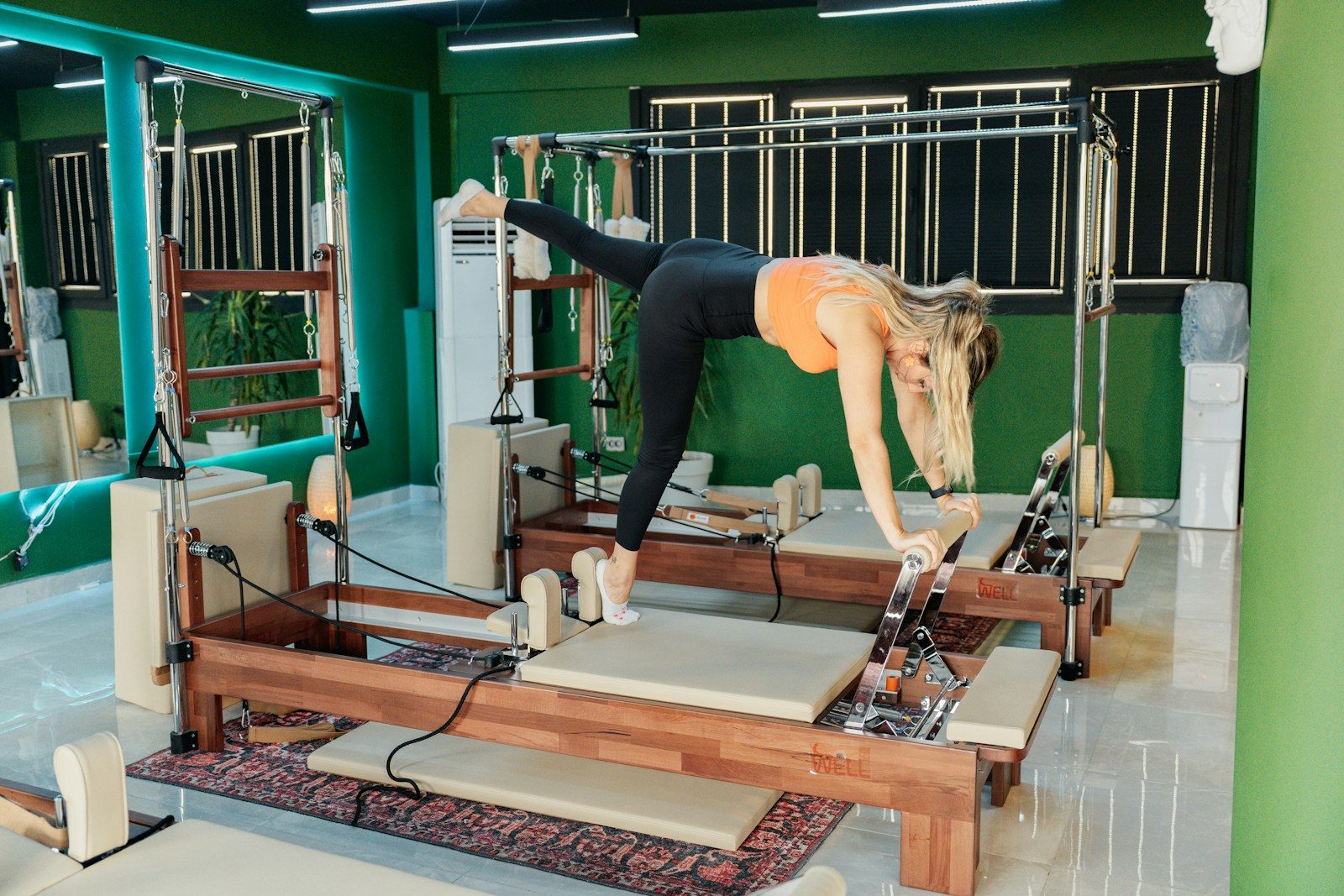
The main difference in Pilates vs Lagree is the training emphasis: Pilates combines controlled movement, strength, and mobility, while Lagree emphasizes sustained resistance and muscular endurance through slow repetitions and holds. Both require good technique, but they are different methods—not easier and harder versions of the same workout.
The better choice depends on what you enjoy, what you want to improve, and whether the class provides appropriate instruction. Here is how they compare, what you actually do, and how to start without making exhaustion the goal.
Pilates vs Lagree at a Glance
| Feature | Pilates | Lagree |
|---|---|---|
| Main emphasis | Movement control, strength, flexibility, and coordination | Muscular endurance and control under sustained resistance |
| Equipment | A mat or apparatus such as a reformer | Purpose-built equipment such as a Megaformer |
| Resistance | Body weight, props, or springs | Spring resistance combined with body position and leverage |
| Movement style | Precise repetitions with exercise-specific breathing and pacing | Deliberately slow repetitions, holds, and connected exercise sequences |
| Difficulty | Ranges from introductory to advanced | Generally demanding, with beginner modifications available |
| Home access | Mat Pilates requires little equipment | The machine-based format requires suitable Lagree equipment |
A Pilates reformer and a Megaformer both use a sliding carriage and springs, but similar-looking equipment does not make the methods interchangeable. Balanced Body explains the reformer’s adaptable resistance and support, while Lagree Fitness describes its method as using slow tempo, sustained work, and carefully sequenced exercises.
What Do You Actually Do in Each Workout?
Pilates: Coordinate Movement, Breathing, and Resistance
In Pilates, you practice moving specific parts of your body while controlling others. An exercise might ask you to extend your legs without changing your pelvic position or move your arms while maintaining a steady trunk.
As Cleveland Clinic explains, Pilates combines precise movement, breathing, and muscular control. It can be performed on a mat or specialized equipment. It is strengthening exercise—not simply stretching.
Example: Reformer Footwork With Heels on the Bar
Best for: Learning to move the legs against resistance while keeping the trunk and pelvis controlled.
Muscles worked: Primarily the quadriceps and hip extensors, with the abdominal muscles helping stabilize the trunk.
Equipment: A Pilates reformer with instructor-selected spring resistance, footbar position, and head support.
How to do it:
- Lie on your back on the carriage. Place your heels securely on the footbar, with your feet parallel and comfortably spaced.
- Keep your pelvis steady and your knees tracking in the same direction as your feet.
- Press the carriage away by extending your hips and knees without forcefully locking your knees.
- Bend your knees to return smoothly. Do not let the carriage slam into the stopper.
Merrithew demonstrates this heels-on-the-bar variation as part of its introductory reformer repertoire.
Practice guidance: After learning the setup, a suggested starting range is one set of 6–10 controlled repetitions, followed by a brief rest. Your instructor may adjust this.
Common mistakes: Bouncing, allowing the knees to drift inward, changing the position of the pelvis, or using resistance that prevents a smooth return.
Make it easier: Use a smaller comfortable range and ask the instructor to adjust the setup. Do not assume that removing springs is always the correct modification.
Lagree: Maintain Control During Sustained Work
Lagree uses exercises such as lunges, planks, and machine-based variations arranged into continuous sequences. Its slow repetitions and holds keep the muscles working for extended periods; muscular endurance means the ability to maintain or repeat that effort.
The movement itself is slow, even when transitions between exercises are brief. Moving faster to finish a difficult interval defeats that training emphasis.
Example: Front-Facing Lagree Wheelbarrow
Best for: Practicing trunk stability while the carriage moves.
Muscles worked: The abdominal muscles and shoulder-supporting muscles, with the upper body controlling movement at the shoulders.
Equipment: A Lagree machine with a fixed front platform and moving carriage, set up by an instructor.
How to do it:
- Under the instructor’s direction, place your hands on the fixed front platform and your knees on the carriage.
- Establish a supported kneeling-plank position, keeping your head, trunk, and pelvis aligned.
- With your arms long but not forcefully locked, allow the carriage to travel backward through a small, controlled range.
- Return toward the starting position without dropping your abdomen, arching your lower back, or sitting your hips toward your heels.
The Lagree Academy identifies the Wheelbarrow as a foundational trunk-stabilization exercise. The purpose is to maintain your position while moving—not to push the carriage as far away as possible.
Practice guidance: Learn a few controlled repetitions before attempting longer timed sequences. Ask for shorter work intervals and take breaks before your position deteriorates.
Common mistakes: Reaching too far, collapsing through the shoulders, holding your breath, or continuing after you lose trunk control.
Make it easier: Shorten the carriage travel and work interval. Have the instructor determine whether a different spring setting or supported position would be more appropriate.
These examples illustrate the methods; they are not a complete workout. Learn machine setup, mounting, and dismounting in an introductory session before practicing independently.
Which Muscles Do Pilates and Lagree Work?
Both methods can train more than the abdominals. The exercises selected—not simply the class label—determine the emphasis.
| Area | How it can be challenged |
|---|---|
| Abdominals and trunk | Controlling the ribs, pelvis, and spine while the limbs or carriage move |
| Glutes and legs | Pressing, extending the hips, and performing supported lunge patterns |
| Shoulders and arms | Supporting body weight or working against spring resistance |
| Back muscles | Maintaining trunk position and participating in appropriately selected pulling or extension exercises |
Pilates should not be described as training only “small muscles,” with Lagree training only “large muscles.” Both involve muscles that produce movement and muscles that help control position. Their exercise selection and programming differ.
When choosing a class, ask whether its weekly programming covers the whole body rather than repeatedly emphasizing the same areas.
Which Is Better for Your Goals?
For Movement Control and Mobility: Consider Pilates First
An introductory Pilates class is a sensible starting choice when you want to coordinate breathing, trunk control, and comfortable movement.
Mat Pilates also provides a straightforward way to practice without a large machine. Reformer Pilates adds adjustable assistance and resistance, which can help an instructor tailor exercises to your needs. This recommendation reflects the method’s structure—not evidence that it is universally superior.
For Sustained Muscular Effort: Consider Lagree
Lagree may suit you when you enjoy slow resistance exercise, timed work, and the challenge of maintaining technique as your muscles become tired.
Choose an introductory format rather than assuming that being comfortable with another workout makes you ready for every Lagree variation. Lagree On Demand provides beginner-focused instruction that uses shorter sequences and slower transitions, giving new participants more time to adapt.
For Strength: Look at the Program, Not Just the Name
Neither class label tells you exactly how much strength training you will receive. Consider whether the exercises challenge the relevant muscles, whether resistance can be progressed, and whether you can perform the work consistently.
The American College of Sports Medicine emphasizes individualized, progressive resistance training in its updated resistance-training guidance. For a specific strength goal, choose a program designed to develop and measure that ability rather than assuming that the class that feels hardest will produce the best result.
What Does the Research Actually Show?
A randomized Pilates study available through PubMed involved 50 active, middle-aged adults and found improvements in abdominal endurance, upper-body muscular endurance, and hamstring flexibility after a 12-week program. It did not find significant improvements in posture or balance compared with the control group.
A 2026 exploratory case series published by Scientific Archives followed eight adults through six weeks of Lagree training. Some movement and balance measures improved, but the measured muscular-endurance changes were not statistically significant. The study also lacked a control group.
These studies do not establish that one method is better than the other. They involved different participants, programs, and study designs. Lagree’s findings are preliminary, and neither study justifies guaranteed results or transformation timelines.
How to Start Safely and Avoid Common Mistakes
Choose Instruction Before Intensity
Book an introductory class or private orientation. Ask whether the instructor is trained in the specific method and whether the session includes machine setup, individual corrections, and modifications.
Before beginning, learn which parts of the machine move, where to place your hands and feet, and how to stop safely. Do not rush a transition because the rest of the class has already moved on.
Do Not Guess at Spring Settings
Springs can provide resistance, assistance, or stability depending on the exercise. Less spring tension can make some movements harder to control rather than easier.
Merrithew emphasizes selecting spring settings for the individual and the specific exercise. Use your instructor’s directions rather than copying another participant’s configuration.
Keep Breathing and Stop Before Technique Breaks Down
Use a range in which you can control your body and the carriage. Shorten the movement or take a break when you begin compensating.
You do not need to reach complete muscular failure for a worthwhile session. The American College of Sports Medicine’s updated resistance-training review found that training to failure did not consistently improve outcomes for the average healthy adult.
Treat Symptoms Differently From Ordinary Effort
Low impact does not mean effortless or appropriate for every person. Tell the instructor about relevant injuries, symptoms, or movement restrictions.
The NHS recommends seeking professional advice when exercise suitability is uncertain and stopping if exercise causes pain or illness. Stop and seek appropriate professional help for sharp pain, numbness, dizziness, chest pain, or other unusual symptoms.
How to Fit Pilates and Lagree Into Your Week
Start with a schedule that leaves room to recover and learn. Someone new to structured exercise can begin with one introductory session rather than starting both methods immediately.
For someone already comfortable with regular exercise, the following is a suggested trial schedule—not a complete weekly activity prescription.
| Day | Session | Main focus |
|---|---|---|
| Monday | Beginner mat or reformer Pilates | Learn breathing, alignment, and controlled movement |
| Thursday | Introductory Lagree session | Use modifications, shorter work intervals, and breaks |
| Other days | Familiar activity and recovery as appropriate | Avoid adding unfamiliar demanding sessions simply to fill the calendar |
Effort: Keep early sessions manageable—roughly 4–6 out of 10 is a suggested starting target. You should be able to follow instructions and maintain control without straining.
Rest: Pause between exercises whenever needed. During independent technique practice that an instructor has already taught you, 30–60 seconds can be a starting rest interval; take longer when necessary.
Recovery: Leave at least a day between demanding sessions at first, and allow more recovery when fatigue affects normal movement. Count these classes as part of your existing training rather than automatically adding them on top.
Progress One Thing at a Time
First, make the movement smoother and more repeatable. Then, with your instructor, adjust one variable: comfortable range, resistance, repetitions, or work duration.
Do not increase difficulty, lengthen every interval, and remove breaks simultaneously. A useful progression is one you can repeat with good technique—not one that leaves you unable to complete the next session.
Frequently Asked Questions
Is Lagree a Type of Pilates?
No. Lagree is a separate exercise method with its own equipment and programming principles. A class using a sliding carriage is not automatically Pilates, and an intense reformer class is not automatically Lagree.
Is Lagree Harder Than Pilates?
Not necessarily in every situation. Lagree is generally structured around sustained resistance, slow repetitions, holds, and limited downtime, so many people may find it demanding.
Pilates difficulty varies widely. An introductory mat class can be very different from an advanced reformer or apparatus session. Instead of judging either method only by difficulty, consider whether the class matches your experience and goals.
Do You Need Pilates Experience Before Trying Lagree?
Prior Pilates experience is not a requirement for a properly designed beginner Lagree session. The more important step is choosing a class that teaches setup, basic positions, modifications, and safe transitions.
Can Pilates Build Strength?
Yes. Pilates exercises can challenge muscles using body weight, leverage, springs, and other forms of resistance. The amount of strength development depends on exercise selection, resistance, progression, frequency, and your starting level.
If maximum strength is your primary goal, traditional progressive resistance training may still need to be part of your overall program.
Can You Do Either Workout at Home?
Mat Pilates can be practiced with minimal equipment. Reformer Pilates and the machine-based Lagree format discussed here require appropriate equipment and instruction.
A floor workout using similar movement patterns does not reproduce every feature of a machine-based session.
Do Pilates or Lagree Replace Cardio?
Do not assume that muscular effort automatically provides all the aerobic activity you need. Include enjoyable aerobic movement alongside your chosen classes.
The Centers for Disease Control and Prevention uses the talk test as one practical way to judge aerobic intensity: during moderate-intensity activity, you can generally talk but not sing. Assess the activity itself rather than relying only on the class name.
The Bottom Line
Choose Pilates when you prefer a movement-focused practice with mat and apparatus options. Consider Lagree when sustained, machine-based resistance work appeals to you.
Start with an introductory session and judge the experience by the quality of instruction, available modifications, and your ability to move with control. The better workout is not necessarily the harder one—it is the one that fits your goals and supports consistent, manageable training.
This content is for informational purposes only and is not a substitute for medical advice.
References
- Pilates for Improvement of Muscle Endurance, Flexibility, Balance, and Posture — PubMed
- Is Pilates Better Than Other Exercises at Increasing Muscle Strength? A Systematic Review — PubMed
- Defining Pilates Exercise: A Systematic Review — PubMed
- A 6-Week Lagree Intervention Improves Functional Movement, Dynamic Balance, and Muscular Endurance — Scientific Archives
- Effect of the Pilates Method on Physical Conditioning of Healthy Subjects: Systematic Review and Meta-Analysis — PubMed