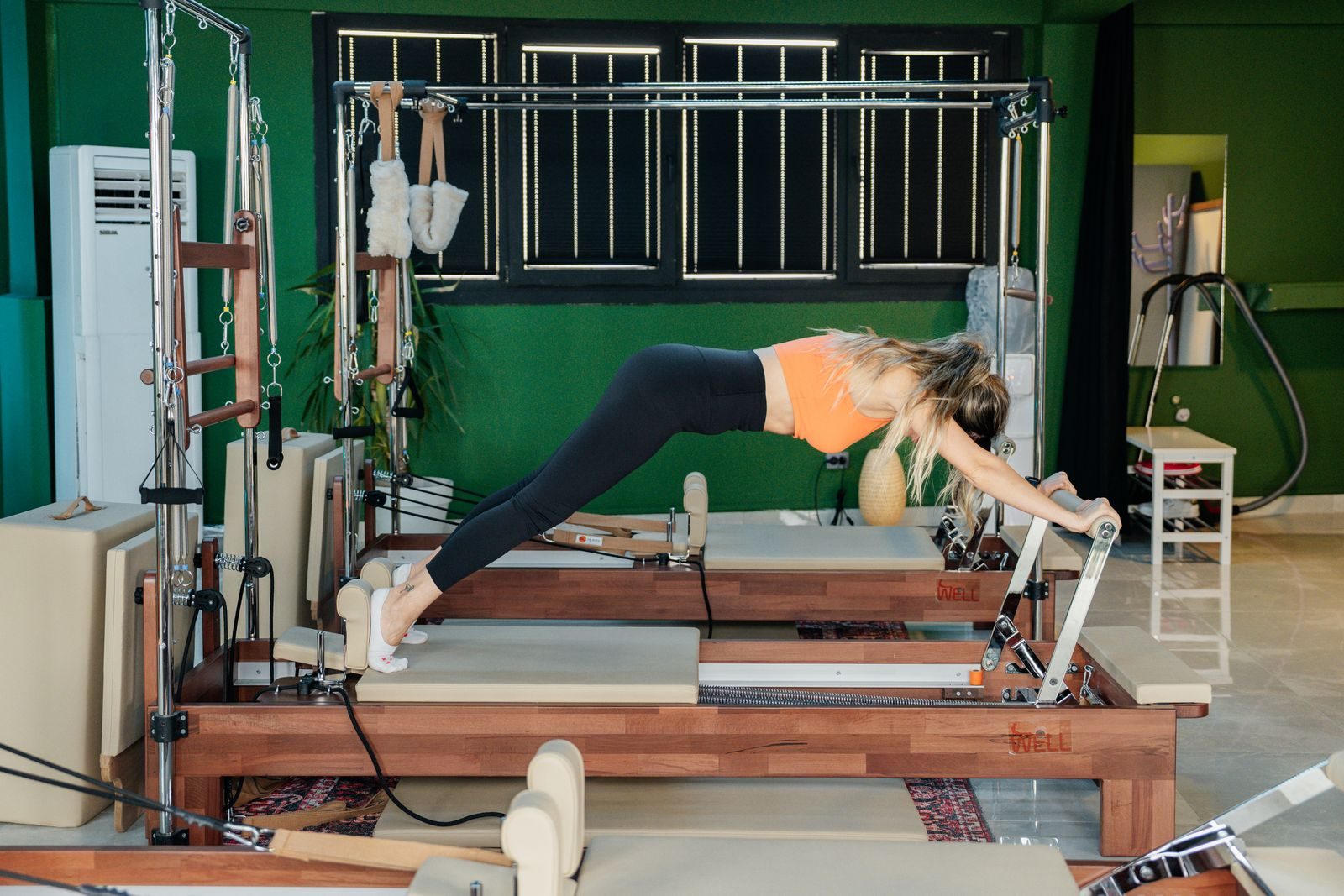
Pilates reformer exercises can provide a full-body workout by challenging the legs, hips, core, back, shoulders, chest, and arms through controlled spring resistance. The best routine combines lower-body presses, feet-in-straps work, upper-body pulling, trunk stabilization, and exercises that teach the whole body to move as one unit.
A reformer uses a sliding carriage, springs, ropes, straps, shoulder rests, and a footbar. Depending on the exercise, the springs may add resistance, provide support, or make the moving carriage less stable. That versatility allows exercises to be adjusted for different abilities and training goals, as explained in Merrithew guidance on Pilates reformer design and use.
This guide covers 10 effective exercises, correct form, muscles worked, common mistakes, modifications, and a practical full-body workout.
Pilates Reformer Exercises at a Glance
| Exercise | Main training focus | Level | Additional equipment |
|---|---|---|---|
| Reformer Footwork Series | Lower-body strength and alignment | Beginner | None |
| Reformer Shoulder Bridge | Glutes, hamstrings, and trunk control | Beginner | None |
| The Hundred on the Reformer | Abdominal endurance and breathing | Beginner to intermediate | Hand loops |
| Frog in Straps | Hip and knee extension | Beginner | Foot straps |
| Leg Circles in Straps | Hip control and pelvic stability | Beginner to intermediate | Foot straps |
| Supine Arm Circles | Shoulders, arms, and trunk stability | Beginner | Hand loops |
| Arms Pulling Straps | Upper back, triceps, and spinal extensors | Beginner to intermediate | Long box |
| Short Box Flat Back | Upright core strength and hip hinging | Beginner to intermediate | Short box and foot strap |
| Long Stretch | Full-body plank strength | Intermediate | None |
| Elephant | Core control and posterior-chain mobility | Beginner to intermediate | None |
Before Starting Pilates Reformer Exercises
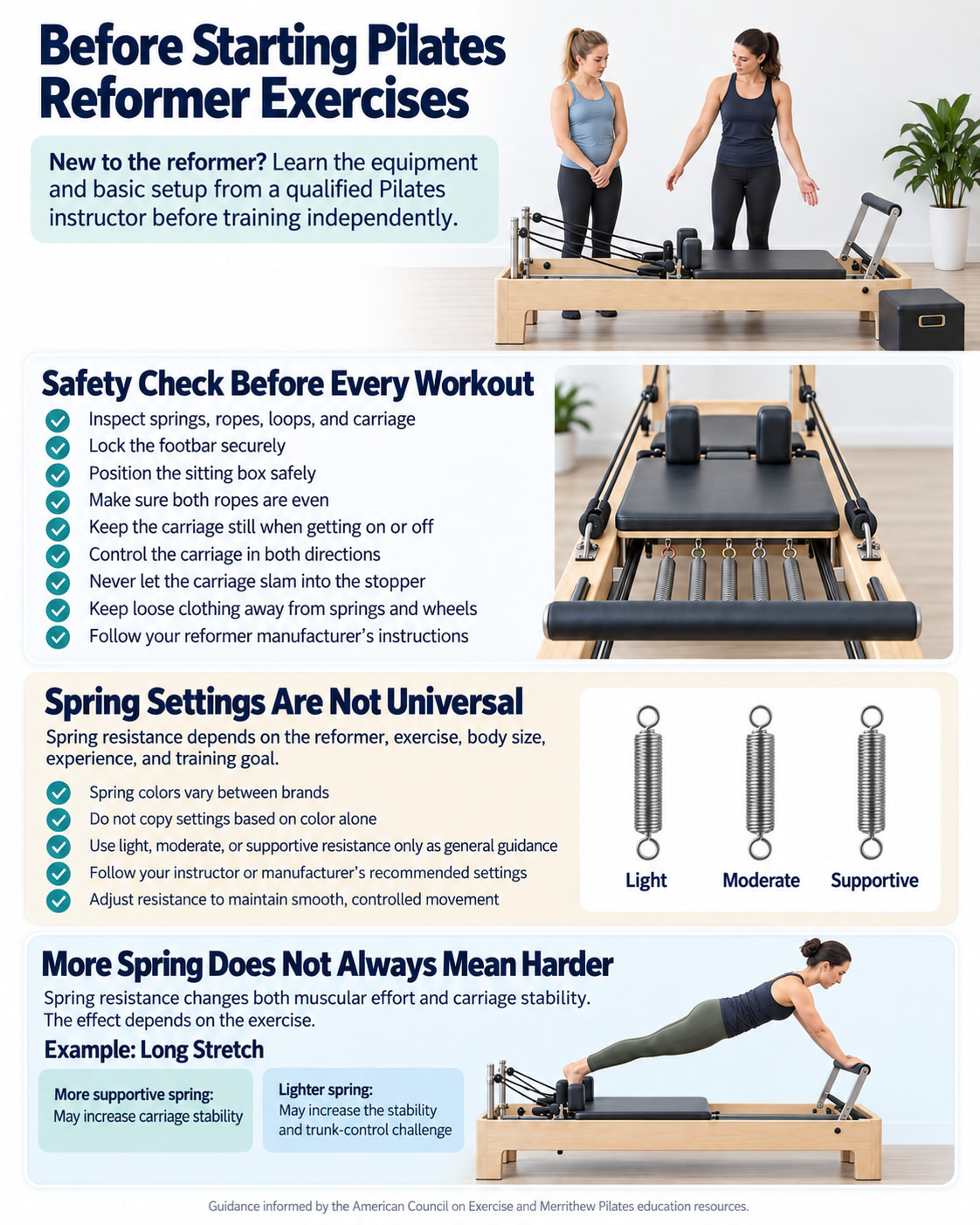
A reformer is not a machine that should be learned entirely through written instructions. New users should take an introductory class or private session with a qualified Pilates instructor to learn how to adjust the springs, footbar, headrest, straps, ropes, carriage stopper, and sitting box. Reformer education from the American Council on Exercise emphasizes equipment setup, spring selection, exercise sequencing, modifications, and progression as separate skills.
Before every workout:
- Inspect the springs, ropes, loops, footbar, shoulder rests, and carriage.
- Make sure the footbar and sitting box are securely positioned.
- Adjust both ropes evenly.
- Keep the carriage still while mounting, dismounting, or changing equipment.
- Maintain control as the carriage moves away and returns.
- Do not let the carriage slam into the stopper.
- Wear clothing that cannot become caught in the springs, wheels, or carriage.
- Follow the instructions provided with your specific reformer.
Spring Settings Are Not Universal
Spring colors, resistance levels, carriage dimensions, and stopper positions differ between reformer brands. Body size, limb length, exercise selection, comfort, and experience also affect the appropriate setting.
Use descriptions such as light, moderate, or supportive spring resistance only as general guidance. Follow the spring recommendations supplied by your reformer manufacturer or instructor.
More resistance does not always make a reformer exercise more difficult. In exercises such as Long Stretch, a stronger spring may make the carriage more stable, while a lighter setting can increase the balance and trunk-control challenge. Merrithew also explains that spring and stopper settings should be adjusted to the individual and the exercise rather than treated as universal.
10 Best Pilates Reformer Exercises
These 10 Pilates reformer exercises train the legs, glutes, core, back, shoulders, and arms for a balanced full-body workout.
Use controlled movement, appropriate spring resistance, and proper form to build strength, stability, and muscular endurance safely.
1. Reformer Footwork Series
Best for: Warming up the lower body, practicing knee alignment, and strengthening the legs through a controlled pressing pattern.
Muscles worked: Quadriceps, gluteus maximus, hamstrings, calves, foot muscles, and abdominals.
Equipment needed: Reformer with the footbar securely locked.
Sets, reps, and rest: Perform 8–12 repetitions in two or three foot positions. Rest for 15–30 seconds when changing positions.
How to Do It
- Lie on your back with your head supported, shoulders comfortably against the shoulder rests, and pelvis in a controlled position.
- Place your feet about hip-width apart on the footbar. Begin with the heels or the balls of the feet on the bar.
- Brace your trunk lightly and press through both feet to move the carriage away.
- Extend your legs without forcefully locking your knees.
- Bend your knees and hips to return the carriage slowly, keeping your knees aligned with your toes.
- Repeat with another foot position, such as parallel toes or a small Pilates V, when comfortable.
Merrithew identifies Footwork as a foundational reformer exercise for the legs, feet, and ankles and commonly places it near the beginning of a session.
Common mistakes: Allowing the knees to collapse inward, lifting the heels unintentionally, rolling onto the inner or outer edges of the feet, locking the knees, lifting the pelvis, or allowing the carriage to hit the stopper.
Regression: Use a comfortable parallel foot position, reduce the knee-bend depth, and select a supportive spring setting.
Progression: Add a controlled calf raise or progress to single-leg Footwork after you can keep the pelvis level and both knees properly aligned.
Coaching cue: Push through the whole foot and control the carriage in both directions.
2. Reformer Shoulder Bridge
Best for: Strengthening the glutes and hamstrings while practicing pelvic and spinal control.
Muscles worked: Gluteus maximus, hamstrings, abdominals, spinal stabilizers, and inner thighs.
Equipment needed: Reformer with a stable footbar and a spring setting that keeps the carriage controlled.
Sets, reps, and rest: Perform 1–2 sets of 6–10 repetitions. Rest for 20–30 seconds between sets.
How to Do It
- Lie on your back with your feet about hip-width apart on the footbar and your knees bent.
- Keep your arms relaxed beside your body and your knees pointing in the same direction as your toes.
- Exhale, gently tilt the pelvis, and lift your hips by gradually peeling the spine away from the carriage.
- Stop when your weight is supported across your upper back rather than your neck.
- Keep the carriage still and your pelvis level at the top.
- Lower the spine gradually until the pelvis returns to the carriage.
Use the headrest position recommended by your instructor or reformer manufacturer for bridging exercises.
Common mistakes: Pushing the carriage away, lifting from the lower back instead of the hips, flaring the ribs, allowing the knees to separate, turning the head while lifted, or pressing body weight into the neck.
Regression: Practice a small pelvic curl without lifting into a full bridge.
Progression: Pause for two or three seconds at the top. A Shoulder Bridge Press, in which the carriage moves while the hips remain lifted, should be added only after the basic bridge is controlled.
Coaching cue: Send your knees forward as your hips lift upward.
3. The Hundred on the Reformer
Best for: Developing abdominal endurance and coordinating breathing with controlled arm movement.
Muscles worked: Rectus abdominis, transverse abdominis, obliques, hip flexors, shoulders, chest, and triceps.
Equipment needed: Reformer with hand loops.
Sets, reps, and rest: Begin with 5 breathing cycles. Progress toward 10 cycles, inhaling for five arm pumps and exhaling for five. Rest for 30–45 seconds afterward.
How to Do It
- Lie on your back with a loop in each hand and your knees bent in a tabletop position or your feet supported.
- Keep the ropes taut and press your arms down toward your sides.
- Lift your head and upper chest only when you can do so without straining your neck. You may also keep your head down.
- Pump your straight arms through a small range from the shoulders.
- Inhale for five pumps and exhale for five pumps.
- Keep the pelvis, rib cage, and carriage controlled throughout the set.
Balanced Body describes Hundred Prep as a foundational exercise for connecting rhythmic arm movement, breathing, abdominal control, and upper-body coordination.
Common mistakes: Pulling the chin toward the chest, gripping the neck, pumping from the wrists, flaring the ribs, holding the breath, lowering the legs too far, or allowing the carriage to move unpredictably.
Regression: Keep your head on the carriage and your feet on the footbar or knees bent.
Progression: Extend your legs to a comfortable diagonal. Lower them only as far as you can maintain trunk and pelvic control.
Coaching cue: Pump from your shoulders while keeping your rib cage quiet.
4. Frog in Straps
Best for: Strengthening the hips and legs while learning to control the pelvis against spring resistance.
Muscles worked: Glutes, hamstrings, quadriceps, inner thighs, deep hip muscles, and abdominals.
Equipment needed: Reformer with foot straps.
Sets, reps, and rest: Perform 1–2 sets of 8–12 repetitions. Rest for 20–30 seconds.
How to Do It
- Lie on your back and place one foot at a time into the straps while the carriage is stable.
- Bring your heels together, turn your toes slightly outward, and bend your knees toward your shoulders.
- Keep the turnout small and comfortable rather than forcing your hips outward.
- Exhale as you extend both legs to a comfortable diagonal.
- Stop before your knees lock or your pelvis changes position.
- Inhale as you bend your hips and knees, returning with steady tension in the straps.
Common mistakes: Forcing a large turnout, allowing the heels to separate, pulling the knees too deeply toward the chest, snapping the knees straight, arching or tucking the pelvis, or allowing the ropes to become slack.
Regression: Perform a parallel Bend and Stretch with the knees and toes pointing upward, or use a smaller range.
Progression: Slow the return phase to three or four seconds. Single-leg variations require more pelvic stability and should be learned with an instructor.
Coaching cue: Move the carriage from your hips instead of snapping your knees straight.
5. Leg Circles in Straps
Best for: Improving controlled hip movement without allowing the pelvis or spine to move unnecessarily.
Muscles worked: Hip flexors, glutes, inner thighs, outer hips, hamstrings, and abdominals.
Equipment needed: Reformer with foot straps.
Sets, reps, and rest: Perform 5–8 circles in each direction. Rest for 20–30 seconds before leaving the straps.
How to Do It
- Begin on your back with both feet in the straps and your legs extended on a comfortable diagonal.
- Keep your pelvis heavy and level on the carriage.
- Lift your legs within a comfortable range.
- Open the legs, circle them around, and return to the starting position.
- Reverse the direction after completing the planned repetitions.
- Keep equal tension in both straps and make the circle only as large as you can control.
Merrithew teaches Leg Circles as a reformer exercise that develops controlled hip movement while the trunk and pelvis remain stable.
Common mistakes: Making the circles so large that the pelvis rocks, bending the knees unintentionally, allowing one leg to lead, losing tension in the ropes, or lowering the legs until the lower back arches.
Regression: Use smaller circles, keep the knees slightly bent, or practice Frog until you are comfortable controlling the straps.
Progression: Gradually increase the range without changing pelvic position. Unilateral circles add a greater anti-rotation challenge.
Coaching cue: Make the circle smaller than the point where your pelvis begins to move.
6. Supine Arm Circles
Best for: Training the shoulders and arms while the abdominals stabilize the rib cage and pelvis.
Muscles worked: Deltoids, chest, latissimus dorsi, triceps, scapular stabilizers, and abdominals.
Equipment needed: Reformer with hand loops.
Sets, reps, and rest: Perform 6–8 circles in each direction. Rest for 20–30 seconds.
How to Do It
- Lie on your back with a loop in each hand. Keep your feet supported on the footbar or your knees in a comfortable tabletop position.
- Extend your arms toward the ceiling with your palms facing forward or inward.
- Press your arms toward your hips without lifting your shoulders.
- Open your arms out to the sides and circle them back to the starting position.
- Reverse the circle if you can maintain smooth shoulder movement.
- Keep your ribs, pelvis, and carriage controlled throughout.
Common mistakes: Shrugging the shoulders, pushing the ribs upward, bending the wrists, locking the elbows forcefully, allowing the loops to become loose, or taking the arms behind a comfortable shoulder range.
Regression: Perform straight-arm presses toward the hips instead of complete circles.
Progression: Move the legs to tabletop or add a small chest lift after you can keep the trunk stable with the feet supported.
Coaching cue: Let your arms move around a quiet rib cage.
7. Arms Pulling Straps on the Long Box
Best for: Strengthening the upper back and arms while practicing controlled upper-spine extension.
Muscles worked: Latissimus dorsi, middle and lower trapezius, rhomboids, rear deltoids, triceps, spinal extensors, glutes, and hamstrings.
Equipment needed: Reformer, straps, and a securely positioned long box.
Sets, reps, and rest: Perform 1–2 sets of 6–8 repetitions. Rest for 30–45 seconds.
How to Do It
- Position the long box securely according to your reformer’s instructions.
- Lie face down lengthwise on the box with your legs reaching long and your head aligned with your spine.
- Hold the straps with straight but not forcefully locked arms, maintaining light rope tension.
- Draw your shoulders away from your ears.
- Pull your arms toward your hips as you gently lengthen and lift through the upper chest.
- Return the arms and carriage slowly without dropping your chest or losing strap tension.
Merrithew identifies Arms Pulling Straps as an exercise that emphasizes the upper-back extensors and triceps.
Common mistakes: Lifting the chin, overextending the lower back, shrugging, bending the elbows too early, letting the legs hang, using momentum, or selecting more resistance than the upper back can control.
Regression: Use a light spring and perform a shorter pull without lifting the chest.
Progression: Add the T-position variation, in which the arms begin wide and pull toward the sides of the body.
Coaching cue: Reach your arms backward as your chest lengthens forward.
8. Short Box Flat Back
Best for: Building upright trunk endurance and learning to hinge from the hips without rounding the back.
Muscles worked: Abdominals, spinal stabilizers, hip flexors, back extensors, and inner thighs.
Equipment needed: Short box, foot strap, and optional Pilates pole.
Sets, reps, and rest: Perform 1–2 sets of 6–8 repetitions. Rest for 30 seconds.
How to Do It
- Secure the short box across the carriage and use the manufacturer-recommended spring setting to keep the carriage closed.
- Sit facing the footbar with both feet securely placed under the foot strap.
- Flex your ankles and maintain active pressure against the strap.
- Sit tall with your arms crossed over your chest or reaching forward.
- Hinge backward from your hips while maintaining a long, neutral spine.
- Stop before your back rounds or your feet lose contact with the strap.
- Use your abdominals to return to an upright position.
Merrithew’s Flat Back guidance similarly emphasizes secure feet, an upright neutral spine, and hinging backward from the hips rather than collapsing through the trunk.
Common mistakes: Rounding the shoulders, arching the lower back, bending from the waist, pulling excessively against the foot strap, leaning too far, or using momentum to sit up.
Regression: Cross your arms over your chest and use a very small hinge.
Progression: Reach your arms overhead or hold a lightweight pole, provided you can prevent the ribs from lifting.
Coaching cue: Move your entire torso backward as one long unit.
9. Long Stretch
Best for: Integrating plank strength with controlled shoulder movement on the sliding carriage.
Muscles worked: Abdominals, chest, shoulders, triceps, serratus anterior, glutes, quadriceps, and spinal stabilizers.
Equipment needed: Reformer with a securely locked footbar.
Sets, reps, and rest: Perform 1–2 sets of 5–8 controlled repetitions. Rest for 45–60 seconds.
How to Do It
- Use a supportive spring setting and confirm that the footbar is securely locked.
- Place your hands on the footbar and your feet against the shoulder rests or in the position taught for your reformer.
- Extend into a straight plank from your head through your heels.
- Press the carriage away through controlled shoulder movement while keeping your body in one line.
- Bring the carriage back without allowing your hips to rise, drop, or twist.
- Finish the repetition with the carriage controlled before changing position.
Merrithew teaches Long Stretch with the body maintained in a plank and notes that the exercise can be modified by placing the knees down. Lighter springs can increase the stability challenge, while greater spring tension may provide more support.
Common mistakes: Allowing the lower back to sag, lifting the hips, locking the elbows, collapsing between the shoulder blades, pushing the carriage too far, or choosing a spring setting that makes the carriage difficult to control.
Regression: Keep your knees on the carriage and perform a small range. Beginners can also practice a stationary reformer plank before moving the carriage.
Progression: Increase the carriage range gradually or use a less supportive spring only under appropriate instruction.
Coaching cue: Move the carriage without changing the shape of your plank.
10. Elephant
Best for: Combining abdominal control, shoulder stability, hip hinging, and posterior-chain mobility.
Muscles worked: Abdominals, shoulders, serratus anterior, latissimus dorsi, glutes, hamstrings, calves, and spinal stabilizers.
Equipment needed: Reformer with a stable footbar.
Sets, reps, and rest: Perform 1–2 sets of 6–10 repetitions. Rest for 30–45 seconds.
How to Do It
- Stand on the carriage facing the footbar with your heels near the shoulder rests.
- Place your hands securely on the footbar and hinge at your hips.
- Keep your shoulders supported, arms long, and abdominal wall gently engaged.
- Press the carriage backward through a small range by moving from the hips.
- Draw the carriage forward under control without shifting excessive weight into your hands.
- Keep your heels reaching downward and your hips relatively steady.
Balanced Body describes Elephant as an exercise in which the hips and core control the moving carriage while the calves and hamstrings work through a lengthened position.
Common mistakes: Rounding or arching excessively, bending the knees unintentionally, pushing only with the arms, shifting the shoulders far beyond the wrists, lifting the heels, or allowing the carriage to close abruptly.
Regression: Bend your knees slightly, reduce the carriage range, and use a supportive spring setting.
Progression: Use a straighter-leg position or progress to a controlled single-leg variation after mastering the basic movement.
Coaching cue: Pull the carriage home from your center rather than your shoulders.
Sample Full-Body Pilates Reformer Workout
This routine uses all 10 exercises in a practical order. Beginners should complete one round and use the regressions for the Hundred, Long Stretch, or Elephant when needed.
| Order | Exercise | Training volume |
|---|---|---|
| 1 | Reformer Footwork Series | 8–12 reps in 2–3 positions |
| 2 | Reformer Shoulder Bridge | 6–10 reps |
| 3 | The Hundred or Hundred Prep | 5–10 breathing cycles |
| 4 | Frog in Straps | 8–12 reps |
| 5 | Leg Circles in Straps | 5–8 each direction |
| 6 | Supine Arm Circles | 6–8 each direction |
| 7 | Arms Pulling Straps | 6–8 reps |
| 8 | Short Box Flat Back | 6–8 reps |
| 9 | Long Stretch or Knee-Down Long Stretch | 5–8 reps |
| 10 | Elephant | 6–10 reps |
Workout Guidelines
- Frequency: Begin with two sessions per week on nonconsecutive days.
- Sets: One set of each exercise is enough when learning. Add a second set selectively.
- Rest: Use 15–60 seconds depending on the exercise and equipment transition.
- Effort: Aim for approximately 5–7 out of 10.
- Repetitions in reserve: Finish most sets feeling that you could perform two or three more controlled repetitions.
- Tempo: Move smoothly and spend at least as much time returning the carriage as you spend pressing or pulling it away.
- Session focus: Prioritize carriage control, breathing, and alignment rather than completing repetitions quickly.
The CDC recommends that adults perform muscle-strengthening activity involving all major muscle groups on at least two days per week, along with regular aerobic activity. Pilates reformer training can contribute to the muscle-strengthening portion when the exercises provide a meaningful muscular challenge.
How to Progress Reformer Exercises Safely
Progress does not always require stronger springs. A reformer exercise can become more demanding through changes in range, tempo, stability, coordination, or body position.
Use the following order:
- Improve carriage control. Complete every repetition without jerking or hitting the stopper.
- Maintain consistent alignment. Keep the knees, pelvis, spine, ribs, and shoulders in the intended position.
- Increase repetitions gradually. Add one or two repetitions while staying within the recommended range.
- Slow the return phase. Take three or four seconds to return the carriage.
- Increase the movement range. Use only a range that does not change your alignment.
- Change the spring setting carefully. Make one small adjustment and reassess the exercise.
- Add a more complex variation. Progress to unilateral, kneeling, standing, or less-supported versions only after mastering the basic movement.
Change one variable at a time. Reducing spring resistance and adding a harder balance variation simultaneously can make it difficult to determine why your form changed.
Benefits of Pilates Reformer Exercises
Full-Body Muscular Endurance
A well-designed reformer workout can train the legs, hips, back, abdomen, chest, shoulders, and arms. The continuous spring tension also requires muscles to control both the working phase and the return.
Adjustable Resistance and Support
Springs can make some movements more challenging while assisting others. This makes the reformer useful for teaching movement patterns before progressing to less-supported variations.
Core and Pelvic Control
Exercises such as the Hundred, Short Box Flat Back, Long Stretch, and Leg Circles require the trunk to resist unwanted spinal or pelvic movement while the arms or legs move.
Controlled Mobility
Frog, Leg Circles, Elephant, and Shoulder Bridge move the hips or spine through a controlled range while the springs provide feedback.
Low-Impact Training
Most reformer exercises do not involve running or repeated landing. However, low impact does not mean effortless. The muscles may still work hard, and kneeling, planking, or weight-bearing positions may need modification.
Research indexed by PubMed suggests Pilates may help improve measures such as strength, muscular endurance, flexibility, and balance. However, a systematic review comparing Pilates with other exercise methods did not establish that Pilates was clearly superior for strength, balance, or flexibility, and the certainty of evidence was limited. Reformer Pilates is therefore best viewed as one effective training option rather than a uniquely superior method.
Common Pilates Reformer Mistakes
Choosing Springs by Color Alone
The same color may represent a different resistance on another reformer. Learn the spring system used by your machine.
Allowing the Carriage to Control the Movement
The carriage should not pull you rapidly into the return. Maintain muscular control until it stops.
Using the Largest Possible Range
A larger movement is not better when it causes the pelvis, spine, knees, or shoulders to lose position.
Holding Your Breath
Breathing should support the movement rather than become another source of tension. Exhale during the more demanding phase when that helps you maintain control.
Progressing to Standing Exercises Too Early
Exercises performed with one foot on the platform and one foot on the moving carriage require balance, equipment knowledge, and careful supervision. Build control through supported exercises first.
Treating More Spring as Automatically Harder
More spring can increase muscular resistance in Footwork but may provide additional stability in a plank exercise. Consider what the spring is doing in that specific movement.
Frequently Asked Questions
Are Pilates reformer exercises suitable for beginners?
Yes, many reformer exercises can be adapted for beginners. Footwork, Frog, supported arm work, and basic Short Box exercises are common starting options. New users should first learn equipment setup and safe transitions from an instructor.
How often should beginners do reformer Pilates?
Two nonconsecutive sessions per week is a practical starting point. A third session can be added when you are recovering comfortably and maintaining good technique.
What spring setting should a beginner use?
There is no universal beginner setting. Use the recommendation for your specific reformer, exercise, body size, and experience level. The correct setting allows you to move smoothly without losing alignment or control.
Is reformer Pilates considered strength training?
It can be. An exercise contributes to strength training when the resistance meaningfully challenges the targeted muscles. The amount of resistance, exercise selection, range, volume, and progression all matter.
Can reformer Pilates build muscle?
Reformer Pilates may help build muscle and muscular endurance, particularly in people who are new to resistance exercise. For continued muscle growth, exercises must become progressively more challenging. Traditional resistance training may make heavier loading and precise load progression easier for people whose main goal is maximizing muscle size.
Is reformer Pilates better than mat Pilates?
Neither is automatically better. Mat Pilates develops control using body weight and gravity. The reformer adds adjustable resistance, assistance, moving surfaces, and a wider range of exercise positions. The better option depends on your goals, access, experience, and preferences.
Is a reformer workout enough for total fitness?
A balanced reformer routine can train the major muscle groups, but it may not provide enough aerobic activity for cardiovascular fitness. Combine it with activities such as brisk walking, cycling, swimming, or another suitable form of cardio.
Conclusion
The best Pilates reformer exercises are not necessarily the most complicated ones. Footwork, Frog, Leg Circles, Pulling Straps, Short Box Flat Back, Long Stretch, and Elephant can collectively train the whole body when they are performed with appropriate springs and controlled technique.
Begin with a manageable range, keep the carriage quiet, and progress only when you can maintain alignment and steady breathing. Quality repetitions will provide more training value than using stronger springs or attempting advanced movements before you are ready.
Stop exercising and seek professional guidance if you experience sharp pain, numbness, dizziness, chest pain, unusual shortness of breath, or symptoms that do not settle when you stop.
This content is for informational purposes only and is not a substitute for medical advice.
References
- American Council on Exercise (ACE) — Pilates Reformer Instructor Training
Supports reformer setup, spring selection, exercise technique, sequencing, modifications, and progression.
Pilates Reformer Instructor Training — ACE - Merrithew — Five STOTT PILATES Reformer Exercises to Try at Home
Especially relevant to Footwork, Leg Circles, Long Stretch, and Arms Pulling Straps included in your article.
STOTT PILATES Reformer Exercises — Merrithew - Merrithew — Is There a Standard Spring and Stopper Setting on the Reformer?
Strong source for your explanation that spring settings vary by person, exercise, and reformer rather than following one universal setting.
Reformer Spring and Stopper Settings — Merrithew - PubMed — Is Pilates Better Than Other Exercises for Increasing Muscle Strength?
Systematic review supporting balanced claims about Pilates for strength, flexibility, and balance without overstating its superiority.
View the Systematic Review — PubMed - PubMed — Pilates for Muscular Endurance, Flexibility, Balance, and Posture
Relevant to the article’s discussion of abdominal endurance, upper-body muscular endurance, and flexibility.
View the Pilates Study — PubMed - Centers for Disease Control and Prevention (CDC) — Adult Physical Activity Guidelines
Supports your programming section on muscle-strengthening frequency and combining reformer training with aerobic activity.
Adult Physical Activity Guidelines — CDC