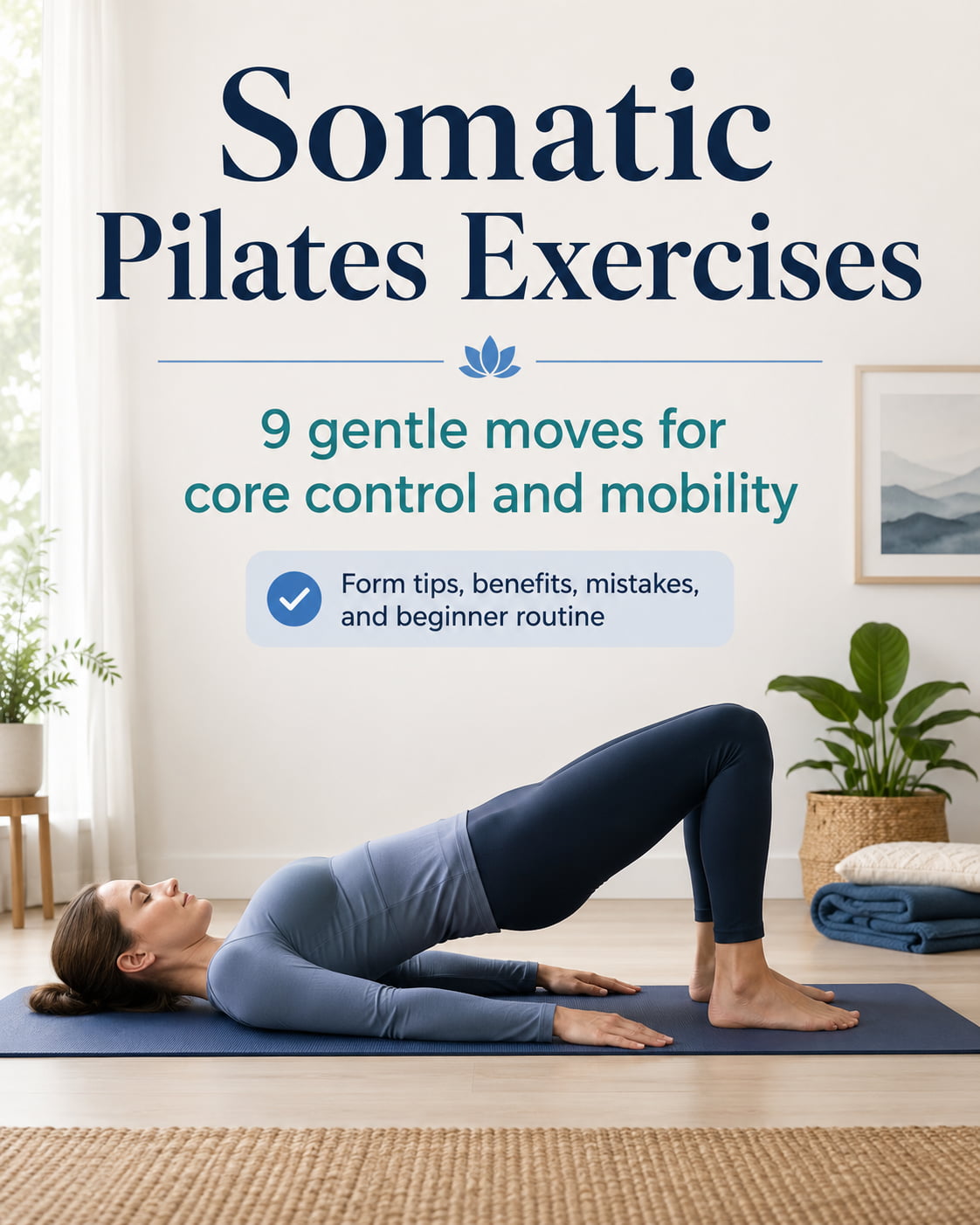
Somatic Pilates exercises are slow, controlled Pilates movements performed with body awareness, breath, and pain-free range of motion. Instead of rushing through reps, you move with attention so you can build better core control, mobility, posture awareness, and low-impact strength.
This guide covers the best somatic Pilates exercises for beginners and early intermediates, how to do each one, which muscles they work, common mistakes to avoid, and how to combine them into a simple routine.
What Are Somatic Pilates Exercises?
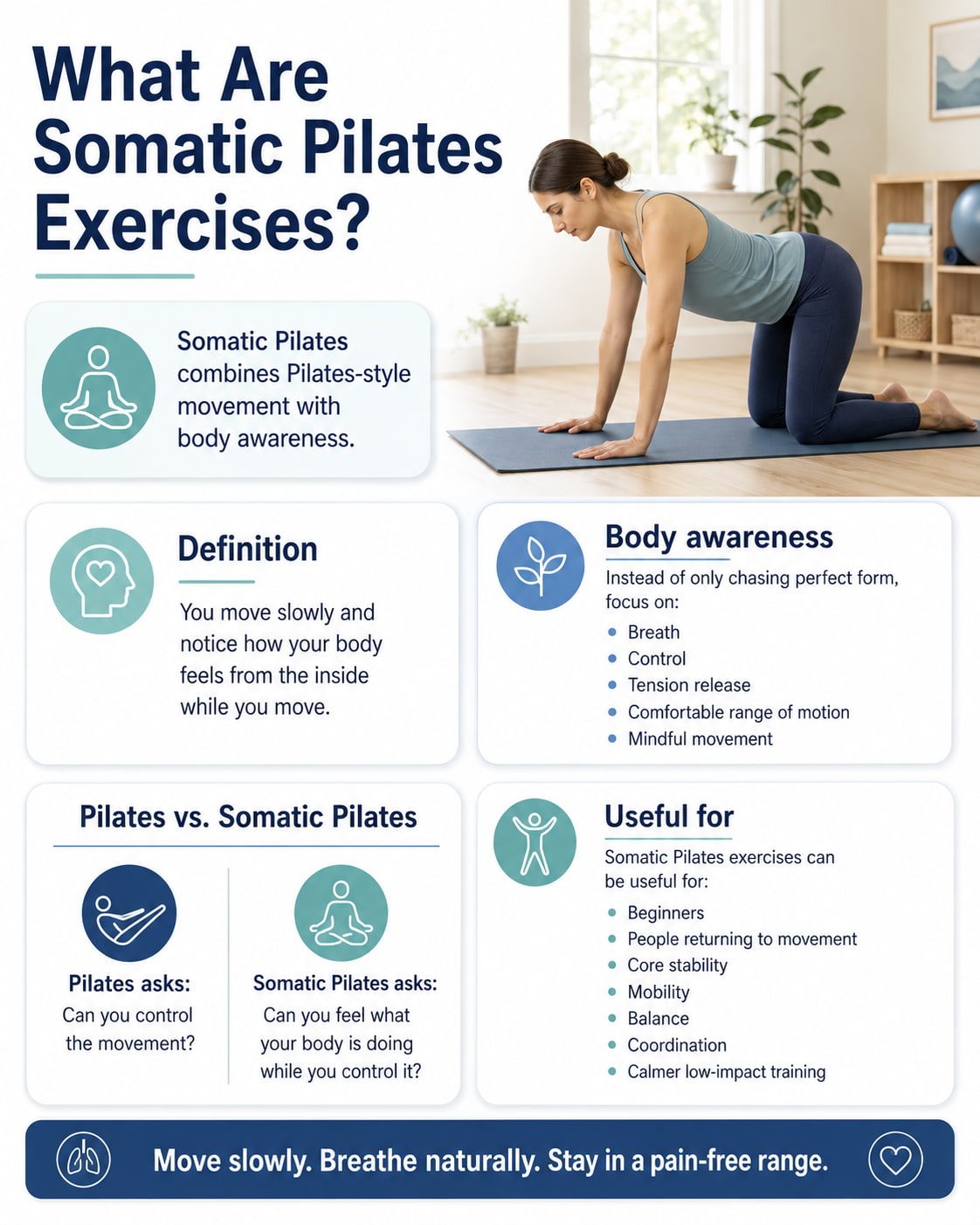
Somatic Pilates combines traditional Pilates-style movement with a somatic focus: noticing how your body feels from the inside while you move. Cleveland Clinic describes somatic Pilates as a blend of Pilates and somatics that puts more emphasis on body awareness and mindful connection than on chasing perfect form, strength, or flexibility alone.
A regular Pilates class may focus on precise positions, core strength, alignment, and flowing sequences. Somatic Pilates still uses many of those ideas, but the pace is usually slower and more exploratory. Healthline describes somatic Pilates as slow, mindful movement that helps you notice tension, habits, and how movement feels rather than only how it looks.
Think of it this way:
- Pilates asks, “Can you control the movement?”
- Somatic Pilates also asks, “Can you feel what your body is doing while you control it?”
That makes somatic Pilates exercises useful for beginners, people returning to movement, and anyone who wants a calmer way to train core stability, mobility, balance, and coordination.
Benefits of Somatic Pilates Exercises
Somatic Pilates is not just stretching, and it is not just relaxation. It is a low-impact training method that can help you move with more control.
Potential benefits include:
- Better body awareness
- Improved core control
- Gentle strength through the hips, glutes, abdominals, and back
- Better breathing coordination
- Improved spinal mobility
- More controlled posture and alignment
- Better balance and coordination
- A calmer, slower approach to exercise
Johns Hopkins describes somatic movement as movement performed consciously with internal focus and attention, while Better Health Channel notes that Pilates focuses on deep core muscles and may improve posture, flexibility, strength, balance, and body awareness.
The key is to keep the work intentional. A somatic Pilates routine should feel controlled, steady, and focused—not rushed, forced, or painful.
How to Practice Somatic Pilates Exercises Safely
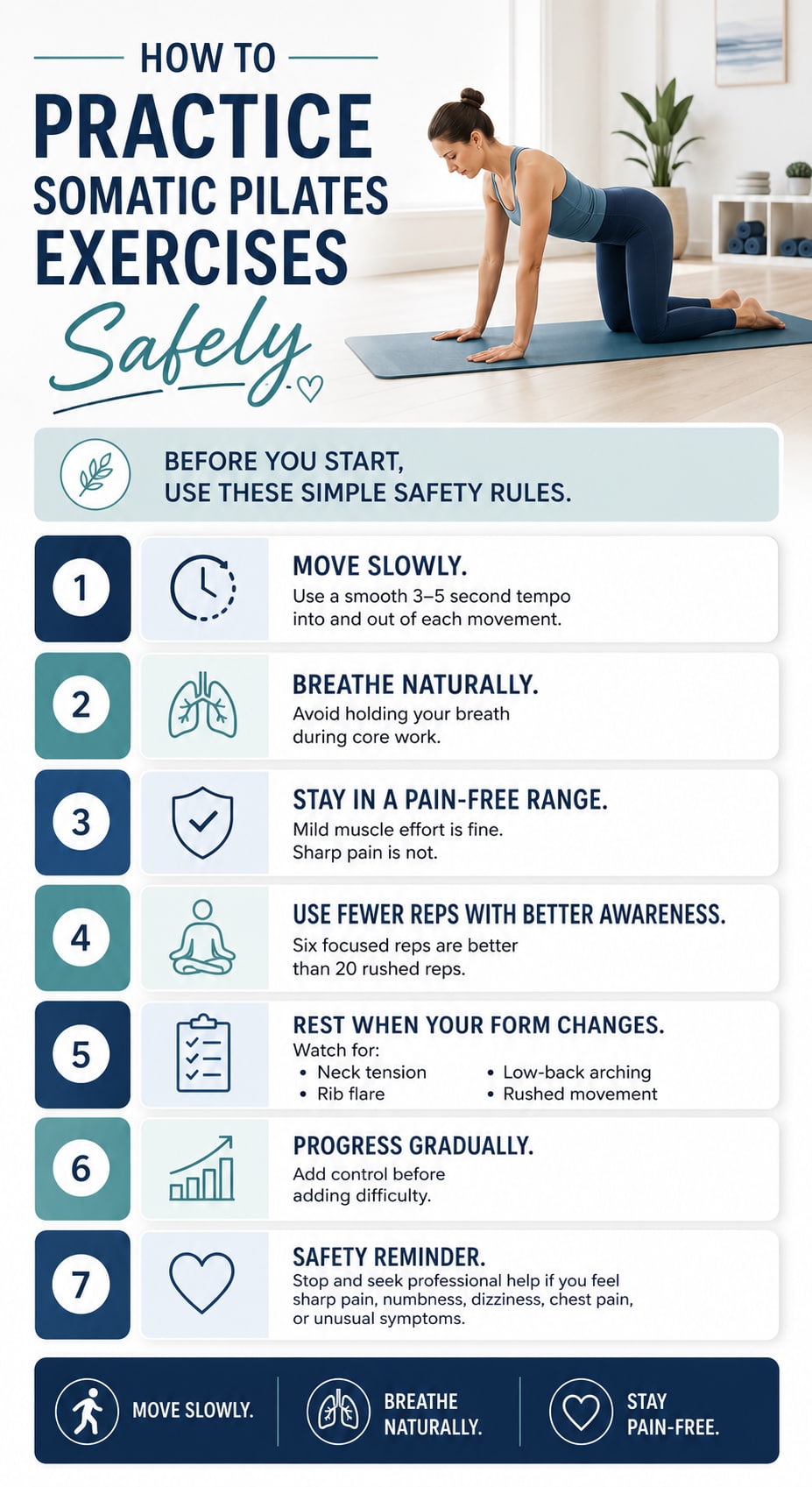
Before you start, use these simple rules:
- Move slowly. A good tempo is usually 3–5 seconds into the movement and 3–5 seconds out.
- Breathe naturally. Avoid holding your breath during core work.
- Stay in a pain-free range. Mild muscular effort is fine. Sharp pain is not.
- Use fewer reps with better awareness. Six focused reps are better than 20 rushed reps.
- Rest when your form changes. Fatigue often shows up as neck tension, rib flare, or low-back arching.
- Progress gradually. Add control before adding difficulty.
Stop the exercise and seek professional help if you feel sharp pain, numbness, dizziness, chest pain, or unusual symptoms.
The 9 Best Somatic Pilates Exercises
These somatic Pilates exercises are chosen because they train the main qualities most people want from this style: pelvic awareness, spinal mobility, deep core control, hip stability, breathing, and coordinated movement.
1. Pelvic Clock
Best for: Pelvic awareness, low-back control, beginner core activation
Muscles worked: Deep abdominals, pelvic floor awareness, hip stabilizers, lower-back stabilizers
Equipment needed: Exercise mat
Why it stands out
Pelvic clock is one of the best somatic Pilates exercises for learning how your pelvis moves. It teaches small, controlled motion without needing strength or flexibility first.
Instead of forcing your lower back flat or arching hard, you gently explore different pelvic positions. This makes it a useful starting point before bridges, heel slides, and core exercises.
Suggested sets, reps, and rest
Do 1–2 sets of 4–6 slow circles in each direction. Rest 30–45 seconds as needed.
How to do it
- Lie on your back with your knees bent and feet flat on the floor.
- Place your feet about hip-width apart.
- Imagine a clock on your lower belly and pelvis: 12 o’clock is toward your ribs, 6 o’clock is toward your pubic bone, and 3 and 9 are your hip bones.
- Gently tilt your pelvis toward 12 o’clock, letting your lower back soften toward the mat.
- Slowly tilt toward 6 o’clock, allowing a small natural arch in your lower back.
- Move toward 3 o’clock, then 9 o’clock.
- Blend the points into a slow circle.
- Reverse direction.
Common mistakes
- Moving too fast
- Pressing the low back aggressively into the floor
- Holding the breath
- Letting the knees sway around
- Making the movement too large
Coaching cue
“Move like you are drawing a small circle with your pelvis, not doing a big crunch.”
Variations, progressions, or regressions
Regression: Make the circle smaller and keep your hands on your hip bones for feedback.
Progression: Pause at each clock point and take one slow breath before moving on.
Variation: Try it with feet wider if your hips feel tight.
How to use it in a workout
Use pelvic clock at the beginning of a somatic Pilates routine. It works well as a 2–3 minute warm-up before bridges, heel slides, or single leg stretch.
2. Cat-Cow
Best for: Spinal mobility, breath coordination, upper-back awareness
Muscles worked: Spinal erectors, abdominals, upper back, chest, shoulder stabilizers
Equipment needed: Exercise mat
Why it stands out
Cat-cow is a simple way to explore spinal flexion and extension. In a somatic Pilates routine, the goal is not to push into the biggest possible stretch. The goal is to feel each section of your spine move.
ACE Fitness teaches cat-cow from a hands-and-knees position, using core engagement to find neutral spine before moving into the cat and cow phases.
Suggested sets, reps, and rest
Do 1–2 sets of 6–10 slow reps. Rest as needed.
How to do it
- Start on your hands and knees.
- Place your hands under your shoulders and knees under your hips.
- Spread your fingers and press gently through the floor.
- Inhale and slowly let your chest move forward as your tailbone tips slightly up.
- Exhale and round your spine upward, letting your head and tailbone soften down.
- Move one section of the spine at a time.
- Repeat slowly.
Common mistakes
- Collapsing into the shoulders
- Forcing the low back into a deep arch
- Throwing the head back
- Moving only from the neck
- Rushing the breathing
Coaching cue
“Let the breath start the movement, then let the spine follow.”
Variations, progressions, or regressions
Regression: Place a folded towel under your knees.
Progression: Move in segments: pelvis first, then low back, mid-back, upper back, and head.
Variation: Try seated cat-cow if kneeling is uncomfortable.
How to use it in a workout
Use cat-cow early in the routine to prepare your spine and breathing. It pairs well with pelvic clock and wall roll down.
3. Heel Slides
Best for: Deep core control, pelvic stability, beginner-friendly abdominal training
Muscles worked: Transverse abdominis, hip flexors, lower abdominals, pelvic stabilizers
Equipment needed: Exercise mat
Why it stands out
Heel slides teach one of the most important Pilates skills: keeping the pelvis steady while the leg moves. This is a quiet exercise, but it can be surprisingly useful when done slowly.
It is especially helpful for beginners who feel their lower back arch during leg-lowering exercises.
Suggested sets, reps, and rest
Do 2 sets of 6–8 reps per side. Rest 30–45 seconds between sets.
How to do it
- Lie on your back with your knees bent and feet flat.
- Place your arms by your sides.
- Find a neutral pelvis: not jammed flat, not overly arched.
- Inhale to prepare.
- Exhale and slowly slide one heel away from your body.
- Keep your pelvis still as the leg lengthens.
- Inhale and slide the heel back in.
- Repeat on the other side.
Common mistakes
- Letting the low back arch as the leg slides out
- Pushing the leg too far
- Holding the breath
- Tensing the neck and jaw
- Sliding quickly with no control
Coaching cue
“Your leg moves, but your pelvis stays quiet.”
Variations, progressions, or regressions
Regression: Slide only halfway out.
Progression: Hover the heel slightly above the floor as it moves.
Variation: Place your hands on your lower ribs to check that they stay heavy and relaxed.
How to use it in a workout
Use heel slides before single leg stretch. They teach the control needed for harder core movements.
4. Pelvic Curl / Glute Bridge
Best for: Glute strength, spinal articulation, hip extension control
Muscles worked: Glutes, hamstrings, deep abdominals, lower-back stabilizers
Equipment needed: Exercise mat
Why it stands out
The pelvic curl is a Pilates-style version of the glute bridge. It adds a somatic focus by asking you to roll through the spine slowly instead of lifting the hips as high as possible.
The glute bridge works the abs and butt/hips, and a key form goal is using the abdominals to help avoid excessive low-back arching.
Suggested sets, reps, and rest
Do 2 sets of 6–10 reps. Rest 45–60 seconds between sets.
How to do it
- Lie on your back with knees bent and feet flat.
- Place your feet hip-width apart.
- Let your arms rest on the floor.
- Inhale to prepare.
- Exhale and gently tilt your pelvis so your lower back softens toward the mat.
- Slowly peel your hips and spine off the floor one section at a time.
- Stop when your body forms a long line from shoulders to knees.
- Inhale at the top without flaring your ribs.
- Exhale and roll down slowly, upper back first, then mid-back, low back, and pelvis.
Common mistakes
- Thrusting the hips up quickly
- Overarching the lower back at the top
- Pushing through the toes instead of the heels
- Letting the knees collapse inward
- Rushing the roll-down
Coaching cue
“Roll up like you are lifting one vertebra at a time, then roll down the same way.”
Variations, progressions, or regressions
Regression: Do a small bridge and skip the full spinal roll.
Progression: Add a 3-second pause at the top.
Advanced progression: Try a single-leg bridge only if your pelvis stays level.
Variation: Place a small pillow or yoga block between your knees and lightly squeeze it.
How to use it in a workout
Use pelvic curl after your warm-up. It is a good bridge between mobility work and strength-focused somatic Pilates exercises.
5. Single Leg Stretch
Best for: Core control, breath coordination, controlled hip movement
Muscles worked: Rectus abdominis, transverse abdominis, obliques, hip flexors
Equipment needed: Exercise mat
Why it stands out
Single leg stretch is a classic Pilates core exercise. In somatic Pilates, you slow it down and focus on how your trunk responds as each leg changes position.
The goal is not to crank out fast reps. The goal is to keep the ribs, pelvis, and neck calm while the legs move.
Suggested sets, reps, and rest
Do 1–2 sets of 5–8 reps per side. Rest 45–60 seconds between sets.
How to do it
- Lie on your back with knees bent.
- Bring both knees toward your chest.
- Place one hand near the outside of one shin and the other hand near the opposite knee or shin.
- Gently curl your head and shoulders up only if your neck feels comfortable.
- Extend one leg away from you at a height where your low back stays steady.
- Inhale as you switch legs slowly.
- Exhale as you draw the opposite knee in.
- Continue alternating with control.
Common mistakes
- Pulling hard on the knee
- Letting the low back arch
- Extending the leg too low
- Straining the neck
- Moving too fast
Coaching cue
“Switch legs without letting your ribs pop up or your pelvis rock.”
Variations, progressions, or regressions
Regression: Keep your head down on the mat.
Regression: Extend the leg higher toward the ceiling.
Progression: Slow each switch to a 3-second count.
Advanced progression: Add a longer exhale as the leg extends.
How to use it in a workout
Use single leg stretch after heel slides. Heel slides build the control; single leg stretch challenges it.
6. Bird Dog
Best for: Core stability, balance, cross-body coordination
Muscles worked: Deep abdominals, spinal stabilizers, glutes, hamstrings, shoulders
Equipment needed: Exercise mat
Why it stands out
Bird dog trains your body to stabilize the spine while your arms and legs move. That makes it one of the best somatic Pilates exercises for coordination and balance.
The key is to raise the arm and leg only as high as you can while keeping the low back controlled, the hips level, and the movement steady.
Suggested sets, reps, and rest
Do 2 sets of 5–8 reps per side. Rest 45–60 seconds between sets.
How to do it
- Start on your hands and knees.
- Place hands under shoulders and knees under hips.
- Find a long spine from head to tailbone.
- Gently brace your core without holding your breath.
- Slowly reach one arm forward.
- If stable, extend the opposite leg back.
- Pause for 2–3 seconds.
- Lower with control.
- Repeat on the other side.
Common mistakes
- Lifting the leg too high
- Letting the low back sag
- Rotating the hips open
- Shrugging the shoulders
- Looking forward and compressing the neck
Coaching cue
“Reach long, not high.”
Variations, progressions, or regressions
Regression: Move only one arm at a time.
Regression: Move only one leg at a time.
Progression: Hold each rep for 5 seconds.
Advanced progression: Draw the elbow and knee slightly toward each other, then re-extend without shifting the pelvis.
How to use it in a workout
Use bird dog in the middle of your routine, after your body is warm. It works well after pelvic curl or before spine stretch forward.
7. Spine Stretch Forward
Best for: Spinal flexion control, hamstring awareness, breath-led movement
Muscles worked: Abdominals, spinal erectors, hamstrings, hip flexors
Equipment needed: Exercise mat
Why it stands out
Spine stretch forward is a seated Pilates exercise that fits well into somatic training because it encourages slow spinal movement and breath awareness.
It is not about grabbing your toes. It is about rounding forward with control and noticing where your spine, ribs, pelvis, and hamstrings feel limited.
Suggested sets, reps, and rest
Do 1–2 sets of 5–8 slow reps. Rest 30–45 seconds as needed.
How to do it
- Sit tall with your legs extended in front of you.
- Open your legs about mat-width apart.
- Flex your feet gently.
- Reach your arms forward at shoulder height.
- Inhale and sit tall.
- Exhale and nod your chin slightly.
- Round forward from the upper back, then mid-back, then low back.
- Pause and breathe into the back of your ribs.
- Inhale and stack your spine back up slowly.
Common mistakes
- Collapsing forward with no control
- Locking the knees
- Pulling on the feet
- Shrugging the shoulders
- Forcing the hamstrings to stretch
Coaching cue
“Round forward like you are curling over a beach ball.”
Variations, progressions, or regressions
Regression: Sit on a folded towel or cushion.
Regression: Bend your knees slightly.
Progression: Pause for two slow breaths at the forward position.
Variation: Place hands on your thighs instead of reaching forward.
How to use it in a workout
Use spine stretch forward after core and hip work. It helps slow the pace and reconnect movement with breathing.
8. Saw
Best for: Controlled rotation, oblique activation, spinal mobility
Muscles worked: Obliques, spinal rotators, upper back, hamstrings, deep core
Equipment needed: Exercise mat
Why it stands out
The saw adds rotation, which many beginner routines miss. In somatic Pilates, this exercise should feel smooth and controlled—not like twisting as far as possible.
It teaches you to rotate through the spine while keeping the pelvis grounded and the breath steady.
Suggested sets, reps, and rest
Do 1–2 sets of 4–6 reps per side. Rest 30–45 seconds as needed.
How to do it
- Sit tall with your legs extended slightly wider than hip-width.
- Reach your arms out to the sides.
- Inhale and grow tall through the spine.
- Exhale and rotate your torso to one side.
- Reach the opposite hand toward the outside of the foot or shin.
- Keep both sitting bones grounded.
- Inhale and return to center.
- Repeat on the other side.
Common mistakes
- Twisting from the neck instead of the torso
- Letting one hip lift off the mat
- Reaching aggressively for the foot
- Rounding too deeply
- Holding the breath
Coaching cue
“Rotate first, then reach.”
Variations, progressions, or regressions
Regression: Bend your knees or sit on a cushion.
Regression: Keep hands on your shoulders instead of reaching the arms wide.
Progression: Add a slow 2-second pause in the rotated position.
Variation: Do a smaller rotation and focus on keeping both hips heavy.
How to use it in a workout
Use saw near the end of the routine after spine stretch forward. It adds gentle rotation without needing equipment.
9. Wall Roll Down
Best for: Spinal articulation, posture awareness, gentle hamstring/back mobility
Muscles worked: Abdominals, spinal erectors, hamstrings, calves, postural muscles
Equipment needed: Wall
Why it stands out
Wall roll down is one of the most practical somatic Pilates exercises because you do not need a mat. It teaches you to feel how your head, ribs, spine, pelvis, and legs relate to gravity.
The goal is to move slowly, breathe, and modify the movement if the stretch feels too intense.
Suggested sets, reps, and rest
Do 1–2 sets of 3–5 slow reps. Rest 30–60 seconds between reps if needed.
How to do it
- Stand with your back against a wall.
- Place your feet about 6–12 inches away from the wall.
- Let your knees stay soft.
- Rest your arms by your sides.
- Take a slow inhale.
- Exhale and nod your chin toward your chest.
- Slowly roll your upper back away from the wall.
- Continue rolling down one section at a time.
- Stop at a comfortable range.
- Breathe once at the bottom.
- Slowly roll back up, stacking your spine against the wall.
Common mistakes
- Locking the knees
- Dropping down too quickly
- Forcing the hands toward the floor
- Holding the breath
- Feeling dizzy and continuing anyway
Coaching cue
“Let your spine peel away from the wall slowly, like a sticker.”
Variations, progressions, or regressions
Regression: Roll down only a few inches.
Regression: Keep your hands on your thighs for support.
Progression: Pause at three points on the way down and up.
Variation: Try it away from the wall only after you can control the movement without dizziness or balance issues.
How to use it in a workout
Use wall roll down at the end of a routine as a slow cooldown. You can also use it during the day as a short posture reset.
Beginner Somatic Pilates Routine
This routine uses the nine exercises above in a simple, low-impact structure. It should take about 15–25 minutes.
Somatic Pilates Beginner Routine
| Exercise | Sets | Reps | Rest |
|---|---|---|---|
| Pelvic Clock | 1–2 | 4–6 circles each way | 30 sec |
| Cat-Cow | 1–2 | 6–10 reps | 30 sec |
| Heel Slides | 2 | 6–8 per side | 30–45 sec |
| Pelvic Curl / Glute Bridge | 2 | 6–10 reps | 45–60 sec |
| Single Leg Stretch | 1–2 | 5–8 per side | 45–60 sec |
| Bird Dog | 2 | 5–8 per side | 45–60 sec |
| Spine Stretch Forward | 1–2 | 5–8 reps | 30–45 sec |
| Saw | 1–2 | 4–6 per side | 30–45 sec |
| Wall Roll Down | 1–2 | 3–5 reps | 30–60 sec |
Frequency
Start with 2–3 days per week. If you feel good and recover well, increase to 3–4 days per week.
ACSM guidance recommends adults include muscle-strengthening activities at least two days per week, and its resistance training guidance emphasizes that bodyweight and home-based routines can still support strength and physical function.
Effort level
Keep the routine at an easy to moderate effort. A good target is about RPE 4–6 out of 10, where 10 means maximum effort.
You should finish feeling more aware and controlled, not exhausted.
Progression advice
Progress in this order:
- Slow down the tempo.
- Add a longer pause.
- Add 1–2 reps per set.
- Add another set.
- Try a harder variation.
Do not progress if your breathing becomes tense, your low back arches, your neck tightens, or your movement feels rushed.
How to Progress Somatic Pilates Exercises
Somatic Pilates progression is different from regular strength training. You are not trying to make every exercise harder as fast as possible. You are trying to improve control.
Use these progression methods:
Add time under tension
Slow each rep down. For example, take 4 seconds to slide the heel out and 4 seconds to return.
Add pauses
Pause at the hardest part of the movement for 2–5 seconds. This works well for bird dog, pelvic curl, and single leg stretch.
Add range of motion carefully
Only move farther if you can keep your breath calm and your spine controlled.
Add complexity
Progress from:
- Heel slide to single leg stretch
- Small bridge to full pelvic curl
- Arm-only bird dog to full bird dog
- Small wall roll down to deeper wall roll down
Add volume last
Only add more sets or reps when your form is consistent. More reps with less awareness defeats the purpose of somatic Pilates.
Common Mistakes to Avoid
Moving too fast
Speed makes it harder to feel what is happening. Slow down enough that you can notice your breath, rib position, pelvis, and muscle tension.
Forcing the stretch
Somatic Pilates should not feel like a flexibility contest. Stay within a range you can control.
Holding your breath
Breath-holding often means you are working too hard or bracing too aggressively. Exhale during effort and inhale during easier phases.
Overarching the lower back
This often happens during bridges, heel slides, single leg stretch, and bird dog. Reduce the range of motion and reconnect your ribs and pelvis.
Tensing the neck and shoulders
Your neck should not do the work of your abdominals. If you feel strain, lower your head, reduce the range, or rest.
Treating it like a calorie-burning workout
Somatic Pilates is better used as a movement-quality practice. You can still build strength, but the main goal is control, awareness, and better movement.
Who Should Be Careful With Somatic Pilates?
Somatic Pilates is gentle for many people, but gentle does not mean risk-free.
Speak with a healthcare professional or qualified instructor before starting if you:
- Have a current injury
- Have recently had surgery
- Have osteoporosis or bone-density concerns
- Have joint instability or ligament issues
- Have balance problems
- Feel dizziness during forward folds or roll-downs
- Are pregnant or recently postpartum
- Have been told to avoid certain spinal movements
People with certain medical conditions, osteoporosis, joint or ligament issues, or injuries should speak with a healthcare professional before starting because some movements may aggravate symptoms.
When in doubt, start with the smallest version of each movement and use professional guidance.
FAQs About Somatic Pilates Exercises
What are somatic Pilates exercises?
Somatic Pilates exercises are Pilates-inspired movements performed slowly with internal body awareness. The goal is to notice how the body feels while improving control, mobility, breathing, and strength.
Is somatic Pilates good for beginners?
Yes, somatic Pilates can be beginner-friendly because many exercises are low-impact, slow, and easy to modify. Beginners should start with basic moves like pelvic clock, cat-cow, heel slides, and pelvic curl before moving to harder core exercises.
How often should you do somatic Pilates?
Most beginners can start with 2–3 sessions per week. Short sessions of 15–25 minutes are enough to build consistency. More experienced exercisers may use somatic Pilates 3–4 times per week or as a warm-up, cooldown, or recovery-focused routine.
What is the difference between Pilates and somatic Pilates?
Traditional Pilates often focuses on precise form, core strength, posture, and controlled sequences. Somatic Pilates uses many similar movements but slows them down and puts more attention on internal sensation, breath, comfort, and body awareness.
Can somatic Pilates help with tightness?
Somatic Pilates may help you feel less tight by improving breathing, joint motion, body awareness, and muscle control. It should not be used as a replacement for medical care if tightness is linked to pain, injury, numbness, or other symptoms.
Do you need equipment for somatic Pilates exercises?
No. Most somatic Pilates exercises can be done with just a mat or soft floor space. A wall, folded towel, small pillow, or yoga block can help with comfort and support, but they are optional.
Should somatic Pilates feel hard?
It can feel challenging, especially when you slow down and control each rep. However, it should not feel sharp, forced, or overwhelming. Aim for steady effort, smooth breathing, and clean movement.
Conclusion
Somatic Pilates exercises are a practical way to build core control, mobility, posture awareness, and low-impact strength without rushing your body. Start with simple movements like pelvic clock, cat-cow, heel slides, and pelvic curl, then progress to single leg stretch, bird dog, spine stretch forward, saw, and wall roll down.
The best routine is not the hardest one. It is the one you can do with control, attention, and consistency.
This content is for informational purposes only and is not a substitute for professional medical advice.