The single leg deadlift is a unilateral hip-hinge exercise that trains your hamstrings, glutes, core, and balance while teaching better control on one leg. It is often used as an accessory exercise after squats, deadlifts, lunges, or lower-body strength work because it builds posterior-chain strength without needing very heavy weight.
In this guide, you will learn how to do the single leg deadlift with proper form, which muscles it works, the biggest mistakes to avoid, the best beginner regressions, useful progressions, and how to include it in a real workout.
What Is a Single Leg Deadlift?
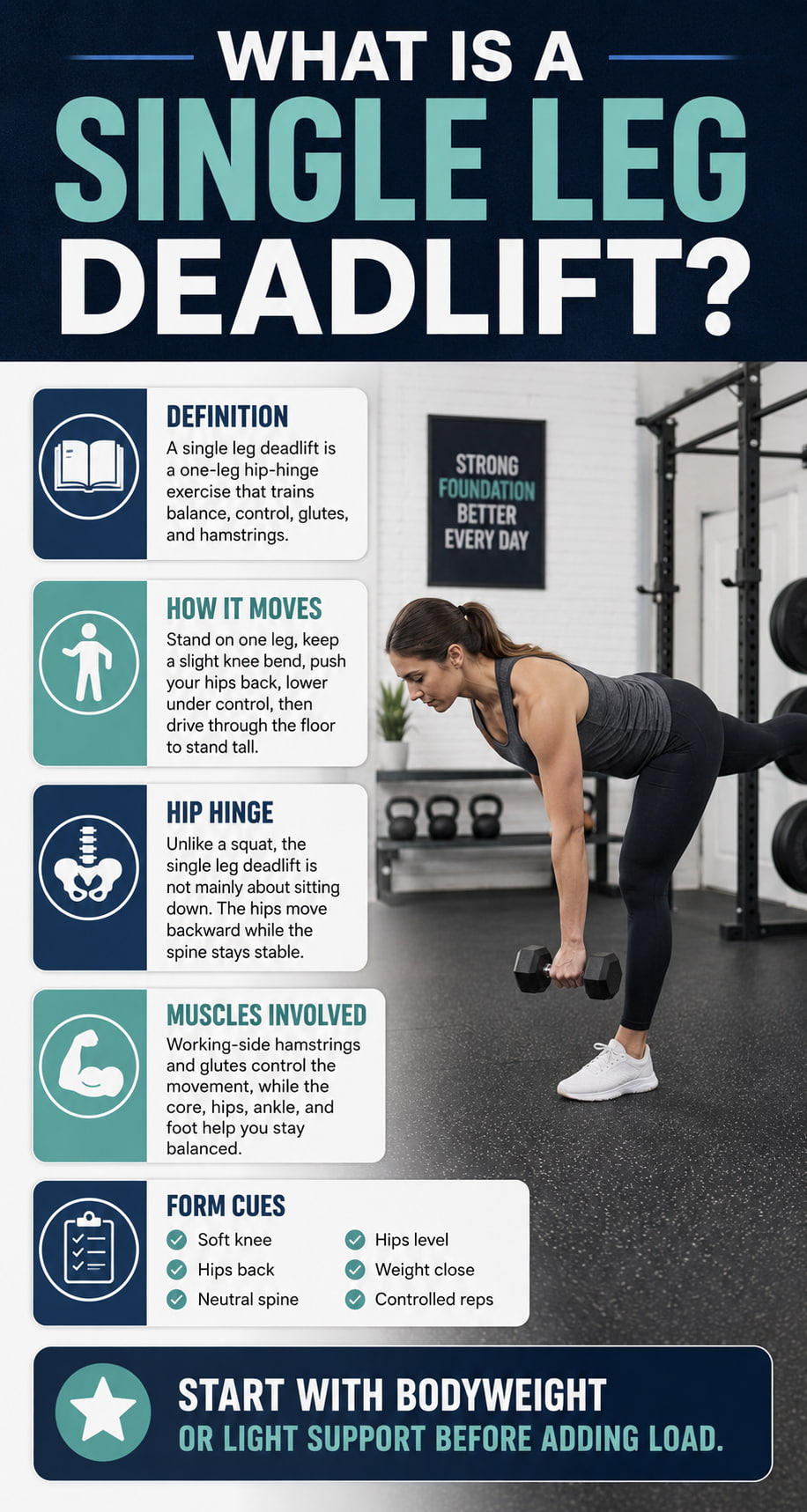
A single leg deadlift is a one-leg hinge exercise. You stand on one leg, keep a slight bend in the working knee, push your hips back, lower your torso under control, then drive through the floor to stand tall again.
The exercise is closely related to the single-leg Romanian deadlift. In many fitness programs, the terms are used almost interchangeably. The main idea is the same: your hips move back, your torso leans forward, your rear leg moves behind you, and your working-side hamstrings and glutes control the motion.
Unlike a squat, the single leg deadlift is not mainly about bending the knees and sitting down. It is a hip-hinge movement. That means the hips travel backward while the spine stays stable and the working leg supports your balance.
The American Council on Exercise single-leg Romanian deadlift guide describes key setup points such as standing tall, keeping the back straight, slightly bending the knee, and pushing the hips backward. Those same coaching principles apply to most single leg deadlift variations.
Single Leg Deadlift Muscles Worked
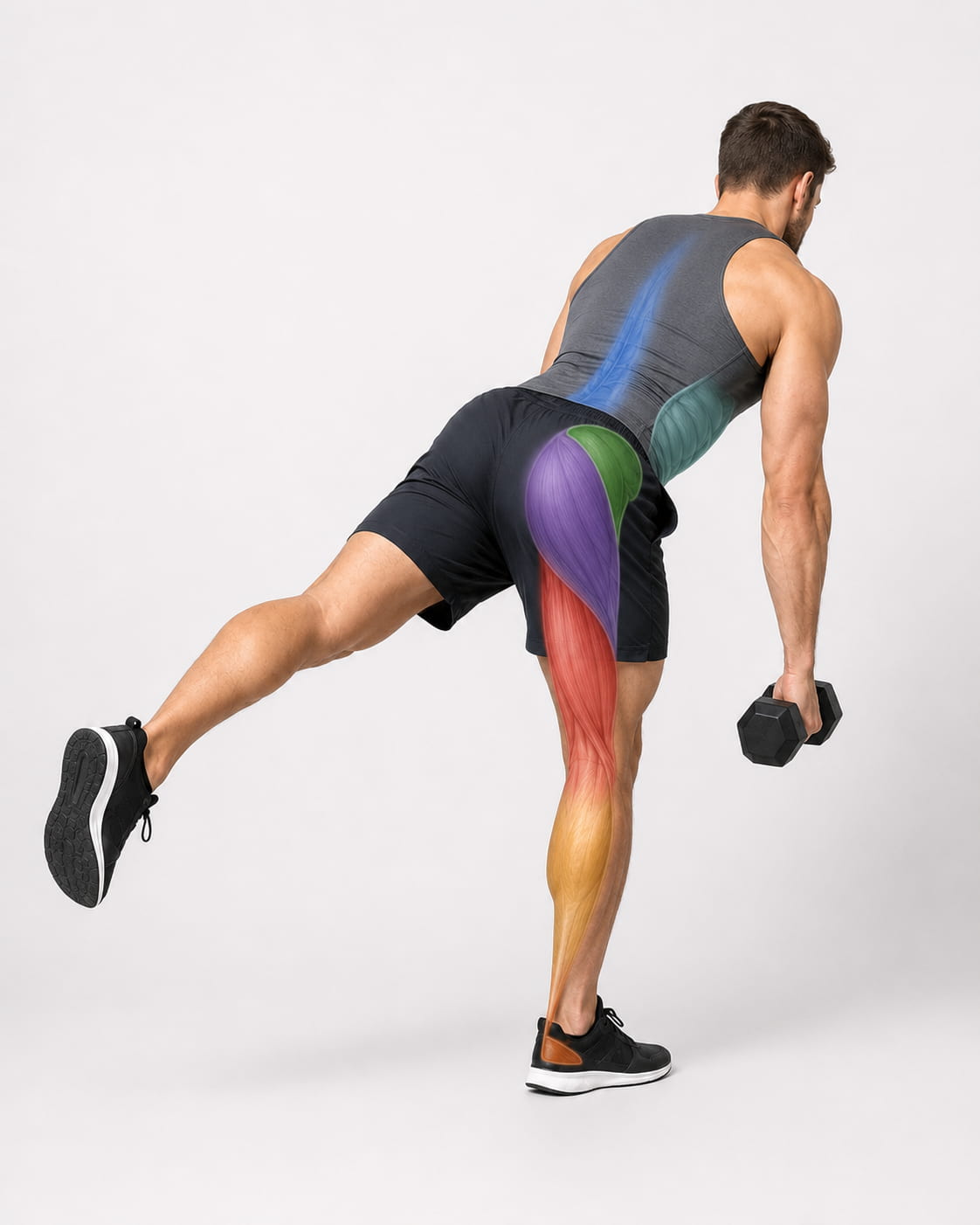
The single leg deadlift mainly works the hamstrings and glutes, with help from the core, spinal erectors, calves, and hip stabilizers.
The hamstrings work hard because they help control hip flexion as you lower and assist hip extension as you stand back up. You should usually feel tension through the back of the working thigh, especially during the lowering phase.
The gluteus maximus helps extend the hip and finish the lift. When you drive the floor away and stand tall without leaning back, the glutes help bring your hips through the movement.
The gluteus medius and gluteus minimus help control the pelvis. They are especially important because the exercise is done on one leg. If your hips rotate, tilt, or drop to one side, these smaller hip muscles are not controlling the position well enough.
The spinal erectors help keep your torso stable. They should support the movement, not dominate it. If you mostly feel your lower back, the load may be too heavy, your brace may be weak, or you may be reaching too far forward.
The core muscles help resist rotation. A good single leg deadlift should feel controlled through the trunk, not loose or twisted.
The calves and foot muscles also assist because the standing leg must balance and stabilize your body. This is one reason the exercise can feel challenging even before you add much weight.
Research published in Frontiers in Physiology compared trunk and hip muscle activity during single-leg Romanian deadlift variations and noted the importance of trunk and pelvic stabilization during the movement.
Single Leg Deadlift Exercise Guide
Equipment needed: You can do this exercise with body weight only. For loaded versions, use a dumbbell, kettlebell, cable handle, or two dumbbells.
Why it stands out: The single leg deadlift combines posterior-chain strength with balance and hip control. It is harder to load than a regular deadlift, but it gives you more feedback on side-to-side control and body position.
Suggested sets and reps: Start with 2–3 sets of 6–8 reps per side. Intermediate lifters can use 3–4 sets of 8–10 reps per side. Advanced lifters can use 3–4 sets of 6–8 controlled reps per side with heavier loading, tempo, or pauses.
Beginners: Start with a wall-supported or kickstand variation. Use a slow tempo and keep the range of motion short enough that your hips stay level and your back stays neutral.
Intermediate: Use one dumbbell or kettlebell. Holding the weight in the hand opposite the working leg is a common option because it challenges the core and hip stabilizers.
Advanced: Use heavier dumbbells, two-dumbbell loading, a cable version, a pause near the bottom, or a controlled deficit. Only progress if your balance, spine position, and hip control stay clean.
Rest: Rest 60–90 seconds between sets for light technique work. Rest 90–150 seconds if you are using heavier loads or training closer to a strength goal.
How to do it:
- Stand tall with your feet about hip-width apart and your weight balanced through one foot.
- Keep a slight bend in the working knee and brace your core.
- Push your hips back as your torso leans forward and your opposite leg moves behind you.
- Keep your hips square to the floor instead of opening them to the side.
- Lower until you feel a strong stretch in the working-side hamstring or until your form starts to change.
- Drive through the standing foot and squeeze the working-side glute to return to standing.
- Finish tall with your ribs down, hips extended, and balance under control before starting the next rep.
Common mistakes: The most common mistakes are turning the movement into a squat, rounding the back, opening the hips, locking the standing knee, reaching the weight too far forward, rushing the lowering phase, and using more load than you can control.
Expert tip: Think about making a long line from your head to your back heel. Your torso and rear leg should move together as your hips hinge back.
Exercise variations: Useful variations include the bodyweight single leg deadlift, dumbbell single leg deadlift, kettlebell single leg deadlift, contralateral single leg deadlift, two-dumbbell single leg deadlift, cable single leg deadlift, tempo single leg deadlift, and pause single leg deadlift.
Easier variation: The kickstand deadlift is the best easier variation for most beginners. Keep most of your weight on the front leg and use the back foot lightly for balance.
Harder variation: A paused dumbbell single leg deadlift is a strong progression. Pause near the bottom for one or two seconds while keeping your hips square, then stand without bouncing.
Benefits of the Single Leg Deadlift
The single leg deadlift is useful because it trains strength, balance, and movement control at the same time.
Builds Hamstring and Glute Strength
The single leg deadlift trains the posterior chain, especially the hamstrings and glutes. It is not usually loaded as heavily as a barbell deadlift, but the one-leg position makes each side work independently.
This makes it useful as an accessory lift after heavier lower-body exercises. You can use it to add quality volume for the hamstrings and glutes without putting the same total load on your body as a heavy bilateral deadlift.
Improves Balance and Body Control
Because you stand on one leg, the exercise challenges balance, foot pressure, hip control, and trunk position. The ACE lower-body dynamic balance guide includes the single-leg Romanian deadlift as a balance exercise that combines a hip hinge with one-leg control.
The goal is not to wobble through reps. The goal is to learn how to create enough tension that your body stays organized.
Helps Train Left and Right Sides Separately
Many people have one side that feels stronger, smoother, or more stable than the other. The single leg deadlift makes those differences easier to notice.
This does not mean every small difference is a problem. It simply gives you a way to train each side with attention and control.
Teaches a Better Hip Hinge
The single leg deadlift can improve your hinge mechanics because it forces you to move from the hips rather than just bending forward from the back.
If you learn to push the hips back, keep the spine stable, and maintain tension through the hamstrings, that skill can carry over to Romanian deadlifts, kettlebell swings, deadlifts, good mornings, and athletic movement patterns.
Useful With Minimal Equipment
You can do the single leg deadlift with body weight, one dumbbell, two dumbbells, a kettlebell, a cable machine, or light hand support. That makes it useful for home workouts, gym sessions, warm-ups, accessory work, and lower-body strength programs.
How to Know If Your Form Is Correct
Good form should feel controlled, stable, and smooth. You should feel the working-side hamstring and glute doing most of the work. Your lower back should feel supported, not strained.
Your standing foot should stay planted. A small amount of natural foot movement is normal, but your toes should not grip the floor aggressively every rep. Try to keep pressure through the heel, big toe, and little toe.
Your hips should stay mostly level. A common mistake is letting the rear-leg side rotate open toward the ceiling. When that happens, the movement becomes less of a clean hinge and more of a twist.
Your spine should stay neutral. You do not need to force a perfectly flat-looking back, but you should avoid collapsing, rounding, or craning your neck upward.
Your range of motion should match your control. Lowering farther is not better if your hips twist or your back position changes. Stop where you can still own the rep.
Common Single Leg Deadlift Mistakes and Fixes
| Mistake | Why it matters | How to fix it |
|---|---|---|
| Squatting instead of hinging | It shifts focus away from the hamstrings and glutes | Push the hips back and keep the working shin relatively still |
| Rounding the back | It reduces trunk control and may irritate the back | Brace first and lower only as far as you can stay stable |
| Opening the hips | It turns the exercise into a rotation pattern | Point both hip bones toward the floor |
| Reaching the weight too far forward | It pulls you out of position | Keep the weight close to the standing leg |
| Locking the knee | It can make balance harder and reduce control | Keep a soft bend in the working knee |
| Moving too fast | It hides balance and hinge mistakes | Use a slow 2–3 second lowering phase |
| Loading too soon | It makes balance the limiter instead of strength | Master bodyweight or support first |
Best Single Leg Deadlift Regressions
Wall Supported Single Leg Deadlift
This is the best starting option if balance is the main problem. Stand near a wall, lightly touch it with one hand, and perform the hinge slowly. Use the wall as guidance, not as something to lean on heavily.
Kickstand Deadlift
The kickstand deadlift keeps the back foot lightly on the floor. Most of your weight stays on the front leg, but the rear foot gives enough support to make the movement easier to control.
This is one of the best regressions because it still trains the hip hinge, hamstrings, and glutes without making balance the biggest challenge.
Bodyweight Single Leg Deadlift
Use this version before loading the movement. It teaches the pattern and helps you find your natural range of motion.
Keep your hands on your hips, reach them forward, or hold them across your chest. Choose the position that helps you control your trunk best.
Reach to Box Single Leg Deadlift
Place a box, bench, or yoga block in front of you and reach toward it as you hinge. The target gives you a consistent depth and prevents you from forcing more range than you can control.
Best Single Leg Deadlift Progressions
Dumbbell Single Leg Deadlift
This is the most common loaded version. Hold one dumbbell in front of your body or in the hand opposite your working leg.
The ACE single-arm single-leg Romanian deadlift guide demonstrates a version where the dumbbell is held in the opposite hand from the standing leg. This option increases the anti-rotation challenge.
Kettlebell Single Leg Deadlift
A kettlebell works well because the handle is easy to hold and the weight can move close to the standing leg. Keep the kettlebell close to your body rather than reaching it far in front of you.
Two Dumbbell Single Leg Deadlift
Holding a dumbbell in each hand adds more load and makes the exercise feel more even. This is useful when your balance is solid and you want more hamstring and glute stimulus.
Cable Single Leg Deadlift
The cable version provides constant tension and can be useful for lifters who want a smoother resistance curve. Start light because the cable can pull you off balance.
Tempo Single Leg Deadlift
Use a slow lowering phase, such as three seconds down and one second up. This makes the exercise more demanding without needing much weight.
Pause Single Leg Deadlift
Pause near the bottom for one or two seconds. This teaches control, reduces bouncing, and helps you build strength in the most challenging position.
How to Use the Single Leg Deadlift in Workouts
The single leg deadlift works best as an accessory exercise, technique drill, warm-up movement, or lower-body strength builder. It does not need to replace squats, lunges, hip thrusts, or regular deadlifts. It fits well beside them.
For most people, train the single leg deadlift 1–3 times per week depending on your program, recovery, and training level. The American College of Sports Medicine notes that adults should perform muscle-strengthening activities for major muscle groups at least two days per week. Your exact plan should match your goals and recovery.
The ACSM resistance training guideline update also emphasizes that resistance training variables can be adjusted for different goals, including strength, muscle growth, and power. For the single leg deadlift, most people should prioritize control before heavy loading.
Beginner Single Leg Deadlift Workout
| Exercise | Sets | Reps | Rest |
|---|---|---|---|
| Bodyweight squat | 2 | 10 | 60 sec |
| Wall supported single leg deadlift | 2–3 | 6–8 per side | 60–90 sec |
| Glute bridge | 2–3 | 10–12 | 60 sec |
| Side plank | 2 | 20–30 sec per side | 45–60 sec |
Effort level: Keep 3–4 reps in reserve.
Frequency: 1–2 times per week.
Progression: Move from wall support to kickstand deadlifts, then to bodyweight single leg deadlifts.
Intermediate Lower Body Accessory Workout
| Exercise | Sets | Reps | Rest |
|---|---|---|---|
| Goblet squat | 3 | 8–10 | 90 sec |
| Dumbbell single leg deadlift | 3 | 8–10 per side | 90 sec |
| Reverse lunge | 3 | 8 per side | 90 sec |
| Calf raise | 3 | 12–15 | 60 sec |
Effort level: Keep 2–3 reps in reserve.
Frequency: 1–2 times per week.
Progression: Add small amounts of weight when every rep stays balanced and controlled.
Advanced Posterior Chain Accessory Workout
| Exercise | Sets | Reps | Rest |
|---|---|---|---|
| Romanian deadlift | 4 | 6–8 | 2 min |
| Paused single leg deadlift | 3–4 | 6–8 per side | 90–150 sec |
| Hip thrust | 3 | 8–10 | 90 sec |
| Hamstring curl | 3 | 10–12 | 60–90 sec |
Effort level: Keep 1–3 reps in reserve.
Frequency: 1–2 times per week.
Progression: Add load, slow the lowering phase, or add a pause before increasing range of motion.
When Should You Do Single Leg Deadlifts?
Do single leg deadlifts after your main strength lift if your goal is muscle and strength. For example, place them after squats, deadlifts, or hip thrusts.
Do them earlier in the workout if your main goal is balance, skill, or movement quality. In that case, use lighter loads and focus on clean reps.
You can also use a light version during warm-ups. A 2025 cohort study in the International Journal of Sports Physical Therapy found that adding single-leg Romanian deadlifts to warm-ups for high school track and field athletes was associated with reduced mild to moderate hamstring strain risk. This should be viewed as supportive research, not a guarantee that the exercise prevents injuries.
How Heavy Should You Go?
Start lighter than you think. The single leg deadlift is not a max-strength lift for most people. If the weight causes twisting, wobbling, rounding, or shortened range of motion, it is too heavy for your current level.
A good rule is to choose a weight that lets you complete every rep with about 2–3 reps in reserve. You should feel challenged, but you should not be fighting for balance on every repetition.
Increase weight only when you can complete all reps with stable hips, a neutral spine, steady foot pressure, and no rushing.
Single Leg Deadlift Safety Tips
Start with a regression if balance is limiting your form. There is no need to force the full version on day one.
Keep the movement slow and controlled. Fast reps make it harder to feel your hips, hamstrings, and trunk position.
Do not chase depth. Lower only as far as you can control without rounding your back or opening your hips.
Avoid heavy loading if you cannot perform the bodyweight version well. Load should build the exercise, not hide poor mechanics.
Stop the exercise and seek professional help if you feel sharp pain, numbness, dizziness, chest pain, or unusual symptoms.
Frequently Asked Questions
Is the single leg deadlift good for glutes?
Yes. The single leg deadlift trains the gluteus maximus as a hip extensor and also challenges the gluteus medius and minimus as stabilizers. To feel it more in the glutes, keep the working foot planted, hinge from the hips, and squeeze the working-side glute as you return to standing.
Should I feel single leg deadlifts in my lower back?
You may feel your lower back working lightly to stabilize your torso, but it should not be the main area doing the work. Most of the effort should be in the hamstrings, glutes, and core. If your lower back dominates, reduce the load, shorten the range of motion, and focus on bracing before you hinge.
Are single leg deadlifts better than regular deadlifts?
They are not automatically better. Regular deadlifts are usually better for heavy total-body strength. Single leg deadlifts are better for training each side separately, improving balance, and building controlled hip-hinge strength with lighter loads. Many programs can use both.
What is the difference between a single leg deadlift and a single-leg Romanian deadlift?
A single-leg Romanian deadlift usually starts from the top and emphasizes lowering under control with a hip hinge. A single leg deadlift may be used more broadly to describe one-leg deadlift variations. In most general fitness programs, people use the terms to describe the same basic movement.
How many reps should I do?
Most people should use 6–10 reps per side. Beginners can start with 2–3 sets of 6–8 reps per side. Intermediate lifters can use 3–4 sets of 8–10 reps. Advanced lifters can use 3–4 sets of 6–8 reps with heavier load, pauses, or tempo.
Why do I lose balance during single leg deadlifts?
Balance can break down because of weak foot control, poor hip stability, rushing, too much range of motion, or using too much weight. Use a wall-supported or kickstand version first. Then progress once your hips stay level and your reps feel smooth.
Conclusion
The single leg deadlift is a practical exercise for building stronger hamstrings, glutes, balance, and hip-hinge control. Start with a version you can perform cleanly, keep the reps slow, and progress only when your balance and form stay consistent.
Use it as an accessory lift, warm-up drill, or lower-body strength exercise. The best results come from patient practice, controlled loading, and clean movement on both sides.
This content is for informational purposes only and is not a substitute for professional medical advice.