A dumbbell face pull is a light rear-shoulder and upper-back exercise performed with the torso inclined so gravity can load the pulling movement. It can be a useful option when you have dumbbells but no cable machine, although it does not reproduce the resistance of a conventional cable face pull exactly.
For beginners, the most practical version is the chest-supported incline dumbbell face pull. Supporting your torso on a bench limits swinging, reduces lower-back fatigue, and makes it easier to concentrate on moving the shoulders and shoulder blades correctly.
This guide explains the setup, proper form, muscles worked, common mistakes, suitable weights, and how to include dumbbell face pulls in a workout.
What Is a Dumbbell Face Pull?
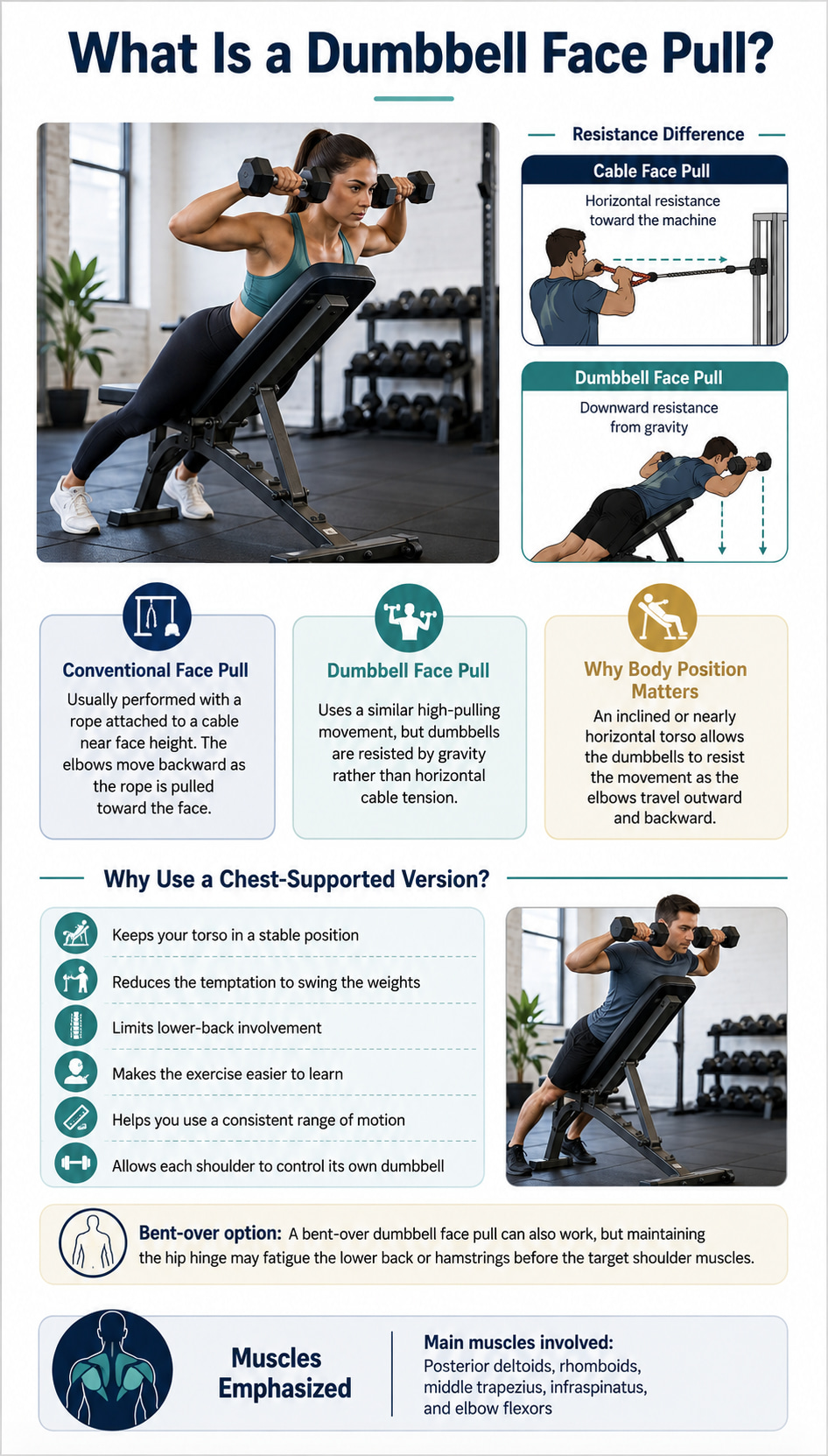
A conventional face pull is normally performed with a rope attached to a cable set near face height. You pull the rope toward your face by moving the elbows backward, retracting the shoulder blades, and controlling the return.
The National Academy of Sports Medicine face-pull guide describes the standard exercise as a cable-based movement that emphasizes the posterior deltoids, rhomboids, middle trapezius, infraspinatus, and elbow flexors.
A dumbbell face pull follows a related movement pattern, but the resistance works differently.
A cable pulls horizontally toward the machine. A dumbbell is always pulled downward by gravity. Performing the dumbbell version while standing upright therefore does not create the same resistance path as a cable face pull.
To make the dumbbell variation more effective, you need to place your torso in an inclined or nearly horizontal position. This allows the dumbbells to resist the high pulling motion as your elbows move outward and backward.
Why Use a Chest-Supported Version?
The chest-supported incline version is recommended in this guide because it:
- Keeps your torso in a stable position
- Reduces the temptation to swing the weights
- Limits lower-back involvement
- Makes the exercise easier to learn
- Helps you use a consistent range of motion
- Allows each shoulder to control its own dumbbell
A bent-over version can also work, but maintaining the hip-hinge position adds another demand. Beginners may find that their lower back or hamstrings fatigue before the target shoulder muscles.
How to Do a Dumbbell Face Pull With Proper Form
Equipment needed: Two light dumbbells and a stable adjustable bench.
Sets, reps, and rest: Start with 2–3 sets of 10–15 controlled repetitions. Rest for 60–90 seconds between sets.
How to Set Up the Bench
- Adjust an incline bench to approximately 30–45 degrees.
- Place two light dumbbells on the floor beside the bench.
- Lie face down with your chest and abdomen supported.
- Plant both feet firmly on the floor.
- Keep your head and neck naturally aligned with your spine.
- Hold one dumbbell in each hand with your palms facing each other.
- Let your arms hang beneath your shoulders with a slight bend in the elbows.
- Lightly brace your abdomen and keep your chest against the pad.
The exact bench angle is not mandatory. Use an angle that gives your arms enough clearance to hang freely without forcing your neck upward or causing the dumbbells to hit the floor.
Step-by-Step Instructions
- Set your shoulders.
Keep your neck long and shoulders relaxed away from your ears. Do not force the shoulder blades together before starting. - Lead with your elbows.
Pull your elbows outward and backward rather than curling the dumbbells directly toward your shoulders. - Bend the elbows as you pull.
Allow the elbows to bend to approximately 90 degrees while the dumbbells travel upward. - Bring the dumbbells toward the sides of your face.
Finish with your hands near your temples or ears rather than beside your ribs. - Use comfortable external rotation.
Allow the upper arms to rotate outward slightly so the hands finish near or slightly above the elbows. Do not force the dumbbells behind your head. - Pause without shrugging.
Hold the top position briefly while keeping your chest supported and neck relaxed. - Lower the weights under control.
Reverse the movement over approximately two to three seconds until the arms return to the starting position. - Reset before the next repetition.
Avoid bouncing immediately into the next pull.
Coaching cue: Pull your elbows wide and bring your hands toward your ears while keeping your neck long.
How High Should Your Elbows Finish?
Your elbows should generally finish around shoulder height or slightly below it.
They do not need to travel as high as possible. Raising them excessively can encourage shrugging or create an uncomfortable shoulder position.
Use the highest position you can control without:
- Shoulder pinching
- Neck tension
- Wrist bending
- Lifting your chest from the bench
- Forcing the upper arms behind the torso
What Should the Exercise Feel Like?
You should primarily feel muscular effort:
- Across the backs of your shoulders
- Between and around your shoulder blades
- Through the upper back
- Lightly around the back of the shoulder joint
You should not feel most of the exercise in:
- The front of the shoulders
- The upper trapezius near the neck
- The lower back
- The wrists
- The elbows
A small amount of biceps involvement is normal because the elbows bend during the pull.
Dumbbell Face Pull Muscles Worked
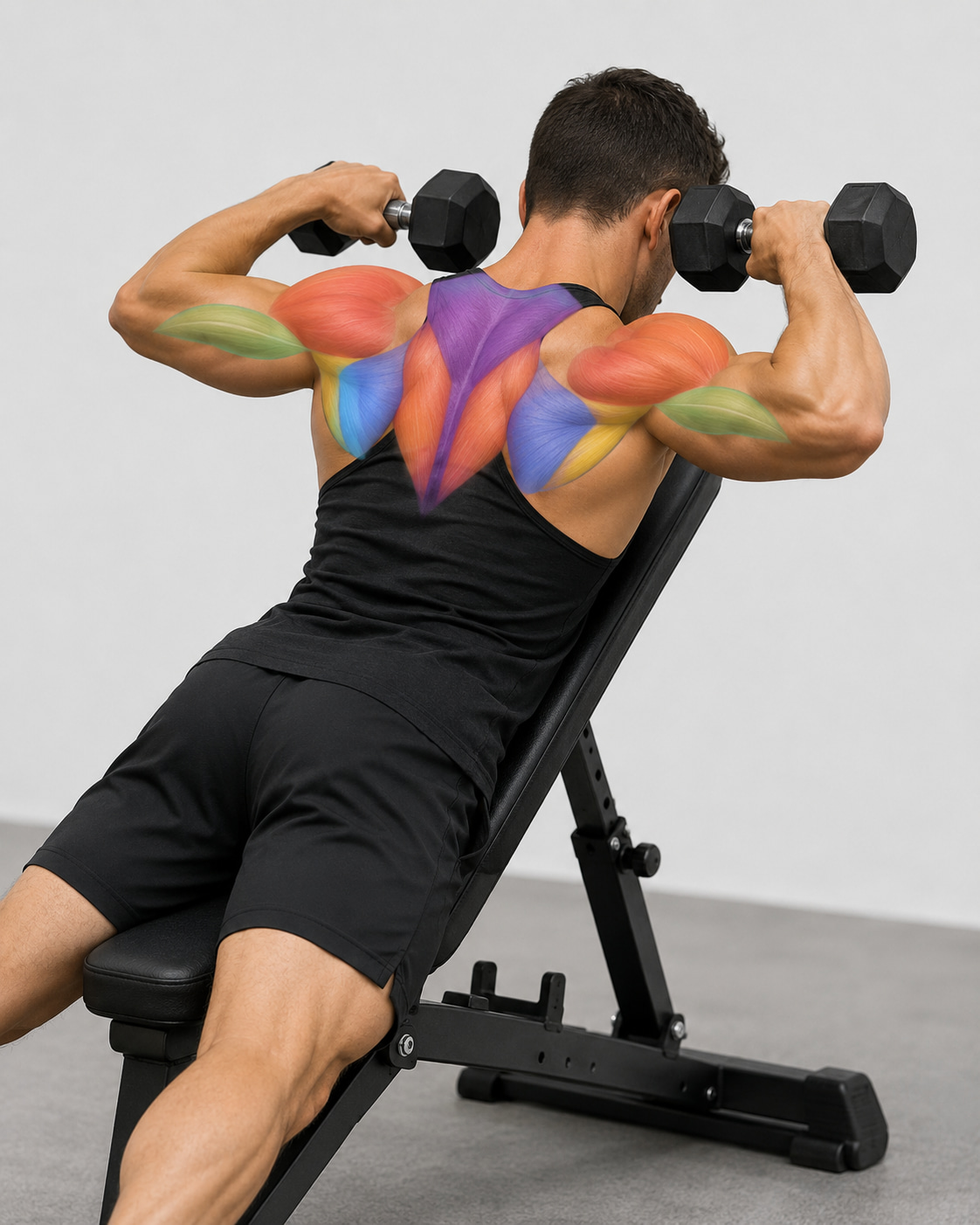
The dumbbell face pull combines shoulder movement, shoulder-blade movement, and elbow flexion. Several muscles contribute rather than one muscle working alone.
1. Posterior Deltoids
The posterior deltoids, commonly called the rear delts, are major contributors.
They help move the upper arms backward and outward as the elbows travel away from the body. The posterior deltoids also assist with external rotation of the upper arm.
You will usually feel them most strongly when you keep the elbows wide and finish the pull near face level.
2. Middle Trapezius and Rhomboids
The middle trapezius and rhomboids help control the shoulder blades as you pull.
The NCBI Bookshelf overview of scapular anatomy identifies the middle trapezius and rhomboids as important muscles for scapular retraction. It also describes the trapezius, rhomboids, and other surrounding muscles as contributors to shoulder-blade movement and stability.
These muscles should work without aggressively pinching the shoulder blades together or elevating the shoulders toward the ears.
3. Infraspinatus and Teres Minor
The infraspinatus and teres minor are rotator-cuff muscles that externally rotate the upper arm and help stabilize the shoulder joint.
According to the NCBI Bookshelf shoulder-muscle overview, the infraspinatus and teres minor perform external rotation, while the rotator-cuff group helps support the shoulder joint.
Their contribution increases when the movement includes a controlled external-rotation finish. If you perform only a high row without rotating the upper arms, the exercise places less emphasis on this part of the movement.
4. Biceps and Brachialis
The biceps, brachialis, and other elbow flexors assist because the elbows bend as the dumbbells move toward your face.
They should support the exercise rather than dominate it. If you mainly feel your biceps, the weight may be too heavy or you may be curling the dumbbells instead of leading with the elbows.
Benefits of Dumbbell Face Pulls
1. Strengthens the Rear Shoulders and Upper Back
Dumbbell face pulls train the posterior deltoids, middle trapezius, and rhomboids together.
These muscles are involved in pulling the upper arms backward and controlling the shoulder blades. Strengthening them may help create a more balanced upper-body program, particularly when you also perform frequent pressing exercises.
2. Includes Controlled External Rotation
When performed with an appropriate finish, the exercise includes shoulder external rotation.
This gives the infraspinatus and teres minor an active role alongside the rear deltoids and upper-back muscles. The movement should remain controlled and comfortable rather than being forced through the largest possible range.
3. Requires Minimal Equipment
The exercise can be performed with:
- Two light dumbbells
- An adjustable bench
- A small amount of training space
It is useful for home gyms and situations where a cable station is unavailable or occupied.
4. Trains Each Side Independently
Each arm controls its own dumbbell.
This makes it easier to notice whether one side:
- Moves through a shorter range
- Shrugs more
- Rotates differently
- Loses control sooner
The goal is not to force both sides into identical movement. Use a comfortable, controlled range for each shoulder.
5. Complements Pressing Exercises
Bench presses, push-ups, and overhead presses train the chest, front deltoids, and triceps heavily.
Dumbbell face pulls add rear-shoulder and upper-back work that can complement those exercises. They should be part of a balanced program rather than used as a guaranteed solution for posture or shoulder problems.
Dumbbell Face Pull vs. Cable Face Pull
The dumbbell and cable variations train several similar muscles, but they are not mechanically identical.
| Feature | Dumbbell Face Pull | Cable Face Pull |
|---|---|---|
| Resistance source | Gravity | Cable stack |
| Resistance direction | Downward | Horizontal toward the machine |
| Body position | Inclined, prone, or bent over | Usually standing or seated upright |
| Equipment | Dumbbells and preferably a bench | Cable machine and rope |
| Torso stability | High with bench support | Requires standing or seated stability |
| Starting tension | Lower when the arms hang vertically | Cable maintains tension from the start |
| Loading | Usually very light | Easier to adjust in small increments |
| Best use | Home or dumbbell-only training | More direct conventional face-pull pattern |
Which Version Is Better?
The cable version is generally the more direct choice when your goal is to perform a conventional face pull. Its horizontal resistance matches the direction of the pull while you remain upright.
The dumbbell version is a practical alternative when you do not have a cable machine. It may also be useful when you prefer chest support or independent loading for each arm.
The American College of Sports Medicine’s 2026 resistance-training guidance emphasizes consistency, individualization, and selecting methods that fit the trainee’s goals. It also notes that one specific equipment type does not consistently determine results for the average healthy adult.
Use the version that lets you train the intended muscles with good control and without discomfort.
Dumbbell Face Pull vs. Rear-Delt Fly
These exercises are related, but their arm paths are different.
| Feature | Dumbbell Face Pull | Dumbbell Rear-Delt Fly |
|---|---|---|
| Elbow position | Elbows bend significantly | Elbows remain only slightly bent |
| Arm path | Elbows pull outward and backward | Arms sweep outward in a wide arc |
| Finish position | Hands near the face or ears | Hands farther from the body |
| External rotation | Can be included deliberately | Usually less emphasized |
| Biceps involvement | Moderate assisting role | Minimal |
| Main purpose | High pull with external-rotation component | Shoulder horizontal abduction |
During a face pull, think about guiding the elbows backward while the hands travel toward your head.
During a rear-delt fly, think about spreading the arms apart while maintaining almost the same elbow angle.
Common Dumbbell Face Pull Mistakes
Performing the Exercise Upright
Holding dumbbells while standing upright does not reproduce a cable face pull because the weights pull straight down.
Correction: Support your chest on an incline bench or hinge forward until your torso is close to horizontal.
Using Too Much Weight
Heavy dumbbells encourage swinging, shrugging, shortened range, and poor external rotation.
The NASM face-pull instructions also identify excessive weight, reduced range, jerky movement, and shrugging as common errors in the cable version.
Correction: Select a load that allows a brief pause beside the face without lifting your chest or tensing your neck.
Turning It Into a Regular Row
Pulling the dumbbells toward your ribs with the elbows close to your sides changes the exercise into a row.
Correction: Keep the elbows wider and guide the dumbbells toward the sides of your face.
Shrugging Toward the Ears
Shrugging often causes the upper trapezius and neck to dominate the movement.
Correction: Keep the neck long and shoulders comfortably away from the ears. Do not force the shoulder blades down, but avoid actively lifting them.
Lifting the Chest From the Bench
Raising the chest creates momentum and reduces the stability that makes the supported version useful.
Correction: Maintain light abdominal tension and keep your ribs and chest against the pad.
Forcing External Rotation
Trying to place the hands far behind the head can create an uncomfortable shoulder position.
Correction: Rotate only as far as you can without pinching, twisting the wrists, or losing elbow position.
Bending the Wrists
Letting the dumbbells fold backward places unnecessary stress on the wrists and makes the finishing position less stable.
Correction: Keep the knuckles, wrists, and forearms aligned.
Dropping the Weights Quickly
The lowering phase is part of the exercise.
Correction: Take approximately two to three seconds to return the dumbbells to the starting position.
How Much Weight Should You Use?
Dumbbell face pulls usually require much less weight than dumbbell rows.
Start with the lightest dumbbells available if necessary. A suitable weight should allow you to:
- Complete at least 10 controlled repetitions
- Keep your chest supported
- Avoid shrugging
- Finish with the hands near the face
- Pause briefly at the top
- Lower the dumbbells slowly
- Retain approximately two or three good repetitions at the end of the set
The weight is too heavy if:
- Your hands cannot reach face level
- Your elbows drop toward your ribs
- You swing or lift your torso
- Your wrists bend
- You cannot control the lowering phase
- You feel mostly biceps or neck tension
When to Increase the Weight
Increase the load only after you can complete the top of your target repetition range with consistent form for every set.
For example, when you can perform three sets of 15 repetitions with a controlled pause and lowering phase, increase each dumbbell by the smallest available amount.
After increasing the weight, return to the lower end of the repetition range and build back up.
Dumbbell Face Pull Sets, Reps, and Rest
There is no single mandatory repetition range for this variation. The following are practical starting points.
| Training use | Sets | Reps | Rest | Effort |
|---|---|---|---|---|
| Learning the exercise | 2 | 10–12 | 60–90 seconds | 3–4 reps remaining |
| Upper-body accessory work | 2–3 | 12–15 | 60–90 seconds | 2–3 reps remaining |
| Higher-rep rear-delt work | 2–3 | 15–20 | 45–75 seconds | 1–3 reps remaining |
| Light preparation work | 1–2 | 12–15 | 30–60 seconds | Stop well before fatigue |
Beginners can start with one or two sessions per week. Add frequency only when your shoulders recover comfortably and the exercise does not interfere with other pressing or pulling work.
Where to Place It in a Workout
Most people should perform dumbbell face pulls after their main compound exercises, such as:
- Dumbbell bench presses
- Overhead presses
- Dumbbell rows
- Pull-ups or pulldowns
Using them later in the workout allows you to treat them as controlled accessory work rather than trying to lift the heaviest possible dumbbells.
They can also be used near the beginning of a session with very light resistance. In that case, stop well before fatigue so the exercise does not weaken your shoulders before pressing.
Dumbbell Face Pull Regressions
Prone W Raise Without Weights
Lie chest down on an incline bench and practice moving your arms into a W position without dumbbells.
This helps you learn the elbow and hand path without external load.
One-Arm Dumbbell Face Pull
Perform the exercise with one arm at a time while the opposite arm remains relaxed.
This can make it easier to concentrate on shoulder position and compare sides.
Shorter Range of Motion
Stop before the top position if you cannot reach face level without discomfort or shrugging.
Gradually increase the range only when the movement remains controlled.
Light Band Face Pull
A resistance band allows you to practice a more horizontal pull while standing.
Secure the band to a stable anchor around face height and inspect it before use. Do not attach it to an object that can move, open, or break.
Dumbbell Face Pull Progressions
Add a Pause
Hold the top position for one or two seconds without shrugging or lifting your chest.
Slow the Lowering Phase
Take three to four seconds to lower the dumbbells.
This increases control without requiring heavier weights.
Add Repetitions
Progress from 10 repetitions toward 15 or 20 before increasing the load.
Increase the Weight Gradually
Use the smallest available weight increase. If the new load changes your movement path, return to the lighter dumbbells.
Use the Bent-Over Variation
Once you can maintain a stable hip hinge, perform the movement without chest support.
Keep your torso close to horizontal, knees slightly bent, spine neutral, and abdomen braced. Stop if lower-back fatigue prevents you from controlling the shoulder movement.
Sample Upper-Body Workout With Dumbbell Face Pulls
Perform this routine one or two times per week with at least one recovery day between sessions.
1. Dumbbell Bench Press
- Sets: 3
- Reps: 8–12
- Rest: 90 seconds
- Effort: Finish with 2–3 repetitions remaining
2. One-Arm Dumbbell Row
- Sets: 3 per side
- Reps: 8–12
- Rest: 60–90 seconds
- Effort: Finish with 2–3 repetitions remaining
3. Chest-Supported Dumbbell Face Pull
- Sets: 2–3
- Reps: 12–15
- Rest: 60–75 seconds
- Effort: Finish with 2–3 repetitions remaining
4. Dumbbell Lateral Raise
- Sets: 2
- Reps: 12–20
- Rest: 60 seconds
- Effort: Finish with 2–3 repetitions remaining
Before lifting, perform five to ten minutes of easy movement and one light practice set of each exercise. The American Academy of Orthopaedic Surgeons shoulder-conditioning guidance recommends warming up with five to ten minutes of low-impact activity and advises against ignoring pain during shoulder exercise.
How to Progress the Routine
When you reach the top of the repetition range for every set with good form:
- Increase the dumbbell weight by the smallest available amount.
- Return to the lower end of the repetition range.
- Build the repetitions back up gradually.
For the face pull, prioritize pauses, control, and consistent positioning before adding weight.
Frequently Asked Questions
Can You Really Do Face Pulls With Dumbbells?
Yes, but you need to change your body position.
Because dumbbells pull downward, perform the movement chest supported or bent over. An upright dumbbell version does not provide the same resistance direction as a cable face pull.
Are Dumbbell Face Pulls as Good as Cable Face Pulls?
They can train several of the same muscles, but they are not identical.
A cable provides more direct horizontal resistance and usually maintains tension more consistently. The dumbbell version remains useful when you have limited equipment or prefer chest-supported training.
Should You Pull the Dumbbells Toward Your Face or Chest?
Pull toward the sides of your face or ears.
Pulling toward your lower chest or ribs with the elbows close to your body turns the movement into more of a regular row.
Should Your Elbows Be Higher Than Your Shoulders?
Not necessarily.
Aim to finish with the elbows around shoulder height or slightly below. Raising them higher is not automatically better and may encourage shrugging or discomfort.
Why Do Dumbbell Face Pulls Feel Hard With Light Weights?
The exercise places the dumbbells far from the shoulder joint and combines several controlled movements.
The rear deltoids and external rotators are also smaller than the large back muscles used in heavy rows. Light weights can therefore be challenging when the exercise is performed strictly.
Can Dumbbell Face Pulls Fix Rounded Shoulders?
The exercise may strengthen muscles involved in rear-shoulder and shoulder-blade control, but it cannot guarantee a permanent posture change.
Posture is affected by many factors, including daily positions, mobility, training habits, comfort, anatomy, and activity level. Use face pulls as one part of a balanced program rather than as a treatment.
What Should You Do if Face Pulls Hurt Your Shoulder?
Stop the set rather than training through sharp or increasing pain.
Try a lighter weight, shorter range, lower elbow position, or a different variation. Seek guidance from a qualified medical or rehabilitation professional if you experience persistent pain, weakness, numbness, tingling, or difficulty using the arm normally.
Conclusion
The dumbbell face pull is most effective when treated as a light, controlled rear-shoulder and upper-back exercise—not as a heavy row.
Use a chest-supported incline bench, lead with your elbows, bring the dumbbells toward the sides of your face, and include only as much external rotation as feels comfortable. Progress through better control, longer pauses, and more repetitions before adding weight.
References
- National Academy of Sports Medicine: Face Pull
- American College of Sports Medicine: 2026 Resistance Training Guidelines
- American Academy of Orthopaedic Surgeons: Rotator Cuff and Shoulder Conditioning Program
- NCBI Bookshelf: Anatomy of the Scapula
- NCBI Bookshelf: Shoulder Muscles
This content is for informational purposes only and is not a substitute for medical advice.