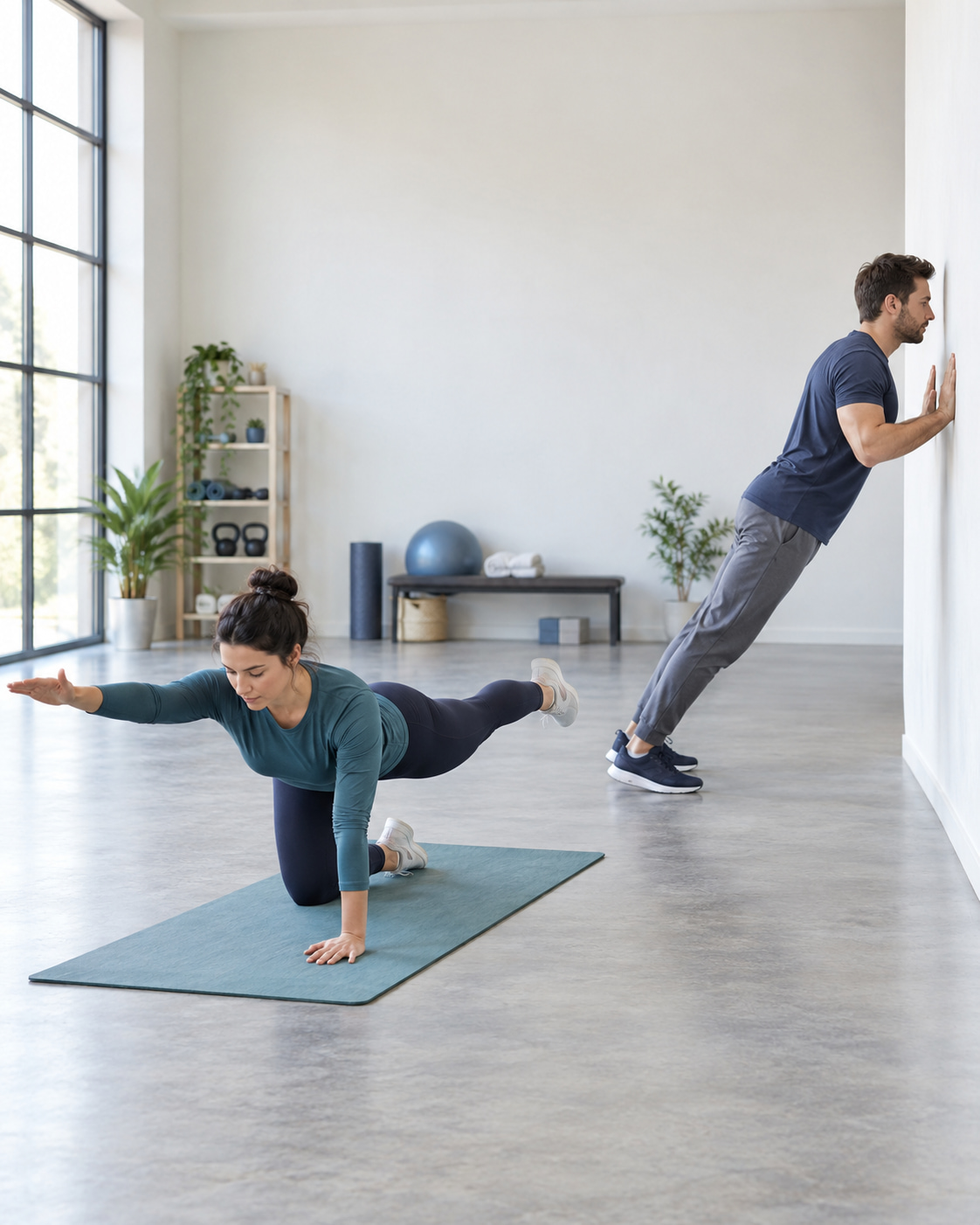
Pilates vs calisthenics comes down to your training goal: Pilates emphasizes controlled, coordinated movement, while calisthenics offers a direct way to develop progressive bodyweight strength. Both can be adapted for beginners, and neither is automatically better for everyone. Beginner guidance from the NHS emphasizes breathing, positioning, and controlled movement as important Pilates principles.
Here is how they differ, what the exercises involve, and how to build a manageable routine with either—or both.
Pilates vs Calisthenics at a Glance
Pilates is a structured movement method built around principles such as breathing, control, and precision. Calisthenics is a broader category of exercise that uses your body weight as resistance. There is overlap: bridges and other floor exercises can appear in both types of training. Merrithew explains that mat Pilates primarily uses body weight and gravity, while reformer Pilates introduces specialized equipment and spring resistance.
| Feature | Pilates | Calisthenics |
|---|---|---|
| Main training emphasis | Coordinating movement, breathing, and trunk control | Developing strength through bodyweight movements |
| Resistance | Body weight and gravity on a mat; springs on a reformer | Primarily body weight, sometimes with equipment providing support |
| Typical exercises | Controlled leg movements, bridges, and kneeling reaches | Squats, push-ups, rows, and their variations |
| Beginner approach | Supported positions and smaller movement ranges | Easier leverage, wall exercises, and assisted movements |
| Equipment | A mat for basic floor practice; specialized equipment for reformer work | None for many exercises; suitable equipment for pulling movements |
| How difficulty increases | Longer reaches, less support, more coordination, or adjusted equipment resistance | Harder body angles, less assistance, increased range, or additional repetitions |
These are typical differences, not rigid rules. A demanding Pilates sequence can challenge strength, and well-coached calisthenics also requires precise body control.
Where Reformer Pilates Fits
Reformer Pilates is different from a basic mat routine. Its moving carriage and springs can provide resistance or assistance. That means reformer work is not automatically harder—or easier—than mat Pilates. Beginners should learn the equipment with a qualified instructor.
What Do You Actually Do in Each Workout?
The following exercises show accessible ways to begin. Some movements are shared across training methods; the exercise selection, coaching, and progression give the session its emphasis.
Use the sets, repetitions, and rest periods in the routine section below.
Beginner Pilates Examples
These floor exercises introduce the movement-control approach used in beginner Pilates-style practice. Use a comfortable exercise mat.
1. Heel Slide
Best for: Practicing leg movement while keeping the trunk steady.
Muscles worked: Abdominal muscles stabilize the trunk while the hip and thigh muscles move the leg.
How to do it:
- Lie on your back with your knees bent, feet flat, and head supported on the mat.
- Exhale and slowly slide one heel away from you. Keep your pelvis steady and the other leg still.
- Stop before your back position changes, then slide the heel back. Alternate sides.
Common mistakes: Letting the pelvis tip, forcing the leg completely straight, or holding your breath.
Make it easier: Shorten the slide. The goal is controlled movement, not maximum reach.
NHS Pilates guidance includes this supported movement as a basic exercise.
2. Glute Bridge
Best for: Strengthening the hips while practicing trunk control.
Muscles worked: Primarily the glutes, with the abdominal muscles helping control the trunk.
How to do it:
- Lie on your back with your knees bent and feet approximately hip-width apart.
- Exhale, press through your feet, and lift your hips to a comfortable height. Keep your knees aligned with your feet.
- Pause briefly without forcing your ribs upward, then lower slowly.
Common mistakes: Lifting too high, excessively arching the lower back, or allowing the knees to drift inward.
Make it easier: Use a smaller lift.
The American Council on Exercise emphasizes avoiding excessive lower-back arching rather than chasing the highest possible bridge.
3. Four-Point Kneeling Reach
Best for: Coordinating opposite arm-and-leg movement without twisting the trunk.
Muscles worked: Abdominal and back stabilizers, with the glutes and shoulder muscles contributing to the movement.
How to do it:
- Start on your hands and knees, with hands beneath shoulders and knees beneath hips.
- Reach one arm forward and the opposite leg backward. Keep your hips facing the floor and your neck aligned with your spine.
- Reach only as far as you can without arching or rotating, then return and change sides.
Common mistakes: Raising the leg too high, shifting heavily to one side, or looking forward and straining the neck.
Make it easier: Keep both hands down and slide one leg backward with the toes staying on the floor.
This movement is also commonly called the bird dog.
Beginner Calisthenics Examples
These movements introduce lower-body strength, upper-body pushing, and upper-body pulling without requiring advanced skills.
1. Chair Sit-to-Stand
Best for: Learning a squat-related movement with a clear starting and finishing position.
Muscles worked: Primarily the quadriceps and glutes.
Equipment: A sturdy, non-wheeled chair secured against a wall.
How to do it:
- Sit toward the front of the chair with your feet flat and approximately hip-width apart.
- Lean slightly forward from your hips and press through your feet to stand. Let your knees follow the direction of your toes.
- Move your hips back and lower to the seat under control.
Common mistakes: Rocking repeatedly for momentum, letting the knees collapse inward, or dropping onto the chair.
Adjust the challenge: Use light hand assistance when necessary. Progress by relying less on your hands and controlling the lowering phase.
The NHS includes sit-to-stands as an accessible starting strength exercise.
2. Wall Push-Up
Best for: Building the foundation for stronger pushing movements.
Muscles worked: Chest, shoulders, and triceps.
How to do it:
- Face a wall and place your hands around chest height, approximately shoulder-width apart.
- Keep your body aligned as you bend your elbows and bring your chest toward the wall.
- Exhale and press away smoothly. Avoid leading with your head or letting your hips sag.
Common mistakes: Shrugging the shoulders, flaring the elbows excessively, or bending only at the hips.
Adjust the challenge: Use a smaller range at first. When the movement becomes comfortable, progress toward an incline push-up on a fixed, stable exercise rail.
North Tees and Hartlepool NHS Foundation Trust recommends wall push-ups for shoulder, chest, and arm strengthening.
3. Standing Suspension Row
Best for: Adding pulling work to a bodyweight routine.
Muscles worked: Back muscles, including the lats, and the biceps.
Equipment: A properly installed suspension trainer. Have a qualified trainer check the setup before use; do not improvise an anchor with household furniture.
How to do it:
- Face the anchor and hold the handles with your palms facing inward. Keep your feet planted and lean back slightly with the straps taut.
- Bend your elbows close to your sides and pull your body toward the handles, keeping your trunk aligned.
- Slowly straighten your arms to return without dropping your hips or jerking the straps.
Common mistakes: Starting at an overly difficult angle, shrugging, or using the hips to generate momentum.
Adjust the challenge: Stay more upright to make the movement easier.
TRX explains how changing your body angle can adjust the difficulty of a suspension row.
Which Is Better for Your Goals?
For Stronger Push-Ups and Bodyweight Strength: Choose Calisthenics
Calisthenics is the more direct choice when your goal is to improve movements such as push-ups, rows, and squats. You can practice those movements at an appropriate difficulty and make them progressively more challenging.
A small 2018 randomized trial indexed by the National Library of Medicine found that progressive push-up training improved upper-body strength in moderately trained men. It supports the usefulness of progression, but it was not a comparison with Pilates.
For Focused Movement-Control Practice: Start With Pilates
Choose Pilates when you enjoy deliberate repetitions and close attention to how your ribs, pelvis, and limbs move together.
For example, keeping your pelvis still during a heel slide gives you a specific coordination task—not simply a repetition count to finish. This fits the emphasis on breathing and positioning in beginner Pilates instruction.
That is a reason to choose the practice, not evidence that calisthenics cannot develop trunk control.
For Flexibility and Balance: Compare the Actual Programs
Do not assume Pilates automatically wins every flexibility or balance comparison.
A 2022 systematic review indexed in PubMed found no clear differences between Pilates and other exercise methods for the strength, balance, and flexibility outcomes assessed. Evidence certainty was low to very low, and the comparison was not limited to calisthenics.
The practical takeaway is to choose a program that actually practices the movements and ranges you want to improve, rather than relying on its label.
For Convenient Home Training: Either Can Work
Mat Pilates and basic calisthenics both offer low-equipment starting options. The difference is what you prefer practicing: a floor-based movement sequence or a selection of bodyweight strength exercises.
Check the equipment requirement before choosing a routine. A workout that includes rows needs a suitable pulling setup; push-ups alone do not replace that movement.
Beginner Workout Options
These are starting examples, not repetition targets you must force.
Begin with one set of each exercise. Add a second set when you can maintain control and recover comfortably. For strength movements, stop while you could still perform roughly two or three good repetitions.
You do not need to train to failure to make a session worthwhile. The American College of Sports Medicine emphasizes consistent, individualized resistance training and recognizes bodyweight exercise as an effective option in its 2026 resistance-training guidance.
Option 1: Short Mat Pilates Practice
| Exercise | Starting repetitions |
|---|---|
| Heel slide | 6–8 per side |
| Glute bridge | 8–10 |
| Four-point kneeling reach | 4–6 per side |
Rest approximately 45–90 seconds between sets or exercises, taking longer when needed. Keep breathing and end a set when you cannot maintain smooth movement.
This is a short trunk-and-hip practice sequence, not a complete full-body strength program.
Option 2: Basic Calisthenics Session
| Exercise | Starting repetitions |
|---|---|
| Chair sit-to-stand | 6–10 |
| Wall push-up | 6–10 |
| Standing suspension row | 6–10 |
| Glute bridge | 8–10 |
Rest approximately 60–120 seconds between sets, rather than rushing through the exercises as a conditioning challenge.
Without safe rowing equipment, leave that exercise out temporarily. Recognize that the session then lacks upper-body pulling work rather than replacing the row with more push-ups.
How to Combine Pilates and Calisthenics
For one combined session, use the calisthenics routine and finish with either heel slides or four-point kneeling reaches. There is no need to complete both full routines back-to-back.
A manageable starting schedule is two nonconsecutive training days, such as Monday and Thursday. For adults, ACSM recommends strengthening all major muscle groups at least twice weekly. A Pilates-only schedule should therefore be assessed by the muscles it actually challenges, not simply by the number of classes attended.
Also make room for aerobic activity you enjoy. The Centers for Disease Control and Prevention treats aerobic exercise and muscle strengthening as separate parts of a balanced weekly activity routine; neither workout label guarantees that both are covered.
How to Progress Without Losing Form
Make the current version repeatable first. Use a range you can control, keep breathing, and finish your repetitions without rushing. A practical checkpoint is completing the upper end of the suggested range comfortably in two consecutive sessions.
Change one thing at a time. Add a repetition or two, use slightly less assistance, or choose a modestly harder variation. Do not increase repetitions, sets, difficulty, and frequency together. Gradually building repetitions is also part of the NHS approach to beginner strength training.
Treat technique changes as a signal to adjust. For a kneeling reach, that might mean shortening the reach when the back starts arching. For a row, it might mean standing more upright rather than pulling with momentum. A harder-looking exercise is not necessarily a better exercise for your current ability.
Safety and When to Get Guidance
Use stable equipment and choose exercise variations that feel manageable. Before following a general routine, get individualized advice when you have an injury, a health condition, or uncertainty about which movements are appropriate. The NHS beginner Pilates guidance makes the same distinction between general exercise guidance and individual health needs.
Stop exercising and seek professional help if you experience sharp pain, numbness, dizziness, chest pain, or other unusual symptoms. Do not try to work through them to finish a set. South Tees Hospitals NHS Foundation Trust advises stopping exercise when adverse symptoms occur and seeking appropriate professional guidance.
Frequently Asked Questions
Is Pilates a Form of Calisthenics?
There is overlap because mat Pilates uses body weight and gravity. However, Pilates is a specific movement method with its own principles and exercise sequences, while calisthenics describes a broader category of bodyweight training. Reformer Pilates also uses external spring resistance.
Can Pilates Build Strength?
Yes, Pilates can provide strengthening work. The amount and location of that challenge depend on the exercises, resistance, and your current ability. Do not assume a gentle abdominal sequence provides the same training stimulus as challenging pushing, pulling, and leg exercises.
Which Is Easier for Beginners?
Neither method has a fixed difficulty. A wall push-up may be more manageable than a demanding Pilates exercise, while a supported heel slide may be more manageable than a floor push-up. Choose the variation you can control rather than the workout with the easier-sounding name.
Do You Need to Be Flexible Before Starting Pilates?
No. Beginner Pilates does not require advanced flexibility or previous experience. Start with comfortable ranges and suitable modifications instead of forcing yourself to match an instructor’s reach or position.
Does Calisthenics Always Include Jumping?
No. Sit-to-stands, wall push-ups, and controlled rows do not involve jumping. You can build a beginner bodyweight routine around deliberate strength movements rather than fast circuits or high-impact exercises.
The Bottom Line
Choose calisthenics when progressively stronger bodyweight movements are your main priority. Choose Pilates when you prefer a structured practice centered on movement control and coordination.
Start with manageable exercises, keep the routine consistent, and track improvements in control and performance. Combining the two is also a practical option—without doubling your workload.
This content is for informational purposes only and is not a substitute for medical advice.
References
- Is Pilates Better Than Other Exercises at Increasing Muscle Strength?
- Effects of Calisthenics and Pilates Exercises on Coordination and Proprioception
- Effect of Progressive Calisthenic Push-Up Training on Muscle Strength and Thickness
- Effect of the Pilates Method on Physical Conditioning of Healthy Subjects
- Defining Pilates Exercise: A Systematic Review