This 20-minute mat Pilates workout routine trains your core, hips, glutes, back, shoulders, and arms using controlled bodyweight exercises. You only need an exercise mat and enough floor space to move comfortably.
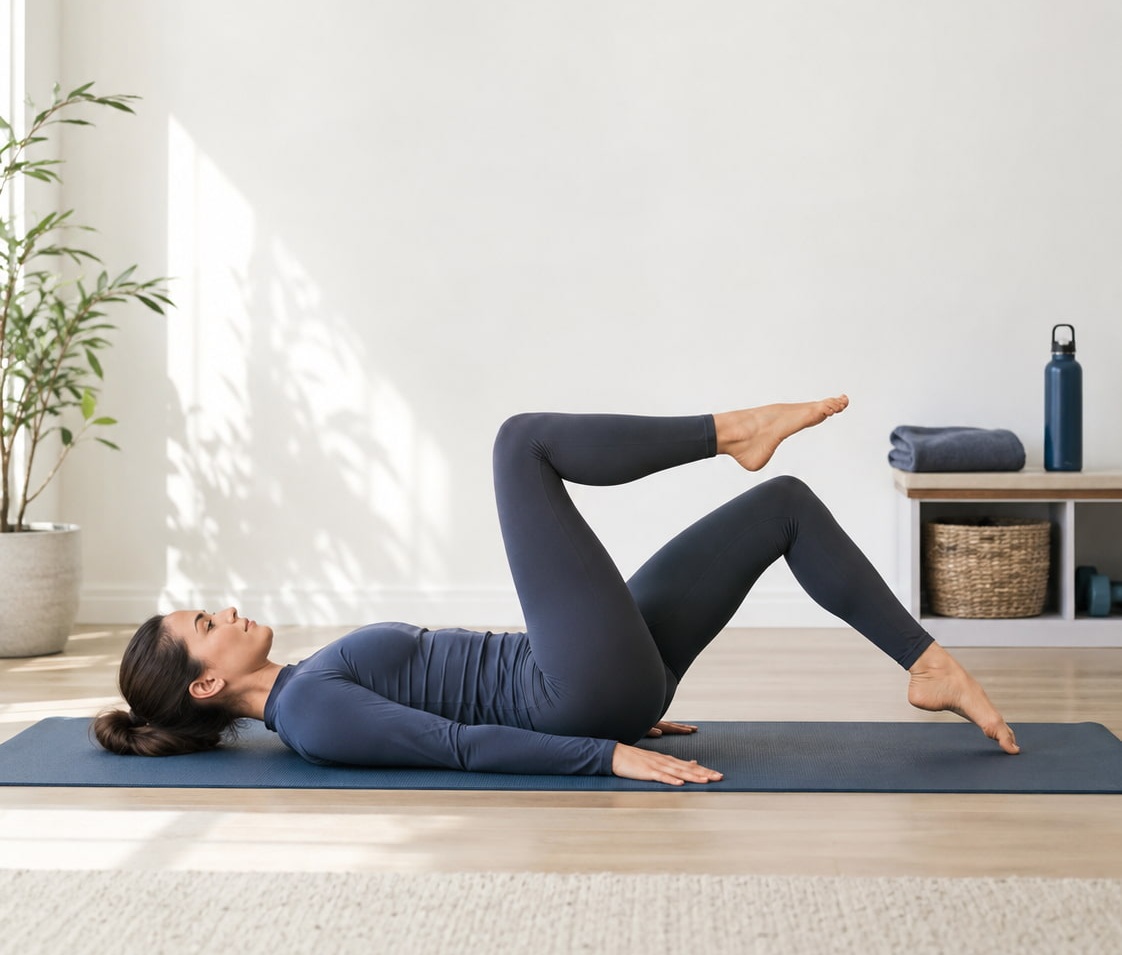
The routine is designed for beginners, but each exercise includes a simple way to reduce or increase the difficulty. Move slowly, breathe continuously, and prioritize control over completing a specific number of repetitions.
20-Minute Mat Pilates Workout Routine at a Glance
Complete one round in the order shown. Allow approximately 10 to 20 seconds to change positions between exercises.
| Exercise | Beginner starting dose | Main focus | |
|---|---|---|---|
| 1 | Pilates rib-cage breathing | 5 controlled breaths | Breathing and core awareness |
| 2 | Pelvic tilt | 8 reps | Pelvic control and spinal mobility |
| 3 | Pelvic curl | 8–10 reps | Glutes, hamstrings, and core |
| 4 | Tabletop toe tap | 6–8 per side | Deep abdominal control |
| 5 | Modified Pilates Hundred | 30–50 arm pumps | Core endurance and breathing |
| 6 | Modified single-leg stretch | 6–8 per side | Core control and coordination |
| 7 | Side-lying leg lift | 8–12 per side | Outer hips and glutes |
| 8 | Quadruped arm and leg reach | 6–8 per side | Core, back, and glutes |
| 9 | Swan prep | 6–8 reps | Upper back and spinal extensors |
| 10 | Swimming prep | 6 per side | Posterior chain and coordination |
| 11 | Modified side plank | 15–20 seconds per side | Obliques, shoulders, and hips |
| 12 | Kneeling Pilates push-up | 6–10 reps | Chest, shoulders, arms, and core |
| 13 | Mermaid stretch | 2–3 breaths per side | Side-body and hip mobility |
The goal is not to race through the routine. Take additional rest when needed to restore your breathing or reposition your body.
Muscles Worked in This Mat Pilates Routine
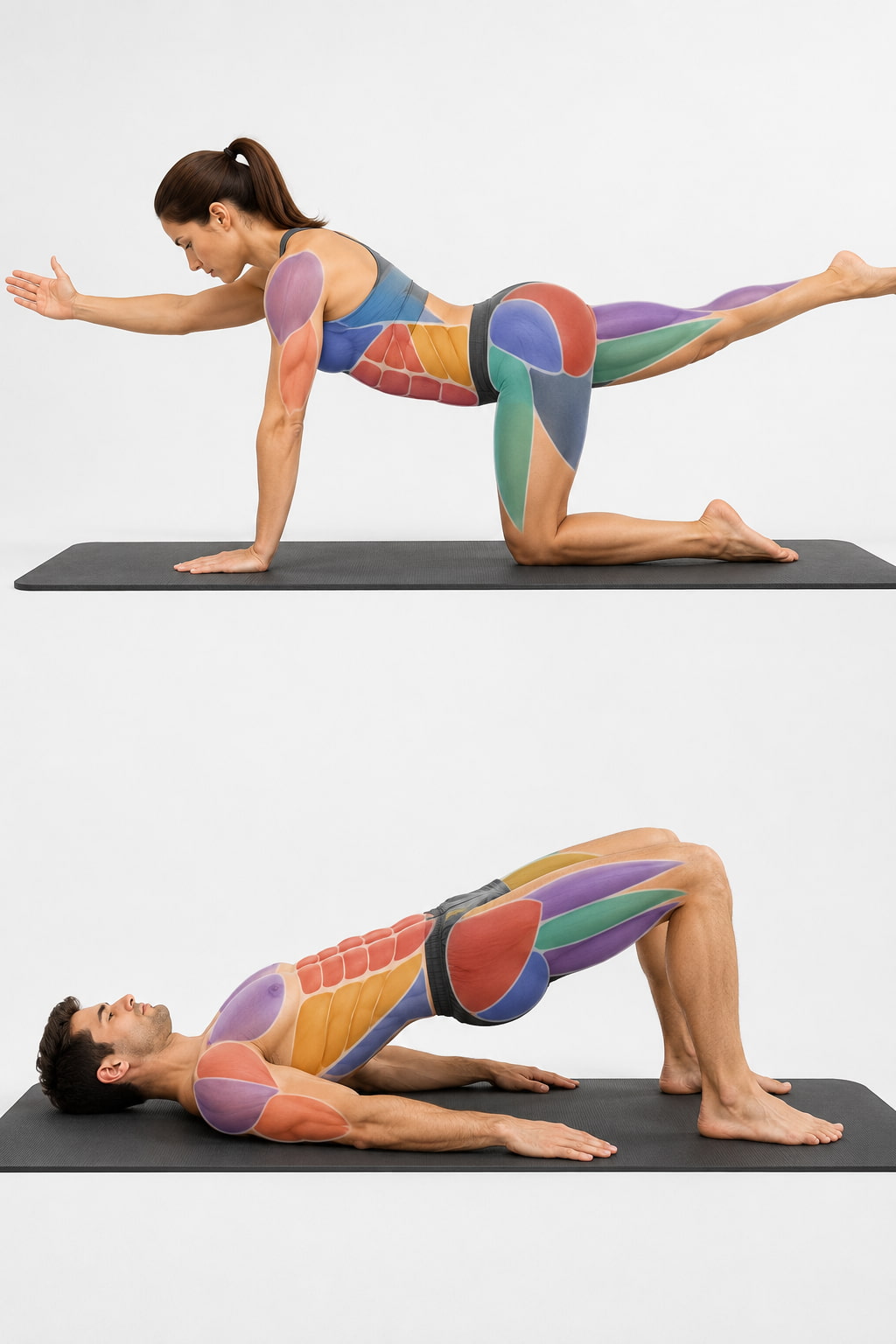
This is a full-body routine rather than an abdominal-only workout.
The main muscles involved include:
- Transverse abdominis and other deep trunk stabilizers
- Rectus abdominis and obliques
- Gluteus maximus and gluteus medius
- Hamstrings and hip flexors
- Spinal extensors and multifidus
- Chest, shoulders, and triceps
- Upper-back and shoulder-blade stabilizers
- Hip abductors and adductors
Research in healthy adults suggests Pilates may help improve muscular endurance, flexibility, and dynamic balance. However, the quality of the evidence has varied, so Pilates should not be presented as a guaranteed solution for posture problems, injuries, weight loss, or medical conditions.
What You Need Before Starting
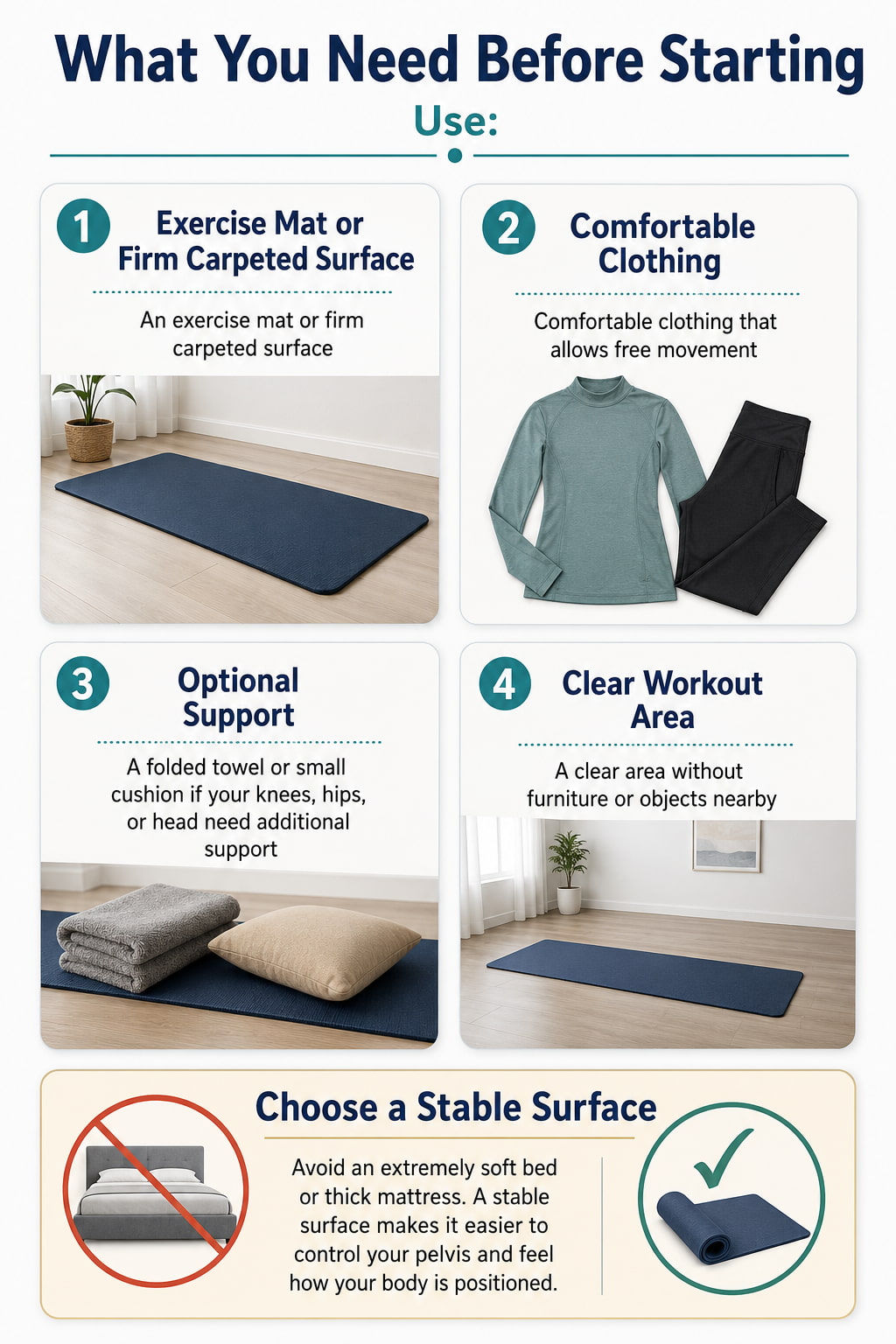
Use:
- An exercise mat or firm carpeted surface
- Comfortable clothing that allows free movement
- A folded towel or small cushion if your knees, hips, or head need additional support
- A clear area without furniture or objects nearby
Avoid an extremely soft bed or thick mattress. A stable surface makes it easier to control your pelvis and feel how your body is positioned.
Pilates Breathing and Body Position
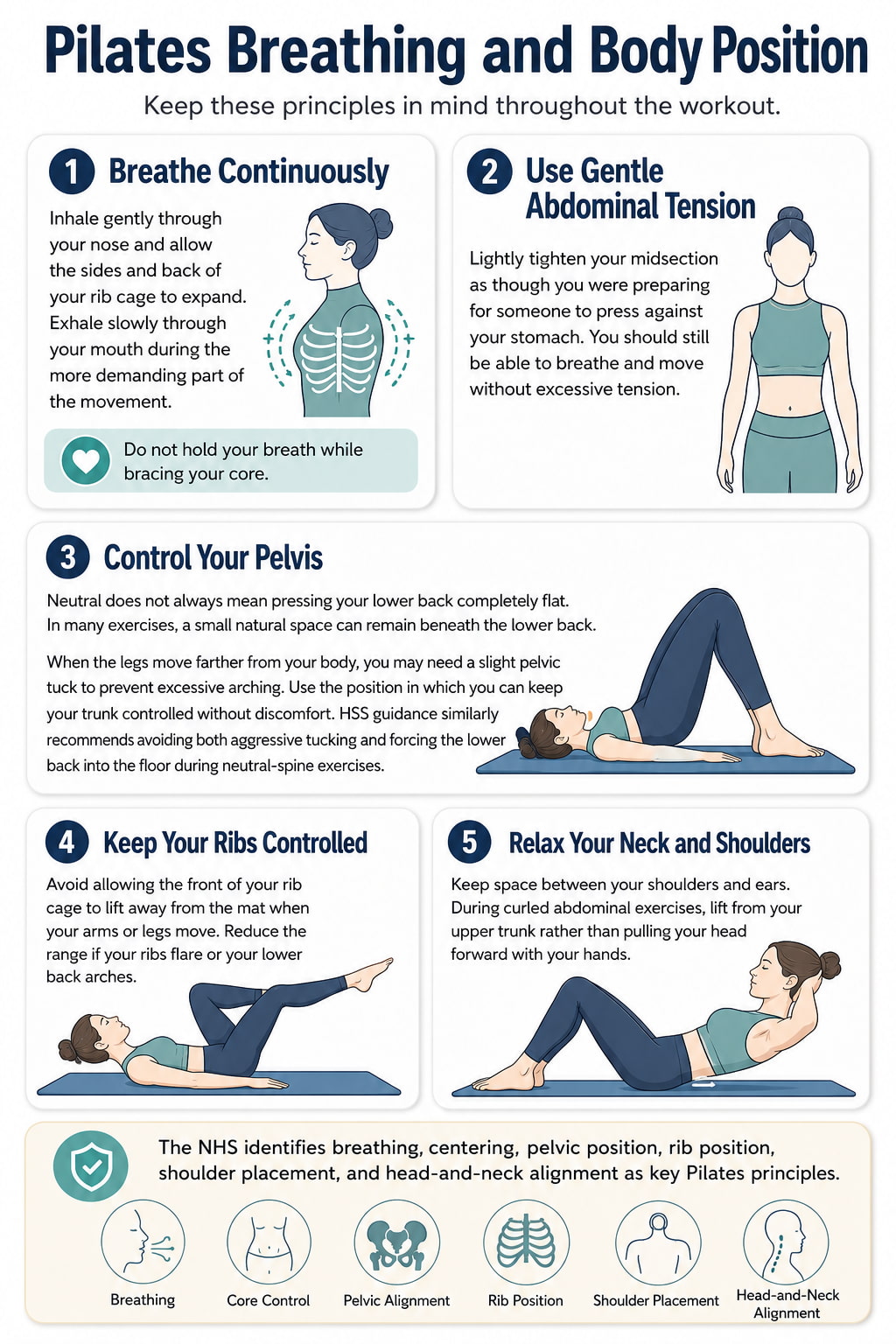
Keep these principles in mind throughout the workout:
- Breathe continuously: Inhale through your nose and exhale during the harder part of each movement.
- Engage your core gently: Brace your midsection without holding your breath or creating excessive tension.
- Control your pelvis: Maintain a comfortable neutral position and use a slight pelvic tuck if your lower back begins to arch.
- Keep your ribs controlled: Reduce the movement range if your ribs lift or your back arches.
- Relax your neck and shoulders: Keep your shoulders away from your ears and avoid pulling your head forward.
The NHS identifies breathing, core control, and proper alignment of the pelvis, ribs, shoulders, head, and neck as key Pilates principles.
20-Minute Mat Pilates Workout Routine
Complete the following exercises in order for one full-body mat Pilates session. Move slowly, breathe continuously, and rest for 10 to 20 seconds when changing positions.
1. Pilates Rib-Cage Breathing
Best for: Preparing your breathing and learning to engage your core without unnecessary tension.
Muscles worked: Diaphragm, deep abdominals, pelvic floor, and other breathing and trunk-control muscles.
Sets, reps, and rest: Take 5 slow breaths. No rest is required.
How to do it:
- Lie on your back with your knees bent and feet flat.
- Place your hands around the sides of your lower ribs.
- Inhale and feel your ribs expand into your hands.
- Exhale slowly while gently tightening your lower abdominals.
- Keep your jaw, neck, and shoulders relaxed.
Common mistakes: Raising the shoulders with each breath, pulling the stomach inward aggressively, holding the breath, or forcing an exaggerated pelvic tuck.
Coaching cue: Expand the ribs outward as you inhale, then narrow them gently as you exhale.
2. Pelvic Tilt
Best for: Learning how to control the pelvis and move the lower spine gently.
Muscles worked: Deep abdominals, glutes, and muscles around the lower spine.
Sets, reps, and rest: Perform 8 slow repetitions.
How to do it:
- Remain on your back with your knees bent.
- Begin with a small natural curve beneath your lower back.
- Exhale and gently tilt your pelvis so your belt line rolls toward your ribs.
- Allow your lower back to move slightly closer to the mat.
- Inhale and return to the middle position without creating a large arch.
Common mistakes: Pushing hard through the feet, squeezing the glutes excessively, lifting the hips, or making the movement larger than necessary.
Progression or regression: Make the movement smaller if you feel lower-back discomfort. Progress by using the same pelvic control during toe taps and other leg movements.
3. Pelvic Curl
Best for: Strengthening the glutes and hamstrings while practicing controlled spinal movement.
Muscles worked: Gluteus maximus, hamstrings, deep abdominals, and spinal stabilizers.
Sets, reps, and rest: Perform 8 to 10 reps, then rest for 15 seconds.
How to do it:
- Lie on your back with your feet hip-width apart and relatively close to your hips.
- Exhale and gently tilt your pelvis backward.
- Press through your feet and lift your hips gradually.
- Stop when your body forms a comfortable line from shoulders to knees.
- Inhale at the top, then exhale as you lower with control.
Common mistakes: Pushing the hips too high, flaring the ribs, placing pressure on the neck, letting the knees spread apart, or dropping quickly.
Easier option: Lift only a few inches from the mat.
Harder option: Pause at the top for two or three seconds without allowing the ribs to rise.
4. Tabletop Toe Tap
Best for: Building abdominal control while the legs move independently.
Muscles worked: Transverse abdominis, rectus abdominis, obliques, and hip flexors.
Sets, reps, and rest: Perform 6 to 8 reps per side.
How to do it:
- Lie on your back and bring one leg at a time into tabletop, with your hips and knees bent.
- Keep your arms beside your body.
- Exhale as you lower one foot toward the floor.
- Lightly tap your toes without transferring weight into the foot.
- Inhale as you return the leg and alternate sides.
Common mistakes: Arching the lower back, moving both legs together unintentionally, lowering too far, or holding the breath.
Easier option: Keep one foot on the floor and lift only one leg at a time.
Harder option: Move the tapping foot slightly farther away while maintaining the same trunk position.
5. Modified Pilates Hundred
Best for: Training core endurance while coordinating breathing with continuous arm movement.
Muscles worked: Deep abdominals, rectus abdominis, obliques, hip flexors, shoulders, and upper back.
Sets, reps, and rest: Complete 30 to 50 arm pumps. Rest for 20 seconds afterward.
How to do it:
- Lie on your back with your knees bent and feet flat.
- Reach your arms long beside your body, slightly above the mat.
- Keep your head down or lift your head and shoulders only if your neck remains comfortable.
- Pump your arms a few inches up and down using small, controlled movements.
- Inhale for several pumps and exhale for several pumps.
Common mistakes: Holding the breath, rapidly flapping the arms, pulling the chin toward the chest, or allowing the lower back to arch.
Easier option: Keep your feet and head on the mat.
Harder option: Bring your legs into tabletop or gradually work toward 100 total pumps.
6. Modified Single-Leg Stretch
Best for: Improving coordination between the trunk and alternating leg movement.
Muscles worked: Abdominals, obliques, hip flexors, and quadriceps.
Sets, reps, and rest: Perform 6 to 8 reps per side.
How to do it:
- Lie on your back and bring your right knee toward your chest.
- Keep your left foot on the floor or slide the left leg forward.
- Hold behind your right thigh without pulling aggressively.
- Exhale as you switch legs slowly.
- Keep your pelvis steady as the legs alternate.
Common mistakes: Pulling on the knee, switching too quickly, rocking the pelvis, or extending the leg so low that the back arches.
Easier option: Keep your head down and slide the extended heel along the floor.
Harder option: Lift your head and shoulders and extend the moving leg above the floor without losing trunk control.
7. Side-Lying Leg Lift
Best for: Strengthening the outer hips and improving lateral pelvic stability.
Muscles worked: Gluteus medius, gluteus minimus, outer hip muscles, obliques, and inner thigh of the supporting leg.
Sets, reps, and rest: Perform 8 to 12 reps per side.
How to do it:
- Lie on one side with your legs long and stacked.
- Support your head with your lower arm or a folded towel.
- Place your top hand on the mat for light balance.
- Lift the top leg without rolling your pelvis backward.
- Lower slowly until the legs nearly touch.
Common mistakes: Turning the toes toward the ceiling, swinging the leg, hiking the top hip, or shortening the waist against the mat.
Easier option: Bend the lower knee for additional stability.
Harder option: Pause at the top or add small controlled circles after the final repetition.
8. Quadruped Arm and Leg Reach
Best for: Training trunk stability while the arms and legs move.
Muscles worked: Deep core, spinal extensors, glutes, shoulders, upper back, and hamstrings.
Sets, reps, and rest: Perform 6 to 8 reps per side.
How to do it:
- Begin on your hands and knees with your hands beneath your shoulders.
- Gently brace your midsection.
- Extend one leg behind you without lifting it higher than your hips.
- Reach the opposite arm forward if you can keep your trunk steady.
- Pause briefly, return slowly, and switch sides.
Common mistakes: Rotating the hips, arching the lower back, lifting the leg too high, shrugging the supporting shoulder, or rushing between sides.
Easier option: Move only one arm or one leg at a time.
Harder option: Hold each extension for three to five seconds.
9. Swan Prep
Best for: Strengthening the upper back and practicing controlled spinal extension.
Muscles worked: Spinal extensors, upper back, rear shoulders, glutes, and deep core.
Sets, reps, and rest: Perform 6 to 8 reps.
How to do it:
- Lie face down with your legs comfortably apart.
- Place your hands beside your lower ribs or slightly farther forward.
- Gently lengthen through the top of your head.
- Lift your head and upper chest a small distance using your back muscles.
- Lower slowly without collapsing.
Common mistakes: Pushing forcefully with the hands, throwing the head backward, squeezing the glutes excessively, or trying to create a large backbend.
Easier option: Keep your hands off the floor and lift only your head and upper chest slightly.
Coaching cue: Think about moving forward and upward, not bending sharply backward.
10. Swimming Prep
Best for: Training the muscles along the back of the body and improving opposite-side coordination.
Muscles worked: Spinal extensors, glutes, hamstrings, shoulders, and upper back.
Sets, reps, and rest: Perform 6 controlled reps per side.
How to do it:
- Remain face down with your arms reaching forward.
- Keep your forehead close to the mat.
- Gently tighten your abdominals.
- Lift your right arm and left leg a small distance.
- Lower with control, then switch sides.
Common mistakes: Lifting too high, arching mainly through the lower back, moving quickly, or holding the breath.
Easier option: Lift only an arm or only a leg.
Harder option: Alternate sides continuously while keeping the movement small and controlled.
11. Modified Side Plank
Best for: Strengthening the obliques, shoulders, and outer hips.
Muscles worked: Internal and external obliques, transverse abdominis, gluteus medius, shoulders, and upper back.
Sets, reps, and rest: Hold for 15 to 20 seconds per side.
How to do it:
- Lie on your side with your elbow beneath your shoulder.
- Bend your knees and stack or stagger them comfortably.
- Press through your forearm and knees.
- Lift your hips until your body forms a straight line from head to knees.
- Breathe normally, then lower with control.
Common mistakes: Placing the elbow too far from the shoulder, sinking into the supporting shoulder, rotating the chest downward, or holding the breath.
Easier option: Keep your lower hip on the mat and perform a small side-body lift.
Harder option: Straighten the legs and support yourself from your feet.
12. Kneeling Pilates Push-Up
Best for: Adding upper-body pushing strength to a mat-based routine.
Muscles worked: Chest, triceps, front shoulders, serratus anterior, and core.
Sets, reps, and rest: Perform 6 to 10 reps.
How to do it:
- Begin on your hands and knees.
- Walk your hands forward until your body forms a straight line from head to knees.
- Place your hands slightly wider than shoulder-width.
- Bend your elbows and lower your chest toward the mat.
- Press the floor away and return without allowing your lower back to sag.
Common mistakes: Dropping the hips, leading with the head, shrugging the shoulders, flaring the elbows directly outward, or using a very small uncontrolled range.
Easier option: Perform the push-up against a wall, countertop, or sturdy bench.
Harder option: Progress to a full push-up from your toes.
13. Mermaid Stretch
Best for: Cooling down and gently lengthening the side of the trunk.
Muscles worked: This is primarily a mobility exercise for the obliques, latissimus dorsi, intercostals, shoulders, and hips.
Sets, reps, and rest: Hold for 2 to 3 relaxed breaths per side.
How to do it:
- Sit in a comfortable cross-legged, kneeling, or side-sitting position.
- Place one hand on the floor beside you.
- Reach the opposite arm overhead.
- Lean gently toward the supporting hand without rotating your chest downward.
- Breathe into the open side of your rib cage and repeat on the other side.
Common mistakes: Forcing the range, lifting both hips, collapsing forward, or shrugging the overhead shoulder.
Easier option: Sit on a folded towel or perform the stretch while seated in a chair.
Common Mat Pilates Mistakes
Moving too quickly
Pilates movements should be controlled. Slowing down makes it easier to notice when your pelvis rotates, your ribs lift, or momentum replaces muscular effort.
Choosing too large a range
Lowering a leg close to the floor is not automatically better. Stop the movement where you can still control your back and pelvis.
Pulling on your neck
During curled positions, your hands should support your head rather than drag it forward. Keep your head down when your neck tires.
Holding your breath
Use a steady exhale through the difficult part of each repetition. Reduce the exercise difficulty if you cannot breathe comfortably.
Doing every exercise at the hardest level
A regression is not a failed repetition. It is the correct choice when it lets you maintain alignment, breathing, and control.
Treating the routine as only an abdominal workout
A balanced mat Pilates session should also include hip, glute, back, shoulder, and upper-body exercises.
How Often Should You Do This Routine?
Beginners can perform this routine two or three times per week, ideally with at least one easier day between demanding sessions.
Use an effort level of approximately 5 to 7 out of 10. The final repetitions should require concentration, but your breathing and body position should remain controlled.
Progress when you can complete every exercise without:
- Holding your breath
- Shaking excessively
- Losing pelvic or rib control
- Feeling strain in your neck
- Rushing the final repetitions
- Experiencing joint pain
The American College of Sports Medicine emphasizes that resistance programs should match the individual’s abilities, goals, enjoyment, and safety. Its updated guidance also recognizes bodyweight exercises and home-based routines as effective training options.
How to Progress the Mat Pilates Workout Routine
Change only one part of the routine at a time.
Weeks 1 and 2
- Complete one round.
- Use the easier variations.
- Perform the lower end of each repetition range.
- Focus on breathing and positioning.
Weeks 3 and 4
- Add two repetitions to selected exercises.
- Increase plank holds by five seconds.
- Use tabletop legs during the Hundred if controlled.
- Extend the moving leg farther during toe taps.
Week 5 and beyond
Choose one progression:
- Complete a second round of four to six exercises.
- Add a light resistance band to hip exercises.
- Progress from kneeling to full side planks or push-ups.
- Increase holds gradually.
- Add a separate strength workout using squats, rows, hinges, and loaded carries.
Do not progress by moving faster. Increase range, repetitions, resistance, or exercise difficulty while preserving control.
How to Combine Pilates With Other Exercise
Mat Pilates can contribute to your weekly muscle-strengthening activity, particularly when the exercises become challenging enough to fatigue the working muscles. However, this routine provides limited pulling resistance and may not offer enough load for continued lower-body strength or muscle growth.
A balanced weekly plan could include:
- Monday: 20-minute mat Pilates routine
- Tuesday: Brisk walking or cycling
- Wednesday: Full-body resistance workout
- Thursday: Rest or gentle mobility
- Friday: 20-minute mat Pilates routine
- Saturday: Walking, swimming, or another aerobic activity
- Sunday: Rest
Current US physical activity guidance recommends that adults work toward 150 to 300 minutes of moderate-intensity aerobic activity per week and perform muscle-strengthening activity on at least two days. Short sessions still count toward the overall weekly total.
Mat Pilates Safety Tips
This general routine is intended for adults who are in reasonably good health and can move between the floor and standing safely.
Speak with an appropriate healthcare professional before starting when you:
- Are pregnant or recently gave birth
- Recently had surgery or a significant health event
- Have an injury or health condition that affects exercise
- Are unsure whether floor exercises are appropriate
- Have significant osteoporosis or balance limitations
- Experience persistent neck, back, hip, or joint symptoms
The NHS advises stopping exercise immediately if it causes pain or makes you feel unwell.
Stop and seek professional help if you experience sharp pain, numbness, dizziness, chest pain, unusual shortness of breath, weakness, or symptoms that continue after you stop exercising.
Frequently Asked Questions
Is 20 minutes of mat Pilates enough?
Twenty minutes is enough for a focused beginner session, especially when you move with control and perform it consistently. Over time, you can increase repetitions, use harder variations, or add a second round.
Can beginners do mat Pilates every day?
A short breathing or mobility session may be appropriate on most days. However, beginners usually benefit from performing challenging strength-focused Pilates two to four times per week and allowing tired muscles to recover.
Does mat Pilates build muscle?
Mat Pilates can strengthen muscles and improve muscular endurance, particularly in beginners. Building substantial muscle normally requires progressively increasing the resistance or difficulty over time. Additional resistance training may be needed when bodyweight variations become easy.
Can mat Pilates help with weight loss?
Mat Pilates can contribute to overall physical activity, but it does not directly remove fat from the stomach or another specific area. Changes in body weight depend on total activity, nutrition, recovery, and long-term energy balance.
Should my lower back stay flat during Pilates?
Not during every exercise. A small natural curve may be appropriate in neutral-spine positions. During exercises with both legs raised, a slight pelvic tuck may help some people prevent excessive arching. Use the position that allows controlled movement without pain.
What should I do if my neck hurts during abdominal exercises?
Place your head on the mat, reduce the number of repetitions, or support your head with a folded towel. Avoid pulling your chin forcefully toward your chest. Stop the exercise if discomfort continues.
Is mat Pilates harder than reformer Pilates?
Neither form is always harder. Mat Pilates relies heavily on body weight and may provide less assistance, while a reformer can either support a movement or add resistance through its springs. Difficulty depends on the exercise, setup, and individual experience.
Conclusion
A useful mat Pilates workout routine does not need dozens of complicated exercises. Begin with one controlled 20-minute round, use modifications when needed, and focus on breathing, pelvic stability, and smooth movement.
Practice the routine two or three times per week. Once the basic versions feel steady, progress gradually by adding repetitions, longer holds, resistance, or more challenging variations.
References
- NHS: Pilates Video for Beginners
- NHS Cambridgeshire and Peterborough: Key Elements of Pilates
- Hospital for Special Surgery: Pilates and Neutral-Spine Guidance
- American College of Sports Medicine: Updated Resistance Training Guidelines
- US Office of Disease Prevention and Health Promotion: Physical Activity Guidelines
- PubMed: Systematic Review of Pilates in Healthy People
This content is for informational purposes only and is not a substitute for medical advice.
1 thought on “Mat Pilates Workout Routine: 20-Minute Beginner Plan”