
The dumbbell front raise is a shoulder exercise that primarily trains the anterior deltoids at the fronts of your shoulders. It is most useful as light, controlled accessory work when your program needs more direct front-delt training.
Front raises are not essential for everyone. Shoulder presses, incline presses, and other pressing exercises already train the anterior deltoids, so the exercise should complement your existing routine rather than automatically being added to every shoulder workout. Research indexed by the National Library of Medicine found substantial anterior-deltoid activity during the shoulder press.
This guide explains proper dumbbell front raise form, the muscles worked, suitable weight and repetition ranges, common mistakes, useful variations, and how to program the exercise without adding unnecessary shoulder volume.
Dumbbell Front Raise at a Glance
| Training detail | Recommendation |
|---|---|
| Best for | Direct anterior-deltoid accessory training |
| Primary muscle | Anterior deltoid |
| Main assisting muscle | Clavicular portion of the pectoralis major |
| Supporting muscles | Rotator cuff, trapezius, serratus anterior, forearms, and core |
| Equipment needed | Two dumbbells |
| Difficulty | Beginner-friendly, but easy to perform with momentum |
| Suggested starting range | 2–3 sets of 8–15 repetitions |
| Rest between sets | 60–90 seconds |
| Typical frequency | 1–2 times per week when additional front-delt work is needed |
| Effort | Finish with approximately 2–3 controlled repetitions remaining |
| Standard range of motion | Raise the dumbbells to approximately shoulder height |
| Workout placement | After compound pressing exercises |
What Is a Dumbbell Front Raise?
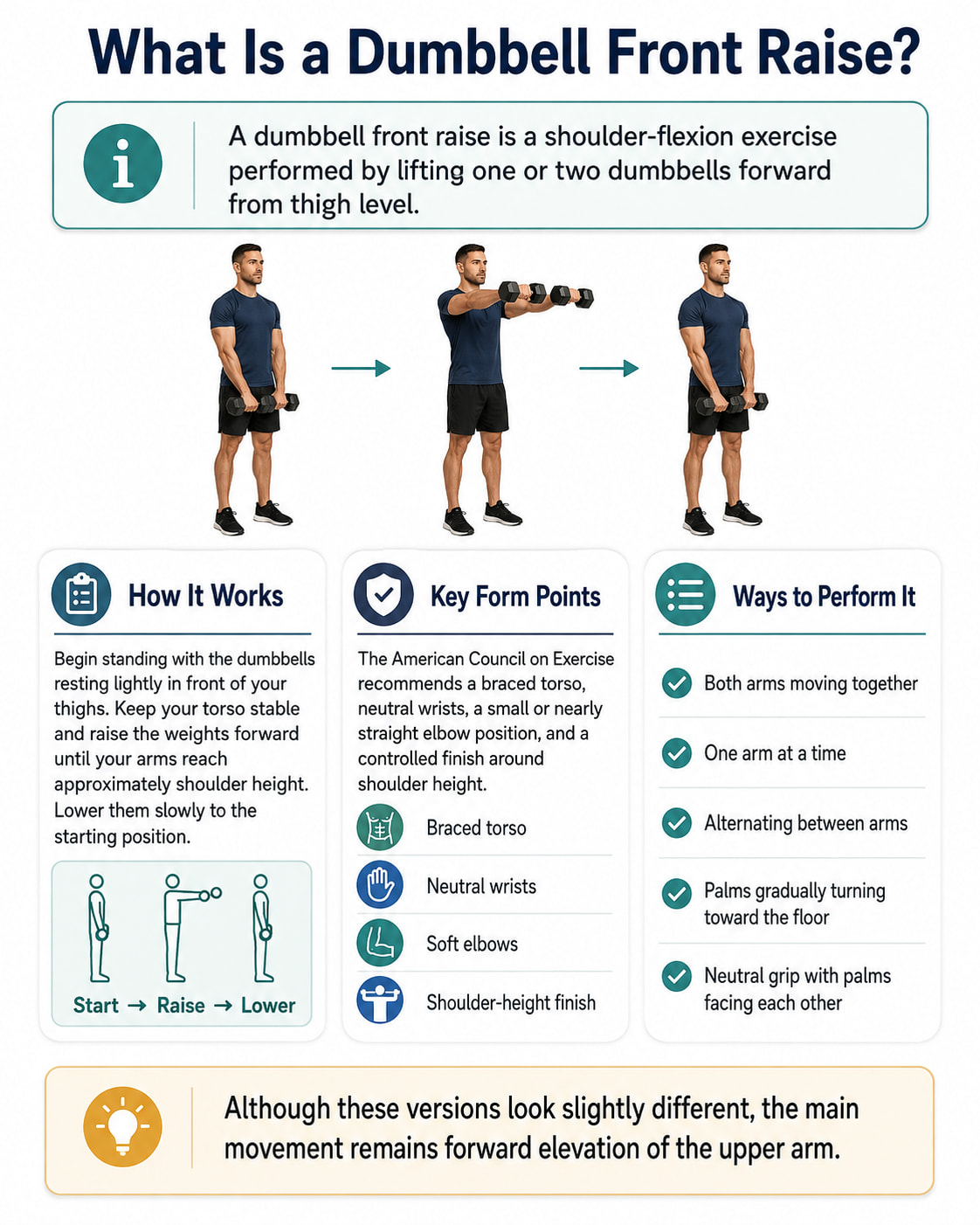
A dumbbell front raise is a shoulder-flexion exercise performed by lifting one or two dumbbells forward from thigh level.
You normally begin standing with the dumbbells resting lightly in front of your thighs. Keeping your torso stable, you raise the weights in front of your body until your arms reach approximately shoulder height. You then lower them slowly to the starting position.
The American Council on Exercise recommends a braced torso, neutral wrists, a small or nearly straight elbow position, and a controlled finish around shoulder height.
The exercise can be performed in several ways:
- Both arms moving together
- One arm at a time
- Alternating between arms
- With the palms gradually turning toward the floor
- With a neutral grip and the palms facing each other
Although these versions look slightly different, the main movement remains forward elevation of the upper arm.
Dumbbell Front Raise Muscles Worked
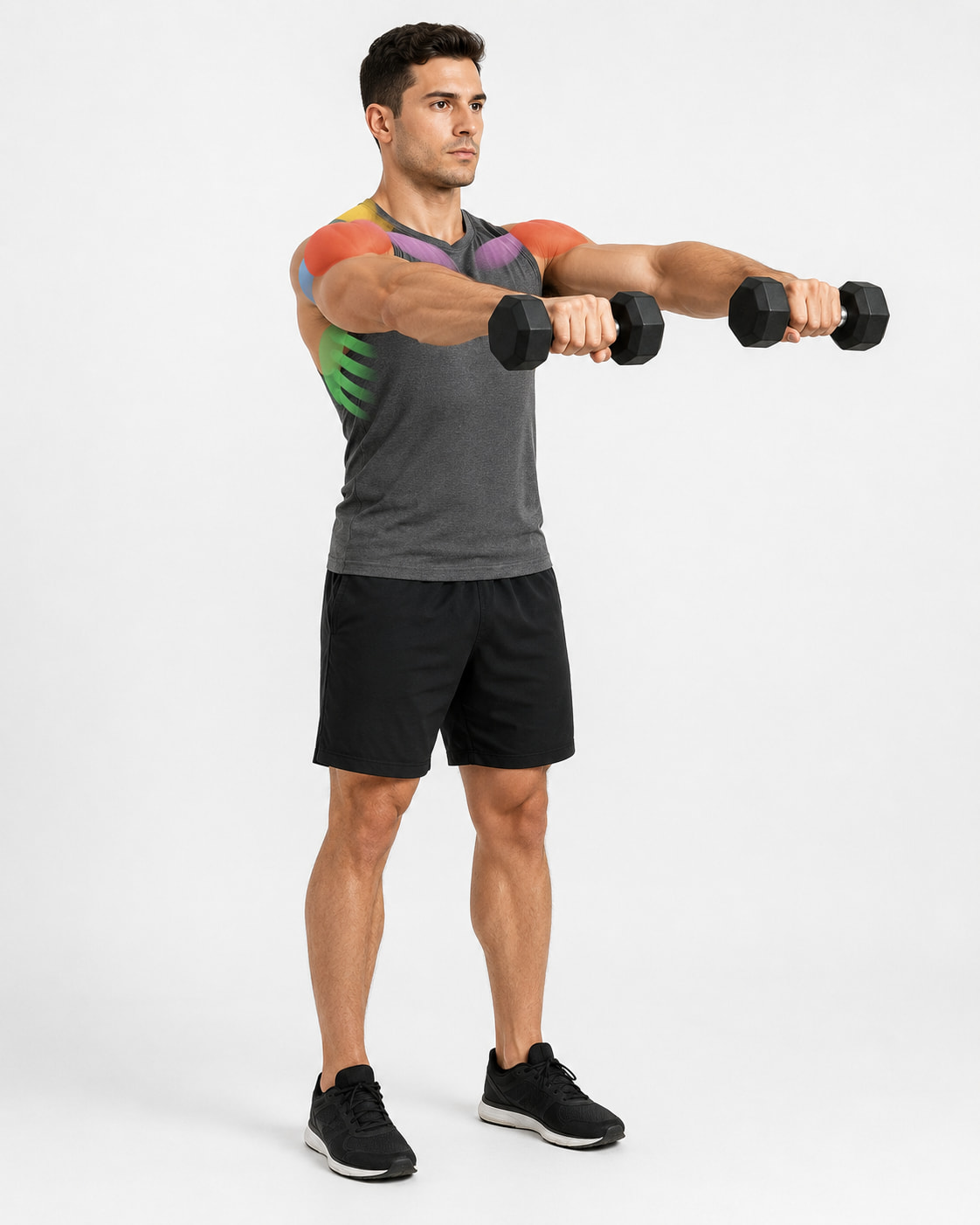
Anterior Deltoids
The anterior deltoids are the front portions of the shoulder muscles. They are the primary target of the dumbbell front raise and help lift the upper arms forward.
A small electromyography study published in the International Journal of Environmental Research and Public Health involving 10 competitive male bodybuilders found that the frontal raise produced strong anterior-deltoid activity compared with the lateral-raise variations tested.
Electromyography measures electrical activity during an exercise. It helps identify which muscles are active, but it does not prove that an exercise will produce greater long-term muscle growth than every alternative.
Clavicular Pectoralis Major
The clavicular portion of the pectoralis major is the upper section of the chest muscle. It assists the anterior deltoid as the arm moves forward.
The same frontal-raise study reported substantial pectoralis-major activity during the exercise. This means the upper chest contributes, although the dumbbell front raise should still be treated primarily as a shoulder exercise.
Trapezius and Serratus Anterior
The trapezius and serratus anterior help control the shoulder blades as the arms rise.
Your shoulder blades should not remain completely fixed during a front raise. Normal arm elevation includes upward rotation and other coordinated shoulder-blade movements. A review indexed by the National Library of Medicine found that the serratus anterior and trapezius contribute to these movements during arm elevation.
Begin with your shoulders relaxed and controlled. Avoid an exaggerated shrug, but do not forcefully pin your shoulder blades down throughout the entire repetition.
Rotator Cuff
The rotator-cuff muscles help stabilize the upper-arm bone within the shoulder joint as the dumbbells move.
They are not the main muscles producing the raise, but their stabilizing role helps you maintain a controlled arm path.
Core, Forearms, and Grip
Your abdominal and lower-back muscles resist leaning and excessive spinal movement. Your forearms and hand muscles maintain a secure grip and keep the wrists aligned.
These muscles support the exercise, but they should not become the limiting factor when an appropriate dumbbell weight is used.
Do Front Raises Work the Side and Rear Delts?
The middle and posterior deltoids may contribute to shoulder control, but they are not the main targets.
A complete shoulder program should also include exercises that emphasize the middle and posterior deltoids, such as lateral raises, reverse fly variations, and suitable rowing movements. No single exercise maximally trains every region of the deltoid.
How to Do a Dumbbell Front Raise
Equipment needed: Two light dumbbells.
Sets, reps, and rest: Begin with 2–3 sets of 8–15 repetitions. Rest for 60–90 seconds between sets.
Step-by-Step Instructions
- Stand with your feet approximately hip- to shoulder-width apart. Hold one dumbbell in each hand in front of your thighs.
- Keep your wrists straight and your elbows extended with a small, comfortable bend. Brace your abdominal muscles and keep your ribs positioned over your pelvis.
- Raise the dumbbells forward in a smooth arc. Keep the elbow angle mostly unchanged and avoid using your legs or hips.
- Stop at approximately shoulder height, or earlier if that is the highest position you can control comfortably.
- Lower the dumbbells slowly until they return to the starting position. Begin the next repetition without bouncing them off your thighs.
Exhale as you raise the dumbbells and inhale as you lower them.
Coaching Cue
Lift with your shoulders while keeping the rest of your body quiet.
How High Should You Raise the Dumbbells?
Shoulder height is a practical endpoint for a standard dumbbell front raise.
At the top, your arms will usually be approximately parallel to the floor. You do not need to lift the dumbbells above your head to train the anterior deltoids effectively.
Shoulder height is not a rigid rule for every person. Stop earlier when going higher causes:
- Shoulder discomfort
- Excessive shrugging
- Lower-back arching
- Bent wrists
- A change in elbow position
- Loss of control
Raising slightly above shoulder height is not automatically harmful, but it is rarely necessary for a standard front raise. Use the range you can control without pain or compensation.
Best Grip for Dumbbell Front Raises
Pronated Grip
In the traditional version, the palms face the thighs at the bottom and gradually face the floor as the arms rise.
Keep your wrists neutral rather than allowing them to bend backward or downward.
Neutral Grip
A neutral, or hammer, grip keeps the palms facing each other.
This version may feel more comfortable for some lifters because it avoids forcing the arms into a strongly internally rotated position. However, there is not enough evidence to declare one grip universally best for everyone.
Use the grip that lets you maintain comfortable shoulder movement, straight wrists, and a controlled arm path.
Avoid Forcing a Thumbs-Down Position
Do not deliberately turn your thumbs sharply toward the floor.
The ACE technique guide recommends a slight change toward external rotation as the arms approach shoulder height rather than maintaining an aggressively internally rotated position.
Bilateral vs. Alternating Front Raises
Both Arms Together
Raising both dumbbells at the same time is efficient and creates a balanced challenge for the trunk.
However, it also makes leaning backward more tempting. Reduce the weight when your torso cannot remain stable.
Alternating Arms
Alternating front raises allow you to focus on one repetition at a time. They can be easier for beginners to control.
Keep your torso facing forward. Do not rotate or shift your body toward the working arm.
Single-Arm Repetitions
You can complete all repetitions on one side before changing arms.
This version is useful when you want to concentrate on one arm, but you must resist leaning away from the dumbbell.
None of these versions is automatically superior. Choose the one that produces the best technique and fits your workout.
Benefits of Dumbbell Front Raises
Provides Direct Front-Delt Training
Pressing exercises train several muscles at once. Front raises allow you to add more focused work for the anterior deltoids without making the triceps a major limiting factor.
This can be useful when front-delt development is a specific goal and your existing pressing volume is relatively low.
Requires Minimal Equipment
You need only a pair of dumbbells and enough clear space to lift your arms safely.
Because the arms create a long lever, relatively light dumbbells can provide a meaningful challenge. Adjustable dumbbells are useful, but not required.
Allows Each Arm to Work Independently
Each arm supports its own dumbbell. This can make differences in control, coordination, or range of motion easier to notice.
The exercise does not automatically correct those differences, but it can help you avoid one arm directly moving the other, as may happen with a barbell.
Works in Home and Gym Programs
Front raises do not require a bench, rack, or cable machine. They can be included in home workouts, gym sessions, or short accessory circuits.
Offers Several Easy Modifications
The exercise can be performed standing, seated, bilaterally, or one arm at a time. You can also use a neutral grip or shorten the range when needed.
Limitations of the Dumbbell Front Raise
The dumbbell front raise is a targeted accessory exercise, not a complete shoulder workout.
Its main limitations are:
- It primarily emphasizes the front of the shoulder.
- Pressing exercises may already provide enough front-delt work.
- It does not replace lateral or rear-delt exercises.
- Heavy weights quickly encourage swinging and leaning.
- The exercise may not be appropriate for every person with existing shoulder symptoms.
Research from the American Council on Exercise found higher anterior-deltoid activation during the dumbbell shoulder press than during the other shoulder exercises tested, including the front raise. That does not make front raises ineffective, but it supports evaluating whether you genuinely need additional direct work.
Common Dumbbell Front Raise Mistakes
Using Too Much Weight
A weight that is too heavy usually causes swinging, shrugging, and shortened repetitions.
Reduce the load until you can raise and lower the dumbbells without momentum. Front raises generally require less weight than curls, rows, or presses.
Leaning Backward
Leaning backward changes your body angle and helps move the dumbbells through momentum.
Brace your core, keep your ribs controlled, and stop the set when you can no longer remain upright.
Bouncing the Dumbbells Off the Thighs
The dumbbells may lightly approach the thighs, but they should not rebound into the next repetition.
Pause briefly at the bottom or stop just before contact when bouncing is difficult to avoid.
Bending the Elbows During the Raise
A small elbow bend is acceptable, but the angle should remain mostly unchanged.
Progressively bending the elbows turns part of the movement into a curl and reduces consistency between repetitions.
Raising the Shoulders Toward the Ears
Some natural shoulder-blade movement occurs as your arms rise. The mistake is turning the exercise into an aggressive shrug.
Keep your neck relaxed and allow the shoulder blades to move naturally without forcing the shoulders toward your ears.
Dropping the Dumbbells
The lowering phase is part of the exercise.
Take approximately two to three seconds to lower the weights. Reduce the load when you cannot control the descent.
Adding Front Raises Without Reviewing Pressing Volume
Front raises are often added automatically to shoulder workouts that already contain overhead presses, incline presses, push-ups, or bench presses.
Review your total training before adding more direct front-delt work. More exercises do not always create a better-balanced program.
Dumbbell Front Raise Progressions and Regressions
Beginner Regressions
Use lighter dumbbells: This is the simplest and usually the most effective regression.
Raise one arm at a time: Alternating repetitions can make torso control easier.
Sit against an upright bench: The bench reduces the opportunity to use leg drive or large body movements.
Use a shorter range: Raise the dumbbells only as high as you can control comfortably.
Practice without weights: Rehearse the arm path before adding resistance.
Progressions
Add repetitions: Move from the lower to the upper end of your target range before increasing weight.
Slow the lowering phase: Use a controlled three-second descent.
Pause near shoulder height: Hold the top position for one second without shrugging.
Raise both arms together: Progress from alternating to bilateral repetitions when you can keep your torso stable.
Increase the load gradually: Use the smallest available weight increase while preserving the same technique.
A heavier dumbbell is not a progression when it causes swinging, leaning, or a shorter range.
Sets, Reps, Weight, and Rest
For most lifters, a practical starting point is:
- Sets: 2–3
- Repetitions: 8–15
- Rest: 60–90 seconds
- Frequency: 1–2 times per week when needed
- Effort: Stop with approximately 2–3 controlled repetitions remaining
- Tempo: About one to two seconds up and two to three seconds down
Choose a weight that lets you complete at least eight smooth repetitions without leaning or swinging.
When you can perform all planned sets at the top of your repetition range with consistent form, increase the dumbbells by the smallest practical amount. Because a front raise uses a long arm lever, even a small weight increase can feel significant.
The American College of Sports Medicine emphasizes consistent resistance training, individualization, and appropriate weekly volume rather than unnecessarily complicated programming. Its 2026 guidance also reports that reaching momentary muscular failure is not required for the average healthy adult.
How Often Should You Do Dumbbell Front Raises?
One or two sessions per week is usually enough when front raises are included as an accessory exercise.
However, frequency should not be considered separately from your other exercises. The anterior deltoids also work during:
- Dumbbell shoulder presses
- Barbell overhead presses
- Incline presses
- Flat chest presses
- Push-ups
- Dips
The general recommendation to train the major muscle groups at least twice weekly refers to total training, not to performing every individual exercise twice per week.
A person performing several weekly pressing exercises may need little or no direct front-raise work. Someone with limited pressing volume may have more room for it.
Where to Place Front Raises in a Workout
Perform dumbbell front raises after your main compound exercises.
A sensible exercise order is:
- Main chest or shoulder press
- Rowing or pulling exercise
- Lateral or rear-delt exercise
- Dumbbell front raise
- Optional arm work
Doing front raises first may fatigue the anterior deltoids and reduce performance during heavier pressing exercises. An exception is a workout in which the front raise is the main exercise you specifically want to improve.
Sample Balanced Shoulder Workout
Perform this workout once or twice per week, depending on the rest of your training schedule.
1. Dumbbell Shoulder Press
- 3 sets of 6–10 repetitions
- Rest 90–120 seconds
- Finish with 2–3 controlled repetitions remaining
2. Dumbbell Lateral Raise
- 3 sets of 10–15 repetitions
- Rest 60–90 seconds
3. Dumbbell Reverse Fly
- 3 sets of 10–15 repetitions
- Rest 60–90 seconds
4. Dumbbell Front Raise
- 2 sets of 10–15 repetitions
- Rest 60–90 seconds
- Include only when additional front-delt work is appropriate
Do not treat these two front-raise sets as separate from the shoulder presses. Both exercises contribute to your total anterior-deltoid workload.
Progression
Begin by adding controlled repetitions. Once you reach the top of the repetition range for every set without losing form, increase the load slightly and return to the lower end of the range.
Front Raise vs. Lateral Raise vs. Shoulder Press
| Exercise | Main movement | Primary emphasis | Typical role |
|---|---|---|---|
| Dumbbell front raise | Shoulder flexion | Anterior deltoids | Direct front-delt accessory |
| Dumbbell lateral raise | Shoulder abduction | Middle deltoids | Direct side-delt accessory |
| Dumbbell shoulder press | Vertical pressing | Anterior and middle deltoids, triceps | Compound shoulder strength exercise |
A front raise and lateral raise are not interchangeable. The front raise moves the arms forward and emphasizes the anterior deltoids. The lateral raise moves the arms outward and places more emphasis on the middle deltoids.
The shoulder press trains several muscles simultaneously and generally allows greater loading. Research has reported high anterior-deltoid activity during the shoulder press, which is one reason front raises may be optional in pressing-heavy programs.
Safety Considerations
Warm up your shoulders and upper body before using challenging resistance. Begin with one or two light practice sets to confirm that the movement feels comfortable.
Keep the area around you clear, use secure dumbbells, and avoid lifting near another person or breakable objects.
Stop the exercise and seek appropriate professional help if you experience sharp pain, numbness, dizziness, chest pain, or other unusual symptoms. Do not continue by shortening the range or using momentum simply to work through shoulder pain.
People with an existing shoulder injury, recent surgery, unexplained weakness, or ongoing pain should seek guidance from a qualified healthcare professional before adding front raises.
Frequently Asked Questions
Are Dumbbell Front Raises Necessary?
No. They are optional accessory exercises.
Front raises can be useful when you need additional anterior-deltoid work. They may be unnecessary when your routine already includes substantial shoulder pressing, incline pressing, or other front-delt-dominant exercises.
How Heavy Should Dumbbell Front Raises Be?
Use a weight you can lift for 8–15 repetitions without swinging, leaning backward, shrugging excessively, or dropping the dumbbells.
Most people should use considerably less weight for front raises than for shoulder presses or rows.
Should Your Arms Be Completely Straight?
Keep your elbows extended with a small, comfortable bend.
Do not forcefully lock the elbows. More importantly, keep the elbow angle mostly unchanged throughout the repetition.
Should the Dumbbells Touch at the Top?
No. The dumbbells do not need to touch.
Keep them approximately shoulder-width apart or follow the natural path that lets your shoulders and wrists remain comfortable.
Is a Neutral Grip Better Than a Palms-Down Grip?
Neither grip is universally best.
A neutral grip may feel more comfortable for some people, while others prefer gradually turning the palms toward the floor. Choose the version that allows controlled movement without wrist or shoulder discomfort.
Can You Perform Front Raises Every Day?
Daily front raises are usually unnecessary.
Your anterior deltoids also need to recover from pressing exercises. Count all shoulder and chest pressing when deciding how frequently to train the front delts.
Why Do I Feel Front Raises in My Upper Traps?
The upper trapezius helps control the shoulder blades, so some involvement is normal.
However, the weight may be too heavy if the exercise becomes an exaggerated shrug or you cannot keep your neck relaxed. Lower the load and focus on raising the arms without pulling the shoulders aggressively toward the ears.
Conclusion
The dumbbell front raise is a simple way to add direct anterior-deltoid work, but it should be used selectively.
Choose light dumbbells, keep your torso still, maintain neutral wrists, and raise the weights only as high as you can control. Progress through better repetitions and small weight increases rather than momentum.
Most importantly, consider your entire program. Front raises can complement a balanced shoulder routine, but they should not replace pressing, lateral-delt work, or rear-delt training.
This content is for informational purposes only and is not a substitute for medical advice.
References
- American Council on Exercise. Front Raise Exercise Guide.
View the ACE Front Raise Exercise Guide - Coratella G, Tornatore G, Longo S, Esposito F, Cè E. An Electromyographic Analysis of Lateral Raise Variations and Frontal Raise in Competitive Bodybuilders. 2020.
Read the Full Study on PubMed Central - Campos YAC, Vianna JM, Guimarães MP, et al. Different Shoulder Exercises Affect the Activation of Deltoid Portions in Resistance-Trained Individuals. 2020.
Read the Full Study on PubMed Central - American College of Sports Medicine. Resistance Training Prescription for Muscle Function, Hypertrophy, and Physical Performance in Healthy Adults. 2026.
Read the ACSM Resistance-Training Position Stand - Escamilla RF, Yamashiro K, Paulos L, Andrews JR. Shoulder Muscle Activity and Function in Common Shoulder Rehabilitation Exercises. 2009.
View the Study on PubMed - Phadke V, Camargo PR, Ludewig PM. Scapular and Rotator Cuff Muscle Activity During Arm Elevation: A Review of Normal Function and Alterations With Shoulder Impingement. 2009.
View the Review on PubMed