The dumbbell upright row is a standing upper-body exercise that primarily trains the side deltoids and upper trapezius. It can be a useful shoulder and upper-back accessory when you use a controlled weight, allow the dumbbells to follow a comfortable path, and stop at or below shoulder height.
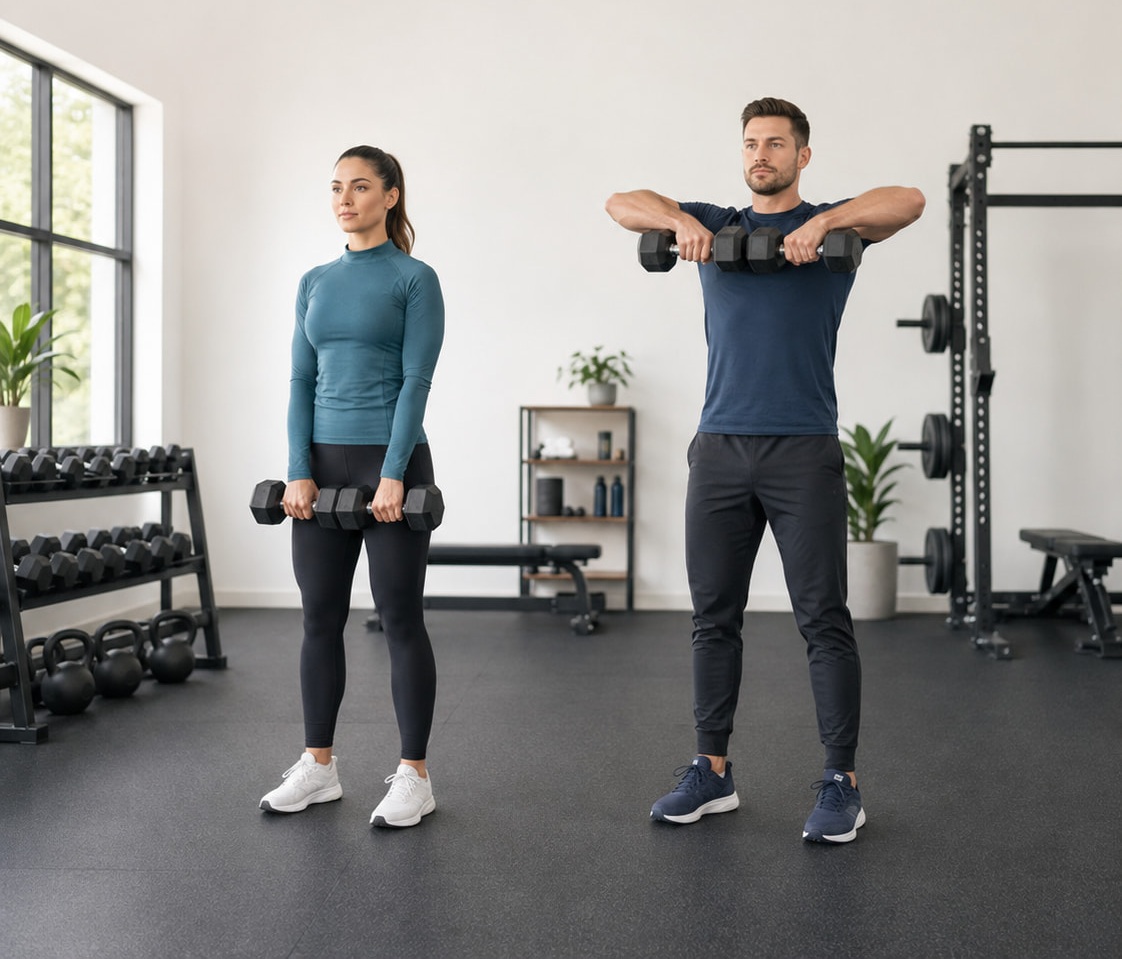
The exercise is not essential for building strong shoulders, and it does not feel comfortable for everyone. This guide explains how to perform the dumbbell upright row, which muscles it works, how high to pull, common mistakes, shoulder-friendly modifications, and how to program it effectively.
Dumbbell Upright Row at a Glance
| Training detail | Recommendation |
|---|---|
| Best for | Accessory shoulder and upper-trapezius training |
| Primary muscles | Lateral deltoids and upper trapezius |
| Assisting muscles | Other deltoid regions, biceps, brachialis, forearms, and grip muscles |
| Equipment needed | Two dumbbells |
| Recommended range | Elbows at or below shoulder height |
| Sets and reps | 2–3 sets of 8–15 repetitions |
| Rest | 60–90 seconds |
| Effort | Finish with about 2–3 repetitions in reserve |
| Frequency | 1–2 times per week |
| Difficulty | Beginner to intermediate |
What Is a Dumbbell Upright Row?
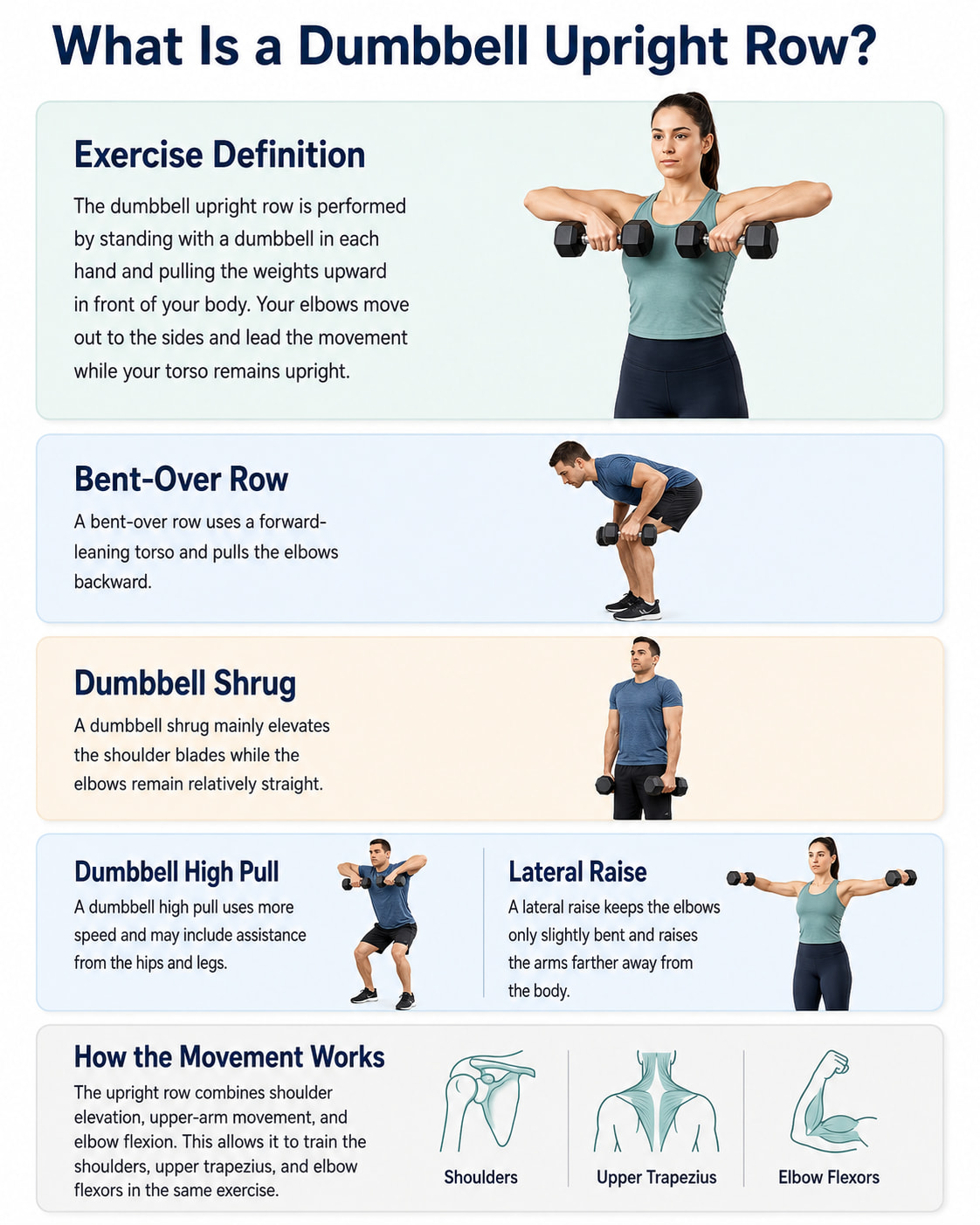
The dumbbell upright row is performed by standing with a dumbbell in each hand and pulling the weights upward in front of your body. Your elbows move out to the sides and lead the movement while your torso remains upright.
It differs from several exercises that may look similar:
- A bent-over row uses a forward-leaning torso and pulls the elbows backward.
- A dumbbell shrug mainly elevates the shoulder blades while the elbows remain relatively straight.
- A dumbbell high pull uses more speed and may include assistance from the hips and legs.
- A lateral raise keeps the elbows only slightly bent and raises the arms farther away from the body.
The upright row combines shoulder elevation, upper-arm movement, and elbow flexion. This allows it to train the shoulders, upper trapezius, and elbow flexors in the same exercise.
Dumbbell Upright Row Muscles Worked
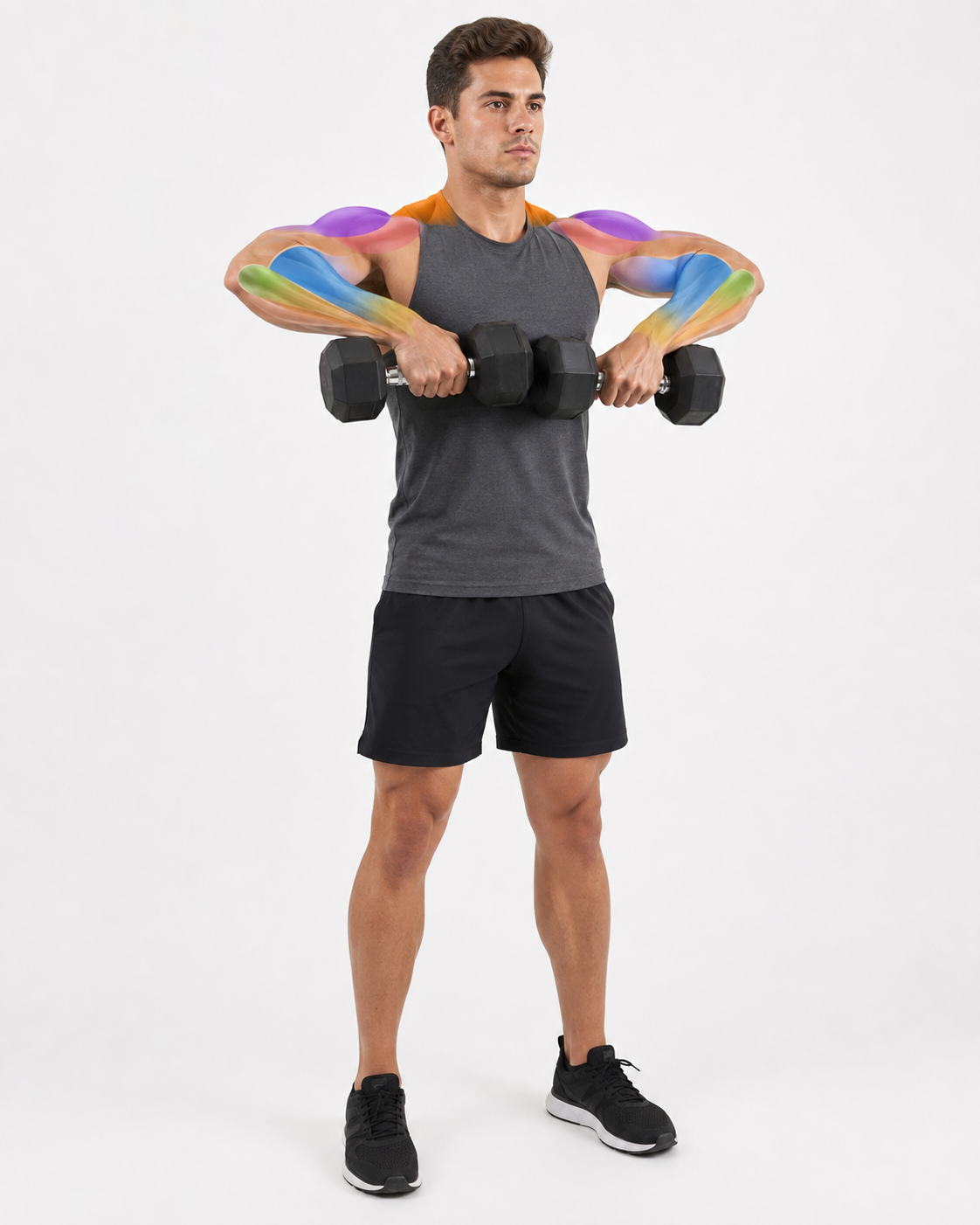
- Lateral deltoids: One of the main muscles worked. They help raise your upper arms out to the sides as your elbows move upward.
- Upper trapezius: Helps elevate and control the shoulder blades during the pull. Avoid turning the movement into an exaggerated shrug.
- Front and rear deltoids: Assist the movement, with their involvement changing based on grip width, elbow path, and range of motion.
- Biceps and brachialis: Assist by bending the elbows as the dumbbells rise.
- Forearms and grip muscles: Help hold the dumbbells and keep your wrists stable.
A small Journal of Strength and Conditioning Research study found that wider upright-row grips produced greater deltoid and trapezius activity and less biceps activity than a narrow grip.
Practical tip: Keep the dumbbells around shoulder width or slightly wider rather than pressing them together.
How to Do a Dumbbell Upright Row
Equipment needed: Two matched dumbbells.
Sets, reps, and rest: Start with 2–3 sets of 8–15 repetitions. Rest for 60–90 seconds between sets.
Step-by-Step Instructions
- Stand with your feet approximately hip- to shoulder-width apart.
- Hold one dumbbell in each hand in front of your thighs with your palms facing your body.
- Keep the dumbbells around shoulder width or slightly wider. Wrap your thumbs securely around the handles.
- Stand tall with a small bend in your knees, your ribs controlled, and your abdomen lightly braced.
- Pull your elbows upward and outward. Allow the dumbbells to travel close to the front of your body.
- Stop when your elbows reach approximately shoulder height, or earlier if a lower position feels more comfortable.
- Keep your wrists mostly straight and your hands slightly below your elbows at the top.
- Lower the dumbbells slowly until your arms return to the starting position.
Coaching cue: Lead with your elbows and stop before your shoulders feel crowded.
Breathing
Exhale as you raise the dumbbells and inhale as you lower them. Avoid holding your breath unnecessarily, especially when using a moderate accessory weight.
Dumbbell Upright Row Range of Motion: How High Should You Pull?
Pulling the dumbbells higher does not automatically make the exercise more effective.
For most lifters, the top of the repetition should occur when the elbows are approximately level with the shoulders. The dumbbells will usually finish around the upper chest rather than directly beneath the chin.
You can stop lower if:
- Your shoulders feel pinched or crowded.
- Your wrists begin to bend.
- You need to shrug aggressively to continue.
- Your torso starts leaning backward.
- You lose control of the lowering phase.
A reduced range can still train the intended muscles. Progress should come from better control, more repetitions, or a gradual increase in weight—not from forcing the elbows higher.
Are Dumbbell Upright Rows Safe?
The dumbbell upright row is not automatically harmful, but it is also not appropriate for every shoulder.
The traditional version is sometimes performed with a close grip while pulling the elbows well above the shoulders. This creates a high arm position that may feel uncomfortable for some people.
A small Physical Therapy in Sport study involving 25 healthy men compared several loaded shoulder positions. Under a 4-kilogram load, a shoulder-abduction position using external rotation maintained more space beneath the bony roof of the shoulder than the upright-row position. However, the study measured shoulder space during a single test; it did not track injuries or prove that upright rows inevitably cause pain.
A Strength & Conditioning Journal review recommends keeping the upper arms below approximately 90 degrees of elevation and reducing the range further when the exercise causes symptoms.
Practical Safety Guidelines
- Begin with light dumbbells and learn the movement before adding weight.
- Keep your elbows at or below shoulder height.
- Let each arm follow a natural path instead of forcing the dumbbells together.
- Use a range you can control without pinching, instability, or sharp discomfort.
- Do not use momentum to pull through an uncomfortable position.
Dumbbells allow each hand to move independently, which may make it easier to find a comfortable arm path than with a fixed barbell. However, there is not enough direct research to claim that dumbbell upright rows are always safer than barbell upright rows.
Stop the exercise and seek appropriate professional help if you experience sharp pain, numbness, dizziness, chest pain, sudden weakness, or other unusual symptoms.
Benefits of the Dumbbell Upright Row
Trains the Side Deltoids and Upper Trapezius Together
The exercise combines upper-arm elevation with shoulder-blade movement, allowing you to train two important areas in one movement.
This makes it a practical accessory after a main press or row.
Allows Each Arm to Move Independently
A barbell fixes your hands at one width. Dumbbells allow each arm to follow a slightly different path, which may feel more natural when shoulder mobility or body proportions differ from side to side.
The arms should still move with similar control. Avoid twisting or lifting one elbow substantially higher than the other.
Requires Minimal Equipment
You only need two dumbbells and enough space to stand. The exercise can be used in a commercial gym or a basic home workout.
Provides an Easy-to-Measure Progression
You can progress by:
- Adding repetitions
- Increasing the dumbbell weight gradually
- Slowing the lowering phase
- Adding a short controlled pause
- Improving consistency between both arms
Adds Variety to Shoulder Training
The upright row offers a different resistance pattern from presses, lateral raises, and rear-delt exercises.
However, it should not be treated as complete shoulder training. A balanced routine should normally include a pressing movement, an upper-back or rear-shoulder exercise, and other movements that match your goals and comfort.
Common Dumbbell Upright Row Mistakes
| Common mistake | How to correct it |
|---|---|
| Pulling the elbows far above the shoulders | Stop at shoulder height or lower |
| Trying to touch the dumbbells to the chin | Finish around the upper chest |
| Holding the dumbbells too close together | Allow approximately shoulder-width spacing |
| Using momentum or leaning backward | Reduce the weight and brace your torso |
| Bending the wrists sharply | Keep the wrists neutral and let the elbows lead |
| Letting the dumbbells drift far forward | Keep the weights reasonably close to your body |
| Forcing an aggressive shrug | Allow natural shoulder-blade movement without compressing your neck |
| Dropping the dumbbells quickly | Lower them under control for about 2–3 seconds |
| Continuing through shoulder pain | Stop, reduce the range, or choose another exercise |
Beginner Modifications
Use a Shorter Range of Motion
Raise the dumbbells only until your elbows reach the lower chest or another comfortable height. A shorter range helps you learn the elbow path without forcing the top position.
Perform One Arm at a Time
Hold a light dumbbell in one hand and place your other hand on a stable support. This can help you focus on the movement of one shoulder at a time.
Keep your torso facing forward instead of rotating as you lift.
Use Very Light Dumbbells
The upright row is an accessory movement, not a test of maximum strength. Start lighter than you think you need and increase the weight only after you can control every repetition.
How to Progress the Dumbbell Upright Row
Use a double-progression approach:
- Choose a weight you can lift for at least 8 controlled repetitions.
- Continue using that weight until you can perform all sets for 15 repetitions.
- Keep approximately 2–3 good repetitions in reserve.
- Increase each dumbbell by the smallest practical amount.
- Return to the lower end of the repetition range and build up again.
You can also make the exercise harder without adding weight by using a two- to three-second lowering phase or briefly pausing near the top.
Do not progress by pulling the elbows farther above the shoulders.
Dumbbell Upright Row Alternatives
The best alternative depends on which part of the exercise you want to replace.
Dumbbell Lateral Raise
Best for: Emphasizing the side deltoids with less elbow flexion.
Keep a small bend in the elbows and raise the arms out to the sides. Stop at approximately shoulder height.
This is often the simplest replacement when the upright-row pattern feels uncomfortable.
Dumbbell Shrug
Best for: Emphasizing the upper trapezius.
Hold the dumbbells by your sides and elevate your shoulders under control. Avoid rolling the shoulders in circles.
High-Incline Dumbbell Row
Best for: Training the upper back, rear deltoids, and trapezius with chest support.
Lie chest-down on an incline bench and row with the elbows angled outward. This changes the movement from vertical pulling to a supported horizontal row.
Lateral Raise and Shrug Combination
No single exercise perfectly duplicates both the deltoid and trapezius work of an upright row. Using lateral raises and shrugs as separate exercises is a simple way to train both areas without performing the upright-row movement.
Dumbbell Upright Row Sets, Reps, and Frequency
For most recreational lifters, the upright row works best with moderate repetitions and controlled loading.
A practical starting prescription is:
- Sets: 2–3
- Repetitions: 8–15
- Rest: 60–90 seconds
- Effort: Stop with approximately 2–3 repetitions in reserve
- Frequency: 1–2 times per week
- Tempo: Lift smoothly and lower for about 2–3 seconds
Very heavy sets of three to five repetitions are usually unnecessary for this exercise. As the load becomes too heavy, lifters are more likely to lean backward, swing the dumbbells, bend their wrists, or force the elbows higher.
The American College of Sports Medicine’s 2026 resistance-training guidance emphasizes consistent training, individualized programming, sufficient effort, and gradual progression rather than complicated methods or mandatory training to failure.
Where to Place It in a Workout
Perform the upright row after your main compound exercise, such as a dumbbell shoulder press or upper-body row.
A typical order is:
- Main pressing exercise
- Main rowing or pulling exercise
- Dumbbell upright row
- Smaller shoulder or arm exercises
Placing it later in the workout allows you to train the movement as an accessory without tiring your shoulders before heavier exercises.
Sample Dumbbell Shoulder and Upper-Back Workout
Perform this workout once or twice per week with at least one recovery day between sessions.
| Exercise | Sets and reps | Rest |
|---|---|---|
| Dumbbell shoulder press | 3 × 6–10 | 90–120 seconds |
| One-arm dumbbell row | 3 × 8–12 per side | 90 seconds |
| Dumbbell upright row | 2 × 10–15 | 60–90 seconds |
| Dumbbell reverse fly | 2 × 12–15 | 60 seconds |
Finish most sets with approximately two or three repetitions in reserve. Do not take every exercise to complete muscular failure.
When you reach the top of a repetition range with controlled form, increase the weight by the smallest available amount or add one repetition per set.
Frequently Asked Questions
Are dumbbell upright rows bad for your shoulders?
Not automatically. Some people can perform them comfortably, while others experience discomfort in the high pulling position.
Use a moderate load, let the dumbbells remain separated, and stop with the elbows at or below shoulder height. Replace the exercise if it continues to cause pain despite reducing the weight and range.
How high should I pull the dumbbells?
Pull until your elbows reach approximately shoulder height, or stop earlier if that is your highest comfortable position.
You do not need to bring the dumbbells to your chin.
Should I use a narrow or wide hand position?
Start with the hands approximately shoulder width or slightly wider. Avoid pressing the dumbbells together into an extremely narrow position.
Because the weights move independently, you can adjust the spacing slightly to find a comfortable elbow path.
Is the dumbbell upright row better than a lateral raise?
Neither exercise is universally better.
The upright row involves more elbow flexion and usually more upper-trapezius participation. The lateral raise focuses more directly on raising the arms out to the sides and may feel more comfortable for some lifters.
Choose the movement that matches your goal and can be performed without pain.
Are dumbbell upright rows suitable for beginners?
Beginners can perform them, but the exercise is optional. Start with light dumbbells, use a shorter range, and focus on controlled elbow movement.
A lateral raise may be an easier alternative for someone who cannot find a comfortable upright-row path.
How heavy should dumbbell upright rows be?
Use a weight that allows at least 8 controlled repetitions without swinging, leaning backward, or bending your wrists.
At the end of the set, you should usually feel capable of performing another two or three good repetitions.
Conclusion
The dumbbell upright row can be a useful accessory for the lateral deltoids and upper trapezius, but good execution matters more than lifting heavy or pulling high.
Keep the dumbbells comfortably separated, lead with your elbows, stop at or below shoulder height, and lower the weights slowly. Start light, progress through repetitions and control, and use lateral raises, shrugs, or supported rows when the movement does not suit your shoulders.
This content is for informational purposes only and is not a substitute for professional medical advice.
References
- Effect of Grip Width on Electromyographic Activity During the Upright Row. Journal of Strength and Conditioning Research, 27(1), 181–187.
- The Upright Row: Implications for Preventing Subacromial Impingement. Strength & Conditioning Journal, 33(5).
- Ultrasound Evaluation of the Subacromial Space During Loaded and Unloaded Shoulder Positions. Physical Therapy in Sport.
- Resistance Training Prescription for Muscle Function, Hypertrophy, and Physical Performance in Healthy Adults. Medicine & Science in Sports & Exercise, 58(4), 851–872.
- Anatomy, Shoulder and Upper Limb, Deltoid Muscle. StatPearls, NCBI Bookshelf.
- Anatomy, Back, Trapezius. StatPearls, NCBI Bookshelf.