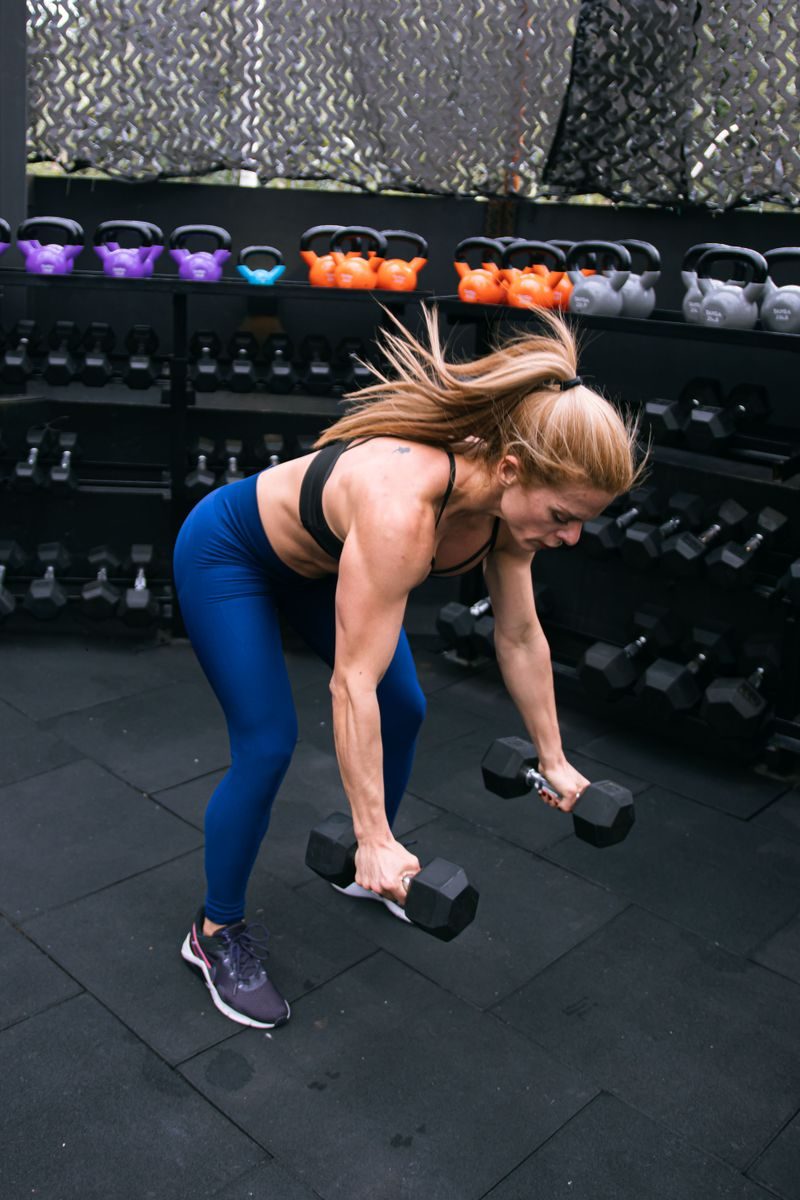
The dumbbell devil press is a full-body conditioning exercise that combines a chest-to-floor dumbbell burpee with a double-dumbbell ground-to-overhead snatch. It primarily challenges the glutes, quadriceps, hamstrings, shoulders, chest, and triceps while demanding substantial work from the core, upper back, spinal stabilizers, forearms, and grip.
This is a technically demanding exercise rather than a basic beginner movement. Learning the burpee, hip hinge, and dumbbell snatch separately will help you perform it more efficiently and maintain better form when fatigue builds.
Dumbbell Devil Press at a Glance
| Category | Details |
|---|---|
| Exercise type | Full-body conditioning and power exercise |
| Main movement | Chest-to-floor dumbbell burpee plus double-dumbbell ground-to-overhead snatch |
| Primary muscles | Glutes, quadriceps, hamstrings, shoulders, chest, and triceps |
| Assisting muscles | Upper back, trapezius, core, spinal erectors, forearms, and grip |
| Equipment | Two equal-weight dumbbells |
| Difficulty | Intermediate to advanced |
| Suggested starting volume | 2–4 sets of 3–5 repetitions |
| Rest | 90–180 seconds between technique-focused sets |
| Effort | Approximately RPE 6–8 |
| Best for | Full-body conditioning, power endurance, coordination, and work capacity |
What Is a Dumbbell Devil Press?
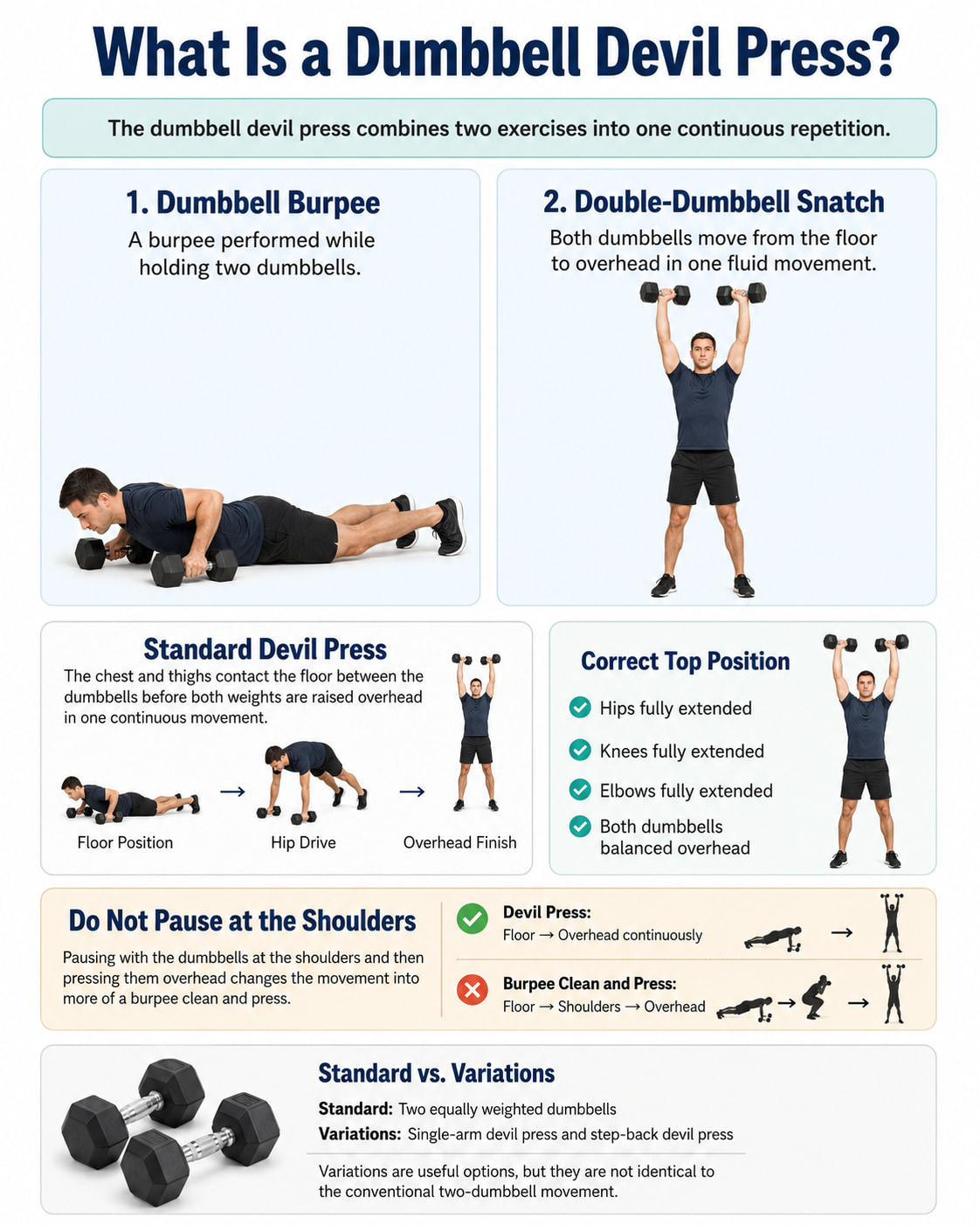
The dumbbell devil press combines two exercises into one continuous repetition:
- A burpee performed while holding two dumbbells.
- A double-dumbbell snatch that moves both weights from the floor to overhead.
Official Wodapalooza devil press movement standards begin with the athlete reaching a push-up position while gripping both dumbbells. The chest and thighs contact the floor between the weights, after which the dumbbells are raised overhead in one fluid movement.
At the top, the hips, knees, and elbows should be fully extended, with both dumbbells balanced over or slightly behind the middle of the body. Pausing with the dumbbells at the shoulders and then pressing them changes the exercise into more of a burpee clean and press.
The standard devil press uses two equally weighted dumbbells. Single-arm and step-back versions are useful variations, but they are not identical to the conventional movement.
How to Do a Dumbbell Devil Press
Best for: Full-body conditioning, power endurance, and coordination.
Muscles worked: Glutes, quadriceps, hamstrings, shoulders, chest, triceps, upper back, core, spinal stabilizers, forearms, and grip.
Equipment needed: Two equally weighted dumbbells. Stable hex dumbbells are generally easier to control on the floor than round dumbbells.
Sets, reps, and rest: Begin with 2–4 sets of 3–5 controlled repetitions. Rest for 90–180 seconds between sets and keep the effort around RPE 6–8.
How to Do It
- Set the dumbbells on the floor.
Position two dumbbells approximately shoulder-width apart. Leave enough space for your chest to reach the floor between them. - Grip the handles.
Stand just behind the weights, bend your knees, hinge at the hips, and take a firm grip. Keep your wrists straight and your feet planted securely. - Move into the floor position.
Step or jump both feet backward while keeping your hands on the dumbbells. Lower your chest and thighs to the floor between the weights. - Bring your feet forward.
Push away from the floor and step or jump your feet forward. Land in a stable stance that gives the dumbbells a clear path, usually slightly wider than hip width. - Load the hips.
Keep your spine neutral and guide the dumbbells back between or alongside your legs. Your arms should remain relatively long while your hips move backward. - Drive through the floor.
Extend your hips and knees forcefully. Use the momentum created by your legs and hips to accelerate both dumbbells upward. - Guide the dumbbells overhead.
After the hips and knees extend, allow the elbows to bend and guide the weights overhead in one continuous movement. Do not pause at the shoulders. - Finish in a stable position.
Stand tall with the hips, knees, and elbows extended. Keep your ribs controlled, core braced, and dumbbells stacked over the middle of your body. - Lower the weights under control.
Bring the dumbbells toward your shoulders or sides and hinge to return them to the floor. Reset your stance and grip before starting the next repetition.
Coaching cue: Drive with your hips, then guide with your arms.
Breathing
Take a controlled breath before moving toward the floor. Exhale during the explosive ground-to-overhead phase, then take another breath and reset before the next repetition.
Avoid holding your breath through several continuous repetitions. Briefly resetting your breathing can help you maintain control as fatigue increases.
Key Technique Points
1. Use Your Hips Instead of Muscling the Dumbbells Up
The devil press is not meant to be a slow double-arm front raise or shoulder press. The lower body should produce the majority of the momentum.
Think about pushing the floor away and extending your hips before pulling aggressively with your arms.
2. Create Enough Space for the Dumbbells
Bring your feet far enough forward and wide enough to avoid rounding your back or trapping the weights between your legs.
The dumbbells may travel between or outside the legs, depending on your build and the movement standard you are following. Choose the path that allows a stable hinge and clear movement overhead.
3. Keep the Weights Close
Allowing the dumbbells to swing far away from your body increases the demand on your shoulders and lower back. Keep their path reasonably close as you transition from the hinge into the overhead finish.
4. Finish Stacked, Not Leaning Back
At lockout, your hips and knees should be extended without pushing the pelvis far forward or arching your lower back.
The dumbbells should finish over your base of support, with your head and chest in a natural position.
5. Reset Before Form Deteriorates
Fast repetitions are only useful when the positions remain consistent. Slow down, reduce the load, or end the set if your landing, hinge, or overhead position begins to change.
Dumbbell Devil Press Muscles Worked
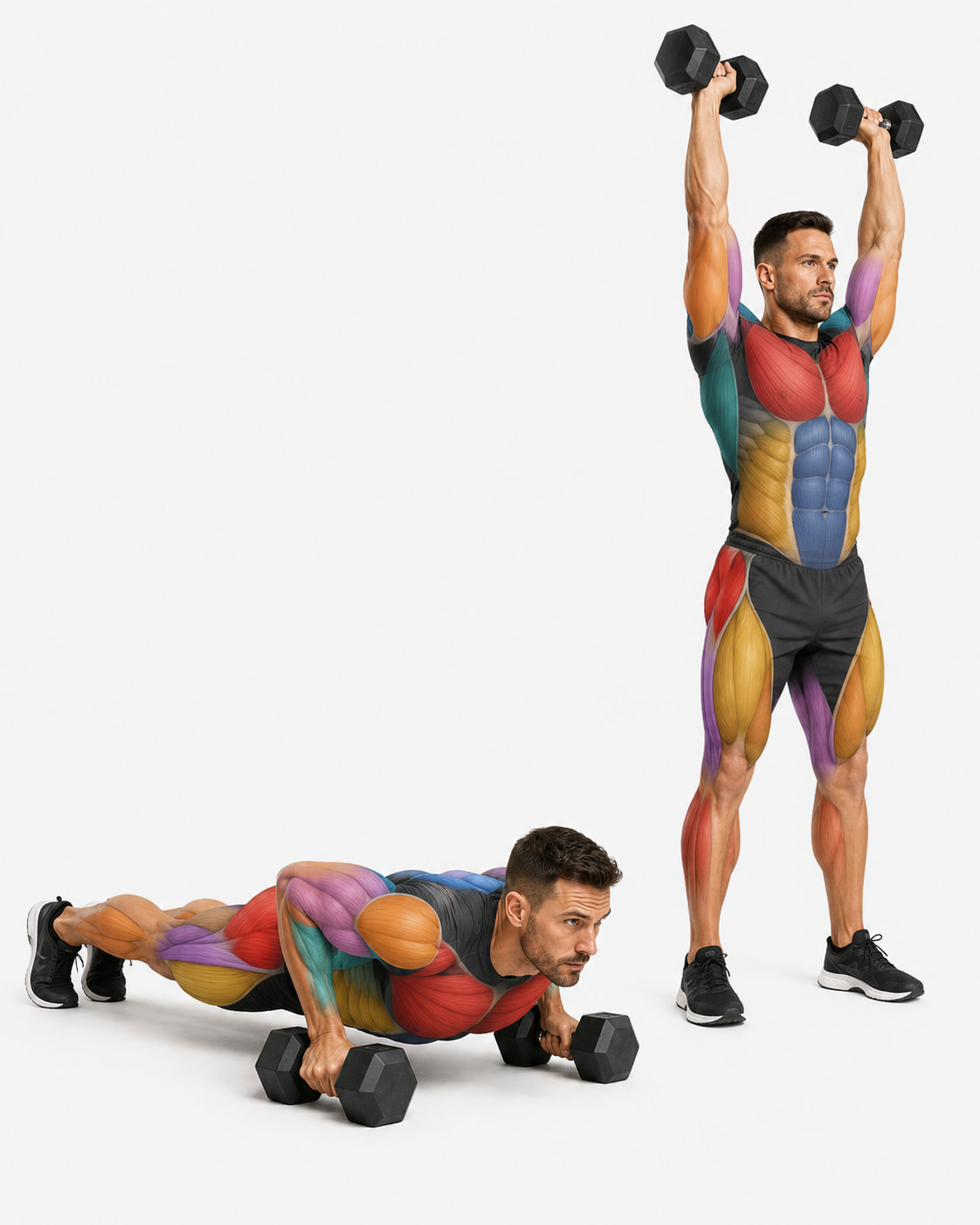
The muscles emphasized by the dumbbell devil press change throughout the repetition. It is more accurate to examine each movement phase than to name one muscle as the sole target.
| Movement phase | Main muscles involved | Primary role |
|---|---|---|
| Chest-to-floor burpee | Pectoralis major, triceps, anterior deltoids | Lower and push the upper body from the floor |
| Foot transition | Quadriceps, glutes, hip flexors, core | Bring the feet forward and establish a lifting position |
| Hip hinge and upward drive | Glutes, hamstrings, quadriceps | Produce force to accelerate the dumbbells |
| Overhead finish | Deltoids, upper trapezius, triceps | Guide and stabilize the dumbbells overhead |
| Entire repetition | Abdominals, obliques, spinal erectors, lats, upper back, forearms | Brace the torso, control the weights, and maintain grip |
1. Glutes
The gluteus maximus helps extend the hips as you drive the dumbbells upward. Strong hip extension is one of the most important parts of an efficient devil press because it reduces the need to pull or press excessively with the arms.
2. Quadriceps
The quadriceps help extend the knees as you stand and accelerate the dumbbells. They also work when you bring your feet forward from the floor and establish a stable lifting stance.
3. Hamstrings
The hamstrings assist the glutes during the hip hinge and explosive hip extension. They also help control the torso and hips as the dumbbells return toward the floor.
4. Shoulders
The anterior and lateral deltoids help guide the dumbbells overhead. They also support the upper body during the floor phase.
5. Chest and Triceps
The pectoralis major and triceps work during the chest-to-floor transition and as you push away from the ground. The triceps also help finish and stabilize the overhead lockout.
6. Upper Back and Trapezius
The trapezius and other upper-back muscles assist the upward pull and stabilize the shoulder blades as the dumbbells move overhead.
7. Core and Spinal Stabilizers
The abdominals, obliques, and spinal erectors brace the torso during the plank, hip hinge, upward drive, and overhead finish. The goal is to transfer force through a stable trunk without rounding the lower back or leaning excessively at the top.
8. Forearms and Grip
You hold the dumbbells throughout the repetition, so the hands and forearms work continuously. Grip fatigue often becomes noticeable before the larger lower-body muscles are fully tired.
The lower body should create most of the upward momentum. The CrossFit dumbbell power-snatch guide identifies the hips, quadriceps, glutes, and hamstrings as major force producers while the core, shoulders, upper back, and arms transfer and stabilize that force.
Common Dumbbell Devil Press Mistakes
1. Starting With the Dumbbells Too Close Together
When the weights are too close, there may not be enough room for your chest to reach the floor. This can force the shoulders and wrists into awkward positions.
Place the dumbbells around shoulder width and adjust slightly for your body size.
2. Landing With the Feet Too Narrow
A narrow foot position leaves little room for the dumbbells and may cause the lower back to round.
Bring your feet forward into a stable stance that allows you to hinge without forcing the knees or dumbbells into an awkward path.
3. Pulling With the Arms Too Early
Early elbow bending reduces the contribution from the legs and hips. It also causes the shoulders and arms to fatigue quickly.
Keep your arms relatively long until you have forcefully extended your hips and knees.
4. Turning the Movement Into a Clean and Press
Bringing the dumbbells to your shoulders, pausing, and pressing them overhead changes the movement pattern.
For a standard devil press, the weights should move from the floor to overhead in one continuous action.
5. Rounding the Lower Back
Rounding commonly occurs when the feet do not land far enough forward, the dumbbells are too heavy, or the athlete rushes the transition.
Use a wider landing, bend the knees as needed, brace your abdomen, and begin the upward drive from a controlled hinge.
6. Overarching at the Top
Leaning backward to complete the lockout usually means the load is too heavy or the dumbbells have moved too far in front of the body.
Use a lighter weight and finish with your ribs controlled and the dumbbells stacked overhead.
7. Dropping the Dumbbells Carelessly
Repeatedly dropping the weights can damage the floor or equipment and may cause the dumbbells to bounce or roll.
Lower them under control unless you are using equipment and a training area specifically designed for dropping weights.
8. Continuing After Technique Breaks Down
Fatigue can quickly change the devil press from a controlled power exercise into a series of rushed repetitions.
Reduce the number of repetitions, extend your rest, or stop the set when you can no longer maintain the same positions.
Benefits of the Dumbbell Devil Press
Full-Body Conditioning
One repetition combines a floor transition, upper-body push, hip hinge, explosive extension, and overhead lockout.
This can make the devil press a practical choice when you want to challenge several major muscle groups without moving between multiple pieces of equipment.
Lower-Body Power
The ground-to-overhead phase requires forceful hip and knee extension. When performed with an appropriate load, it can help train the coordination needed to transfer force from the legs through the torso and into the dumbbells.
Muscular Endurance
Repeated devil presses challenge the legs, shoulders, chest, triceps, back, and grip over an extended set.
This makes the movement especially suitable for conditioning workouts in which maintaining effective technique under moderate fatigue is part of the goal.
Core and Overhead Control
Your trunk must remain stable while transitioning from the floor, accelerating the dumbbells, and standing with both weights overhead.
The exercise therefore challenges bracing and overhead stability in addition to general conditioning.
Coordination
The devil press requires several movement phases to connect smoothly. You must coordinate the burpee, foot transition, hinge, hip drive, arm action, and overhead finish within one repetition.
Minimal Equipment
You need only two dumbbells, a non-slip floor, sufficient floor space, and safe overhead clearance.
Limitations of the Devil Press
The devil press is useful, but it should not replace all of your strength exercises.
Because it involves several movements and is often performed under fatigue, the amount of weight you can use is limited by coordination, breathing, grip, and overhead control. A squat, deadlift, press, row, or other dedicated strength exercise is usually a better choice when maximum strength or muscle growth is the main goal.
Use the devil press primarily for:
- Full-body conditioning
- Power endurance
- Coordination
- Workout finishers
- Moderate-load circuit training
Use more specific resistance exercises when your main goal is:
- Maximum strength
- Targeted muscle development
- Heavy lower-body training
- Focused chest or shoulder training
- Precise progression in one movement pattern
Is the Dumbbell Devil Press Beginner-Friendly?
The complete movement is generally better suited to intermediate or advanced exercisers. A beginner must manage a loaded floor transition, hip hinge, explosive pull, and overhead lockout while maintaining control of two dumbbells.
Instead of immediately attempting fast repetitions, learn each component separately.
The National Strength and Conditioning Association recommends keeping the load modest and avoiding high fatigue while developing technical mastery of complex movements.
Beginner Learning Progression
- Practice a bodyweight step-back burpee.
- Learn a controlled dumbbell deadlift.
- Practice a dumbbell deadlift and shrug.
- Add a light high pull.
- Learn a single-arm dumbbell muscle snatch.
- Practice a light double-dumbbell ground-to-overhead movement.
- Combine the floor transition and overhead lift.
- Add speed only after every position remains consistent.
You do not need to master all these steps in one workout. Spend as much time as necessary developing control before combining the full movement.
Dumbbell Devil Press Regressions
Step-Back Devil Press
Step one foot back at a time instead of jumping into the floor position. Step forward again before performing the ground-to-overhead phase.
This reduces impact and gives you more time to organize your stance.
Elevated Burpee to Dumbbell Deadlift
Place your hands on a secure elevated surface for the burpee, then perform a separate dumbbell deadlift from the floor.
This removes the explosive overhead phase while allowing you to practice the basic floor transition and hinge.
Burpee and Dumbbell Snatch Performed Separately
Complete a bodyweight burpee, pause, and then perform a light dumbbell snatch.
Separating the movements reduces coordination demands and lets you concentrate on one skill at a time.
Single-Arm Devil Press
Use one dumbbell and switch arms between repetitions or sets.
This lowers the total external load, although the uneven weight increases the anti-rotation demand on your core. Start light and move deliberately.
Dumbbell Deadlift to High Pull
Replace the overhead finish with a high pull. This lets you practice hip extension without requiring a full overhead lockout.
Dumbbell Devil Press Progressions
Once you can perform all repetitions with consistent technique, progress by changing one variable at a time:
- Add one repetition to each set.
- Add one additional set.
- Increase the dumbbell weight slightly.
- Reduce rest by a small amount.
- Use a controlled jump-back instead of stepping.
- Improve the speed of each repetition without rushing the positions.
Do not simultaneously increase the weight, repetitions, and speed. A gradual approach makes it easier to identify when your technique is beginning to change.
Sets, Reps, Rest, and Workout Placement
For Technique Practice
- Sets: 2–4
- Repetitions: 3–5
- Rest: 90–180 seconds
- Effort: RPE 6–7
- Placement: Near the beginning of the workout, after the warm-up
This approach works well when learning the exercise or improving movement quality. Each repetition should look nearly identical.
For Full-Body Conditioning
- Sets or rounds: 3–5
- Repetitions: 4–6
- Rest: 60–120 seconds
- Effort: RPE 7–8
- Placement: After the main strength exercises or as a short finisher
Choose a load that allows you to complete the prescribed repetitions without pressing the weights slowly overhead or rounding your back.
Frequency
One or two sessions per week is a practical starting point. Consider the amount of burpee, hip-hinge, shoulder, and overhead work already included in your program.
Choosing the Right Weight
Use dumbbells light enough that you can:
- Move from the floor without rounding your back
- Generate most of the upward momentum with your hips
- Finish overhead without leaning backward
- Control the weights on the way down
- Maintain the same technique from the first repetition to the last
The correct starting weight may feel surprisingly light. The devil press becomes difficult because of its complexity and conditioning demand, not only because of the dumbbell load.
Current ACSM resistance-training guidance emphasizes consistent training, gradual progression, and matching the program to the individual rather than making training unnecessarily complicated.
Sample Dumbbell Devil Press Technique Workout
Perform this session once or twice per week with at least one recovery day between sessions involving substantial overhead or full-body conditioning.
| Exercise | Sets | Reps | Rest |
|---|---|---|---|
| Dumbbell deadlift | 2 | 6 | 45–60 seconds |
| Step-back burpee | 2 | 4 | 45–60 seconds |
| Light double-dumbbell high pull or muscle snatch | 2 | 3–5 | 60–90 seconds |
| Dumbbell devil press | 3 | 3–5 | 90–180 seconds |
Keep the main devil press sets around RPE 6–7. You should finish each set knowing you could have completed at least two more technically sound repetitions.
How to Progress the Workout
Begin with three repetitions per devil press set. Over several sessions, build toward five controlled repetitions.
Once you can complete 3 sets of 5 without changing your landing, hinge, dumbbell path, or overhead position, increase the weight by the smallest practical amount and return to 3 repetitions.
How to Warm Up for Dumbbell Devil Presses
Spend approximately five to 10 minutes preparing your heart rate, hips, shoulders, wrists, and movement pattern.
The American Academy of Orthopaedic Surgeons recommends beginning exercise with easy activity and gentle rehearsal of the movements you are about to perform.
A practical warm-up can include:
- Three to five minutes of easy walking, cycling, or rowing.
- Five bodyweight squats.
- Five slow hip hinges.
- Five high-plank shoulder taps per side.
- Three to five step-back burpees.
- Five light dumbbell deadlifts.
- Three light dumbbell snatches per side.
- Two controlled devil press repetitions with a light pair of dumbbells.
The warm-up should make the movement feel smoother, not leave you tired before the working sets begin.
Dumbbell Devil Press Safety Tips
- Use dumbbells that remain stable when placed on the floor.
- Train on a level, non-slip surface.
- Make sure there is enough room behind you for the floor transition.
- Check that there is sufficient overhead clearance.
- Keep your wrists straight while supporting your body on the dumbbells.
- Do not use a load that forces you to round your back or lean backward.
- Stop the set when your movement quality deteriorates.
- Lower the weights in a controlled manner.
- Practice the burpee and snatch separately before combining them.
- Avoid high-repetition timed workouts until you can perform the movement consistently.
Stop exercising if you experience sharp pain, numbness, dizziness, chest pain, extreme shortness of breath, or other unusual symptoms. MedlinePlus exercise guidance recommends stopping and seeking appropriate help when pain, extreme shortness of breath, dizziness, or other concerning symptoms occur.
Frequently Asked Questions
Is a devil press the same as a burpee clean and press?
No. A standard devil press moves the dumbbells from the floor to overhead in one fluid action after the chest-to-floor burpee.
A burpee clean and press brings the dumbbells to the shoulders before pressing them overhead. It is a useful exercise, but it is a different movement.
Should the dumbbells go between or outside the legs?
Either path may be used, depending on your body proportions and the rules of the workout. Official standards have allowed the dumbbells to travel between or outside the legs.
Choose the path that lets you maintain a neutral spine, clear the knees, and keep the weights under control.
How many dumbbell devil presses should I do?
For technique, begin with 3–5 repetitions per set. For conditioning, 4–6 controlled repetitions per round is a practical starting range.
Very high repetitions are not necessary. End the set before your hinge, floor position, or overhead lockout deteriorates.
How heavy should dumbbells be for devil presses?
Use a weight that feels lighter than what you would normally choose for dumbbell deadlifts or presses. Your load must suit every part of the movement, including the floor transition and overhead finish.
You should be able to complete each repetition without pausing at the shoulders, pressing slowly, or leaning backward.
Can beginners perform dumbbell devil presses?
Beginners can work toward the exercise, but most should first practice burpees, dumbbell deadlifts, and light dumbbell snatches separately.
A step-back or elevated variation is often a better starting point than immediately performing fast repetitions with two dumbbells.
Are dumbbell devil presses good for building muscle?
They can contribute to muscular endurance and provide some muscle-building stimulus, particularly for the legs, shoulders, chest, and triceps.
However, they are not usually the best primary exercise for hypertrophy because breathing, grip, coordination, and cardiovascular fatigue may limit the set before a specific muscle reaches a strong local training stimulus. Use squats, hinges, presses, and rows as the foundation of a muscle-building program.
Why does my lower back work during devil presses?
The spinal erectors help stabilize your torso during the hinge and overhead phases, so some muscular effort is expected.
However, stop if you experience sharp or unusual pain. Check whether your dumbbells are too heavy, your feet are landing too far behind you, or your spine is rounding as you begin the upward drive.
Conclusion
The dumbbell devil press is a challenging full-body exercise that combines a loaded burpee with an explosive double-dumbbell ground-to-overhead movement. The legs and hips create the main upward force, while the shoulders, chest, triceps, upper back, core, and grip support the transition and overhead finish.
Learn each component separately, begin with light dumbbells, and prioritize consistent technique over speed. Once you can maintain a stable floor position, strong hip drive, and balanced overhead lockout, gradually add repetitions or load according to your conditioning goal.
References
- Wodapalooza: 2023 Devil Press Movement Standards
- CrossFit: The Dumbbell Power Snatch
- Rogue Fitness: Devil Press Movement Demonstration
- American College of Sports Medicine: 2026 Resistance Training Guidelines
- National Strength and Conditioning Association: Developing Technical Mastery
- American Academy of Orthopaedic Surgeons: Safe Exercise
- MedlinePlus: Exercise and Physical Fitness
This content is for informational purposes only and is not a substitute for medical advice.