The dumbbell deadlift is a floor-start compound exercise that strengthens the glutes, quadriceps, hamstrings, trunk, upper back, and grip. You perform it by lifting two dumbbells from the floor, standing tall, and returning them to the floor under control.
This guide covers the standard two-dumbbell deadlift rather than the Romanian deadlift. You will learn proper form, muscles worked, common mistakes, beginner modifications, progression methods, and practical workout programming.
What Is a Dumbbell Deadlift?
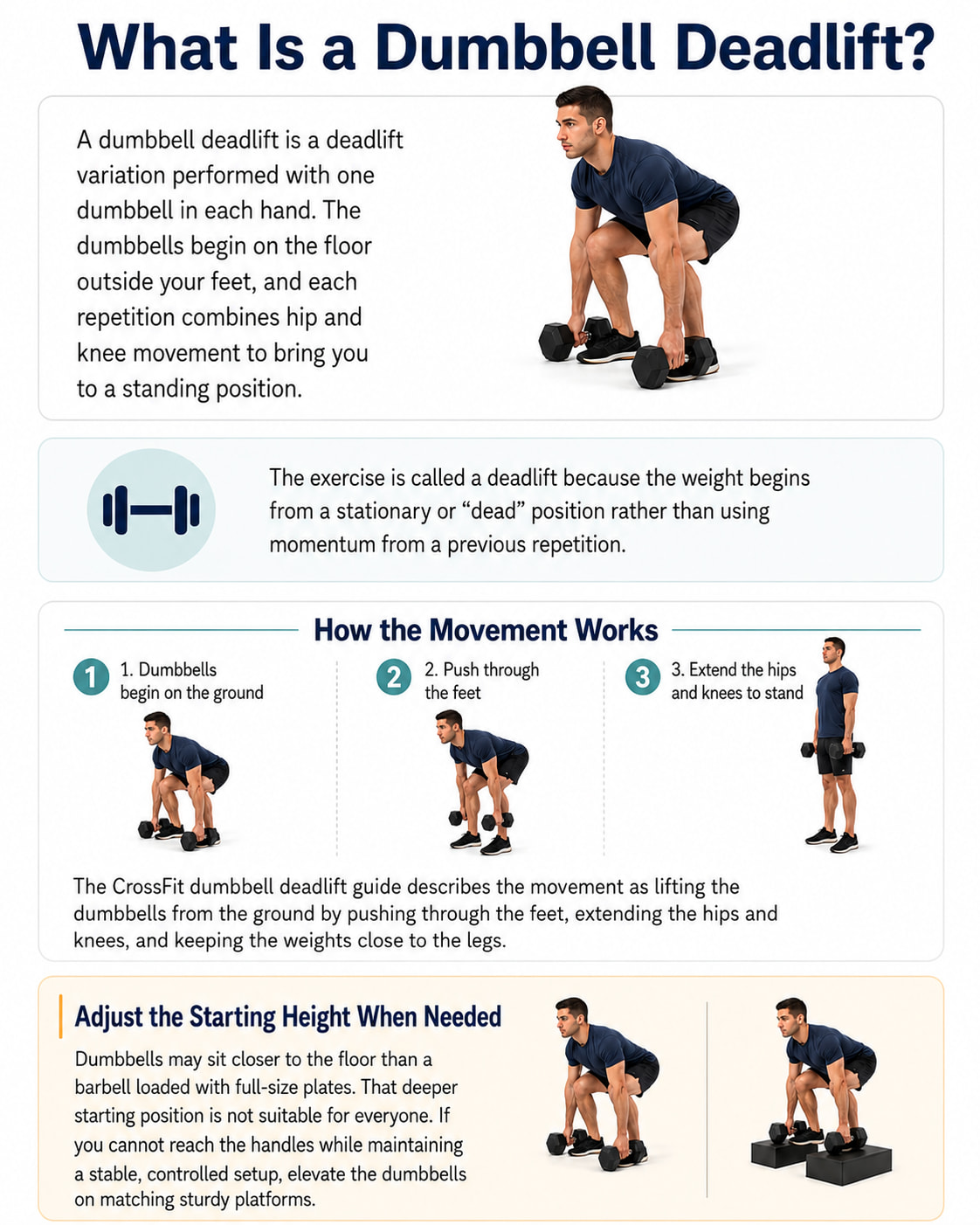
A dumbbell deadlift is a deadlift variation performed with one dumbbell in each hand. The dumbbells begin on the floor outside your feet, and each repetition combines hip and knee movement to bring you to a standing position.
The exercise is called a deadlift because the weight begins from a stationary or “dead” position rather than using momentum from a previous repetition.
The CrossFit dumbbell deadlift guide describes the movement as lifting the dumbbells from the ground by pushing through the feet, extending the hips and knees, and keeping the weights close to the legs.
Dumbbells may sit closer to the floor than a barbell loaded with full-size plates. That deeper starting position is not suitable for everyone. If you cannot reach the handles while maintaining a stable, controlled setup, elevate the dumbbells on matching sturdy platforms.
Dumbbell Deadlift at a Glance
| Category | Details |
|---|---|
| Best for | Lower-body strength, learning to lift from the floor, home and gym workouts |
| Primary muscles | Gluteus maximus, quadriceps, hamstrings |
| Assisting muscles | Adductor magnus, spinal erectors, abdominals, upper back, forearms |
| Equipment | Two dumbbells and optional stable risers |
| Movement pattern | Hip hinge combined with knee extension |
| Starting position | Dumbbells on the floor outside the feet |
| General training range | 2–4 sets of 6–12 repetitions |
| Typical rest | 90–180 seconds |
| Difficulty | Beginner to intermediate, depending on load and starting height |
Dumbbell Deadlift vs. Dumbbell Romanian Deadlift
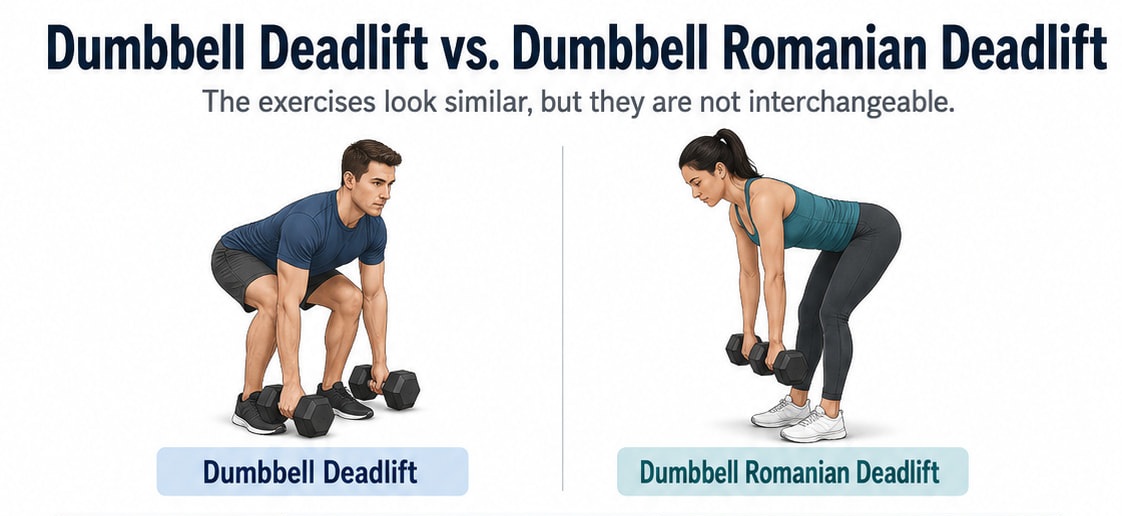
The exercises look similar, but they are not interchangeable.
| Feature | Dumbbell Deadlift | Dumbbell Romanian Deadlift |
|---|---|---|
| Starting position | Dumbbells on the floor | Standing with dumbbells in the hands |
| Knee movement | Moderate knee bend | Slight knee bend maintained throughout |
| Main action | Lift from the floor by extending the knees and hips | Push the hips backward and return to standing |
| Bottom position | Dumbbells return to the floor or elevated starting surface | Usually stops around the shins when hamstring tension limits the range |
| General emphasis | Glutes, quadriceps, hamstrings, and total-body support | Greater hip-hinge and hamstring emphasis |
| Reset between repetitions | Usually yes | Usually no |
The National Academy of Sports Medicine begins its dumbbell Romanian deadlift instructions from standing and uses a hip-dominant lowering motion with only a small amount of knee bend.
Research published in the Journal of Exercise Science & Fitness comparing conventional and Romanian barbell deadlifts found greater rectus femoris and gluteus maximus activity during the conventional version. Although this does not directly test the two-dumbbell exercise, it helps explain why a floor-start deadlift generally involves more knee extension than an RDL. Neither variation is automatically better; they serve different training purposes.
Dumbbell Deadlift Muscles Worked
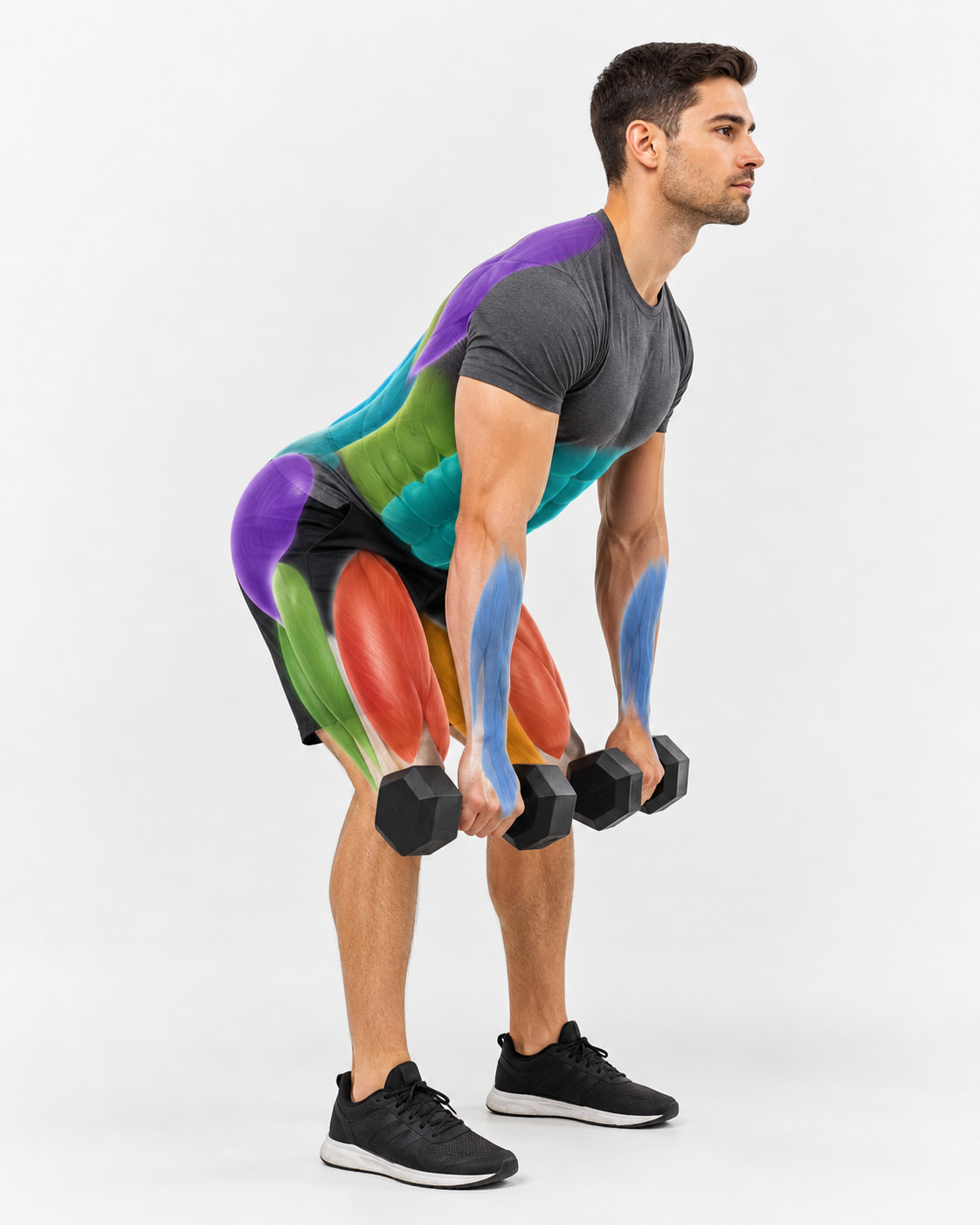
The dumbbell deadlift is primarily a lower-body exercise, but several trunk, back, and grip muscles must work to keep the weights controlled.
Most muscle-activation research has examined barbell deadlifts and other deadlift variations rather than the exact two-dumbbell floor-start exercise. The precise contribution of each muscle therefore changes with your stance, starting depth, load, and technique. A systematic review published in PLOS ONE still supports substantial involvement from the thigh, hip, and spinal-extensor muscles across deadlift variations.
Primary Muscles
Gluteus maximus: Extends the hips as you move from the bent-over position to standing.
Quadriceps: Extend the knees, especially while the dumbbells are leaving the floor.
Hamstrings: Assist hip extension and help control the dumbbells during the lowering phase.
Adductor magnus: Part of this inner-thigh muscle can assist with hip extension, particularly when the hips begin in a flexed position, according to the anatomy overview from NCBI Bookshelf.
Supporting Muscles
Erector spinae: Help maintain a stable trunk position while the load moves.
Abdominals and obliques: Brace the torso and resist unwanted rotation or excessive movement.
Latissimus dorsi: Help keep the dumbbells close to the legs.
Trapezius and other upper-back muscles: Support the shoulders while the weights hang at arm’s length.
Forearms and hands: Maintain your grip on each dumbbell.
You will normally feel the exercise in your glutes, front and back thighs, grip, and trunk. Working tension is expected, but sharp pain is not.
How to Do a Dumbbell Deadlift
Dumbbell Deadlift
Best for: Building general lower-body strength and learning a controlled floor-to-standing lifting pattern.
Muscles worked: Gluteus maximus, quadriceps, hamstrings, adductor magnus, spinal erectors, abdominals, upper back, and forearms.
Equipment needed: Two dumbbells and optional matching risers.
Sets, reps, and rest: Start with 2–3 sets of 8–10 repetitions. Rest for 90–120 seconds and finish each set with approximately 2–3 controlled repetitions still available.
How to Do It
- Place two dumbbells on the floor just outside your feet.
- Stand approximately hip-width apart with your weight balanced through the whole foot.
- Push your hips backward and bend your knees until you can reach the handles.
- Grip the dumbbells with your palms facing your legs. Keep your arms straight, brace your trunk, and position your shoulders approximately over or slightly in front of the weights.
- Push your feet into the floor and begin standing. Allow your hips and shoulders to rise together rather than letting your hips shoot upward first.
- Keep the dumbbells close to your legs as you extend your knees and hips.
- Finish standing tall with your knees and hips extended. Do not lean backward or shrug the dumbbells upward.
- Begin the descent by pushing your hips backward. Once the dumbbells pass your knees, bend your knees more and return the weights to the floor under control.
- Reset your position before beginning the next repetition.
Take a controlled breath and brace before lifting. Exhale as you complete the repetition, then reset your breathing before the next lift. This technique follows the main setup, lifting, and lowering principles described in CrossFit’s exercise guidance.
Common mistakes: Letting the dumbbells move away from the legs, jerking them from the floor, allowing the hips to rise before the chest, bending the elbows, or leaning backward at the top.
Regression: Elevate the dumbbells on two secure, matching platforms to reduce the required range of motion.
Progression: Add repetitions, increase the dumbbell weight, pause briefly after lifting from the floor, or use a slower lowering phase.
Coaching cue: Push the floor away while keeping the dumbbells close.
Should Dumbbells Touch the Floor?
In a standard dumbbell deadlift, the weights return to the floor at the end of each repetition. However, reaching the floor is not more important than maintaining a controlled setup.
Dumbbells can require a deeper starting position than a barbell because their heads are often smaller than standard weight plates. Your height, arm length, mobility, and dumbbell design also affect how easily you can reach them.
Use an elevated starting position when you cannot reach the floor without:
- Losing control of your trunk position
- Shifting excessively onto your toes
- Letting the dumbbells move away from your legs
- Starting with your hips unusually high
- Forcing a range that feels uncomfortable
Place both dumbbells on sturdy, equal-height risers. Do not use unstable household objects or uneven stacks.
As your control improves, you can gradually reduce the elevation. CrossFit also recommends raising the starting position when the full floor range prevents a stable setup.
When you want a top-down hip-hinge exercise that does not return to the floor, use a dumbbell Romanian deadlift instead.
Benefits of Dumbbell Deadlifts
Builds Lower-Body Strength
The glutes and hamstrings extend the hips, while the quadriceps help extend the knees. Increasing the dumbbell load gradually can strengthen these movements over time.
Trains Several Muscles Efficiently
One exercise challenges the hips, thighs, trunk, upper back, and grip. This makes the dumbbell deadlift useful when you want an efficient lower-body exercise without using several machines.
May Help Build Muscle
Dumbbell deadlifts can provide a muscle-building stimulus when performed with enough effort and gradually increased training volume. The glutes and thighs receive the main dynamic work, while the trunk and upper body stabilize the weights.
The 2026 American College of Sports Medicine resistance-training guidance emphasizes that load and weekly volume should be adjusted to the individual’s goals. It also notes that consistency and regular training matter more than following an unnecessarily complicated program.
Strengthens the Grip
Each hand must independently hold a dumbbell. Your grip may become a limiting factor as the dumbbells get heavier, which makes the exercise useful for developing general carrying and holding strength.
Uses Accessible Equipment
You only need two dumbbells and a small amount of floor space. The American College of Sports Medicine recognizes that free weights, bodyweight exercises, bands, and home-based routines can all support improvements when training is consistent and appropriately challenging.
Practices Lifting a Load From the Floor
The exercise gives you a structured way to practice moving a load from a low position to standing. This does not mean one lifting technique is required for every real-life object, but the exercise can improve your strength and coordination in a floor-to-standing movement.
Common Dumbbell Deadlift Mistakes
| Mistake | Why It Matters | How to Fix It |
|---|---|---|
| Performing an RDL instead | The dumbbells never return to a dead stop, changing the exercise | Begin each repetition from the floor or an elevated starting surface |
| Forcing the dumbbells to the floor | Your available range may not match the dumbbell height | Elevate both dumbbells until you can reach them comfortably |
| Letting the dumbbells drift forward | The weights become harder to control | Keep them beside and close to your legs |
| Hips rising before the chest | The knees straighten too early and the lift becomes poorly coordinated | Use less weight and think about pushing the floor away |
| Starting with the hips extremely low | The movement can turn into an inefficient squat-like pull | Position the hips between the shoulders and knees |
| Jerking the dumbbells from the floor | Momentum replaces controlled force production | Create full-body tension before the weights leave the floor |
| Bending the elbows | The arms are no longer acting as secure straps | Keep the elbows straight throughout the repetition |
| Leaning backward at the top | It adds unnecessary movement after the lift is complete | Finish standing tall with the ribs and pelvis controlled |
| Dropping or bouncing the dumbbells | You lose control of the lowering phase and setup | Lower the weights deliberately and reset between repetitions |
| Using excessive weight | Technique changes and the descent becomes difficult to control | Reduce the weight and rebuild from consistent repetitions |
Hips and shoulders should generally rise together during the first portion of the lift. If your hips repeatedly shoot upward, reducing the load or raising the starting height can improve the movement.
Beginner Modifications
Bodyweight Hip Hinge
Stand several inches in front of a wall and practice pushing your hips backward until they lightly touch it. Keep your feet planted and allow a small amount of knee bend.
This teaches the hip movement without requiring you to lift a weight from the floor.
Elevated Dumbbell Deadlift
Place each dumbbell on a stable riser. Use a height that allows you to grip the dumbbells without forcing the bottom position.
This is usually the most useful regression because it keeps the basic floor-start movement while reducing the range.
Single-Dumbbell Deadlift
Stand with one dumbbell positioned vertically between your feet. Hold the top of the dumbbell with both hands and perform the same hip-and-knee movement.
This can be easier to coordinate than controlling two separate weights.
How to Progress the Dumbbell Deadlift
Progress the exercise only when your current sets remain controlled from the first repetition to the last.
A simple progression method is:
- Select a repetition range such as 8–12.
- Begin with a weight you can lift for 8 controlled repetitions.
- Add repetitions over the following sessions.
- Once you complete every set for 12 repetitions with approximately two repetitions still available, increase to the next manageable dumbbell weight.
- Return to the lower end of the repetition range and repeat.
When the available dumbbell increase is too large, progress by:
- Adding one repetition to each set
- Adding one additional set
- Lowering the dumbbells over two or three seconds
- Pausing for one second immediately after the weights leave the floor
- Improving the range of motion gradually
You do not need to take every set to complete muscular failure. The American College of Sports Medicine reports that training to failure is not consistently necessary for the average healthy adult. Stop the set when you can no longer maintain the same controlled technique.
Sets, Reps, Rest, and Frequency
Use the following ranges as starting points rather than rigid rules.
| Goal | Sets | Repetitions | Rest | Effort |
|---|---|---|---|---|
| Learn the movement | 2–3 | 8–10 | 90–120 seconds | Finish with 3–4 repetitions available |
| General strength | 3–4 | 5–8 | 2–3 minutes | Finish with 1–3 repetitions available |
| Muscle development | 3–4 | 8–12 | 90–150 seconds | Finish with 1–3 repetitions available |
| Technique practice | 2–3 | 6–8 | 60–90 seconds | Light weight and deliberate tempo |
Place the dumbbell deadlift near the beginning of your workout, after warming up. It requires more coordination and total-body control than most isolation exercises.
Many people can perform the exercise once or twice per week. You can train the same muscle groups with squats, lunges, hip hinges, or other lower-body exercises during another session.
The American College of Sports Medicine recommends training all major muscle groups at least twice per week, but that does not mean every individual exercise must be performed twice weekly.
How to Choose the Right Dumbbell Weight
Choose a weight that allows you to complete every repetition without jerking, bouncing, or losing control of the lowering phase.
A suitable starting weight should let you:
- Complete at least 8 controlled repetitions
- Keep the dumbbells close to your legs
- Make your hips and shoulders rise together
- Finish without leaning backward
- Lower the dumbbells under control
- Stop with approximately 2–3 good repetitions remaining
The dumbbells are probably too heavy when your first few repetitions look controlled but your hips, back, or weight path changes noticeably near the end of the set.
Beginners should prioritize consistent technique rather than trying to discover a maximum weight.
How to Warm Up
Before challenging sets, complete:
- Five to 10 minutes of light movement, such as brisk walking or easy cycling.
- One or two hip-hinge drills, such as bodyweight hinges or light Romanian deadlifts.
- Two or three lighter dumbbell deadlift sets, gradually working toward your training weight.
For example:
- 8 repetitions with very light dumbbells
- 5 repetitions with a moderate weight
- Begin the first working set
The Mayo Clinic recommends warming up before lifting and moving weights in a controlled manner rather than relying on momentum.
Beginner Dumbbell Deadlift Workout
Perform this lower-body workout once or twice per week on nonconsecutive days.
| Exercise | Sets and Reps | Rest |
|---|---|---|
| Dumbbell deadlift | 3 × 8 | 90–120 seconds |
| Goblet squat | 2 × 8–10 | 90 seconds |
| Reverse lunge | 2 × 8 per side | 60–90 seconds |
| Glute bridge | 2 × 10–15 | 60 seconds |
| Standing calf raise | 2 × 12–15 | 45–60 seconds |
Keep approximately 2–3 repetitions in reserve during each working set. The listed sets do not include warm-up sets.
Progress the deadlift first by adding repetitions. Increase the dumbbell weight only after all three sets remain controlled.
Dumbbell Deadlift Safety Considerations
Use a clear, flat training area and check that adjustable dumbbell plates are securely fastened before beginning.
Do not force the dumbbells to the floor when your current range does not allow a controlled setup. Raise the weights rather than trying to gain mobility during a loaded repetition.
Start with light dumbbells when learning the exercise. Control both the lifting and lowering phases, breathe between repetitions, and stop the set when fatigue causes a clear technique change. Mayo Clinic similarly advises using manageable weight, maintaining proper form, breathing during strength training, and avoiding rushed repetitions.
A dumbbell deadlift should not be presented as a treatment for back pain. A review published in the Journal of Sport Rehabilitation found that deadlift-inclusive exercise programs may improve pain and function for some people with low-back pain, but they were not clearly superior to lower-load motor-control exercise. Anyone using deadlifts as part of rehabilitation should follow an individualized plan from an appropriate healthcare or rehabilitation professional.
Stop exercising and seek professional help if you experience sharp pain, numbness, dizziness, chest pain, or other unusual symptoms.
Frequently Asked Questions
Is a Dumbbell Deadlift the Same as a Romanian Deadlift?
No. A standard dumbbell deadlift begins with the weights on the floor and uses both hip and knee extension. A dumbbell Romanian deadlift begins from standing, uses less knee movement, and normally stops before the weights reach the floor.
Should the Dumbbells Touch the Floor on Every Repetition?
They normally touch the floor during the standard variation. When reaching the floor causes you to lose control, place the dumbbells on matching elevated platforms and treat that height as your starting position.
Where Should You Hold the Dumbbells?
For the variation described in this guide, hold one dumbbell outside each leg with your palms facing inward. Keep the dumbbells close to your legs throughout the lift.
Are Dumbbell Deadlifts Good for Beginners?
They can be beginner-friendly because the load is easy to adjust. Beginners should start with light weights, practice the hip hinge, and elevate the dumbbells when the floor position is too demanding.
How Heavy Should Dumbbells Be for Deadlifts?
Use a weight you can lift for the intended repetitions while keeping approximately 2–3 repetitions in reserve. The correct weight varies according to experience, strength, dumbbell design, and the number of repetitions being performed.
Should You Feel Dumbbell Deadlifts in Your Lower Back?
Your spinal erectors help stabilize your trunk, so some muscular effort in the back can occur. However, sharp, increasing, or unusual back pain is not a normal training goal. Stop the exercise and get appropriate guidance if symptoms persist.
Can Dumbbell Deadlifts Replace Barbell Deadlifts?
They can replace barbell deadlifts in a general fitness or home workout when your goal is strengthening the same broad movement pattern. They will not fully replace barbell practice when your specific goal is improving barbell deadlift skill or competition performance.
Conclusion
The dumbbell deadlift is a practical compound exercise for strengthening the hips, thighs, trunk, upper back, and grip. The defining feature is that each repetition begins from the floor or a stable elevated surface.
Keep the dumbbells close, allow the hips and shoulders to rise together, and finish by standing tall rather than leaning backward. Start with a range and weight you can control, then progress through additional repetitions or small load increases.
This content is for informational and educational purposes only and is not intended as a substitute for professional medical advice, diagnosis, or treatment.
References
- CrossFit: The Dumbbell Deadlift
- National Academy of Sports Medicine: Dumbbell Romanian Deadlift
- PLOS ONE: Electromyographic Activity in Deadlift Exercise and Its Variants—A Systematic Review
- Journal of Exercise Science & Fitness: Conventional and Romanian Deadlift Comparison
- American College of Sports Medicine: Resistance-Training Position Stand
- Mayo Clinic: Weight Training—Do’s and Don’ts of Proper Technique
- Journal of Sport Rehabilitation: Exercise Programs That Include Deadlifts and Low-Back Pain